
Vienna, 1992 —
The so-called “Second Viennese School” consisted of influential master composer Arnold Schoenberg and his protegés, Alban Berg and Anton Webern in early 20th-century Vienna. They pioneered a compositional approach described succinctly by Wikipedia as “totally chromatic expressionism without a firm tonal centre, often referred to as atonality; and later, Schoenberg’s serial twelve-tone technique.”
When I began studying composition at Michigan in 1968, I quickly became immersed in exploration of pitch structure and broader tonality freed from the long-traditional restrictive limits of tonality: diatonic major and minor keys and their chromatic extensions, triadic sonorities and tonal centers. The complexity of this new musical realm is not truly “atonal” but rather an opening to a universe of fascinating, colorful possibility.
Three pieces of the early 20th century, which I studied deeply in the 1970s and later used extensively in my teaching of modern music, were each masterful explorations of musical sound color.
- Claude Debussy’s La Mer (1905), an iconic tone poem of Impressionistic musical painting, was discussed in Journal 1. Musique Française.
- Anton Webern’s Symphony, Op. 21 (1928) is maybe the briefest piece ever titled as a symphony, a succinct, two-movement work whose first movement is a delicate gem of pointillistic color and complex 12-tone harmony.
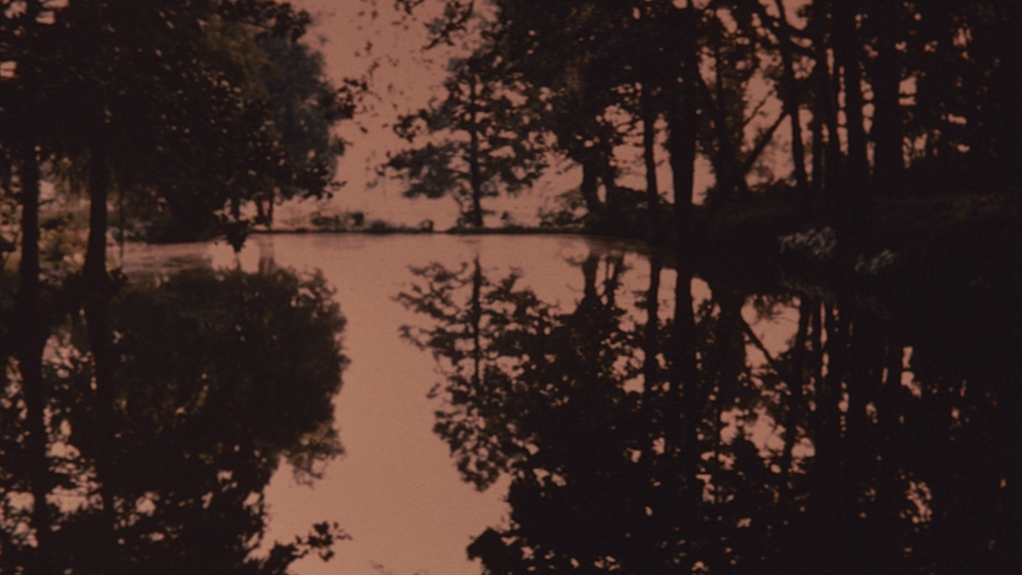
- Arnold Schoenberg’s Five Pieces for Orchestra, Op. 16 (1909); the third piece is a gentle study of orchestral sound color titled “Sommermorgen an einem See (Farben)” — (Summer Morning by a Lake: Colors”.
After fifty years, these works are embedded more deeply than ever in my musical consciousness.
It was only in 1992, on a side trip by bus from Brno, that I visited Vienna, the great musical city of Haydn, Beethoven, and Mozart in his last years. Mozart’s grave, not in the main cemetery but on the edge of the city, was hard to find but emotionally powerful to visit.
Farben
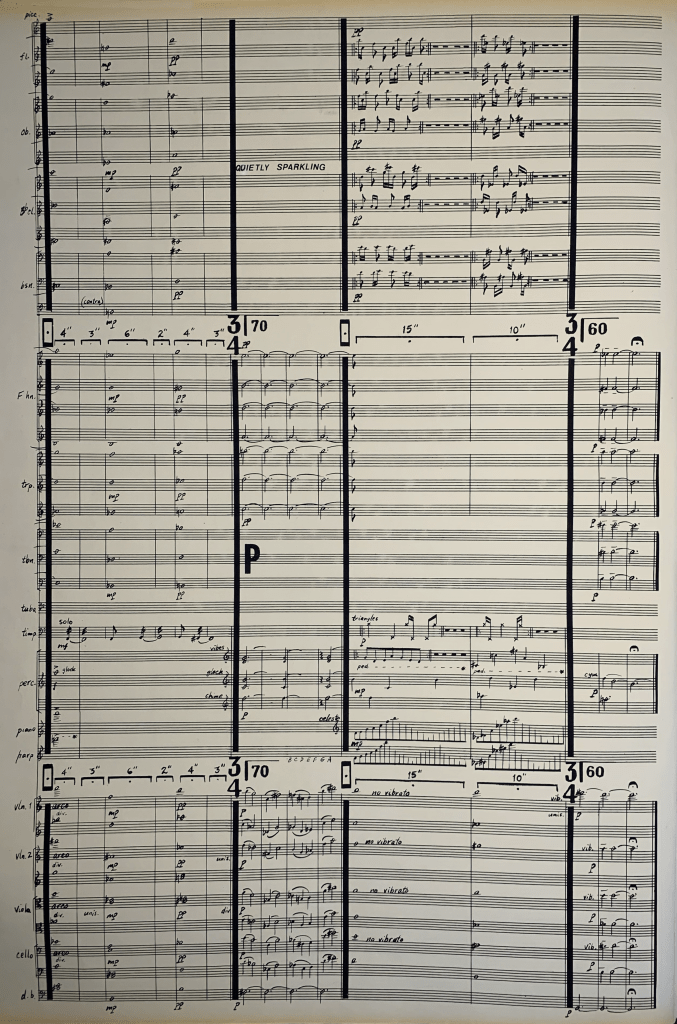
“Farben” is an early Schoenberg piece that is all about instrumental sound color and exotic harmonic color. The chords are not triads but rather atonally “dissonant” sonorities that place the instrumental colors in close, glowing pitch-interval proximity.
LISTEN ›
Five Pieces for Orch – III (Farben)
Chicago Symphony on YouTube
My recent piece, Farben, pays special homage to Schoenberg’s masterpiece, layering kaleidoscopic wind-instrument colors to build massive, morphing constellations, echoing Webern’s hidden chord-color symmetry.
FARBEN
Clark 2025 (TC-149)
I have long admired and been influenced by the music of Anton Webern. Known historically as a member of the Second Viennese School with Alban Berg and mentor Arnold Schoenberg, the three were pioneers of so-called atonal music and 12-tone-row serial harmonic organization. I find the term “atonal” misleading and negative, as their 12-tone processes achieved new “12-tone tonalities” — not simply a rejection of traditional tonal harmony but also striving to create new and more complex tonalities.
What I admire about Webern’s mostly-quiet instrumental miniatures (his Symphonie Op. 21 has only two sparsely-scored movements) is the delicate, crystalline quality of his pitch constellations; and their gently lyric, precious setting into transparent, pointillistic textures, pearl-strings of separate, delicate instrumental colors (called Klangfarbenmelodie). The first movement is built on one enormous, static, 13-pitch chord containing all 12 pitch classes of the chromatic universe in a symmetrical interval pattern, a palindrome interval pattern, the same top to bottom as bottom to top.
Todesfall in Mittersill
Webern’s mentor, Schoenberg, as a Jew was compelled to emigrate to the U.S. in 1933 before it was too late. Webern, not Jewish, stayed in Vienna, where he was born, suffered through and survived World War II, only to be fatally shot by a U.S. Army soldier during the Allied occupation of Austria in 1945. My homage to this beautiful musical mind tries to capture his music’s “lyrical, poetic concision” (Wikipedia).
WEBERN ELEGY
Clark 2024 (TC-115)
Neue Tonalität
My compositional excursions in 12-tone tonality traverse many of my compositions. One that sums it up well, if not succinctly, is VIENNESE SKETCHES. A set of “Twelve Miniatures in Twelve Tones,” parts I through IV are adapted from Webern Elegy , and V through XII from MapLab7 – For Little Arnold from my book, Mapping the Music Universe.
Not intended to portray the historical European city, VIENNESE SKETCHES instead explores various textures and tonalities using the musical techniques of the Second Viennese School. My goal was to create a complex counterpoint of sound constellations that is less dissonant and more sonorous — my sense of a new tonality.
VIENNESE SKETCHES
Clark 2023 (TC-131)









































 MAPPING MUSIC