Category: pitch space

  • Book of Canons

    My compositional fascination with musical canons began in the early 1970s with study (at the University of Michigan) of Ockeghem’s 15th-century polyphony, the 10 canons in Bach’s 18th-century The Musical Offering, and Webern’s 20th-century Symphonie Op.21. As a young professor in the 1980s teaching 16th-century counterpoint at what was then North Texas State University (now UNT), I used canon as a challenging contrapuntal writing assignment. In 1985, a wind ensemble piece, Parallel Horizons (Homage to Schoenberg), was my first formal composition constructed by canon. In Dark Matter, other contrapuntal writing surrounds an extended canon. Now canon pervades much of my 21st-century writing, a challenging yet stimulating and gratifying approach to texture and continuity of material.

    The definition of this ancient form of Rumpelstiltskin magic, spinning complex counterpoint out of a single melodic line:

    CANON
    A leading line is echoed after some delay by one or more answering lines of identical rhythmic values and melodic shape (possibly transposed)

    For a collection of 21st-century examples – 14 studies in 3-voice canon – go to my BOOK OF CANONS in the appendices. For pedagogical demonstration purposes, the subject of each is shown, with indications for when and at what pitch level each answer will occur.

    Read more at Mapping the Music Universe: COUNTERPOINT.
  • Mapping the Music Universe – preview

    Mapping the Music Universe is written for the literate musician, including college music students through music scholars, and anyone who is intellectually curious about how music works, especially in the 20th-21st-century modern and “post-modern” eras.

    Purpose

    The mapping project is a comprehensive catalog of patterns and processes, meant to provide simple tools for understanding modern music. This is not a theoretical treatise but a practical guide for all educated or educating musicians and the intellectually curious, requiring only basic music literacy. For me as a composer, it is also an exploration of how some of the less travelled conceptual paths lead to interesting creative possibilities. Sample composed etudes will give examples to connect the abstractions back to our musical imaginations.

    In 1989 I co-authored a composition textbook with Larry Austin, Learning to Compose: Modes, Materials, and Models of Musical Invention. We felt it was conceptually ground-breaking. My next book, ARRAYS, was an aural skills workbook covering basic modal, tonal, and “post-tonal” music of the Renaissance through the Twentieth Century. They were intended as college-level textbooks, ARRAYS basic and Learning to Compose quite advanced — maybe too advanced to succeed as a textbook, turning out to be more of a technical monograph than a basic guide. Mapping the Music Universe draws in part on the ideas and approaches of both these now out-of-print publications.

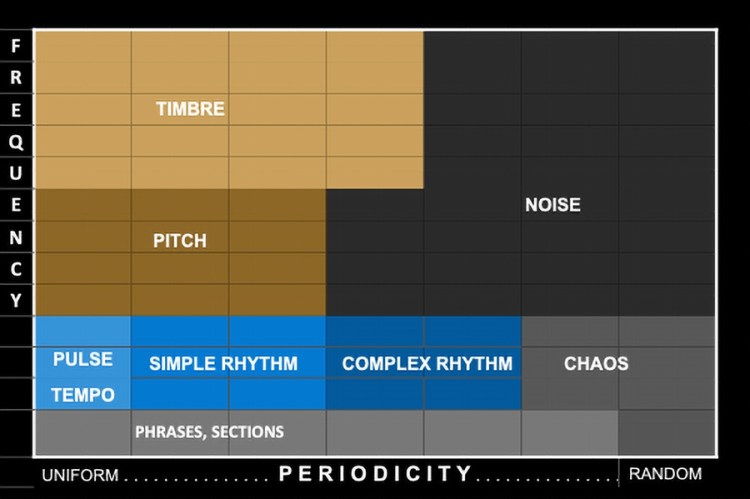
    The three parts progress logically from fundamental — time and periodicity — to pitch space, then to larger structures — texture and form. They can be read in this sequence or separately in any order. Likewise, within each part, the various topics are presented in a progressive order, but jumping in at any point is not to be discouraged. As terms are defined, they are set off to the right. Figures include musical examples, sample etude compositions, tables, and graphic illustrations of patterns and their relationships.

    Read full Introduction . . .

    Mapping the Music Universe by Thomas S. Clark . . . CONTENTS

    .

  • CONSTELLATIONS: Pitch Space, Arrays, Tonality

    Introduction

    Galileo revolutionized astronomy, in part by using a new tool: the telescope. Schoenberg revolutionized harmony by evolving an existing concept, the chromatic scale, into a new tool: the 12-tone scale. (He also devised the compositional tool of the 12-tone row — but that’s another story.) Allen Forte took Schoenberg’s ideas to another level of abstraction: defining Pitch Class and applying basic math to the 12-tone universe. Christman focused on intervallic essence of pitch patterns: defining the “successive interval array.” I am merely another explorer using their maps but choosing my own creative path. In doing so, I will define some of my own terms, while adapting and clarifying some established terms that fit what I’m thinking and expressing.

    Topics

    • Tuning
    • Constellations
    • Interval Arrays
    • Scales
    • Scale prototypes
    • Scale patterns and set classes
    • Harmonic complexity
    • Constellation streams
    • Constreams and 12-tone sets
    • Progressive alterations of arrays
    • Clusters
    • Cells – melodic molecules
    • Cell class

    To read more, request a password from tc24@txstate.edu

    Mapping the Music Universe by Thomas S. Clark . . . CONTENTS