This lab will incorporate several compositional techniques.
It will be entirely a repetitive ostinato texture. The unfortunate term “minimalism” is popular but misleading to describe a style in which continuous periodic rhythmic activity builds a continuous texture of repeated arpeggios or melodic motives (ostinato). Though “minimalism” refers mostly to the lack of melody, the textures and overall rhythmic character are “maximal” in activity.
As with MapLab 3, it will be multi-layered counterpoint utilizing canon homogenizing the texture.
Multiple layers will provide the opportunity to generate complex phase relationships between contrapuntal voices, with patterns of differing length repeating and changing at different times in the four layers.
Layers of texture will change at different times to a new pattern, overlapping each other. Thus overall change of harmony unfolds gradually and continuously instead of at definite time points of harmonic rhythm, building a metamorphic form (instead of a traditional episodic sequence of chords, phrases, and sections).
1. Choose a model
The classic granddaddy of this whole genre is Terry Riley’s monumental 60-to-90-minute improvisatory piece, In C. My own 1984 homage to that classic, EFFULGENCE, models with Riley’s many innovative techniques.
2. Select a source scale
While any scale can work, those most commonly used are diatonic scales. In the TC example, we’ll go with the same as In C, a C-major/A-minor no-sharps-or-flats key signature. (We’ll see later, however, that a motive can be transposed into another diatonic scale and key signature.)
3. Make motives
First, design two or three motives, basic shapes of 3 to 7 pitches from the source scale.
TC example:
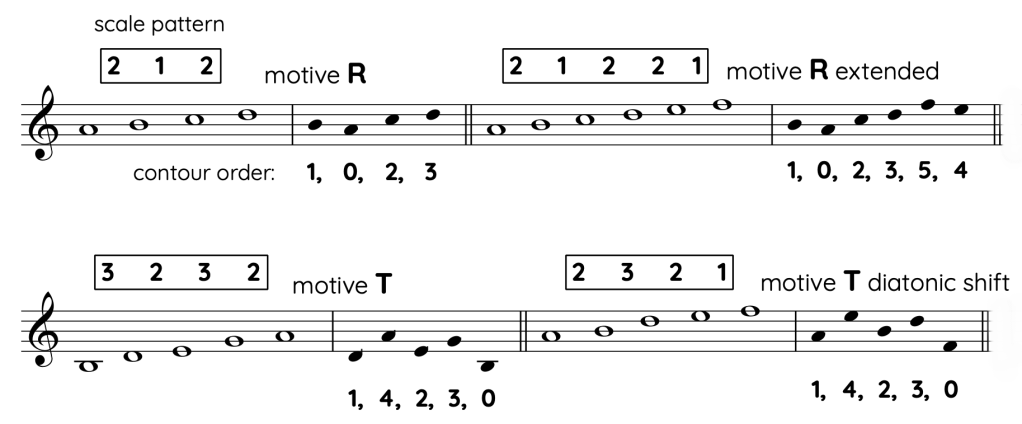
Motive R gets extended by the addition of two pitches, F and E. The last example shows motive T’s shape shifted to a different level of the diatonic scale (what Sibelius calls a diatonic transposition). A motive can also be truncated to as few as two notes:

4. Plan a stream of motive variants
Motive patterns can and should vary in length, especially when rhythmic values are mostly all 8th-notes, providing a changing landscape of rhythmic vitality. In the TC example, however, most patterns are 5 8th-notes long. Since 5 is a prime number, and set in a 3 4 meter, the overlaps of these 5-patterns in the competing lines fulfills that energetic complexity of rhythmic fabric.
TC example
For the pitch motives, a process of adding or abandoning pitches to make the next pattern creates the metamorphic unfolding process that is the true magic of this lab. In the TC example below, this add/abandon process is color coded:
- GREEN for newly added pitches
- BLUE for pitches appearing in a different octave than in the previous pattern
- PURPLE for pitches that will appear next in a different octave
- RED for pitches that will be abandoned in the next pattern

You can see that by letter K the original C-major diatonic is modulating to a new diatonic, Bb major. These two keys have in common 5 pitch classes, and the patterns capitalize on the F, G, and C common tones to connect smoothly. (Riley’s In C also modulates, eventually adding F# and Bb in much the same way Bach inflects the C-major tonality toward the end of his famous C Major Prelude that launches Book I of the Well-Tempered Klavier.)
Here is the lead voice of the ostinato canon:
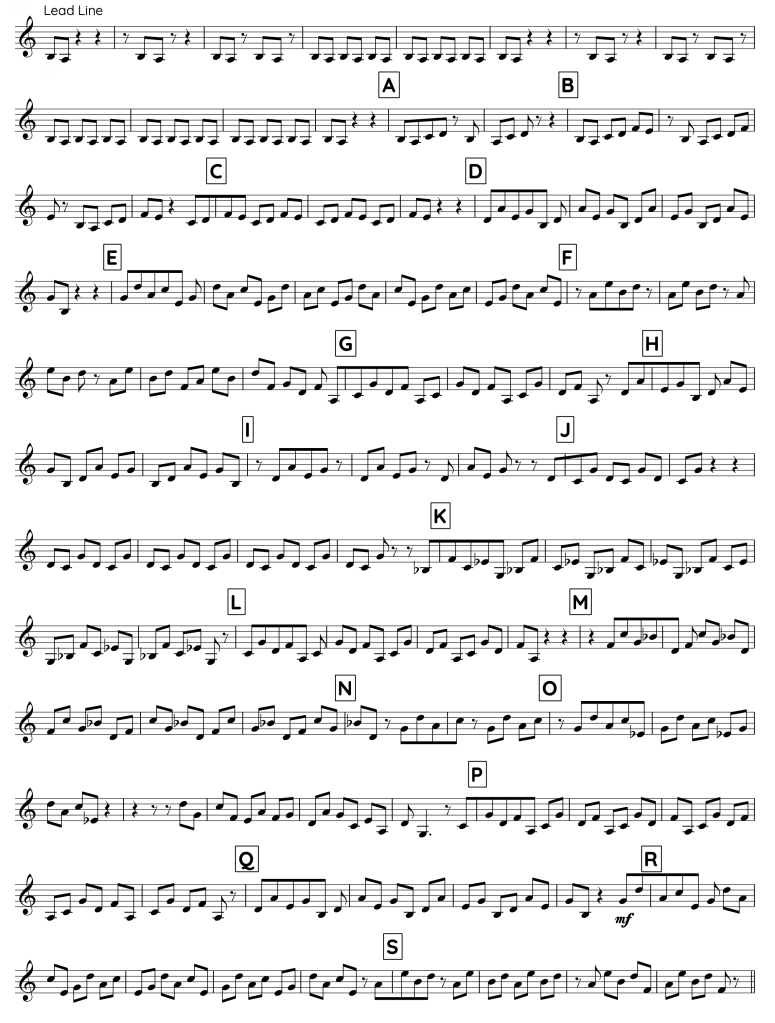
You can see that the number of repetitions of a pattern and the overall duration of its presence in the texture vary throughout. Patterns E, F, K, and P run for five full measures in the lead line alone (plus delayed answers in the whole texture), while the simple transitional pattern N runs for only five beats in the lead line.
5. Spin the canonic counterpoint
The time delays of canonic answer should be chosen not to match the length of the typical pattern. Otherwise, the answers would lock into fixed duplications of each other, making a rigid, uninteresting periodicity. Each new motive-pattern entry is highlighted below with a new dynamic marking. Here is a sample excerpt starting around pattern H:

The answers all enter at unison or octave, with timings determined by a mostly trial-and-error method as follows:
- PP – 9 beats later at unison, then 9 more beats down an octave
- P – same
- MF – almost same, but shortened last answer comes one 8th-note early
- MP – (for a 3-8th-note pattern) 5 8th-notes later then 7 8th-notes after that
- PP – top voice leads, answers are 2 beats later then 3 8th-notes after that
This last is what we described in MapLab 3 as a stretto, answers coming in with very short time delay.
6. Interrupt with an interlude
As with In C, the ostinato texture can blast through from beginning to end in a continuous monolithic stream. Another form scheme, which I will invoke in the TC example, breaks the stream with an interrupting interlude before a coda to come. Of course, it’s another canon, a stretto of cascading downward dotted quarter-notes.

7. Ending an ostinato stream
Several considerations . . .
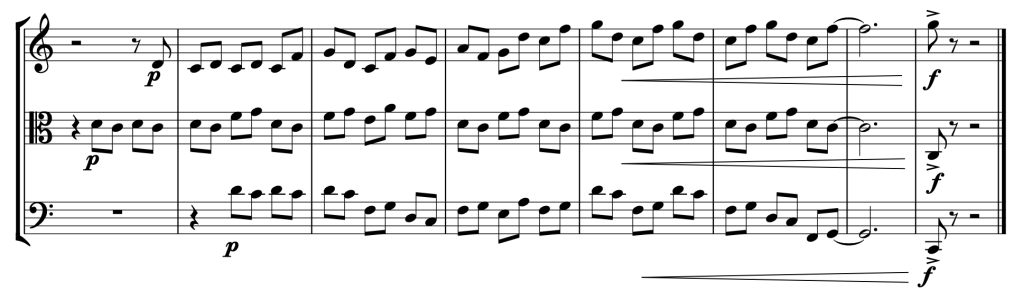
First, since you’ve built a canon with staggered entrances, the last notes will be staggered as well. To make any kind of cadential closure, however, you’ll want to have them stop at the same time, right? That is accomplished simply by truncating the answering lines and/or adding repetitions of the final pattern in the lead voice.
Think about the lead line and its answers leading to a point of harmonic stability and finality — somewhere that feels like tonic home base.
More repetitions help slow and stop the harmonic momentum.
In the TC example, an ostinato coda after interruption settles into and prolongs what will sound like a dominant chord in C major, then crash lands on a tonic C-major stinger.
8. Title and listen
The picturesque metaphor of a babbling creek made me reminisce about a favorite adventure on days off from working at the National Music Camp in Interlochen, Michigan back in the ’70s and early ’80s. We would canoe down the Platte River to its end flowing into Platte Bay on Lake Michigan. There was also a nearby spot where tiny Otter Creek trickled out onto a more secluded sandy Lake Michigan beach offering northward a spectacular view of Empire Bluff.
Otter Creek

 MAPPING MUSIC