Ann Arbor, 1970 —
The first Earth Day was April 22, 1970. In the buildup to it, a group of University of Michigan students organized an environmental teach-in on March 11–14, presenting a series of speeches dealing with various environmental problems. Following its lead, 2,000 other universities and colleges ultimately put on events.
My doctoral composition studies at Michigan began in 1974. Two seminars were mandatory requirements, on the works of the great 20th-century icons, Stravinsky and Bartok. I also took seminars in medieval and Renaissance music. Fifty years later, listening to a stunning recording of ancient choral music, I became re-interested in the rhythmic subtleties of voices executing the unspecified time flow of Gregorian chant.
Using a variety of similar but slightly different note values, including the ancient semi-minim, minim, dotted-minim, breve, dotted-breve, and lunga, I composed a new plain chant. Beginning with pitches of a Dorian mode, my wordless chant takes chromatic turns, providing tonal color without chords above a motionless deep drone. A high, windblown echo of the chant’s shape appears as prelude and coda to its “singing” deepness.
In this era facing global crises on our blue planet, Canticum Terra is a musical homage to and prayer for Mother Earth.
Canticum Terra
Clark 2023 (TC-136)

“In the beginning God created the heavens and the earth. 2 Now the earth was formless and empty, darkness was over the surface of the deep, and the Spirit of God was hovering over the waters. 3 And God said, “Let there be light,” and there was light. 4 God saw that the light was good, and he separated the light from the darkness. 5 God called the light “day,” and the darkness he called “night.” And there was evening, and there was morning—the first day. 6 And God said, “Let there be a vault between the waters to separate water from water.” 7 So God made the vault and separated the water under the vault from the water above it. And it was so. 8 God called the vault “sky.” And there was evening, and there was morning—the second day. 9 And God said, “Let the water under the sky be gathered to one place, and let dry ground appear.” And it was so. 10 God called the dry ground “land,” and the gathered waters he called “seas.”
Genesis (The Holy Bible, NIV translation)
Stravinsky’s 1955 masterpiece in three movements, Symphony of Psalms, ends with Psalm 150 “laudate Dominum” in reverent praise of this awesome creation.
III. Alleluia, laudate Dominum
Berlin Philharmonic
LISTEN › YouTube
Mycology
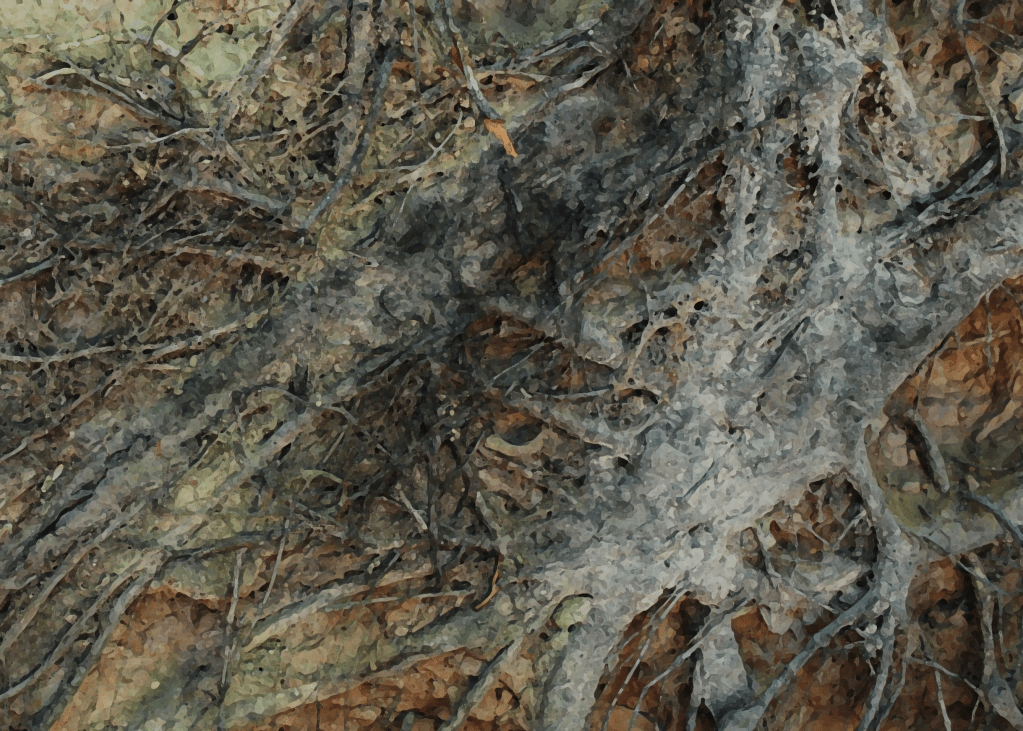
I read a fascinating book, Entangled Life by Merlin Sheldrake (Random House, 2021) about the mostly unseen bizarre world of fungi. Mycelium is the root-like mass of a fungus branching out in soil, forming a colony too small to see or grown to span thousands of acres as in Armillaria. Lichens are complex fungal communities of different organisms, like the black rocky shoreline stripes of Hydropunctaria.
Mycology
Clark 2022 (TC-118)
Branching is a recursive process, with a pitch splitting into two mirroring lines of pitches, then each of those lines mirror splitting again. By powers of 2, the branches eventually build a tone-mass of 8 lines then even massive 16-pitch sonorities.
Mycelium
branching, thread-like hyphae
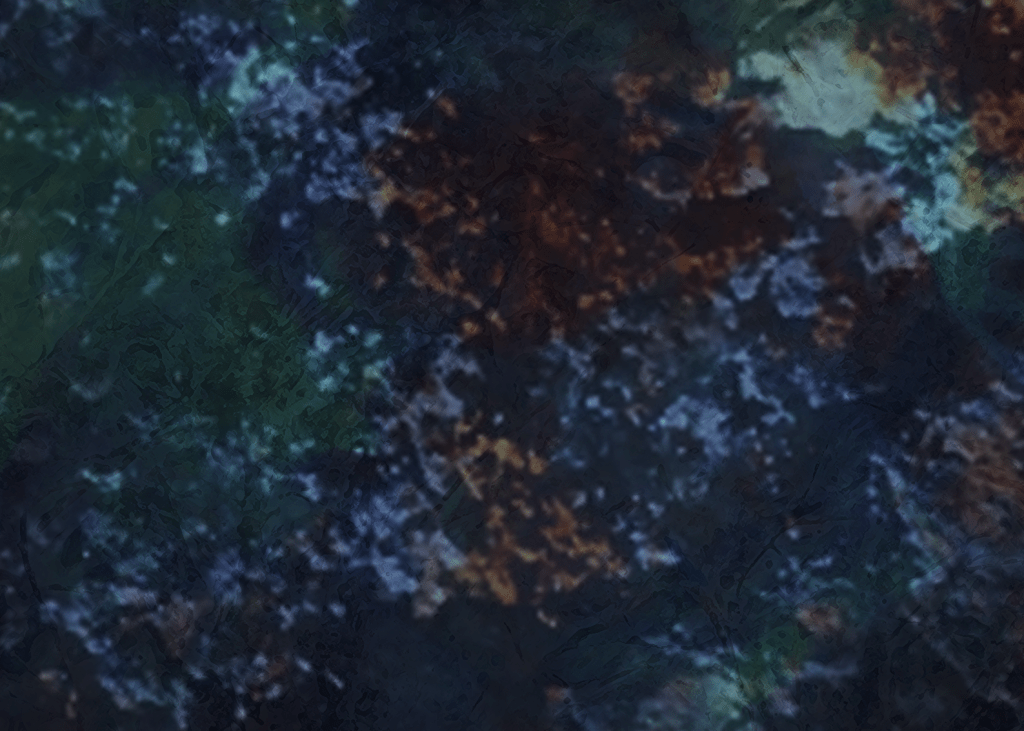
Pointillistic speckles are set in the dark tonal colors of a Viennese 12-tone pitch series, never random but kaleidoscopically sparkling in a restless texture of overlapping rhythms.
Hydropunctaria maura
“water speckled midnight”
Crystallography
From the stars and cosmos, we have come down to Earth, the third planet from the sun, to delve into its inner mysteries.
Very different from the lyric adoration of the Alleluia of Symphony of Psalms, Stravinsky’s later work (1966) explores serial atonality with a dark, dissonant edge. The percussive brilliance of its postlude is evocative of the prodigious granite masses created in Genesis verse 9.
Requiem Canticles – Postlude
London Sinfonietta
LISTEN › YouTube
In the midst of my recent Impressionistic “Sketches” series, the 2024 piece Folio (TC143) was a throwback to the more abstract sound mass style of the 1960s and ’70s. Its percussive attacks and inert masses of sound were all synthesized, also throwbacks to my early days of electronic tape music. (One of the earliest electronic compositions, Stockhausen’s 1960 Nr. 12 Kontakte, was full of sounds like giant steel beams hitting a concrete floor!) The other retro feature of Folio is suggested in its title: homage to Earle Brown’s 1952 FOLIO, a collection of abstract art scores in stark, proportional graphic notation.
A wind and percussion transformation of Folio was challenging. It was composed in the abstract avant-garde style of the ’60s, carving sound sculptures of solid, hard-edged sonorities in expansive pitch/time space. Now colored with cool woodwind sounds, radiating brass, and sparkling percussion, GEODES animates Folio‘s solid sound masses in surging and fading rhythmic textures.
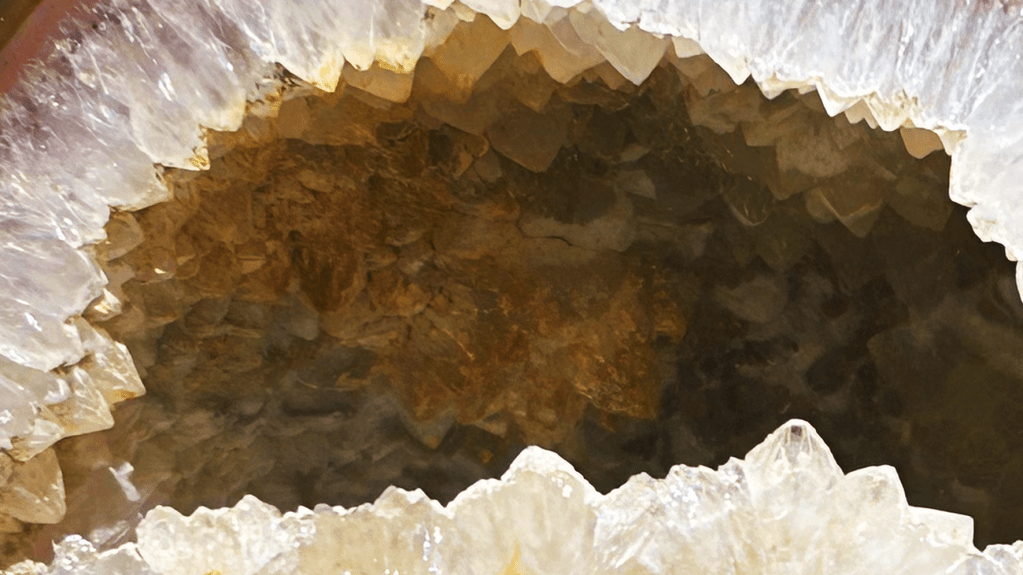
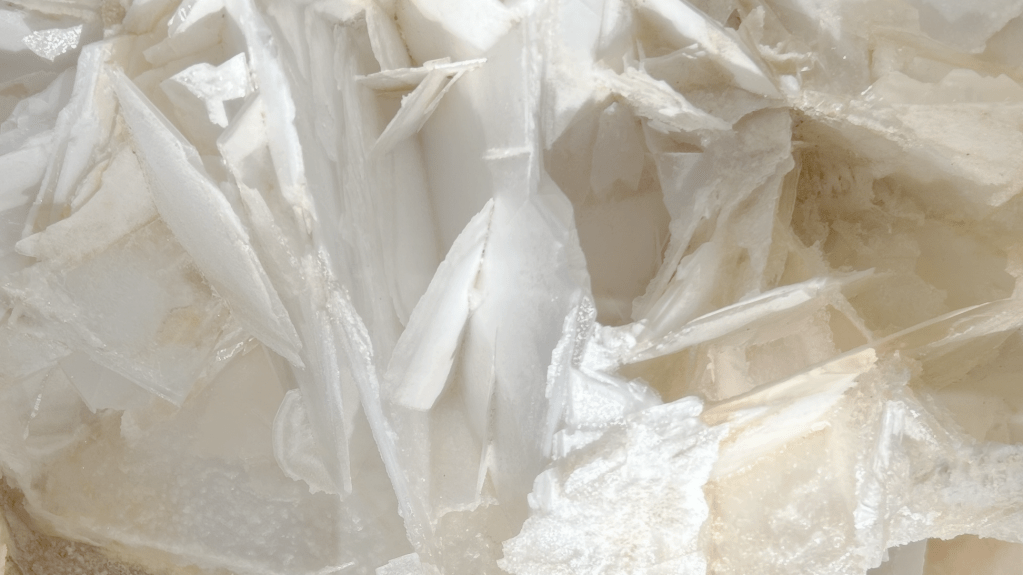
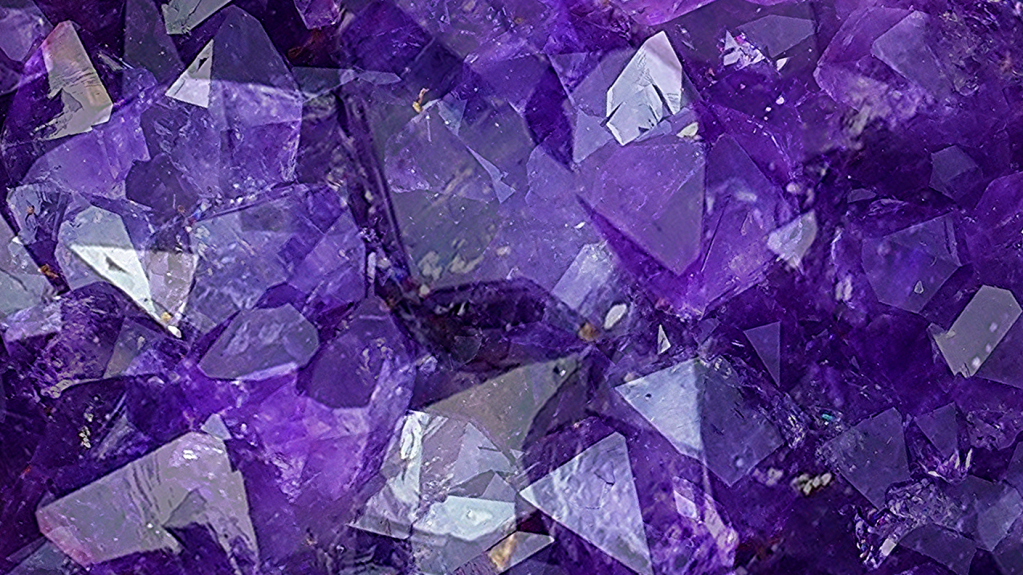
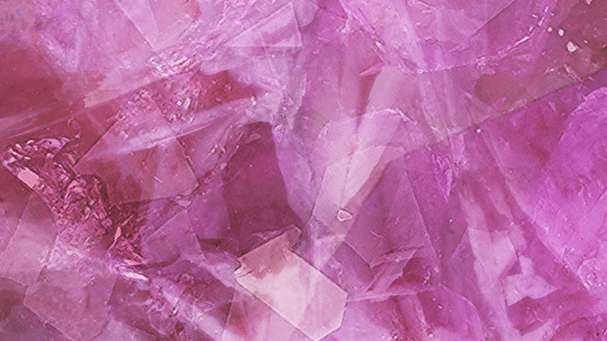
The chaotic boldness of rocks . . . my own collection of many found on beaches and hikes, but also splendid displays at three places: Dick’s Rock Shoppe in Estes Park, Colorado; Lizzadro Museum of Lapidary Art in Elmhurst (now in Oak Brook), Illinois; and a wonderful gallery of geodes at the Permian Basin Petroleum Museum in Midland, Texas. A geode is Nature’s sculpture, an inscrutable gray rock sphere that, when sawed open, reveals a magical world of dazzling-colored crystals. Different minerals make crystals of varied hues of pink, purple, umber, or cream, reflecting new light.
GEODES
Clark 2025 (TC-143)
Pyrite
Calcite
Amethyst
Quartz
Geology
In CANYON SKETCHES (Clark 2024 TC-141), three sound sketches explore the timeless qualities of three magnificent canyons: Black Canyon of the Gunnison (Colorado); Glacier Gorge in Rocky Mountain National Park; and Palo Duro Canyon (Texas).
Actually, each sketch began fundamentally based not so much on the canyons as on musical techniques. For example, in “Black Canyon,” a complex three-part canon of meandering 12-tone lines musically sketches the colorful streaks of pegmatite dikes in the Black Canyon’s cliff walls of Precambrian gneiss.
Black Canyon

 MAPPING MUSIC