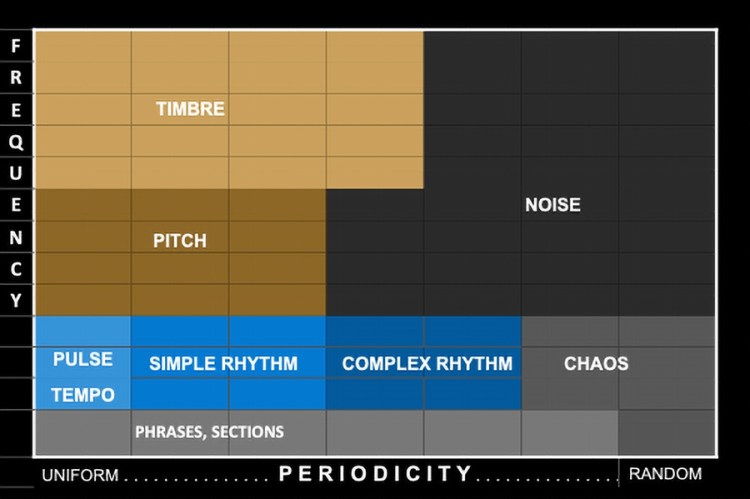
Mapping the Music Universe is written for the literate musician, including college music students through music scholars, and anyone who is intellectually curious about how music works, especially in the 20th-21st-century modern and “post-modern” eras.
Purpose
The mapping project is a comprehensive catalog of patterns and processes, meant to provide simple tools for understanding modern music. This is not a theoretical treatise but a practical guide for all educated or educating musicians and the intellectually curious, requiring only basic music literacy. For me as a composer, it is also an exploration of how some of the less travelled conceptual paths lead to interesting creative possibilities. Sample composed etudes will give examples to connect the abstractions back to our musical imaginations.
In 1989 I co-authored a composition textbook with Larry Austin, Learning to Compose: Modes, Materials, and Models of Musical Invention. We felt it was conceptually ground-breaking. My next book, ARRAYS, was an aural skills workbook covering basic modal, tonal, and “post-tonal” music of the Renaissance through the Twentieth Century. They were intended as college-level textbooks, ARRAYS basic and Learning to Compose quite advanced — maybe too advanced to succeed as a textbook, turning out to be more of a technical monograph than a basic guide. Mapping the Music Universe draws in part on the ideas and approaches of both these now out-of-print publications.
The three parts progress logically from fundamental — time and periodicity — to pitch space, then to larger structures — texture and form. They can be read in this sequence or separately in any order. Likewise, within each part, the various topics are presented in a progressive order, but jumping in at any point is not to be discouraged. As terms are defined, they are set off to the right. Figures include musical examples, sample etude compositions, tables, and graphic illustrations of patterns and their relationships.
Read full Introduction . . .
Mapping the Music Universe by Thomas S. Clark . . . CONTENTS
.

 MAPPING MUSIC