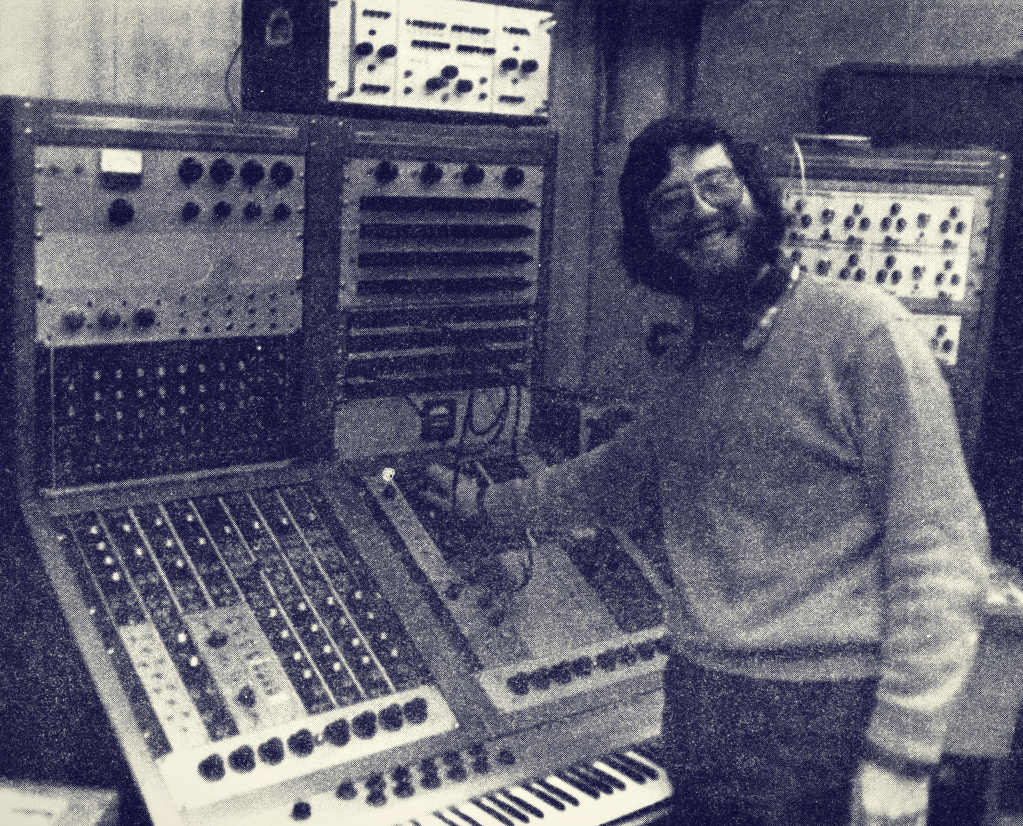
Interlochen, 1976 —
The German word Zeit means “time.” While masse sounds like “masses,” it actually tranlates “measures.” The two together make the musical term “tempos”. Karlheinz Stockhausen composed his “Time Measures” in 1956, N. 5 Zeitmasse for five woodwinds. Time is unmetered, rapidly and unpredictably ebbing and flowing in a dense texture of highly stretchy, elastic rhythms. Instead of predictably placed bricks, musical notes are dancing sparkles or sustained starlight.
London Sinfonietta
LISTEN › YouTube
Compare that time sense with a work of mine composed 67 years later.
DARK MATTER
Clark 2023 (TC-133)

Lucas Foss was among many composing works that were all about time. The opening song of his 1960 work,Time Cycle, for soprano, piano, clarinet, cello, and percussion, sets a poem by W. H. Auden, “We’re Late.” It begins:
“Clocks cannot tell our time of day
For what event to pray
Because we have no time, because
We have no time until
We know what time we fill,
Why time is other than time was.”
Judith Kelloch, soprano
LISTEN › YouTube
Refracting time
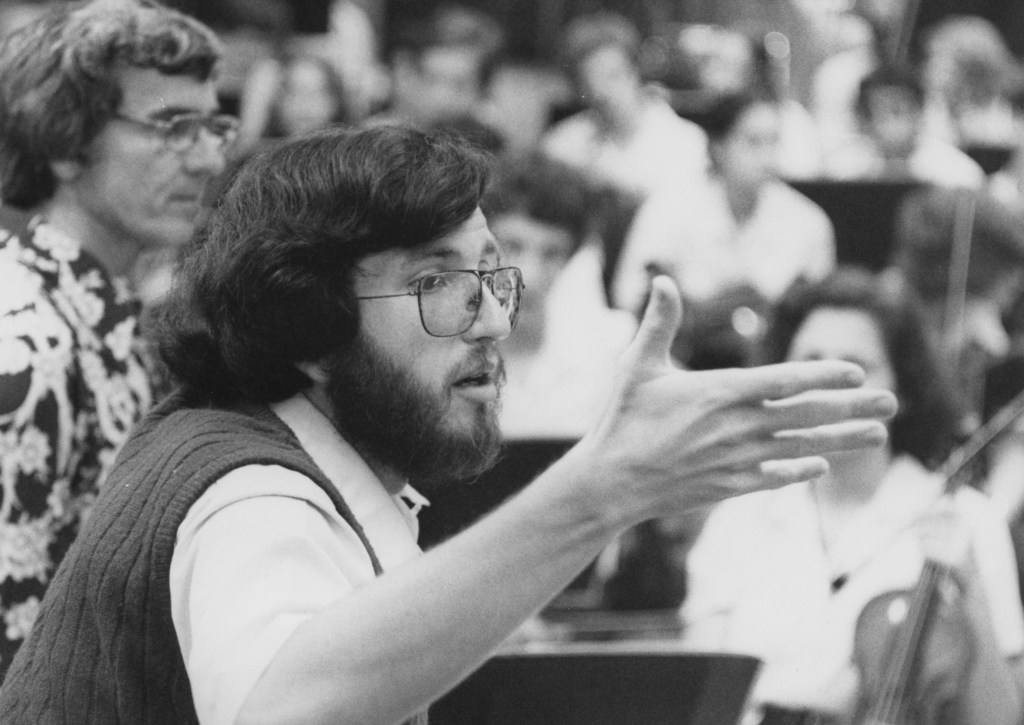
I met Foss in 1973 or ’75 when he guest conducted at the National Music Camp in Interlochen, Michigan, where I worked as assistant to the director of the university-level program (my first adminstrative gig). Back in Ann Arbor in the fall of 1975, I began writing my doctoral dissertation, a large three-movement score for symphony orchestra. Following the direction of my previous orchestral work, Animated Landscapes: Nocturne (1971), ILLUMINATIONS built sound masses animated in widely varying tempi, meters, and even unmetered free sprays of notes.
ILLUMINATIONS – Three Refractions of Time
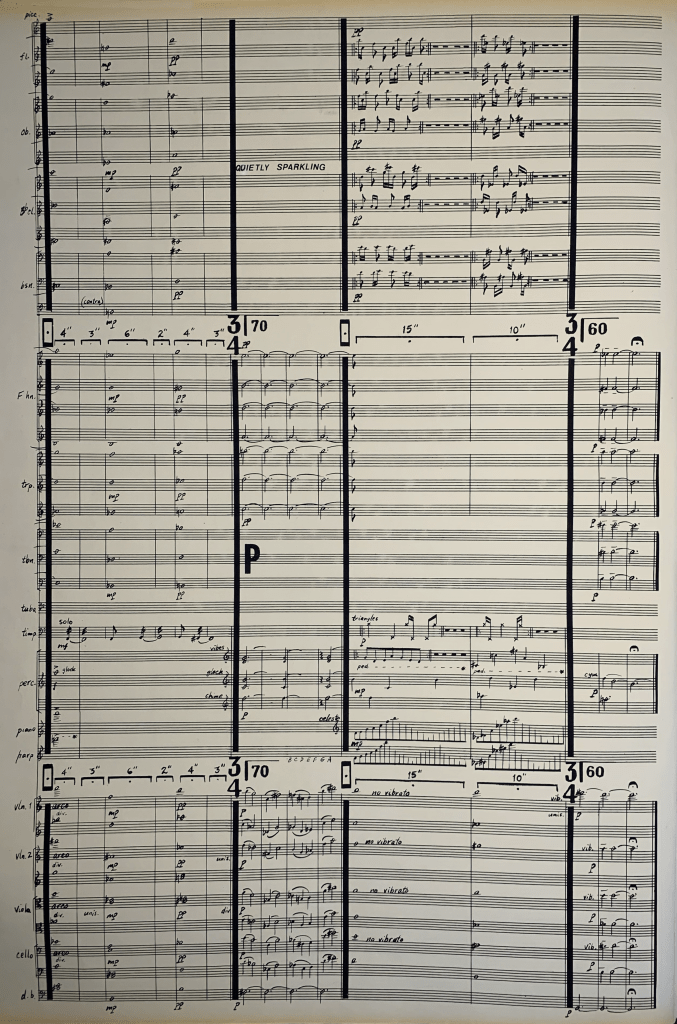
Clark 1976 (TC-33)
1. PROJECTION (future)
2. REFLECTION (past)
3. EMANATION (present)
Receiving a Bicentennial commission from the Federation of Women’s Clubs, it was premiered in 1976 by the World Youth Symphony at Interlochen.

Chronos
Avant garde music in the middle of the 20th century was exploring an exploding range of new tonal possibilities — from by-tonaility to all-chromatic scales, from massive unresolved dissonance to pitchless noise. At the same time, composers were intensely interested in stretching rhythmic possibilities to the extremes of aperiodic time perception.
The term trope in medieval music was an elaboration inserted into a liturgical passage. In the 20th century, Hauer used it to name an unordered collection of six different pitches (called an unordered hexachord), half of an equal-tempered twelve-tone set. Italian Niccolo Castiglioni’s TROPI (1959) uses this pitch organizing technique, but is more about blocks of contrasting rhythmic texture separated by extended silences. Moment by moment, these blocks succeed each other, recur, combine, and dissapate — a kaleidoscope of sound in time.
Gruppo “Musica Insieme” di Cremona
LISTEN › YouTube
American George Crumb composed ground-breaking works for piano, beginning with Five Pieces for Piano in 1962. With imaginative, free-wheeling non-metric notation, he conjured a menagerie of sound sprites dancing through an ever-changing timescape.
Thomas Little, piano
LISTEN › YouTube
In 1973, he went deeper with the first of four volumes of innovative piano music, Makrokosmos I – Twelve Fantasy Pieces after the Zodiac. Here is Nr. 12:
Scott Sherman, piano
LISTEN › YouTube
In 1975 at Rackham Auditorium on the University of Michigan campus, I heard a live performance of this monumental work by David Burge, for whom the piece was composed. It had a profound impact. My own dive into this sound-in-time cosmos had only four character studies:
- precession of the equinoxes
- Stonehenge at dawn
- Heraclitean vortex
- lunar litany
Geography of the Chronosphere
Clark 1975 (TC-32)
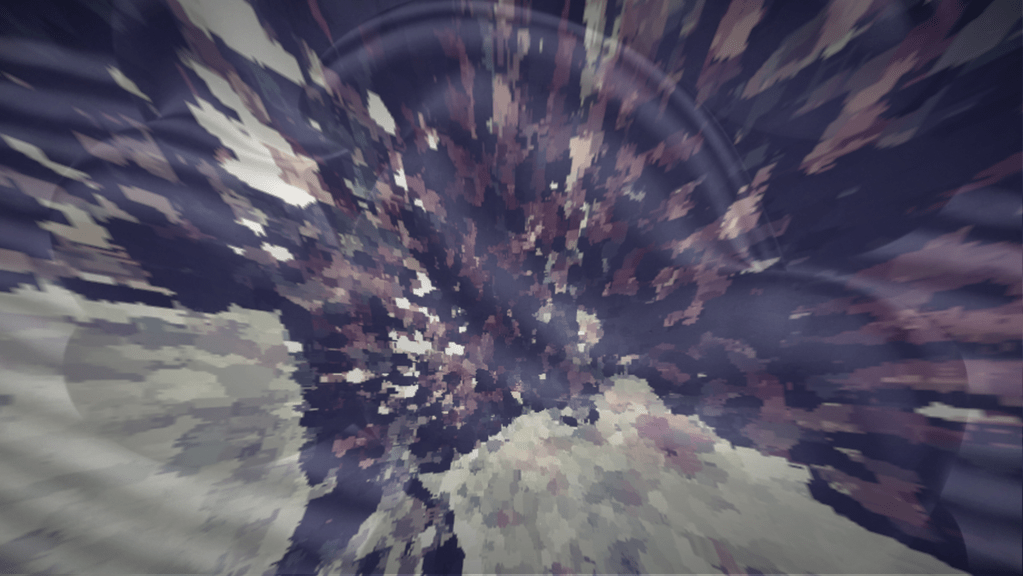
Max Lifchitz, piano

Before Time
Stephen Hawking, the great theoretical physicist and cosmologist, is famous for solving in 1974 the mind-boggling mathematics of black holes and what became known as their Hawking Radiation. He also wrote a fascinating book, A Brief History of Time. Now, after Hawking’s death, his last collaborator, Thomas Hertog, has published On the Origins of Time explaining Hawking’s theory of how Time itself began at the Hot Big Bang birth of the universe. The idea, in grossly simplified geometry, is that Space and Time were united as one primordial sphere that dramatically split apart at the Big Bang’s initial hyperinflation into expanding Space and progressing Time. Before that moment, there was no time, no before.
The musical challenge: how to express utter timelessness before the explosion; and how to build a sound space that sits still then explodes. You’ll hear an initial sound space of just one pitch, G, which at first quivers in color but without perceivable rhythm. While standing still, the sound space expands by octaves and eventually explodes with a fuller spectrum of chromatic pitch color.
Clark 2023 (TC-133)





 MAPPING MUSIC