Category: MapLabs

  • MapLab 4. Model a Metamorphosis

    As with MapLab 3, this will be multi-layer counterpoint utilizing canon in a homogenious texture. Now it will be entirely a repetitive ostinato texture — flowing, periodic rhythmic activity building a continuous texture of repeated arpeggios or melodic motives. Commonly called “minimalism,” its texture and overall rhythmic character are maximally dense.

    Multiple layers generate complex phase relationships between contrapuntal voices, with patterns of differing length repeating and changing at different times in the four layers.

    Layers of texture will change at different times to a new pattern, overlapping each other. Thus overall change of harmony unfolds gradually and continuously instead of at definite time points of harmonic rhythm, building a metamorphic form (instead of a traditional episodic sequence of chords, phrases, and sections).

    1. Choose a model

    The classic granddaddy of this whole genre is Terry Riley’s monumental 60-to-90-minute improvisatory piece, In C. My own 1984 homage to that classic, EFFULGENCE, models with Riley’s many innovative techniques.

    2. Select a source scale

    While any scale can work, those most commonly used are diatonic scales. In the TC example, we’ll go with the same as In C, a C-major/A-minor no-sharps-or-flats key signature. (We’ll see later, however, that a motive can be transposed into another diatonic scale and key signature.)

    3. Make motives

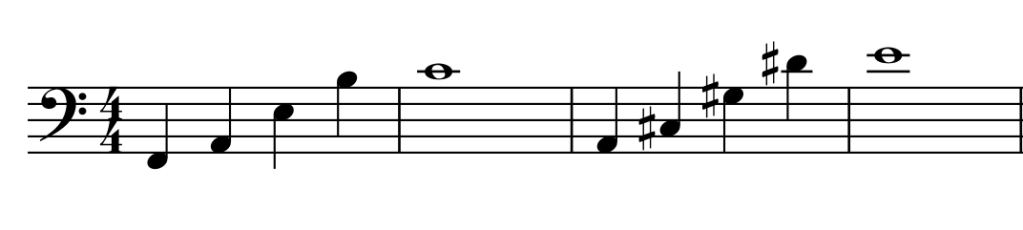
    First, design two or three motives, basic shapes of 3 to 7 pitches from the source scale.

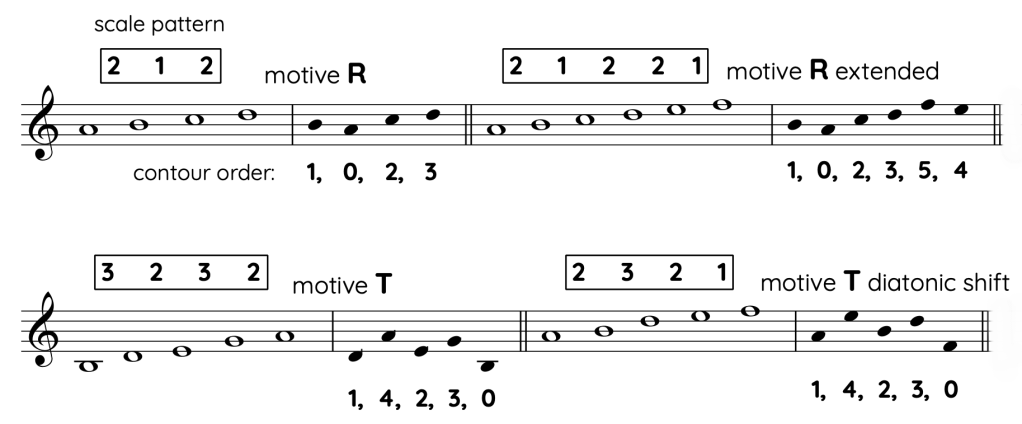
    TC example:

    Motive R gets extended by the addition of two pitches, F and E. The last example shows motive T’s shape shifted to a different level of the diatonic scale (what Sibelius calls a diatonic transposition). A motive can also be truncated to as few as two notes:

    4. Plan a stream of motive variants

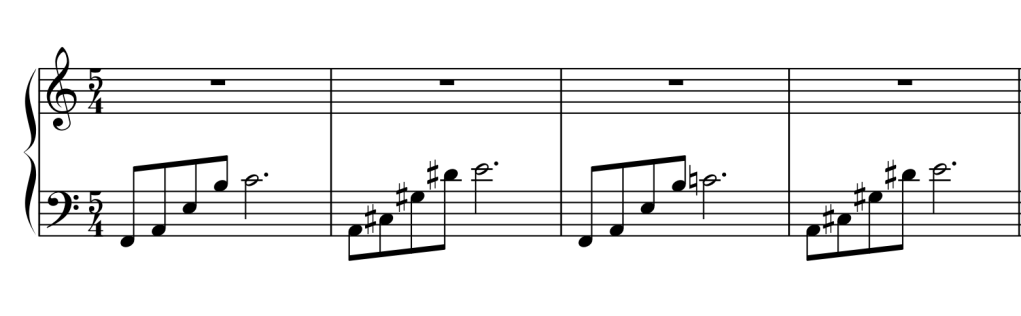
    Motive patterns can and should vary in length, especially when rhythmic values are mostly all 8th-notes, providing a changing landscape of rhythmic vitality. In the TC example, however, most patterns are 5 8th-notes long. Since 5 is a prime number, and set in a 3 4 meter, the overlaps of these 5-patterns in the competing lines fulfills that energetic complexity of rhythmic fabric.

    TC example

    For the pitch motives, a process of adding or abandoning pitches to make the next pattern creates the metamorphic unfolding process that is the true magic of this lab. In the TC example below, this add/abandon process is color coded:

    • GREEN for newly added pitches
    • BLUE for pitches appearing in a different octave than in the previous pattern
    • PURPLE for pitches that will appear next in a different octave
    • RED for pitches that will be abandoned in the next pattern

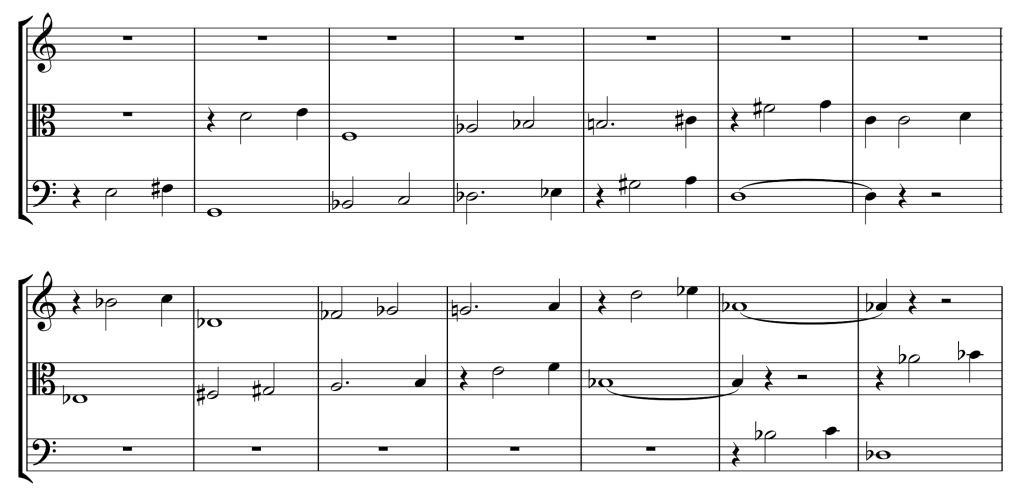
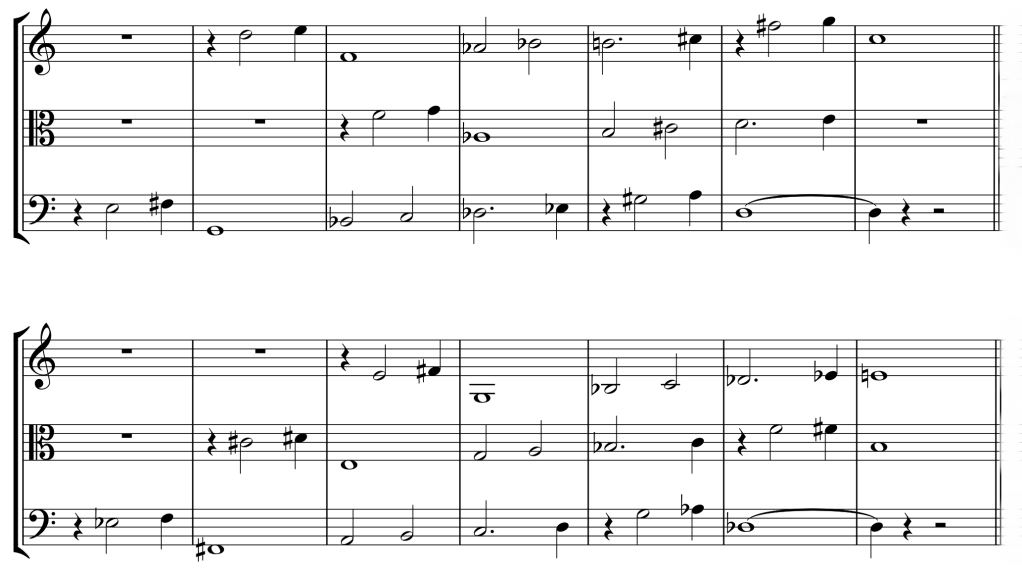
    You can see that by letter K the original C-major diatonic is modulating to a new diatonic, Bb major. These two keys have in common 5 pitch classes, and the patterns capitalize on the F, G, and C common tones to connect smoothly. (Riley’s In C also modulates, eventually adding F# and Bb in much the same way Bach inflects the C-major tonality toward the end of his famous C Major Prelude that launches Book I of the Well-Tempered Klavier.)

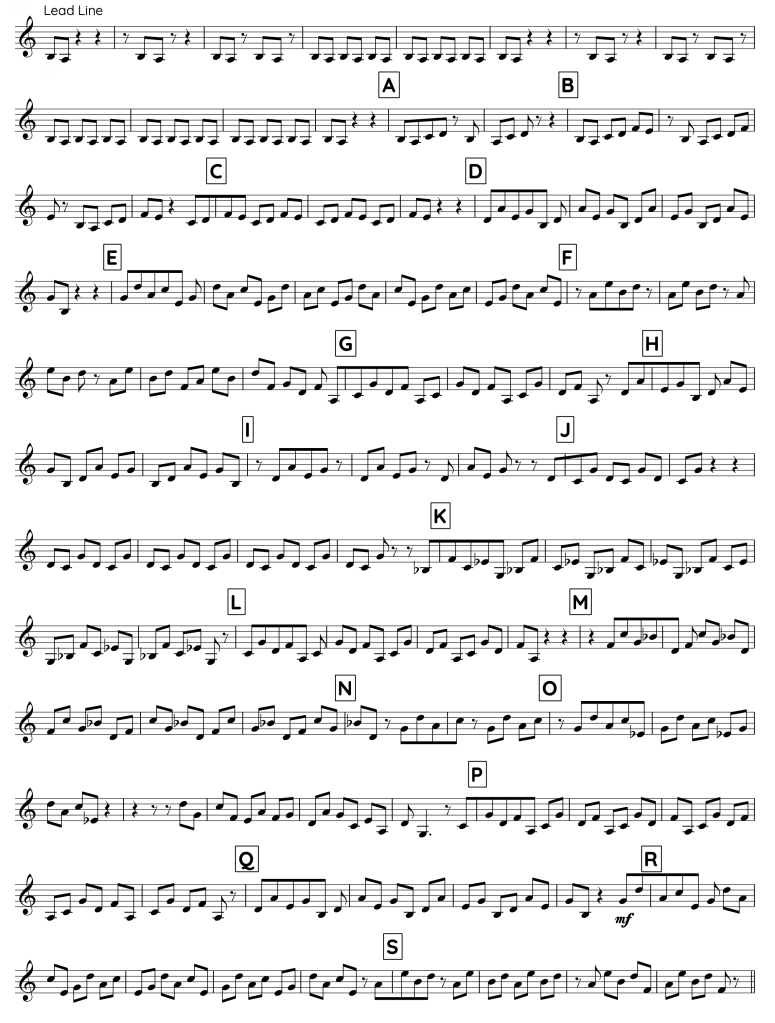
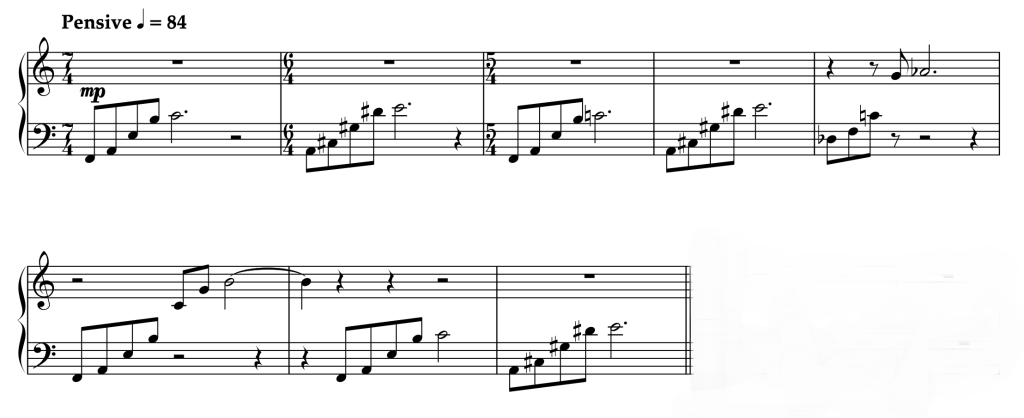
    Here is the lead voice of the ostinato canon:

    You can see that the number of repetitions of a pattern and the overall duration of its presence in the texture vary throughout. Patterns E, F, K, and P run for five full measures in the lead line alone (plus delayed answers in the whole texture), while the simple transitional pattern N runs for only five beats in the lead line.

    5. Spin the canonic counterpoint

    The time delays of canonic answer should be chosen not to match the length of the typical pattern. Otherwise, the answers would lock into fixed duplications of each other, making a rigid, uninteresting periodicity. Each new motive-pattern entry is highlighted below with a new dynamic marking. Here is a sample excerpt starting around pattern H:

    The answers all enter at unison or octave, with timings determined by a mostly trial-and-error method as follows:

    • PP – 9 beats later at unison, then 9 more beats down an octave
    • P – same
    • MF – almost same, but shortened last answer comes one 8th-note early
    • MP – (for a 3-8th-note pattern) 5 8th-notes later then 7 8th-notes after that
    • PP – top voice leads, answers are 2 beats later then 3 8th-notes after that

    This last is what we described in MapLab 3 as a stretto, answers coming in with very short time delay.

    6. Interrupt with an interlude

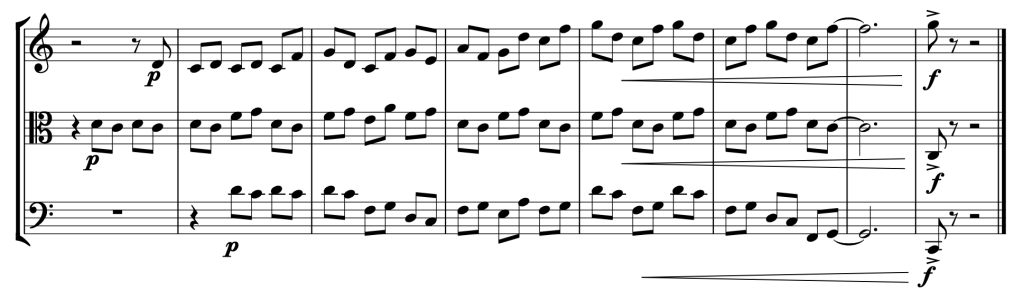
    As with In C, the ostinato texture can blast through from beginning to end in a continuous monolithic stream. Another form scheme, which I will invoke in the TC example, breaks the stream with an interrupting interlude before a coda to come. Of course, it’s another canon, a stretto of cascading downward dotted quarter-notes.

    7. Ending an ostinato stream

    Several considerations . . .

    First, since you’ve built a canon with staggered entrances, the last notes will be staggered as well. To make any kind of cadential closure, however, you’ll want to have them stop at the same time, right? That is accomplished simply by truncating the answering lines and/or adding repetitions of the final pattern in the lead voice.

    Think about the lead line and its answers leading to a point of harmonic stability and finality — somewhere that feels like tonic home base.

    More repetitions help slow and stop the harmonic momentum.

    In the TC example, an ostinato coda after interruption settles into and prolongs what will sound like a dominant chord in C major, then crash lands on a tonic C-major stinger.

    8. Title and listen

    The picturesque metaphor of a babbling creek made me reminisce about a favorite adventure on days off from working at the National Music Camp in Interlochen, Michigan back in the ’70s and early ’80s. We would canoe down the Platte River to its end flowing into Platte Bay on Lake Michigan. There was also a nearby spot where tiny Otter Creek trickled out onto a more secluded sandy Lake Michigan beach offering northward a spectacular view of Empire Bluff.

    Otter Creek

    Continue reading Mapping the Music Universe . . .

    MapLab 5. Spin a solo

  • MapLab 3. Construct a Canon

    Canon is a venerable, centuries-old compositional device, building counterpoint between a melodic line and one or more delayed and possibly transposed echoes of itself. Like a magic trick, it makes a strongly cohesive contrapuntal texture of rhythmically independent lines that are like clones of each other. Canon is more intense than a fugue, which formalizes the echo cloning technique, interspersed with free counterpoint.

    1. Study historical models

    There are many great models to study. Many 16th-century composers (notably Josquin and di Lasso) wrote canonic choral mass movements. Known more for his fugues, the great 18th-century contrapuntal master, Bach, also wrote several intriguing canons in his late work The Musical Offering. No more elegant model exists than the first movement of Anton Webern’s Symphonie Op. 21 (1928), in which four voices are spun out by successions of instruments each in turn differently coloring two to four notes of the same 12-tone line.

    Like every fine magic trick, there are several basic techniques we can learn to construct a canon. I’ll cover three, which I will call Zigzag technique, Trial-and-error technique, Rhythmic alternation, and Stretto echo.

    In 1610, Venetian composer Diruta wrote Il Transilvano analyzed Renaissance polyphonic style by codifying five species of rhythmic relationships between contrapuntal lines. Johann Joseph Fux, in his monumental 1725 pedagogy, Gradus ad Parnassum, explicated 16th-century counterpoint using these rhythmic species, of which the following are of special importance for us in this lab:

    • FIRST Species – note against note
    • FOURTH Species – lines alternating, seldom moving simultaneously
    • FIFTH Species – a mixture of rhythmic values in all lines

    2. Zigzag

    My name for it says it simply, like laying bricks one at a time but staggered to overlap.

    • Compose a few notes of the lead line. (In the example below, it is just three notes in two measures.)
    • ZIG: Establish a time delay. (in the example, one measure of two half-note beats). Duplicate the first notes (rhythm and melodic interval shape) in the following line, starting on a chosen pitch that makes the kind of vertical contrapuntal interval you desire to emphasize.
    • ZAG: Select new notes for the lead line that overlap with the ZIG notes, again making your desired vertical contrapuntal intervals. These ZAG notes need not match one-to-one the rhythms of the ZIG notes, providing the opportunity if desired to establish a Fifth-species rhythmic mixture.
    • The notes of this ZAG now ZIG into the following line, preserving the same transpositional level you established in the first ZIG.
    • Keep going as long as you wish or have stamina for. When ready to cadence, arrive at a longer note of stable pitch-sense in the lead line.

    The canonic material you just contructed can be reused transposed. Just be sure you transpose all lines together by the same transpositional interval.

    In the example below, my seven zigzag-composed measures are transposed down one semitone.

    Starting on Eb might be useful to follow the first statement of the material, which ended on D in the lead (lower) line. Or I could transpose the whole thing up 8 semitones to start on C, eliding with the middle C (bass clef) that ended the following line.

    Adding the third part enables this stair-step sequential transposition of the two-voice canon to go on and on . . .

    3. Trial and error

    Let’s try a different technique to add a canonic answer, one that is facilitated by notation software such as Finale or Sibelius. This way involves

    • copy the whole lead line, not just a head motive
    • choose a time delay or maintain one already established. Paste into the new answering voice the lead line
    • Playback the synthesized audio to test aurally for contrapuntal viability.
    • If it sounds bad, analyze the vertical intervals to discover why.
    • Make a strategic choice of a transposition of the pasted-in answer, then test it aurally.
    • Keep trying different transpositions until you find one you really like.

    For traditional diatonic tonal subjects, common transpositional choices are: unison; octave; Perfect 5th (7 semitones); Perfect 4th (5 semitones).

    In the following examples, I show in the first system a trial of an added third voice in the middle, starting on E (alto clef) transposed an octave up from the lead. For the second system, I tried adding a third voice on top, transposed up a Major 9th (14 semitones) from the lead’s start on Eb to start on F (treble clef).

    Horrible, yes? Why? What vertical contrapuntal invervals are the sour ones to your ear?

    I’ll jump to a better trial that succeeds in both places.

    In this successful trial, the first system’s added middle voice transposes from the lead’s E up 13 semitones (minor 9th), and later in the second system the added upper voice transposes up also 13 semitones from the lead’s Eb to a second answer starting on E. The minor 9th is unusual, unorthodox, chromatic, not a solution we might predict . . . but it works!

    4. Rhythmic alternation

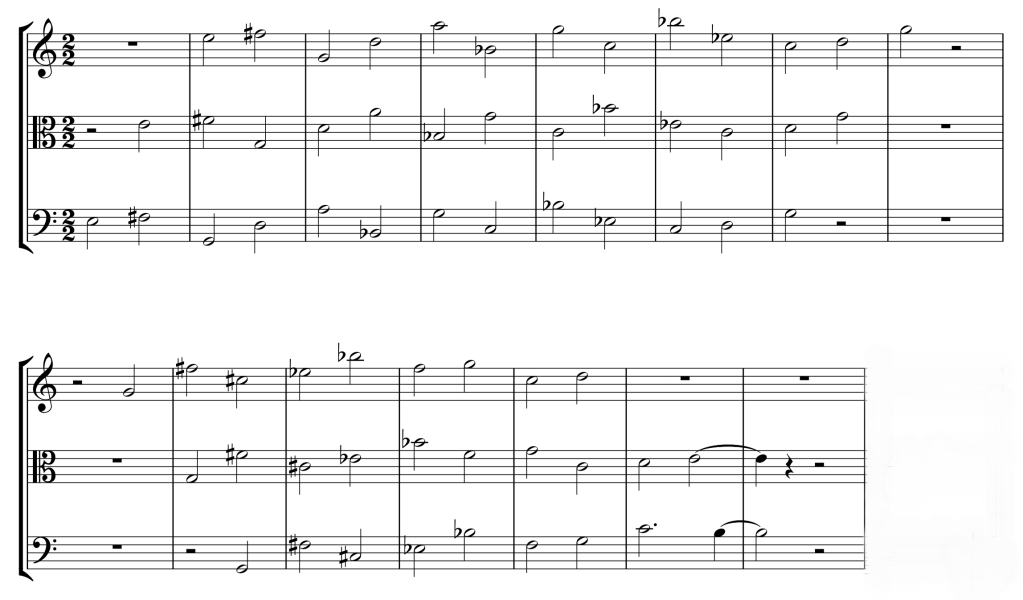
    This will be like Fux’s Fourth Species. The lead subject is best with some long note values, leaving ample time for answering voices to present pitches when it is not moving. Transpositional choices for entering answers become fixed as predominant vertical intervals throughout the canon. In this example, the first answer chooses down 11 semitones plus an octave, and the second answer enters up 7 semitones (Perfect 5th) from the first answer, which is down a Major 10th (14 semitones) from the lead line. Thus vertical (harmonic) intervals of 11, 7, and 14 semitones end up projecting harmonies based on the 7 4 array: G up 7 to D up 4 to F#, which is up 11 from G. That sets the harmonic character of pitch constellations throughout the canon.

    5. Stretto echo

    Stretto is the term used in fugue structure for when an answer to the subject happens before the subject is finished, sometimes with a delay as short as only one or two beats. For a canon, this offers an interesting strategy for choosing pitches to shape a subject that makes its own arpeggiated harmony as it goes. The answers at unison (not transposed) are literally echoes. Even with answers octave-transposed, the effect is a multivoice arpeggiation. The fascinating wrinkle, however, is that the “chord” being arpeggiated is constantly evolving, dropping one pitch and adding one new at each note of the lead line.

    Though this setup can work with other rhythmic “species” of lines, it is particularly interesting in the note-against-note conforming rhythms of “First Species.”

    Here is how it can work, using the canon above as a straightforward example.

    This analysis sounds as a rather nice progression of arpeggiated chords and simple flute line! The important point, though, is that this progression did not come first. It was built by the canonic subject line as each new pitch was chosen to make a certain array with the previous two pitches in an ongoing, evolving flow. Magic!

    6. Spin a piece

    For our example, we’ll follow the order of the example techniques:

    • two-voice zigzag canon
    • add a third voice by trial and error
    • stretto echo of the same subject
    • Rhythmically spacious subject allowing non-synchronous timing of answers
    • Recapitulation of the stretto echo canon

    The result is a fuller working out of No. 10 of the 14 specimens in my Book of Canons:

    Black Canyon

    The title comes from my photographic memories of the Black Canyon of the Gunnison River, named for the ever-present shadows the narrow canyon’s steep, sheer, tall rock walls cast on the river flowing far below. The sheer cliffs of the Black Canyon are metamorphic Precambrian gneiss and schist, streaked with thin, brighter-colored layers of pegmatite. These streaks sketched on the darker rock look like maps of ancient contrapuntal lines.

    Continue reading Mapping the Music Universe . . .

    MapLab 4. Model a metamorphosis

  • MapLab 2. Sketch a Song

    Many great art-song models . . .

    Schubert‘s famous lied, Erlkönig — a dramatic setting of Goethe’s poem with a hammering piano ostinato as the running horse’s hooves, it uses tonal changes and vocal tessitura to draw distinctions between four dramatic voices.

    Or Charles Ives“The Cage” — utilizes whole-tone scales and “quartal chords” to depict the restless pacing of a leopard in its cage.

    2. Find simple lyrics

    A short poem or single stanza that evokes colorful or dramatic images — or write your own. Limit the total number of syllables so that the vocal line isn’t forced to be too “note-busy” just to cover each syllable. This leaves room for some syllables to have more than one pitch, a melisma that extends the duration of an important syllable’s vowel with beautiful melodic curves.

    TC example

    Speaking of curves, a recent visit to the shores of Michigan’s Leelanau Peninsula inspired me to write a poem:

    Yin Yang

    Peninsula upon peninsula upon grand peninsula,
    Lee upon Leelanau upon Lower.
    Cove from bay from great lake,
    Suttons Bay off Grand Traverse Bay off Lake Michigan.

    Land curves in myriad shore shapes,
    Reaching out to blue water.
    Fresh wind weds the land and water,
    Sun warms bright sails and sailor.

    That is a total of 76 syllables. Though it does not rhyme, there is a simple poetic structure. Each stanza has two 2-line sentences. In both sentences of the first stanza, the first line describes a general recursive process, then the following line particularizes that with geographic names. The second stanza follows this same two 2-line sentences pattern. Land touches water in the first 2-line sentence. The last sentence, like a traditional sonnet-ending couplet, introduces the melding elements of wind and sun.

    3. Design tonal material

    For this lab, let’s start with a scale pattern, something different than a major or minor scale. Let’s limit it to a pattern of no more than 6 pitches in an octave.

    TC example

    I am choosing a six-note pattern, array 2 2 2 1 2, that is actually a truncated Lydian mode scale:

    It also has a similarity to a whole-tone scale, with three consecutive array intervals of 2 semitones (the “whole-tones”). Both the Lydian and whole-tone characters are exotic sounding, conducive to the Impressionistic landscape painting quality I want.

    It also interests me from the remarkable standpoint that its complement, the six other pitch-classes of a 12-tone scale not included, make an incomplete Dorian scale pattern whose array, 2 1 2 2 2, is just the reverse/inverse of the incomplete Lydian. Cool!

    4. Make a melodic theme or motive

    Think about shape: a line can step through the scale pattern or skip or leap to non-adjacent tones of the scale. A line can go straight up or down (like an arpeggio), or it can turn (change direction) occasionally or frequently, or even incessantly (making a stationary oscillation).

    TC example

    This melodic shape has three turns in direction, on the F then on D then on B. (Only the A is not a turning point.) It also uses five different melodic interval sizes, each only once. The mirror inversion has these same features, here starting on G#.

    5. Construct prototype constellations

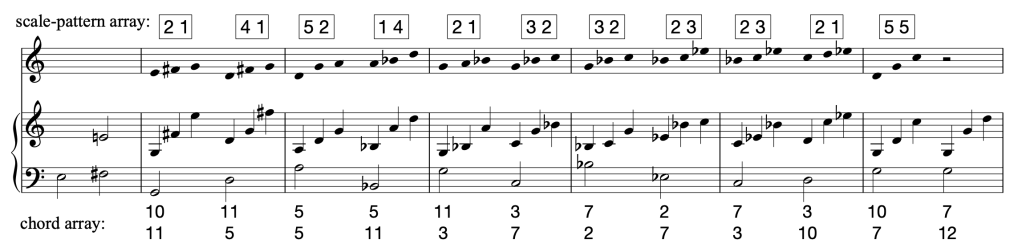
    Drawing pitches from the chosen scale, establish preferred harmonic interval arrays.

    TC example

    Mine emphasize the intervals 2, 5, 7, and 10, setting a harmonic character

    5. Build the song’s form

    The large-scale form of a song will usually be prescribed by the nature of the lyrics, such as the stanza structure of a poem. The music’s sectional form may use changes in tonality, tempo, or rhythmic character to parallel changes of tone or image in the lyrics.

    TC example

    Instead of marking sections or stanzas by tonality, I will choose to differentiate with tempo and rhythmic fabric. Bright introductory chords are sustained for different prime numbers of 8th-notes — 7 then 5 then 3 then 7.

    The land sentence will be set in continuous quarter-notes. Pitches are again drawn from our primary Lydian-and-Dorian scale patterns but with varying orders and octave placements.

    In a faster tempo and pace, water will be set in continuous flowing 8th-notes.

    The second stanza will transition from the 8th-note flow to slower, more mixed rhythms and, finally, back to an echo of the static chords from the beginning.

    6. Shape vocal melodies to lyrics

    For singing, multi-syllable words should be divided the way a singer would sustain the vowel before ending the syllable with the consonant initiating the next syllable.

    Vocal range should be considered and the pitch space used limited to the likely capabilities of the kind of singer you’re writing for. The higher tessitura (portion of the range) might be reserved to effect a climax if appropriate to the lyrics.

    In determining rhythmic values for the melodic vocal pitches, it is important to recognize the accent pattern of the words, giving accented syllables a musical accent, either by:

    • metric — placing them on a beat or strong beat
    • agogic — sustaining them for longer duration
    • contour — placing the accented syllables on pitch high or low arrival points
    • combination of any of these emphases

    TC example

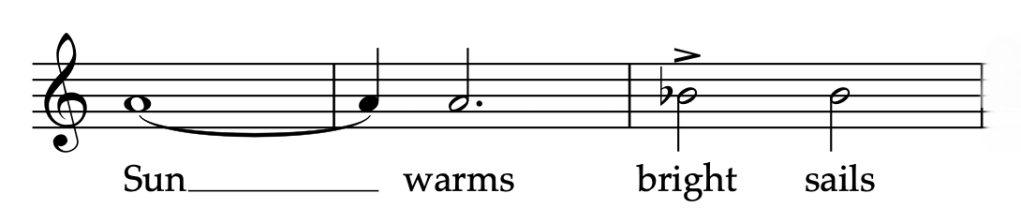
    Trying to limit the vocal range required to sing this simple song, Yin Yang extends from middle C to the D an octave and a step higher . . . except saving an Eb yet one semitone higher for the dramatic last note on the last word.

    Pe-nin-su-la u-pon pe-nin-su-la u-pon grand pe-nin-su-la,
    Lee u-pon Lee-la-nau u-pon Lo-wer.
    Cove from bay from great lake,
    Sut-tons Bay off Grand Tra-verse Bay off Lake Mi-chi-gan.

    Land curves in my-ri-ad shore shapes,
    Rea-ching out to blue wa-ter.
    Fresh wind weds the land and wa-ter,
    Sun warms bright sails and sai-lor.

    Notice how the incidence of consecutive stressed syllables increases toward the end.

    7. Fit the melodic and accompanying lines together

    Melodic pitches can be drawn from the underlying chord. Or they can represent “non-harmonic tones” forming a dissonance against some pitch of the harmony.

    TC example

    My Peninsula melodic pitches are taken from the underlying chord.

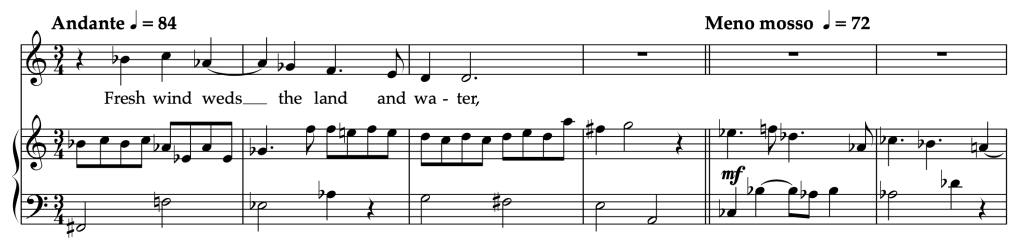
    Since the piano presents the chord as a moving line, vocal pitches often are a simultaneous with the same piano pitch, as in “Fresh” and “weds” above. Melodic tones can also occur not at the same time as the matching harmonic pitch, but instead make a contrapuntal (vertical) interval between the two parts. Under each new vocal pitch below, I’ve indicated the contrapuntal interval it forms with the differing piano pitch of that moment.

    You can see a contrapuntal interval consistency between the voice and piano, even as their rhythmic streams contrast.

    8. Assemble the song

    Now it’s time to put everything together. A traditional approach will include a piano-only introduction and at least one interlude without the voice.

    Normally I suggest listening to a whole piece without watching a score. Since my synthesized rendering here cannot pronounce the words in the synthetic voice, however, I suggest watching below to get the feel of the lyrics that, after all, drive the whole song.

    Yin Yang

    Continue reading Mapping the Music Universe . . .

    MapLab 3. Construct a canon

  • MapLab 1. Generate a Gymnopédie

    For this first mapping lab, a basic experimental process is outlined step-by-step and demonstrated with examples from a sample composition. Once you’ve studied the example piece, you can start over and craft your own experiment using the same open steps. General instructions leave you free to openly consider and choose from many musical possibilities.

    1. Choose a model

    Trois Gymnopédies (1888) by Erik Satie

    Simple in harmony, meter, melody, texture, repetitive form.

    2. Design a theme

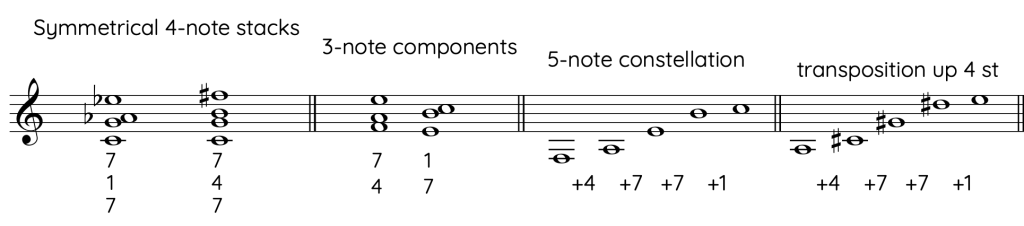
    Start with a pair of 4-note constellations of considerable interest due to their symmetrical interval stacks and “perfect fifth” 7-semitone interval separated by a smaller interval. (See “Symmetrical interval arrays.”)

    We’ve made two chords, both with the same identical interval stack.

    3. Choose a meter and rhythm/tempo character.

    A prime-number meter (such as the 7 4 meter used for the Finale of Stravinsky’s Firebird) can have a more “timeless” quality, due to its lack of layers of nested pulse between beats and bars. The prime number of beats prevents them from grouping into regular sub-measure groupings.

    To follow through further on the floating feel of lacking groupings, let’s stretch the timings a bit between arpeggios.

    4. Add a line and sound color to the texture

    I call this technique extraction or refraction, pulling selected tones of a complex line into a separate voice:

    5. Make variations

    Arpeggios with refracted color line:

    Pull the 8th-note arpeggios into a continuous stream:

    Canon at the octave:

    Rhythmic augmentation, without then with the refracted color line:

    Mirror inversion of augmentation, canon:

    6. Assemble the large-scale form

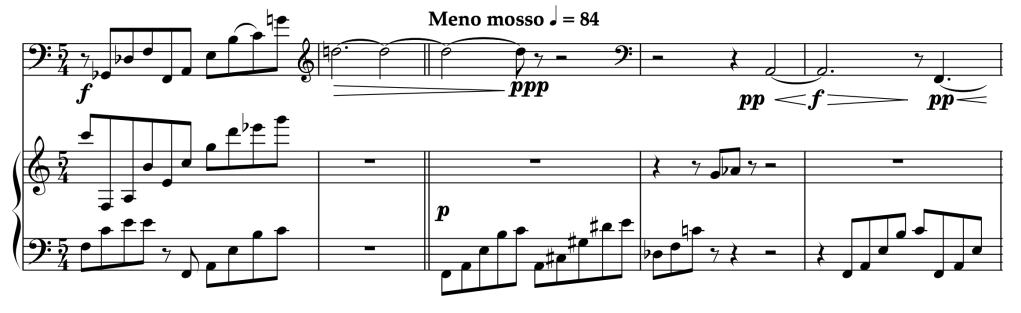
    The theme and each variation end with a clear cadence, a sustained final note and pause in rhythmic activity . . . except Variation 3, the continuous 8th notes. It morphs into a transition that both interrupts the 8th-note flow and slows the tempo, preparing for calmer, much less dense quarter-note variation:

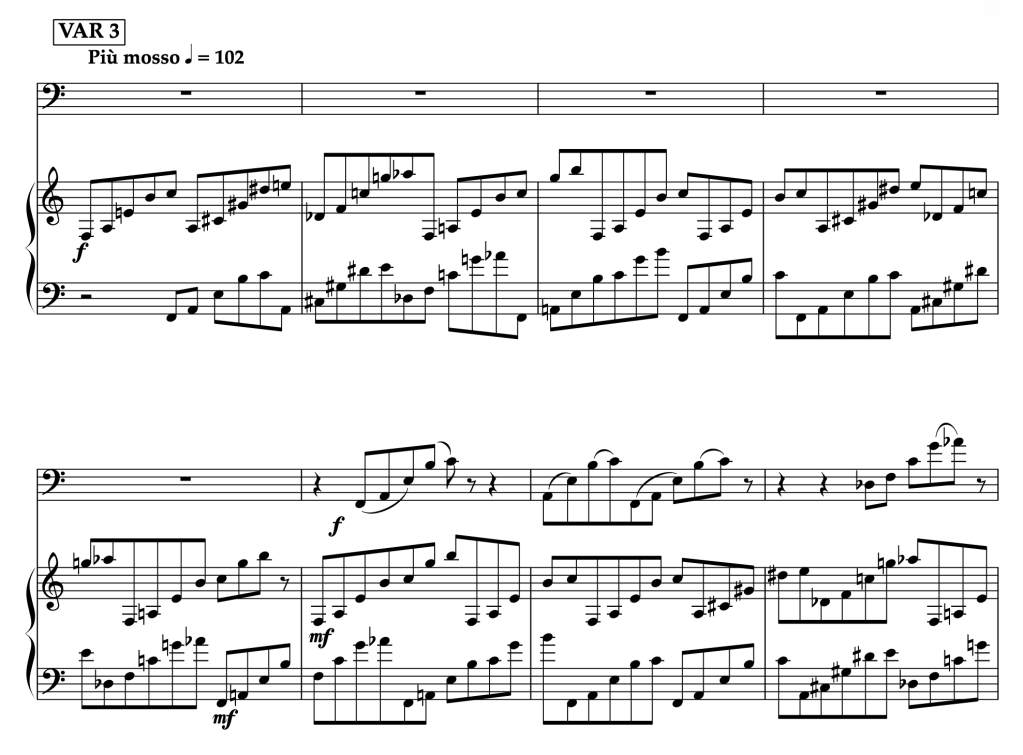
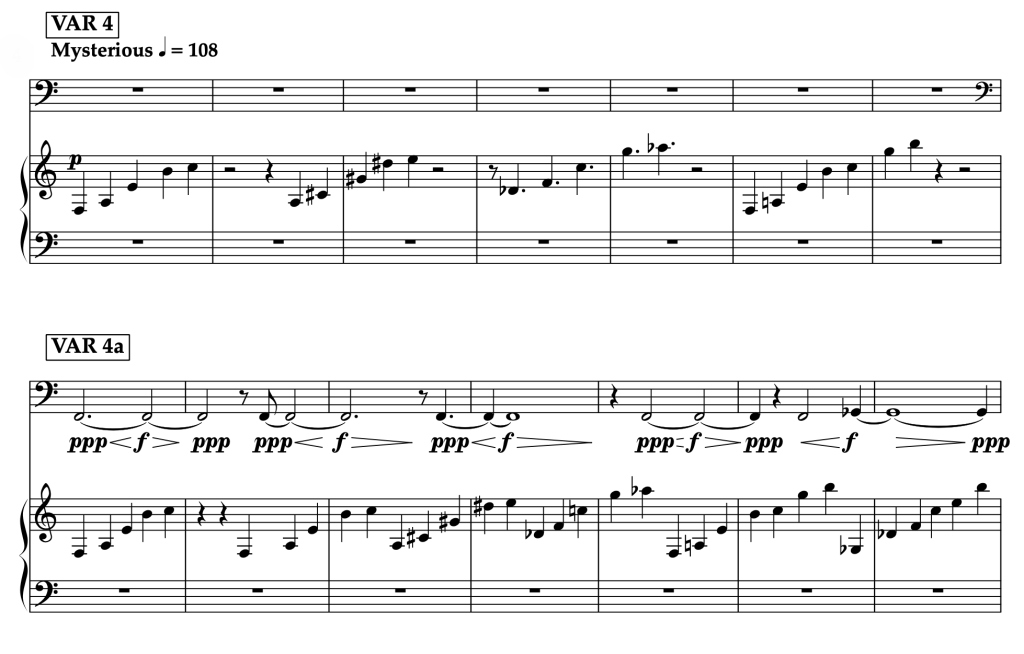
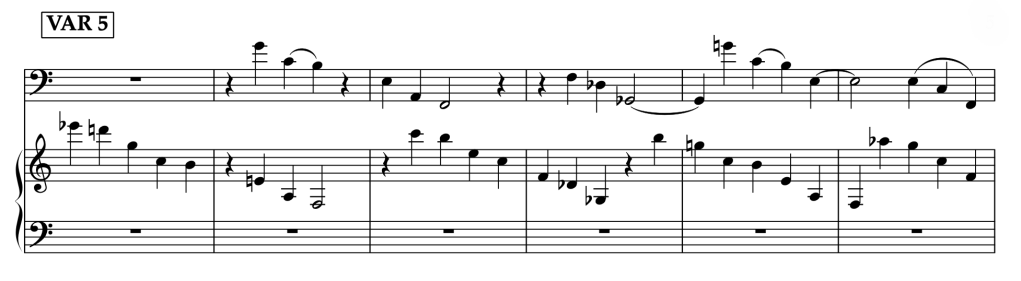
    The variation process is serial, each one progressing from the previous idea, rather than “starting over” each time. Thus the overall unfolding form feels evolutionary rather than episodic. Then a kind of recap does start over with a return to the opening idea, making a rather traditional coda ending,

    6. Title

    This musical sketch, like most of my pieces, was composed without a title or guiding image. The compositional process began with the basic challenge to make a small piece out of simple, limited material. The adopted model was Satie’s radically sparse, (one could even say) minimalist style in his Trois Gymnopédies for piano (1888), Its title may have been taken from a French poem by J. P. Contamine de Latour — the poem ends with the word gymnopédie:

    Oblique et coupant l’ombre un torrent éclatant
    Ruisselait en flots d’or sur la dalle polie
    Où les atomes d’ambre au feu se miroitant
    Mêlaient leur sarabande à la gymnopédie

    Slanting and shadow-cutting a bursting stream
    Trickled in gusts of gold on the shiny flagstone
    Where the amber atoms in the fire gleaming
    Mingled their sarabande with the gymnopaedia.

    My title will adopt the English translation of one selected metaphor: Amber Atoms in the Fire Gleaming.

    7. The finished piece

    In keeping with the Satie models, this study generates entirely from one modern harmonic constellation, arpeggiated repeatedly in a gentle, almost imperceptible meter, then growing colorful “amber” sustained highlight sounds. Eventually the arpeggios begin to spin and swirl in a layered, kaleidoscopic texture that is “minimalist” in the 20th-century usage as the description for repetitive ostinato music.

    8. Test sample

    Listen without looking at a score, the best way to first sample created art:

    Amber Atoms in the Fire Gleaming

    Continue reading Mapping the Music Universe . . .

    MapLab 2. Sketch a Song

  • MapLabs — Modeling Music

    “Mapping” has double meaning. A road atlas measures and records all the routes through a given territory. But we also call “mapping” the creative act of planning out a journey, using map information to choose between many possible routes. Composers use an array of processes to map out a musical journey. Designing a piece entails making a storytelling rhetoric, a pacing plan, and an architecture of interrelated components. 

    Each Map Lab in Mapping the Music Universe presents step-by-step recipes to compose simple pieces based on models of different musical genres. Each lab also includes an original sample piece following the Map Lab guidelines, illustrating one possible creative path and outcome.

    Try your own experiment with any of these lab projects:

    MapLab 1. Generate a Gymnopédie

    MapLab 2. Sketch a Song

    MapLab 3. Construct a Canon

    MapLab 4. Model a Metamorphosis

    MapLab 5. Spin a Solo

    MapLab 6. Paint a Landscape

    MapLab 7. Twelve-Tonal Trichords in a Ternary Trio

    MapLab 8. A Small Sonata

  • MapLab: A Small Sonata

    A sonata is typically a multi-movement piece for solo piano or for an instrument with piano. A shorter form with just three connected sections, the middle slower and quieter, can be called a sonatina. Here is an inside look at how one was composed, step by step. Like the MapLabs in Mapping the Music Universe, this guided tour is in the form of a recipe you can follow to write your own sonata.

    Choose a model

    I started formal composition study in 1968, first with composer Eugene Kurtz, based in Paris but filling in that semester at the University of Michigan. A proponent of modern French music, his compositional models included Debussy and Ravel. He assigned me to immerse myself in deep study of their music, in particular Ravel’s 1905 work, SONATINE.

    I met Beth, a flower lover, in Interlochen in 1975. She had been a promising flute student at Aspen, but was then embarking on a journalism career specializing in horticultural writing.

    The Ravel study came back to me later in my career, as I began to adopt its lush, bright harmonic language and a gentle French Impressionist quality. My SONATINE for Beth (2025) brings together the Ravel study, the flute sound, and (in my video version on YouTube) even the flower motif.

    Start with a generating idea

    The impelling theme can be a melody, a rhythmic pattern, a special kind of chord, or a non-musical image such as a painting or poem.

    Sonatine for Beth is spun entirely from a single harmonic progression, seven chords, each stacking one Perfect 5th interval above another.
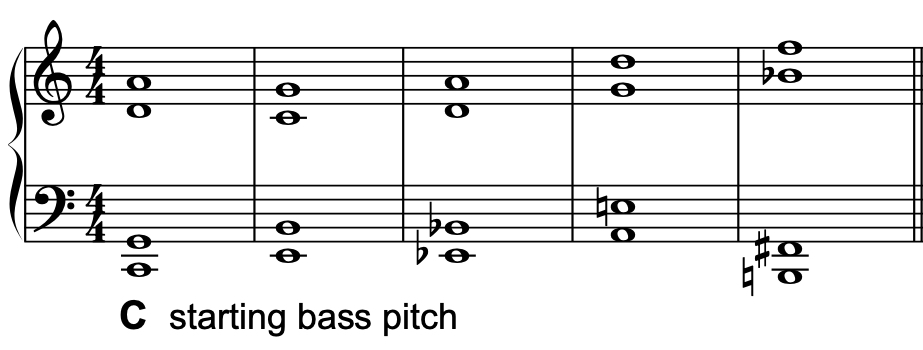
    The Perfect 5ths in the two hands are separated by one or more octaves, highlighting this strong interval as a characteristic sound for the piece.

    Now some basic tools to develop and vary a generating theme.

    Transposition

    The whole five-chord progression can be transposed. The harmony is heard plainly in a middle section as ten block chords. The last five chords are a transposition of the first five, up three semitones, starting on the bass pitch Eb instead of C.

    Sequence is successive statements of a pattern transposed by a consistent interval.

    Here is another transposition of the whole ten-chord sequence:
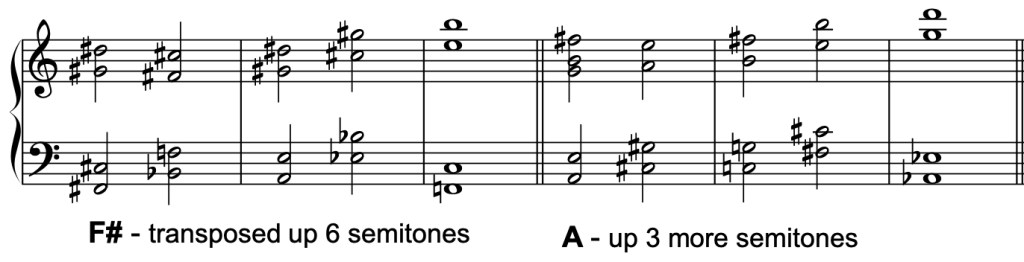
    This harmonic material generates melodic lines and many arpeggio patterns, in successive variations of changing register, intensity, and rhythmic pace. Let’s go through the compositional unfolding of this thematic idea.

    Extract a melody and bass

    Since the starting idea is simply a chord progression, we can select individual tones from each chord for a melody. The most obvious selection is the highest pitch of each chord, even if it is not in a soprano singing range.
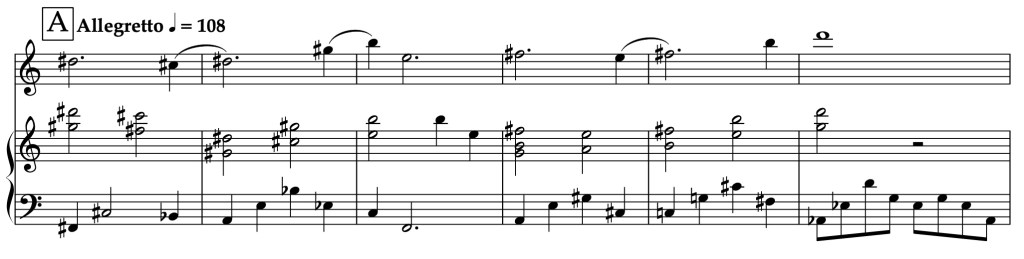
    At letter A the melody is given a slightly independent rhythm to help set it off from the chords, in addition to the different sound color of the flute. Also, the lower chord tones are articulated one at a time, making a bass line also rhythmically distinct, faster than the half-note chords. (The Bb in the bass line’s first bar is a passing tone, not a chord tone.)

    Add arpeggios

    An arpeggio is any pattern articulating chord tones one at a time. Usually in order lowest to highest or back down, the individual chord tones can be articulated in any order. At letter A shown above, we already saw the left hand articulate its chord tones one at a time. In the introduction, the right hand is partially broken up into arpeggios.
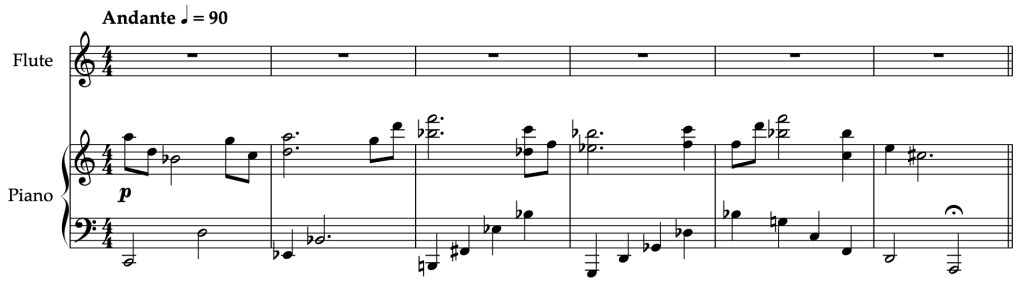
    In the next variation below, right-hand treble chord tones and still some bass chord tones are arpeggiated. Now all three lines (flute, right hand, left hand) have distinct rhythmic patterns, though congruent with each other in the established 4 4 meter.
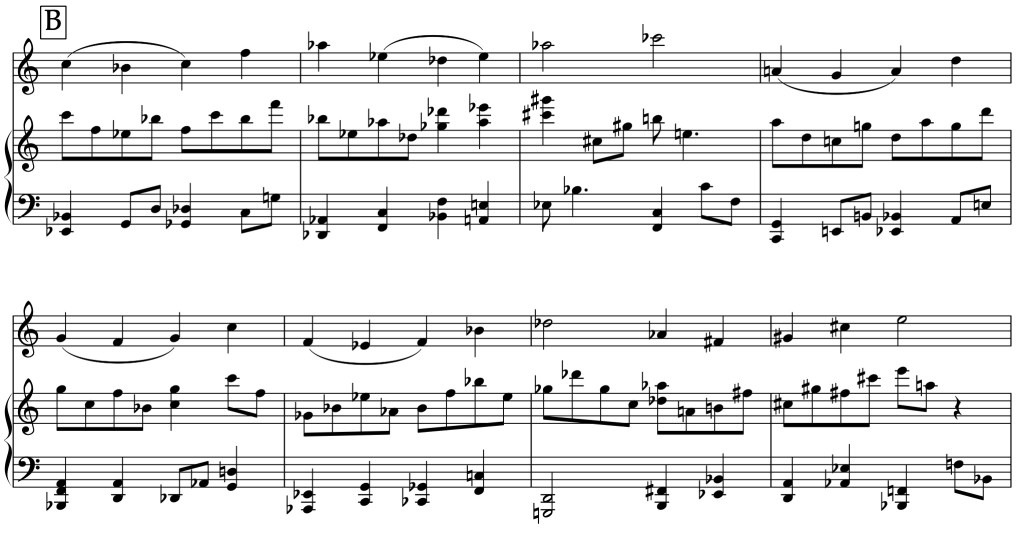
    Next, the flute arpeggiates chord tones in eighth-notes, with the left hand simplified to quarter-notes of two pitches from each chord.
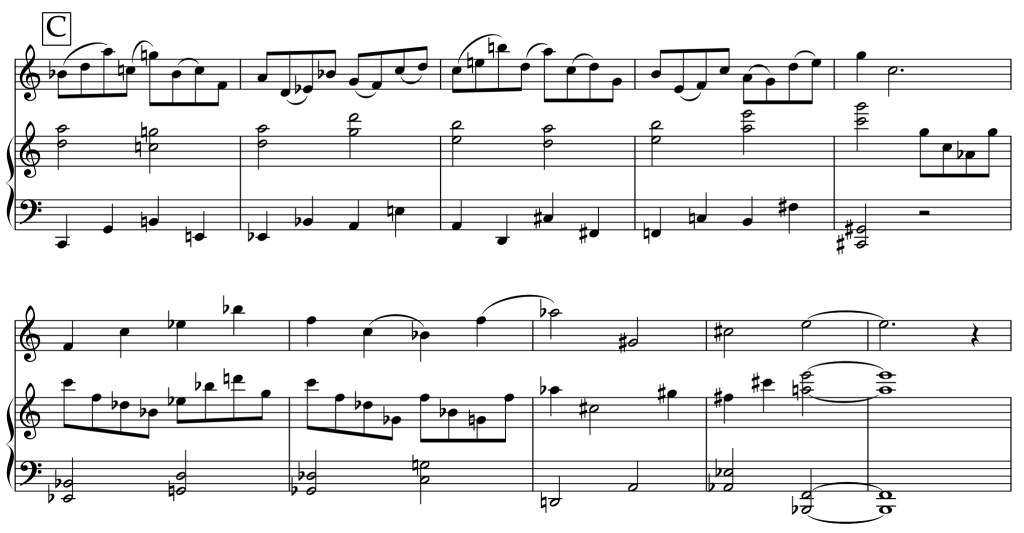
    Rhythmic variations

    Variation D simplifies the flute melody to just two half-note chord tones per bar.
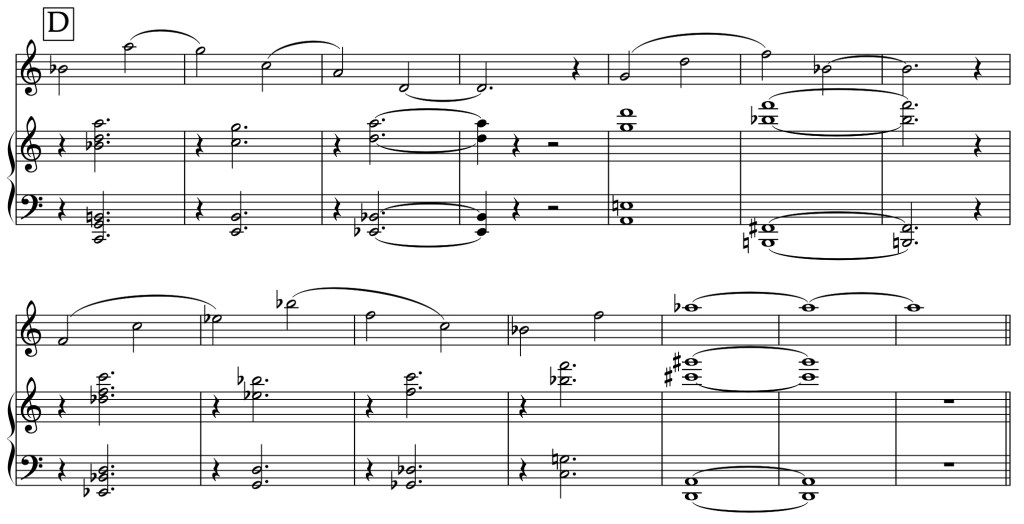
    The two hands reunite rhythmically to place some chords after the downbeat and between flute notes.

    Counterpoint

    The original term, contrapunctus, translates “point against point” — two or more independent lines interacting in time.

    A more active rhythm for the flute line leaves time gaps that can be filled in by another line. The right hand selects chord tones to make a similarly playful rhythmic line that mostly alternates and sometimes lines up with the flute rhythm.
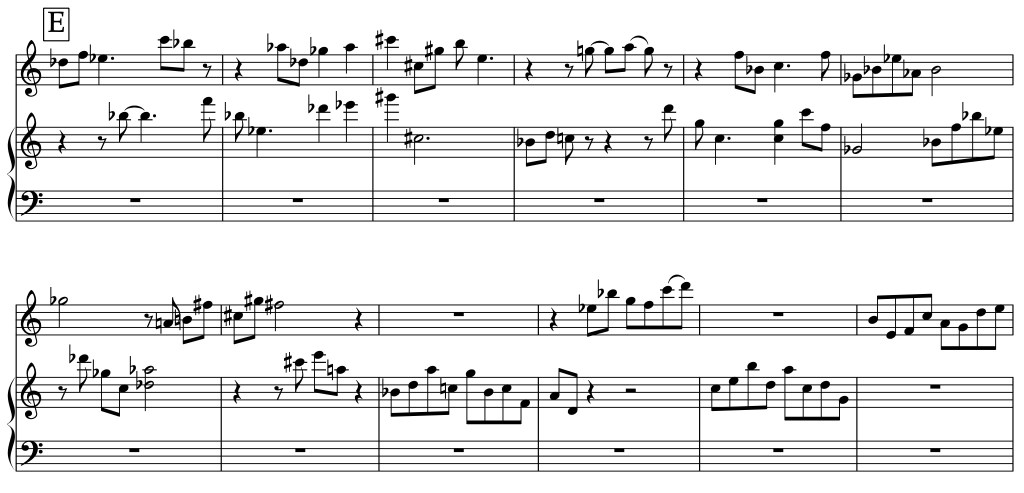
    The harmonic progression is still there but just hinted at by the chord tones selected for these interacting lines.

    Variation F continues this back-and-forth rhythmic interaction of the flute and piano right hand, now adding back in the left-hand chord-tone pairs with a simple rhythm for a supporting third contrapuntal line.
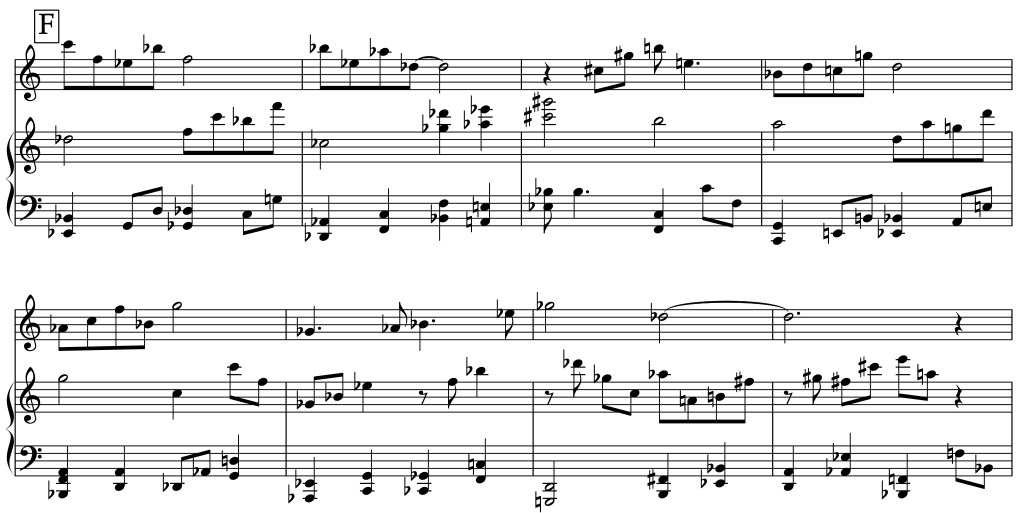
    Texture

    Having reached a complex level of three rhythmically interacting, independent contrapuntal lines, a nice contrast will be to simplify. Variation G reduces to a lower-register flute line and only a much simplified skeletal supporting line above it in the right hand.
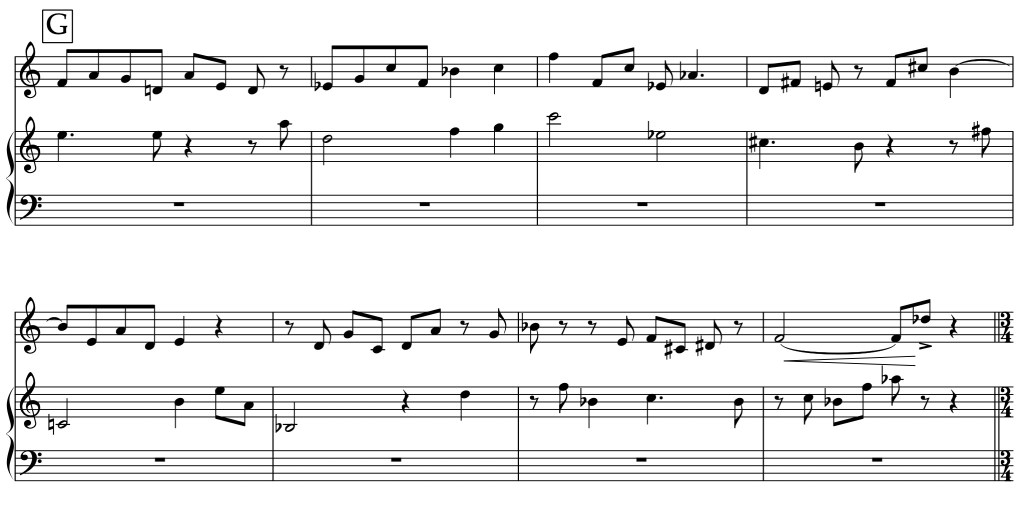
    Then the texture begins to revert rhythmically to a simpler alignment of all chord tones.
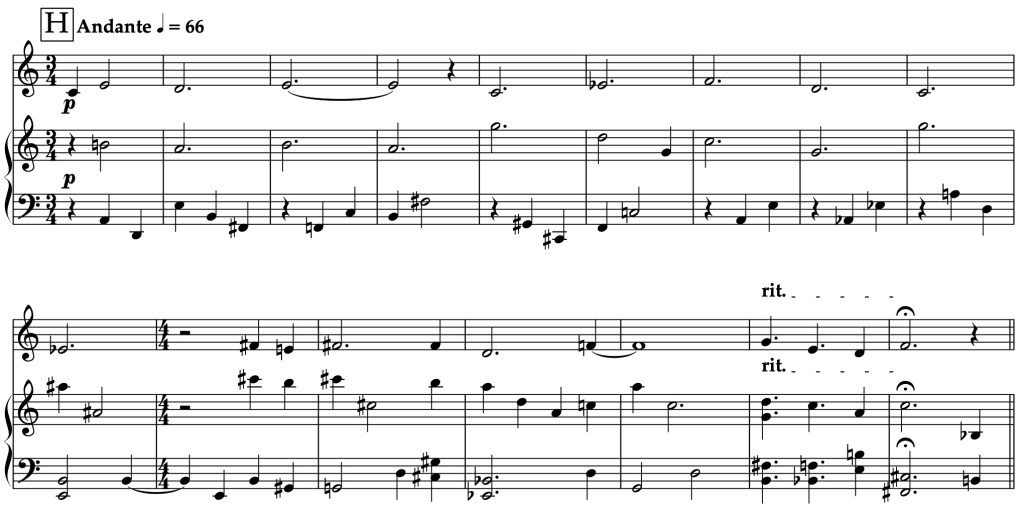
    This paves the way back to a simple piano texture revealing the fundamental thematic chord progression.

    Shape a time form

    What is the plan for the whole? How will the various versions of the generating idea unfold in the larger time span of the whole piece?

    The quiet letter I variation is the apex of an arch form . . .

    • starting with simple
    • building up more rhythmic and textural complexity
    • reaching a stable plateau
    • subsiding back to what started it all.

    That sets up a recapitulation of the whole process, building up textural complexity again, first with the high two-part counterpoint:
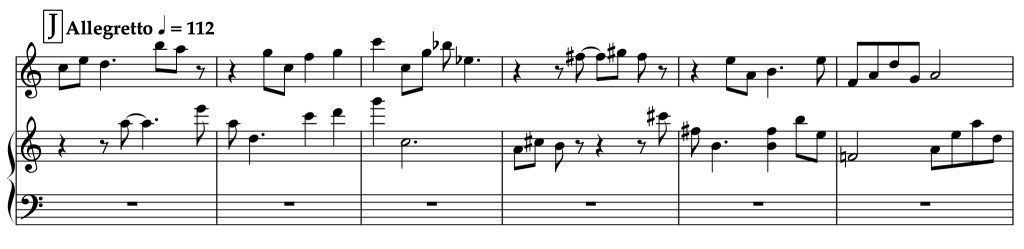
    Then with three voices:
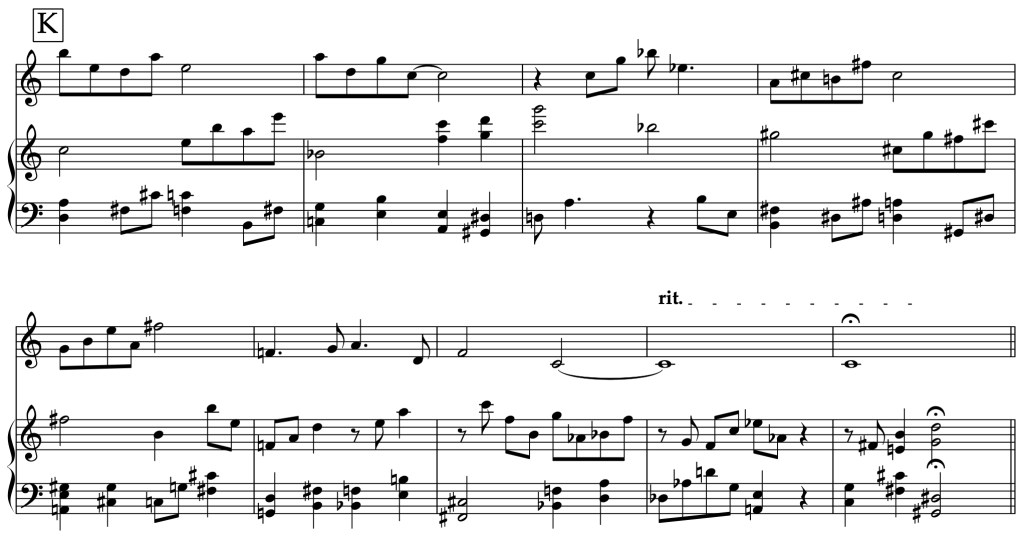
    Flute line “calming down”:
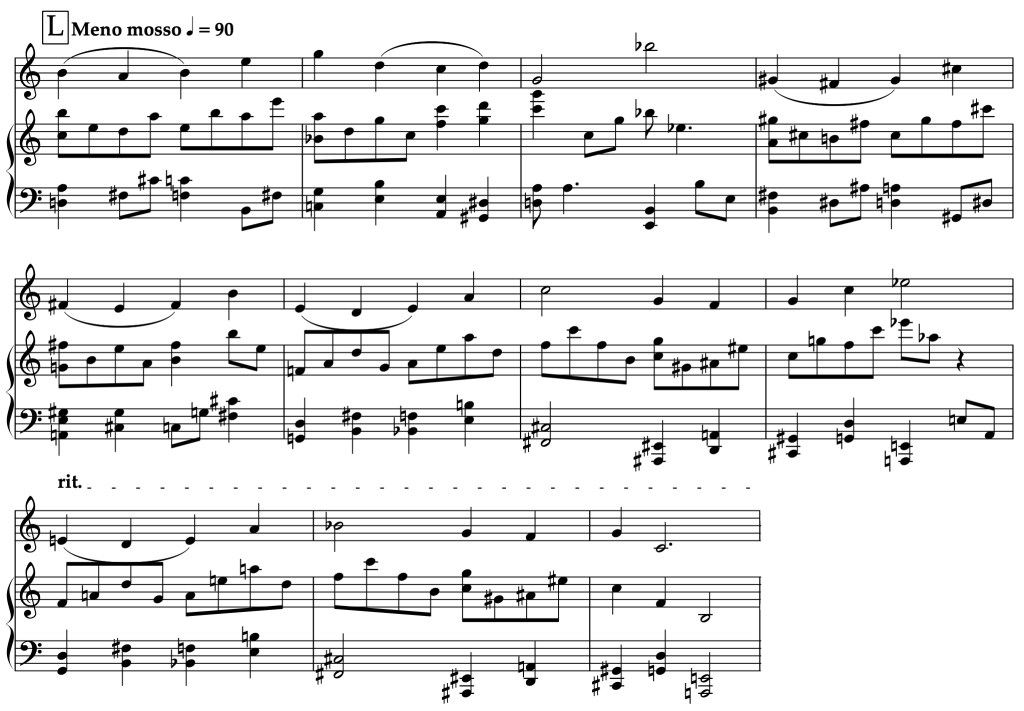
    Coda

    A good essay ends with a conclusion or a summary restatement of the thesis.

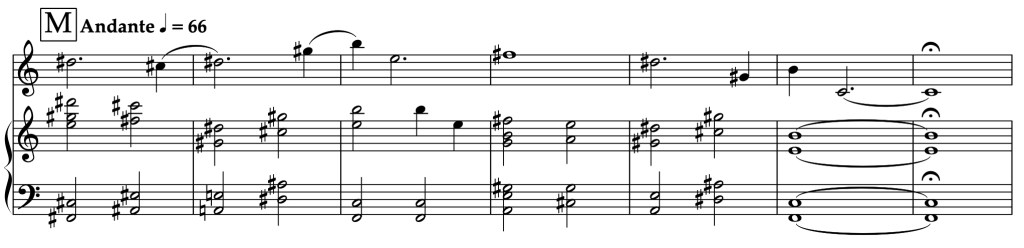
    Our musical coda summarizes with a last return to the beginning. The chords are back to their very low and very high registers. The flute makes a small melodic arch, ascending to the pitch B, then climbing down gently to its lowest possible pitch, C.
    Fine

    A final edit and audit are mandatory. In the case of our example, listening revealed that the beginning needed a piano introduction with some rhythmic vitality. Some sections were also reordered to improve the flow. Thus, the piece will not begin with a plain statement of the progression, and there will be a somewhat different order of other events.

    Now listen to the whole 6-minute parade of variations on a single chord progression.