Category: Mapping Music

  • Mapping Music 2. RHYTHM

    Rhythm is a stream of event durations. Often repetitive but potentially elastic, rhythm can be steady, as a simple march, or volatile, as a melody that hovers, trots, then suddenly starts running.

    Defining some basic terms:

    TIME POINT — a precise moment in time marking the beginning of a span of time extending until a comparable event marks the next time point

     TIME SPAN — the duration of time from one point to the next point marking a comparable event

     STREAM — a series of events formed by the elements of consecutive groups

     PERIODIC — a stream of events whose elements exhibit equivalent time spans

     PULSE — ungrouped periodic time marking in a speed of about 48 to 1,000 per minute (above 1000 per minute becomes pitch)

     METER — a nested hierarchy of periodic streams of of time points

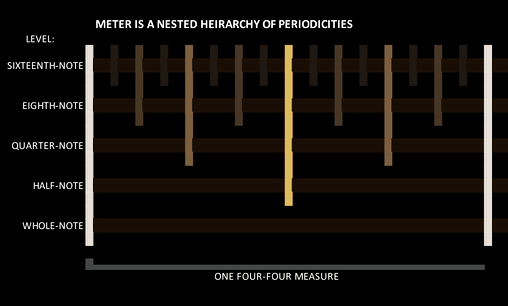
    Nested means that two or more time-spans at a quicker level are synchronized with the next longer durational level. Two eighth-notes “fit” within the metric time-span of one quarter-note, for example. Meter creates the perception/expectation of events happening at periodic time points on more than one level of speed/duration.

    BEAT — pulse that constitutes the primary level of a meter’s hierarchy, the connector between both quicker subdivided and slower grouped levels

    PACE — general quickness / slowness of rhythmic activity in a line or whole fabric

    HYPERMEASURE — extension of metric hierarchy grouping measures, typically in two- or three-measure units

    PHRASE — grouping of molecules, shapes, motives, chord changes, etc. in a coherent stream, typically the length of the human breath

     PERIOD — grouping of phrases, typically concluded with a significant harmonic cadence and/or melodic sense of arrival

    Pulse and Beat

    Underneath the sense of a beat, pulse is primordial periodicity – clapping hands, stomping feet, banging rocks, running strides – features we inherit from our primitive musical ancestry and still use to organize our musical actions.

    Susie Ibarra – Sky Islands (2025)

    A rapid pulse can drive music with frenetic motion. Much of jazz relies on this power source. The tension between a fast, steady pulse vs. unpredictable accents (syncopations) and other turbulence generates energy and excitement.

    SYNCOPATION — an accent not synchronized with the beats, or a note length shifted from its regular metric starting point

    Listen to how a relentless, fast pulse drives this music.

    Julia Wolfe – Believing (2012)

    Rhythm makes meter, Meter drives rhythm

    Rhythm first generates meter by marking periodic time points at different levels of speed. The marking is just the moment of initiation of each note but also accents, chord changes, etc. at broader time levels. As a great example, let’s use a famous theme from a piece nicknamed for a planet:

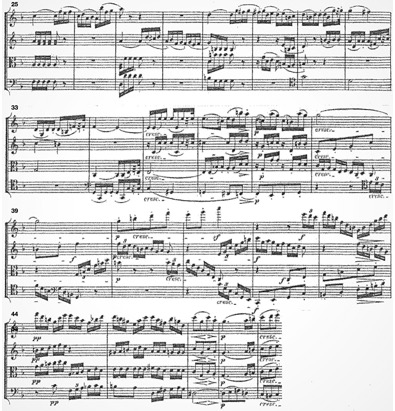
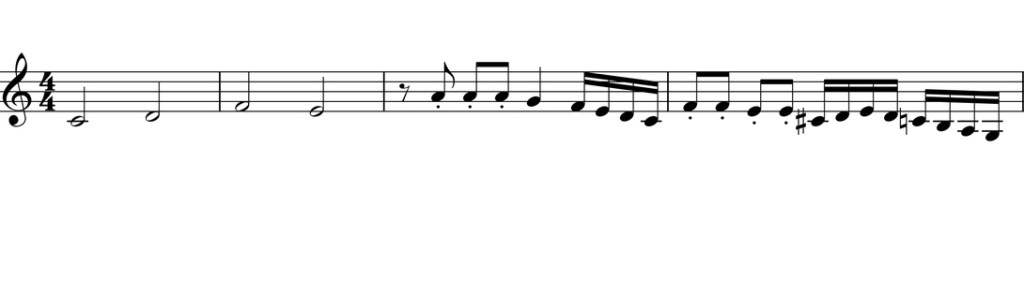
    Jupiter Symphony theme

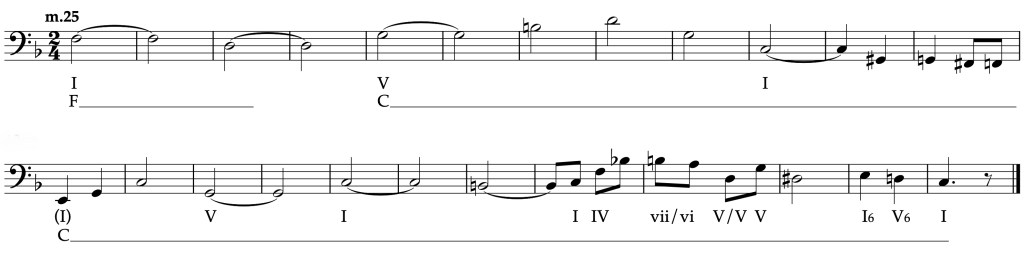
    This melody first establishes periodicity of half-notes but nothing shorter for a while. This could be any duple meter. Once we hear these first four equal notes, we tend to perceive them as two pairs, establishing the whole-note measure-level meter. We feel the time point that begins the third measure on two levels of periodicity even though no note happens to mark it. In this third measure, eighth-notes then divide those half-note time spans into four parts. In the middle of measure 3, a quarter-note fills in the missing level of meter. Finally, in the last beat of the measure, a burst of sixteenth-notes establishes the fourth, quickest periodicity of the nested hierarchy. This example extends the hierarchy to show 2-bar hypermeasures in a 4-bar phrase.

    Once the tune repeats, our sense of that nested hierarchy of speeds is in full cognitive play. While jumping from metric level to level, half-notes to eighth-notes to quarter-notes then 16th-notes, the melodic rhythm undergoes a compression of pace, moving from longer rhythmic values to quicker and quickest, while the Allegro tempo does not change.

    More definitions


    CYCLE — the duration of equivalent time spans in a periodic stream of events

     ELEMENT — a point and following time span of an event or group of events, relating to other consecutive elements to form a group at a broader (slower) level of time

    COMPRESSION — an element of a group or stream is a shorter span than the previous element

    Example: rhythm changing from half-notes to quarter-notes to eighth-notes, compression of pace.

     EXPANSION — opposite of compression, elements of a group or stream are longer spans than previous elements

     ACCELERATION — consistent successive small compressions of beat or pulse

    PROPORTION — relationship of time spans expressed as a ratio, reduced to smallest-possible integers (whole numbers)

     RHYTHMIC GROUP — consecutive related elements, with a point of initiation and accumulated durational span

     RHYTHMIC RANGE — ratio of longest duration to the shortest

    In the Mozart Jupiter example above, the rhythmic range is 1:1 conformity for the first two bars, then 4:1 with three different note values in the third and fourth bars.)

    RHYTHMIC VARIETY — number of different note values in a stream of notes

    In the Mozart Jupiter example above, the rhythmic variety is 4 (halfs, quarters, eighths, sixteenths).

    Stress and accent

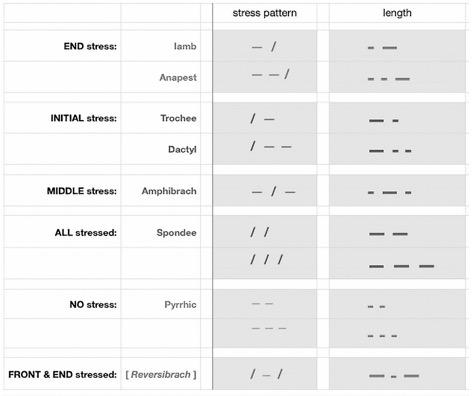
    Classic poetry classifies each syllable grouping (a “foot”) in a line of poetry according to which syllable in the grouping is stressed or longer length (agogic stress). (The last, a “reversibrach,” is my addition to complete the set of possibilities for musical purposes.)

    Metric “feet” in poetry

    Rhythmic molecules, groupings of two or more notes, can be similarly characterized, though with more stress possibilities:

    • Strength (accent) stress
    • Length (agogic) stress
    • Metric stress (strong beat vs. weak beat; on the beat vs. off-beat)

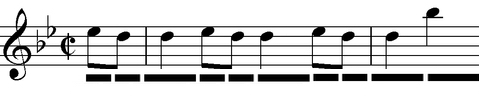
    A molecule can have one stress pattern in accent contradicting a different stress pattern in length or metric placement. Another familiar Mozart example: the opening themes of the first movement of Mozart’s Symphony No. 40 in G Minor. The first theme is fast (allegro) but steady (low elasticity).

    Symphony No.40 1st theme

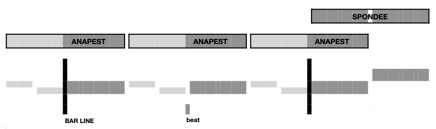
    Analyzed as three rhythmic molecules:

    Three quick, predictable anapests, in which the longer, metrically-accented note is precisely the same length as the pair of shorter notes that lead to it. It also shows a narrow rhythmic range, 2:1, and little rhythmic variety, with only two rhythmic values, the eighth-note and quarter-note.

    Now the contrasting second theme, a soaring oboe line, highly elastic in rhythm.

    Symphony No.40 2nd theme

    This phrase launches with a long trochee, beginning-stressed in both length and metric placement. This rhythm uses four different note values, the longest of which is 12 times the length of the shortest. The first note sounds stretched, like an elastic band that is then released after the third note, unleashing the quick notes that scamper to the last.

    This is just a glimpse on the micro-level of rhythmic contrasts and a temporal elasticity that propels the exciting roller-coaster allegro opening of this great symphony. All our perceptual and gestalt faculties are engaged in a grand game of play with time.

    Molecules

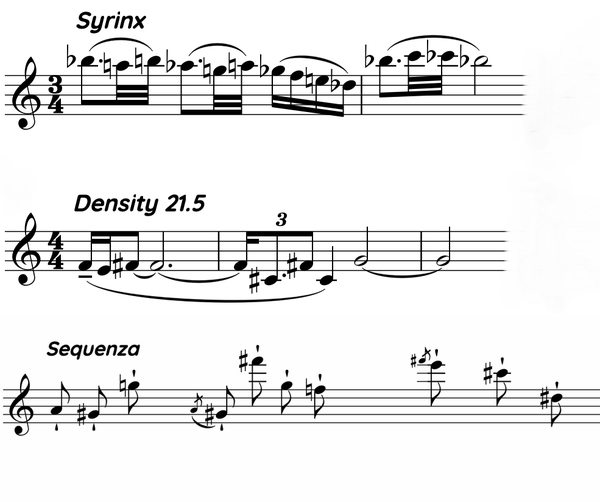
    Here are the opening notes of three famous 20th-century unaccompanied flute pieces, by Debussy, Varese, and Berio, respectively.

    Each uses a three-pitch motive that, when analyzed as a pitch-class set, is a segment of the chromatic scale.

    • Syrinx: A Bb B = +1 +1 semitones chromatic scale pattern
    • Density 21.5: E F F# = +1 +1 semitones, same scale pattern
    • Sequenza: G G# A = same +1 +1 chromatic scale pattern (G displaced by an octave)

    Shown above in their chronological order of writing, it is likely that one influenced the next, and it the next in a chain of evolving variation. While this shared pitch-class-set characteristic is the usual basis for comparison, it is also interesting to compare the rhythmic molecules of their generating motives.

    Syrinx starts with a clear front-stressed dactyl, repeated then echoed in bar 2.

    The Density 21.5 motive is more complicated. Its opening three notes, from a short/long durational standpoint, is an end-stressed anapest. But the first note, though short, has the metric accent, being the only note of the three written on a beat. That first note is also emphasized by the tenuto mark. Those accent factors point toward a front-stressed dactyl like Syrinx. The next three notes starting with the C# are a more ambiguous stress shape.

    The opening three notes of Sequenza have no clear metric or dynamic accent difference; they are all strong. But by duration, the third note is “longer” in effect in the time stream (agogic stress), as the silent time after it, before the next note comes along,is longer. Also the third pitch, G, is much higher, giving it a registral or contour accent. This 3-note molecule is an end-stressed anapest.

    In all three pieces, however, the sense of simple repetition of matching poetic feet is not established or maintained. It is more productive to understand throughout each piece how rhythmic range and variety expand and contract and pace intensifies or subsides.

    © 2026 – All Rights Reserved

    Thomas S. Clark

    Continue reading Mapping the Music Universe:

    TClarkArtMusic.com

  • Mapping Music 1. TIME

    “If you want to find the secrets of the universe,

    think in terms of energy, frequency, and vibration.”

    (Nikola Tesla)

    We start with time. Everything in music involves time, is of time, sound events occurring in our perceived flow of time.

    Sound itself is periodic vibration, a repetition of compression waves of energy in air (or water). Repetition of an event or series of events establishes a frequency of repetition and the period or cycle length, the elapsed time duration from each event’s starting time point (moment) to the starting point (moment) of its repetition.

    We perceive the frequency of air-compression waves as pitch if they are faster than 20 per second and slower than about 4,000. Frequency is typically measured in cycles per second, called Hertz. Non-periodic waves faster than about 20 Hz are perceived as noise. Events or time cycles slower than 20 Hz are perceived as pulses, tempo, rhythm, phrase structure, etc. At these slower sub-sonic event speeds, it is more convenient to identify the duration of the cycle, its period, than the frequency.

    Periodicity, this repetitive aspect of sound events in time, gives us a dimension to map all the possibilities, from extremely fast to almost frozen slowness, and from simple, highly regular repetitions to a very complex succession of variants.

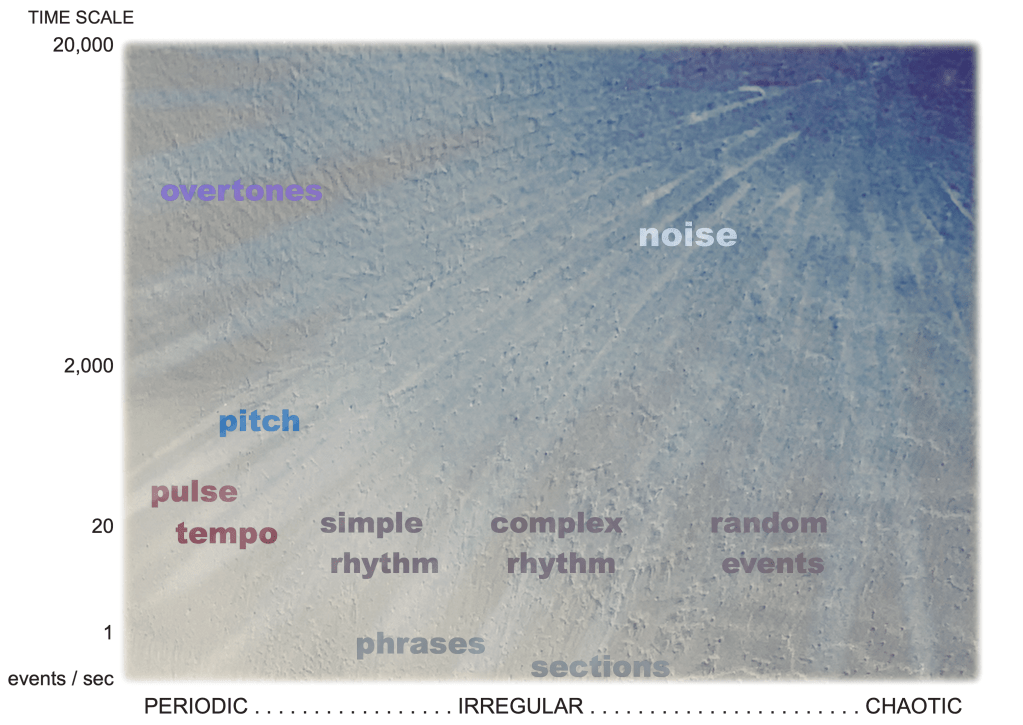
    the periodic time/sound universe

    In this illustration, the Y-axis is speed/frequency (slowest at bottom, fastest on top), the X-axis is regularity of repetition (perfectly regular at left, randomly sporadic time spans at right). The blocks have sharp rectangular edges; if I were a better artist, the boundaries between descriptive categories would actually be curving and very blurred. Though the graph shows firm straight lines separating pitch and noise, there is actually a fuzzy, curving grayscale continuum from pure, simple pitch through complex, colorful pitched timbres to noise.

    Defining time

    What is time and how does it work in our lives and in the rhythms that are the fundamental “substance” of music? I say substance metaphorically, because time does not exist as any physical matter. It is a perceptual construct, a complex quilt stitched out of human experience.

    Discover magazine ran an article in June of 2007 titled, “Time May Not Exist”.

    “Efforts to understand time below the Planck scale have led to an exceedingly strange juncture in physics. The problem, in brief, is that time may not exist at the most fundamental level of physical reality. If so, then what is time? And why is it so obviously and tyrannically omnipresent in our own experience? ‘The meaning of time has become terribly problematic in contemporary physics,’ says Simon Saunders, a philosopher of physics at the University of Oxford. ‘The situation is so uncomfortable that by far the best thing to do is declare oneself an agnostic.’”

    The mysteries of time were explored as early as sixteen hundred years ago by the great Saint Augustine of Hippo, in Book XI of his deeply philosophical work, Confessions.

    “. . . What is time? Who can give that a brief or easy answer? Who can even form a conception of it to be put in words? Yet what do we mention more often or familiarly in our conversation than time? We must therefore know what we are talking about when we refer to it, or when we hear someone else doing so. But what, exactly, is that? [Book XI, Section 17]

    Nicholas Stratas’ thought-provoking article in the July 2007 issue of Wake County Physician, “Time – Continuous Yet Bidimensional” asserts that most of us have a firm concept of Past, Present, and Future. But defining them is challenging, and sorting out how these constructs interact in our consciousness even more so. Michael Spitzer, in The Musical Human (Bloomsbury Publishing, 2021), wrote:

    “Musical time is a window into time consciousness in general. We listen to music in the moment, sitting in the saddle of an ever-shifting Now, as the past whizzes by to become memory, and the present anticipates what is just around the corner. Music’s present tense is really a bundle of memories and anticipations . . .”

    Many years ago, I first read an article translated from Die Reihe, written by a preeminent avant-garde experimental composer, Karlheinz Stockhausen. “Structure and Experiential Time” described Stockhausen’s view that time does not flow uniformly through the experience of a serious musical composition. It ebbs and surges as the composer shapes not just the tempo but the flow of information in the form of repeated or new musical events, simple or complex musical structures.

    “When we hear a piece of music, processes of alteration follow each other at varying speeds; we have now more time to grasp alterations, now less.”

    Even tempo, a supposedly steady clock in most music, ebbs and flows. Computer music composers in synthesizing musical sounds have found that a mechanistically rigid clock tempo sounds artificial. Human musicians are constantly flexing tempo in subtle ways to convey almost subliminally where the music is “going” (another metaphor, that of travel through space).

    Saint Augustine recognizes the slippery challenge of measuring time:

    “ . . . We observe the different ways times lapse, and compare them, and call some longer and some shorter. . . . It is passing time we measure, as we experience it. . . . Time can only be measured as it passes. Once past, it is no longer there to be measured.” [Book XI, Section 21]

    “We measure time as it passes . . . . But how can we measure the present, when it has no extent of its own? . . . Time must be measured in something with extent . . . But in what extended thing do we measure time as it passes?” [Book XI, Section 27]

    “So time is measured, my mind, in you. Raise no clamor against me—I mean against yourself—out of your jostling reactions. I measure time in you . . . because I measure the reactions that things caused in you by their passage, reactions that remain when the things that occasioned them have passed on. . . . Time has to be these reactions for me to be able to measure it.” [Book XI, Section 36]

    Time perception

    Pulling all this together, I’d like to suggest several things about time in classical music.

    • Time is perceptual.
    • Time is multidimensional.
    • Time is elastic.
    • Time is experienced in complex ways as the fundamental basis of music’s richness.

    In LEARNING TO COMPOSE, co-author Larry Austin and I begin the chapter titled “Time Streams” with a quote from a philosopher, and then express in our own words the fundamental nature of time.

    “ ‘Music makes time audible and its form and continuity sensible.’
    —Suzanne Langer

    Music exists in time. Time exists as we sense it, articulated on many levels by changing and cyclically recurring events.

    As beautiful, colorful and essential as sound is in making music, musical sounds are the means to an end, building blocks for events that primarily mark articulations of time.

    We sometimes like to think of music as having two fundamental dimensions, like a graph. The horizontal dimension is the parameter of time. The vertical dimension is the parameter of pitch. But pitch is actually a temporal phenomenon – the frequency (periodic change over time) of sound waves. How amazing are the human ear and human mind to perceive waves of air coming at us a thousand times a second or much faster and distinguish the small differences that make a pitch “in tune” (or not) and the even subtler differences that identify an oboe instead of a violin producing that pitch. All of this from a perception simply of periodic rates in time!

    Stockhausen pointed out that in mentally processing all of these sonic distinctions, we are forced to pay more attention to changes in their qualities, combinations, and “spacing” in time. These are his “alterations”.

    “The greater the temporal density of unexpected alterations . . . the more time we need to grasp events, and the less time we have for reflection, the quicker time passes; the lower the effective density of alteration (not reduced by recollection or the fact that the alterations coincide with our expectation), the less time the senses need to react, so the greater intervals of experiential time lie between the processes, and the slower time passes.”

    The concepts of expectation and information help make some sense of things. “Information” is perceptual data that is similar to what you just heard or logically confirms what you were expecting next. “Entropy” is the opposite perception – surprise, contrast, noticeable change. In musical listening, though we don’t do so consciously, we are constantly “computing,” assessing, retaining, and predicting.

    Saint Augustine connects Past, Present, and Future with memory, experience, and expectation:

    “What should be clear and obvious by now is that we cannot properly say that the future or the past exist, or that there are three times, past, present, and future. Perhaps we can say that there are three tenses, but that they are the present of the past, the present of the present, and the present of the future. This would correspond, in some sense, with a triad I find in the soul and nowhere else, where the past is present to memory, the present is present to observation, and the future is present to anticipation.” [Confessions, Book XI, Section 26]

    And to make matters more complicated, it is not at all a linear process. Let’s take a metaphor. I can’t resist one that Einstein was very fond of in his thought experiments.

    As listeners, we’d like to imagine ourselves as a train riding on tracks through time, a train that keeps moving forward and doesn’t back up. The clickety-clack of our wheels is a steady tempo measuring time. We only remember back to the tracks the locomotive has passed but still lie under the wheels of our caboose at the end. And we only look ahead a little bit, as the tree-bordered tracks curve, preventing a longer straight view.

    That’s way too simple, a two-dimensional time frame in which we either recall a little of what we just heard or maybe guess a little what might happen next. As Meyers, Stockhausen, Spitzer, and Dr. Stratas all observe, in keen listening to music our minds are filled with memories of not just the previous measure or phrase, but the very beginning of the piece, its theme or launching impetus (Grundgestalt as Schoenberg named it) and, in a more diffuse sense, all that has “happened” up to the present moment. The present moment is not one single phenomenon in time either. Melody, countermelody, bass line, chordal texture, and punctuating sounds are simultaneously tracing distinct paths, each with its own pace through time. At the same time, we are constantly expecting what’s coming, or at least “feeling” where the music might be going. And, as if that weren’t complicated enough, we are busy reevaluating what we just heard in relation to what we had been expecting. Saint Augustine describes it more succinctly:

    “Only in the mind can this [the experience of time] be accomplished, because of three activities there—the acts of anticipating, of observing, and of remembering.” [Book XI, Section 37]

    None of this is conscious, but in describing it in concrete terms, we recognize the dizzying multidimensionality, time arrows pointing in all directions and curling back on themselves. This is what I believe constitutes deep listening, “getting lost in the music”.

    Just one more idea – elasticity. Stockhausen recognizes that in music the sense of time passing changes, stretches or compresses, depending on how much “alteration” is being encountered. This is why music can seem “steady” or “surging ahead” or dissipating and almost “frozen”. It is not at all the tempo that causes this, but rather the rate of change, sharp contrast or subtle evolution, in the harmonies, the melodic character, or the rhythm.

    A rhythmic playfulness in modern music stretches our sense of timing. Tempos change, are interrupted, break down, tumble into avalanches, come to rest. Time itself stretches and becomes the titled thematic element in pieces such as Time Cycles (1960) by Lukas Foss. Here is another example titled about time, written at the starting gun of the new millennium.

    Fred Lerdahl – Time After Time (2000)

    Awe

    In his book When (Riverhead Books, 2018) Daniel H. Pink writes,

    “I used to believe that timing was everything. Now I believe that timing is everything. . . . The experience of awe changes our perception of time. When we experience awe, time slows down. It expands. We feel like we have more of it. And that sensation lifts our well-being.”

    He quotes researchers Rudd, Vohs, and Aaker in Psychological Science 23 No. 10 (2012):

    “Experiences of awe bring people into the present moment, and being in the present moment underlies awe’s capacity to adjust time perception.”

    © 2026 – All Rights Reserved

    Thomas S. Clark

    Continue reading Mapping the Music Universe:

    TClarkArtMusic.com

  • Mapping Music — PRELUDE

    The heavenly motions are nothing

    but a continuous song for several voices,

    perceived not by the ear but by the intellect,

    music that sets landmarks

    in the immeasurable flow of time.”

    Galileo

    When we gaze at stars and planets, they appear as stationary points of light, fixed in place in what seems a random pattern across the entire night sky visible to our hemisphere. Time stands still.

    Throughout human time, humans have imagined that stars make picture patterns we name as constellations: fish, warriors, goddesses, animals. Only the persistent observers, such as astronomers, identify their nightly march across the sky, rising in the east and disappearing below the western horizon.

    Metaphor

    Musical sounds mark points in time, like stars. They form immediately into recognizable patterns we call chords, melodies, rhythms, memorable themes. They convey a sense of motion, time surging forward or slackening in our perception of their well choreographed parade.

    Astronomers observing and mapping (recording) the myriad points discovered that some of the stars are actually whole galaxies, with exotic forms of spirals and clouds. They observed through the color of the light that all these objects are racing away from us and each other in an expanding universe.

    Mapping music means cataloging many possible patterns, distinguishing their contrasts and commonalities. We will explore how to measure and compare the periodic rhythmic streams of musical events and their changing momentum. We will define and employ a simple but powerful math tool for cataloging and then creatively sculpting with all natures of harmony and melodic line in our 88-key chromatic universe. We will explore how master composers weave colorful fabrics and grand structures from skillfully crafted materials.

    Pursuing periodicity

    My music-mapping Periodicity Project began in 2021 as a comprehensive catalog of musical patterns and processes, meant to provide simple tools for understanding the complexities of modern music. It grew into this book, Mapping the Music Universe, written for anyone who is curious about how music works, especially in the 20th-21st-century modern and “post-modern” eras. For me as a composer, it is also an exploration of how some less traveled conceptual paths lead to interesting creative possibilities.

    In 1989 I co-authored a conceptually ground-breaking composition textbook with Larry Austin, Learning to Compose: Modes, Materials, and Models of Musical Invention. My next book, ARRAYS, was an aural skills workbook covering basic modal, tonal, and “post-tonal” music of the Renaissance through the Twentieth Century. Mapping the Music Universe draws in part on the ideas and approaches of both these now out-of-print publications.

    A common assumption within Western culture is that Science is all about observation, measurement, precision, and mathematical rigor . . . and Art is all about the “i” words: imagination, inspiration, intuition, improvisation. Science is Deductive, art is Creative. Our culture has begun to recognize the commonality of all these intellectual strengths, that the best Science can be creatively intuitive and great Art can be rigorous.

    Pioneer map makers

    As an educated musician and professional composer, I also have long been deeply interested in science, especially astronomy. Having read a great deal of general science writing, I am inspired particularly by ground-breaking pioneers who methodically and comprehensively mapped the possibilities of their particular field.

    Johann Joseph Fux — wrote Gradus ad Parnassum in 1725, codifying basic contrapuntal principles of Renaissance music.

    William Smith — a rural surveyor, in 1799 drew a colorful map of the subterranean rock strata of his county in English coal country, launching the modern science of geology.   

    Meriwether Lewis — kept extensive journals of the 1804-1806 Lewis and Clark Expedition, documenting and illustrating the discovered new world of the Northwest.  

    Dmitri Mendeleev — devised a “periodic table of the chemical elements,” published in 1869, providing a solid basis for modern chemistry through its graphic and organizational genius.

    Amédée Mouchez — launched an ambitious international star-mapping project (Carte du Ciel) in 1887 at the Paris Observatory.

    Henrietta Swan Leavitt — worked at the Harvard College Observatory as a “computer,” examining thousands of photographic plates from telescopes to measure and catalog the brightness of stars, identified 1777 variable stars.

    Lawrence Herbert — invented the Pantone system in 1956 to systematize color for printing ink and fabrics.

    Allen Forte — published an article in 1964 that launched musical set theory, defining, classifying and comparing all possible collections of “pitch classes” drawn from the equal-tempered 12-tone chromatic galaxy.

    The work and insights of the two on the list representing rigorous study of music, Fux and Forte, were part of my formal education in music and later an integral part of my teaching of composition and music theory.

    Maps

    Carte du Ciel was an ambitious second phase of an international star-mapping project initiated in 1887 by Paris Observatory director Amédée Mouchez.  A new photographic process revolutionizing the gathering of telescope images inspired the first phase, the Astrographic Catalogue of a dense, whole-sky array of star positions. Carte du Ciel, never completed after 70 years, used the Catalogue as a reference system for a complex survey of the vast field of even fainter images.

    Celebrating the grand metaphor relating astronomy to art music, here is my 8-minute computer-music sound sculpture. In the music, ghostly wisps of sound are punctuated by brighter bursts, clustered in a natural, not-quite randomly dispersed texture.

    _______________

    Looking ahead

    The blog-post chapters of Mapping the Music Universe will proceed in three broad phases, progressing logically from fundamental — time and periodicity — to pitch space, then to larger structures, texture and form. Within each phase, various topics are presented in a progressive order, but jumping in at any point is fine.

    Terms will sometimes be freshly coined. Graphic figures will include notated musical examples, tables, and graphic illustrations of patterns and their relationships. Big Ideas — Periodicity, Complexity, Symmetry, Relativity — will be explored using precise mathematical arrays as well as broad metaphors. Newly composed sample etudes will illustrate aurally.

    Along the way, “Map Labs” will present step-by-step recipes to compose simple pieces based on models of different compositional genres. Each Lab includes an original sample piece following the Map Lab guidelines, illustrating one possible creative outcome.

    Welcome! Join this creative journey of discovery . . .

    a composer’s expedition.

    © 2026 – All Rights Reserved

    Thomas S. Clark

    Continue reading Mapping the Music Universe:

    1. TIME

    TClarkArtMusic.com

  • journal 21. Constellations

    Texas Hill Country, 2021 —

    Retiring as a college music dean in 2020, I turned to writing. Long interested in astronomy, and reading about various sciences, I discovered ground-breaking pioneers who had methodically and comprehensively mapped the possibilities of their particular field — cartography, astronomy, chemistry — and the meticulous journals of Lewis and Clark’s Expedition of Discovery. Inspired by them, my music-mapping Periodicity Project began in 2021 as a comprehensive catalog of musical patterns and processes, meant to provide simple tools for understanding the complexities of modern music. It grew into a book, Mapping the Music Universe, written for anyone curious about how music works, especially in the 20th-21st-century modern and post-modern eras. It is my exploration of how some less traveled conceptual paths lead to musically interesting creative possibilities.

    Mapping the Cosmos

    Along the way, Mapping the Music Universe produced several small etudes to illustrate the compositional potential of musical patterns explained in the book. The inspiration to collect them into a series came from many years of fascination with Bartók’s wonderful Mikrokosmos series of piano pieces in modern styles. Here are two of my favorites to play and to teach:

    Lajos Kertész, piano

    Lajos Kertész, piano

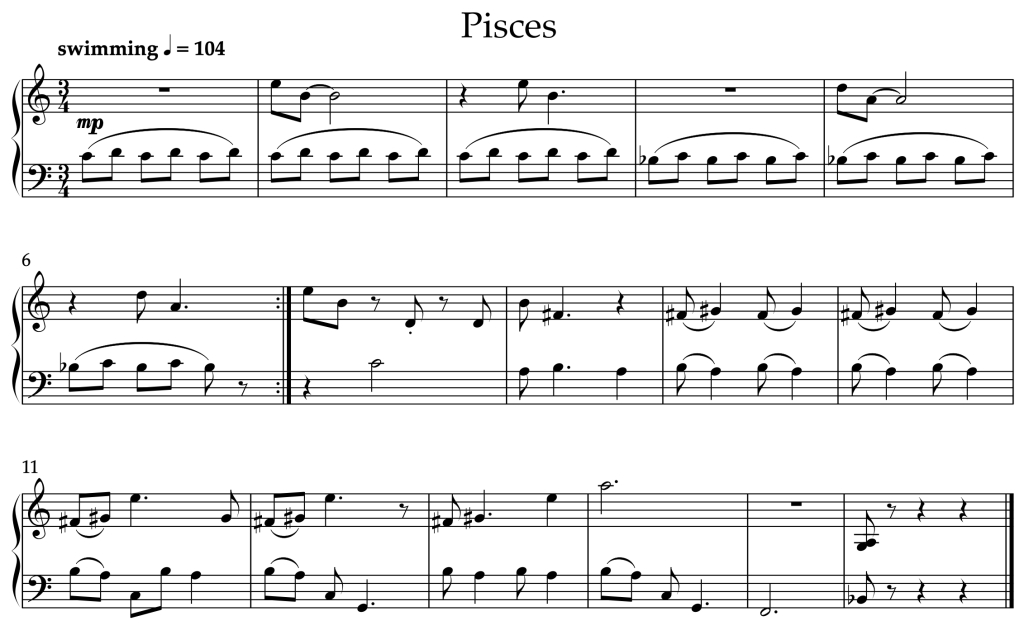
    Book I of my Mapping the Cosmos contained seven etudes originally sketched for piano. The five in Book II were adapted from more complex textures. The seven of Book I are simpler, each etude titled with an astronomical entity named for a mythological character.

    Here are four from Book I that are named for constellations.

    Pisces – The Fish; 12th constellation of the Zodiac

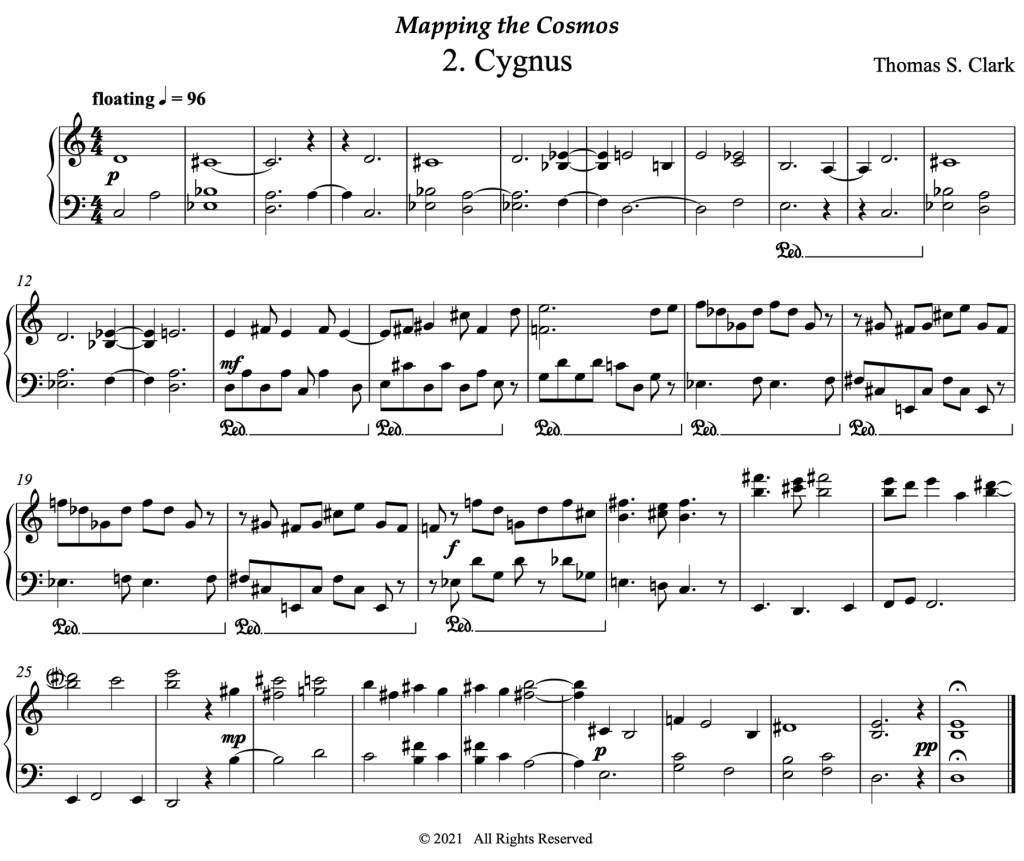
    Cygnus – The Swan; a northern constellation

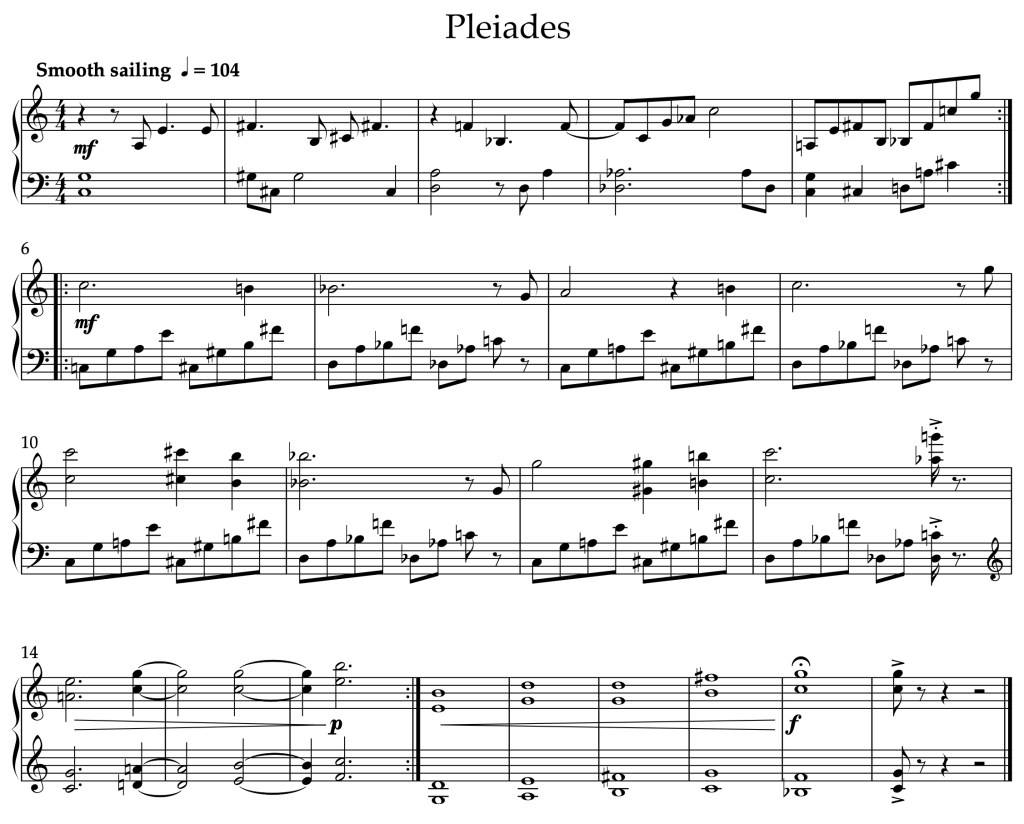
    Pleiades – Seven Daughters of sea-nymph Pleione; an open star cluster

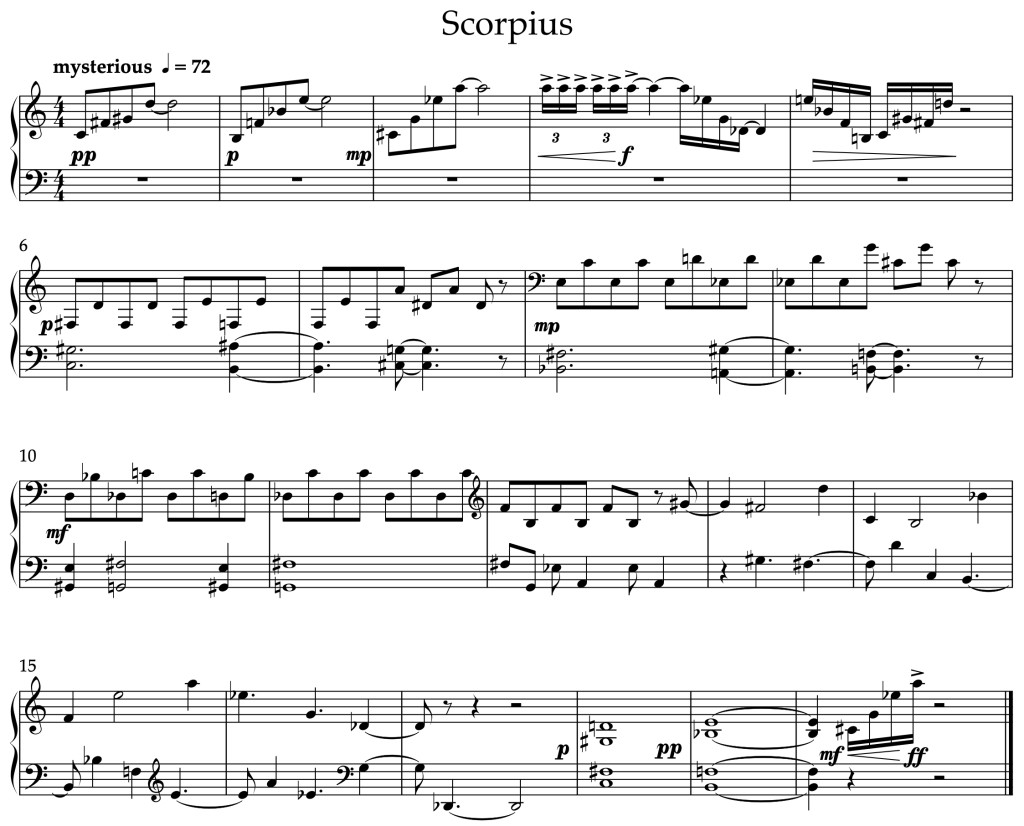
    Scorpius – The Scorpion; 8th constellation of the Zodiac

    Here are all seven in more colorful sound synthesis:

    Mapping the Cosmos – Book I

    Clark 2023 (TC-114)

    all seven synthesized

    Cassiopeia

    In Journal episode 9, I described a compositional process I began exploring in the 1980s. Inspired by Larry Austin’s groundbreaking Canadian Coastlines, I began tracing natural patterns onto graph paper. Particular points on the graph yielded 2-dimensional coordinate values that could be interpreted as timing and pitch information. The first patterns were shorelines, making the initial sketches for PENINSULA (1984, TC-50).

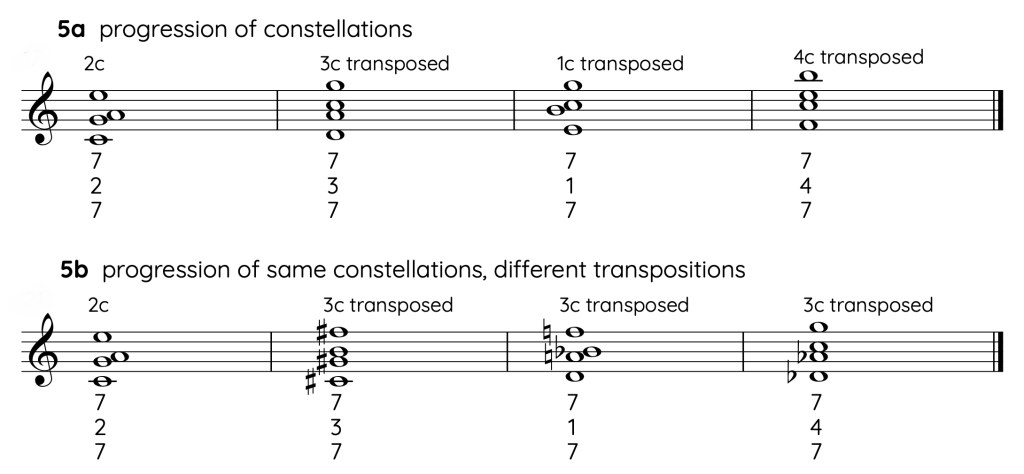
    Having always been interested in astronomy, I then tried plotting star constellations on two-dimensional matrix graphs. The coordinates of each star in a constellation could be interpreted as time-point and pitch information, resulting in a complex arpeggiated group of notes. More intriguing was the capability to rotate the map, resulting in many possible variants that stretch or compress the rhythm and chord structure.

    The first compositional product of the star map work, LIGHTFORMS 1 – Constellations (TC-65), scored for piano, was published by Borik Press in 1992. Naming these patterns, pitch-time chord arpeggios, as constellations became a breakthrough concept.

    Arvo Pärt: Für Alina (1976)

    The constellation Cassiopeia in the northern sky is named after the vain queen Cassiopeia, mother of Andromeda in Greek mythology. One of 48 constellations listed by the ancient astronomer Ptolemy, its distinctive ‘W‘ shape is formed by five bright stars. Cassiopeia contains some of the most luminous stars known, including three hypergiants. Its brightest star, Cassiopeia A (“Schedar”), is a supernova remnant and bright radio source.

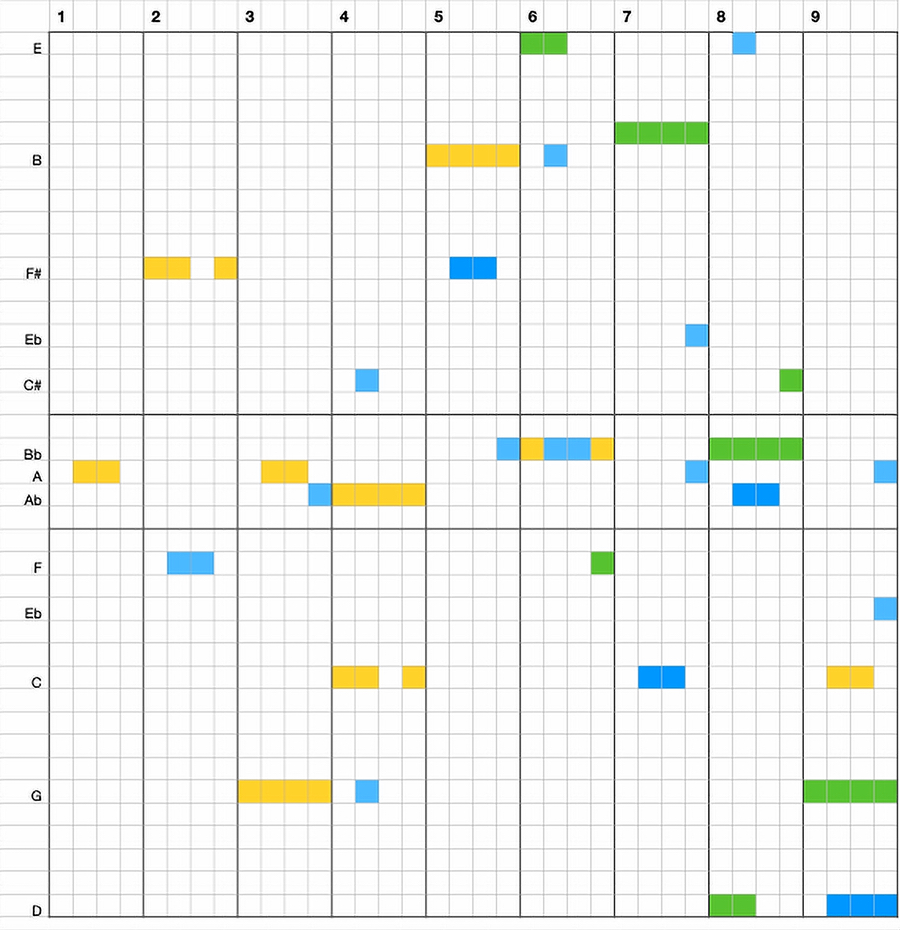
    The music arose from tracing a map of its brightest points of light. The coordinates of these points on a two-dimensional graph were converted into time and pitch patterns articulating a grand sonority. The graph can be rotated, kaleidoscopically transforming the pattern into similar sonorities.

    PERSEUS

    CASSIOPEIA

    CEPHEUS

    ROTATED 90 degrees

    The same treatment applied to Cassiopeia’s constellation neighbors Perseus and Cepheus builds a denser field of sounds. All this elaborate graphing and plotting may seem too complex and too abstract. The process, however, resulted in an intentionally abstract musical experience that metaphorically echoes the awe of viewing the brilliant star-studded dark sky through a powerful telescope.

    CASSIOPEIA

    Clark 2025 (TC-157)

  • journal 10. Lightforms

    Denton, 1985 —

    One of Schoenberg’s Five Pieces for Orchestra , Op. 16, subtitled “Summer morning by a lake,” evokes the color (farben) of light. Another work, by Schoenberg’s Vienna colleague, Webern, to me is metaphorically also about light and color, though abstractly titled Variations, Op. 30. Brief flashes of light come out of silence, isolated fragments of singular orchestral instruments’ sound colors.

    Berliner Philharmoniker

    LISTEN › YouTube

    Light follows form

    In 1985 I first saw the work of photographer Carlotta Corpron in Denton, where she was on the faculty at Texas Woman’s University. Her stark black-and-white images were all about how light embraced the contours of physical objects.

    Light follows form – C. Corpron

    This inspired what became a continuing fascination for me in exploring musical metaphors for the magic of light, beginning with:

    • LIGHT FOLLOWS FORM — digital sound sculpture. TC-51 (1985) Borik Press     
    • PATHS OF LIGHT (Homage to Webern) — mobiles for instruments, tape. TC-52 (1985)
    • OF LIGHT AND SHADOW: Two Canonic Sketches — wind ensemble. TC-54 (1985)

    The first in the LIGHTFORMS series, Constellations (1992, TC-65) for piano and visual projections, combined spacious, floating piano sonorities with photographed light emanating through stained glass windows in the sanctuary of Denton’s First United Methodist Church. Pitch and rhythmic patterns were derived from tracings of star maps of several constellations. (We’ll explore this and its synthesized sequel, LIGHTFORMS 2: Star Spectra (1993, TC-68) in a journal entry, “about mapping”Maps.”)

    LIGHTFORMS 3: Ancient Images (2005, TC-76) is a wind ensemble scoring of a 1996 piece, Mucha’s Light, based on five of Alfons Mucha’s 20 epic paintings, Slovanská Epopej (“Slavic Epic”). We’ll explore this one in another journal post, “Sound painting.”

    Spectrum

    More recently, the LIGHTFORMS series continues, with three multimedia videos (viewable on YouTube) combining new computer music with my more experimental and sometimes abstract photo images.

    Sonic exploration of cosmic harmony in a quiet, almost timeless star-gazing mood . . .

    Clark 2025 (TC-150)

    view YouTube video

    Timbres emerge, echo, and fade in a floating, slow-moving distant landscape of color . . .

    Clark 2025 (TC-152)

    view YouTube video

    Musical impressions of dusk, with a Haiku-like text quoting one mellifluous phrase from Robert Frost’s “Waiting Afield at Dusk” . . .

    Clark 2025 (TC-153)

    view YouTube video

    Streams of crimson streak the sky
    above tree silhouettes.
    Dusk settles
    in the antiphony of afterglow”.
    A new night consumes the shadows.

    ______________

  • journal 9. Mapping

    Leelanau, 1983 —

    My last summer working at what was then called the National Music Camp in Interlochen, Michigan was 1983. We spent as much time off as possible on the nearby shore of Lake Michigan. Three spots on the western edge of the Leelanau peninsula were favorite magical places. Otter Creek played out into a sandy delta at the beach, perfect for a picnic. Good Harbor Bay was an excellent shore for finding gray Petoskey stones, revealing fascinating hexagonal-shaped fossils when wet. Farther north, the Great Sleeping Bear Sand Dunes rise majestically hundreds of feet above the water’s edge.

    Béla Viktor János Bartók’s monumental 1937 work, Music for Strings, Percussion and Celeste, begins with a mysterious, meandering line played by subdued violas. It sounds to me like walking at the water’s curving edge on a fog-shrouded beach. The line becomes the subject of a gigantic fugue, building to a powerful climax. In my imagination, we reach the sheer cliff of a massive bluff at the end of a Lake Michigan bay.

    Music for Strings, Percussion and Celeste

    Chicago Symphony

    LISTEN > YouTube

    Shores

    Of course, Bartók never saw Lake Michigan. But shorelines are a fascinating kind of fractal patterns in nature.

    In 1980, Larry Austin received a commission from the Canadian Broadcasting System and KPFA for an experimental radiophonic work. For the premiere broadcast, the performers were in three different Canadian cities, synchronized by electronic signals! The mind-boggling result was a piece consisting of

    “a massively contrapuntal texture, with many instruments playing continuous, independent lines, all in different, independent tempos. The contours of each contrapuntal part were determined using maps of Canadian coastlines.”

    [Clark — Larry Austin: Life and Works of an Experimental composer. Borik Press, 2012, p. 40]

    I.C.M.C. 1981, Denton Texas

    LISTEN › YouTube

    Glacially-etched shorelines also inspired sonic imagery for a series of my pieces culminating in PENINSULA. Mappings of the natural contours of the Leelanau Peninsula provided richly varied patterns as basic coordinate numbers for sculpting sound patterns. The piano explores some of the endless possibilities for articulating a spectrum of sonorities. A surrounding environment of synthetic sounds was made by digitally analyzing timbral qualities of acoustic instruments, mostly with percussive articulations (metaphorically the rocky shore). The timbres were modified and resynthesized into a pointillistic sound texture. The density of the sound events rises and falls in waves according to changing values derived from the basic mappings. Larger confluences of waves are located in time by map points of special significance on the graph.

    The coexistence of piano sonorities and synthetic sounds is a metaphorical meeting of seascape and landscape, both animated in time.

    PENINSULA

    Clark 1984 (TC-50) Borik Press

    Clifton Matthews, piano, Winston-Salem NC, Feb. 2007

    There were many other groundbreaking pieces by my late friend and collaborator, Larry Austin. The first, Improvisations for Orchestra and Jazz Soloists, brought him to national prominence in 1964 with highly publicized broadcast performances by Bernstein and the New York Philharmonic.

    As Austin moved into computer music, he began exploring compositional algorithms using mathematical models such as fractals.

    Some of Charles Ives’ sketches for his monumental, never completed Universe Symphony were tracings of the outlines of rock formations. Austin studied deeply this Ives work starting in 1974 and eventually completed a version of Universe Symphony for expanded orchestras in 1993. In Austin’s own work beginning in 1976, mapping contours of mountain ridges and star constellations yielded musical patterns for First Fantasy on Ives’ Universe Symphony, Maroon Bells, and *Stars.

    Constellations

    Always interested in astronomy, I tried plotting star constellations on two-dimensional matrix graphs. The coordinates of each star in a constellation could be interpreted as time-point and pitch information, resulting in a complex arpeggiated group of notes. More intriguing was the capability to rotate the map, resulting in many possible variants that stretch or compress the rhythm and chord structure.

    Cygnus
    Cygnus rotated 90º
    Orion
    Orion rotated 90º

    The first compositional product of this design work, LIGHTFORMS 1 – Constellations (TC-65), scored for piano, was published by Borik Press in 1992. Naming these patterns, pitch-time chord arpeggios, as constellations became a breakthrough concept

    In my book, Mapping the Music Universe, I cite a remarkable pioneer of cartography. “William Smith, a rural surveyor, in 1799 drew a colorful map of the subterranean rock strata of his county in English coal country, launching the modern science of geology.”  The map was extraordinary not only as a scientific breakthrough, but also visually by his hand coloring each huge copy.

    As digital synthesizers came along, sound making with computers offered more calculated control of the timbral (tone color) spectrum. My astronomical metaphor continued with a 1993 piece, using the then state-of-the-art Synclavier II digital synthesizer to “color” the constellation patterns of LIGHTFORMS 1. Reflecting the varied colors of stars, I built color families of sound, distinguishing unique frequency-modulation ratios for each group.

    LIGHTFORMS 2: StarSpectra

    Clark 1993 (TC-68)

    In 1887, French astronomer Amédée Mouchez launched an ambitious international star-mapping project (Carte du Ciel) at the Paris Observatory. It was never finished, until now the challenge has been taken up by the new Vera C. Rubin Observatory (formerly the Large Synoptic Survey Telescope) in Chile. It is conducting the Legacy Survey of Space and Time, repeated astronomical surveys of the entire southern sky.

    From wandering forest paths to trekking scenic shorelines, my life has always been full of ambient exploration. Mapping has become my grand metaphor for exploring musical territory, culminating in the book, Mapping the Music Universe. It begins:

    “The heavenly motions are nothing
    but a continuous song for several voices,
    perceived not by the ear but by the intellect,
    a figured music that sets landmarks
    in the immeasurable flow of time.”

    — Galileo Galilei

    “When we gaze at stars and planets, they appear as stationary points of light, fixed in place in what seems a random pattern across the entire night sky visible to our hemisphere. Time stands still.

    “Throughout human time, humans have imagined that stars make picture patterns we name as constellations: fish, warriors, goddesses, animals. Only the persistent observers, such as astronomers, identify their nightly march across the sky, rising in the east and disappearing below the western horizon.”

    In Mapping the Music Universe, a studied journey through musical time, pitch, and structure, many composed examples took on characters of named constellations, galaxies, and galaxy clusters. They coalesced into 12 etudes, collected here as “a continuous song.”

    Clark 2021 (TC-114)

    Listen, imagining a 24-hour 360º rotation of our earthbound telescope, viewing the entire cosmos in 24 minutes.

    _____________

  • journal 8. Zeitmasse

    Interlochen, 1976 —

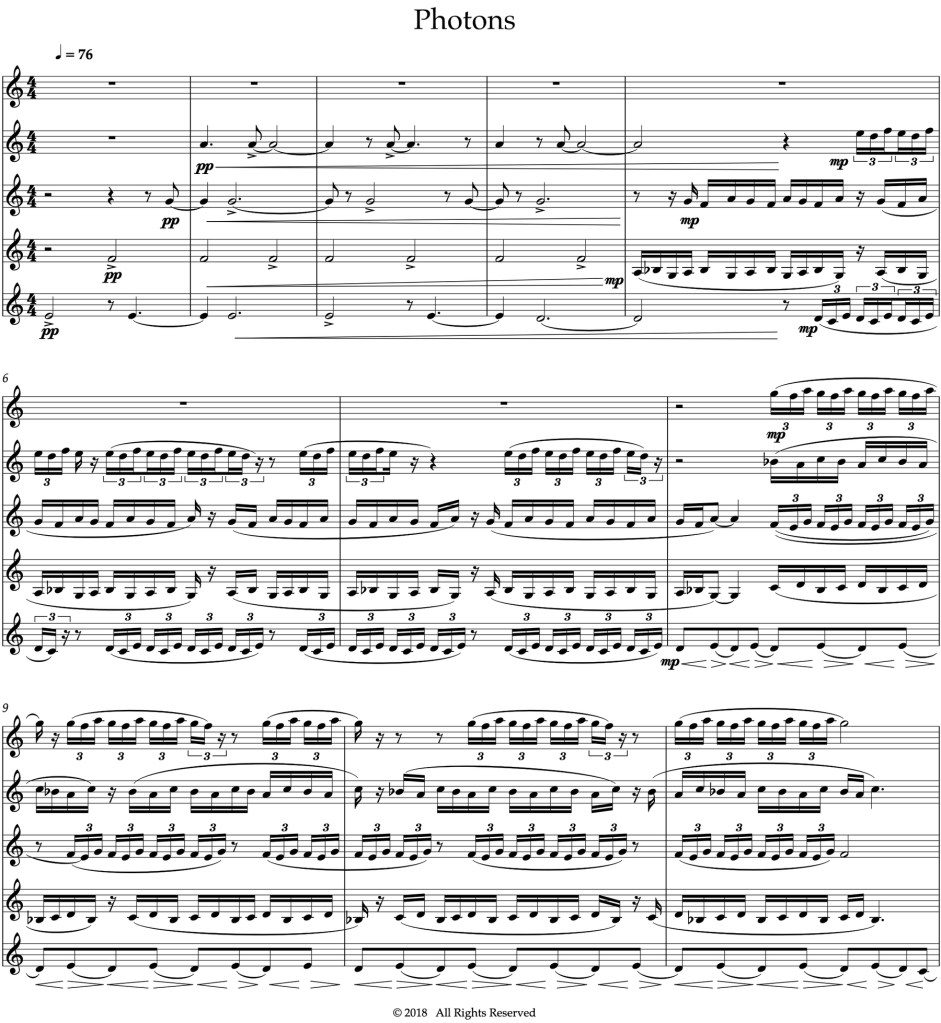
    The German word Zeit means “time.” While masse sounds like “masses,” it actually tranlates “measures.” The two together make the musical term “tempos”. Karlheinz Stockhausen composed his “Time Measures” in 1956, N. 5 Zeitmasse for five woodwinds. Time is unmetered, rapidly and unpredictably ebbing and flowing in a dense texture of highly stretchy, elastic rhythms. Instead of predictably placed bricks, musical notes are dancing sparkles or sustained starlight.

    London Sinfonietta

    LISTEN › YouTube

    Compare that time sense with a work of mine composed 67 years later.

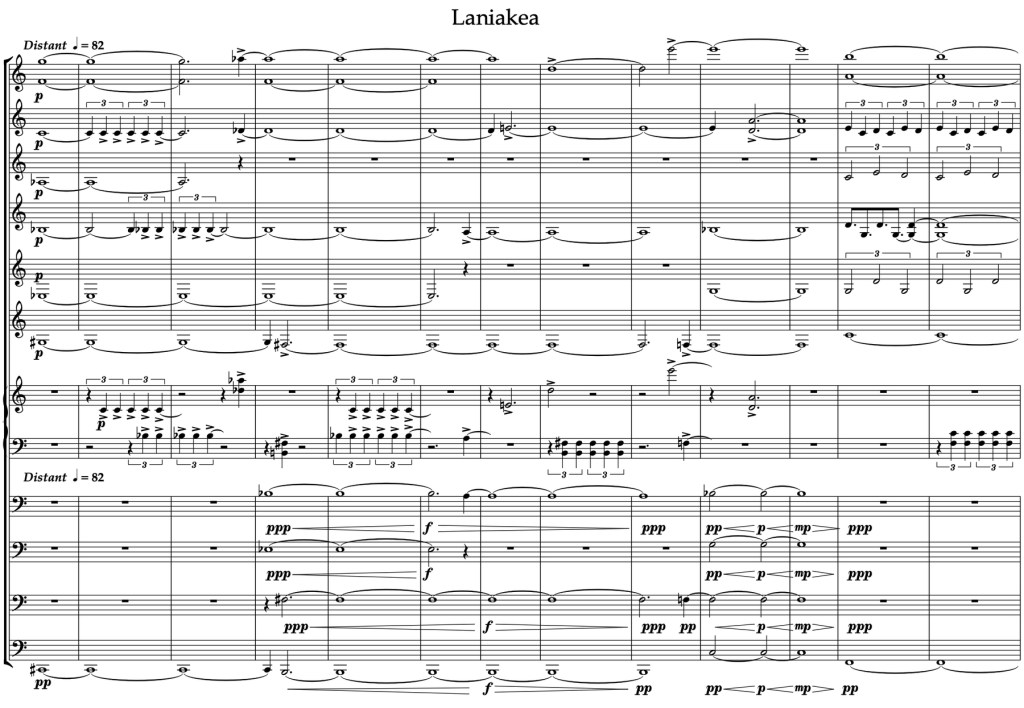
    DARK MATTER

    Clark 2023 (TC-133)

    Lucas Foss was among many composing works that were all about time. The opening song of his 1960 work,Time Cycle, for soprano, piano, clarinet, cello, and percussion, sets a poem by W. H. Auden, “We’re Late.” It begins:

    “Clocks cannot tell our time of day
    For what event to pray
    Because we have no time, because
    We have no time until
    We know what time we fill,
    Why time is other than time was.”

    Judith Kelloch, soprano

    LISTEN › YouTube

    Refracting time

    I met Foss in 1973 or ’75 when he guest conducted at the National Music Camp in Interlochen, Michigan, where I worked as assistant to the director of the university-level program (my first adminstrative gig). Back in Ann Arbor in the fall of 1975, I began writing my doctoral dissertation, a large three-movement score for symphony orchestra. Following the direction of my previous orchestral work, Animated Landscapes: Nocturne (1971), ILLUMINATIONS built sound masses animated in widely varying tempi, meters, and even unmetered free sprays of notes.

    ILLUMINATIONS – Three Refractions of Time

    Clark 1976 (TC-33)

    1. PROJECTION (future)

    2. REFLECTION (past)

    3. EMANATION (present)

    Receiving a Bicentennial commission from the Federation of Women’s Clubs, it was premiered in 1976 by the World Youth Symphony at Interlochen.

    with conductor and World Youth Sym.
    my prof Leslie Bassett

    Chronos

    Avant garde music in the middle of the 20th century was exploring an exploding range of new tonal possibilities — from by-tonaility to all-chromatic scales, from massive unresolved dissonance to pitchless noise. At the same time, composers were intensely interested in stretching rhythmic possibilities to the extremes of aperiodic time perception.

    The term trope in medieval music was an elaboration inserted into a liturgical passage. In the 20th century, Hauer used it to name an unordered collection of six different pitches (called an unordered hexachord), half of an equal-tempered twelve-tone set. Italian Niccolo Castiglioni’s TROPI (1959) uses this pitch organizing technique, but is more about blocks of contrasting rhythmic texture separated by extended silences. Moment by moment, these blocks succeed each other, recur, combine, and dissapate — a kaleidoscope of sound in time.

    Gruppo “Musica Insieme” di Cremona

    LISTEN › YouTube

    American George Crumb composed ground-breaking works for piano, beginning with Five Pieces for Piano in 1962. With imaginative, free-wheeling non-metric notation, he conjured a menagerie of sound sprites dancing through an ever-changing timescape.

    Thomas Little, piano

    LISTEN › YouTube

    In 1973, he went deeper with the first of four volumes of innovative piano music, Makrokosmos I – Twelve Fantasy Pieces after the Zodiac. Here is Nr. 12:

    Scott Sherman, piano

    LISTEN › YouTube

    In 1975 at Rackham Auditorium on the University of Michigan campus, I heard a live performance of this monumental work by David Burge, for whom the piece was composed. It had a profound impact. My own dive into this sound-in-time cosmos had only four character studies:

    1. precession of the equinoxes
    2. Stonehenge at dawn
    3. Heraclitean vortex
    4. lunar litany

    Geography of the Chronosphere

    Clark 1975 (TC-32)

    Max Lifchitz, piano

    Before Time

    Stephen Hawking, the great theoretical physicist and cosmologist, is famous for solving in 1974 the mind-boggling mathematics of black holes and what became known as their Hawking Radiation. He also wrote a fascinating book, A Brief History of Time. Now, after Hawking’s death, his last collaborator, Thomas Hertog, has published On the Origins of Time explaining Hawking’s theory of how Time itself began at the Hot Big Bang birth of the universe. The idea, in grossly simplified geometry, is that Space and Time were united as one primordial sphere that dramatically split apart at the Big Bang’s initial hyperinflation into expanding Space and progressing Time. Before that moment, there was no time, no before.

    The musical challenge: how to express utter timelessness before the explosion; and how to build a sound space that sits still then explodes. You’ll hear an initial sound space of just one pitch, G, which at first quivers in color but without perceivable rhythm. While standing still, the sound space expands by octaves and eventually explodes with a fuller spectrum of chromatic pitch color.

    Clark 2023 (TC-133)

    ______________

  • journal 7. Carte du Ciel

    U.Mich. Electronic Music Studio, 1975 —

    Mapping the stars

    My 2024 book, Mapping the Music Universe, begins with recognition of historic, world-changing pioneers in science and the arts. It includes Carte du Ciel (“Map of the Heavens”), an ambitious second phase of an international star-mapping project initiated in 1887 by Paris Observatory director Amédée Mouchez.  A new photographic process revolutionizing the gathering of telescope images inspired the first phase, the Astrographic Catalogue of a dense, whole-sky array of star positions. Carte du Ciel, never completed after 70 years, used the Catalogue as a reference system for a complex survey of the vast field of even fainter images.

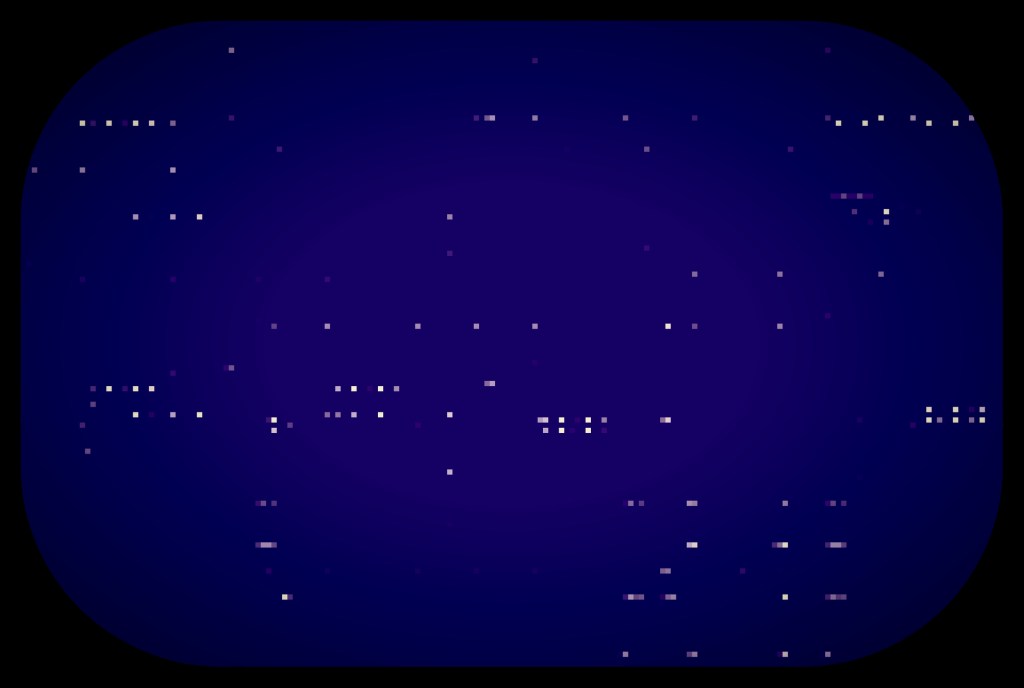
    In my 2019 computer music of that title, ghostly wisps of sound are punctuated by brighter bursts, clustered in a natural, not-quite randomly dispersed texture.

    CARTE DU CIEL

    Clark 2019 (TC-98)

    Space sounds

    A pioneering work of early electronic music made a huge impact on my imagination when I first heard it on FM radio in the 1960s. Karlheinz Stockhausen made Kontakte (Nr. 12 in the composer’s catalogue of works) in 1958–60 at the Westdeutscher Rundfunk electronic-music studio in Cologne with assistance from Gottfried Michael Koenig. It originated as a tape piece for four-channel loudspeaker reproduction. The title refers to “contacts between various forms of spatial movement” of the sounds coming from four different directions.

    Deutsche Grammophon

    LISTEN › YouTube

    American composer Morton Subotnick’s Silver Apples of the Moon was released by Nonesuch Records in 1967. The title comes from a Yeats poem, “The Song of Wandering Aengus”. It was made with a Buchla 100 analog synthesizer, which Subotnick helped develop, a common practice of early electronic music pioneers to build their own tools.

    Part I is a calm exploration of tone quality. Part II generates rapid machine sequences of sounds.

    Nonesuch Records

    LISTEN › YouTube

    Exigencies

    My works of analog electronic music were composed at the University of Michigan Electronic Music Studio in Ann Arbor starting in 1975. The studio, on an upper floor behind the stage and organ pipes of historic Hill Auditorium, was assembled by Michigan composition professor George Balch Wilson in 1962.

    Patterned after the Columbia-Princeton Electronic Music Center, the studio included reel-to-reel half-inch tape decks running at 15 or 30 inches per second, a mixing board and patch bay, an early model of the famous Moog Synthesizer, other tone generators, and a large wooden coffin containing a heavy metal plate to create electronic reverberation.

    Wilson’s first tape piece is an excellent sample of the analog studio’s sound and capability in expert hands.

    Equilibrium records

    LISTEN › YouTube

    My first large work of analog electronic music, Celestial Ceremonies combines otherworldly sounds made with this now antiquated equipment at Wilson’s U.Mich. Electronic Music Studio. (You may hear a resemblance to the sounds of EXIGENCIES.) Updating my work in 2017 with digital enhancements, I also separated out a suite of four sound sketches with subtitles.

    Celestial Ceremonies

    Clark 1976 (TC-33)

    Dark Energy
    Black Hole
    Gravitation
    Luminescence

    Kraken

    For a sample of my current use of digital synthesis technology, we go back to La Mer. Diving into what has been described as our other unexplored frontier, here is a fantasy sketch of the deep sea on the blue planet.

    Mar Profundo

    Clark 2025 (TC-156)

    ______________

  • journal 6. Canticum Terra

    Ann Arbor, 1970 —

    The first Earth Day was April 22, 1970. In the buildup to it, a group of University of Michigan students organized an environmental teach-in on March 11–14, presenting a series of speeches dealing with various environmental problems. Following its lead, 2,000 other universities and colleges ultimately put on events.

    My doctoral composition studies at Michigan began in 1974. Two seminars were mandatory requirements, on the works of the great 20th-century icons, Stravinsky and Bartok. I also took seminars in medieval and Renaissance music. Fifty years later, listening to a stunning recording of ancient choral music, I became re-interested in the rhythmic subtleties of voices executing the unspecified time flow of Gregorian chant.

    Using a variety of similar but slightly different note values, including the ancient semi-minim, minim, dotted-minim, breve, dotted-breve, and lunga, I composed a new plain chant. Beginning with pitches of a Dorian mode, my wordless chant takes chromatic turns, providing tonal color without chords above a motionless deep drone. A high, windblown echo of the chant’s shape appears as prelude and coda to its “singing” deepness.

    In this era facing global crises on our blue planet, Canticum Terra is a musical homage to and prayer for Mother Earth.

    Canticum Terra

    Clark 2023 (TC-136)

    “In the beginning God created the heavens and the earth. Now the earth was formless and empty, darkness was over the surface of the deep, and the Spirit of God was hovering over the waters. And God said, “Let there be light,” and there was light. God saw that the light was good, and he separated the light from the darkness. God called the light “day,” and the darkness he called “night.” And there was evening, and there was morning—the first day. And God said, “Let there be a vault between the waters to separate water from water.” So God made the vault and separated the water under the vault from the water above it. And it was so. God called the vault “sky.” And there was evening, and there was morning—the second day. And God said, “Let the water under the sky be gathered to one place, and let dry ground appear.” And it was so. 10 God called the dry ground “land,” and the gathered waters he called “seas.”

    Genesis (The Holy Bible, NIV translation)

    Stravinsky’s 1955 masterpiece in three movements, Symphony of Psalms, ends with Psalm 150 “laudate Dominum” in reverent praise of this awesome creation.

    III. Alleluia, laudate Dominum

    Berlin Philharmonic

    LISTEN › YouTube

    Mycology

    I read a fascinating book, Entangled Life by Merlin Sheldrake (Random House, 2021) about the mostly unseen bizarre world of fungi. Mycelium is the root-like mass of a fungus branching out in soil, forming a colony too small to see or grown to span thousands of acres as in Armillaria. Lichens are complex fungal communities of different organisms, like the black rocky shoreline stripes of Hydropunctaria.

    Mycology

    Clark 2022 (TC-118)

    Branching is a recursive process, with a pitch splitting into two mirroring lines of pitches, then each of those lines mirror splitting again. By powers of 2, the branches eventually build a tone-mass of 8 lines then even massive 16-pitch sonorities.

    Mycelium

    branching, thread-like hyphae

    Pointillistic speckles are set in the dark tonal colors of a Viennese 12-tone pitch series, never random but kaleidoscopically sparkling in a restless texture of overlapping rhythms.

    Hydropunctaria maura

    “water speckled midnight”

    Crystallography

    From the stars and cosmos, we have come down to Earth, the third planet from the sun, to delve into its inner mysteries.

    Very different from the lyric adoration of the Alleluia of Symphony of Psalms, Stravinsky’s later work (1966) explores serial atonality with a dark, dissonant edge. The percussive brilliance of its postlude is evocative of the prodigious granite masses created in Genesis verse 9.

    Requiem Canticles – Postlude

    London Sinfonietta

    LISTEN › YouTube

    In the midst of my recent Impressionistic “Sketches” series, the 2024 piece Folio (TC143) was a throwback to the more abstract sound mass style of the 1960s and ’70s. Its percussive attacks and inert masses of sound were all synthesized, also throwbacks to my early days of electronic tape music. (One of the earliest electronic compositions, Stockhausen’s 1960 Nr. 12 Kontakte, was full of sounds like giant steel beams hitting a concrete floor!) The other retro feature of Folio is suggested in its title: homage to Earle Brown’s 1952 FOLIO, a collection of abstract art scores in stark, proportional graphic notation.

    A wind and percussion transformation of Folio was challenging. It was composed in the abstract avant-garde style of the ’60s, carving sound sculptures of solid, hard-edged sonorities in expansive pitch/time space. Now colored with cool woodwind sounds, radiating brass, and sparkling percussion, GEODES animates Folio‘s solid sound masses in surging and fading rhythmic textures.

    The chaotic boldness of rocks . . . my own collection of many found on beaches and hikes, but also splendid displays at three places: Dick’s Rock Shoppe in Estes Park, Colorado; Lizzadro Museum of Lapidary Art in Elmhurst (now in Oak Brook), Illinois; and a wonderful gallery of geodes at the Permian Basin Petroleum Museum in Midland, Texas. A geode is Nature’s sculpture, an inscrutable gray rock sphere that, when sawed open, reveals a magical world of dazzling-colored crystals. Different minerals make crystals of varied hues of pink, purple, umber, or cream, reflecting new light.

    GEODES

    Clark 2025 (TC-143)

    Pyrite

    Calcite

    Amethyst

    Quartz

    Geology

    In CANYON SKETCHES (Clark 2024 TC-141), three sound sketches explore the timeless qualities of three magnificent canyons: Black Canyon of the Gunnison (Colorado); Glacier Gorge in Rocky Mountain National Park; and Palo Duro Canyon (Texas).

    Actually, each sketch began fundamentally based not so much on the canyons as on musical techniques. For example, in “Black Canyon,” a complex three-part canon of meandering 12-tone lines musically sketches the colorful streaks of pegmatite dikes in the Black Canyon’s cliff walls of Precambrian gneiss.

    Black Canyon

    ___________
  • journal 5. Dusty Dusk

    Tacoma, 1974 —

    As a teenager, I was into all kinds of art — sketching, painting, reading plays, and writing poetry. Lots of poems, my way of a kind of diary writing, expressing to myself the places, relationships, and feelings. (I won’t reveal any of this naive creative work here.)

    Later, two poems in particular were written at major turning points in my professional and personal life. That’s when I started setting poems as art song lyrics. Some of the musical material for what became Landscapes in Motion was first set in the 1970s, and some in the 1990s, now reworked with a more mature 21st-century craft, while preserving the original dark suppleness of tonality and time.

    Upon completing my master’s degree at Michigan in 1972, I taught music theory as a one-year lecturer at Indiana University in Bloomington. Another one-year fill-in position took me to Pacific Lutheran University in Tacoma, Washington, where I got great experience teaching music theory, composition, new music performance ensemble, and even trombone!

    Without a doctorate, however, there was no real prospect of winning a permanent professor position anywhere. And continuing a succession of one-year gigs moving all over the country was not sustainable. What to do?

    I had taken my sailboat with me all the way out to Tacoma from Interlochen. After a beautiful sunset sail on Lake Spanaway in my little 15-foot “Butterfly” dinghy, I wrote a poem.

                            “Sailing at sunset”  (1974)

    Dusty dusk settling silk on dying silver of wave-modulated water,
    the sail still silently searching for a departing breeze,
    swinging gently its boom and softly rattling its blocks
    in confounded cross-rhythms to the lapping shore.
    Streams of crimson flowing dust streak the sky
    above looming shadowed firs.
    Deepening shadows settle dark dust on the deck
    while still the mast peak rages red and soars into a deepening sky.
    Scorched face soothed by the oncoming night breeze,
    eyes searching the sunset sky for sign of tomorrow’s wind.
    Where will we sail then? Wherever wind wills . . .
    and a new dusk consume our shadows.

    A New Dusk

    Clark 1974 (TC-28)

    Afterglow

    Turns out, I went back to Michigan for doctoral studies, and went back to working at Interlochen as assistant to the director of Michigan’s university-level program there. In that 1975 summer, I met Beth, a journalist working a temp gig on the camp’s publicity staff.

    We fell in love, and I spent many weekends of the following academic year riding the Amtrak Turboliner from Ann Arbor to Chicago to be with her. I wrote a poem on one of those train rides, again uncertain about my (our) future.

                            “Riding backwards on a train”   (1976)

    The cider mill beside the river,
    cows grazing by a dead tree,
    a red barn stuffed with hay.
    An old square house alone on a hilltop,
    a church’s silent steeple above the trees,
    a country cemetery, old stone crosses guarding against oblivion.
    Then the sun is gone,
    storm clouds ripple across meadow skies,
    the river turns away.
    Riding backwards on a train, frozen fields float by.
    Glossy sheets of white ice glow with winter sun.
    Dead brown stubble breaks the mirror, patchy footprints of autumn’s retreat.
    Pale late light of afternoon flickering
    through leafless trees that line the lifeless fields in rows,
    through fields of withered cornstalks.
    Leap into brown dry woods, plunge past barren trees,
    spray a wake of fallen leaves, lunge into holy autumn stillness,
    riding backwards on a train, headed east into a frozen future.

    Shortly before his death, Charles Ives published a collection of 114 Songs in 1922. Many have become exemplars of his iconic 20th-century American style. Here are two that fit our tender twilight theme.

    Paul Sperry, Irma Vallecillo

    LISTEN > YouTube

    Paul Sperry, Irma Vallecillo

    LISTEN > YouTube

    Before night

    So far, I haven’t mentioned an important influence on my ’60s and ’70s immersion into the mid-century Avant Garde. In the 1960s, Luciano Berio wrote an influential, frequently performed series of unaccompanied solos for varied instruments. All are tour-de-force virtuosic technical displays with a theatrical impact. I performed Sequenza V for trombone on a Contemporary Directions concert in Rackham Lecture Hall (Ann Arbor). It was commissioned by and written for virtuoso trombonist Stuart Dempster, with whom I later briefly studied.

    I said instruments, but Sequenza III (1965) is for unaccompanied voice, drastically different than a typical “song.” Berio explains:

    “In Sequenza III the emphasis is given to the sound symbolism of vocal and sometimes visual gestures, with their accompanying ‘shadows of meaning,’ and the associations and conflicts suggested by them. For this reason, Sequenza III can also be considered as a dramatic essay whose story is the relationship between the soloist and her own voice.”

    Sequenza III was written in 1965 for Cathy Berberian. The “modular” text is by Markus Kutter:

    Give me a few words for a woman
    to sing a truth allowing us
    to build a house without worrying before night comes

    Laura Catrani, soprano

    Ice

    In 1983, teaching grad courses and still directing the New Music Performance Lab. Musicology master’s student Robert Nasow played cello in the ensemble, but he was also an avid and talented poet.

    When his fellow grad music student David Lynn Kennedy was killed, Robert wrote a heartfelt elegy for him.

                            “Ice Floe

    by Robert Nasow

    Yes, I am cold . . .
    my hands are cold to the touch.
    Something must fill this hollow at the center of my body.
    Untouched, no one will long remember your face . . .
    She withdraws to contemplate the child,
    her voice breaks into emerald light, effulgent pure water,
    sings unknown distances of sleep.
    Brittle, come break off my hand,
    this glazed stem of Queen Anne’s lace.
    There are ways of living we have never dreamed of.

    His poem became a lovely vehicle for a memorial song, which was premiered by UNT grad students who were also involved in new music with me.

    Ice Floe

    R. Nasow / Clark 1983 (TC-46)

    Jing Ling Tam, soprano

    Paul LeBlanc, guitar