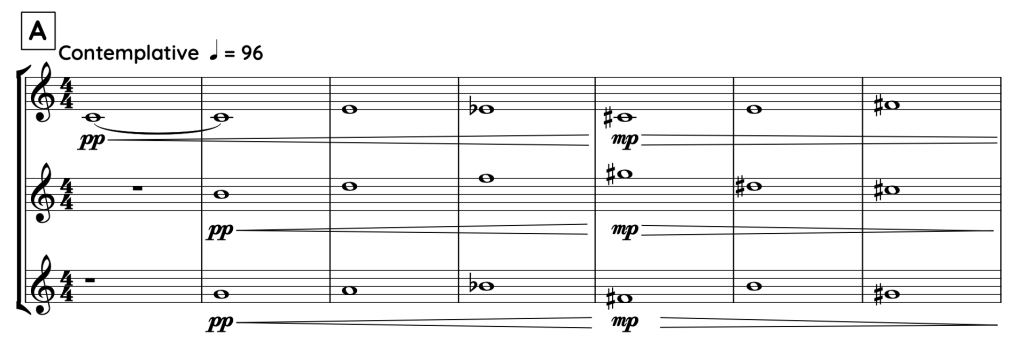
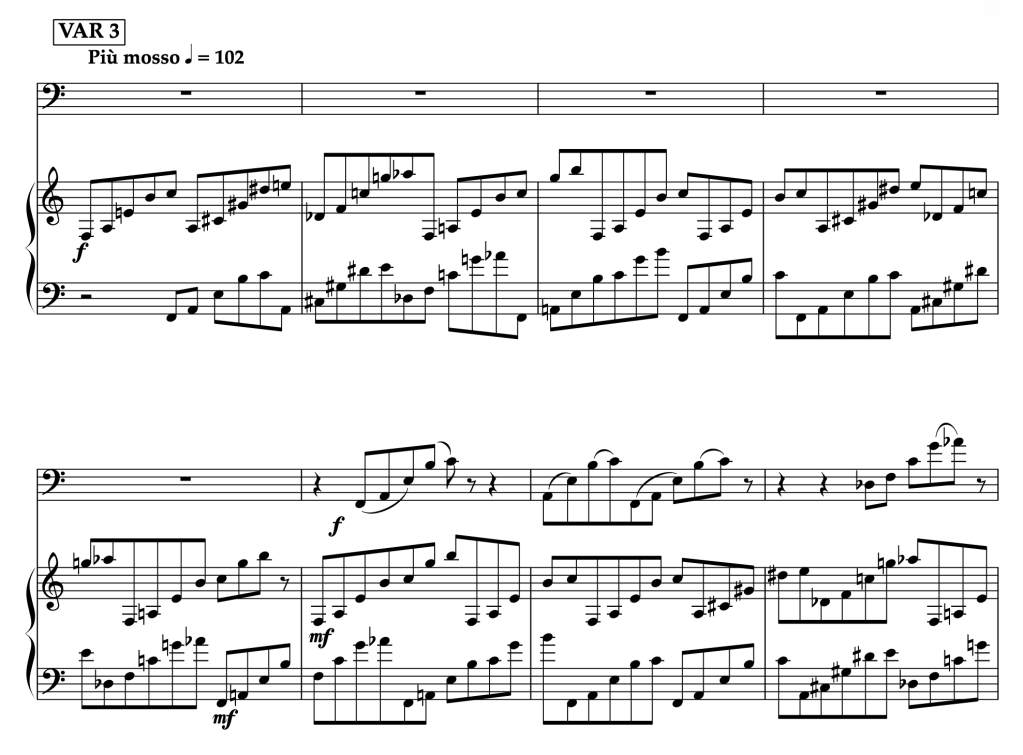
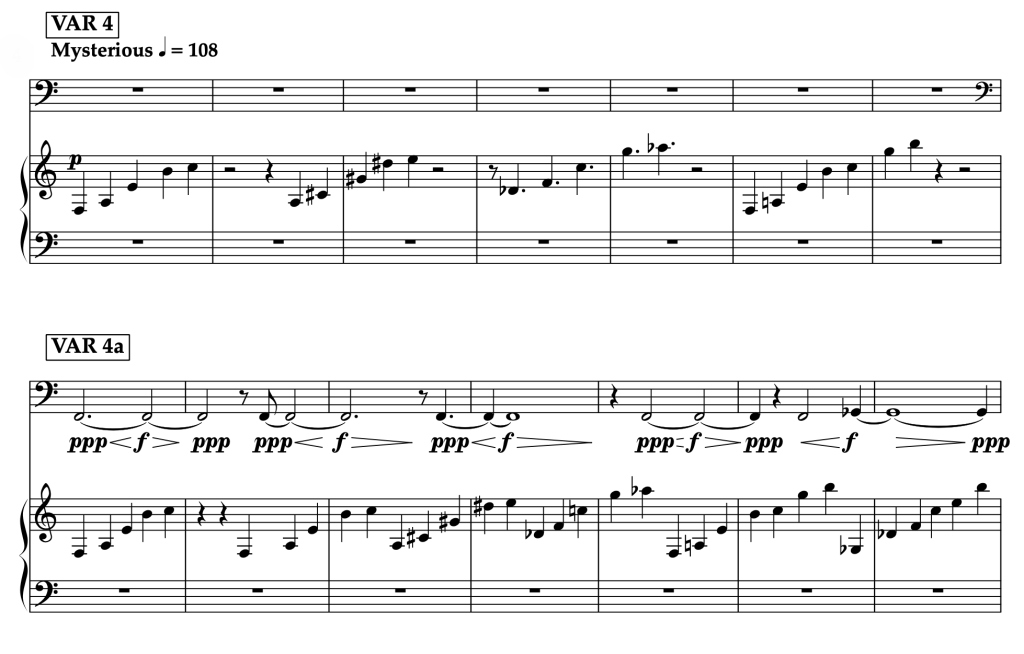
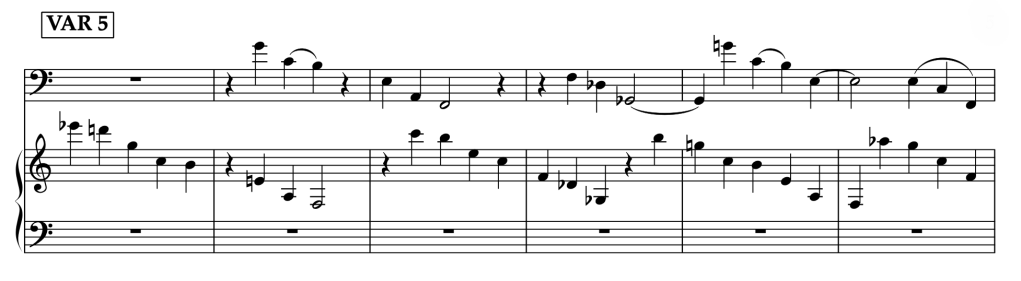
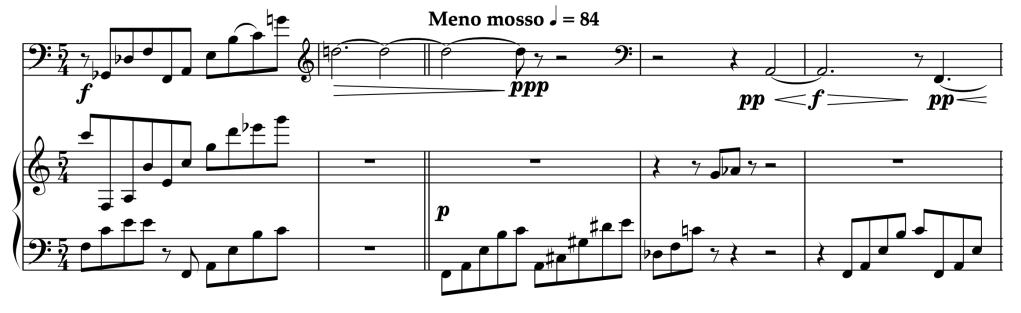
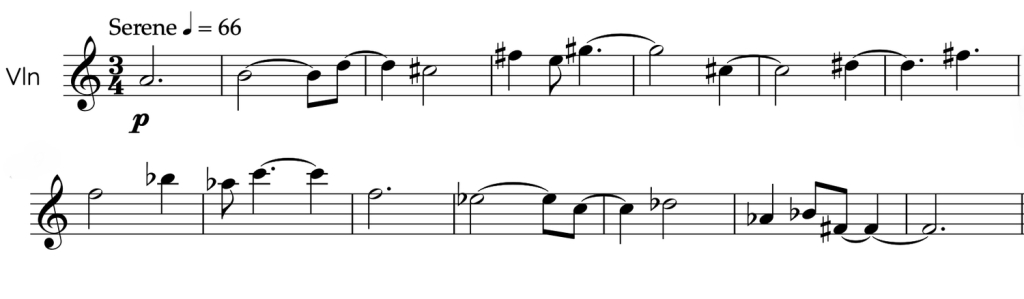
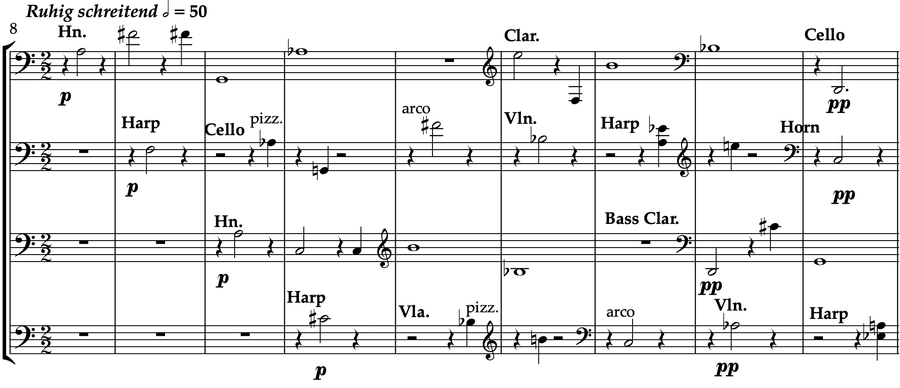
Sonata is typically a multi-movement piece for solo piano or an instrument with piano. A shorter form with just three connected sections, the middle slower and quieter, can be called a sonatina.
An inside look at how one was composed gives a guided tour in the form of a recipe to write your own sonata.
1. Choose a model
I started formal composition study in 1968, first with composer Eugene Kurtz, based in Paris but filling in that semester at the University of Michigan. A proponent of modern French music, his compositional models included Debussy and Ravel. He assigned me to immerse myself in deep study of their music, in particular Ravel’s 1905 work, SONATINE.
I met Beth, a flower lover, in Interlochen in 1975. She had been a promising flute student at Aspen, but was then embarking on a journalism career specializing in horticultural writing.
The Ravel study came back to me later in my career, as I began to adopt its lush, bright harmonic language and a gentle French Impressionist quality. My SONATINE for Beth (2025) brings together the Ravel study, the flute sound, and (in my video version on YouTube) even the flower motif.
2. Start with a generating idea
The impelling theme can be a melody, a rhythmic pattern, a special kind of chord, or a non-musical image such as a painting or poem.
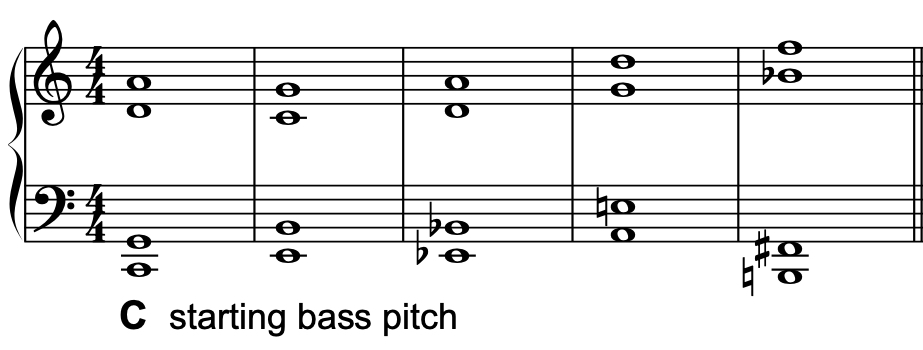
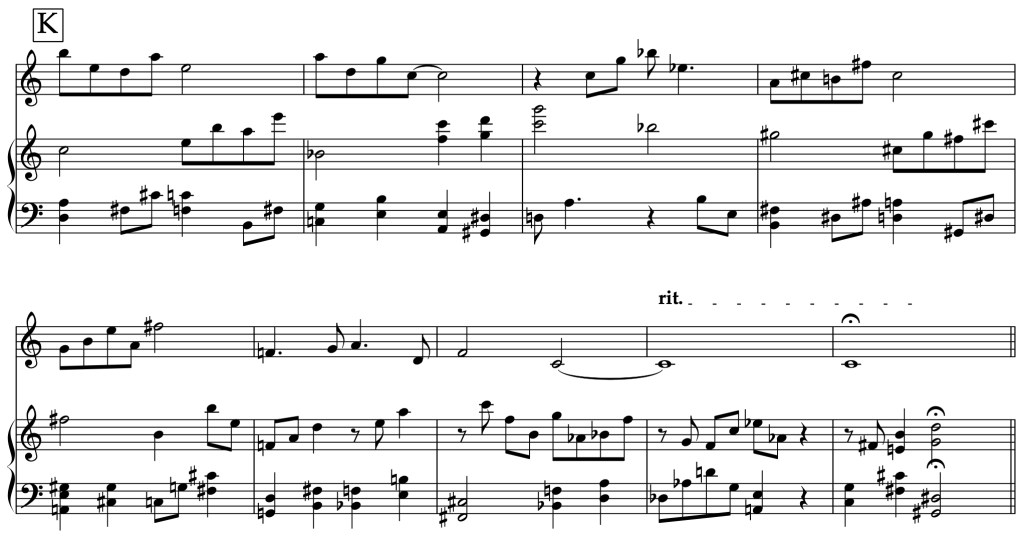
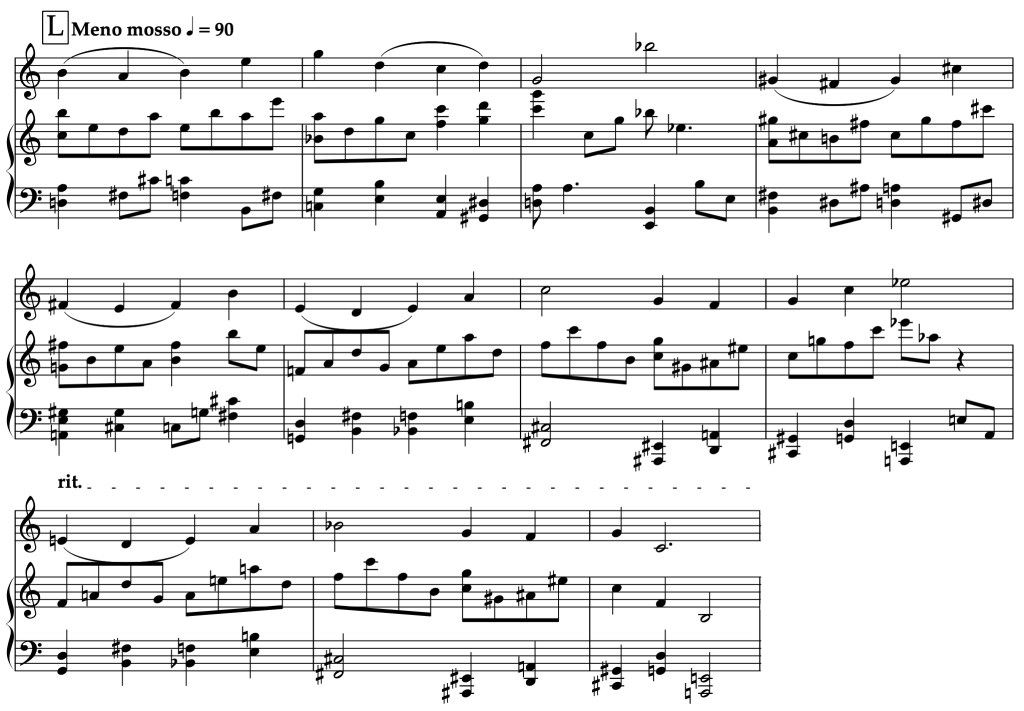
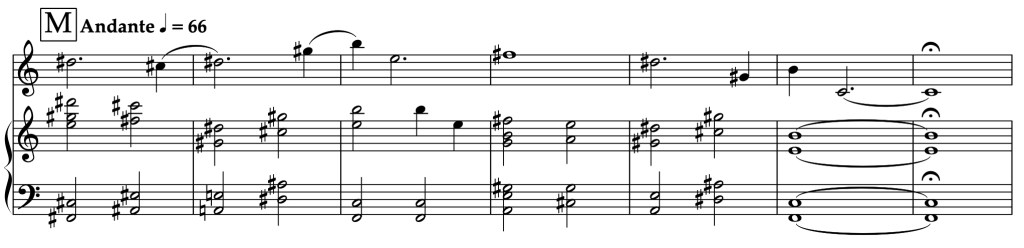
Sonatine for Beth is spun entirely from a single harmonic progression, seven chords, each stacking one Perfect 5th interval above another.
The Perfect 5ths in the two hands are separated by one or more octaves, highlighting this strong interval as a characteristic sound for the piece.
Now some basic tools to develop and vary a generating theme.
3. Transposition
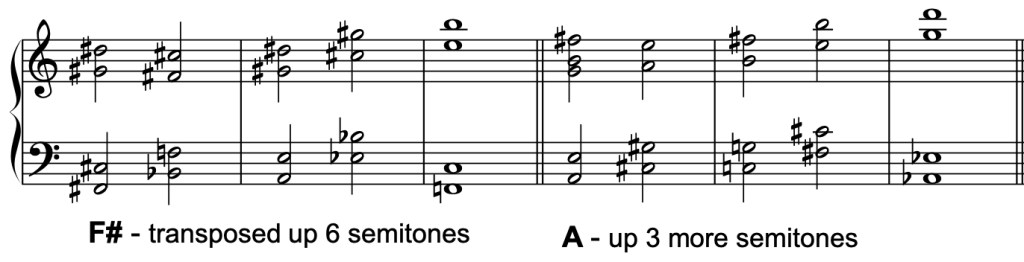
The whole five-chord progression can be transposed. The harmony is heard plainly in a middle section as ten block chords. The last five chords are a transposition of the first five, up three semitones, starting on the bass pitch Eb instead of C.
Sequence is successive statements of a pattern transposed by a consistent interval.
Here is another transposition of the whole ten-chord sequence:
This harmonic material generates melodic lines and many arpeggio patterns, in successive variations of changing register, intensity, and rhythmic pace. Let’s go through the compositional unfolding of this thematic idea.
4. Extract a melody and bass
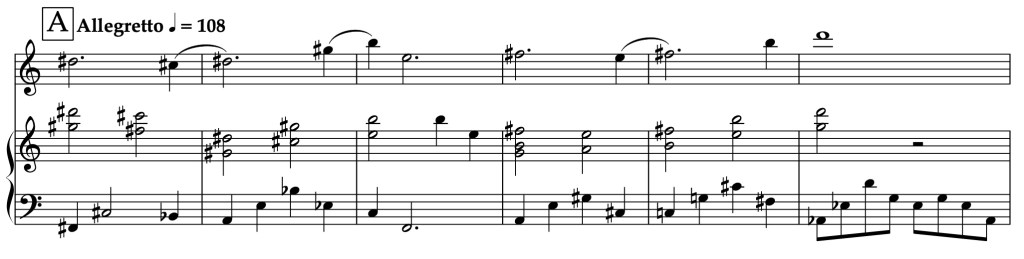
Since the starting idea is simply a chord progression, we can select individual tones from each chord for a melody. The most obvious selection is the highest pitch of each chord, even if it is not in a soprano singing range.
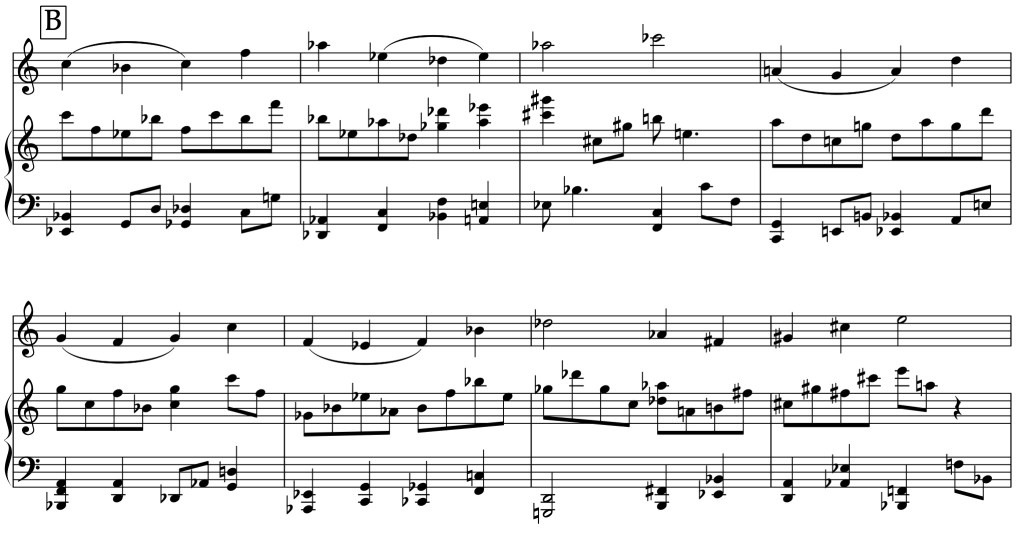
At letter A the melody is given a slightly independent rhythm to help set it off from the chords, in addition to the different sound color of the flute. Also, the lower chord tones are articulated one at a time, making a bass line also rhythmically distinct, faster than the half-note chords. (The Bb in the bass line’s first bar is a passing tone, not a chord tone.)
5. Add arpeggios
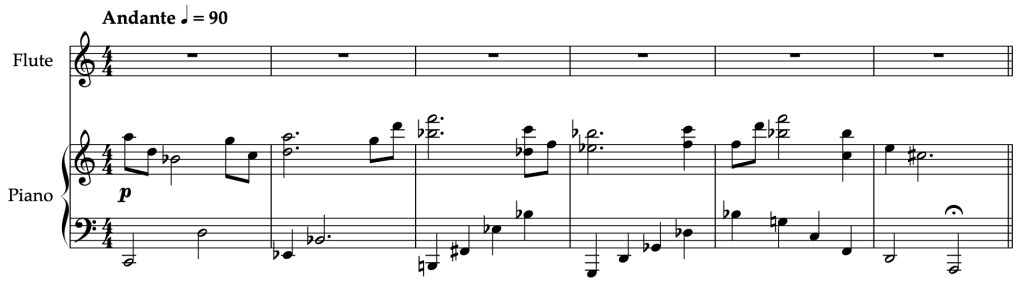
An arpeggio is any pattern articulating chord tones one at a time. Usually in order lowest to highest or back down, the individual chord tones can be articulated in any order. At letter A shown above, we already saw the left hand articulate its chord tones one at a time. In the introduction, the right hand is partially broken up into arpeggios.
In the next variation below, right-hand treble chord tones and still some bass chord tones are arpeggiated. Now all three lines (flute, right hand, left hand) have distinct rhythmic patterns, though congruent with each other in the established 4 4 meter.
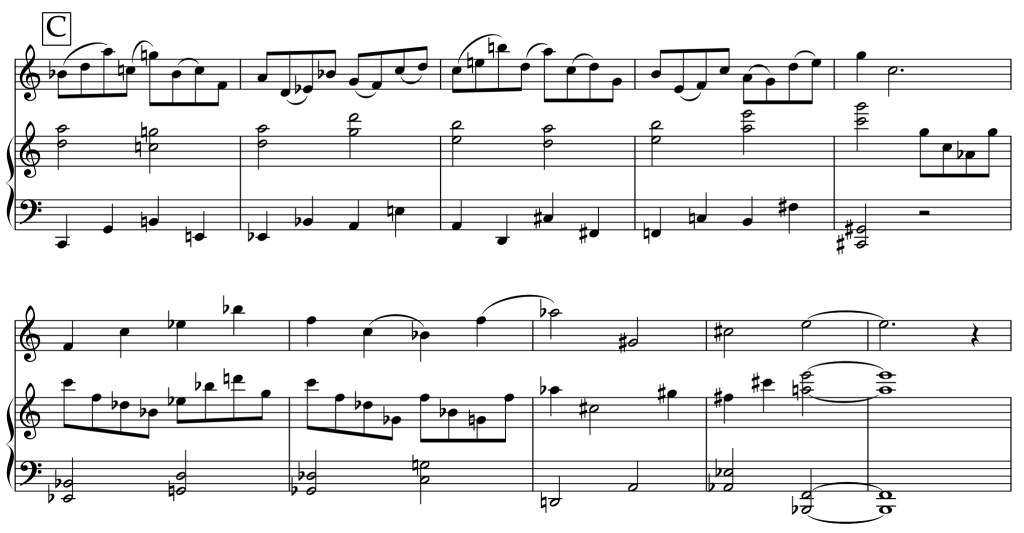
Next, the flute arpeggiates chord tones in eighth-notes, with the left hand simplified to quarter-notes of two pitches from each chord.
6. Rhythmic variations
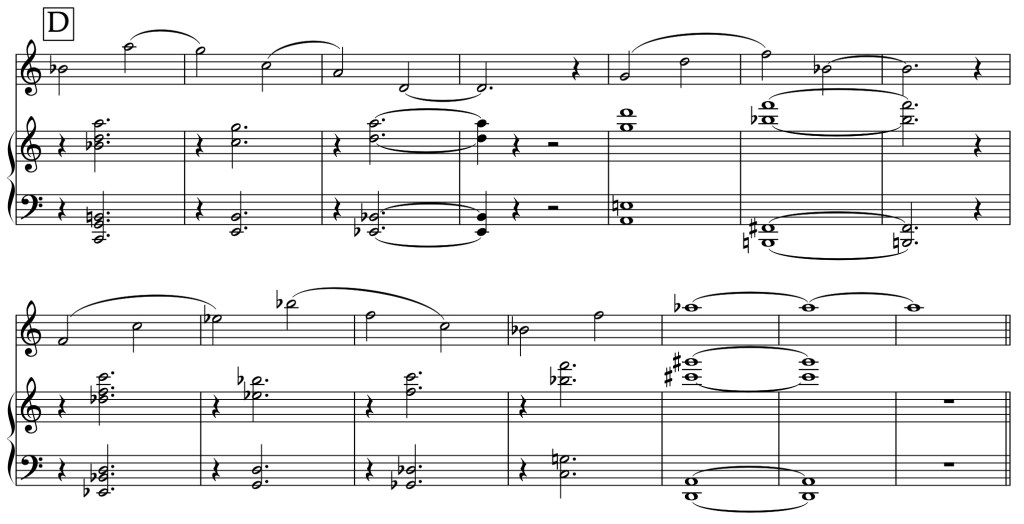
Variation D simplifies the flute melody to just two half-note chord tones per bar.
The two hands reunite rhythmically to place some chords after the downbeat and between flute notes.
7. Counterpoint
The original term, contrapunctus, translates “point against point” — two or more independent lines interacting in time.
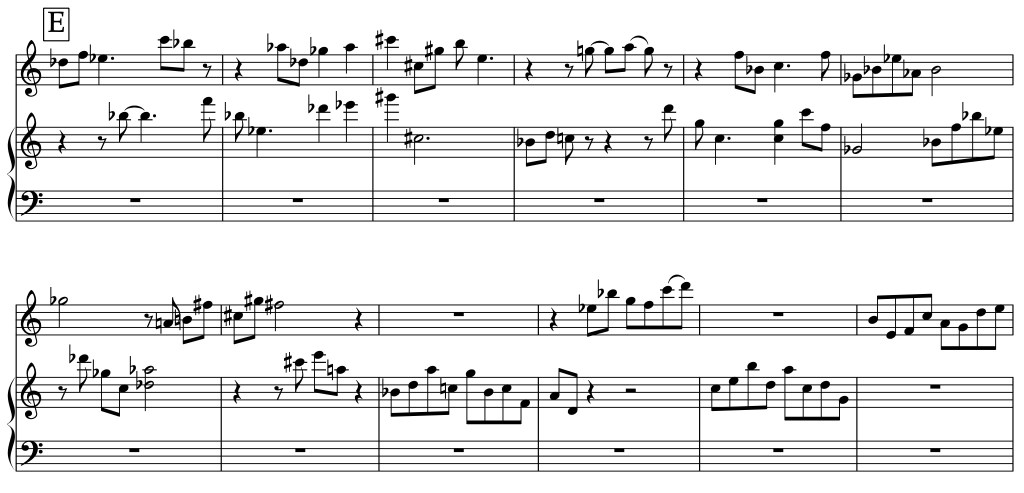
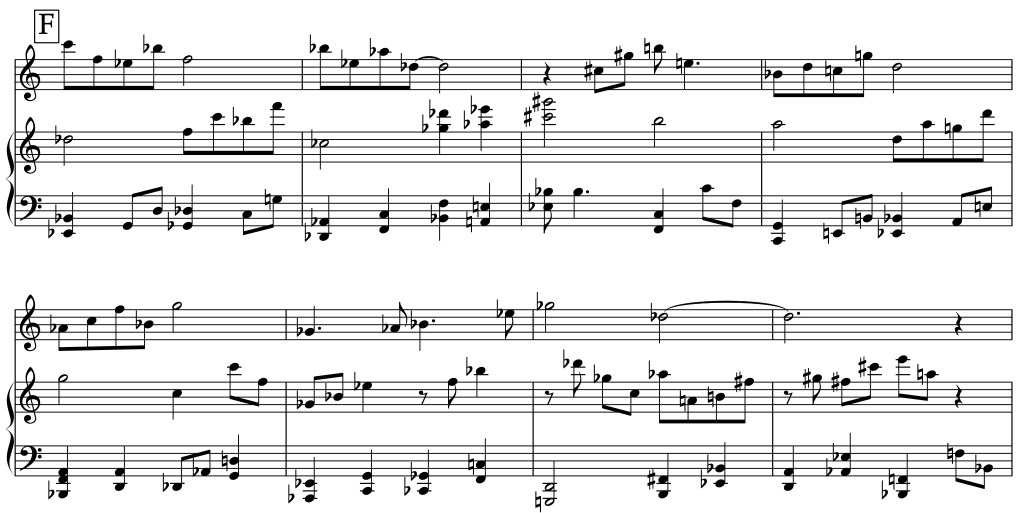
A more active rhythm for the flute line leaves time gaps that can be filled in by another line. The right hand selects chord tones to make a similarly playful rhythmic line that mostly alternates and sometimes lines up with the flute rhythm.
The harmonic progression is still there but just hinted at by the chord tones selected for these interacting lines.
Variation F continues this back-and-forth rhythmic interaction of the flute and piano right hand, now adding back in the left-hand chord-tone pairs with a simple rhythm for a supporting third contrapuntal line.
8. Texture
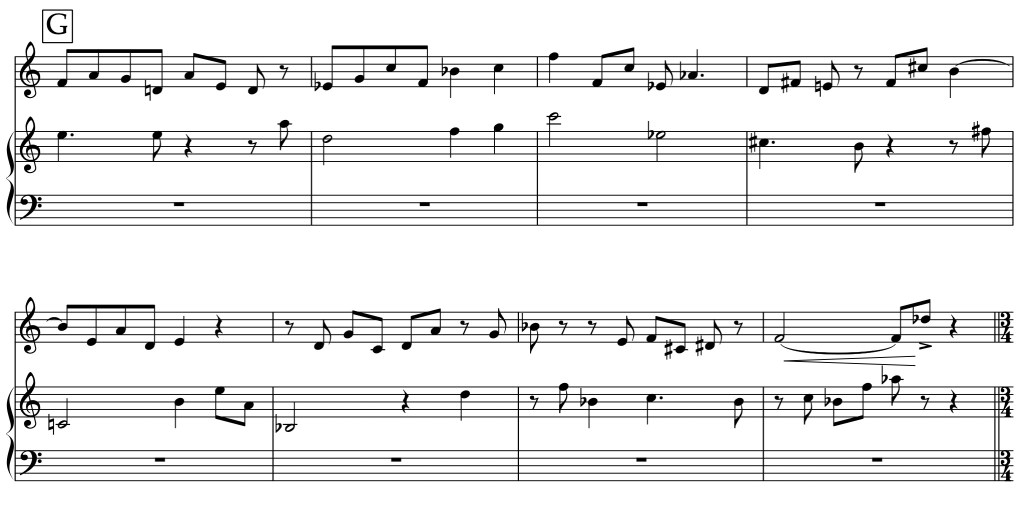
Having reached a complex level of three rhythmically interacting, independent contrapuntal lines, a nice contrast will be to simplify. Variation G reduces to a lower-register flute line and only a much simplified skeletal supporting line above it in the right hand.
Then the texture begins to revert rhythmically to a simpler alignment of all chord tones.
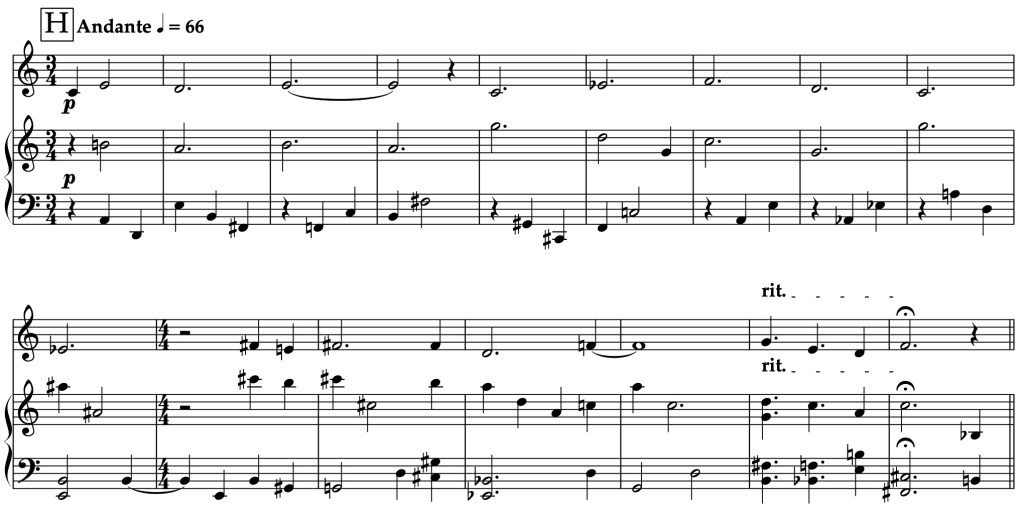
This paves the way back to a simple piano texture revealing the fundamental thematic chord progression.
9. Shape a time form
What is the plan for the whole? How will the various versions of the generating idea unfold in the larger time span of the whole piece?
The quiet letter I variation is the apex of an arch form . . .
starting with simple
building up more rhythmic and textural complexity
reaching a stable plateau
subsiding back to what started it all.
That sets up a recapitulation of the whole process, building up textural complexity again, first with the high two-part counterpoint:
Then with three voices:
Flute line “calming down”:
10. Coda
A good essay ends with a conclusion or a summary restatement of the thesis.
Our musical coda summarizes with a last return to the beginning. The chords are back to their very low and very high registers. The flute makes a small melodic arch, ascending to the pitch B, then climbing down gently to its lowest possible pitch, C.
11. Fine
A final edit and audit are mandatory. In the case of our example, listening revealed that the beginning needed a piano introduction with some rhythmic vitality. Some sections were also reordered to improve the flow. Thus, the piece will not begin with a plain statement of the progression, and there will be a somewhat different order of other events.
Now listen to the whole 6-minute parade of variations on a single chord progression.
Schoenberg’s famous twelve-tone row technique, devised in the early 20th century, prescribed a compositional method to order choice of pitches in the dense forest of possibilities with 12 chromatic scale steps. Music composed in this manner was called “atonal,” but this Lab will create a distinctive individual tonality from a 12-tone series of four trichords.
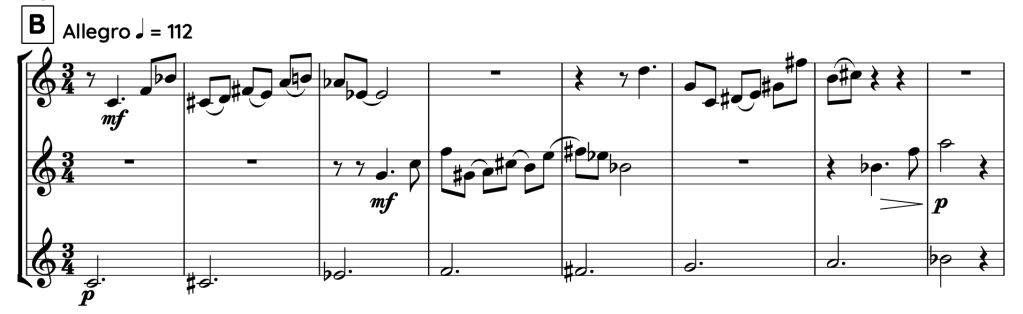
The sample piece, in a classic ternary form, will be scored for a chamber trio of three different instruments.
The so-called atonal music was complex and mostly dark and dissonant. Can a technique like this also be used to methodically create coherent tonal characters of brighter, simpler sonority?
1. Choose a model
One of my favorite 12-tone pieces is Schoenberg’s Wind Quintet, Op. 26. Premiered in 1924 on Schoenberg’s fiftieth birthday, it was dedicated to Schoenberg’s young grandson Arnold. In four movements, it has a graceful neo-classical Viennese quality. It also is historically only the second piece ever (after his Suite for Piano, Op. 25) composed with Schoenberg’s new 12-tone row technique.
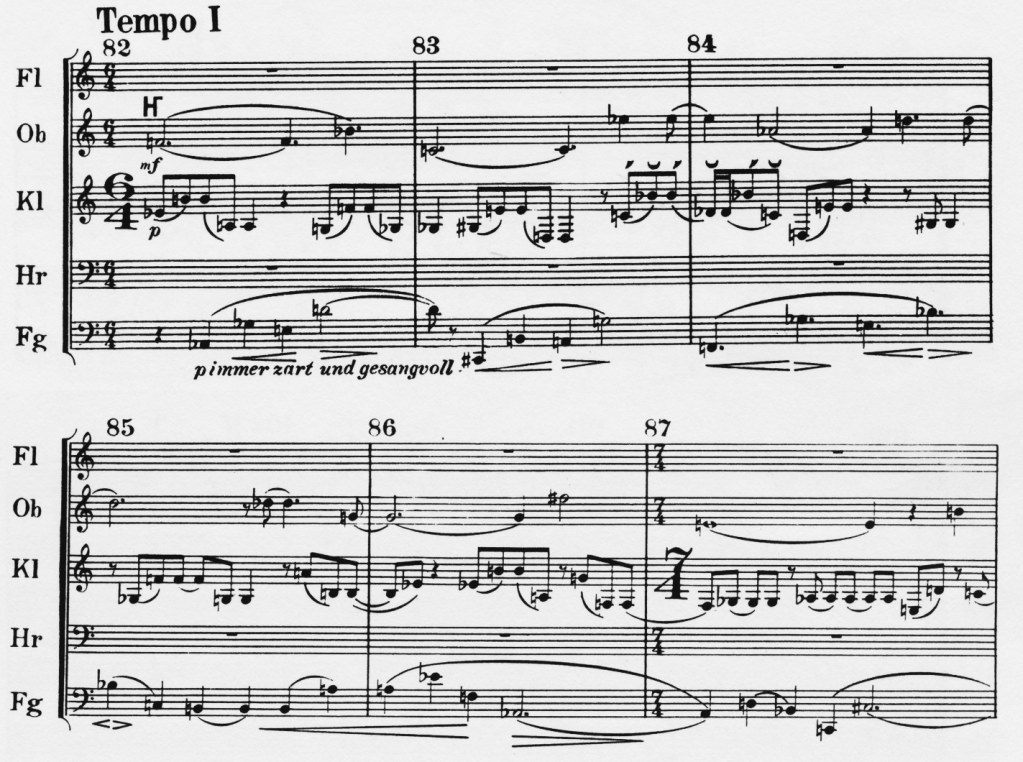
The slow third movement, tempo marked “Etwas langsam,” displays a clear use of a 12-tone row in graceful counterpoint between the five instruments. The facile scoring of these instruments explores textures ranging from isolated solo to duos, trios, and even dense five-part counterpoint.
2. Design a 12-tone series
I imagine the typical way composers design a 12-tone row is by writing a line, choosing the interval from one pitch class to the next while not reusing any pitch class, until all 12 are included. That leads readily to a linear, contrapuntal approach.
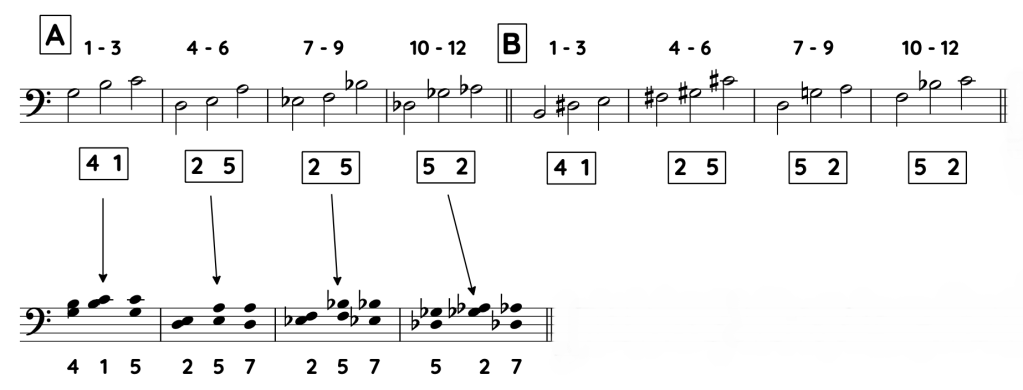
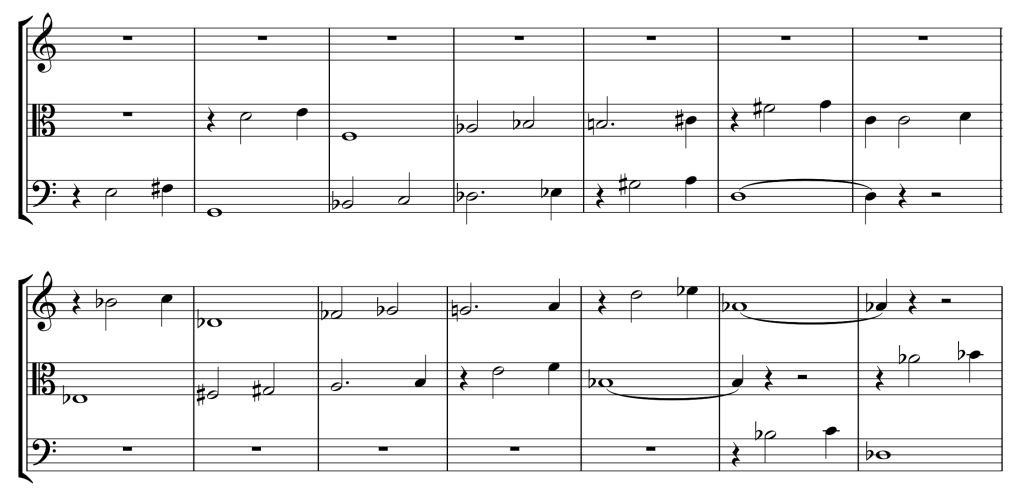
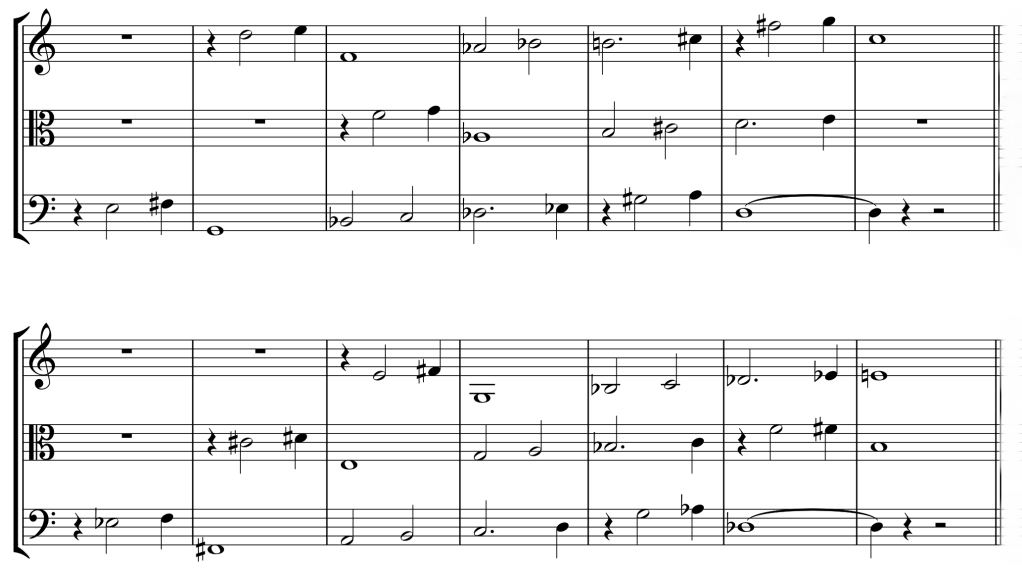
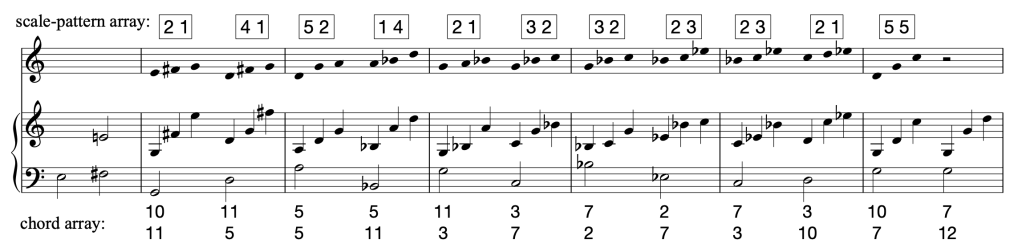
For our example in this lab, we’ll work instead with trichords, each a group of three pitch classes making a three-note array and set of three intervals. Here is such a row (A) and a slight variation of it (B):
The A version also shows the three intervals in each trichord.
Note that the 2 5 and 5 2 scale patterns are the same, representing a set that is inversionally symmetrical. (That is not true of 4 1 and its unique inversion, 1 4.) Its complete-octave array is 2 5 5. Think of it as a circle of the twelve semitones in an octave. Unwinding the circle through octaves looks like: 2 5 5 2 5 5 2 5 5 2 . . . etc. This is a palindrome, reading backwards the same as forwards.
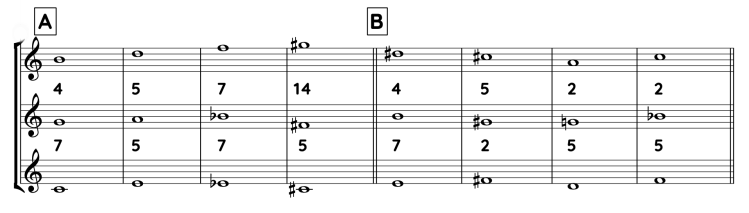
Here is a voicing into 3-voice chords:
You can see (and hear) that the voiced-out trichords can make constellations predominantly of 5-semitone and 7-semitone intervals. This is what makes the sound of the progression coherent and somewhat more like Copland than Schoenberg in character.
3. Twelve-tone rows
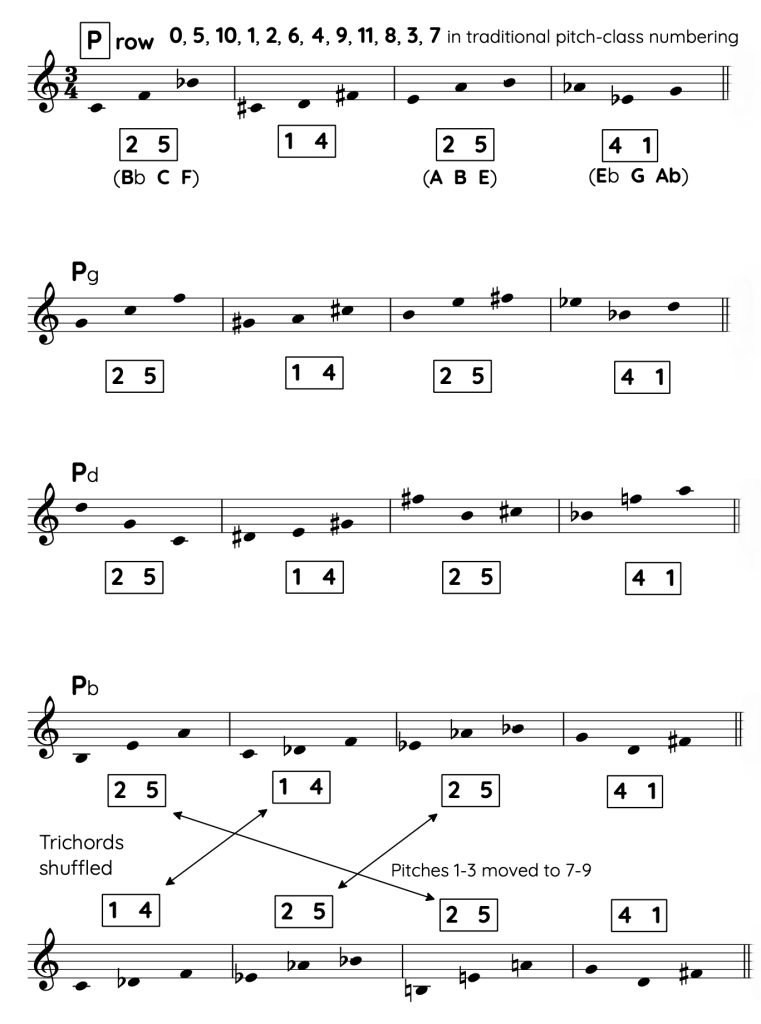
Now we can delve into the linear potential of the series we’ve constructed. I’ll call my principal row P in keeping with standard theory, designating the transposition by the name of the starting pitch class. (Standard theory uses pitch class numbers — C = 0 — to designate the starting pitch.)
Serial technique is just a box of 12-tone tools, which you can use in any way you wish. For the last row above, I shuffled the order of the trichords. The shuffle puts the trichords inside out, with the 1 4 array now at the beginning. This gives me more options when building counterpoint between two lines with each its own row form. Like rearranging four toy blocks, the shuffling still builds a 12-tone aggregate collection no matter the order of trichords or pitches within the trichords.
4. Imitative lines
As we observed earlier in Opus 26, a row is a natural material for building contrapuntal lines that are similar in interval shape. When these similar shapes are reinforced with similar or identical rhythmic patterns, the lines mimic each other in their back-and-forth conversation.
5. Ternary form
Of all the classic form models, ternary is one of the simplest in concept and strongest to perceive. Opening material is contrasted with a middle section of different tempo, texture, register, rhythmic pace, etc., followed by a return to the opening material: A B A. (Several familiar classic model forms are ternary, including Sonata Allegro, Da Capo Aria, and Minuet and Trio.) Often the returning opening material of the third section is embellished or varied in some way while not clouding recognition that it is a recurrence of the opening.
For Schoenberg’s Etwas langsam third movement of the Wind Quintet, the opening material consists of two-part counterpoint between horn, marked as the Hauptstimme preeminent line, and bassoon (Fg) marked as the Nebenstimme subordinate line.
Opus 26 middle section is faster flowing, with much more rapid, complex rhythms in a denser four-part counterpoint:
The third section brings back but alters the opening’s two lines, moved from horn and bassoon to oboe and bassoon, with the addition of a third contrapuntal voice in the clarinet.
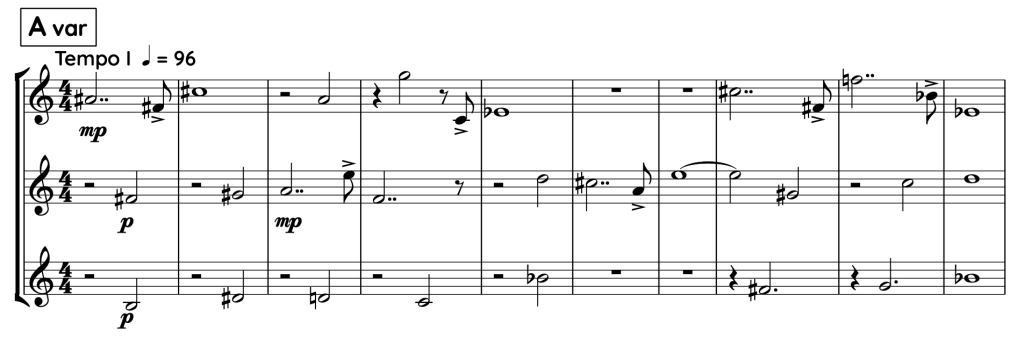
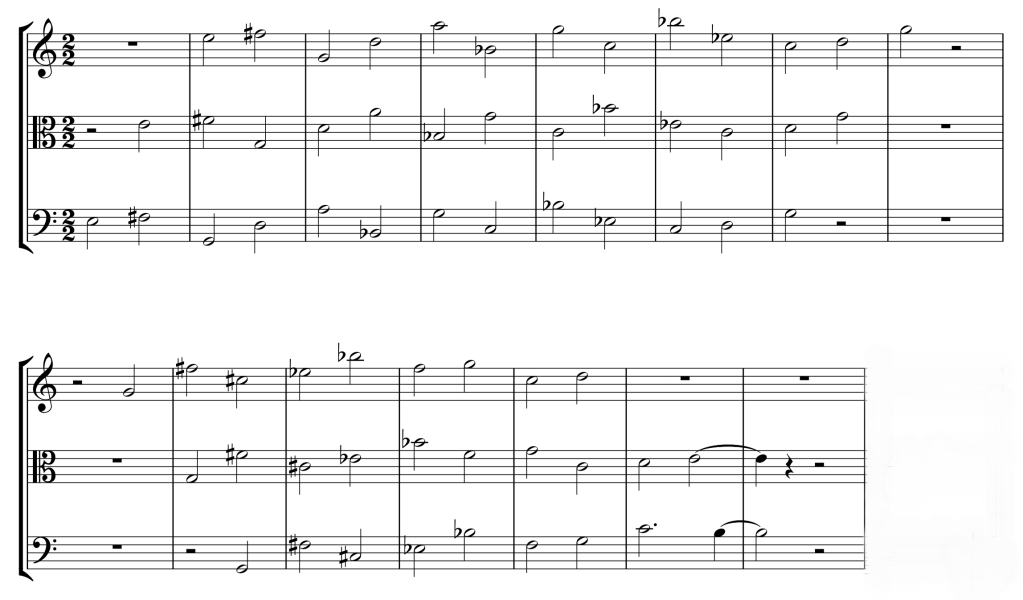
For our MapLab example, the chorale-like chordal setting of the trichords we’ve already seen will be the serene opening and ending material. Imitative contrapuntal setting of the row in a faster tempo and much faster pace make the contrasting middle. (Many classic three-part forms, by the way, are the converse, fast – slow – fast.)
Opening:
The opening material continues with a variation of the chords, transposing them and adding rhythmic interest with single 8th-notes each arpeggiating a pitch of the chord.
Contrasting middle:
Note: if you’re wondering how I pulled the lower line of dotted-half-note steps from the row, I didn’t. It is free counterpoint for a simple supporting “bass line.” Those pitches are drawn from the trichords expressed above them, as unison or octave “doubling” of single pitches from the upper lines.
The recap first brings back the opening’s single-8th-note arpeggiations then proceeds back to the still chords of the very beginning.
6. Scoring the trio
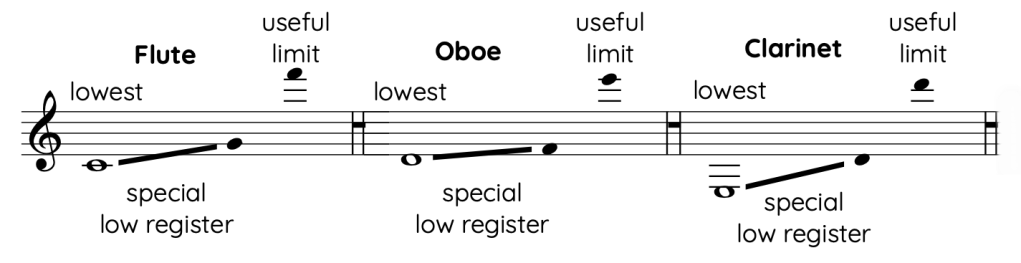
For this lab, choose any three different instruments. They can be in the same instrument family, like a brass trio of trumpet, horn, and trombone. Or it can mix instruments from different families, like flute, horn, and cello. You can guess from the audio above, I choose a woodwind trio of flute, oboe, and Bb clarinet.
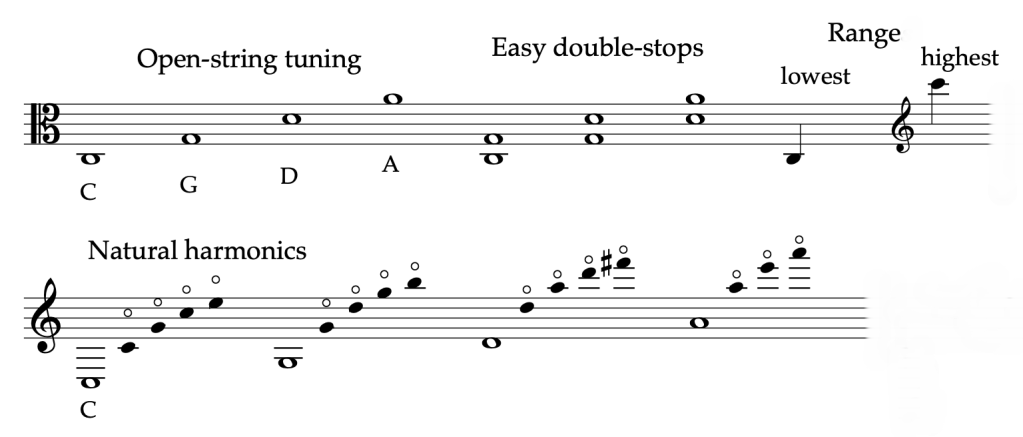
Get to know your chosen instruments, not only their overall range but also the particular characteristics of sub-registers. For orchestral string instruments, it is good to know their open string tunings and recognize those strings’ different qualities; the lowest string of each instrument is thicker and produces a thicker, grittier timbre. For my chosen three, flute and clarinet have wonderfully rich, dark lower registers, while the lowest few pitches of the oboe’s range are squawky. Each of the three instruments have upper ranges that thin a bit in timbre but can be elegant or powerful.
My scoring will emphasize use of those rich low registers of the flute and clarinet. Many chords will be voiced with oboe on top, flute in the middle, and clarinet lowest. Nonetheless, the score will show them in standard score order with flute at the top. Also, the clarinet is a Bb transposing instrument. That means in the score and player’s part, a written C will sound one whole step lower as a concert Bb. When I want, say, an F to sound, the clarinet part will show a written pitch one whole step higher, G.
For a well-balanced chamber-music trio should balance how much time each instrument gets as the active, preeminent voice in the texture (which Schoenberg would call the Hauptstimme).
7. Finished score
Tempo and dynamics are essential to vividly portray where the music is going — launching, growing, swelling, subsiding, approaching a cadence or climax. Articulation marks will be particular to each instrument type. Rehearsal letters or measure numbers will be helpful in rehearsal.
Since my finished example has a childlike playful curiosity, its title follows Schoenberg’s Opus 26 dedication to his grandson. Imagine a child in a sunny garden.
Unaccompanied instrumental solos go back at least to the 18th Century, such as Bach’s violin partitas and cello suites. In the late 19th century, Debussy’s Syrinx for solo flute met the challenge of making a piece with just one wind instrument, not capable of the double-stops that complicate the rich textures of Bach’s string writing.
1. Choose a model
Syrinx launched a whole genre of unaccompanied flute solos, with Density 21.5 (1927) by Edgard Varèse and Sequenza (1958) by Luciano Berio leading the way to experimentation with virtually every wind instrument. My Night Songs (1969) for solo trombone is very much within the tradition of this genre. As a trombonist and undergraduate composition student, I used my intimate knowledge of the instrument to select gestures and techniques to experiment with compositionally.
2. Choose an instrument
I also love the viola, so I readily agreed to write an unaccompanied solo for each member of the Pleasant Street Players, including violist Ames Asbell.
3. Sketch idiomatic gestures
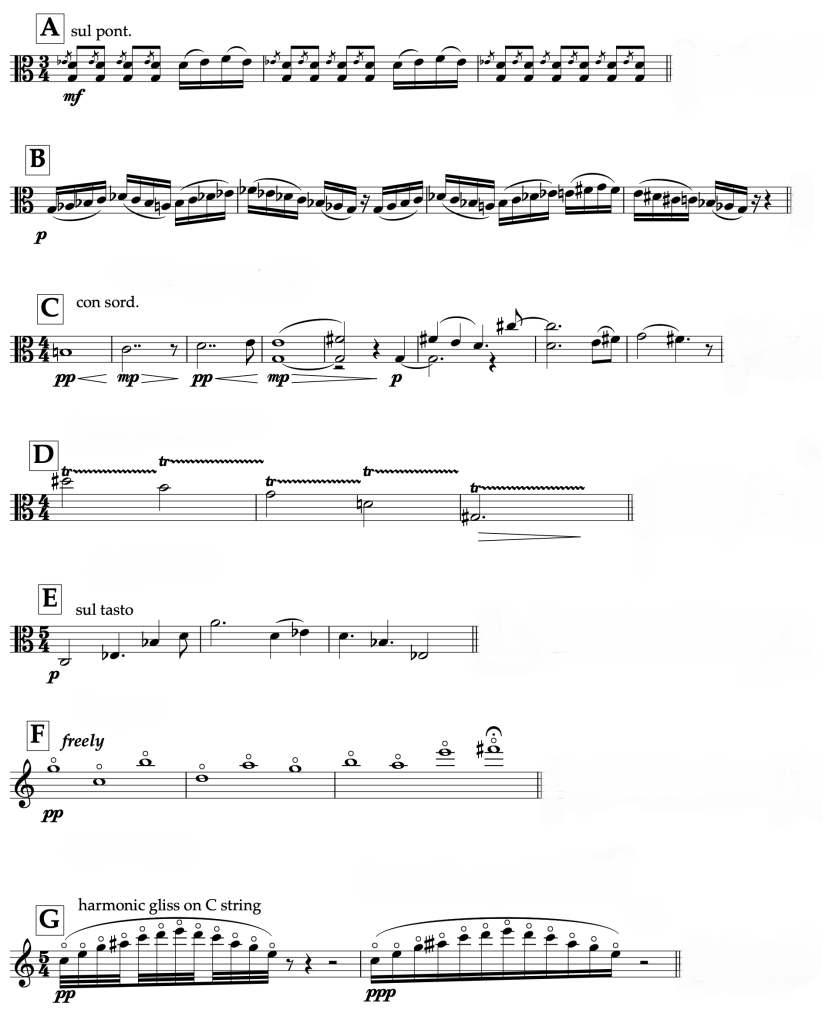
Before I Sleep is inspired by a famous, beautiful Robert Frost poem, “Stopping By Woods.” Its snowy scene tempted me to quote a Mahler’s Symphony No. 4 (1900) that starts with sleigh bells and flutes doing something like the A gesture. (Sul ponticello is a special string technique to brighten tone by moving the bow closer than normal to the bridge.)
B features the quick scale patterns so indigenous to orchestral strings.
C uses a mute, attached to the bridge to subdue the tone. It also uses double-stops, drawing the bow across two adjacent strings together, making two-pitch diads and even two-voice counterpoint. These use an open string and the next string a perfect-fifth higher or fingering a pitch more than a perfect-fifth higher.
D makes bird-like trills.
E uses sul tasto, the reverse effect of sul pont, drawing the bow closer to or over the fingerboard for a darker, warmer sound.
F makes the high, glass-like sounds of natural harmonics, produced by touching a string lightly at one of its partial-vibration nodes while drawing the bow on it. (harmonics, like open strings, have no vibrato. Sorry my synthesizer insists on applying vibrato anyway.)
G is a very special effect used by George Crumb in his early chamber music. Sometimes called a seagull effect, it produces a quick arpeggiated succession of natural harmonics by running a finger lightly up and down across the partial-vibration nodes of the string.
The gestures sketched above show a wide variety of pace and rhythmic characters.
4. Interval language
The B idea is scalar, running around through an unusual scale. It is almost an octatonic wholetone-halftone scale, but modified by an Ab, making the lower tetrachord the start of a Phrygian mode scale.
For the rising and falling landscape of melodic lines, choice of pitches and the cumulative constellations they form can be freely crafted the old fashioned way, plunking out pitches on a piano (or on the actual instrument of the piece) in a trial-and-error search for pleasing pitch streams. Identifying one’s favorite intervals can lead to using a more organized cell approach, limiting melodic interval choices to only two or three sizes.
In the TC example, an interesting constellation is established and simply arpeggiated in various shapes.
This produces a single, stable harmonic prolongation, a calming stasis in which the line keeps retracing recently touched pitches.
5. Edit the notation
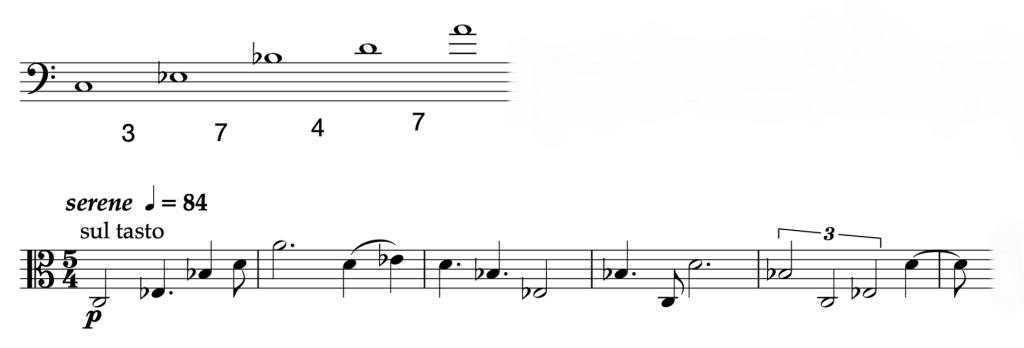
The score is not finished until all details are included, showing clear information and intent. A solo line especially needs strong dynamic shaping to be interesting as a solitary musical voice. The following example from the viola solo notates many of the necessities on this checklist:
timing information, including tempo, rallentando, fermata
expressive indications
dynamics, including ample changes, crescendos, diminuendos
phrasing such as slurs
special techniques such as con sordino, sul pont, sul tasto, harmonics
6. Overall form
An unaccompanied solo is a soliloquy. The dramatic tone can vary: a rage; a contemplation; or a story. The form can be a continuous flow of development of a single, persistent gesture, as in Berio’s Sequenza series. Or it can be sectional, a story told in short chapters, a poem divided into stanzas.
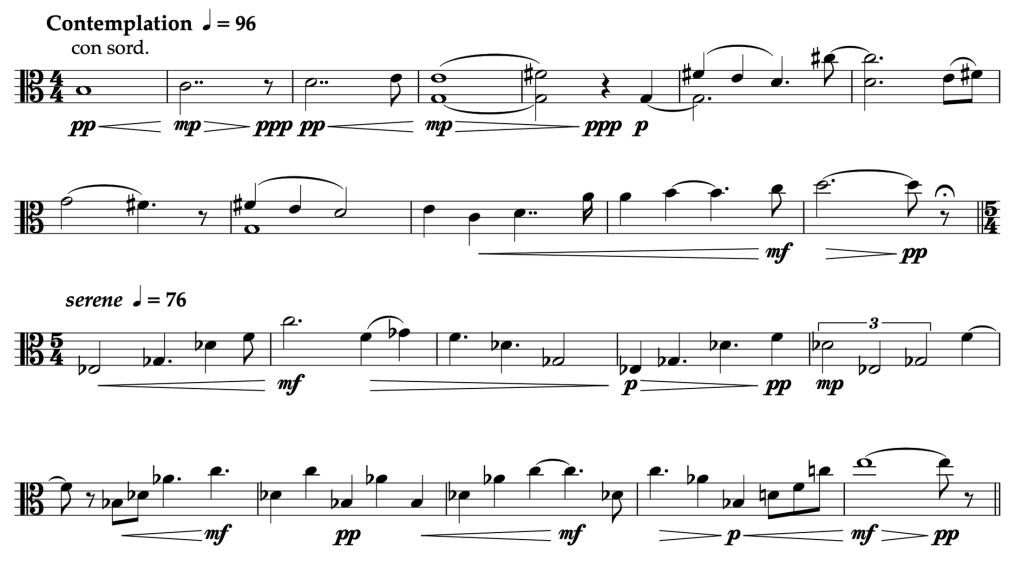
The TC example, actually a previously composed 2018 piece titled Before I Sleep, was written for my colleague Ames Asbell of the Texas State music faculty and Pleasant Street Players, an outstanding artist and player of one of my favorite instruments. The title is a quote from the last lines of Robert Frost’s famous poem “Stopping by Woods,” a contemplation of death on a nocturnal sleigh ride in the snow. The lead motive is a quote from Mahler’s Symphony No. 4, which open with flutes and sleigh bells jingling what is called the “bell theme.” My musical form follows the poem, in three sections:
sleigh bells and a trotting horse (gestures A and B)
snowflakes (a variation of B transitioning into D and F)
contemplation (C and E)
The poem ends famously with a direct repetition of the last line, “and miles to go before I sleep.” That could have been the going-to-sleep hypnotic musical ending as well, but the poet is not ready to die. My musical ending instead is not a coda but a brief tag, gesture G, the horse gently shaking his bells in the glistening moonlight.
Canon is a venerable, centuries-old compositional device, building counterpoint between a melodic line and one or more delayed and possibly transposed echoes of itself. Like a magic trick, it makes a strongly cohesive contrapuntal texture of rhythmically independent lines that are like clones of each other. Canon is more intense than a fugue, which formalizes the echo cloning technique, interspersed with free counterpoint.
1. Study historical models
There are many great models to study. Many 16th-century composers (notably Josquin and di Lasso) wrote canonic choral mass movements. Known more for his fugues, the great 18th-century contrapuntal master, Bach, also wrote several intriguing canons in his late work The Musical Offering. No more elegant model exists than the first movement of Anton Webern’s Symphonie Op. 21(1928), in which four voices are spun out by successions of instruments each in turn differently coloring two to four notes of the same 12-tone line.
Like every fine magic trick, there are several basic techniques we can learn to construct a canon. I’ll cover three, which I will call Zigzag technique, Trial-and-error technique, Rhythmic alternation, and Stretto echo.
In 1610, Venetian composer Diruta wrote Il Transilvano analyzed Renaissance polyphonic style by codifying five species of rhythmic relationships between contrapuntal lines. Johann Joseph Fux, in his monumental 1725 pedagogy, Gradus ad Parnassum, explicated 16th-century counterpoint using these rhythmic species, of which the following are of special importance for us in this lab:
FIRST Species – note against note
FOURTH Species – lines alternating, seldom moving simultaneously
FIFTH Species – a mixture of rhythmic values in all lines
2. Zigzag
My name for it says it simply, like laying bricks one at a time but staggered to overlap.
Compose a few notes of the lead line. (In the example below, it is just three notes in two measures.)
ZIG: Establish a time delay. (in the example, one measure of two half-note beats). Duplicate the first notes (rhythm and melodic interval shape) in the following line, starting on a chosen pitch that makes the kind of vertical contrapuntal interval you desire to emphasize.
ZAG: Select new notes for the lead line that overlap with the ZIG notes, again making your desired vertical contrapuntal intervals. These ZAG notes need not match one-to-one the rhythms of the ZIG notes, providing the opportunity if desired to establish a Fifth-species rhythmic mixture.
The notes of this ZAG now ZIG into the following line, preserving the same transpositional level you established in the first ZIG.
Keep going as long as you wish or have stamina for. When ready to cadence, arrive at a longer note of stable pitch-sense in the lead line.
The canonic material you just contructed can be reused transposed. Just be sure you transpose all lines together by the same transpositional interval.
In the example below, my seven zigzag-composed measures are transposed down one semitone.
Starting on Eb might be useful to follow the first statement of the material, which ended on D in the lead (lower) line. Or I could transpose the whole thing up 8 semitones to start on C, eliding with the middle C (bass clef) that ended the following line.
Adding the third part enables this stair-step sequential transposition of the two-voice canon to go on and on . . .
3. Trial and error
Let’s try a different technique to add a canonic answer, one that is facilitated by notation software such as Finale or Sibelius. This way involves
copy the whole lead line, not just a head motive
choose a time delay or maintain one already established. Paste into the new answering voice the lead line
Playback the synthesized audio to test aurally for contrapuntal viability.
If it sounds bad, analyze the vertical intervals to discover why.
Make a strategic choice of a transposition of the pasted-in answer, then test it aurally.
Keep trying different transpositions until you find one you really like.
For traditional diatonic tonal subjects, common transpositional choices are: unison; octave; Perfect 5th (7 semitones); Perfect 4th (5 semitones).
In the following examples, I show in the first system a trial of an added third voice in the middle, starting on E (alto clef) transposed an octave up from the lead. For the second system, I tried adding a third voice on top, transposed up a Major 9th (14 semitones) from the lead’s start on Eb to start on F (treble clef).
Horrible, yes? Why? What vertical contrapuntal invervals are the sour ones to your ear?
I’ll jump to a better trial that succeeds in both places.
In this successful trial, the first system’s added middle voice transposes from the lead’s E up 13 semitones (minor 9th), and later in the second system the added upper voice transposes up also 13 semitones from the lead’s Eb to a second answer starting on E. The minor 9th is unusual, unorthodox, chromatic, not a solution we might predict . . . but it works!
4. Rhythmic alternation
This will be like Fux’s Fourth Species. The lead subject is best with some long note values, leaving ample time for answering voices to present pitches when it is not moving. Transpositional choices for entering answers become fixed as predominant vertical intervals throughout the canon. In this example, the first answer chooses down 11 semitones plus an octave, and the second answer enters up 7 semitones (Perfect 5th) from the first answer, which is down a Major 10th (14 semitones) from the lead line. Thus vertical (harmonic) intervals of 11, 7, and 14 semitones end up projecting harmonies based on the 7 4 array: G up 7 to D up 4 to F#, which is up 11 from G. That sets the harmonic character of pitch constellations throughout the canon.
5. Stretto echo
Stretto is the term used in fugue structure for when an answer to the subject happens before the subject is finished, sometimes with a delay as short as only one or two beats. For a canon, this offers an interesting strategy for choosing pitches to shape a subject that makes its own arpeggiated harmony as it goes. The answers at unison (not transposed) are literally echoes. Even with answers octave-transposed, the effect is a multivoice arpeggiation. The fascinating wrinkle, however, is that the “chord” being arpeggiated is constantly evolving, dropping one pitch and adding one new at each note of the lead line.
Though this setup can work with other rhythmic “species” of lines, it is particularly interesting in the note-against-note conforming rhythms of “First Species.”
Here is how it can work, using the canon above as a straightforward example.
This analysis sounds as a rather nice progression of arpeggiated chords and simple flute line! The important point, though, is that this progression did not come first. It was built by the canonic subject line as each new pitch was chosen to make a certain array with the previous two pitches in an ongoing, evolving flow. Magic!
6. Spin a piece
For our example, we’ll follow the order of the example techniques:
two-voice zigzag canon
add a third voice by trial and error
stretto echo of the same subject
Rhythmically spacious subject allowing non-synchronous timing of answers
Recapitulation of the stretto echo canon
The result is a fuller working out of No. 10 of the 14 specimens in my Book of Canons:
Black Canyon
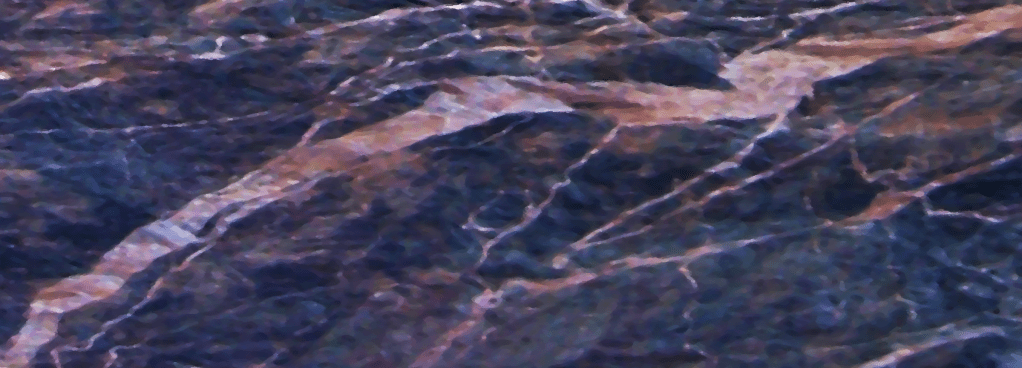
The title comes from my photographic memories of the Black Canyon of the Gunnison River, named for the ever-present shadows the narrow canyon’s steep, sheer, tall rock walls cast on the river flowing far below. The sheer cliffs of the Black Canyon are metamorphic Precambrian gneiss and schist, streaked with thin, brighter-colored layers of pegmatite. These streaks sketched on the darker rock look like maps of ancient contrapuntal lines.
Schubert‘s famous lied, Erlkönig — a dramatic setting of Goethe’s poem with a hammering piano ostinato as the running horse’s hooves, it uses tonal changes and vocal tessitura to draw distinctions between four dramatic voices.
Or Charles Ives‘ “The Cage” — utilizes whole-tone scales and “quartal chords” to depict the restless pacing of a leopard in its cage.
2. Find simple lyrics
A short poem or single stanza that evokes colorful or dramatic images — or write your own. Limit the total number of syllables so that the vocal line isn’t forced to be too “note-busy” just to cover each syllable. This leaves room for some syllables to have more than one pitch, a melisma that extends the duration of an important syllable’s vowel with beautiful melodic curves.
TC example
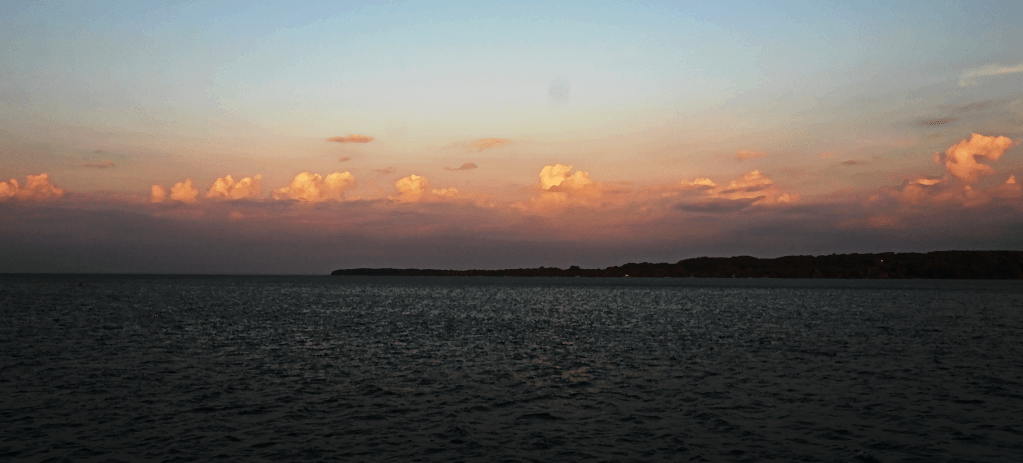
Speaking of curves, a recent visit to the shores of Michigan’s Leelanau Peninsula inspired me to write a poem:
Yin Yang
Peninsula upon peninsula upon grand peninsula, Lee upon Leelanau upon Lower. Cove from bay from great lake, Suttons Bay off Grand Traverse Bay off Lake Michigan.
Land curves in myriad shore shapes, Reaching out to blue water. Fresh wind weds the land and water, Sun warms bright sails and sailor.
That is a total of 76 syllables. Though it does not rhyme, there is a simple poetic structure. Each stanza has two 2-line sentences. In both sentences of the first stanza, the first line describes a general recursive process, then the following line particularizes that with geographic names. The second stanza follows this same two 2-line sentences pattern. Land touches water in the first 2-line sentence. The last sentence, like a traditional sonnet-ending couplet, introduces the melding elements of wind and sun.
3. Design tonal material
For this lab, let’s start with a scale pattern, something different than a major or minor scale. Let’s limit it to a pattern of no more than 6 pitches in an octave.
TC example
I am choosing a six-note pattern, array 2 2 2 1 2, that is actually a truncated Lydian mode scale:
It also has a similarity to a whole-tone scale, with three consecutive array intervals of 2 semitones (the “whole-tones”). Both the Lydian and whole-tone characters are exotic sounding, conducive to the Impressionistic landscape painting quality I want.
It also interests me from the remarkable standpoint that its complement, the six other pitch-classes of a 12-tone scale not included, make an incomplete Dorian scale pattern whose array, 2 1 2 2 2, is just the reverse/inverse of the incomplete Lydian. Cool!
4. Make a melodic theme or motive
Think about shape: a line can step through the scale pattern or skip or leap to non-adjacent tones of the scale. A line can go straight up or down (like an arpeggio), or it can turn (change direction) occasionally or frequently, or even incessantly (making a stationary oscillation).
TC example
This melodic shape has three turns in direction, on the F then on D then on B. (Only the A is not a turning point.) It also uses five different melodic interval sizes, each only once. The mirror inversion has these same features, here starting on G#.
5. Construct prototype constellations
Drawing pitches from the chosen scale, establish preferred harmonic interval arrays.
TC example
Mine emphasize the intervals 2, 5, 7, and 10, setting a harmonic character
5. Build the song’s form
The large-scale form of a song will usually be prescribed by the nature of the lyrics, such as the stanza structure of a poem. The music’s sectional form may use changes in tonality, tempo, or rhythmic character to parallel changes of tone or image in the lyrics.
TC example
Instead of marking sections or stanzas by tonality, I will choose to differentiate with tempo and rhythmic fabric. Bright introductory chords are sustained for different prime numbers of 8th-notes — 7 then 5 then 3 then 7.
The land sentence will be set in continuous quarter-notes. Pitches are again drawn from our primary Lydian-and-Dorian scale patterns but with varying orders and octave placements.
In a faster tempo and pace, water will be set in continuous flowing 8th-notes.
The second stanza will transition from the 8th-note flow to slower, more mixed rhythms and, finally, back to an echo of the static chords from the beginning.
6. Shape vocal melodies to lyrics
For singing, multi-syllable words should be divided the way a singer would sustain the vowel before ending the syllable with the consonant initiating the next syllable.
Vocal range should be considered and the pitch space used limited to the likely capabilities of the kind of singer you’re writing for. The higher tessitura (portion of the range) might be reserved to effect a climax if appropriate to the lyrics.
In determining rhythmic values for the melodic vocal pitches, it is important to recognize the accent pattern of the words, giving accented syllables a musical accent, either by:
metric — placing them on a beat or strong beat
agogic — sustaining them for longer duration
contour — placing the accented syllables on pitch high or low arrival points
combination of any of these emphases
TC example
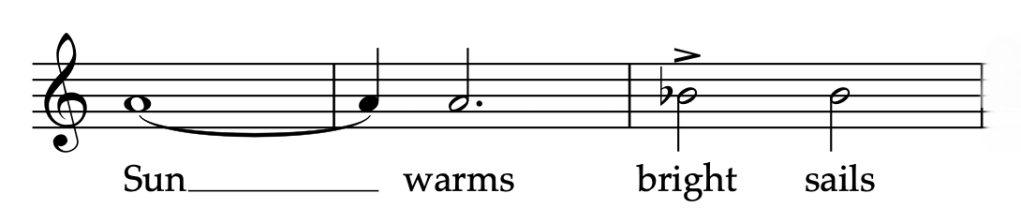
Trying to limit the vocal range required to sing this simple song, Yin Yang extends from middle C to the D an octave and a step higher . . . except saving an Eb yet one semitone higher for the dramatic last note on the last word.
Pe-nin-su-la u-pon pe-nin-su-la u-pongrand pe-nin-su-la, Lee u-ponLee-la-nau u-ponLo-wer. Cove from bay from great lake, Sut-tons Bay off GrandTra-verse Bay off Lake Mi-chi-gan.
Land curves in my-ri-ad shore shapes, Rea-ching out to bluewa-ter. Fresh wind weds the land and wa-ter, Sun warms bright sails and sai-lor.
Notice how the incidence of consecutive stressed syllables increases toward the end.
7. Fit the melodic and accompanying lines together
Melodic pitches can be drawn from the underlying chord. Or they can represent “non-harmonic tones” forming a dissonance against some pitch of the harmony.
TC example
My Peninsula melodic pitches are taken from the underlying chord.
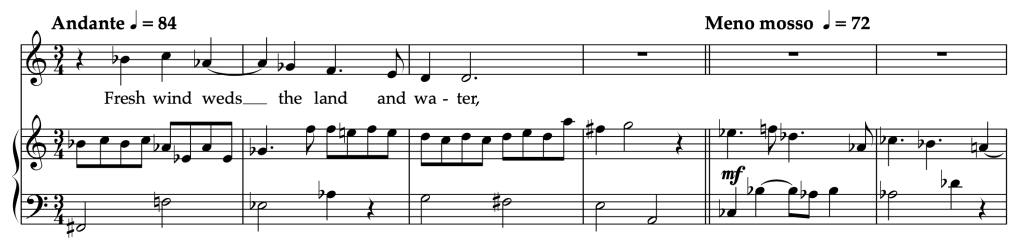
Since the piano presents the chord as a moving line, vocal pitches often are a simultaneous with the same piano pitch, as in “Fresh” and “weds” above. Melodic tones can also occur not at the same time as the matching harmonic pitch, but instead make a contrapuntal (vertical) interval between the two parts. Under each new vocal pitch below, I’ve indicated the contrapuntal interval it forms with the differing piano pitch of that moment.
You can see a contrapuntal interval consistency between the voice and piano, even as their rhythmic streams contrast.
8. Assemble the song
Now it’s time to put everything together. A traditional approach will include a piano-only introduction and at least one interlude without the voice.
Normally I suggest listening to a whole piece without watching a score. Since my synthesized rendering here cannot pronounce the words in the synthetic voice, however, I suggest watching below to get the feel of the lyrics that, after all, drive the whole song.
For this first mapping lab, a basic experimental process is outlined step-by-step and demonstrated with examples from a sample composition. Once you’ve studied the example piece, you can start over and craft your own experiment using the same open steps. General instructions leave you free to openly consider and choose from many musical possibilities.
1. Choose a model
Trois Gymnopédies (1888) by Erik Satie
Simple in harmony, meter, melody, texture, repetitive form.
2. Design a theme
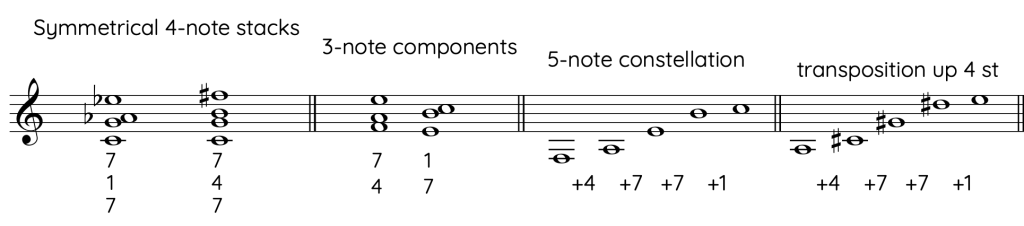
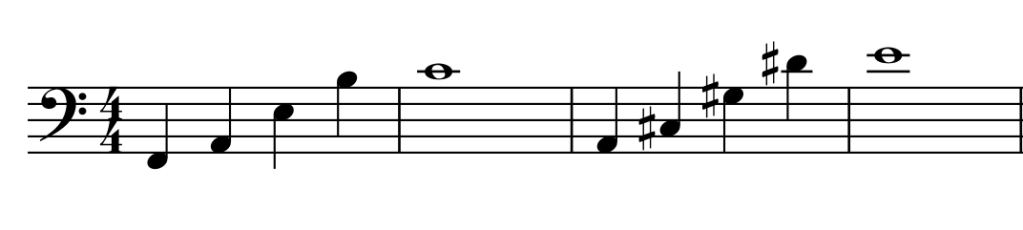
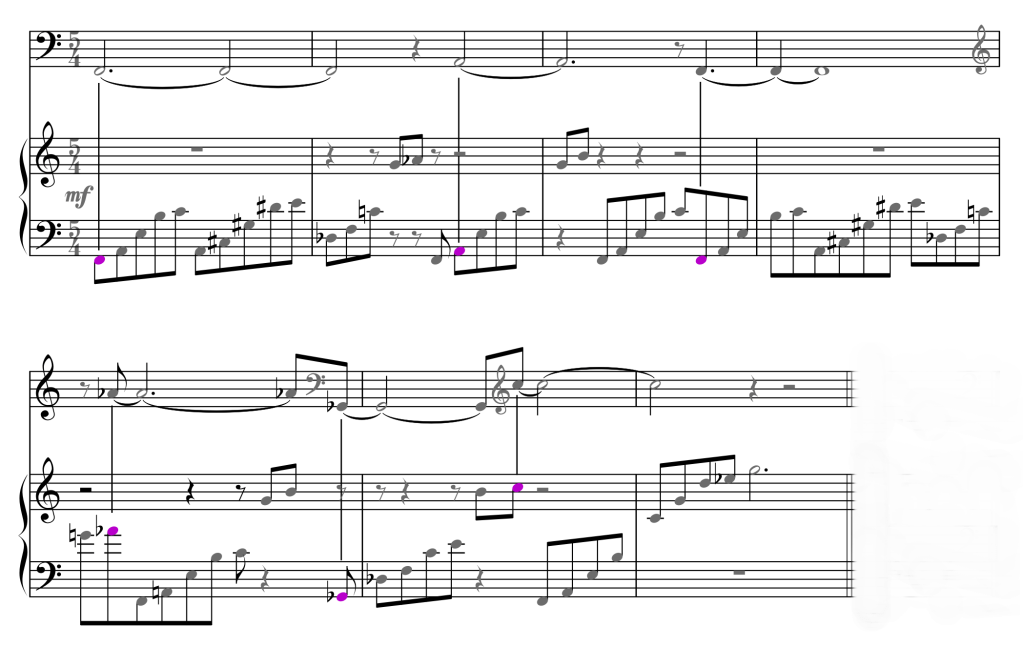
Start with a pair of 4-note constellations of considerable interest due to their symmetrical interval stacks and “perfect fifth” 7-semitone interval separated by a smaller interval. (See “Symmetrical interval arrays.”)
We’ve made two chords, both with the same identical interval stack.
3. Choose a meter and rhythm/tempo character.
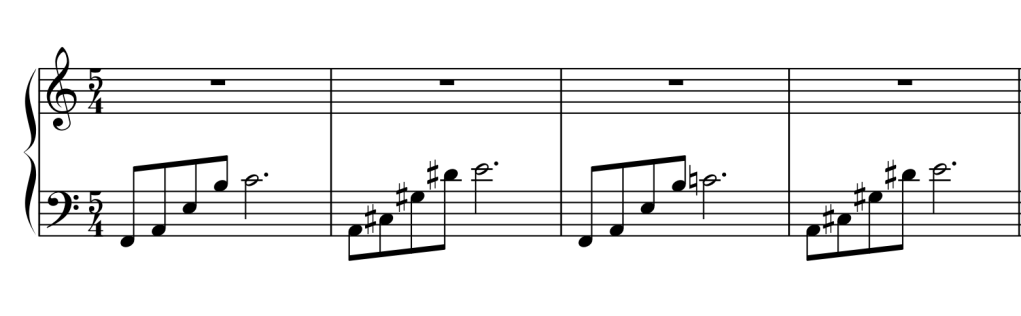
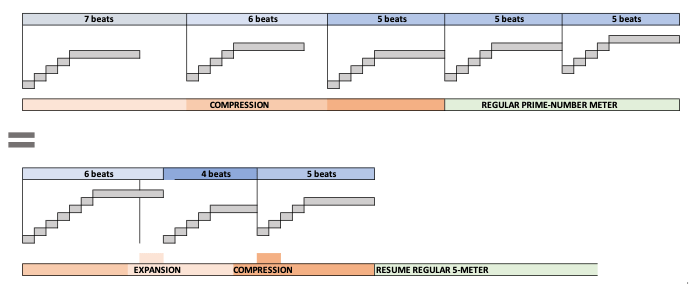
A prime-number meter (such as the 7 4 meter used for the Finale of Stravinsky’s Firebird) can have a more “timeless” quality, due to its lack of layers of nested pulse between beats and bars. The prime number of beats prevents them from grouping into regular sub-measure groupings.
To follow through further on the floating feel of lacking groupings, let’s stretch the timings a bit between arpeggios.
4. Add a line and sound color to the texture
I call this technique extraction or refraction, pulling selected tones of a complex line into a separate voice:
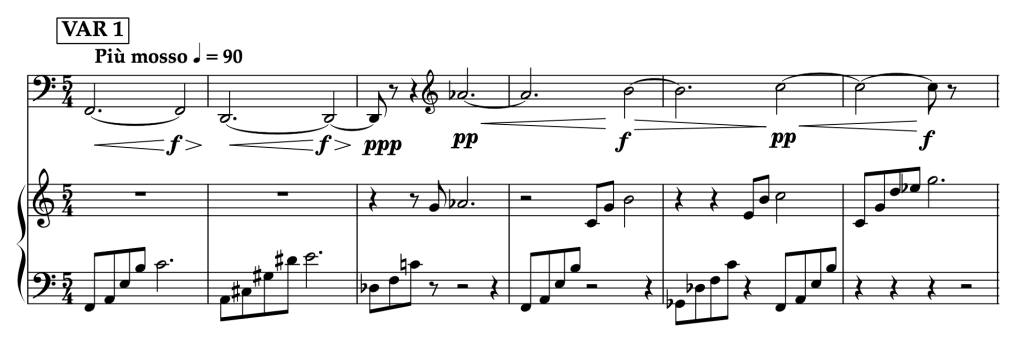
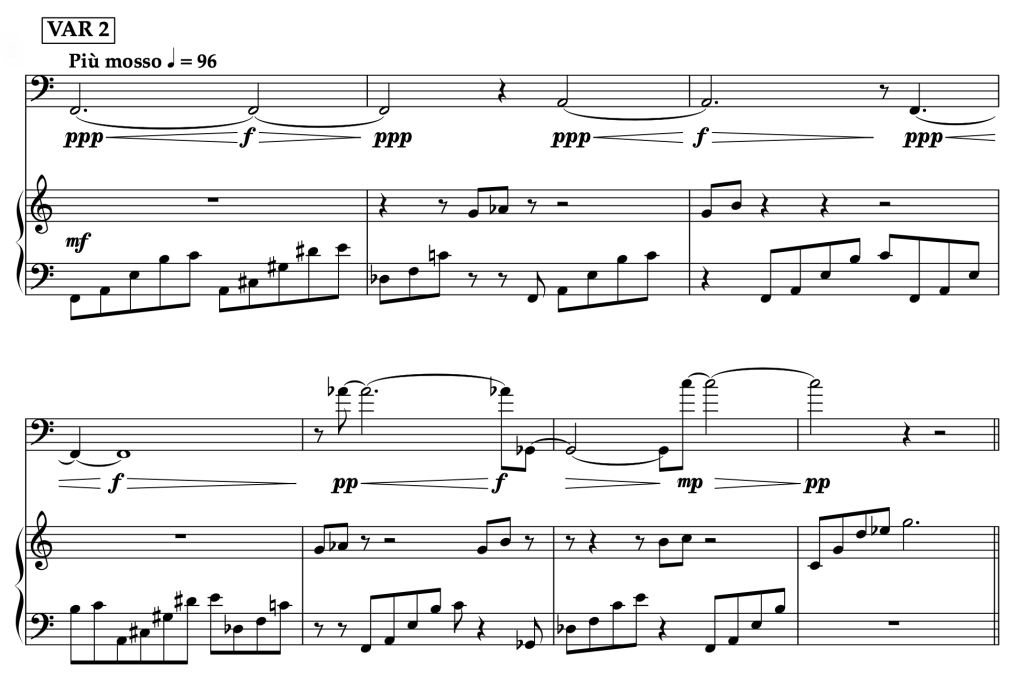
5. Make variations
Arpeggios with refracted color line:
Pull the 8th-note arpeggios into a continuous stream:
Canon at the octave:
Rhythmic augmentation, without then with the refracted color line:
Mirror inversion of augmentation, canon:
6. Assemble the large-scale form
The theme and each variation end with a clear cadence, a sustained final note and pause in rhythmic activity . . . except Variation 3, the continuous 8th notes. It morphs into a transition that both interrupts the 8th-note flow and slows the tempo, preparing for calmer, much less dense quarter-note variation:
The variation process is serial, each one progressing from the previous idea, rather than “starting over” each time. Thus the overall unfolding form feels evolutionary rather than episodic. Then a kind of recap does start over with a return to the opening idea, making a rather traditional coda ending,
6. Title
This musical sketch, like most of my pieces, was composed without a title or guiding image. The compositional process began with the basic challenge to make a small piece out of simple, limited material. The adopted model was Satie’s radically sparse, (one could even say) minimalist style in his Trois Gymnopédies for piano (1888), Its title may have been taken from a French poem by J. P. Contamine de Latour — the poem ends with the word gymnopédie:
Oblique et coupant l’ombre un torrent éclatant Ruisselait en flots d’or sur la dalle polie Où les atomes d’ambre au feu se miroitant Mêlaient leur sarabande à la gymnopédie
Slanting and shadow-cutting a bursting stream Trickled in gusts of gold on the shiny flagstone Where the amber atoms in the fire gleaming Mingled their sarabande with the gymnopaedia.
My title will adopt the English translation of one selected metaphor: Amber Atoms in the Fire Gleaming.
7. The finished piece
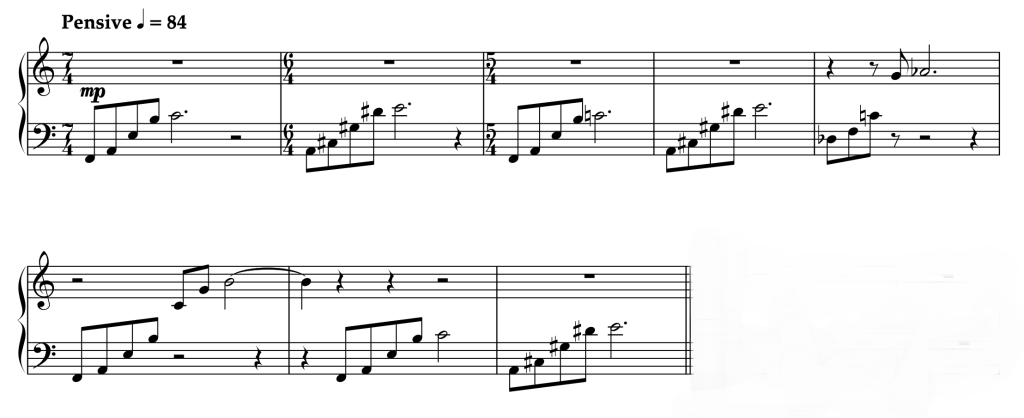
In keeping with the Satie models, this study generates entirely from one modern harmonic constellation, arpeggiated repeatedly in a gentle, almost imperceptible meter, then growing colorful “amber” sustained highlight sounds. Eventually the arpeggios begin to spin and swirl in a layered, kaleidoscopic texture that is “minimalist” in the 20th-century usage as the description for repetitive ostinato music.
8. Test sample
Listen without looking at a score, the best way to first sample created art:
“Mapping” has double meaning. A road atlas measures and records all the routes through a given territory. But we also call “mapping” the creative act of planning out a journey, using map information to choose between many possible routes. Composers use an array of processes to map out a musical journey. Designing a piece entails making a storytelling rhetoric, a pacing plan, and an architecture of interrelated components.
Each Map Lab in Mapping the Music Universe presents step-by-step recipes to compose simple pieces based on models of different musical genres. Each lab also includes an original sample piece following the Map Lab guidelines, illustrating one possible creative path and outcome.
Try your own experiment with any of these lab projects:
Rhythmic intensity is an important factor in shaping musical form. A former research project “Density Functions in the Structure of Modern Music” in the 1970s sought to quantify it along with several other core aspects of structure at play in shaping large-scale form.
In the TIME chapters, we previously mentioned pace and showed how it can accelerate or decelerate in a line while tempo remains steady. (The Beethoven string quartet example Op. 135 illustrated that.) We have now also defined composite rhythm as an intersecting sum of rhythmic time points of lines, the layers of a textural fabric.
Density
In physical terms, density is a ratio comparing the amount of mass to the amount of space it takes up. Measuring time space, tempo (expressed in “M.M.” beats per minute) can convert a count of beats into a time-length in seconds:
DURATION(in seconds) — multiply BEATS times 60, then divide by TEMPO
Now we’re ready to measure the pace of a line for a bar or a whole phrase:
PACE(Notes Per Second) — number of notes divided by the duration of the stream
And then to quantify for a whole texture of rhythmic activity:
RHYTHMIC DENSITY(Attack-Points Per Second) — number of note-starting time-points in the composite rhythm of the whole texture divided by the duration of the stream
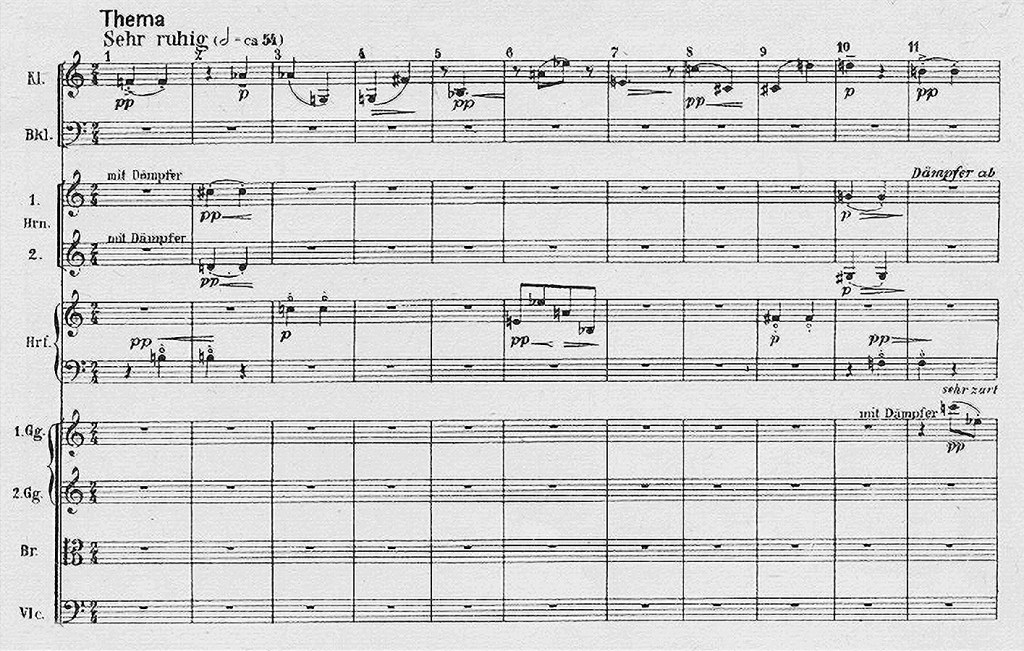
Let’s go back to the Webern Symphonie Op. 21. Though called a symphony, it has only two movements. The second movement is a theme and variations with coda, each exactly 11 bars long in two-four meter. Here’s the theme:
Op. 21, II — theme
Each variation, though 11 bars long like the theme, is in a different marked tempo. Each is distinguished by a contrasting degree of rhythmic density. And though the theme is a sparse (pointillistic) fabric, some variations are contrapuntally thick and intense.
Rhythmic density and what we might define as textural density (how many lines woven into what octave span) basically trace the same unfolding through the variations. The exception is Variation V. There they diverge, intensely active rhythms but only three textural elements in a diffuse pitch span of almost four octaves.
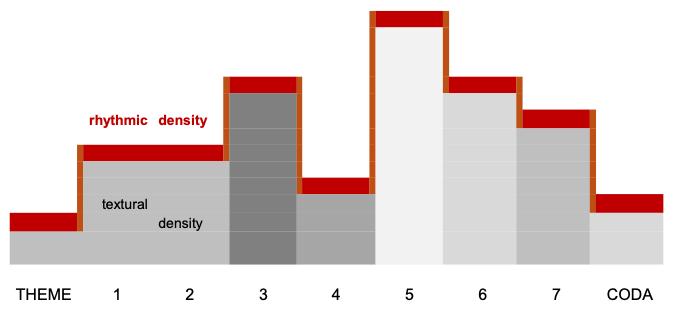
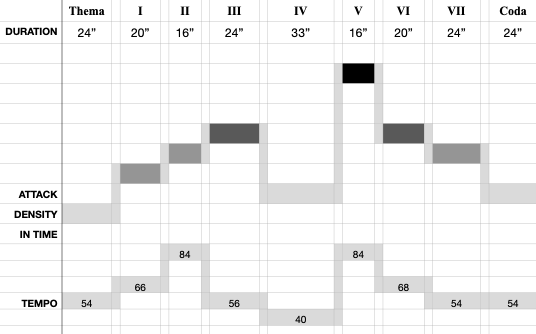
A graph of changing rhythmic density values in each variation highlights rhythmic density as the bolder line:
density graph of Op. 21 II
About broad form, this reveals that from the beginning, rhythmic density increases to a subordinate peak in Variation III and overall peak in Variation V, then variation by variation steps down to a coda that matches how we started with the sparse theme. In rhythmic density, the whole movement is an arch form, with Variation V the “climax.”
In the first “abstract sound mobile” of my 2024 work, FOLIO, it is easier to hear changing density as the changing thickness of clouds of sound, swelling and subsiding.
“Music of the Spheres”
Relativity
Modeling, the process of creating an overall design, can mean creating a new model or expanding the possibilities of an existing model.In Learning to Compose we identified and described three basic musical approaches:
NARRATIVE MODELING — Designing by telling a story, with characters, themes, gestures, suspense. What will happen next?
SPACIAL MODELING — Designing the size, shape, and texture of blocks or sections of material
TEMPORAL MODELING — Designing the flow and momentum of events in the passing of perceived time
Variation and contrast
Contrast is the essential complement to developmental continuity in musical material, driving musical momentum. Theme and variations form is a straightforward, traditional example of narrative modeling balancing contrast and continuity. Each variation preserves some basic element of structure such as harmonic progression (or in the Webern example, the tone row). Each variation presents a setting of that theme element in distinctly different orchestration, texture, mode, tempo, or rhythmic character.
The composer determines not just how and when to make a contrast, but how dramatic the contrast will be. Their fluctuations over time are the core of the composer’s instinctive variation skill. This is the impelling force that gives musical form a sense of going somewhere, of leading up to and flowing away from stable plateaus marking the structural pillars of large-scale form.
FLUCTUATION — Magnitude of contrast from one moment or event to the next
When analytically quantifying fluctuating data, the time scale of measurement matters. In avant-garde or experimental music, a stream of events may be high-contrast on the moment-to-moment scale but steady-state over broader time spans. Conversely and more traditionally, surface events may be continuous, while the bigger chunks of events, like one variation to the next, may pose more dramatic changes in parameters such as rhythmic density.
In typical Beethoven or Brahms variations, material within each variation is continuous, not at all fluctuant. The contrast comes altogether in the next variation.
That consideration plays out differently in Op. 21 II. There is the obvious contrast from one variation to the next; but within each variation, moment-to-moment surface continuity also fluctuates. Surface fluctuation in density factors occurs, especially from one 3-to-4-second “moment” to the next. (We can’t really call them phrases.)
For the Op. 21 II. Theme and Variations, we can now say something deeper about changing rhythmic density as the variations progress. From the Theme through the first two variations, rhythmic density increases gradually to Variation III. But then the fluctuation of rhythmic density spikes, dropping significantly for Variation IV, then suddenly increasing to its highest level in Variation V.
large-scale time form
It is not only Variation V’s greatest rhythmic intensity but also dramatically increased roller-coaster fluctuation, dropping then surging, that makes Variation V the climax of the movement.
Macro-structure
Though Webern may not have thought consciously about Schwankung (fluctuation), this is how composers manipulate momentum to make a climax and shape large-scale form. Likewise, approaching a final ending, not only do fluctuations typically diminish, but also rate of change subsides — the overall change factor levels out to zero. These are examples of temporal modeling.
The parameters of a musical event are numerous, a multidimensional matrix of at least six distinct, interacting qualities: each sound event’s loudness, resonance, timbre or sound color, duration, pitch (frequency), and time point of initiation. Imagine this as a six-dimensional space. In fact, physicists have imagined the structure of matter as exhibiting many more than six dimensions in string theory, M theory, etc.
Musical structure establishes the relativity of these parameters, though not exactly the way Einstein explained time, space, gravity, and energy with mathematical precision. Some structures such as the Schoenberg Farben example relate constellation harmony to sound color. Threnody relates rhythmic activity to fabrics of sound in a broad pitch space (spatial modeling). Counterpoint balances rhythmic relationships, metric placement of lines, and synchronicity with their intervallic relationships of consonance and dissonance. Ostinato music manipulates phase relationships.
And, as observed in Part I, temporal density, the rapidity of fluctuations and larger contrasts in these structures, propels our experience of the whole in time.
In Thinking in Numbers, Daniel Tammet wrote about a mathematical study of poetry,
“The best poems . . . combined in equal parts the predictability of meter with the novelty of unusual words. Too much meter made a poem banal; too much freewheeling . . . rendered it hard to follow. The delicate balance of convention and invention gives meaning to what we say.”
The essence of music’s large-scale temporal form is the relativity of overlapping, fluctuating musical structures in time, repeating, contrasting, interrupting, truncating, expanding, certainly recurring, or simply evolving. Designing a large-scale musical form combines temporal modeling, narrative modeling, and spatial modeling — a pacing plan, a storytelling rhetoric, an architecture of interrelated components.
–
–
Coda
sound mass . . . sound color . . . pitch constellations
ostinato repetition . . . changing density
evolving form . . . cosmic time
In Become Ocean (2013), John Luther Adams takes a deep dive into a serene sound sea, incorporating all of the elements and structures we have explored in our mapping journey.
Imagine a piece of music exploring texture in time, made of single sounds and sonorities occurring one at a time in sustained resonance. Then imagine the points of sound are separated by rests, silence. As the texture drifts in and out of a resonant cloud, the sound events remain unconnected. Suddenly, their pace explodes into a torrent of notes. That describes the following powerful piece by my UNT colleague, Joseph Klein.
Joseph Klein – Pathways IV: Rhymes & Spirals (2024)
Sound color
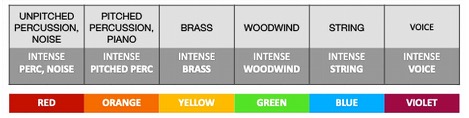
Our next music map shows a simple color-coding graphic system for classifying most musical timbres, informally the tone quality of sounds. The map intuitively chooses colors of the rainbow. While the color spectrum orders the frequencies of light (another manifestation of periodicity), our sound-color classifying map does not imply any ordered quantification of timbral complexity.
instrumental color rainbow
Though we think first of an orchestra for a rainbow of color, chamber music can incorporate a variety of instrumental colors, each produced in vivid isolation by one instrument, standing out or changeably mixed with other colors.
Augusta Read Thomas wrote Dance Mobile in 2021, scored for 13 instruments: Woodwind quartet (Flute, Oboe, Clarinet, Bassoon); Trombone; String quintet: (2 Violins, Viola, Cello, Contrabass); Piano; 2 Percussion (vibraphone/metal, marimba/wood, drums).
The piece starts with a single pitch, blending several colors that swell in intensity. Then ensues a kaleidoscopic dance of at least seven distinct color combinations, of two basic types:
Sustained sounds – strings; high woodwinds; lone brass of the trombone
Sparks – pizzicato strings; ringing metal sounds; drum strokes; staccato piano
Augusta Read Thomas – Dance Mobile (2021)
Though the piece is dedicated “in memoriam Oliver Knussen,” the memory is a joyous dance of color.
Symmetry
In the exposition of Webern’s Symphony, Op. 21, we saw that each contrapuntal line duplicates the exact rhythm of the lead line, with each entrance one bar later — a classic canon. But each contrapuntal line presents a different succession of instrumental colors:
The German term for this is so elegant, we’ll use it here:
KLANGFARBENMELODIE — melodic or contrapuntal line expressed by a string of changing tone colors
Webern placed each pitch in every line in a particular fixed octave, except Eb that appears in two different octaves. This makes a striking, symmetrical 13-pitch constellation with a palindromic array, the same array going down as going up.
Webern 13-pitch constellation
Not only was he obsessed with symmetry in this piece, but this constellation’s symmetry also proves that he was thinking specifically about the chord voicing in what I have identified in successive interval array form.
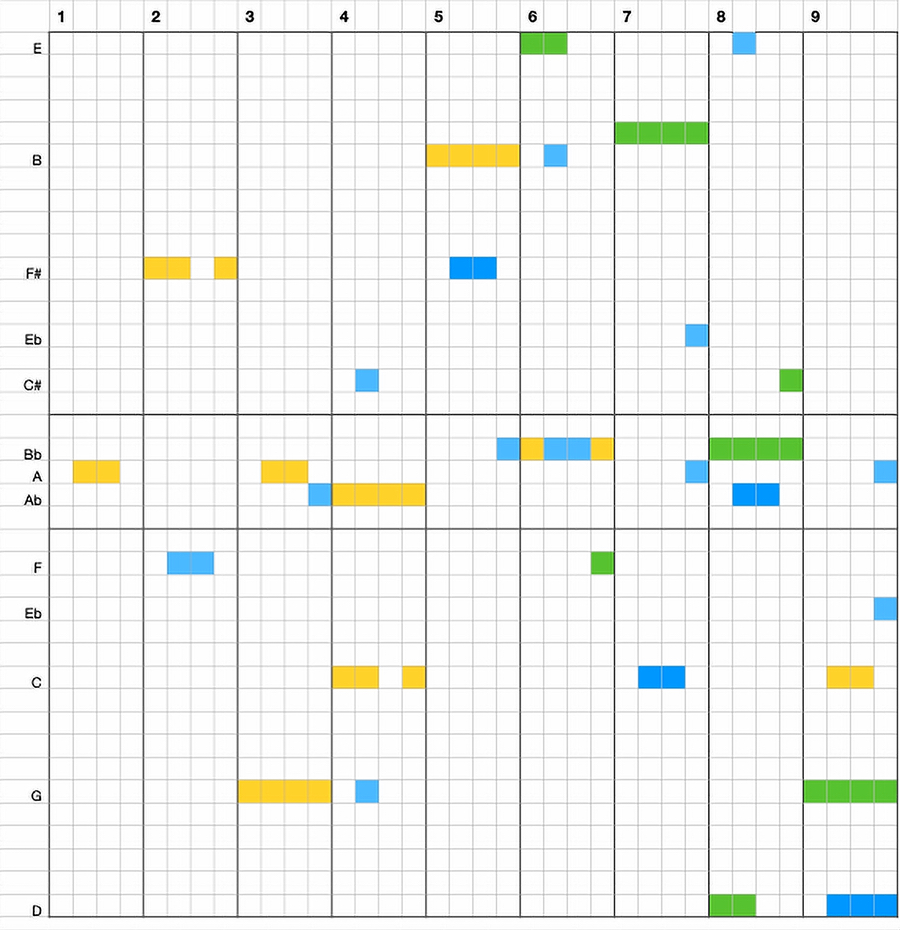
We can use this constellation as a Y-axis for a graph mapping the timbres as they appear in the various parts in canonic lines in pitch space for the first 9 bars. This farben color map looks like one of the later geometric paintings of Piet Mondrian.
Op. 21 color map
Pointillism
Though we often share musical terms and concepts with visual art, we sometimes mean different things by the same term. In painting, a technique developed in the Impressionist style period of the late 19th century that became known as pointillism. The most famous example is Georges Seurat’s “A Sunday Afternoon on the Island of La Grande Jatte” at the Chicago Art Institute. Instead of sweeping brush strokes and palette-blended colors, it used small separate spots of subtly varied colors to make a texture that, when viewed from a distance, seems to merge into a color cloud, giving the impression of animated light.
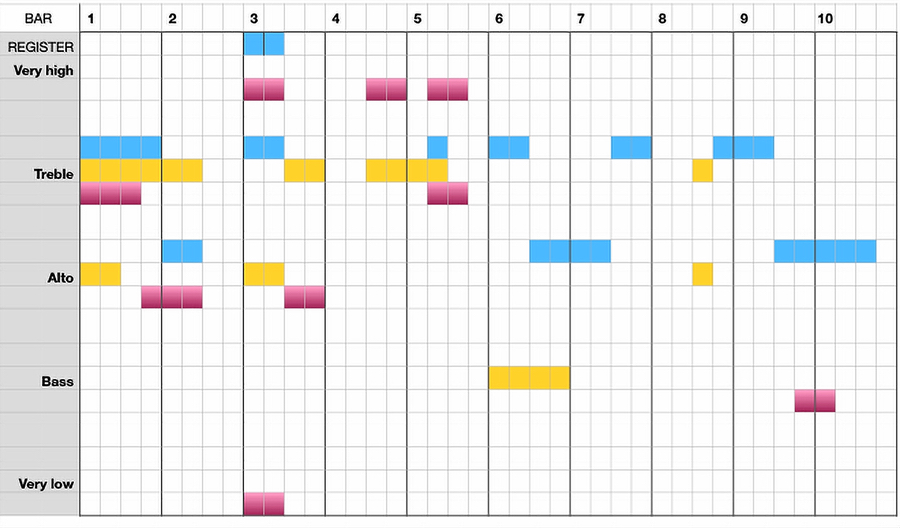
Musical pointillism, unlike painting, separates sounds in time and pitch space, not to blend them into a texture so much as to highlight the different qualities of each unique sound event. Webern was a pioneer of musical pointillism in works such as Op. 21. Let’s graph the first 10 bars of this fabric using our timbre color-coding (BLUE = wind, ORANGE = percussion, VIOLET = plucked string) on a broadly distinguished 6-octave pitch range. We get something as colorful as a Mondrian painting!
Andromeda sound color map
As a musical fabric, isolation — using the vast available range of pitch and the empty time of rests and silence — is a fitting analog for the vast, mostly empty space of a galaxy. Let’s use it for a demonstration etude.
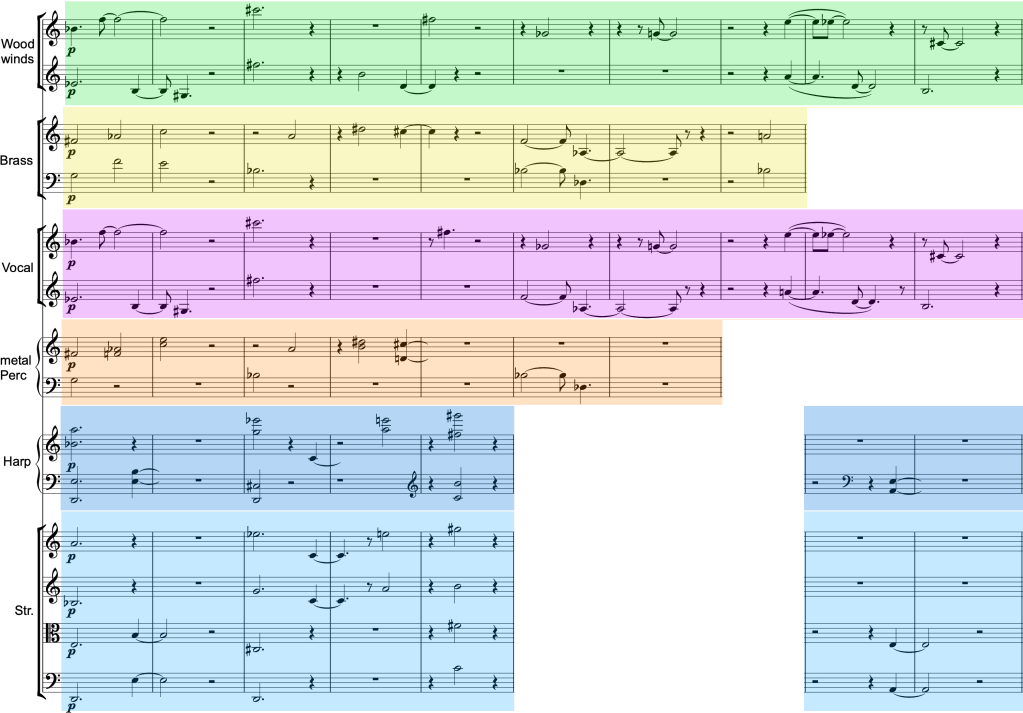
Andromeda is the nearest large galaxy, 2.5 million light-years from our own Milky Way galaxy. Our sound color demonstration study uses every sound quality on our sound color spectrum except red. Here is a score of the first 10 bars.
Notice that the green woodwind notes are doubled with a synthesized vocal-type sound. Yellow brass notes are punctuated by orange metallic percussion attacks. Likewise, blue string notes are articulated by the plucked string sounds of harp.
Here is the whole colorfully pointillistic 3-minute study:
Sound Mass
At a time when electronic music was emerging in the 1950s, new instrumental resources were also developing a new style that was all about animating massive layers of sound.
German experimentalist Karlheinz Stockhausen composed two early, influential sound mass works, Gruppen (1957) for three orchestras, and Carré (1960) for four orchestras and four choirs. The scores were huge, dense, 12-tone, and monolithic in form.
A 2002 piece by John Adams, On the Transmigration of Souls, harkens back to a mid-century masterpiece of the Avant Garde. In 1961, Polish composer Krzysztof Penderecki wrote a piece for a massive score of 52 string instruments. Conceived as an abstract, freeform, dense massing of animated and intense musical fabrics, it represents a pioneer in the genre of sound mass music, winning the UNESCO Prize that year. Only after it was heard in performance, he said, “I was struck by the emotional charge of the work … I searched for associations and decided to dedicate it to the Hiroshima victims” — thus the title, Tren Ofiarom Hiroszimy (translated Threnody for the Victims of Hiroshima).
As a young composer in the ‘70s, I reflected this approach in some pieces titled Animated Landscapes. (The title was inspired by John Cage’s famous Imaginary Landscapes no. 4 for 12 radios.) Beyond referring to the painting genre of landscapes, the title sets the imagination for solid, continuous textures like viewing the shapes of a mountain range, but set into rhythmic motion. (This approach became prevalent in ensemble music, especially of Midwestern composers such as Donald Erb.)
Considerably predating the music mentioned above, Schoenberg’s Fünf Orchesterstücke, Op. 16 (1909), was originally scored for a large orchestra of 37 parts. It is not thought of as sound mass music, as its five movements each have Expressionist or Impressionist titles: “Vorgefühle” (“Premonitions”); “Vergangenes” (“The Past”); “Farben” (“Summer Morning by a Lake”); ”Peripetie” (“Peripeteia”); “Das obligate Rezitativ”(“The Obligato Recitative”). The third movement, Farben, is of special interest not only for its exquisite mixed-palette painting of orchestral timbres, but also for its thick though delicate fabric of sustained sounds. At the start, nothing moves, the subtle shimmer of instrumental colors fading in and out of a continuous fabric of delicate, faint sounds. (A sound mass can be delicate, not necessarily “massive.”)
Here is a score of the first page, showing sounding concert pitches for all instruments.
Schoenberg Farben scoring
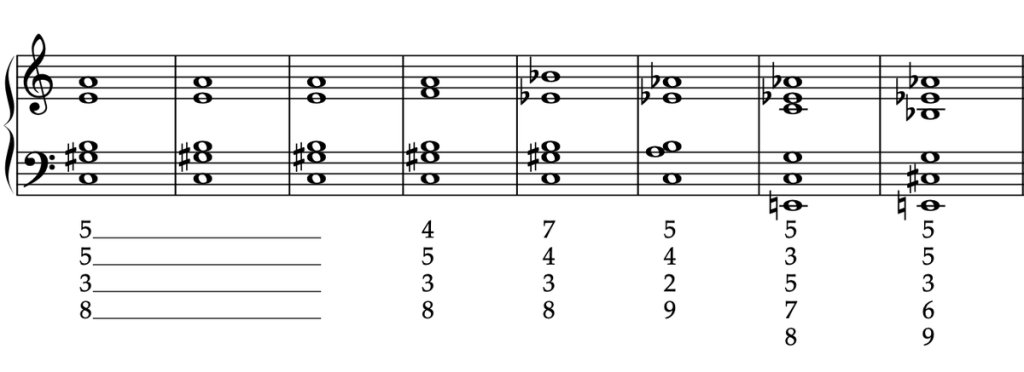
Each measure presents one constellation, recolored with different instruments in the second half of the measure. For the first three bars, the constellation does not change, and then only subtly in the next five bars, maintaining the constant C pedal point in the low strings.
Farben constellations
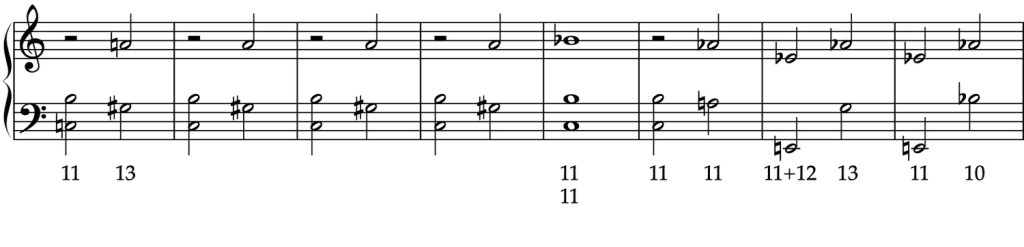
The bass clarinet’s F3 in bar 7 is considered an ornamental non-harmonic pitch. While you can see many recurring smaller constellations imbedded within these changing large constellations, such as 5 5, 3 5 and its inversion 5 3 (which are triads), and some transformations of smaller constituent constellations: 8 3 redistributed to 9 2, 4 7 shrinking to 4 5 (another triad), and 3 4 (also a triad) shrinking to 2 4.
Though there are many triads embedded in the constellations, the overall quality of the sonorities is complex, as the triads are framed within critical dissonances:
framing dissonances
Foreground / background
Most landscape paintings, distant textures of forest, mountains, sky, waves on the sea, or clouds, have some sharp focal point. Often on the horizon (in itself a focusing anchor of the visual display), it may be a barn, a setting sun, a boat, a farmer and dog. If we consider proportion and symmetry in a visual composition, the focal point is best not dead center. A more interesting balance, according to expert photographers, follows the Rule of Thirds, placed one-third from the left or right, one third from the top, or both. Two-thirds is a ratio of 0.667. The Greeks famously defined the Golden Ratio, an ideal ratio dividing a whole length or height into two parts such that the ratio of the smaller part to the larger is the same as the ratio of the larger part to the whole. The ratio is 1.618:1, the solution to the equation: x2 – x – 1 = 0; a 62% and 38% division.
In a simple traditional musical texture, an accompanying harmonic texture is designed as a background for the focal element of a melody. Sound masses may lack such focus, like the forest or sea waves. When there is to be perceived a standout element of the texture, Schoenberg called this focal element of the musical fabric the Hauptstimme. Though that might translate “highest voice,” the melody or other focal events are not necessary to be higher in the pitch range of the fabric than other elements. But there must be some isolation or distinction setting them off from background in at least one of the parameters mentioned above. The Hauptstimme focal line or textural element can be:
in a pitch range isolated from background
a color isolated as a single timbre, not a mixed diffusion of background colors
slower or faster than background
more rhythmically elastic, varied than background
not synchronized with background
loudest line (the most obvious)
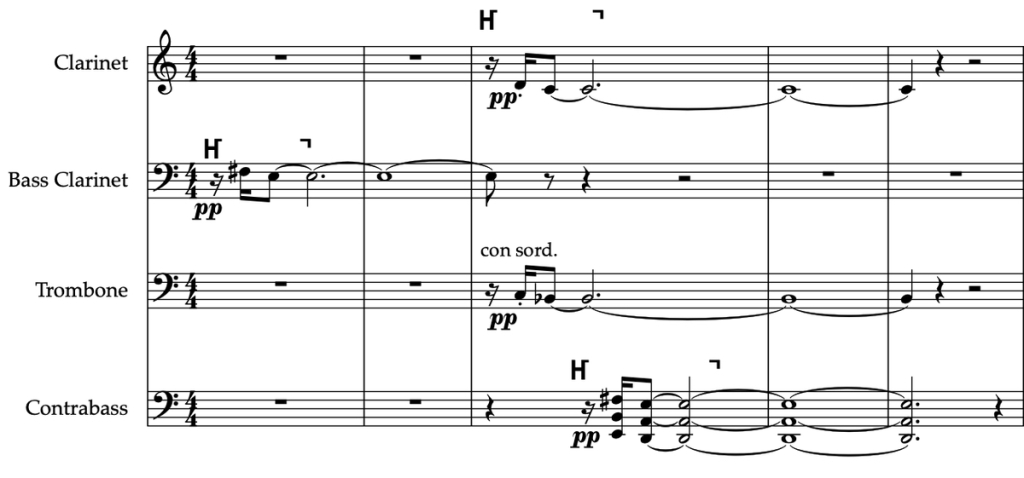
Schoenberg devised a special symbol for the focal Hauptstimme line of a fabric, a boldface stylized capital H, which you see marking the bass clarinet entrance in bar 7 of the Farben example. Here is how that principal Hauptstimme line continues, a Klangfarbenmelodie of changing color, from bass clarinet to clarinet with trombone to three solo contrabasses.
Hauptstimme handoffs
Notice the aggressive rhythmic motive, each time stepping down 2 semitones; and the 7 7 7 quintal-chord constellations in the contrabasses. (The rhythmically aligned clarinet and trombone are separated by 14 semitones, 7 + 7.)
Beyond color isolation, Learning to Compose makes a distinction for a timbre mixed with itself or other colors spread over some pitch register (“diffuse”) or reinforcing itself in a narrow, confined pitch space (“concentrated”). While Farben’sbackground is diffuse, its Hauptstimme color is isolated in the low pitch register of the bass clarinet and then also concentrated with the three solo contrabasses.
In the first movement of Anthracite Fields (2015) by Julia Wolfe, the bass clarinet emerges as a focal sound by its loudness and singularity of pitch in a cloud mass of softer sound. Then aggressively loud clusters suddenly interrupt the steady-state background, yielding eventually to repetitive sung chords and floating vocal duets. The sound fabric maintains a three-dimensional depth of contrasting intensities.
Julia Wolfe – Anthracite Fields I: Foundations (2015)
Galaxy groups
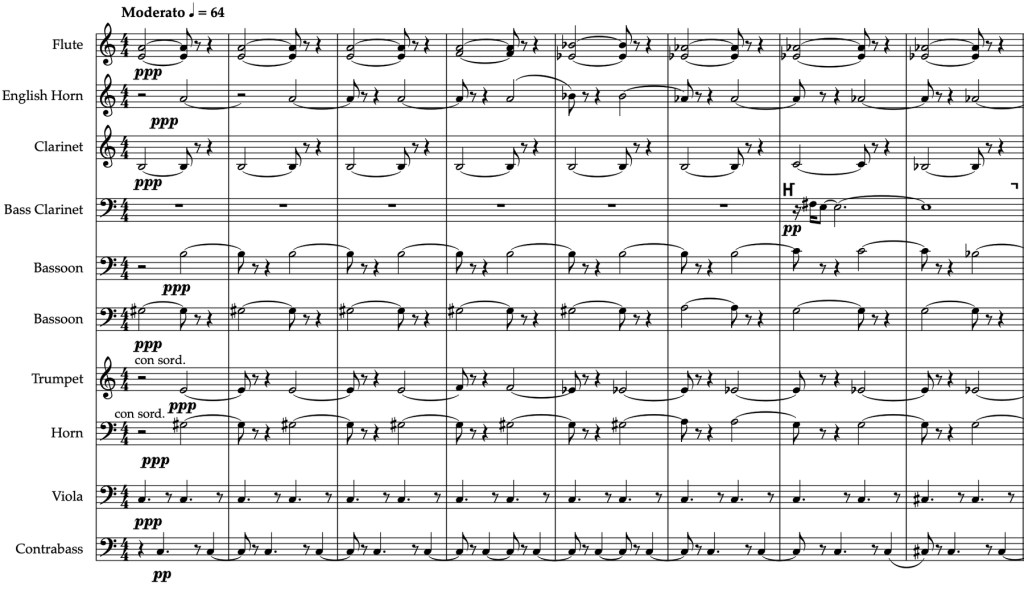
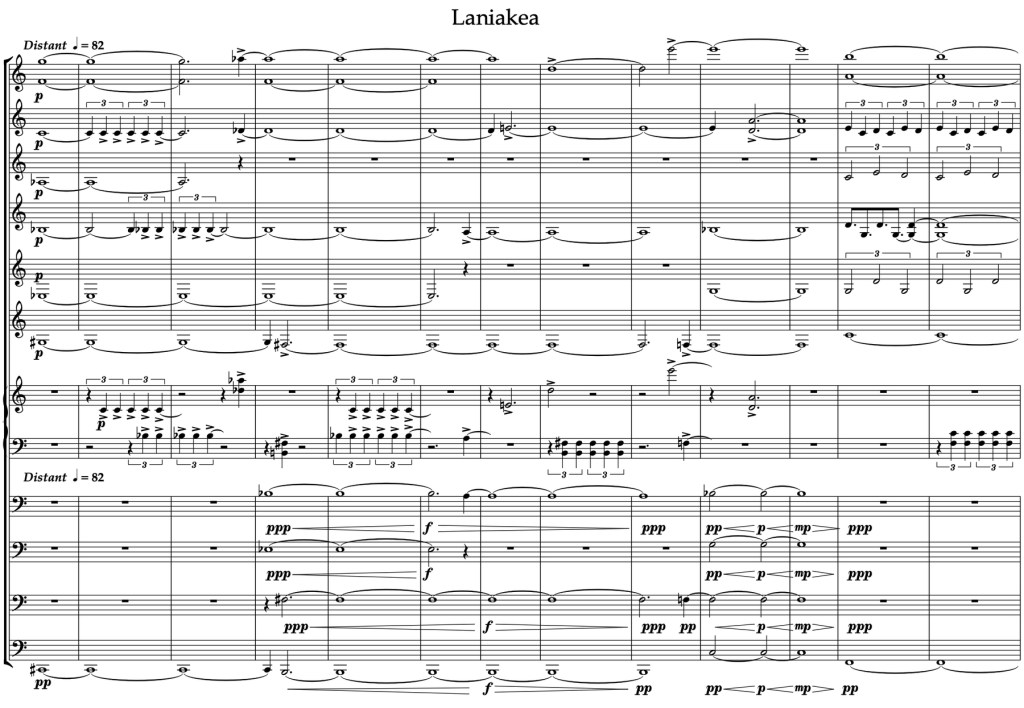
Our sample etude composition for sound mass is a thick score of 10 wind parts and harp, with a fabric the opposite of pointillism: everything sustains and overlaps. There are basically no pauses or holes in the continuous 2-minute sound fabric. Its title, Laniakea, is the name of the supercluster of galaxies that includes the Milky Way.
Laniakea score excerpt
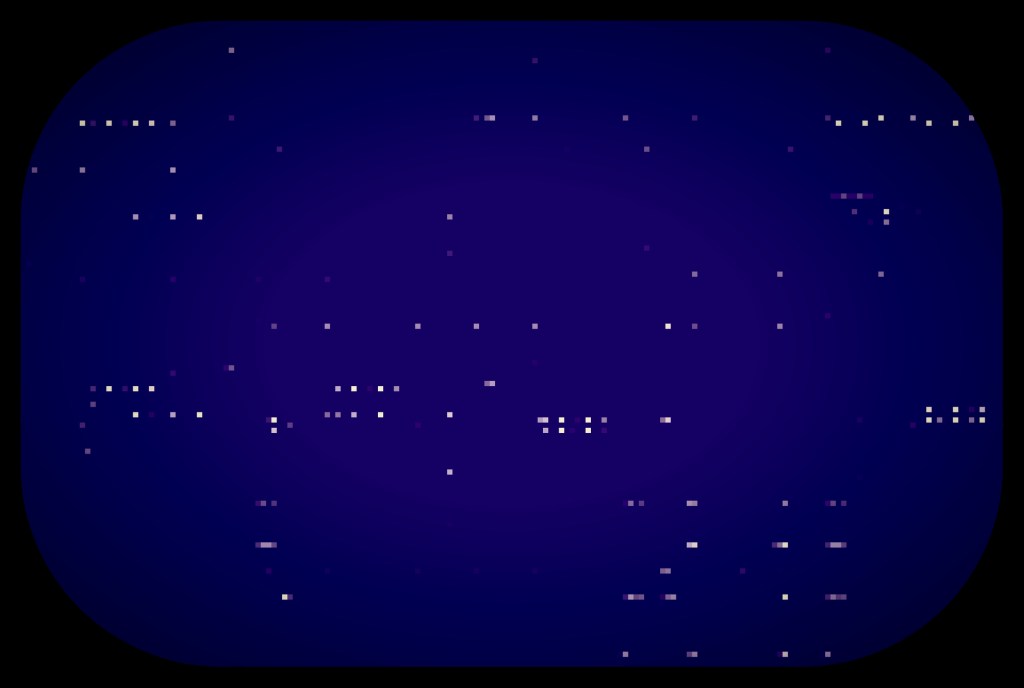
Having shown the score with all its notational details, to better illustrate the main point of the example, sound mass, here is a graphic rendering of that actual second system of notes. We can reveal its pointillism by increasing the contrast in a negative image of light on dark. That makes the attack beginning of each sound show up but not the staff lines or sustained resonances . . . a fanciful art image of Laniakea, a vast empty part of the universe dotted with millions of galaxies.
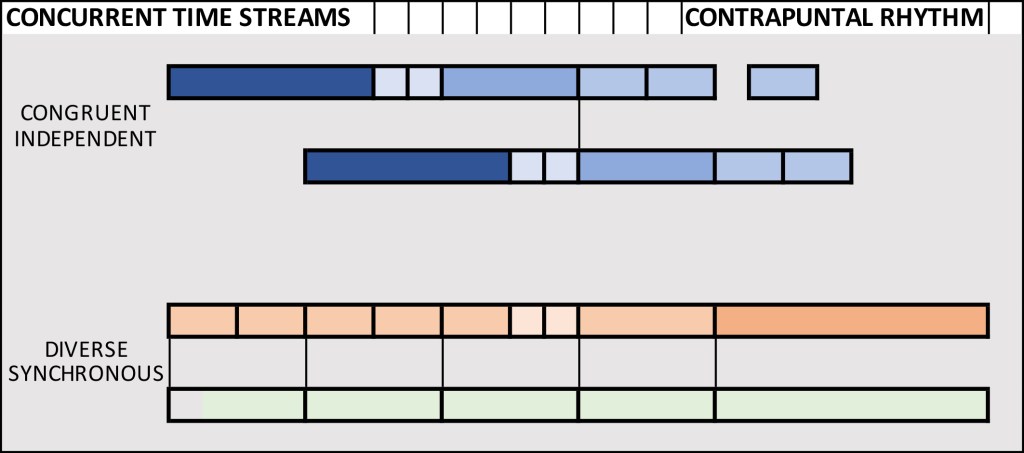
Two lines woven into a shared time stream — counterpoint — can be relatively more or less independent. How similar or diverse are their rhythmic patterns (congruent or diverse)? How often do their note-initiating time points “line up” (synchronous or independent)?
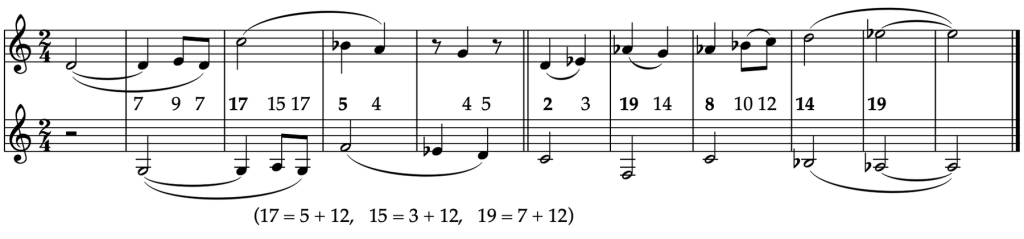
In an example of congruent, matching rhythmic material, the upper line’s rhythm is echoed in the trailing lower line in the first five bars below. But the lines are rhythmically independent, sharing only one time point, the downbeat of bar 4. This echo process is known as . . .
CANON — leading line is echoed after some delay by one or more answering lines of identical rhythmic values and melodic shape (possibly transposed)
For more on canons, go to BOOK OF CANONS, 14 short 3-part canonic studies.
example of two-voice counterpoint
Bars 6-11 show diverse rhythms (the upper line in mostly shorter durations than the lower), and not in canon but synchronized at most of their time points.
Rhythmic alignment
Johann Joseph Fux established a theoretical construct for pedagogical purposes in which contrapuntal lines in a 16th-century style progressed from congruent, synchronous rhythms (“First Species”) to one line twice the pace of the other (“Second Species”), and so on. Only in Fourth Species was the relationship reversed, back to matching, congruent rhythmic values but in studied alternation avoiding synchrony.
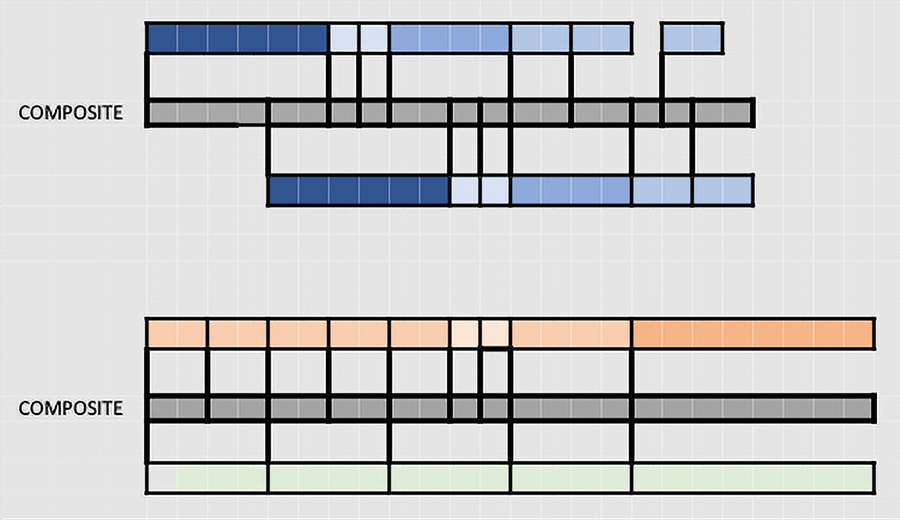
COMPOSITE RHYTHM — stream of durations between time points marked by an attack of a note in one or more lines of the fabric
Here is a graphic identification of the composite rhythm of each contrapuntal phrase above.
composite rhythm
You can see in the first example that there are 7 notes in the upper line and the same 7 rhythmic values in the lower line. But the composite rhythm shows 12 durational values, due to the non-synchrony of the lines. In the second example, the upper line has 9 notes, but the lower line’s 5 notes all align with them. The “sum” of the two lines is a composite rhythm of only 9 durational values, identical to the upper line.
Contrapuntal intervals (in number of semitones) are identified between the staves. The time points of the composite rhythm, moments when both lines are starting a note, are contrapuntally accented and emphasize the contrapuntal intervals (boldface) formed at those points. The consistency — in this example the contrapuntally accented intervals of 7, 8, 2 (and 2+octave), and 5 (and 5+octave).
CONTRAPUNTAL ACCENT — prominence of contrapuntal intervals formed by notes starting together on a time-point
Refraction
This term refers to the metaphor of light going through a prism or drop of water, revealing a spectrum of colors. In that sense, a musical refraction might refer to a line presented by instruments of changing sound color. (See Klangfarbenmelodie below.) But let’s apply the refraction concept to pitches in a line of consistent color.
Refraction can also be a simple way to make two lines out of one, splitting up its notes into two lines shared by alternation or some other less strict pattern. The pitch assigned to one line can be sustained to make a companion pitch to the pitch or pitches that come next in the other line. In this way, the vertical intervals can be strategically controlled to generate a coherent contrapuntal harmonic flow.
To demonstrate, here is the opening theme to Jupiter Rising:
Jupiter Rising theme
Now splitting this violin line into two violin parts:
Jupiter theme refracted
Identifying the contrapuntal intervals (by number of semitones) that are formed reveals a preference for contrapuntal intervals of 2, 4, and 5 semitones.
Some might say this is not real counterpoint, but the total rhythmic independence of the lines argues for that distinction. Mandelbrot, pioneer of fractal mathematics, described fractional spatial dimensions. Maybe we can call our refraction one-and-a-half voice counterpoint.
Canon
Repeating the definition of this ancient form of Rumpelstiltskin magic, spinning complex counterpoint out of a single melodic line:
CANON — leading line is echoed after some delay by one or more answering lines of identical rhythmic values and melodic shape (possibly transposed)
For a collection of 21st-century examples, 14 studies in 3-voice canon, go to BOOK OF CANONS.
Now let’s look closely at a more famous canon, in four parts scored for seven different instruments. Here is a contrapuntal example of canonic threads expressed through changing instrumental colors, the opening of the first movement of Webern’s Symphonie Op. 21:
Webern Symphony opening
Instead of showing each instrument’s part, I have rearranged the score so that each staff line strings together the successive pitches of a 12-tone row:
On the top staff, A F# G Ab played by horn; E F B Bb played by clarinet; then D by cello, continuing past this excerpt to complete the 12-tone row with C# C Eb.
The second staff answers in canon one bar later, starting on F plucked by harp and proceeding with a mirror inversion of the lead-line row: F Ab G F# Bb A Eb E C C# D B.
The third staff is also an inversion of the row starting on A.
The fourth staff, entering last, is a transposition of the original lead-line row starting on C#.
Repetition
Any musical element can be repeated — a note, an arpeggio, a measure, a phrase, a whole section of a form, as in the baroque rounded-binary model or the exposition of a classical sonata-allegro form. When a melodic motive or molecule is continuously repeated many times, it is called an ostinato, usually forming a background to some changing line or evolving stream of events. We can analyze two critical factors:
CYCLE — duration length of a repeating pattern
PHASE — time point at the start of a cyclic repetition
Some 20th-century composers, especially Americans, started to bring background patterns or structures into the foreground, as primary objects rather than accompaniments. The incessant repetition of an ostinato, often a chord arpeggio, became the basis for simple structures. With a relentless pulse at its rhythmic core, most ostinato music generates simple highly congruent rhythmic lines in simple or no counterpoint.
Classic works by composer Philip Glass, such as the ‘70s pieces Music in Twelve Parts, are continual repetition of chord arpeggios, with the chord changing gradually and subtly over many repetitions. This has two effects: making a very slow harmonic change rhythm and time flow under an animated surface; and creating a broad time form that is monolithic and metamorphic, rather than a more traditional multi-section recurrence form.
John Adams brought this relentlessly repetitive approach to appealing prominence in symphonic music. His Fearful Symmetries (1988) has a pulsing persistence reminiscent of the great Stravinsky ballets, such as Le Sacre du Printemps (1913).
John Adams – Fearful Symmetries (1988)
Steve Reich continued this energetic vein of repetitive rhythmic construction into the 21st century with works such as Double Sextet (2008).
Steve Reich – Double Sextet (2008)
Despite its sometimes lush fabric of harmony and animated rhythmic activity, persistent-repetition music has unfortunately been labeled “Minimalist,” often having no melody, no sense of harmonic progression or tonal modulation, no themes, no sectional cadences and divisions, and no discernable large-scale recurrence form. (A music more truly described as Minimalist can be found in the more radical works of John Cage, with sparse sounds — or no prescribed sounds at all — in a time-space of mostly “silence.”)
Phasing
Back to ostinato — what about more than one ostinato layered into a more complex texture? Even if the ostinato patterns are of the same length, it is possible for their repetitions at different times to not synchronize but overlap. We would say their repetitions are out of phase.
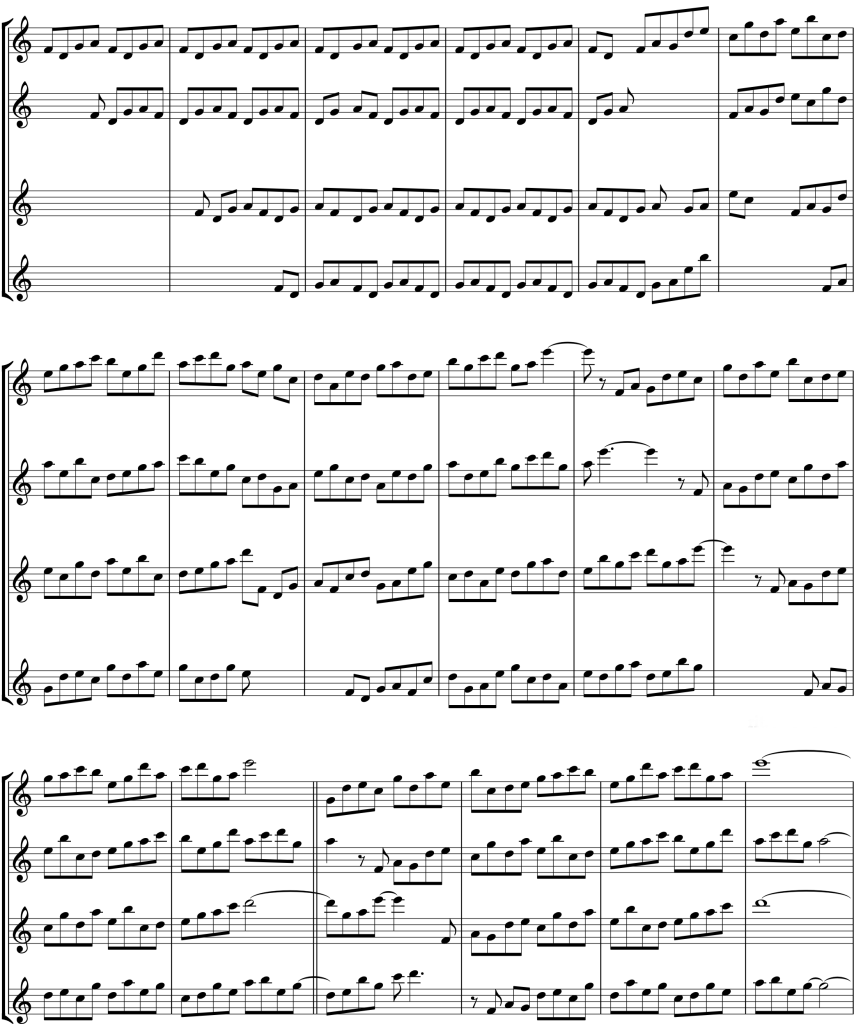
Using Webern’s canon technique to place identical lines out of phase:
Milky Way score excerpt
The Milky Way is our own barred spiral galaxy. The musical fabric is adapted closely from Buckingham Fountain, the third movement of my Chicago Sketches for flute choir.
There is also the potential for each ostinato pattern to have its own cycle length of repetition. And if the lines repeat different cycle lengths, their phase, the start of another repetition, cannot always align in synchrony. This can be described as multi-cycle/multi-phase ostinato music, pioneered among others by American composer Terry Riley.
Inspired by tape loops continuously replaying recorded sequences of sounds, in 1968 Riley produced a massive (45- to 90-minute length) multi-phase ostinato work, In C. Becoming iconic, it has been recorded commercially more than 36 times and performed by countless new music ensembles, finding its improvisatory freedom and large flexible instrumentation attractive. (A 2006 performance at the Walt Disney Concert Hall featured 124 musicians.) It consists of 53 ordered patterns of specified, notated rhythm and pitch, to be continually repeated against a steady eight-note pulse. The patterns range in length from only 4 eighth-notes to extended phrases sprawling across a part’s entire manuscript line (without bar lines). Thus the variety of repetition cycle lengths is enormous. And because each musician chooses when to start and how many times to repeat each pattern, multiple phases are also guaranteed.
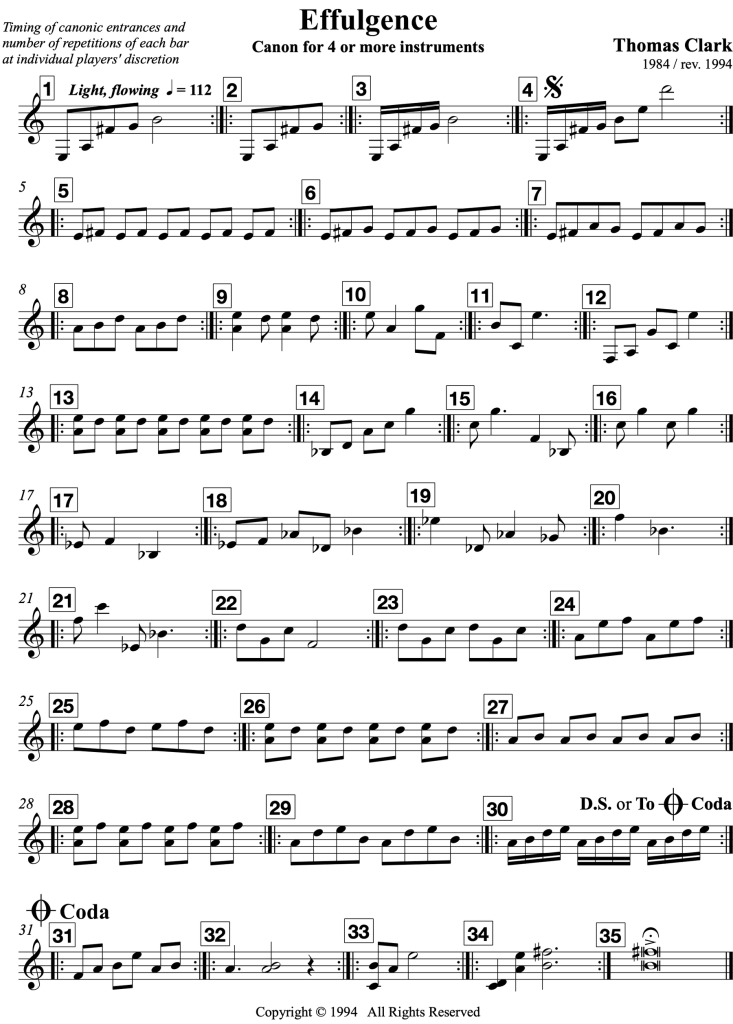
Rather than analyze this iconic piece, I will show and explore a piece of mine inspired by In C, originally composed in 1984. It employs the canon technique and differing-length patterns to create the constant overlapping of patterns out of phase with other lines, This makes it difficult to express all the patterns in one common meter signature. Riley’s solution, and mine, is to use no meter signature, with all lines (parts) aligning only with a constant eighth-note pulse.
Effulgence improv score
Before we dive into its structure, let’s listen to its beginning.
The surface rhythmic relationship of overlapping patterns is simple, all conforming to a common eighth-note pulse, as in Riley’s In C. The differing bar lengths, however, produce different periodicities, different repetition cycles. Patterns of 2, 4, 6 or 8 eighth-notes relate to each other to establish a common quarter-note based meter, a feel of 2/4, 3/4 or 4/4 meter. But the patterns of a prime number of eighth-notes, 3, 5 or 7, oppose the sense of a quarter-note beat.
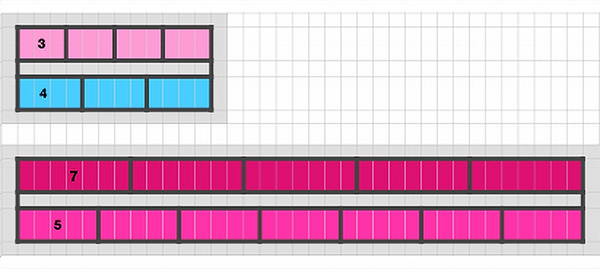
The prime numbers mean also that the repetition cycles will rarely synchronize, creating a more complex, floating or flying fluidity of motion. Three against four is fairly simple, as with Patterns 6 and 7. Repetition of primes seven against five, as in Patterns 19 and 20, make a much more complex composite, taking some 35 eighth-note pulses to return to a synchronous starting point.
multi-phase combinations
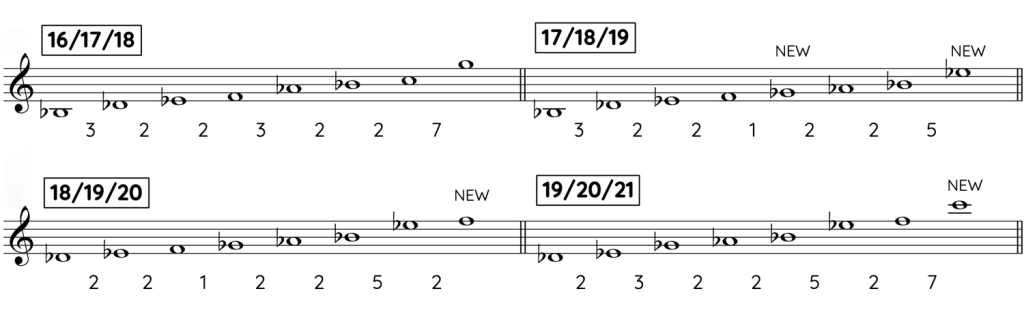
To control the interaction between successive patterns that will overlap in canonic lines, each pattern’s pitch content must work with the pitches of patterns before and after it. By “work” means that the collective, cumulative constellation should be of an intervallic character, an array, that conforms with the overall harmonic character desired.
Assuming a performance spread of three patterns, here is a sample analysis of the middle, Patterns 16 through 21, showing the three-pattern collective constellation. Each pattern intersects with common pitches of its neighbor patterns, adding pitches to the sonority that will eventually disappear.
intersecting pitch collections
This is the mechanics of a metamorphic harmonic process that gives multi-phase ostinato music its graceful evolving form.
Now let’s listen to the complete composition from 1984 (revised 1994), one of my personal favorites.