Tag: Albert Bierstadt

  • MapLab 6. Paint a Landscape

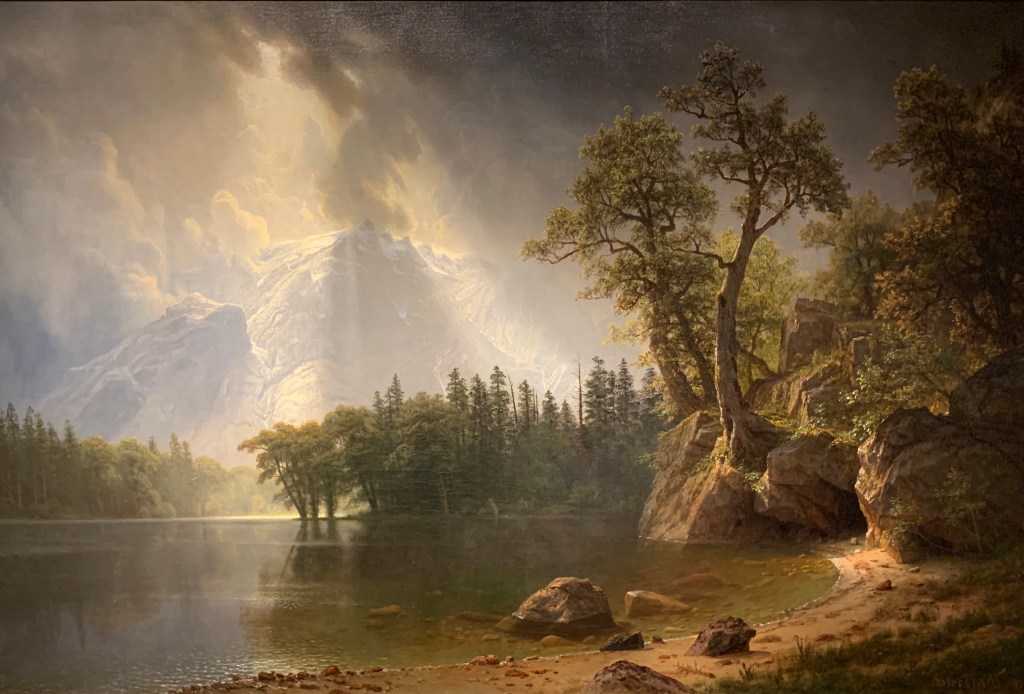
    Many 19th cen. American landscape artists painted fascinating panoramic scenes, including Albert Bierstadt, who captured the grandeur of Western, mountainous landscapes.

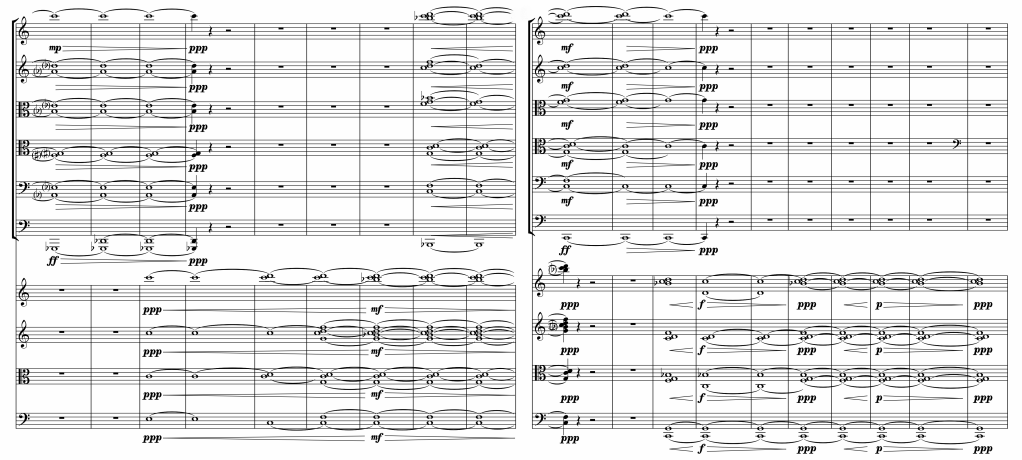
    Much mid-20th-cen. large ensemble music “painted” with sound masses, animated and evolving instead of harmonically progressing — notablyVariations for Orchestra” (Bassett),The Seventh Trumpet (Erb),Aftertones of Infinity (Schwantner). My “Animated Landscapes” (1973) for orchestra was titled echoing Cage’s“Imaginary Landscapes.”

    1. Establish a model

    Albert Bierstadt: Passing Storm over the Sierra Nevadas (1870) – San Antonio Museum of Art

    Choosing one of Bierstadt’s finest works, you can see stark contrasts in brightness and in sense of motion between the mirror-smooth water and roiling clouds. Even the word “passing” in the title suggests change, a necessary ingredient of an analog musical landscape.

    2. Build big constellations

    The fixed, stationary nature of a landscape painting suggests a static harmonic approach, projecting and prolonging one constellation as an underlying sonority for the whole musical “canvas.”

    Here are two examples of a 12-tone constellation. The first was used as the underlying sonority of the pointillistic first movement of Anton Webern’s Symphonie Op. 21 (1929). Note that to accomplish the palindromic symmetry of the interval array, Eb is placed in two different octaves, thus 13 pitches total.

    Another example of placing all 12 pitch classes in particular octaves is from Witold Lutosławski’s Jeux vénitiens (1961):
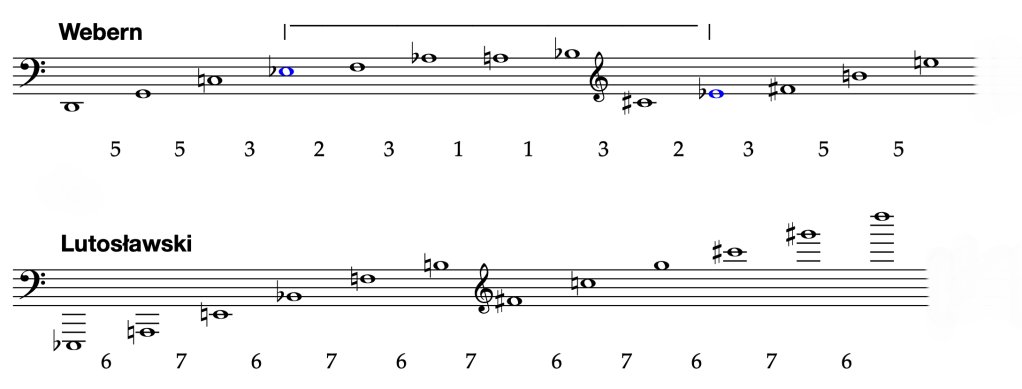
    TC example

    A large register-spanning constellation need not be 12-tone. Building a sonority of very different (less dissonant) quality, let’s start with just octave C’s and their fifths, G. Pitches a whole step away from these tonal pillars are added. The result is 13 pitches only from the F major scale. Then their complement, a big 8-pitch constellation of similar array, is built from the pentatonic scale of the flats, the other “black keys” .

    3. Animations

    Different basic techniques for animating in time a large constellation of pitches . . .

    Arpeggio – one note at a time in any order, is a kind of stacking.
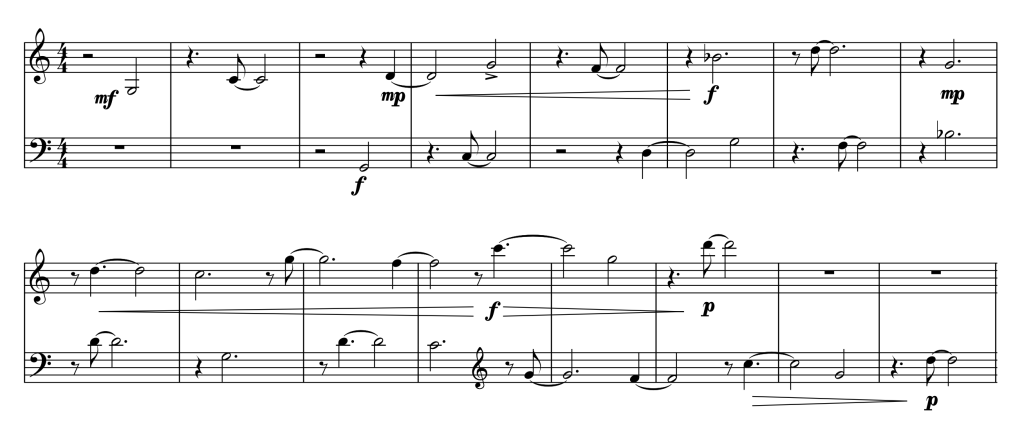
    Stacking – introduce sustained tones one or two at a time. The reverse, unstacking, works too.

    Swells – crescendo/diminuendo the whole sonority (think ocean waves in Debussy’s La Mer)
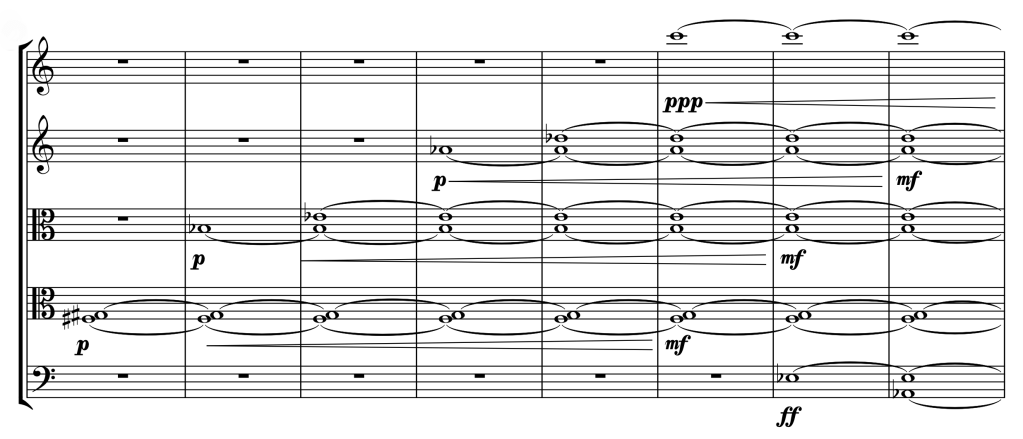
    Pointillism – a more complex texture of distinct sound points separated by registral and rhythmic spacing. Although they can be different sound colors, in this example they are all the same timbre:

    4. Develop a sound palette

    Larger ensembles can be good for musical landscapes, offering a varied palette of instrumental timbres. Like pigments, these sound colors group in hues: the

    • double reeds
    • other woodwinds
    • cylindrical brass (trumpet, trombone)
    • conical brass (horn, euphonium, tuba)
    • bowed strings
    • plucked strings (harp)
    • metal pitched percussion
    • wood percussion; drums; exotic gongs, etc.

    For synthesized sounds, beyond emulating these instrumental timbres, envelope and spectrum distinguish the sounds:

    • sharply accented or gradually emerging sound onset
    • bright metallic to dark hums
    • reverberation.

    For Passing Storm, I chose three “choirs” with distinct sound qualities:
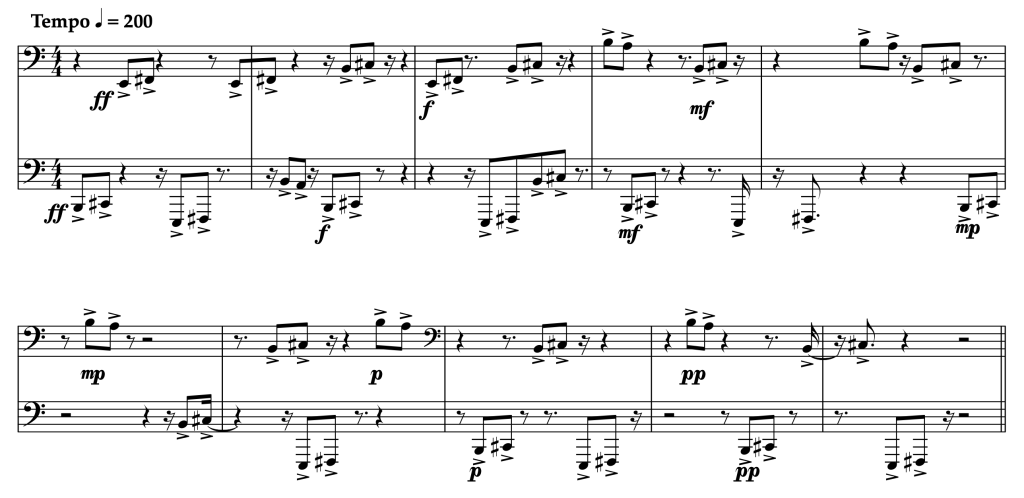
    • Clanging percussion and plucky harp
    • Gentler emerging-onset sounds (Sibelius Pad 2 – warm) functioning like woodwinds
    • Brighter sustained sounds (Sibelius FX4 – atmosphere) in the orchestral role of bowed strings

    5. Compose the whole canvas

    In painting, “composition” refers to the main parts of an image and how they are arranged with each other in two-dimensional and the illusion of three-dimensional space. For music, we might call this the macro form. As with most landscape paintings, the musical textures may overlap in continuous sound. There may be sectional divisions, analogous to strong demarcation lines like a horizon. The sense of broad, distant scale of view will be best captured with extended textures of expansive rhythm and even with reverberation.

    While not trying to actually map the physical composition of a painting, we can get musical inspiration from considering the painting’s features of background, foreground, and highlights of strong visual focus. My example was coming together starting with distant swelling sonorities, which as they crescendo feel like they are emerging forward toward us.

    After deciding to name the piece Passing Storm after the Bierstadt painting, however, I realized I had no storm in the music, just gentle sprinkles. Thus was created a stronger sonic rendering of the sprinkles to provide a more aggressive introduction. The proceeding four minutes overlaps sound masses exhibiting the various animations in time we explored earlier. Dark and light in a painting are portrayed by loud and soft, timeless sustained sound vs. busy points of sound.

    Animated Landscape No. 4: Passing Storm
    Continue reading Mapping the Music Universe . . .

    MapLab 7. Twelve-Tone Trichords in a Ternary Trio

  • journal 4. Sound Painting

    Interlochen, 1973 —

    Gunther Schuller composed Seven Studies on Themes of Paul Klee in 1959 after leaving the Metropolitan Opera Orchestra horn section. Commissioned for the Minneapolis Symphony, it portrays musical analogs for seven works by Swiss painter Paul Klee (1879-1940). Schuller wrote, “Each of the seven pieces bears a slightly different relationship to the original Klee picture from which it stems. Some relate to the actual design, shape, or color scheme of the painting, while others take the general mode of the picture or its title as a point of departure.”

    • “Antique Harmonies”
    • “Abstract Trio”
    • “Little Blue Devil”
    • “The Twittering Machine”
    • “Arab Village”
    • “An Eerie Moment”
    • “Pastorale”

    Seven Studies on Themes of Paul Klee

    Radio Philharmonic of Hannover

    LISTEN › YouTube

    Landscapes

    1976 Interlochen with Leslie Bassett

    As a graduate student at the University of Michigan in 1973, I composed my second orchestra piece. The title, Animated Landscapes, was inspired by John Cage’s famous Imaginary Landscapes No. 4, which we performed as I was an ensemble member of Contemporary Directions.

    The idea of animating an otherwise static sound mass, devoid of progressive harmony, was a quintessential feature of what I came to think of as the Midwestern Style of 1960s and 1970s large ensemble music. Successful models included prize winning pieces such as (my teacher) Leslie Bassett’s Variations for Orchestra (1966), Donald Erb’s The Seventh Trumpet (1969), and Joseph Schwantner’s …and the mountains rising nowhere (1977) and Aftertones of Infinity (1979).

    Animated Landscapes

    Clark 1971 (TC-25)

    U.Mich. Symphony Orchestra

    So many great American landscape artists of the 19th century painted fascinating panoramic scenes. One of my favorites, who captured the grandeur of Western, mountainous landscapes, was Albert Bierstadt:

    Albert Bierstadt: Passing Storm over the Sierra Nevadas (1870) – San Antonio Museum of Art

    You can see stark contrasts in brightness and in sense of motion between the mirror-smooth water and roiling clouds. Even the word “passing” in the title suggests change, a necessary ingredient of an analog musical landscape.

    While not trying to actually map the physical composition of any painting, my musical inspiration came from considering this painting’s features of background, foreground, and highlights of strong visual focus. Musical gestures started with distant swelling sonorities, which as they crescendo feel like they are emerging forward toward us. After deciding to name the piece Passing Storm after the Bierstadt, however, I realized I had no storm in the music, just gentle sprinkles. Thus was created a stronger sonic rendering of the sprinkles to provide a more aggressive introduction. The following four minutes overlaps sound masses animated in time, contrasting dark vs. bright sounds, loud vs. soft, and timeless sustained sound vs. busy points of “light.”

    Animated Landscape No. 4

    Passing Storm

    Clark 2022 (TC-129)

    Mucha’s Light

    I first traveled to the Moravian region of Czechoslovakia in 1991 to conduct my own music at the 26th International Music Festival in Brno. While there, I visited the South Moravian town of Moravský Krumlov. Its castle served as a museum gallery for the epic paintings, Slovanská Epopej, of Alfons Mucha. Better known as the father of art nouveau through his many famous Paris posters, Mucha was deeply interested in Slavic culture and history. The 20 paintings, each a monumental canvas hung as a tapestry, vividly depict both historical and mythical scenes.

    Mucha’s Light: Ancient Images is dedicated to Miroslav Marada, the Moravian gentleman who first showed the paintings to the composer in 1991. A teacher, history buff, and lover of the local wines of south Moravia, Marada fascinated me with elaborate tales, explaining the symbolism of each painting. The five works I selected to sketch musically have a common element, masterfully painted images of exotic light. Composing musical analogs for these ancient images, I incorporated medieval music from the Bohemian/Moravian region of central Europe. The music weaves authentic medieval chant tunes into an intensely contrapuntal fabric, interspersed with modern sparks, streaks, and splashes of sound color. Originally composed for brass quintet, the musical images called for a richer, more varied sound-color palette:

    Instrumentation: piccolo, 2 flutes, 2 oboes, 3 Bb clarinets, bass clarinet, 2 alto saxes, tenor sax, baritone sax, bassoon; 2 F horns, 2 Bb trumpets, 2 trombones, euphonium, tuba; timpani, 3 percussion (misc. unpitched – triangle, sus.cym., etc.; bells, chimes, vibraphone, xylophone)

    Ancient Images

    Clark 2005 (TC-76)

    Five sound sketches on the historical paintings of Alfons Mucha

    I. Star Light

    detail of 1. Slavs in their Original Homeland

    II. Green Light of Mysticism

    detail of 17. Holy Mount Athos

    III. White Light of Learning

    detail of 4. The Bulgarian tsar Simeon

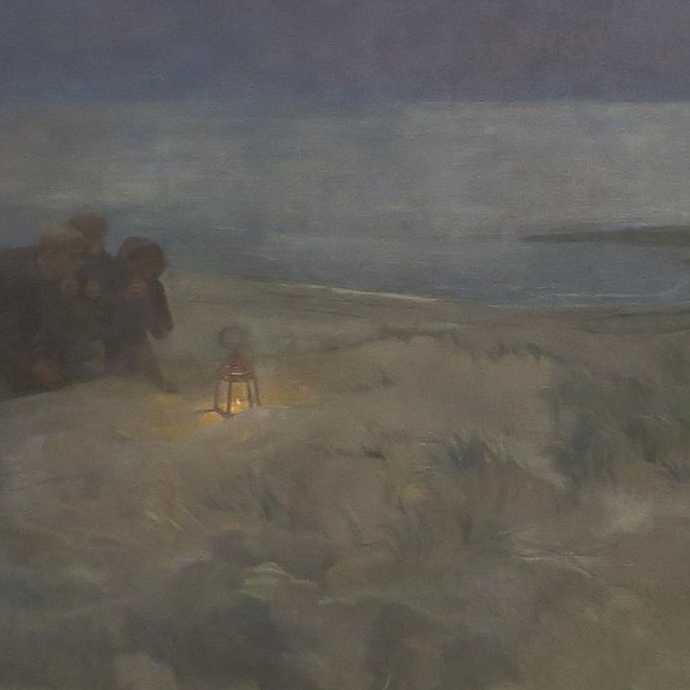
    IV. Lantern Light of Hope

    detail of 16. The Last Days of Jan Amos Komenský in Naarden

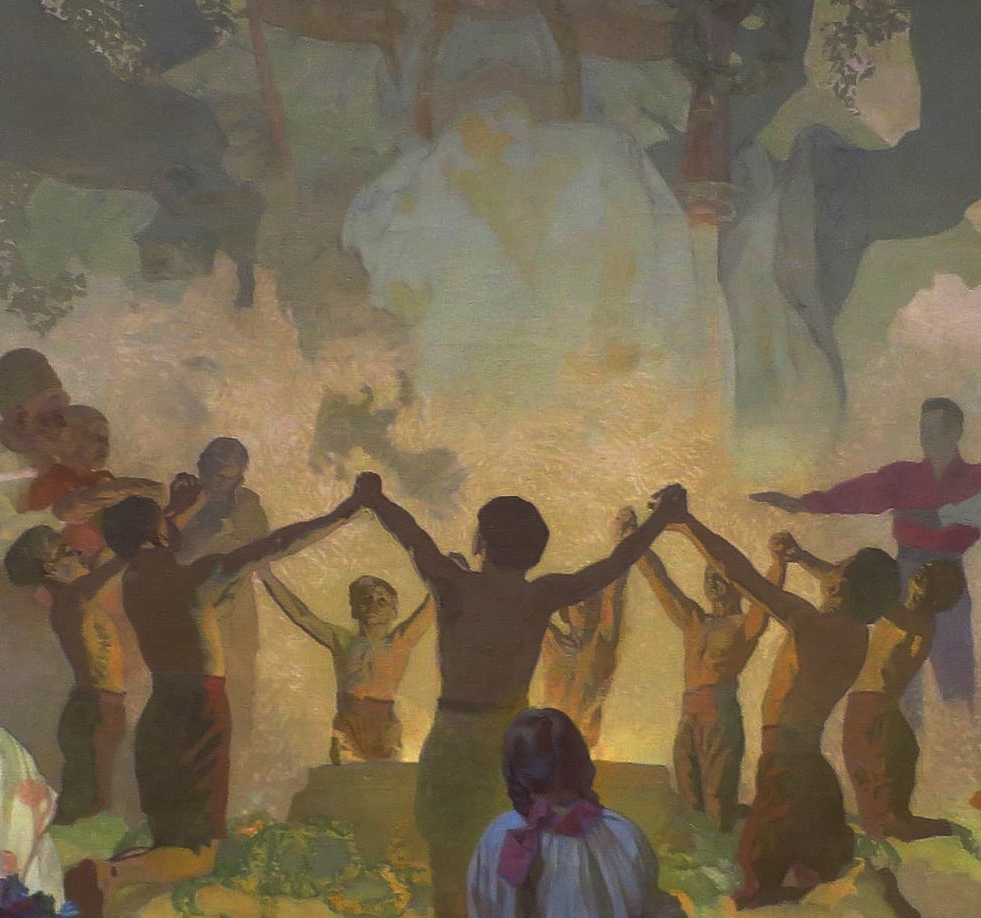
    V. Fire Light

    detail of 18. The Oath of Omladina Under the Slavic Linden Tree

    Quilting

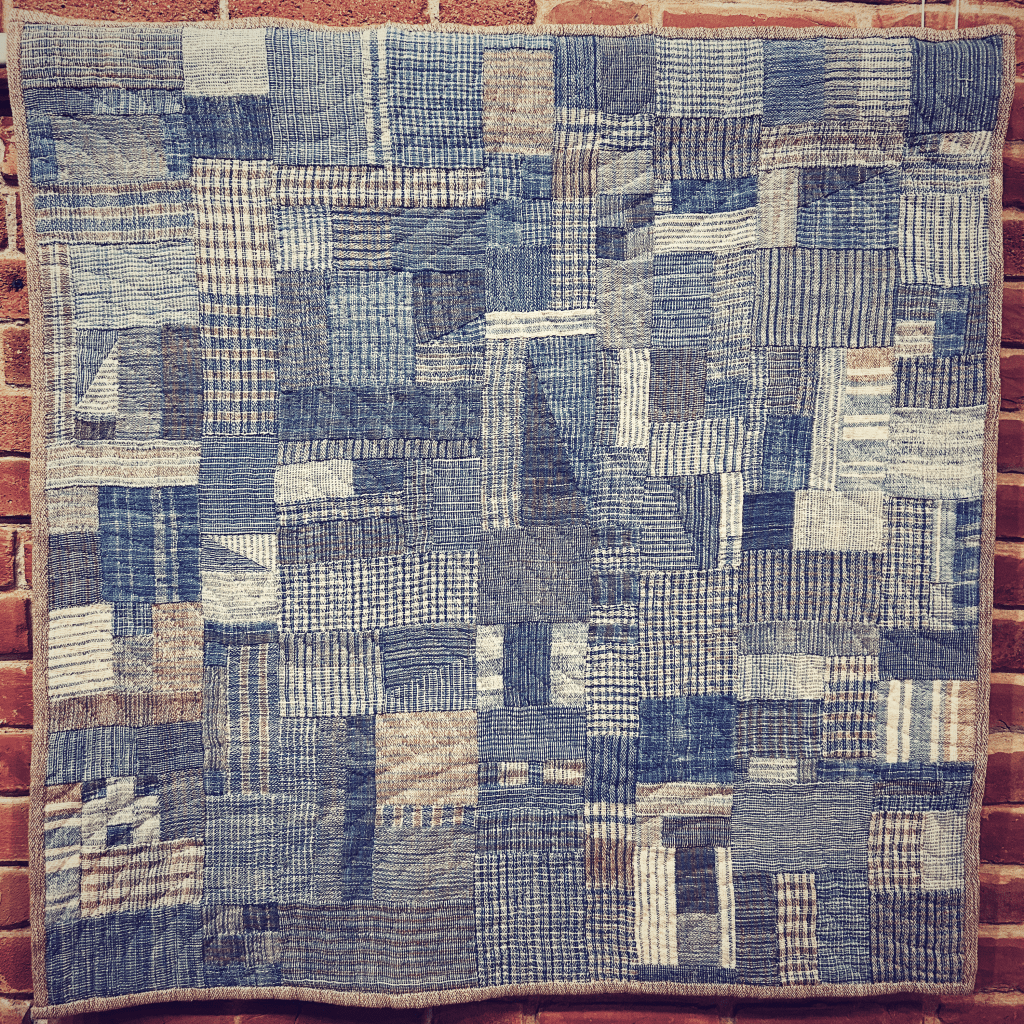
    Now to photo images instead of paintings — both music and visual images can be assembled in a manner inspired by quilts, layers of fabric in small swatches pieced together. The Amish of Lancaster County Pennsylvania were known especially for quilts of contrasting colors of repeating geometric shapes.

    Here is a more-than 100-years-old quilt I found exhibited in the Quilting Museum in LaGrange, Texas.

    Louisiana Acadian quilt, 1890

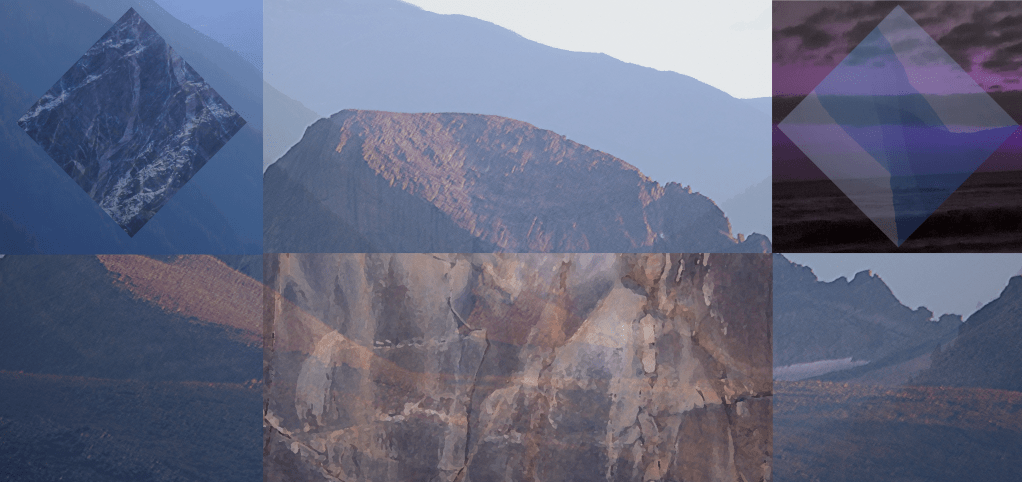
    For a fresh approach to my 2025 multimedia work, this kind of layered patching was applied to both synthesized sound blocks and to digitally enhanced images from my Nikon Z50 (NIKKOR 16-50 lens). Three musical textures — flutters, swelling chords, and an ancient-style canon — are quilted onto an unchanging broad harmonic background. They overlay each other in four different combinations.

    Clark 2025 (TC-154)

    Video here – YouT