Tag: Allen Forte

  • Mapping Music 5. SCALES

    What is a scale? Its essence is an interval pattern, selecting which pitches out of the entire chromatic possibilities become scale steps. Successive interval arrays are a vivid way to describe its pattern:

    SCALE PATTERN — periodic interval pattern that cycles through each octave, defining which pitch-classes from the 12 possibilities are degrees of the scale

    In that sense, it is a theoretical circle, starting over in each octave — or more imaginatively, a spiral. Let’s visualize the natural-note white keys on the keyboard, a prime example of the ubiquitous diatonic scale, as a circle.
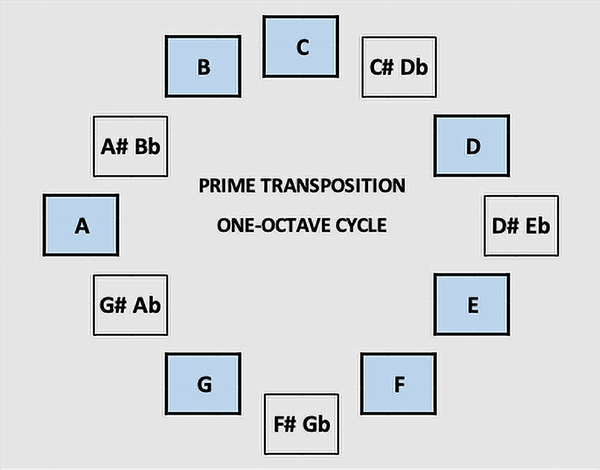
    diatonic scale circle

    Now an unlooped visualization as stair steps, rungs on a spiral ladder:
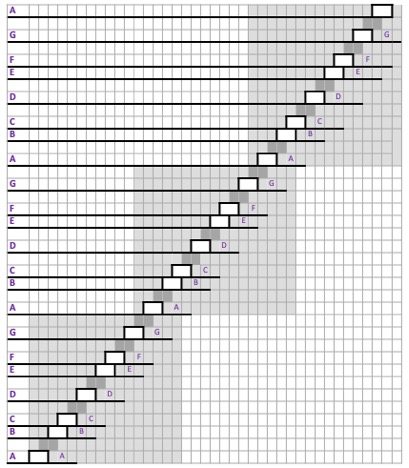
    diatonic scale cycling through three octaves

    Anyone familiar with the white and black keys of a piano will recognize this pattern!

    Chroma

    Almost all scales in both Western music and other art-music traditions are built on the framework of octave equivalence, the close affinity of two pitches that are one or more octaves apart. We give them the same pitch name – all called “C” or “F#” for example. This makes the circular nature of a scale, that its pitch names and the intervals between them start over at the octave and repeat.

    We also have the feature on an equal-tempered piano that one black key produces a pitch with two possible names depending on the scale in which they appear. For example, the D# seventh scale degree in an E Major scale is the same piano key as an Eb, the fourth scale degree in a Bb Major scale. The two pitch names are said to be “enharmonic.”

    When a melodic line in an all-white-key C major scale introduces an F# for color or to temporarily alter the interval terrain, we call it a chromatic tone, after the Greek word for color, chroma. Now we have a comprehensive scale of all possible pitches. Going further, theorist Allen Forte defined  a way to reduce all the pitches in an entire eight-octave chromatic pitch space into just twelve categories:

    PITCH CLASS — a set of all pitches that are octave and/or enharmonically related

    He gave them pitch-class numbers 0 through 11.

    chromatic scale

    In the advent of computer systems to produce, edit, and analyze musical sound, a sound’s identified pitch class is termed its chroma.  

    Synesthesia – some people, such as the composer Scriabin, actually see a color when they hear a pitch or a tonal key. In his variant of synesthesia, C is red, G is orange, D yellow, and A green. Scriabin’s Promethius: The Poem of Fire (1910) includes a part for “clavier à lumières,” a color organ that emitted light of what he deemed the appropriate color for a pitch instead of sound.  

    Scale prototypes

    When we describe a scale, we name the pitches in order within an octave. Better yet, we name the successive intervals going up within the octave. The classic description of the ubiquitous diatonic scale, in whole-steps or half-steps, in its major mode starting on the tonic pitch, is:

    whole / whole / half / whole / whole / whole / half

    [octave repeats the cycle]

    Or in British terms:

    tone / tone / semitone / tone / tone / tone / semitone

    In the chromatic 12-tone universe, that scale pattern measuring the intervals in semitone sizes would be:

    2 2 1 2 2 2 1

    That is what I would call a scale pattern . . . a Successive Upward Interval Sequence in Semitones (SUISS!). But let’s call it a scale pattern array, working exactly like the arrays describing constellations.

    Now we can particularize our scale pattern definition to apply to any smaller set of pitch classes, even if they don’t look like a scale:

    SCALE ARRAY — successive interval array describing the pitches of a constellation condensed by octave equivalence to their most compact pitch-class-equivalent arrangement within an octave, ordered lowest-to-highest (Forte’s “normal order”)

    In this sense, the array of a smaller set or scale fragment is just like a scale pattern.

    Successive Interval array is a versatile tool that can apply to any pitch collection, to a linear, scalar pitch pattern as well as to a vertical chord sonority or even an arpeggiated diagonal collection of pitches I call a constellation.

    Modes

    Most of our familiar scales are actually a different mode of the same 7-note diatonic scale, with a different starting and ending point called a tonic establishing the mode.
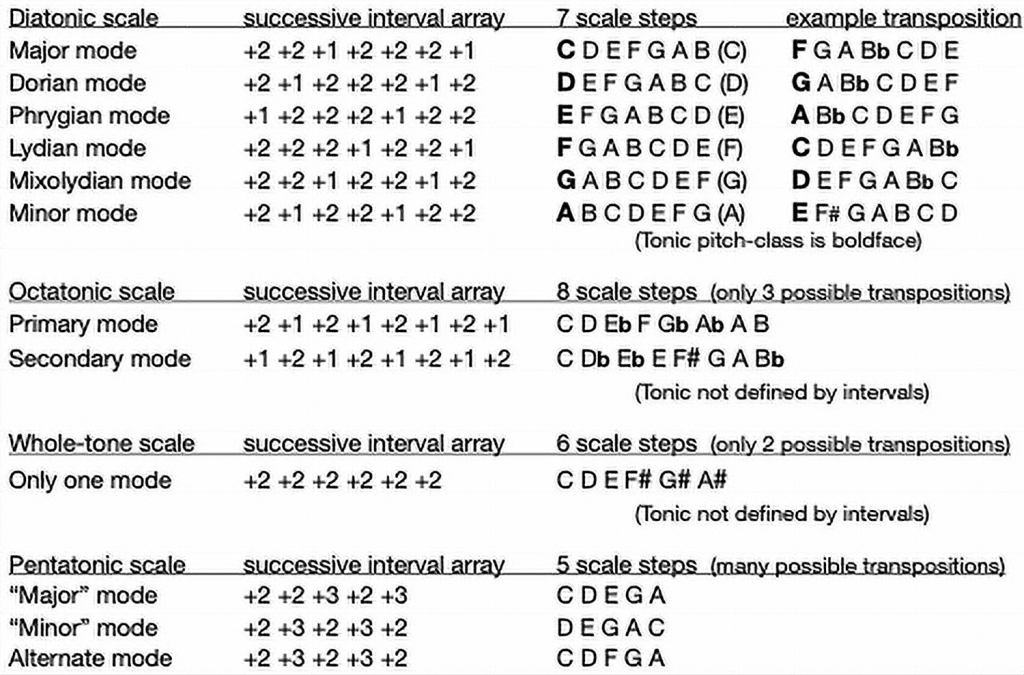
    scale modes

    Scale patterns / set classes

    We can describe a set of pitches as an octave-compressed abstraction of 3 or 4 pitches as a lowest-to-highest ordering of pitch classes. It doesn’t produce anything like the 7 or so notes per octave we’re used to thinking of as a scale, as those shown above. It is conceptually powerful, nonetheless, to call the successive interval array of this compressed abstraction a scale pattern, even though it’s a scale fragment with no name. Its name can simply be the successive interval array, such as 2 4 2, the array describing a symmetrical pitch-class set called the French Augmented Sixth chord.

    [Theoretical aside] In establishing set theory, Forte described these compact arrangements by naming the pitch-classes in order using a mod-12 number system shown above, C=0, C#/Db=1, D=2, etc. He identified twelve 3-note classes, including upside-down inversions reversing the scale pattern, as members of the same class. (Lewin kept these inversions separate, defining instead nineteen 3-note set classes. We’ll use Forte’s; the set classes as generalities are not as crucial to composing as to theoretical analysis.) Forte used cumbersome descriptions employing pitch-class numbers and “normal order.” In the Journal of Music Theory 15 (1971), Richard Chrisman defined and proposed successive interval arrays as a better, more revealing way to characterize the commonality of a family of pitch-class sets that are all related by transposition and/or inversion.

    Relating to Forte’s concept of a set class, any set grouping three pitch-classes can be analyzed as an interval array or partial scale pattern.  
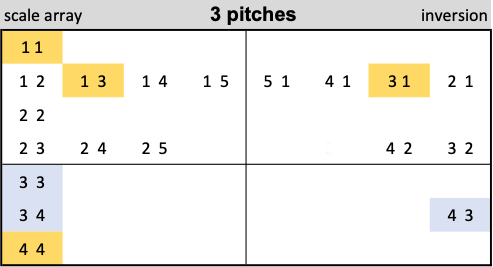
    scale patterns of all 3-pitch-class sets

    Sets forming triads (or seventh chords below) are highlighted in BLUE; those that are atonal (cannot be found in a diatonic scale) are highlighted in GOLD.

    While the number of possible interval arrays for constellations of four pitches is enormous — even if limited to interval stack sizes less than two octaves, there are more than 12,000 possibilities — we can use this scale-pattern abstraction tool to categorize them into forty-three 4-pitch-class families. 
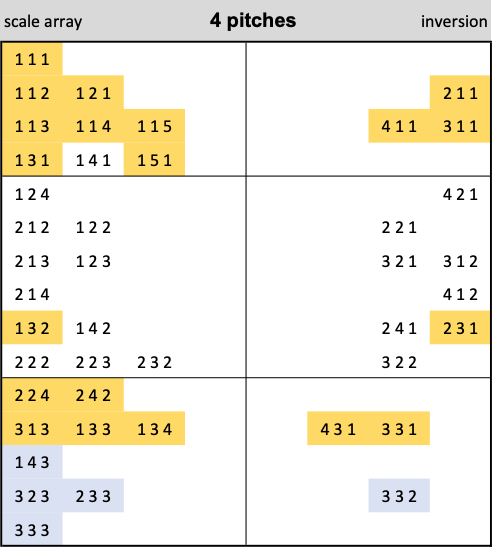
    scale patterns of all 4-pitch-class sets

    The blue-highlighted scale patterns have common triadic chord names:

    • 1 4 3 = “Major Major 7th chord” (in any chord inversion)
    • 3 2 3 = “minor minor 7th chord” (in any chord inversion)
    • 3 3 2 = “dominant 7th chord” (in any chord inversion)
    • 3 3 3 = “fully diminished 7th chord”

    The scale pattern 2 4 2 is an interesting symmetrical, non-diatonic pattern called a “French augmented 6th chord”.

    Vocabulary

    These maps collecting 62 scale-patterns summarize all possible constellations of 3 or 4 unique pitches, our total harmonic vocabulary in the chromatic universe.

    © 2026 – All Rights Reserved

    Thomas S. Clark

    TClarkArtMusic.com 

  • Mapping Music 4. TUNING

    “To understand the Universe,

    you must understand the language in which it’s written,

    the language of Mathematics.”

    — Stephen Hawking

    Galileo revolutionized astronomy, in part by using a new tool: the telescope.

    Schoenberg revolutionized harmony by evolving an existing concept, the chromatic scale, into a new tool: the 12-tone scale, and devised a new compositional tool of the 12-tone row.

    Allen Forte took Schoenberg’s ideas to another level of abstraction: defining Pitch Class and applying basic math to the 12-tone universe.

    Chrisman focused on the interval essence of pitch patterns: defining the “successive interval array.”

    I am merely another explorer using their maps but choosing my own creative path. In doing so, I will define some of my own terms, while adapting and clarifying some established terms that fit what I’m thinking and expressing.

    From Tuning to Tonality

    We think of traditional common-practice Tonality of the 17th through 19th centuries being synonymous with the major and minor scales. But there’s more to traditional common-practice Tonality than just the scale. Here are the four basic factors that determine any tonal design:

    SOURCE SCALEHARMONIC TYPETONAL CENTER
    ancient modeperfect intervalsfixed by mode
    Major / minortriadmodulatory shifting
    extended chromaticextended triadpolytonal centers
    exotic / syntheticnon-triadestablished contextually
    12-tonediversenone

    tonal design factors

    As you can see, there is much to explore: scales, modes, intervals, consonance . . .

    Tuning

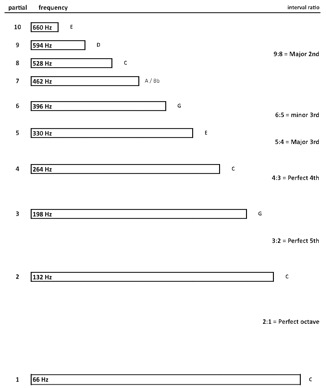
    Taking the overtone series and partial vibrations as a natural acoustical model, Pythagoras identified pitch intervals as simple integer ratios of lengths of a vibrating string. The same ratios describe frequency ratios.

    fundamental pitch C and overtones

    For example, what we call a Perfect Fifth, the interval of the Third Partial to the Second Partial of a natural overtone series, is a 3:2 ratio. Such natural tuning is always employed by orchestras, bands, and a cappella choirs.

    • Octave = 2:1
    • Perfect 5th = 3:2
    • Perfect 4th = 4:3
    • Major 3rd = 5:4
    • Minor 3rd = 6:5
    • Major 6th = 5:3
    • Minor 6th = 8:5
    • Major 2nd = 9:8

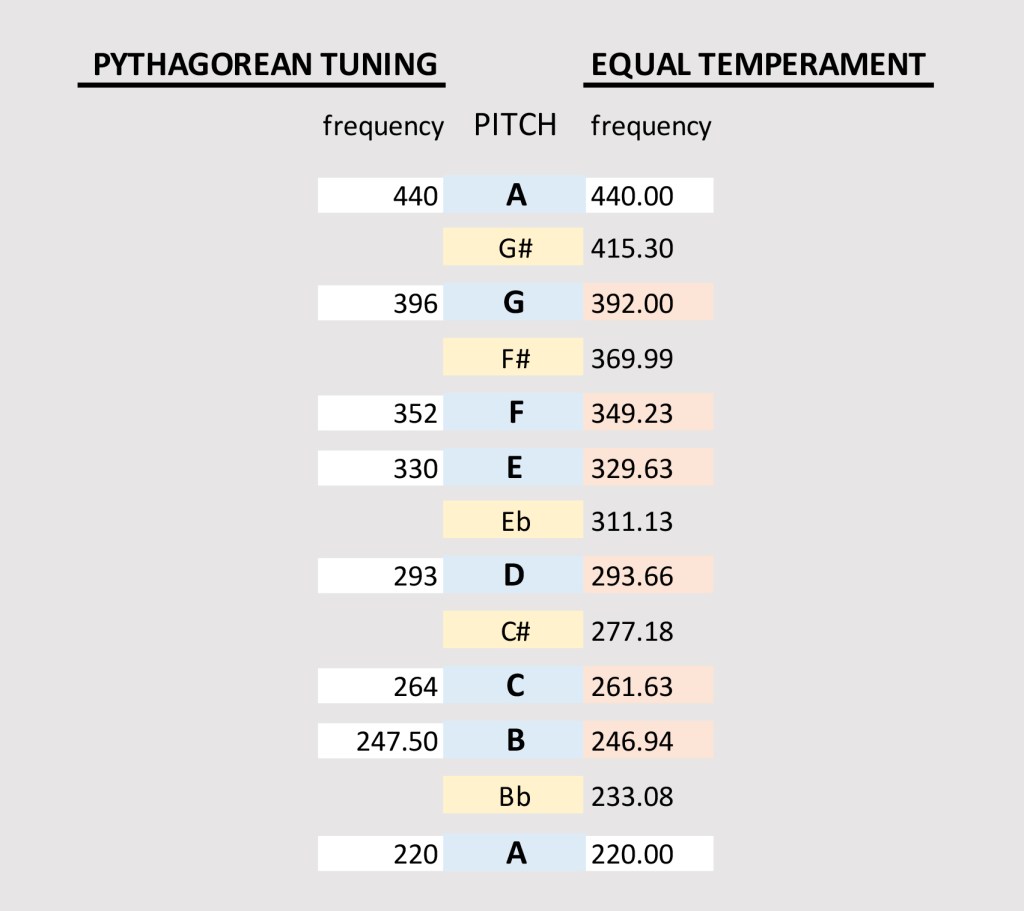
    This approach requires, however, that intonation be constantly adjusted as the key changes or tonal context shifts. For a keyboard that can’t make those adjustments, the fixed tuning devised in the 18th century, called Equal Temperament, compromises the Perfect Fifth, shrinking it from a 1.5 ratio to 1.498307 so that it and all other intervals are very slightly but equally mis-tuned in every possible key or tonal context. The ratio for a semitone is derived mathematically from the 12th root of 2: 1.059643094. That ratio, multiplied by itself 12 times, results in 2.000, the ratio of the octave.

    comparing tuning systems

    While “chromatic” historically meant extending a key with accidentals — temporary extra sharps or flats — now we refer to the 12-half-step scale as the chromatic scale. Two pitch names for the same piano key — C-sharp or D-flat — are said to be enharmonic and considered equivalent, almost interchangeable.

    Equal Temperament became the basis for the 20th-century system of 12 equal semitones per octave, the basis not only for all keyboard instruments but also for harmonic theory in the post-tonal world of 12-tone music. We should not forget, however, that choirs, orchestras and bands still use the purer natural tuning, even with music that has no key signature.

    Other tuning systems

    Long before equal temperament, the Chinese culture developed several systems. A fascinating history is described in Gene Jinsiong Cho’s monograph, LU-LU: A study of Its Historical, Acoustical and Symbolic Signification (Caves Books, Ltd., Taipei, 1989). Cho (a music theory professor colleague at the University of North Texas) explains the LU system from the Chin Dynasty, which extended beyond 12 increments in an octave as far as to the arcane realm of Jing fang’s sixty LU series.

    In the West and into the 20th century, two American composers experimented with microtonal tunings splitting the octave into finer increments than our 12 semitones.

    Working with American Lou Harrison, California composer Harry Partch (1901-1974) devised his own tuning system with 43 increments, described in Genesis of a Music (1947). The system necessitated invention of specialized percussion and string instruments to precisely intone the sounds, which felt exotic both in tuning and sound quality.

    Harry Partch – Castor & Pollux (1952)

    University of Illinois professor Ben Johnston (1926-2019) wrote music for standard orchestral string instruments using the ancient just intonations of Pythagorus. This involved specifying pitches microtonally slightly higher or lower than the equal-tempered standard pitch classes – a notational challenge of pitch-adjustment symbols.  

    Ben Johnston – String Quartet No. 7 (1984)

    In the 21st century, Japanese composer norokusi has produced a broad catalog of microtonal music, apparently using a 17-increment division of the octave.

    norokusi – Piano Sonata n.718 (2018) 17EDO/TET

    Such complex systems as described above never became mainstream. The vast bulk of 20th-century and now 21st-century music is based on the equal-tempered 12-increment system found on a well-tuned piano, with subtle adjustments by orchestral strings, wind bands and a cappella choirs to momentarily purify some sonorities.

    © 2026 – All Rights Reserved

    Thomas S. Clark

    Continue reading Mapping the Music Universe:

    TClarkArtMusic.com

  • Mapping Music — PRELUDE

    The heavenly motions are nothing

    but a continuous song for several voices,

    perceived not by the ear but by the intellect,

    music that sets landmarks

    in the immeasurable flow of time.”

    Galileo

    When we gaze at stars and planets, they appear as stationary points of light, fixed in place in what seems a random pattern across the entire night sky visible to our hemisphere. Time stands still.

    Throughout human time, humans have imagined that stars make picture patterns we name as constellations: fish, warriors, goddesses, animals. Only the persistent observers, such as astronomers, identify their nightly march across the sky, rising in the east and disappearing below the western horizon.

    Metaphor

    Musical sounds mark points in time, like stars. They form immediately into recognizable patterns we call chords, melodies, rhythms, memorable themes. They convey a sense of motion, time surging forward or slackening in our perception of their well choreographed parade.

    Astronomers observing and mapping (recording) the myriad points discovered that some of the stars are actually whole galaxies, with exotic forms of spirals and clouds. They observed through the color of the light that all these objects are racing away from us and each other in an expanding universe.

    Mapping music means cataloging many possible patterns, distinguishing their contrasts and commonalities. We will explore how to measure and compare the periodic rhythmic streams of musical events and their changing momentum. We will define and employ a simple but powerful math tool for cataloging and then creatively sculpting with all natures of harmony and melodic line in our 88-key chromatic universe. We will explore how master composers weave colorful fabrics and grand structures from skillfully crafted materials.

    Pursuing periodicity

    My music-mapping Periodicity Project began in 2021 as a comprehensive catalog of musical patterns and processes, meant to provide simple tools for understanding the complexities of modern music. It grew into this book, Mapping the Music Universe, written for anyone who is curious about how music works, especially in the 20th-21st-century modern and “post-modern” eras. For me as a composer, it is also an exploration of how some less traveled conceptual paths lead to interesting creative possibilities.

    In 1989 I co-authored a conceptually ground-breaking composition textbook with Larry Austin, Learning to Compose: Modes, Materials, and Models of Musical Invention. My next book, ARRAYS, was an aural skills workbook covering basic modal, tonal, and “post-tonal” music of the Renaissance through the Twentieth Century. Mapping the Music Universe draws in part on the ideas and approaches of both these now out-of-print publications.

    A common assumption within Western culture is that Science is all about observation, measurement, precision, and mathematical rigor . . . and Art is all about the “i” words: imagination, inspiration, intuition, improvisation. Science is Deductive, art is Creative. Our culture has begun to recognize the commonality of all these intellectual strengths, that the best Science can be creatively intuitive and great Art can be rigorous.

    Pioneer map makers

    As an educated musician and professional composer, I also have long been deeply interested in science, especially astronomy. Having read a great deal of general science writing, I am inspired particularly by ground-breaking pioneers who methodically and comprehensively mapped the possibilities of their particular field.

    Johann Joseph Fux — wrote Gradus ad Parnassum in 1725, codifying basic contrapuntal principles of Renaissance music.

    William Smith — a rural surveyor, in 1799 drew a colorful map of the subterranean rock strata of his county in English coal country, launching the modern science of geology.   

    Meriwether Lewis — kept extensive journals of the 1804-1806 Lewis and Clark Expedition, documenting and illustrating the discovered new world of the Northwest.  

    Dmitri Mendeleev — devised a “periodic table of the chemical elements,” published in 1869, providing a solid basis for modern chemistry through its graphic and organizational genius.

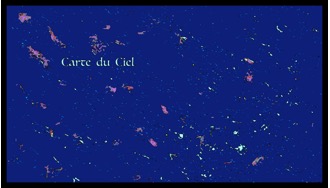
    Amédée Mouchez — launched an ambitious international star-mapping project (Carte du Ciel) in 1887 at the Paris Observatory.

    Henrietta Swan Leavitt — worked at the Harvard College Observatory as a “computer,” examining thousands of photographic plates from telescopes to measure and catalog the brightness of stars, identified 1777 variable stars.

    Lawrence Herbert — invented the Pantone system in 1956 to systematize color for printing ink and fabrics.

    Allen Forte — published an article in 1964 that launched musical set theory, defining, classifying and comparing all possible collections of “pitch classes” drawn from the equal-tempered 12-tone chromatic galaxy.

    The work and insights of the two on the list representing rigorous study of music, Fux and Forte, were part of my formal education in music and later an integral part of my teaching of composition and music theory.

    Maps

    Carte du Ciel was an ambitious second phase of an international star-mapping project initiated in 1887 by Paris Observatory director Amédée Mouchez.  A new photographic process revolutionizing the gathering of telescope images inspired the first phase, the Astrographic Catalogue of a dense, whole-sky array of star positions. Carte du Ciel, never completed after 70 years, used the Catalogue as a reference system for a complex survey of the vast field of even fainter images.

    Celebrating the grand metaphor relating astronomy to art music, here is my 8-minute computer-music sound sculpture. In the music, ghostly wisps of sound are punctuated by brighter bursts, clustered in a natural, not-quite randomly dispersed texture.

    _______________

    Looking ahead

    The blog-post chapters of Mapping the Music Universe will proceed in three broad phases, progressing logically from fundamental — time and periodicity — to pitch space, then to larger structures, texture and form. Within each phase, various topics are presented in a progressive order, but jumping in at any point is fine.

    Terms will sometimes be freshly coined. Graphic figures will include notated musical examples, tables, and graphic illustrations of patterns and their relationships. Big Ideas — Periodicity, Complexity, Symmetry, Relativity — will be explored using precise mathematical arrays as well as broad metaphors. Newly composed sample etudes will illustrate aurally.

    Along the way, “Map Labs” will present step-by-step recipes to compose simple pieces based on models of different compositional genres. Each Lab includes an original sample piece following the Map Lab guidelines, illustrating one possible creative outcome.

    Welcome! Join this creative journey of discovery . . .

    a composer’s expedition.

    © 2026 – All Rights Reserved

    Thomas S. Clark

    Continue reading Mapping the Music Universe:

    1. TIME

    TClarkArtMusic.com