Tag: Anton Webern

  • MapLab 3. Construct a Canon

    Canon is a venerable, centuries-old compositional device, building counterpoint between a melodic line and one or more delayed and possibly transposed echoes of itself. Like a magic trick, it makes a strongly cohesive contrapuntal texture of rhythmically independent lines that are like clones of each other. Canon is more intense than a fugue, which formalizes the echo cloning technique, interspersed with free counterpoint.

    1. Study historical models

    There are many great models to study. Many 16th-century composers (notably Josquin and di Lasso) wrote canonic choral mass movements. Known more for his fugues, the great 18th-century contrapuntal master, Bach, also wrote several intriguing canons in his late work The Musical Offering. No more elegant model exists than the first movement of Anton Webern’s Symphonie Op. 21 (1928), in which four voices are spun out by successions of instruments each in turn differently coloring two to four notes of the same 12-tone line.

    Like every fine magic trick, there are several basic techniques we can learn to construct a canon. I’ll cover three, which I will call Zigzag technique, Trial-and-error technique, Rhythmic alternation, and Stretto echo.

    In 1610, Venetian composer Diruta wrote Il Transilvano analyzed Renaissance polyphonic style by codifying five species of rhythmic relationships between contrapuntal lines. Johann Joseph Fux, in his monumental 1725 pedagogy, Gradus ad Parnassum, explicated 16th-century counterpoint using these rhythmic species, of which the following are of special importance for us in this lab:

    • FIRST Species – note against note
    • FOURTH Species – lines alternating, seldom moving simultaneously
    • FIFTH Species – a mixture of rhythmic values in all lines

    2. Zigzag

    My name for it says it simply, like laying bricks one at a time but staggered to overlap.

    • Compose a few notes of the lead line. (In the example below, it is just three notes in two measures.)
    • ZIG: Establish a time delay. (in the example, one measure of two half-note beats). Duplicate the first notes (rhythm and melodic interval shape) in the following line, starting on a chosen pitch that makes the kind of vertical contrapuntal interval you desire to emphasize.
    • ZAG: Select new notes for the lead line that overlap with the ZIG notes, again making your desired vertical contrapuntal intervals. These ZAG notes need not match one-to-one the rhythms of the ZIG notes, providing the opportunity if desired to establish a Fifth-species rhythmic mixture.
    • The notes of this ZAG now ZIG into the following line, preserving the same transpositional level you established in the first ZIG.
    • Keep going as long as you wish or have stamina for. When ready to cadence, arrive at a longer note of stable pitch-sense in the lead line.

    The canonic material you just contructed can be reused transposed. Just be sure you transpose all lines together by the same transpositional interval.

    In the example below, my seven zigzag-composed measures are transposed down one semitone.

    Starting on Eb might be useful to follow the first statement of the material, which ended on D in the lead (lower) line. Or I could transpose the whole thing up 8 semitones to start on C, eliding with the middle C (bass clef) that ended the following line.
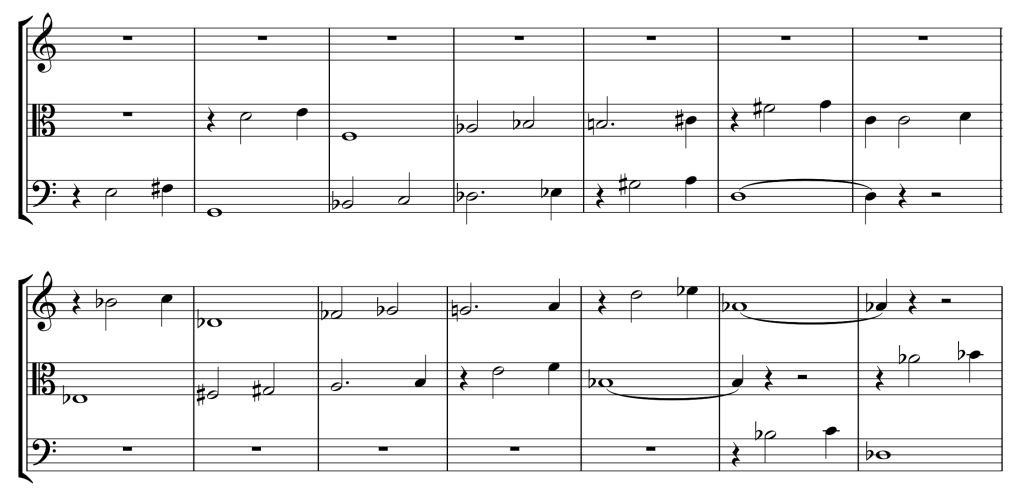
    Adding the third part enables this stair-step sequential transposition of the two-voice canon to go on and on . . .

    3. Trial and error

    Let’s try a different technique to add a canonic answer, one that is facilitated by notation software such as Finale or Sibelius. This way involves

    • copy the whole lead line, not just a head motive
    • choose a time delay or maintain one already established. Paste into the new answering voice the lead line
    • Playback the synthesized audio to test aurally for contrapuntal viability.
    • If it sounds bad, analyze the vertical intervals to discover why.
    • Make a strategic choice of a transposition of the pasted-in answer, then test it aurally.
    • Keep trying different transpositions until you find one you really like.

    For traditional diatonic tonal subjects, common transpositional choices are: unison; octave; Perfect 5th (7 semitones); Perfect 4th (5 semitones).

    In the following examples, I show in the first system a trial of an added third voice in the middle, starting on E (alto clef) transposed an octave up from the lead. For the second system, I tried adding a third voice on top, transposed up a Major 9th (14 semitones) from the lead’s start on Eb to start on F (treble clef).

    Horrible, yes? Why? What vertical contrapuntal invervals are the sour ones to your ear?

    I’ll jump to a better trial that succeeds in both places.
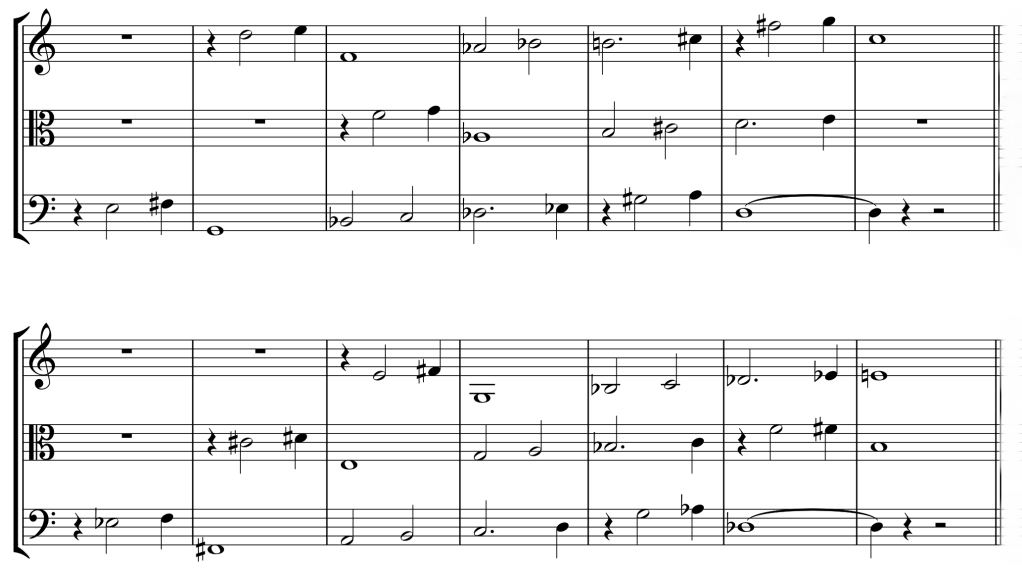
    In this successful trial, the first system’s added middle voice transposes from the lead’s E up 13 semitones (minor 9th), and later in the second system the added upper voice transposes up also 13 semitones from the lead’s Eb to a second answer starting on E. The minor 9th is unusual, unorthodox, chromatic, not a solution we might predict . . . but it works!

    4. Rhythmic alternation

    This will be like Fux’s Fourth Species. The lead subject is best with some long note values, leaving ample time for answering voices to present pitches when it is not moving. Transpositional choices for entering answers become fixed as predominant vertical intervals throughout the canon. In this example, the first answer chooses down 11 semitones plus an octave, and the second answer enters up 7 semitones (Perfect 5th) from the first answer, which is down a Major 10th (14 semitones) from the lead line. Thus vertical (harmonic) intervals of 11, 7, and 14 semitones end up projecting harmonies based on the 7 4 array: G up 7 to D up 4 to F#, which is up 11 from G. That sets the harmonic character of pitch constellations throughout the canon.

    5. Stretto echo

    Stretto is the term used in fugue structure for when an answer to the subject happens before the subject is finished, sometimes with a delay as short as only one or two beats. For a canon, this offers an interesting strategy for choosing pitches to shape a subject that makes its own arpeggiated harmony as it goes. The answers at unison (not transposed) are literally echoes. Even with answers octave-transposed, the effect is a multivoice arpeggiation. The fascinating wrinkle, however, is that the “chord” being arpeggiated is constantly evolving, dropping one pitch and adding one new at each note of the lead line.

    Though this setup can work with other rhythmic “species” of lines, it is particularly interesting in the note-against-note conforming rhythms of “First Species.”
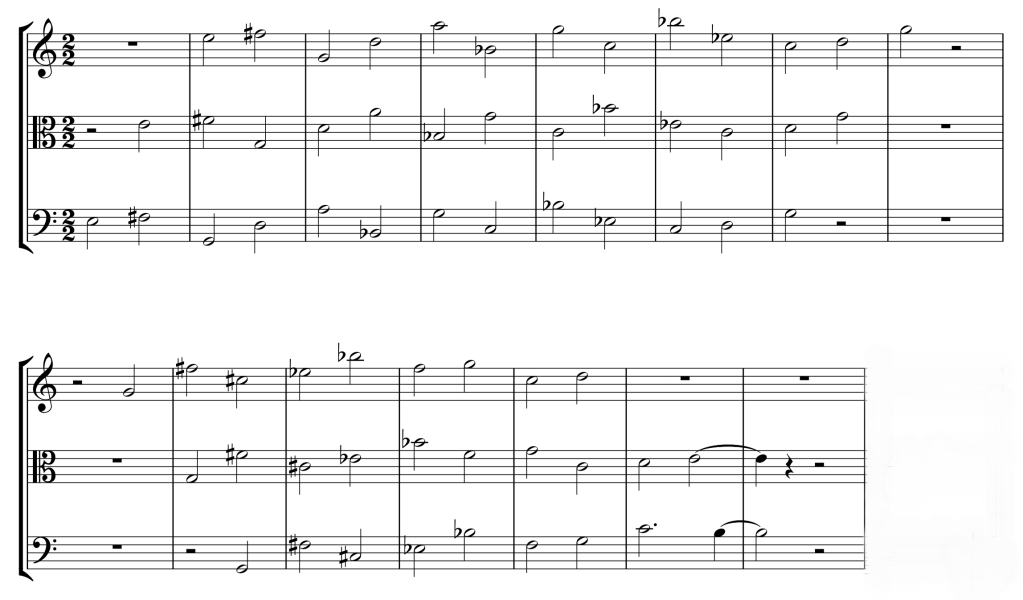
    Here is how it can work, using the canon above as a straightforward example.
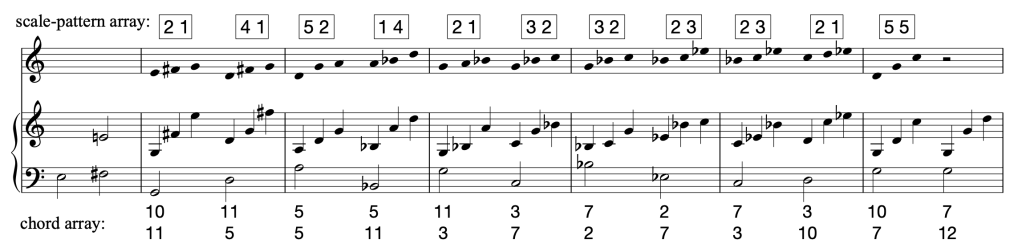
    This analysis sounds as a rather nice progression of arpeggiated chords and simple flute line! The important point, though, is that this progression did not come first. It was built by the canonic subject line as each new pitch was chosen to make a certain array with the previous two pitches in an ongoing, evolving flow. Magic!

    6. Spin a piece

    For our example, we’ll follow the order of the example techniques:

    • two-voice zigzag canon
    • add a third voice by trial and error
    • stretto echo of the same subject
    • Rhythmically spacious subject allowing non-synchronous timing of answers
    • Recapitulation of the stretto echo canon

    The result is a fuller working out of No. 10 of the 14 specimens in my Book of Canons:

    Black Canyon

    The title comes from my photographic memories of the Black Canyon of the Gunnison River, named for the ever-present shadows the narrow canyon’s steep, sheer, tall rock walls cast on the river flowing far below. The sheer cliffs of the Black Canyon are metamorphic Precambrian gneiss and schist, streaked with thin, brighter-colored layers of pegmatite. These streaks sketched on the darker rock look like maps of ancient contrapuntal lines.

    Continue reading Mapping the Music Universe . . .

    MapLab 4. Model a metamorphosis

  • Mapping Music 11. TEXTURE

    Imagine a piece of music exploring texture in time, made of single sounds and sonorities occurring one at a time in sustained resonance. Then imagine the points of sound are separated by rests, silence. As the texture drifts in and out of a resonant cloud, the sound events remain unconnected. Suddenly, their pace explodes into a torrent of notes. That describes the following powerful piece by my UNT colleague, Joseph Klein.

    Joseph Klein – Pathways IV: Rhymes & Spirals (2024)

    Sound color

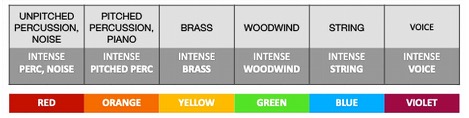
    Our next music map shows a simple color-coding graphic system for classifying most musical timbres, informally the tone quality of sounds. The map intuitively chooses colors of the rainbow. While the color spectrum orders the frequencies of light (another manifestation of periodicity), our sound-color classifying map does not imply any ordered quantification of timbral complexity.

    instrumental color rainbow

    Though we think first of an orchestra for a rainbow of color, chamber music can incorporate a variety of instrumental colors, each produced in vivid isolation by one instrument, standing out or changeably mixed with other colors.

    Augusta Read Thomas wrote Dance Mobile in 2021, scored for 13 instruments: Woodwind quartet (Flute, Oboe, Clarinet, Bassoon); Trombone; String quintet: (2 Violins, Viola, Cello, Contrabass); Piano; 2 Percussion (vibraphone/metal, marimba/wood, drums).

    The piece starts with a single pitch, blending several colors that swell in intensity. Then ensues a kaleidoscopic dance of at least seven distinct color combinations, of two basic types:

    Sustained sounds – strings; high woodwinds; lone brass of the trombone

    Sparks – pizzicato strings; ringing metal sounds; drum strokes; staccato piano

    Augusta Read Thomas – Dance Mobile (2021)

    Though the piece is dedicated “in memoriam Oliver Knussen,” the memory is a joyous dance of color.

    Symmetry

    In the exposition of Webern’s Symphony, Op. 21, we saw that each contrapuntal line duplicates the exact rhythm of the lead line, with each entrance one bar later — a classic canon. But each contrapuntal line presents a different succession of instrumental colors:

    Horn . . . . . . . . . Clar. . . . Cello
          . . . Harp . . . Cello pizz. . . . Cello arco . . . Violin . . . Harp . . . Horn . . . Harp
          . . . . . . Horn . . . . . . . . . Bass Clar. . . . Viola
           . . . . . . . . . Harp . . . Viola pizz . . . Viola arco . . . Violin . . . Harp . . . Horn . . . Harp

    The German term for this is so elegant, we’ll use it here:

    KLANGFARBENMELODIE — melodic or contrapuntal line expressed by a string of changing tone colors

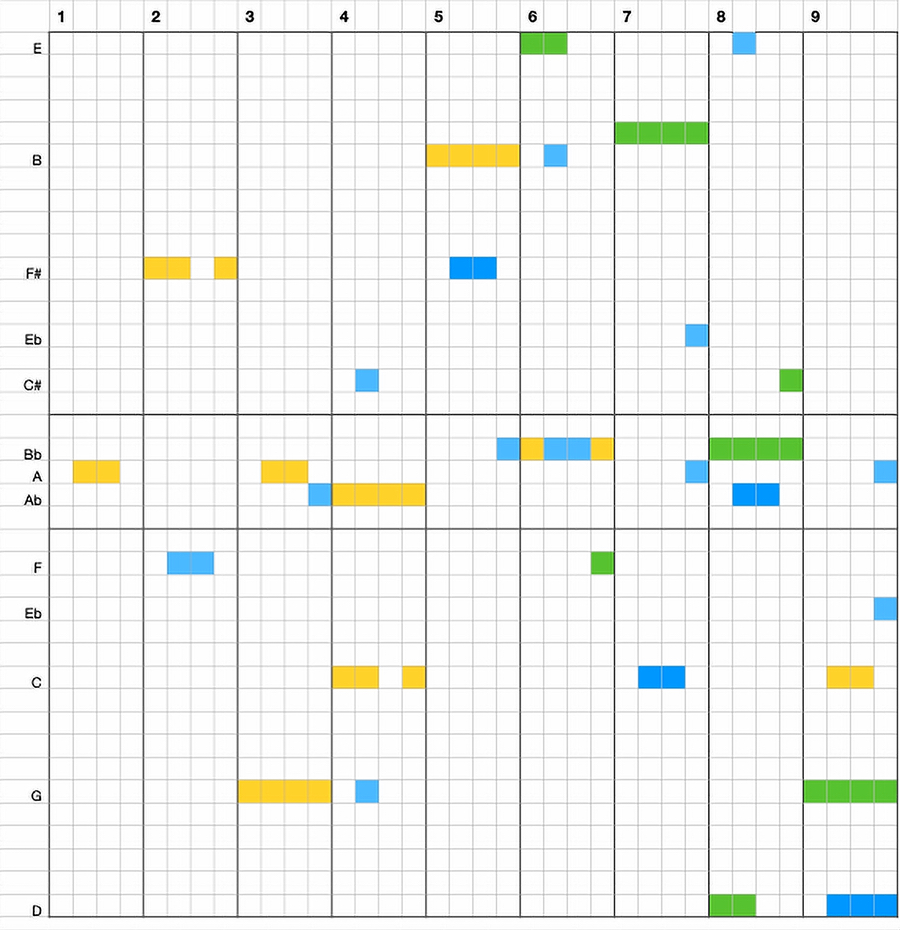
    Webern placed each pitch in every line in a particular fixed octave, except Eb that appears in two different octaves. This makes a striking, symmetrical 13-pitch constellation with a palindromic array, the same array going down as going up.

    Webern 13-pitch constellation

    Not only was he obsessed with symmetry in this piece, but this constellation’s symmetry also proves that he was thinking specifically about the chord voicing in what I have identified in successive interval array form.

    We can use this constellation as a Y-axis for a graph mapping the timbres as they appear in the various parts in canonic lines in pitch space for the first 9 bars. This farben color map looks like one of the later geometric paintings of Piet Mondrian.

    Op. 21 color map

    Pointillism

    Though we often share musical terms and concepts with visual art, we sometimes mean different things by the same term. In painting, a technique developed in the Impressionist style period of the late 19th century that became known as pointillism. The most famous example is Georges Seurat’s “A Sunday Afternoon on the Island of La Grande Jatte” at the Chicago Art Institute. Instead of sweeping brush strokes and palette-blended colors, it used small separate spots of subtly varied colors to make a texture that, when viewed from a distance, seems to merge into a color cloud, giving the impression of animated light.

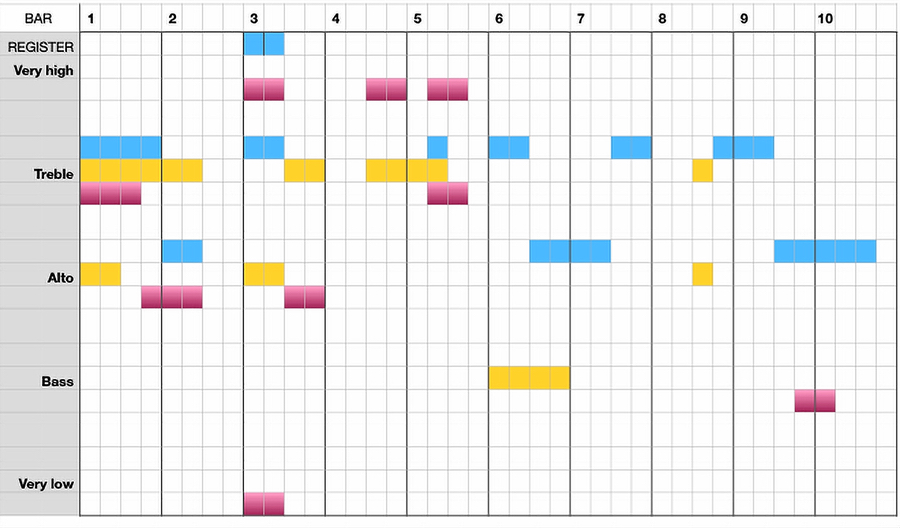
    Musical pointillism, unlike painting, separates sounds in time and pitch space, not to blend them into a texture so much as to highlight the different qualities of each unique sound event. Webern was a pioneer of musical pointillism in works such as Op. 21. Let’s graph the first 10 bars of this fabric using our timbre color-coding (BLUE = wind, ORANGE = percussion, VIOLET = plucked string) on a broadly distinguished 6-octave pitch range. We get something as colorful as a Mondrian painting!

    Andromeda sound color map

    As a musical fabric, isolation — using the vast available range of pitch and the empty time of rests and silence — is a fitting analog for the vast, mostly empty space of a galaxy. Let’s use it for a demonstration etude.

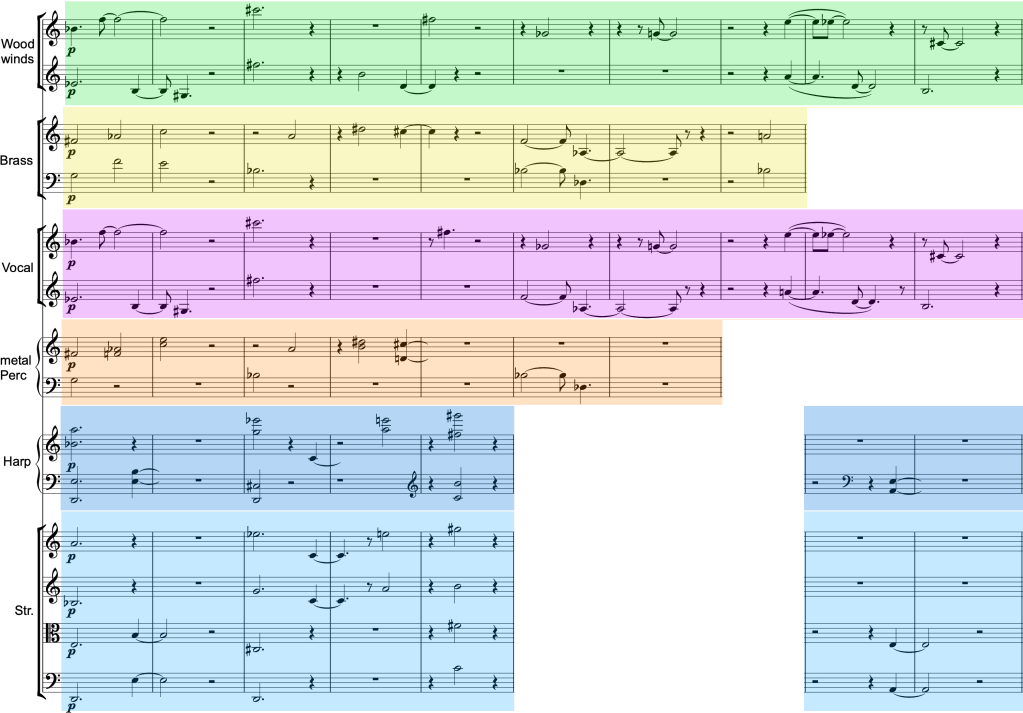
    Andromeda is the nearest large galaxy, 2.5 million light-years from our own Milky Way galaxy. Our sound color demonstration study uses every sound quality on our sound color spectrum except red. Here is a score of the first 10 bars.

    Notice that the green woodwind notes are doubled with a synthesized vocal-type sound. Yellow brass notes are punctuated by orange metallic percussion attacks. Likewise, blue string notes are articulated by the plucked string sounds of harp.

    Here is the whole colorfully pointillistic 3-minute study:

    Sound Mass

    At a time when electronic music was emerging in the 1950s, new instrumental resources were also developing a new style that was all about animating massive layers of sound.

    German experimentalist Karlheinz Stockhausen composed two early, influential sound mass works, Gruppen (1957) for three orchestras, and Carré (1960) for four orchestras and four choirs. The scores were huge, dense, 12-tone, and monolithic in form.

    A 2002 piece by John Adams, On the Transmigration of Souls, harkens back to a mid-century masterpiece of the Avant Garde. In 1961, Polish composer Krzysztof Penderecki wrote a piece for a massive score of 52 string instruments. Conceived as an abstract, freeform, dense massing of animated and intense musical fabrics, it represents a pioneer in the genre of sound mass music, winning the UNESCO Prize that year. Only after it was heard in performance, he said, “I was struck by the emotional charge of the work … I searched for associations and decided to dedicate it to the Hiroshima victims” — thus the title, Tren Ofiarom Hiroszimy (translated Threnody for the Victims of Hiroshima).

    As a young composer in the ‘70s, I reflected this approach in some pieces titled Animated Landscapes. (The title was inspired by John Cage’s famous Imaginary Landscapes no. 4 for 12 radios.) Beyond referring to the painting genre of landscapes, the title sets the imagination for solid, continuous textures like viewing the shapes of a mountain range, but set into rhythmic motion. (This approach became prevalent in ensemble music, especially of Midwestern composers such as Donald Erb.)

    Considerably predating the music mentioned above, Schoenberg’s Fünf Orchesterstücke, Op. 16 (1909), was originally scored for a large orchestra of 37 parts. It is not thought of as sound mass music, as its five movements each have Expressionist or Impressionist titles: “Vorgefühle” (“Premonitions”); “Vergangenes” (“The Past”); “Farben” (“Summer Morning by a Lake”); ”Peripetie” (“Peripeteia”); “Das obligate Rezitativ”(“The Obligato Recitative”). The third movement, Farben, is of special interest not only for its exquisite mixed-palette painting of orchestral timbres, but also for its thick though delicate fabric of sustained sounds. At the start, nothing moves, the subtle shimmer of instrumental colors fading in and out of a continuous fabric of delicate, faint sounds. (A sound mass can be delicate, not necessarily “massive.”)

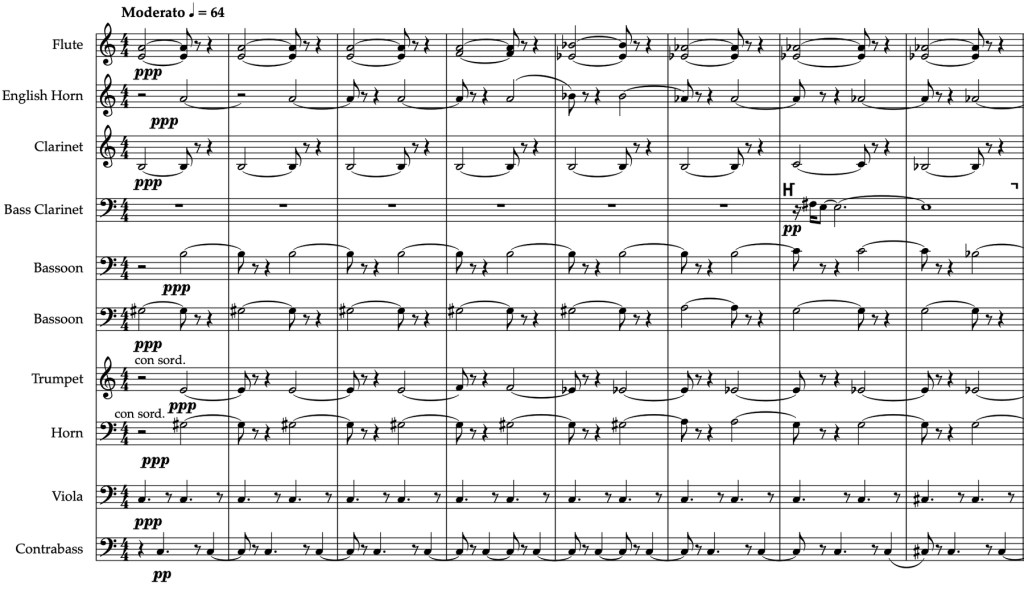
    Here is a score of the first page, showing sounding concert pitches for all instruments.

    Schoenberg Farben scoring

    Each measure presents one constellation, recolored with different instruments in the second half of the measure. For the first three bars, the constellation does not change, and then only subtly in the next five bars, maintaining the constant C pedal point in the low strings.

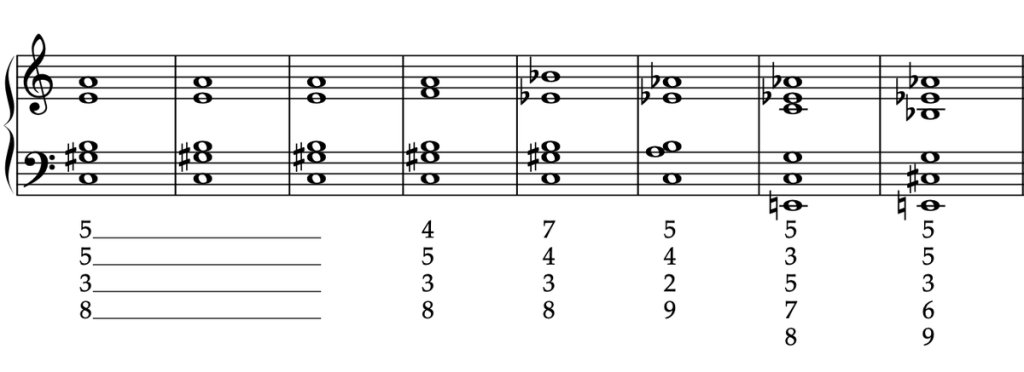
    Farben constellations

    The bass clarinet’s F3 in bar 7 is considered an ornamental non-harmonic pitch. While you can see many recurring smaller constellations imbedded within these changing large constellations, such as 5 5, 3 5 and its inversion 5 3 (which are triads), and some transformations of smaller constituent constellations: 8 3 redistributed to 9 2, 4 7 shrinking to 4 5 (another triad), and 3 4 (also a triad) shrinking to 2 4.

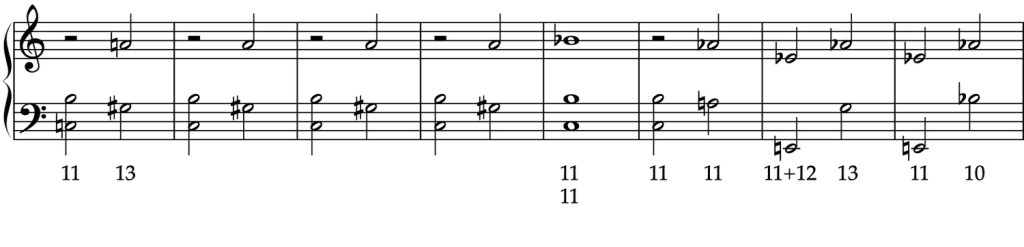
    Though there are many triads embedded in the constellations, the overall quality of the sonorities is complex, as the triads are framed within critical dissonances:

    framing dissonances

    Foreground / background

    Most landscape paintings, distant textures of forest, mountains, sky, waves on the sea, or clouds, have some sharp focal point. Often on the horizon (in itself a focusing anchor of the visual display), it may be a barn, a setting sun, a boat, a farmer and dog. If we consider proportion and symmetry in a visual composition, the focal point is best not dead center. A more interesting balance, according to expert photographers, follows the Rule of Thirds, placed one-third from the left or right, one third from the top, or both. Two-thirds is a ratio of 0.667. The Greeks famously defined the Golden Ratio, an ideal ratio dividing a whole length or height into two parts such that the ratio of the smaller part to the larger is the same as the ratio of the larger part to the whole. The ratio is 1.618:1, the solution to the equation: x2 – x – 1 = 0; a 62% and 38% division.

    In a simple traditional musical texture, an accompanying harmonic texture is designed as a background for the focal element of a melody. Sound masses may lack such focus, like the forest or sea waves. When there is to be perceived a standout element of the texture, Schoenberg called this focal element of the musical fabric the Hauptstimme. Though that might translate “highest voice,” the melody or other focal events are not necessary to be higher in the pitch range of the fabric than other elements. But there must be some isolation or distinction setting them off from background in at least one of the parameters mentioned above. The Hauptstimme focal line or textural element can be:

    • in a pitch range isolated from background
    • a color isolated as a single timbre, not a mixed diffusion of background colors
    • slower or faster than background
    • more rhythmically elastic, varied than background
    • not synchronized with background
    • loudest line (the most obvious)

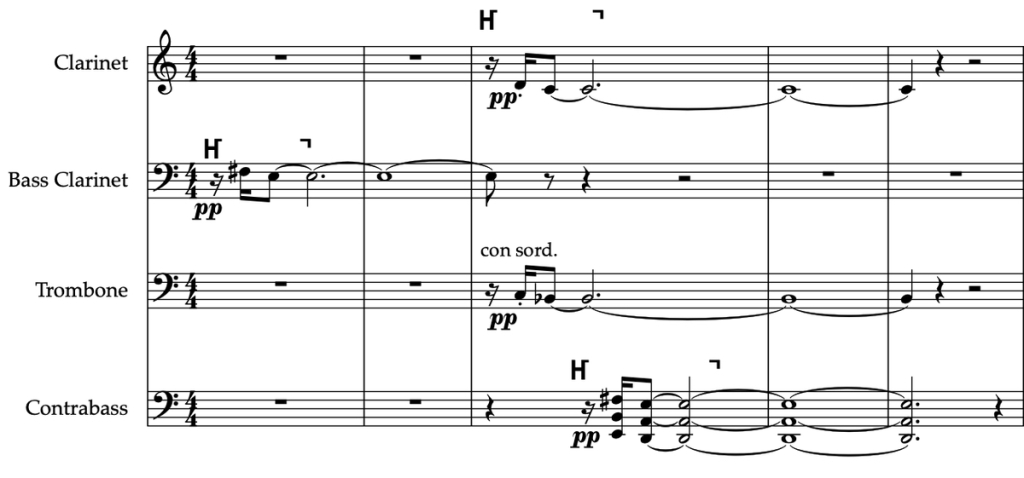
    Schoenberg devised a special symbol for the focal Hauptstimme line of a fabric, a boldface stylized capital H, which you see marking the bass clarinet entrance in bar 7 of the Farben example. Here is how that principal Hauptstimme line continues, a Klangfarbenmelodie of changing color, from bass clarinet to clarinet with trombone to three solo contrabasses.

    Hauptstimme handoffs

    Notice the aggressive rhythmic motive, each time stepping down 2 semitones; and the  7 7 7 quintal-chord constellations in the contrabasses. (The rhythmically aligned clarinet and trombone are separated by 14 semitones, 7 + 7.)

    Beyond color isolation, Learning to Compose makes a distinction for a timbre mixed with itself or other colors spread over some pitch register (“diffuse”) or reinforcing itself in a narrow, confined pitch space (“concentrated”). While Farben’sbackground is diffuse, its Hauptstimme color is isolated in the low pitch register of the bass clarinet and then also concentrated with the three solo contrabasses.

    In the first movement of Anthracite Fields (2015) by Julia Wolfe, the bass clarinet emerges as a focal sound by its loudness and singularity of pitch in a cloud mass of softer sound. Then aggressively loud clusters suddenly interrupt the steady-state background, yielding eventually to repetitive sung chords and floating vocal duets. The sound fabric maintains a three-dimensional depth of contrasting intensities.

    Julia Wolfe – Anthracite Fields I: Foundations (2015)  

    Galaxy groups

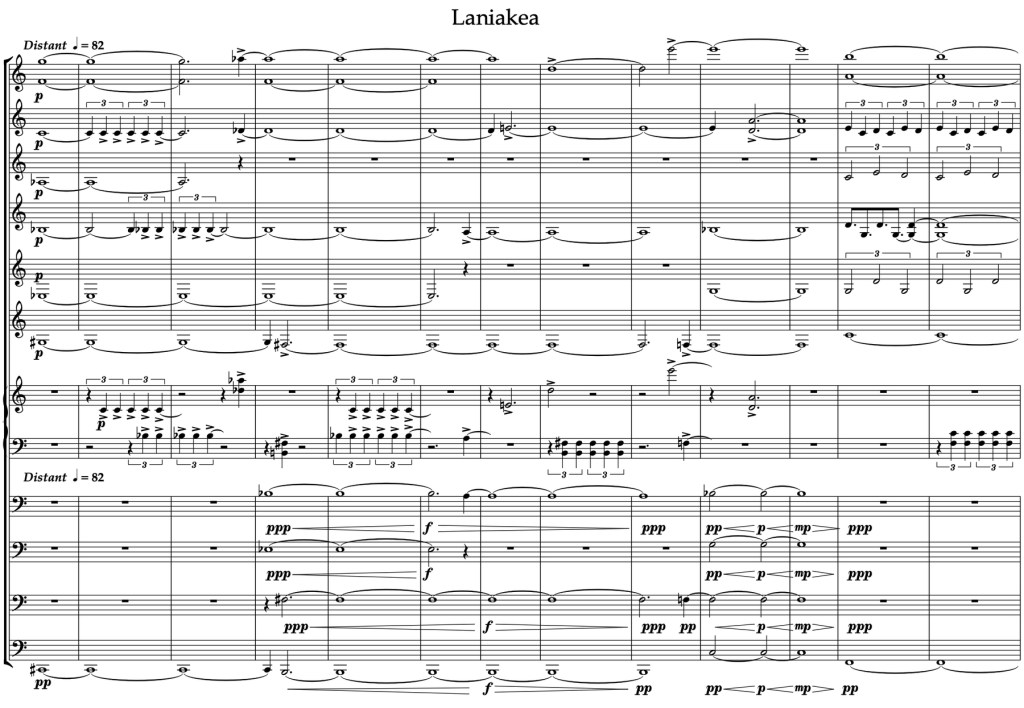
    Our sample etude composition for sound mass is a thick score of 10 wind parts and harp, with a fabric the opposite of pointillism: everything sustains and overlaps. There are basically no pauses or holes in the continuous 2-minute sound fabric. Its title, Laniakea, is the name of the supercluster of galaxies that includes the Milky Way.

    Laniakea score excerpt

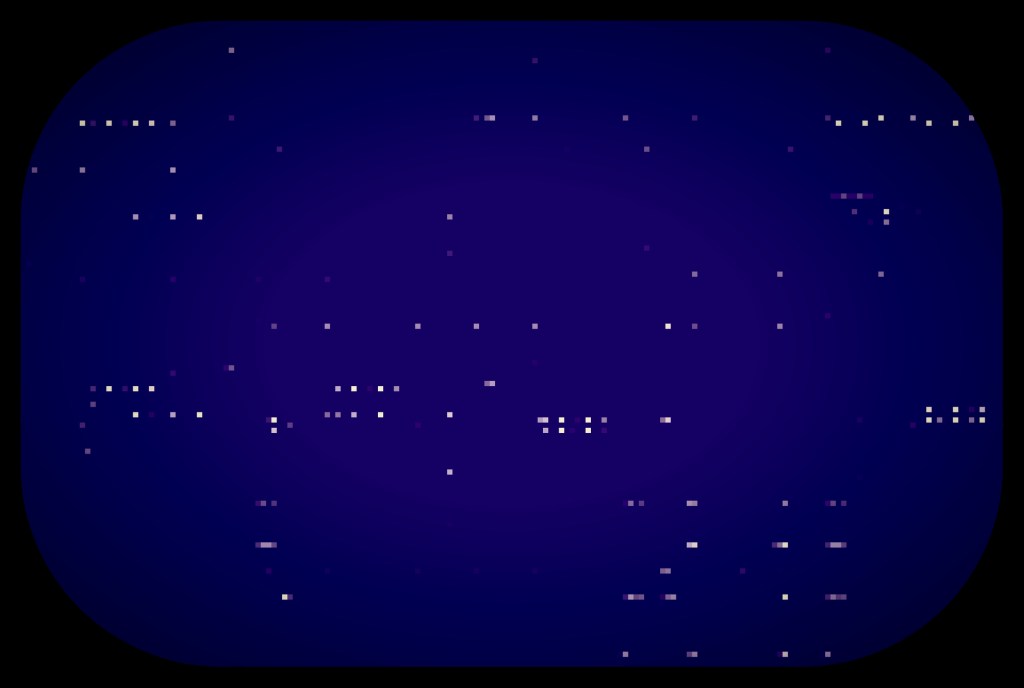
    Having shown the score with all its notational details, to better illustrate the main point of the example, sound mass, here is a graphic rendering of that actual second system of notes. We can reveal its pointillism by increasing the contrast in a negative image of light on dark. That makes the attack beginning of each sound show up but not the staff lines or sustained resonances . . . a fanciful art image of Laniakea, a vast empty part of the universe dotted with millions of galaxies.

    Laniakea score abstracted

    © 2026 – All Rights Reserved

    Thomas S. Clark

    Continue reading Mapping the Music Universe:

    TClarkArtMusic.com

  • journal 12. Zweite Wiener Schule

    Vienna, 1992 —

    The so-called “Second Viennese School” consisted of influential master composer Arnold Schoenberg and his protegés, Alban Berg and Anton Webern in early 20th-century Vienna. They pioneered a compositional approach described succinctly by Wikipedia as “totally chromatic expressionism without a firm tonal centre, often referred to as atonality; and later, Schoenberg’s serial twelve-tone technique.”

    When I began studying composition at Michigan in 1968, I quickly became immersed in exploration of pitch structure and broader tonality freed from the long-traditional restrictive limits of tonality: diatonic major and minor keys and their chromatic extensions, triadic sonorities and tonal centers. The complexity of this new musical realm is not truly “atonal” but rather an opening to a universe of fascinating, colorful possibility.

    Three pieces of the early 20th century, which I studied deeply in the 1970s and later used extensively in my teaching of modern music, were each masterful explorations of musical sound color.

    • Claude Debussy’s La Mer (1905), an iconic tone poem of Impressionistic musical painting, was discussed in Journal 1. Musique Française.
    • Anton Webern’s Symphony, Op. 21 (1928) is maybe the briefest piece ever titled as a symphony, a succinct, two-movement work whose first movement is a delicate gem of pointillistic color and complex 12-tone harmony.
    • Arnold Schoenberg’s Five Pieces for Orchestra, Op. 16 (1909); the third piece is a gentle study of orchestral sound color titled “Sommermorgen an einem See (Farben)” — (Summer Morning by a Lake: Colors”.

    After fifty years, these works are embedded more deeply than ever in my musical consciousness.

    It was only in 1992, on a side trip by bus from Brno, that I visited Vienna, the great musical city of Haydn, Beethoven, and Mozart in his last years. Mozart’s grave, not in the main cemetery but on the edge of the city, was hard to find but emotionally powerful to visit.

    Farben

    Farben” is an early Schoenberg piece that is all about instrumental sound color and exotic harmonic color. The chords are not triads but rather atonally “dissonant” sonorities that place the instrumental colors in close, glowing pitch-interval proximity.

    LISTEN ›

    Five Pieces for OrchIII (Farben)

    Chicago Symphony on YouTube

    My recent piece, Farben, pays special homage to Schoenberg’s masterpiece, layering kaleidoscopic wind-instrument colors to build massive, morphing constellations, echoing Webern’s hidden chord-color symmetry.

    FARBEN

    Clark 2025 (TC-149)

    I have long admired and been influenced by the music of Anton Webern. Known historically as a member of the Second Viennese School with Alban Berg and mentor Arnold Schoenberg, the three were pioneers of so-called atonal music and 12-tone-row serial harmonic organization. I find the term “atonal” misleading and negative, as their 12-tone processes achieved new “12-tone tonalities” — not simply a rejection of traditional tonal harmony but also striving to create new and more complex tonalities.

    What I admire about Webern’s mostly-quiet instrumental miniatures (his Symphonie Op. 21 has only two sparsely-scored movements) is the delicate, crystalline quality of his pitch constellations; and their gently lyric, precious setting into transparent, pointillistic textures, pearl-strings of separate, delicate instrumental colors (called Klangfarbenmelodie). The first movement is built on one enormous, static, 13-pitch chord containing all 12 pitch classes of the chromatic universe in a symmetrical interval pattern, a palindrome interval pattern, the same top to bottom as bottom to top.

    Todesfall in Mittersill

    Webern’s mentor, Schoenberg, as a Jew was compelled to emigrate to the U.S. in 1933 before it was too late. Webern, not Jewish, stayed in Vienna, where he was born, suffered through and survived World War II, only to be fatally shot by a U.S. Army soldier during the Allied occupation of Austria in 1945. My homage to this beautiful musical mind tries to capture his music’s “lyrical, poetic concision” (Wikipedia).

    WEBERN ELEGY

    Clark 2024 (TC-115)

    Neue Tonalität

    My compositional excursions in 12-tone tonality traverse many of my compositions. One that sums it up well, if not succinctly, is VIENNESE SKETCHES. A set of “Twelve Miniatures in Twelve Tones,” parts I through IV are adapted from Webern Elegy , and V through XII from MapLab7For Little Arnold from my book, Mapping the Music Universe.

    Not intended to portray the historical European city, VIENNESE SKETCHES instead explores various textures and tonalities using the musical techniques of the Second Viennese School. My goal was to create a complex counterpoint of sound constellations that is less dissonant and more sonorous — my sense of a new tonality.

    VIENNESE SKETCHES

    Clark 2023 (TC-131)

    ___________

  • journal 10. Lightforms

    Denton, 1985 —

    One of Schoenberg’s Five Pieces for Orchestra , Op. 16, subtitled “Summer morning by a lake,” evokes the color (farben) of light. Another work, by Schoenberg’s Vienna colleague, Webern, to me is metaphorically also about light and color, though abstractly titled Variations, Op. 30. Brief flashes of light come out of silence, isolated fragments of singular orchestral instruments’ sound colors.

    Berliner Philharmoniker

    LISTEN › YouTube

    Light follows form

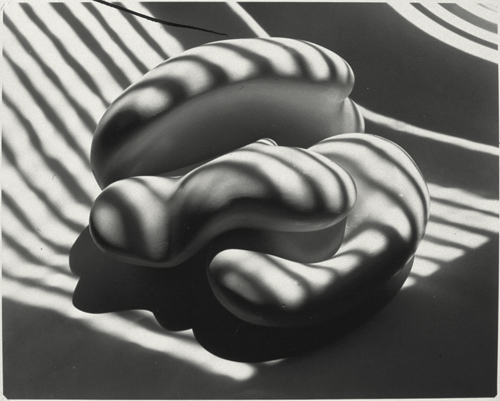
    In 1985 I first saw the work of photographer Carlotta Corpron in Denton, where she was on the faculty at Texas Woman’s University. Her stark black-and-white images were all about how light embraced the contours of physical objects.

    Light follows form – C. Corpron

    This inspired what became a continuing fascination for me in exploring musical metaphors for the magic of light, beginning with:

    • LIGHT FOLLOWS FORM — digital sound sculpture. TC-51 (1985) Borik Press     
    • PATHS OF LIGHT (Homage to Webern) — mobiles for instruments, tape. TC-52 (1985)
    • OF LIGHT AND SHADOW: Two Canonic Sketches — wind ensemble. TC-54 (1985)

    The first in the LIGHTFORMS series, Constellations (1992, TC-65) for piano and visual projections, combined spacious, floating piano sonorities with photographed light emanating through stained glass windows in the sanctuary of Denton’s First United Methodist Church. Pitch and rhythmic patterns were derived from tracings of star maps of several constellations. (We’ll explore this and its synthesized sequel, LIGHTFORMS 2: Star Spectra (1993, TC-68) in a journal entry, “about mapping”Maps.”)

    LIGHTFORMS 3: Ancient Images (2005, TC-76) is a wind ensemble scoring of a 1996 piece, Mucha’s Light, based on five of Alfons Mucha’s 20 epic paintings, Slovanská Epopej (“Slavic Epic”). We’ll explore this one in another journal post, “Sound painting.”

    Spectrum

    More recently, the LIGHTFORMS series continues, with three multimedia videos (viewable on YouTube) combining new computer music with my more experimental and sometimes abstract photo images.

    Sonic exploration of cosmic harmony in a quiet, almost timeless star-gazing mood . . .

    Clark 2025 (TC-150)

    view YouTube video

    Timbres emerge, echo, and fade in a floating, slow-moving distant landscape of color . . .

    Clark 2025 (TC-152)

    view YouTube video

    Musical impressions of dusk, with a Haiku-like text quoting one mellifluous phrase from Robert Frost’s “Waiting Afield at Dusk” . . .

    Clark 2025 (TC-153)

    view YouTube video

    Streams of crimson streak the sky
    above tree silhouettes.
    Dusk settles
    in the antiphony of afterglow”.
    A new night consumes the shadows.

    ______________