Tag: arpeggio

  • MapLab 5. Spin a Solo

    Unaccompanied instrumental solos go back at least to the 18th Century, such as Bach’s violin partitas and cello suites. In the late 19th century, Debussy’s Syrinx for solo flute met the challenge of making a piece with just one wind instrument, not capable of the double-stops that complicate the rich textures of Bach’s string writing.

    1. Choose a model

    Syrinx launched a whole genre of unaccompanied flute solos, with Density 21.5 (1927) by Edgard Varèse and Sequenza (1958) by Luciano Berio leading the way to experimentation with virtually every wind instrument. My Night Songs (1969) for solo trombone is very much within the tradition of this genre. As a trombonist and undergraduate composition student, I used my intimate knowledge of the instrument to select gestures and techniques to experiment with compositionally.

    2. Choose an instrument

    I also love the viola, so I readily agreed to write an unaccompanied solo for each member of the Pleasant Street Players, including violist Ames Asbell.

    3. Sketch idiomatic gestures

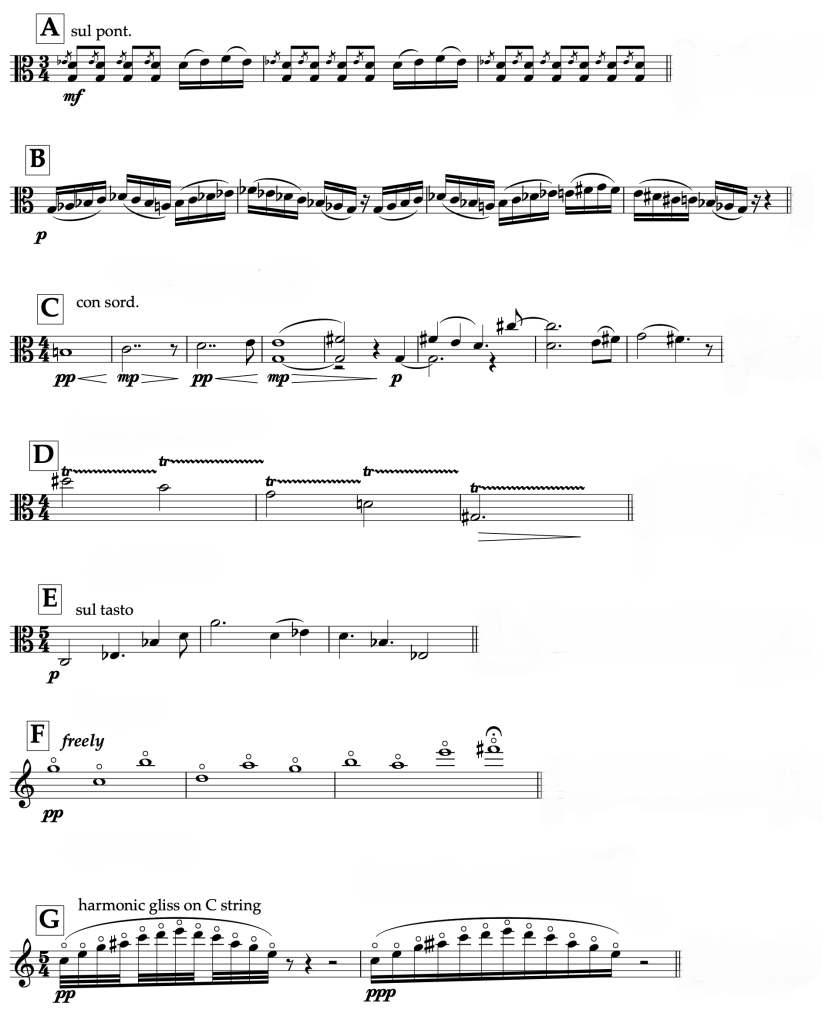
    Before I Sleep is inspired by a famous, beautiful Robert Frost poem, “Stopping By Woods.” Its snowy scene tempted me to quote a Mahler’s Symphony No. 4 (1900) that starts with sleigh bells and flutes doing something like the A gesture. (Sul ponticello is a special string technique to brighten tone by moving the bow closer than normal to the bridge.)

    B features the quick scale patterns so indigenous to orchestral strings.

    C uses a mute, attached to the bridge to subdue the tone. It also uses double-stops, drawing the bow across two adjacent strings together, making two-pitch diads and even two-voice counterpoint. These use an open string and the next string a perfect-fifth higher or fingering a pitch more than a perfect-fifth higher.

    D makes bird-like trills.

    E uses sul tasto, the reverse effect of sul pont, drawing the bow closer to or over the fingerboard for a darker, warmer sound.

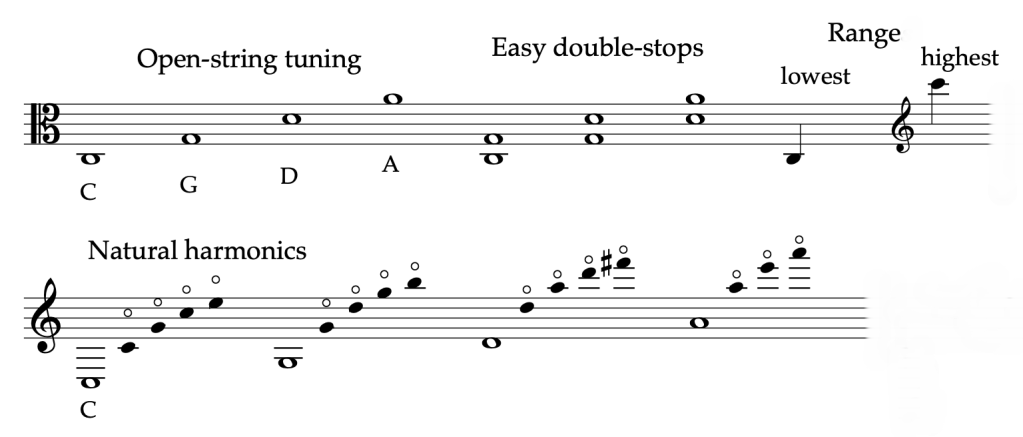
    F makes the high, glass-like sounds of natural harmonics, produced by touching a string lightly at one of its partial-vibration nodes while drawing the bow on it. (harmonics, like open strings, have no vibrato. Sorry my synthesizer insists on applying vibrato anyway.)

    G is a very special effect used by George Crumb in his early chamber music. Sometimes called a seagull effect, it produces a quick arpeggiated succession of natural harmonics by running a finger lightly up and down across the partial-vibration nodes of the string.

    The gestures sketched above show a wide variety of pace and rhythmic characters.

    4. Interval language

    The B idea is scalar, running around through an unusual scale. It is almost an octatonic wholetone-halftone scale, but modified by an Ab, making the lower tetrachord the start of a Phrygian mode scale.

    For the rising and falling landscape of melodic lines, choice of pitches and the cumulative constellations they form can be freely crafted the old fashioned way, plunking out pitches on a piano (or on the actual instrument of the piece) in a trial-and-error search for pleasing pitch streams. Identifying one’s favorite intervals can lead to using a more organized cell approach, limiting melodic interval choices to only two or three sizes.

    In the TC example, an interesting constellation is established and simply arpeggiated in various shapes.

    This produces a single, stable harmonic prolongation, a calming stasis in which the line keeps retracing recently touched pitches.

    5. Edit the notation

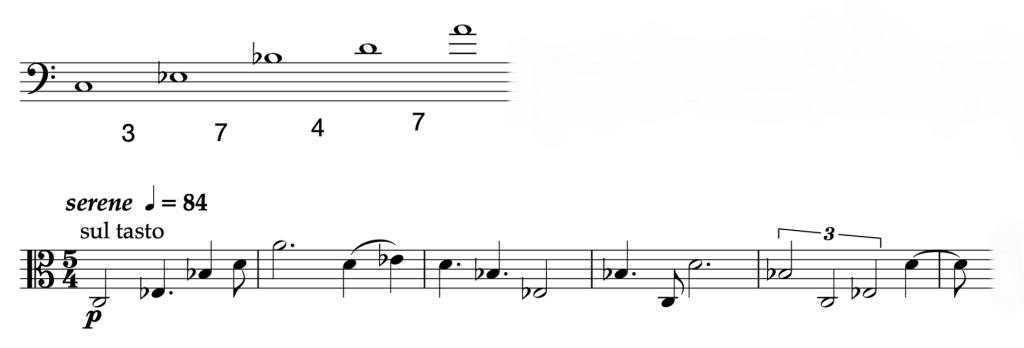
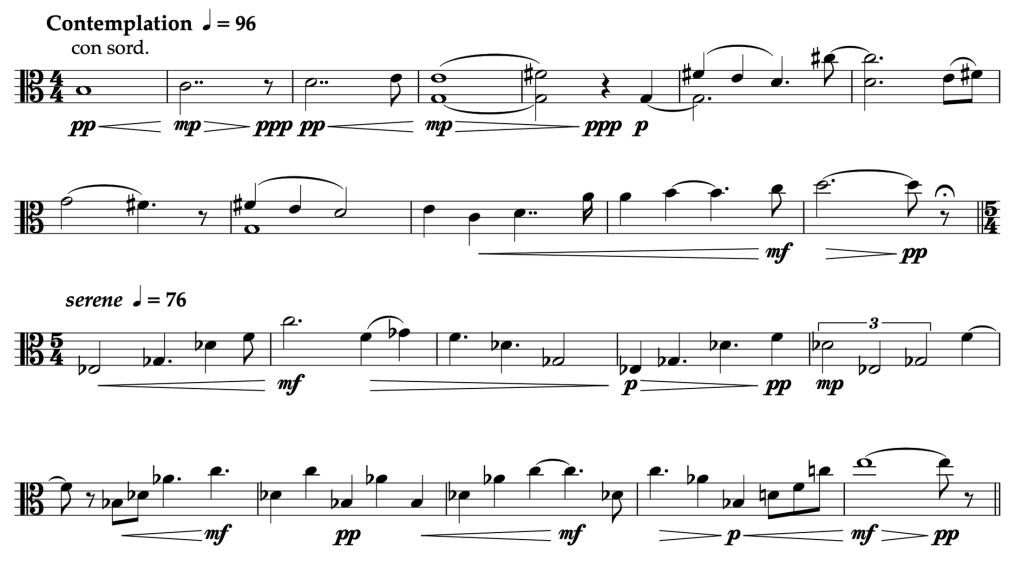
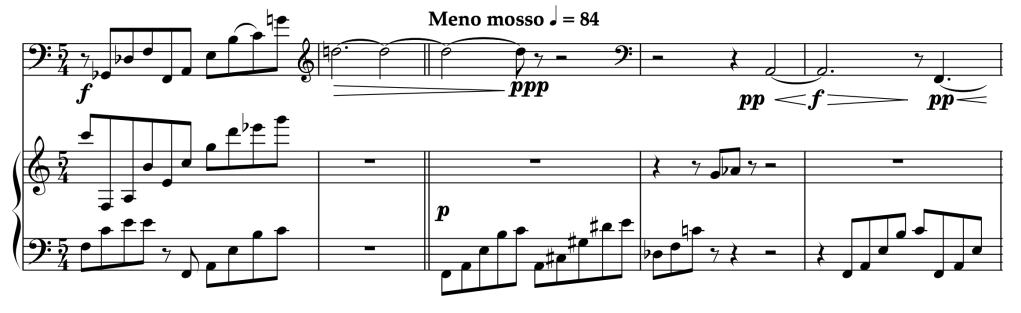
    The score is not finished until all details are included, showing clear information and intent. A solo line especially needs strong dynamic shaping to be interesting as a solitary musical voice. The following example from the viola solo notates many of the necessities on this checklist:

    • timing information, including tempo, rallentando, fermata
    • expressive indications
    • dynamics, including ample changes, crescendos, diminuendos
    • phrasing such as slurs
    • special techniques such as con sordino, sul pont, sul tasto, harmonics

    6. Overall form

    An unaccompanied solo is a soliloquy. The dramatic tone can vary: a rage; a contemplation; or a story. The form can be a continuous flow of development of a single, persistent gesture, as in Berio’s Sequenza series. Or it can be sectional, a story told in short chapters, a poem divided into stanzas.

    The TC example, actually a previously composed 2018 piece titled Before I Sleep, was written for my colleague Ames Asbell of the Texas State music faculty and Pleasant Street Players, an outstanding artist and player of one of my favorite instruments. The title is a quote from the last lines of Robert Frost’s famous poem “Stopping by Woods,” a contemplation of death on a nocturnal sleigh ride in the snow. The lead motive is a quote from Mahler’s Symphony No. 4, which open with flutes and sleigh bells jingling what is called the “bell theme.” My musical form follows the poem, in three sections:

    • sleigh bells and a trotting horse (gestures A and B)
    • snowflakes (a variation of B transitioning into D and F)
    • contemplation (C and E)

    The poem ends famously with a direct repetition of the last line, “and miles to go before I sleep.” That could have been the going-to-sleep hypnotic musical ending as well, but the poet is not ready to die. My musical ending instead is not a coda but a brief tag, gesture G, the horse gently shaking his bells in the glistening moonlight.

    Before I Sleep

    Continue reading Mapping the Music Universe . . .

    MapLab 6. Paint a landscape

  • MapLab 1. Generate a Gymnopédie

    For this first mapping lab, a basic experimental process is outlined step-by-step and demonstrated with examples from a sample composition. Once you’ve studied the example piece, you can start over and craft your own experiment using the same open steps. General instructions leave you free to openly consider and choose from many musical possibilities.

    1. Choose a model

    Trois Gymnopédies (1888) by Erik Satie

    Simple in harmony, meter, melody, texture, repetitive form.

    2. Design a theme

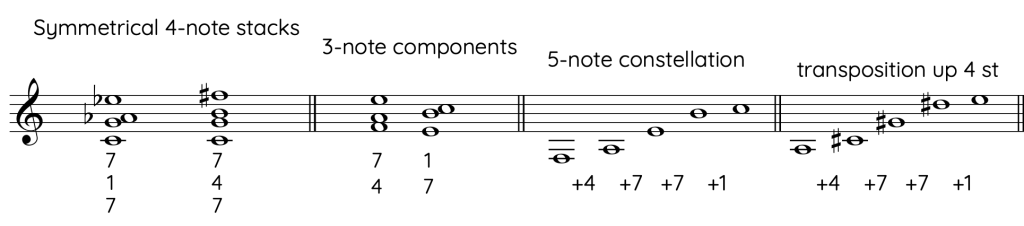
    Start with a pair of 4-note constellations of considerable interest due to their symmetrical interval stacks and “perfect fifth” 7-semitone interval separated by a smaller interval. (See “Symmetrical interval arrays.”)

    We’ve made two chords, both with the same identical interval stack.

    3. Choose a meter and rhythm/tempo character.

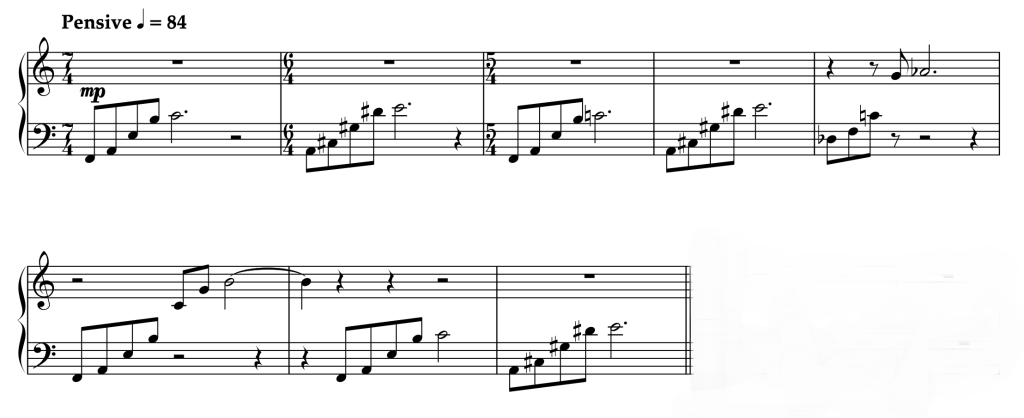
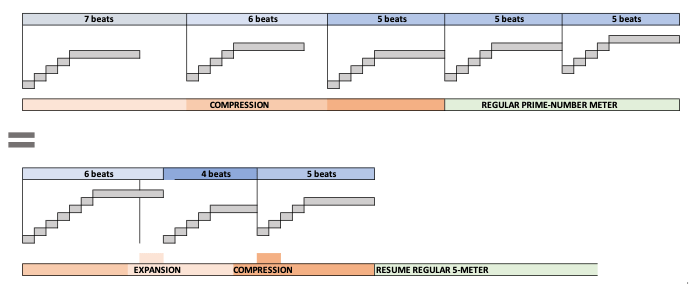
    A prime-number meter (such as the 7 4 meter used for the Finale of Stravinsky’s Firebird) can have a more “timeless” quality, due to its lack of layers of nested pulse between beats and bars. The prime number of beats prevents them from grouping into regular sub-measure groupings.

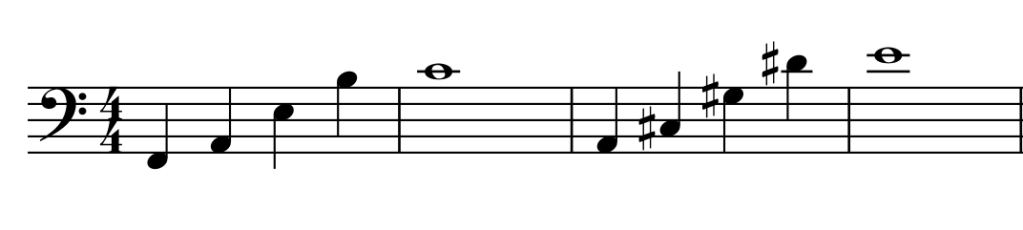
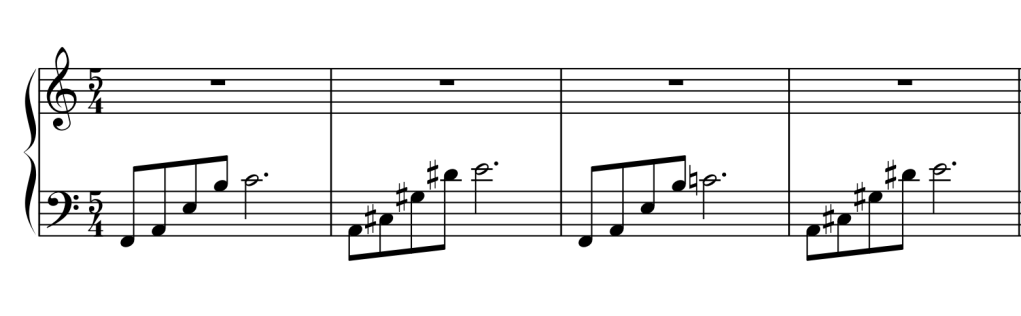
    To follow through further on the floating feel of lacking groupings, let’s stretch the timings a bit between arpeggios.

    4. Add a line and sound color to the texture

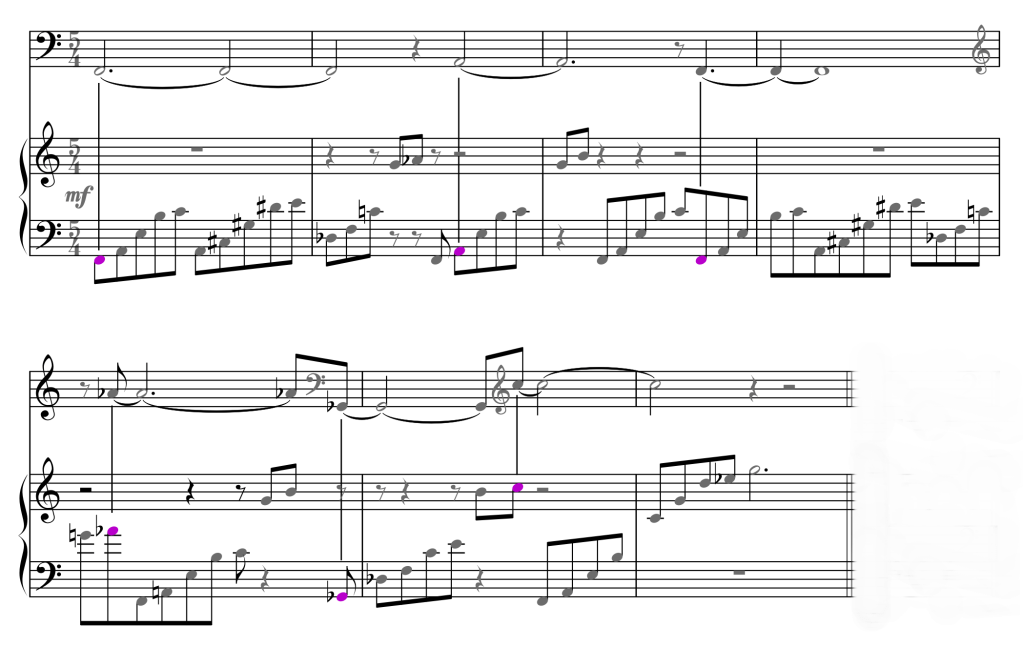
    I call this technique extraction or refraction, pulling selected tones of a complex line into a separate voice:

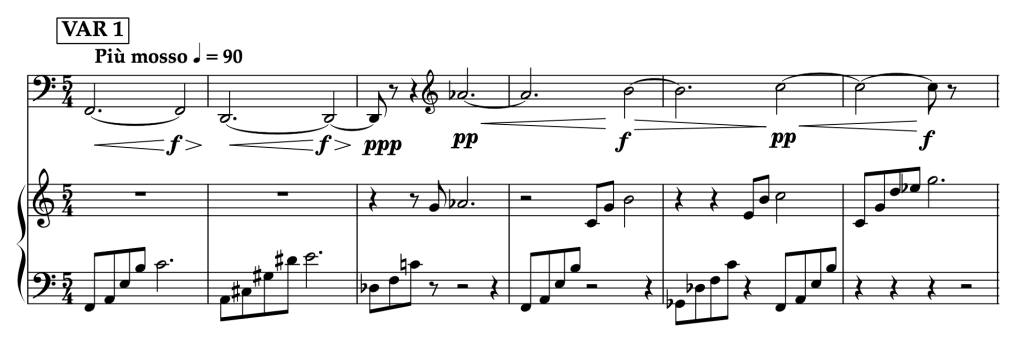
    5. Make variations

    Arpeggios with refracted color line:

    Pull the 8th-note arpeggios into a continuous stream:

    Canon at the octave:

    Rhythmic augmentation, without then with the refracted color line:

    Mirror inversion of augmentation, canon:

    6. Assemble the large-scale form

    The theme and each variation end with a clear cadence, a sustained final note and pause in rhythmic activity . . . except Variation 3, the continuous 8th notes. It morphs into a transition that both interrupts the 8th-note flow and slows the tempo, preparing for calmer, much less dense quarter-note variation:

    The variation process is serial, each one progressing from the previous idea, rather than “starting over” each time. Thus the overall unfolding form feels evolutionary rather than episodic. Then a kind of recap does start over with a return to the opening idea, making a rather traditional coda ending,

    6. Title

    This musical sketch, like most of my pieces, was composed without a title or guiding image. The compositional process began with the basic challenge to make a small piece out of simple, limited material. The adopted model was Satie’s radically sparse, (one could even say) minimalist style in his Trois Gymnopédies for piano (1888), Its title may have been taken from a French poem by J. P. Contamine de Latour — the poem ends with the word gymnopédie:

    Oblique et coupant l’ombre un torrent éclatant
    Ruisselait en flots d’or sur la dalle polie
    Où les atomes d’ambre au feu se miroitant
    Mêlaient leur sarabande à la gymnopédie

    Slanting and shadow-cutting a bursting stream
    Trickled in gusts of gold on the shiny flagstone
    Where the amber atoms in the fire gleaming
    Mingled their sarabande with the gymnopaedia.

    My title will adopt the English translation of one selected metaphor: Amber Atoms in the Fire Gleaming.

    7. The finished piece

    In keeping with the Satie models, this study generates entirely from one modern harmonic constellation, arpeggiated repeatedly in a gentle, almost imperceptible meter, then growing colorful “amber” sustained highlight sounds. Eventually the arpeggios begin to spin and swirl in a layered, kaleidoscopic texture that is “minimalist” in the 20th-century usage as the description for repetitive ostinato music.

    8. Test sample

    Listen without looking at a score, the best way to first sample created art:

    Amber Atoms in the Fire Gleaming

    Continue reading Mapping the Music Universe . . .

    MapLab 2. Sketch a Song

  • Mapping Music 6. CHORDS

    Pursuing our grand space metaphor, here is an important new term:

    CONSTELLATION — a group of pitches occurring in a perceived relationship, either vertical (a chord simultaneity), horizontal (a segment of a melodic line), or diagonal, a combined collection of pitches from various lines sounding in temporal proximity.

    This is intentionally a broadly inclusive concept. Larry Austin and I first coined the term in our 1989 book, Learning to Compose. A constellation can be any number of pitches, but those of three to six pitches are most manageable to analyze, categorize, and manipulate.

    In Mapping Music 5. SCALES, we explored pitch classes (all the D’s in any octave, for example). For now, let’s not go there. A constellation can be very tall, spanning even five octaves, or very narrow, as in three or four close-together pitches well within one octave. (As a chord, we might call these a “cluster.”)

    Common names for types of pitch grouping, “sonority,” “chord,” “harmony,” “melodic motive,” “arpeggio,” or “chord voicing” will all be considered manifestations of a pitch constellation.

    Jennifer Higdon’s 2007 work, Percussion Concerto, driven by rhythmic vitality, romps through a dazzling variety of pitch constellations. Most are more complex sonorities consisting of 4 different pitches, drawn from diatonic scales but extending beyond the basic triads of the scale’s traditional harmony.

    Jennifer Higdon – Percussion Concerto (2007)


    Interval arrays

    NOTE: In place of traditional interval names, which literally don’t add up, we will consistently measure every interval by how many chromatic semitones (half-steps) it spans.

    When pitches of a constellation are considered out of time, like a chord, and rearranged from lowest to highest, we can study their harmonic structure. The stack of intervals makes a successive interval array of semitones from lowest to next, on up to the top.

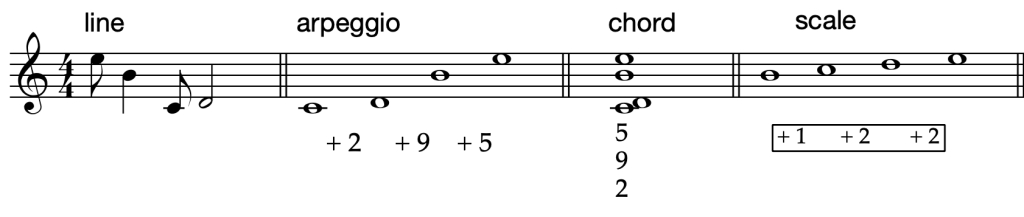
    For example, the following line of four pitches, in order E – B – C – D, rearranged lowest to highest, yields C  –  D  –  B  –  E. Its interval stack =  2  9  5. (Going back to 5. SCALES, the four pitch classes can be derived from the set / diatonic scale-pattern 1 2 2.)

    sample constellation 2 9 5

    This constellation’s particular pitch-pattern shape shows a stack of successive intervals from lowest to highest: 2 9 5.

    INTERVAL ARRAY — stack of intervals that identifies the constellation’s particular intervallic shape in vertical pitch space, listing the successive, additive upward intervals from lowest to highest pitch

    Note: I tend to use “interval stack” and “successive upward interval array” interchangeably. If we wanted an acronym, how about Successive Upward Interval Series Stack — SUISS? No, maybe Vertical Interval Array — VIA? But vertical is not quite right, as the pitches might occur in musical context diagonally in 2-D pitch-time space and only be vertical when theoretically aligned as a chord stack. So let’s stick with interval array — and since conventional music theory doesn’t use the word for anything else, let’s just call it an ARRAY.

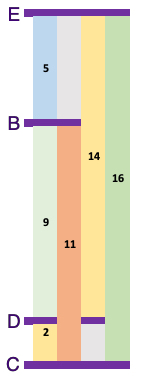
    The constellation above also contains a “Major 7th” 11-semitone interval (+2+9=11), C up to B; a 14-semitone Major 9th, D up to E; and one very large interval of 16 semitones, C up to E in the next higher octave.

    sample constellation 2 9 5

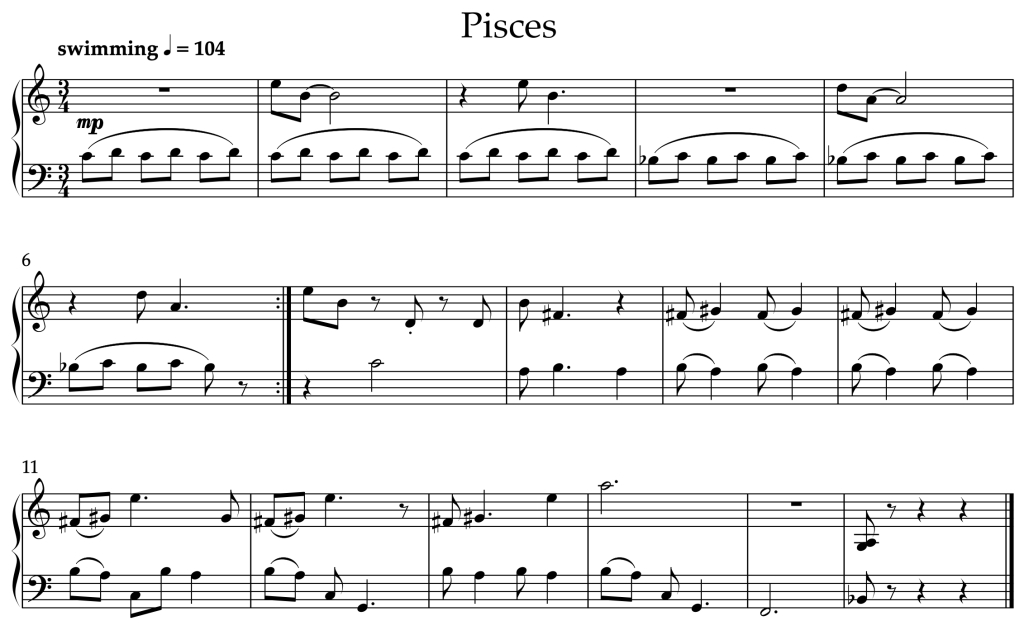
    Below is a sample etude made with just this one 4-pitch constellation and its transpositions (bars 4-6 two semitones down), all with the same interval stack, 2 9 5, or its upside-down inversion, 5 9 2 (bars 12-14 bass clef).

    Pisces etude

    The etude is based on this 2 9 5 array. Bars 11 through 14 in the right hand are a constellation with a slightly altered array: ascending F# G# E A = interval stack 2 8 5, transformed from 2 9 5 by shrinking the middle interval of the stack by one semitone. Why? Sticking with 2 9 5 would have made e# or f and then b-flat on the top, not such great counterpoint against the b-natural in the lower line. And why not? The minor-9th interval A up to B-flat, 13 semitones, is a particularly gritty, unpleasant dissonance.

    One example with pitch classes would be [F B E], in which F up to B is 6 semitones, B up to E is 5 semitones, and F up to E is 11 semitones. This example with all three pitch classes drawn from a C major scale illustrates that [6 5] is correctly shown in white as a diatonic pattern, despite the fact that it is not commonly used as a harmony in common-practice tonal music other than as a Mahler-style suspension.

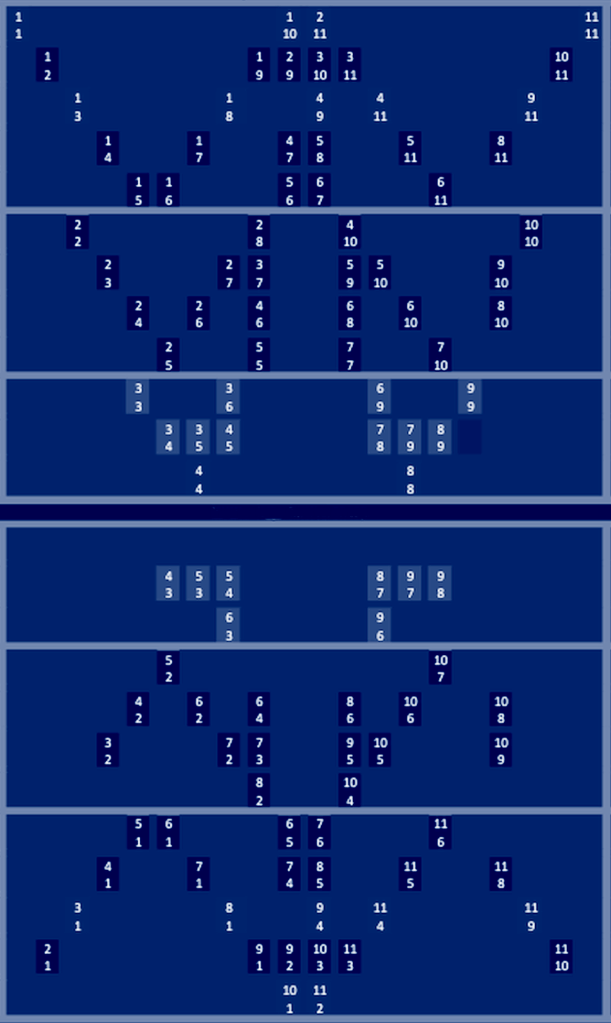
    In the table below, each column groups stacks of the same height – each stack also forms a larger interval (not shown) that is the sum of the adjacency intervals shown.    For example, reading bottom up, the stack 6 5 also forms an 11-semitone interval, the stack’s total height. All 3-pitch-class interval stacks:

    3-pitch interval-stack arrays

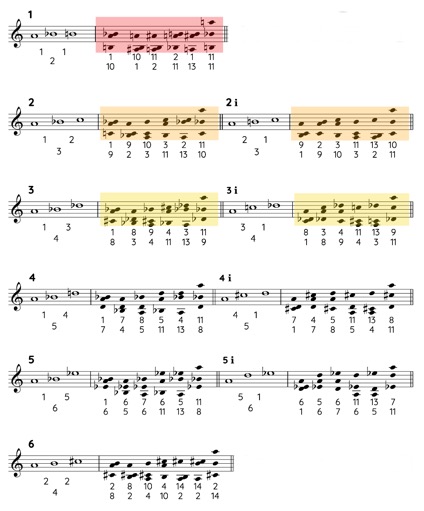
    It may be helpful to see example pitches on a staff illustrating all these possibilities. Each line below shows a family, one Forte set class: first Forte’s “best normal order” with example pitches, then their chord voicings with stacked-interval sizes; then the set’s inverse, if there is a unique one.

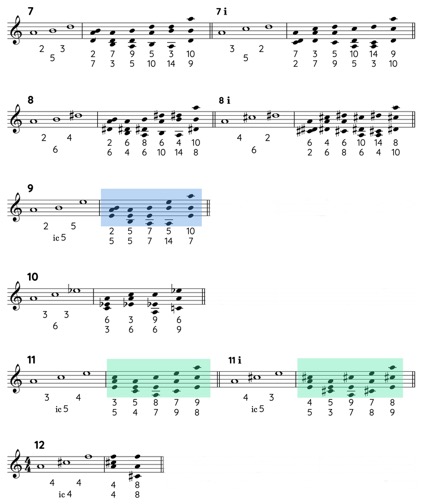
    Here the color shadings denote special degrees of interval complexity: RED = sharply dissonant; ORANGE and YELLOW = mildly dissonant; GREEN = minor and major triads; BLUE = quartal/quintal chords of P4 and P5 intervals.

    3-pitch arrays, families 1-6

    3-pitch arrays, families 7-12

    As with scale-pattern maps, these maps and their notated lists represent the entire chromatic universe of possible constellations within a two-octave range. Each could be expanded by adding an octave to any stacked interval. And of course, each can become a line, a chord, or a temporal proximity of pitches in a texture.

    © 2026 – All Rights Reserved

    Thomas S. Clark

    Continue reading Mapping the Music Universe:

    TClarkArtMusic.com

  • MapLab: A Small Sonata

    A sonata is typically a multi-movement piece for solo piano or for an instrument with piano. A shorter form with just three connected sections, the middle slower and quieter, can be called a sonatina. Here is an inside look at how one was composed, step by step. Like the MapLabs in Mapping the Music Universe, this guided tour is in the form of a recipe you can follow to write your own sonata.

    Choose a model

    I started formal composition study in 1968, first with composer Eugene Kurtz, based in Paris but filling in that semester at the University of Michigan. A proponent of modern French music, his compositional models included Debussy and Ravel. He assigned me to immerse myself in deep study of their music, in particular Ravel’s 1905 work, SONATINE.

    I met Beth, a flower lover, in Interlochen in 1975. She had been a promising flute student at Aspen, but was then embarking on a journalism career specializing in horticultural writing.

    The Ravel study came back to me later in my career, as I began to adopt its lush, bright harmonic language and a gentle French Impressionist quality. My SONATINE for Beth (2025) brings together the Ravel study, the flute sound, and (in my video version on YouTube) even the flower motif.

    Start with a generating idea

    The impelling theme can be a melody, a rhythmic pattern, a special kind of chord, or a non-musical image such as a painting or poem.

    Sonatine for Beth is spun entirely from a single harmonic progression, seven chords, each stacking one Perfect 5th interval above another.
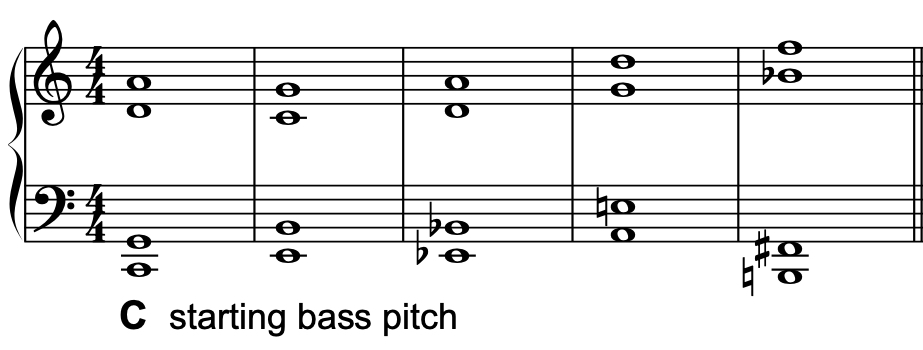
    The Perfect 5ths in the two hands are separated by one or more octaves, highlighting this strong interval as a characteristic sound for the piece.

    Now some basic tools to develop and vary a generating theme.

    Transposition

    The whole five-chord progression can be transposed. The harmony is heard plainly in a middle section as ten block chords. The last five chords are a transposition of the first five, up three semitones, starting on the bass pitch Eb instead of C.

    Sequence is successive statements of a pattern transposed by a consistent interval.

    Here is another transposition of the whole ten-chord sequence:
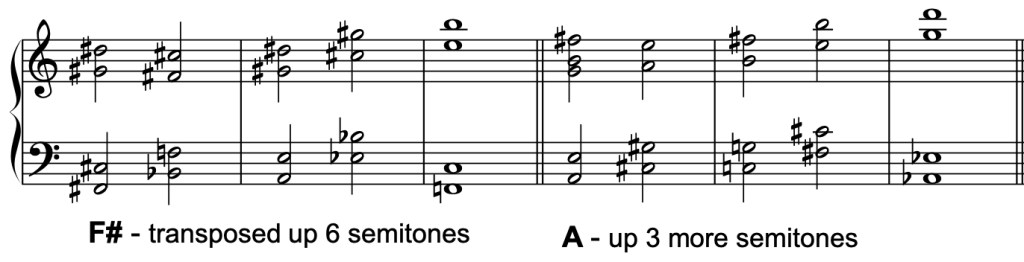
    This harmonic material generates melodic lines and many arpeggio patterns, in successive variations of changing register, intensity, and rhythmic pace. Let’s go through the compositional unfolding of this thematic idea.

    Extract a melody and bass

    Since the starting idea is simply a chord progression, we can select individual tones from each chord for a melody. The most obvious selection is the highest pitch of each chord, even if it is not in a soprano singing range.
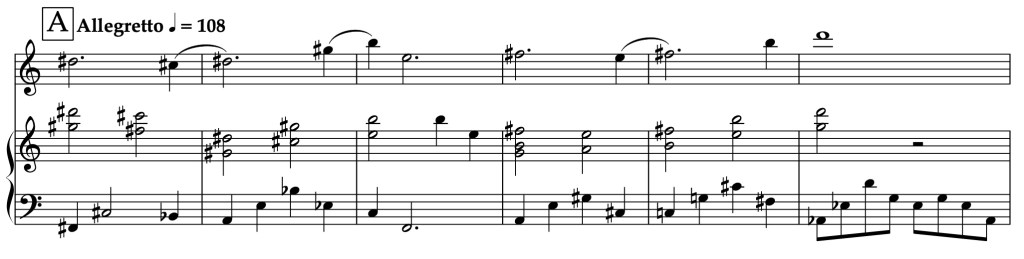
    At letter A the melody is given a slightly independent rhythm to help set it off from the chords, in addition to the different sound color of the flute. Also, the lower chord tones are articulated one at a time, making a bass line also rhythmically distinct, faster than the half-note chords. (The Bb in the bass line’s first bar is a passing tone, not a chord tone.)

    Add arpeggios

    An arpeggio is any pattern articulating chord tones one at a time. Usually in order lowest to highest or back down, the individual chord tones can be articulated in any order. At letter A shown above, we already saw the left hand articulate its chord tones one at a time. In the introduction, the right hand is partially broken up into arpeggios.
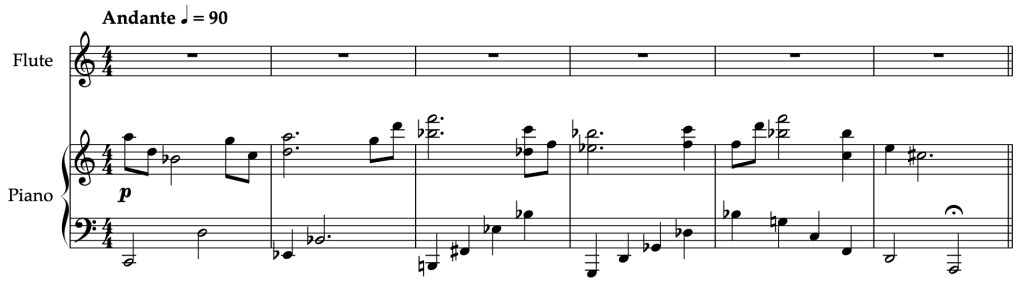
    In the next variation below, right-hand treble chord tones and still some bass chord tones are arpeggiated. Now all three lines (flute, right hand, left hand) have distinct rhythmic patterns, though congruent with each other in the established 4 4 meter.
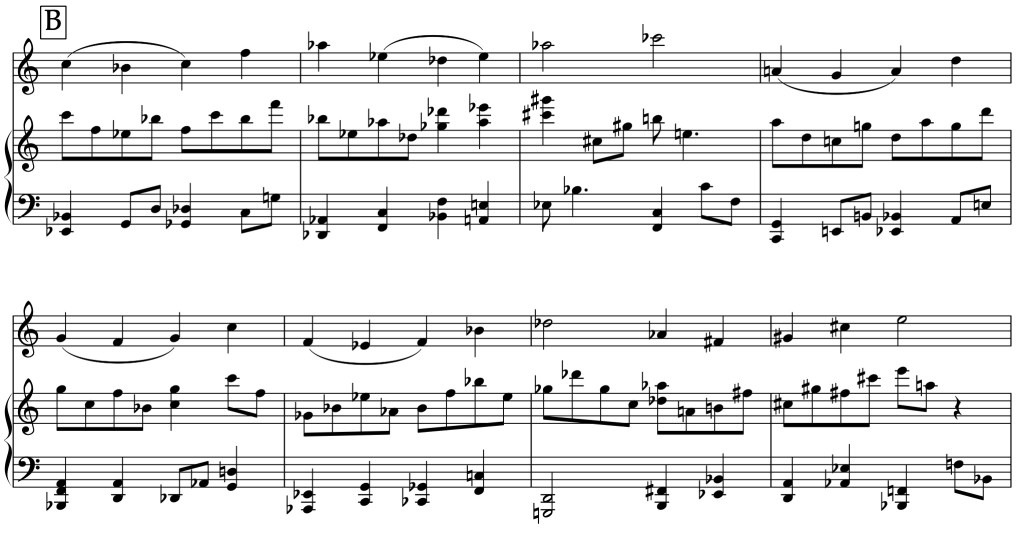
    Next, the flute arpeggiates chord tones in eighth-notes, with the left hand simplified to quarter-notes of two pitches from each chord.
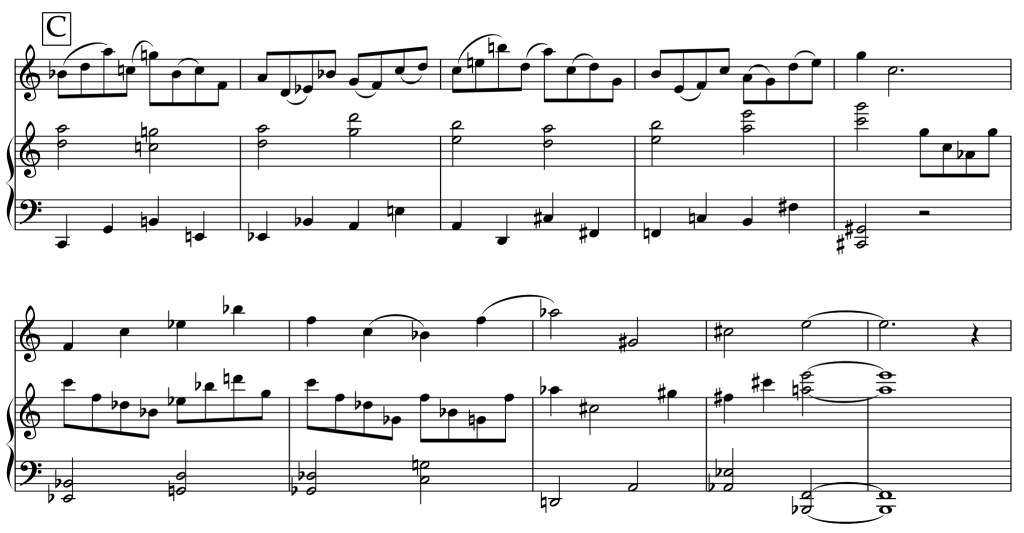
    Rhythmic variations

    Variation D simplifies the flute melody to just two half-note chord tones per bar.
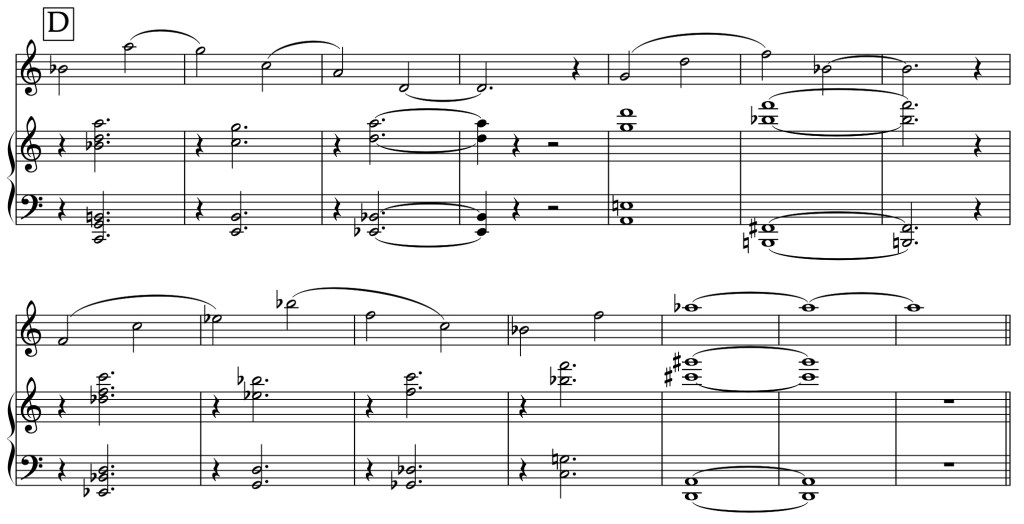
    The two hands reunite rhythmically to place some chords after the downbeat and between flute notes.

    Counterpoint

    The original term, contrapunctus, translates “point against point” — two or more independent lines interacting in time.

    A more active rhythm for the flute line leaves time gaps that can be filled in by another line. The right hand selects chord tones to make a similarly playful rhythmic line that mostly alternates and sometimes lines up with the flute rhythm.
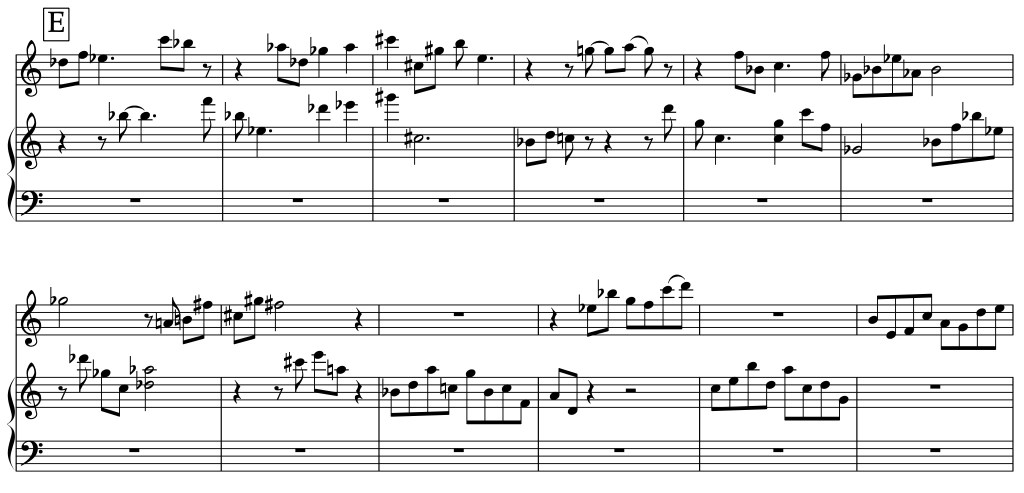
    The harmonic progression is still there but just hinted at by the chord tones selected for these interacting lines.

    Variation F continues this back-and-forth rhythmic interaction of the flute and piano right hand, now adding back in the left-hand chord-tone pairs with a simple rhythm for a supporting third contrapuntal line.
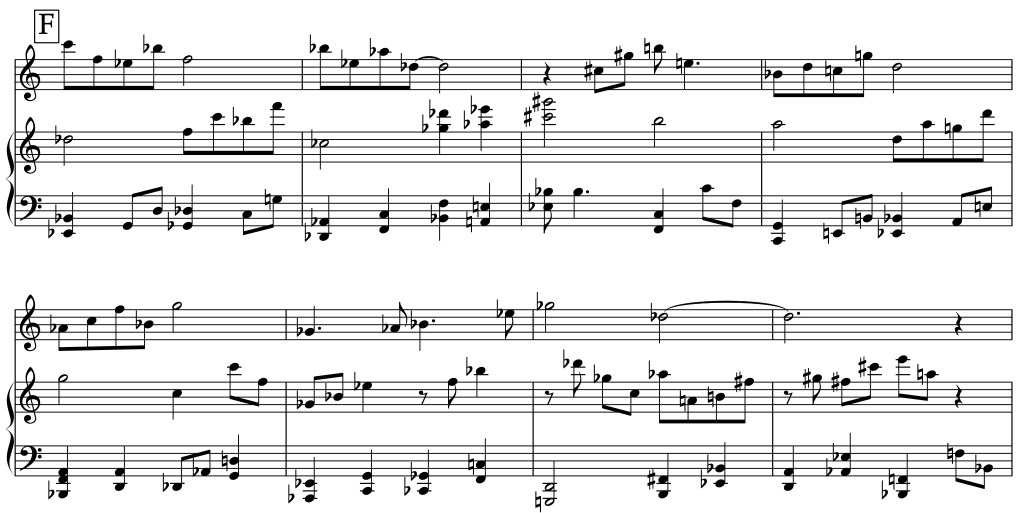
    Texture

    Having reached a complex level of three rhythmically interacting, independent contrapuntal lines, a nice contrast will be to simplify. Variation G reduces to a lower-register flute line and only a much simplified skeletal supporting line above it in the right hand.
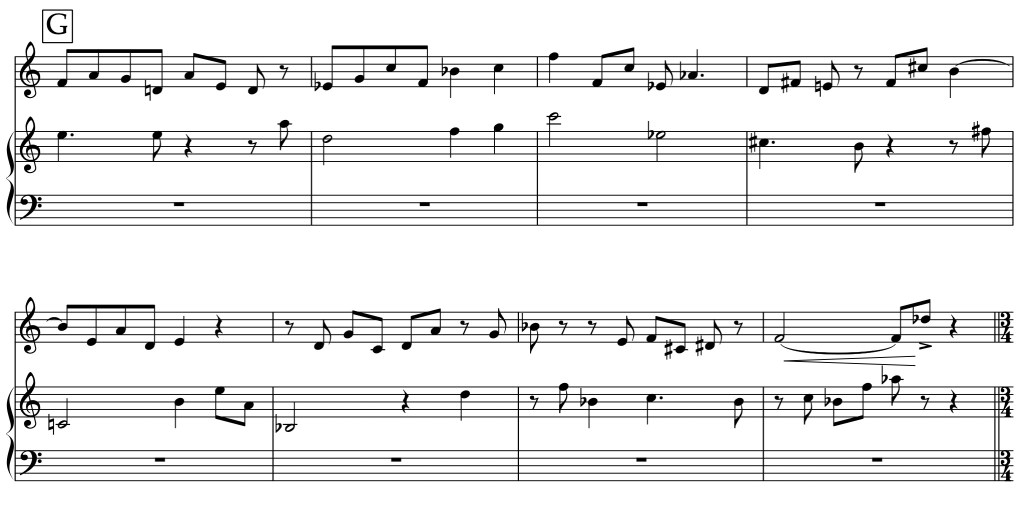
    Then the texture begins to revert rhythmically to a simpler alignment of all chord tones.
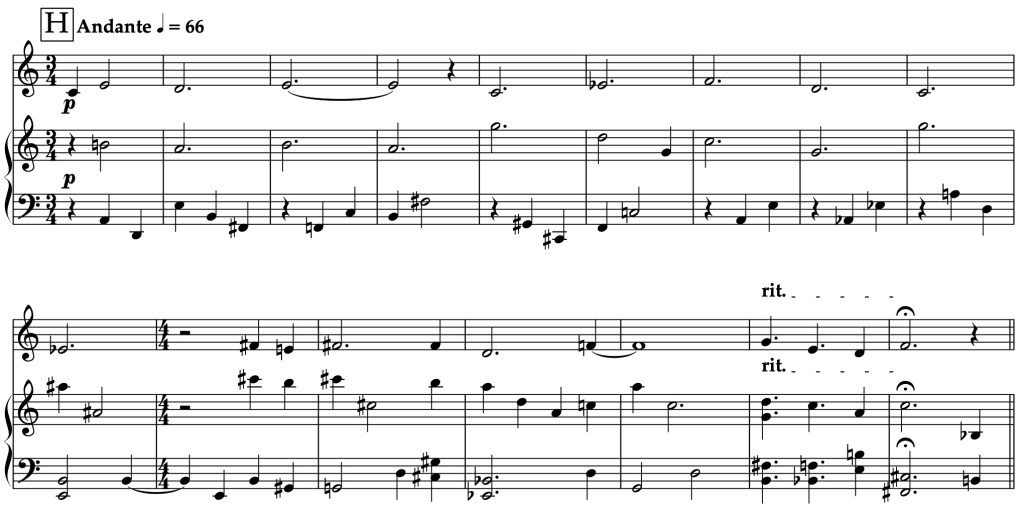
    This paves the way back to a simple piano texture revealing the fundamental thematic chord progression.

    Shape a time form

    What is the plan for the whole? How will the various versions of the generating idea unfold in the larger time span of the whole piece?

    The quiet letter I variation is the apex of an arch form . . .

    • starting with simple
    • building up more rhythmic and textural complexity
    • reaching a stable plateau
    • subsiding back to what started it all.

    That sets up a recapitulation of the whole process, building up textural complexity again, first with the high two-part counterpoint:
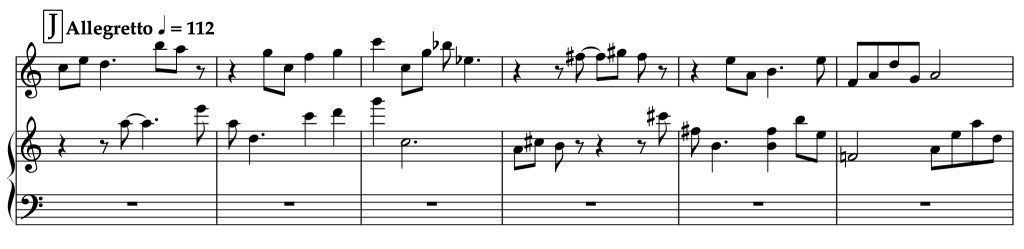
    Then with three voices:
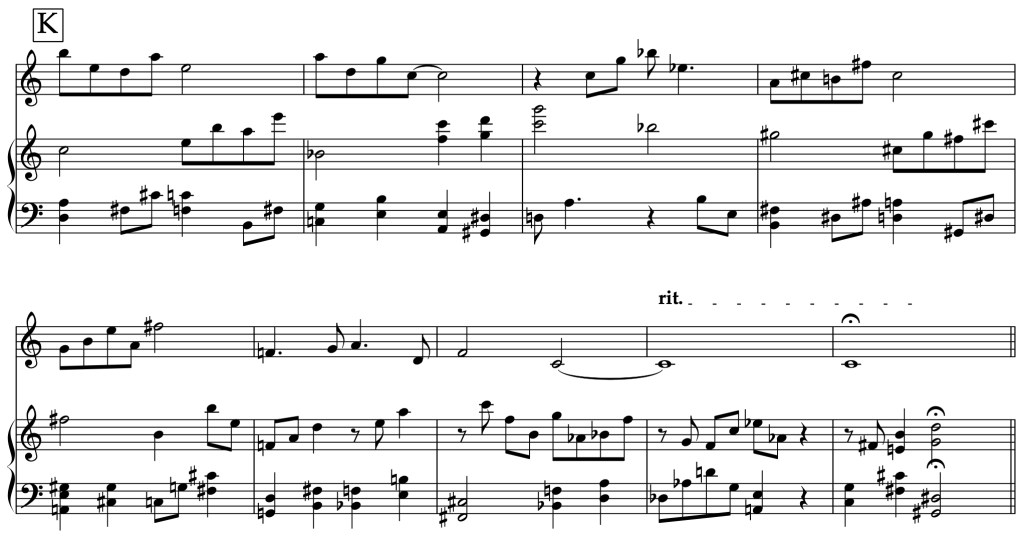
    Flute line “calming down”:
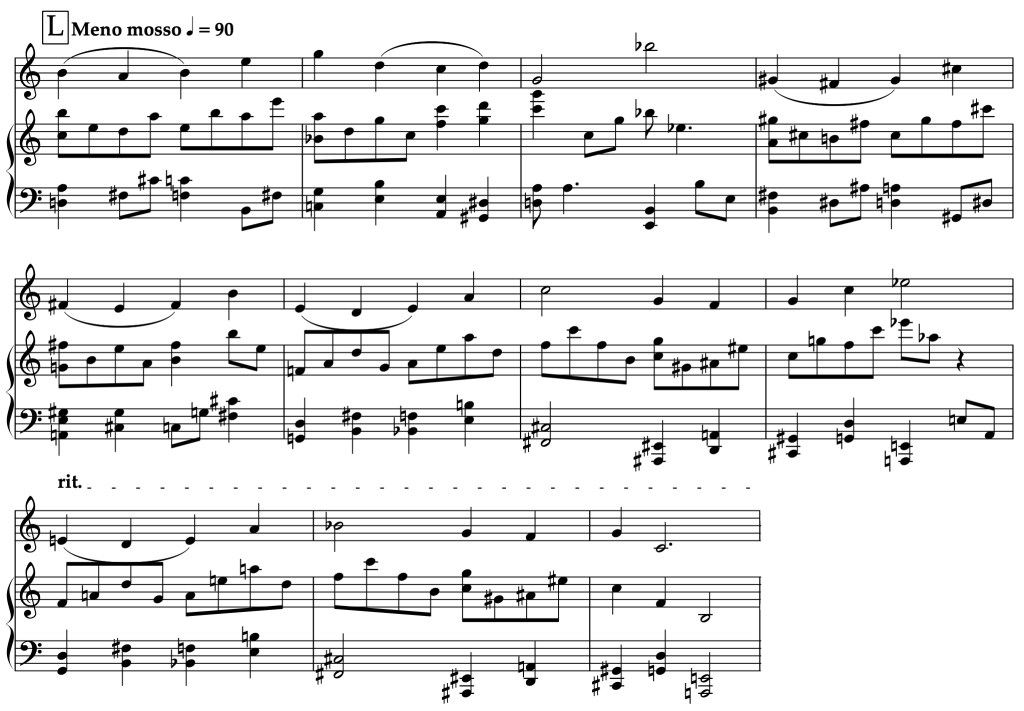
    Coda

    A good essay ends with a conclusion or a summary restatement of the thesis.

    Our musical coda summarizes with a last return to the beginning. The chords are back to their very low and very high registers. The flute makes a small melodic arch, ascending to the pitch B, then climbing down gently to its lowest possible pitch, C.
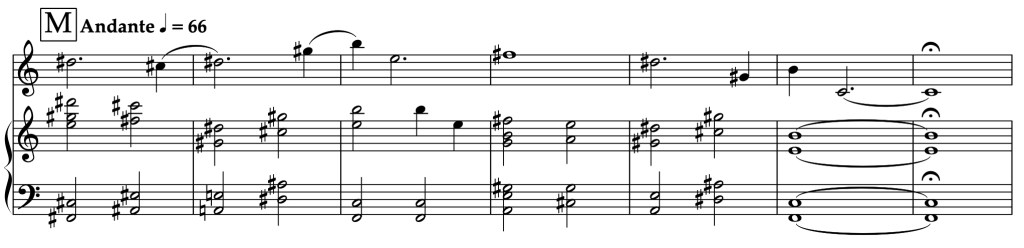
    Fine

    A final edit and audit are mandatory. In the case of our example, listening revealed that the beginning needed a piano introduction with some rhythmic vitality. Some sections were also reordered to improve the flow. Thus, the piece will not begin with a plain statement of the progression, and there will be a somewhat different order of other events.

    Now listen to the whole 6-minute parade of variations on a single chord progression.