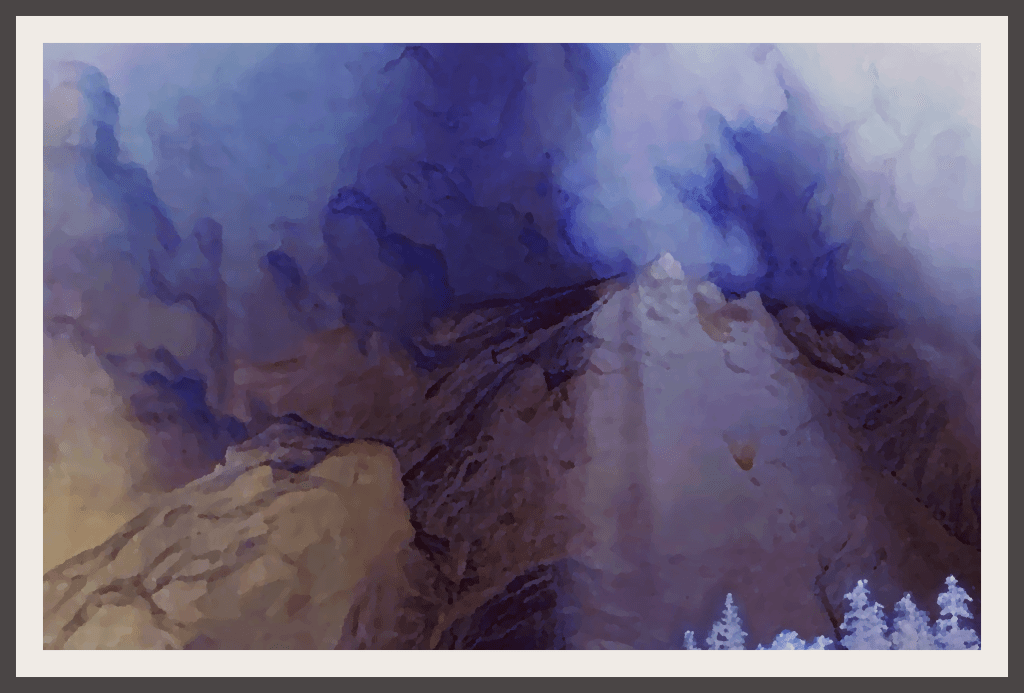
Many 19th cen. American landscape artists painted fascinating panoramic scenes, including Albert Bierstadt, who captured the grandeur of Western, mountainous landscapes.
Much mid-20th-cen. large ensemble music “painted” with sound masses, animated and evolving instead of harmonically progressing — notably“Variations for Orchestra” (Bassett),“The Seventh Trumpet“ (Erb),“Aftertones of Infinity“ (Schwantner). My “Animated Landscapes” (1973) for orchestra was titled echoing Cage’s“Imaginary Landscapes.”
1. Establish a model
Albert Bierstadt: Passing Storm over the Sierra Nevadas (1870) – San Antonio Museum of Art
Choosing one of Bierstadt’s finest works, you can see stark contrasts in brightness and in sense of motion between the mirror-smooth water and roiling clouds. Even the word “passing” in the title suggests change, a necessary ingredient of an analog musical landscape.
2. Build big constellations
The fixed, stationary nature of a landscape painting suggests a static harmonic approach, projecting and prolonging one constellation as an underlying sonority for the whole musical “canvas.”
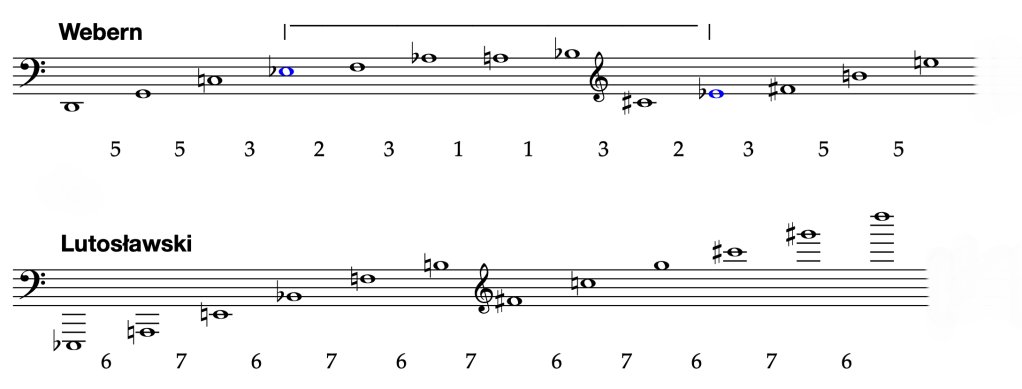
Here are two examples of a 12-tone constellation. The first was used as the underlying sonority of the pointillistic first movement of Anton Webern’s Symphonie Op. 21 (1929). Note that to accomplish the palindromic symmetry of the interval array, Eb is placed in two different octaves, thus 13 pitches total.
Another example of placing all 12 pitch classes in particular octaves is from Witold Lutosławski’s Jeux vénitiens (1961):
TC example
A large register-spanning constellation need not be 12-tone. Building a sonority of very different (less dissonant) quality, let’s start with just octave C’s and their fifths, G. Pitches a whole step away from these tonal pillars are added. The result is 13 pitches only from the F major scale. Then their complement, a big 8-pitch constellation of similar array, is built from the pentatonic scale of the flats, the other “black keys” .
3. Animations
Different basic techniques for animating in time a large constellation of pitches . . .
Arpeggio – one note at a time in any order, is a kind of stacking.
Stacking – introduce sustained tones one or two at a time. The reverse, unstacking, works too.
Swells – crescendo/diminuendo the whole sonority (think ocean waves in Debussy’s La Mer)
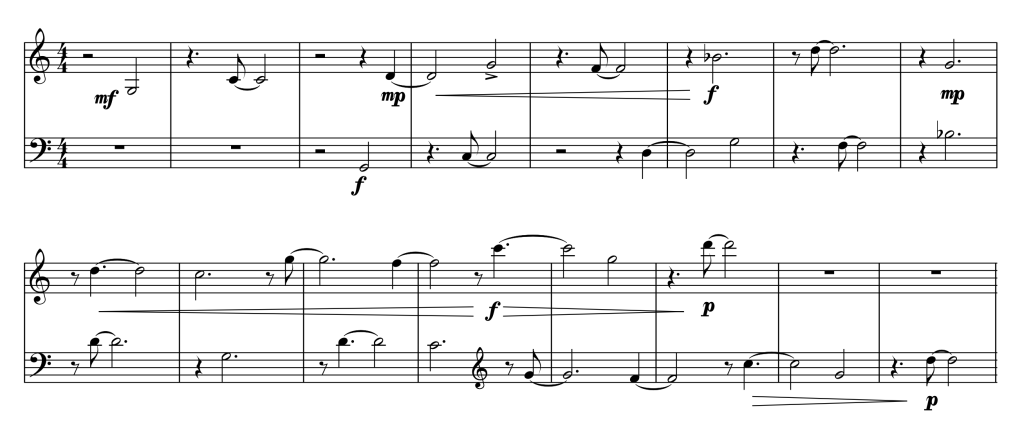
Pointillism – a more complex texture of distinct sound points separated by registral and rhythmic spacing. Although they can be different sound colors, in this example they are all the same timbre:
4. Develop a sound palette
Larger ensembles can be good for musical landscapes, offering a varied palette of instrumental timbres. Like pigments, these sound colors group in hues: the
double reeds
other woodwinds
cylindrical brass (trumpet, trombone)
conical brass (horn, euphonium, tuba)
bowed strings
plucked strings (harp)
metal pitched percussion
wood percussion; drums; exotic gongs, etc.
For synthesized sounds, beyond emulating these instrumental timbres, envelope and spectrum distinguish the sounds:
sharply accented or gradually emerging sound onset
bright metallic to dark hums
reverberation.
For Passing Storm, I chose three “choirs” with distinct sound qualities:
Clanging percussion and plucky harp
Gentler emerging-onset sounds (Sibelius Pad 2 – warm) functioning like woodwinds
Brighter sustained sounds (Sibelius FX4 – atmosphere) in the orchestral role of bowed strings
5. Compose the whole canvas
In painting, “composition” refers to the main parts of an image and how they are arranged with each other in two-dimensional and the illusion of three-dimensional space. For music, we might call this the macro form. As with most landscape paintings, the musical textures may overlap in continuous sound. There may be sectional divisions, analogous to strong demarcation lines like a horizon. The sense of broad, distant scale of view will be best captured with extended textures of expansive rhythm and even with reverberation.
While not trying to actually map the physical composition of a painting, we can get musical inspiration from considering the painting’s features of background, foreground, and highlights of strong visual focus. My example was coming together starting with distant swelling sonorities, which as they crescendo feel like they are emerging forward toward us.
After deciding to name the piece Passing Storm after the Bierstadt painting, however, I realized I had no storm in the music, just gentle sprinkles. Thus was created a stronger sonic rendering of the sprinkles to provide a more aggressive introduction. The proceeding four minutes overlaps sound masses exhibiting the various animations in time we explored earlier. Dark and light in a painting are portrayed by loud and soft, timeless sustained sound vs. busy points of sound.
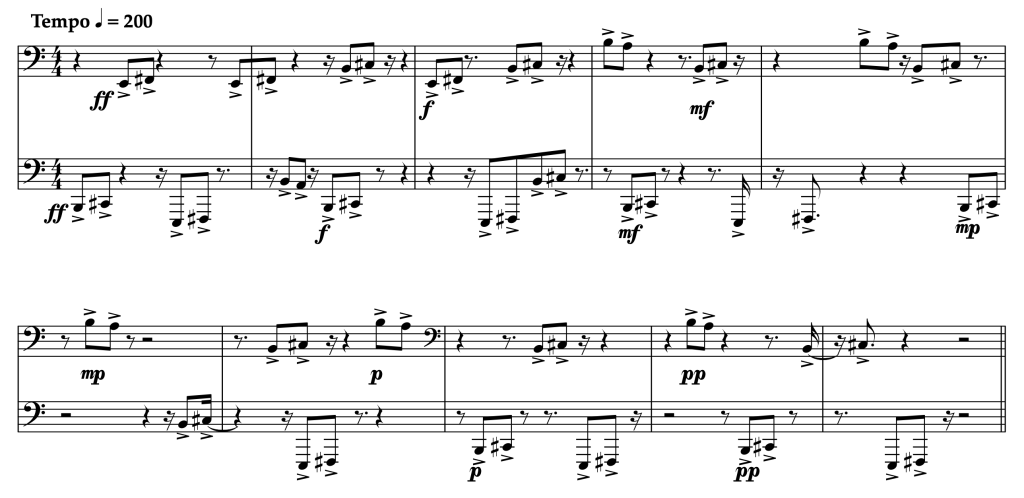
As with MapLab 3, this will be multi-layer counterpoint utilizing canon in a homogenious texture. Now it will be entirely a repetitive ostinato texture — flowing, periodic rhythmic activity building a continuous texture of repeated arpeggios or melodic motives. Commonly called “minimalism,” its texture and overall rhythmic character are maximally dense.
Multiple layers generate complex phase relationships between contrapuntal voices, with patterns of differing length repeating and changing at different times in the four layers.
Layers of texture will change at different times to a new pattern, overlapping each other. Thus overall change of harmony unfolds gradually and continuously instead of at definite time points of harmonic rhythm, building a metamorphic form (instead of a traditional episodic sequence of chords, phrases, and sections).
1. Choose a model
The classic granddaddy of this whole genre is Terry Riley’s monumental 60-to-90-minute improvisatory piece, In C. My own 1984 homage to that classic, EFFULGENCE, models with Riley’s many innovative techniques.
2. Select a source scale
While any scale can work, those most commonly used are diatonic scales. In the TC example, we’ll go with the same as In C, a C-major/A-minor no-sharps-or-flats key signature. (We’ll see later, however, that a motive can be transposed into another diatonic scale and key signature.)
3. Make motives
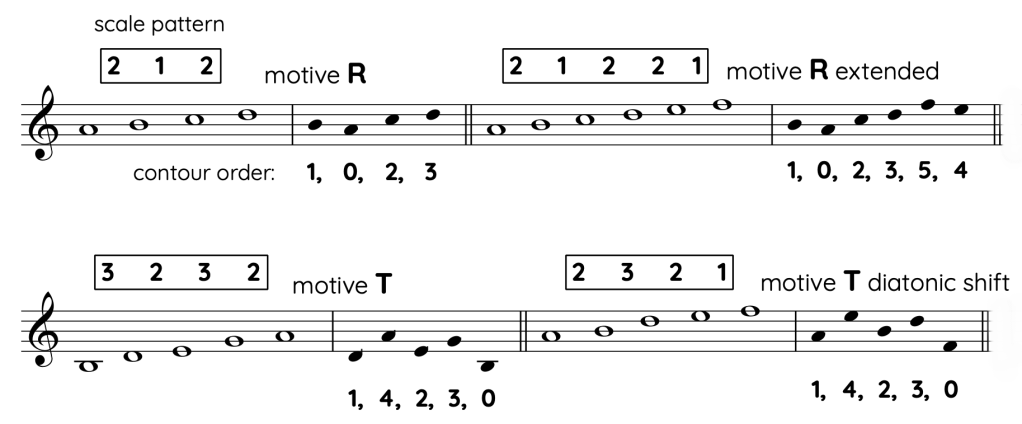
First, design two or three motives, basic shapes of 3 to 7 pitches from the source scale.
TC example:
Motive R gets extended by the addition of two pitches, F and E. The last example shows motive T’s shape shifted to a different level of the diatonic scale (what Sibelius calls a diatonic transposition). A motive can also be truncated to as few as two notes:
4. Plan a stream of motive variants
Motive patterns can and should vary in length, especially when rhythmic values are mostly all 8th-notes, providing a changing landscape of rhythmic vitality. In the TC example, however, most patterns are 5 8th-notes long. Since 5 is a prime number, and set in a 3 4 meter, the overlaps of these 5-patterns in the competing lines fulfills that energetic complexity of rhythmic fabric.
TC example
For the pitch motives, a process of adding or abandoning pitches to make the next pattern creates the metamorphic unfolding process that is the true magic of this lab. In the TC example below, this add/abandon process is color coded:
GREEN for newly added pitches
BLUE for pitches appearing in a different octave than in the previous pattern
PURPLE for pitches that will appear next in a different octave
RED for pitches that will be abandoned in the next pattern
You can see that by letter K the original C-major diatonic is modulating to a new diatonic, Bb major. These two keys have in common 5 pitch classes, and the patterns capitalize on the F, G, and C common tones to connect smoothly. (Riley’s In C also modulates, eventually adding F# and Bb in much the same way Bach inflects the C-major tonality toward the end of his famous C Major Prelude that launches Book I of the Well-Tempered Klavier.)
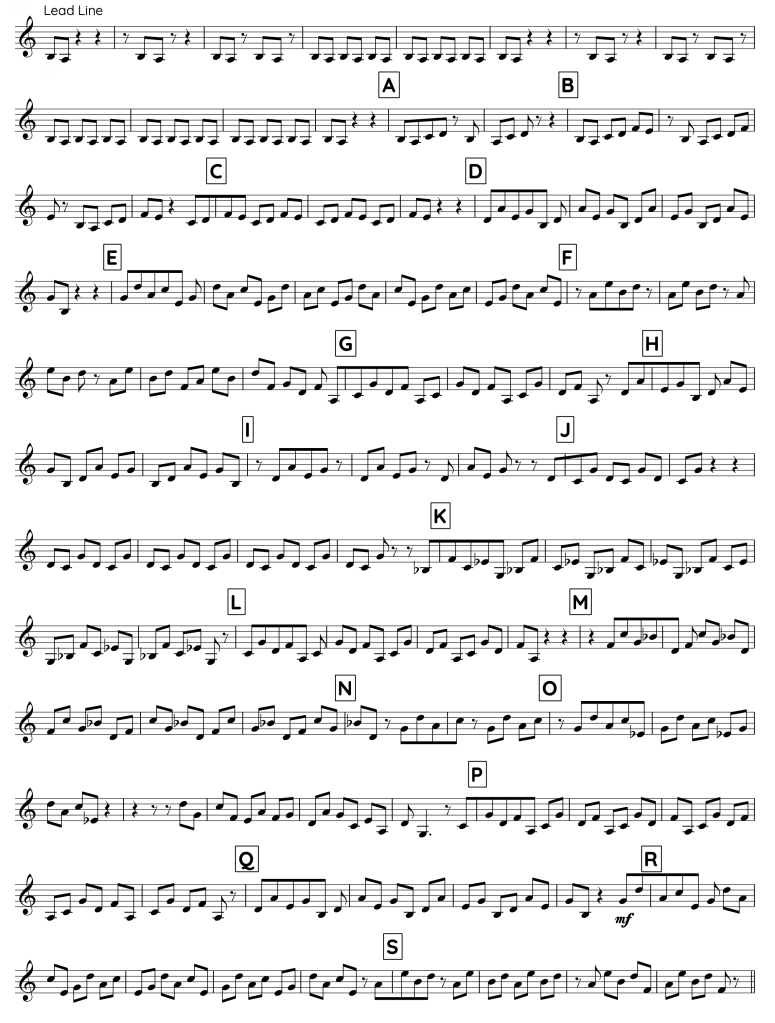
Here is the lead voice of the ostinato canon:
You can see that the number of repetitions of a pattern and the overall duration of its presence in the texture vary throughout. Patterns E, F, K, and P run for five full measures in the lead line alone (plus delayed answers in the whole texture), while the simple transitional pattern N runs for only five beats in the lead line.
5. Spin the canonic counterpoint
The time delays of canonic answer should be chosen not to match the length of the typical pattern. Otherwise, the answers would lock into fixed duplications of each other, making a rigid, uninteresting periodicity. Each new motive-pattern entry is highlighted below with a new dynamic marking. Here is a sample excerpt starting around pattern H:
The answers all enter at unison or octave, with timings determined by a mostly trial-and-error method as follows:
PP – 9 beats later at unison, then 9 more beats down an octave
P – same
MF – almost same, but shortened last answer comes one 8th-note early
MP – (for a 3-8th-note pattern) 5 8th-notes later then 7 8th-notes after that
PP – top voice leads, answers are 2 beats later then 3 8th-notes after that
This last is what we described in MapLab 3as a stretto, answers coming in with very short time delay.
6. Interrupt with an interlude
As with In C, the ostinato texture can blast through from beginning to end in a continuous monolithic stream. Another form scheme, which I will invoke in the TC example, breaks the stream with an interrupting interlude before a coda to come. Of course, it’s another canon, a stretto of cascading downward dotted quarter-notes.
7. Ending an ostinato stream
Several considerations . . .
First, since you’ve built a canon with staggered entrances, the last notes will be staggered as well. To make any kind of cadential closure, however, you’ll want to have them stop at the same time, right? That is accomplished simply by truncating the answering lines and/or adding repetitions of the final pattern in the lead voice.
Think about the lead line and its answers leading to a point of harmonic stability and finality — somewhere that feels like tonic home base.
More repetitions help slow and stop the harmonic momentum.
In the TC example, an ostinato coda after interruption settles into and prolongs what will sound like a dominant chord in C major, then crash lands on a tonic C-major stinger.
8. Title and listen
The picturesque metaphor of a babbling creek made me reminisce about a favorite adventure on days off from working at the National Music Camp in Interlochen, Michigan back in the ’70s and early ’80s. We would canoe down the Platte River to its end flowing into Platte Bay on Lake Michigan. There was also a nearby spot where tiny Otter Creek trickled out onto a more secluded sandy Lake Michigan beach offering northward a spectacular view of Empire Bluff.
Canon is a venerable, centuries-old compositional device, building counterpoint between a melodic line and one or more delayed and possibly transposed echoes of itself. Like a magic trick, it makes a strongly cohesive contrapuntal texture of rhythmically independent lines that are like clones of each other. Canon is more intense than a fugue, which formalizes the echo cloning technique, interspersed with free counterpoint.
1. Study historical models
There are many great models to study. Many 16th-century composers (notably Josquin and di Lasso) wrote canonic choral mass movements. Known more for his fugues, the great 18th-century contrapuntal master, Bach, also wrote several intriguing canons in his late work The Musical Offering. No more elegant model exists than the first movement of Anton Webern’s Symphonie Op. 21(1928), in which four voices are spun out by successions of instruments each in turn differently coloring two to four notes of the same 12-tone line.
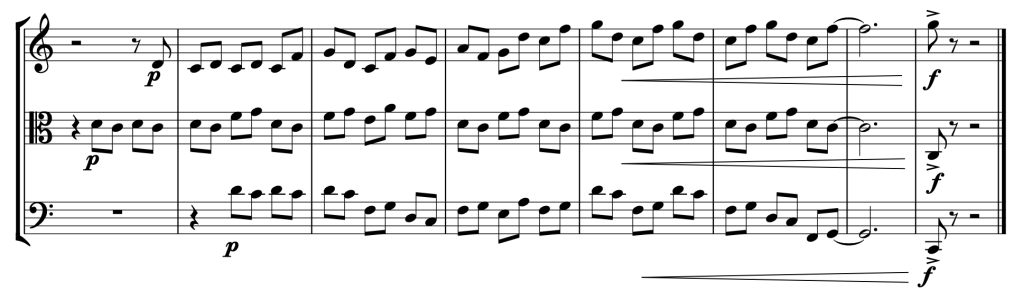
Like every fine magic trick, there are several basic techniques we can learn to construct a canon. I’ll cover three, which I will call Zigzag technique, Trial-and-error technique, Rhythmic alternation, and Stretto echo.
In 1610, Venetian composer Diruta wrote Il Transilvano analyzed Renaissance polyphonic style by codifying five species of rhythmic relationships between contrapuntal lines. Johann Joseph Fux, in his monumental 1725 pedagogy, Gradus ad Parnassum, explicated 16th-century counterpoint using these rhythmic species, of which the following are of special importance for us in this lab:
FIRST Species – note against note
FOURTH Species – lines alternating, seldom moving simultaneously
FIFTH Species – a mixture of rhythmic values in all lines
2. Zigzag
My name for it says it simply, like laying bricks one at a time but staggered to overlap.
Compose a few notes of the lead line. (In the example below, it is just three notes in two measures.)
ZIG: Establish a time delay. (in the example, one measure of two half-note beats). Duplicate the first notes (rhythm and melodic interval shape) in the following line, starting on a chosen pitch that makes the kind of vertical contrapuntal interval you desire to emphasize.
ZAG: Select new notes for the lead line that overlap with the ZIG notes, again making your desired vertical contrapuntal intervals. These ZAG notes need not match one-to-one the rhythms of the ZIG notes, providing the opportunity if desired to establish a Fifth-species rhythmic mixture.
The notes of this ZAG now ZIG into the following line, preserving the same transpositional level you established in the first ZIG.
Keep going as long as you wish or have stamina for. When ready to cadence, arrive at a longer note of stable pitch-sense in the lead line.
The canonic material you just contructed can be reused transposed. Just be sure you transpose all lines together by the same transpositional interval.
In the example below, my seven zigzag-composed measures are transposed down one semitone.
Starting on Eb might be useful to follow the first statement of the material, which ended on D in the lead (lower) line. Or I could transpose the whole thing up 8 semitones to start on C, eliding with the middle C (bass clef) that ended the following line.
Adding the third part enables this stair-step sequential transposition of the two-voice canon to go on and on . . .
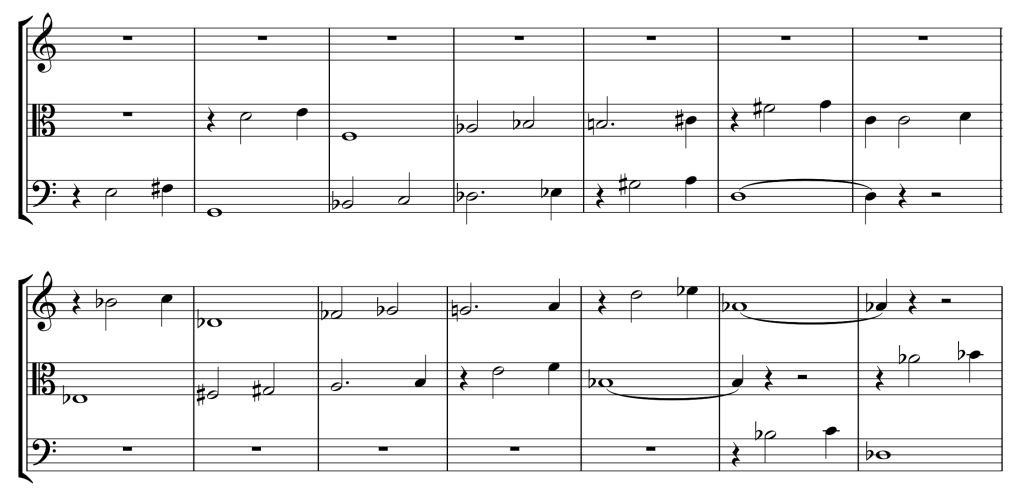
3. Trial and error
Let’s try a different technique to add a canonic answer, one that is facilitated by notation software such as Finale or Sibelius. This way involves
copy the whole lead line, not just a head motive
choose a time delay or maintain one already established. Paste into the new answering voice the lead line
Playback the synthesized audio to test aurally for contrapuntal viability.
If it sounds bad, analyze the vertical intervals to discover why.
Make a strategic choice of a transposition of the pasted-in answer, then test it aurally.
Keep trying different transpositions until you find one you really like.
For traditional diatonic tonal subjects, common transpositional choices are: unison; octave; Perfect 5th (7 semitones); Perfect 4th (5 semitones).
In the following examples, I show in the first system a trial of an added third voice in the middle, starting on E (alto clef) transposed an octave up from the lead. For the second system, I tried adding a third voice on top, transposed up a Major 9th (14 semitones) from the lead’s start on Eb to start on F (treble clef).
Horrible, yes? Why? What vertical contrapuntal invervals are the sour ones to your ear?
I’ll jump to a better trial that succeeds in both places.
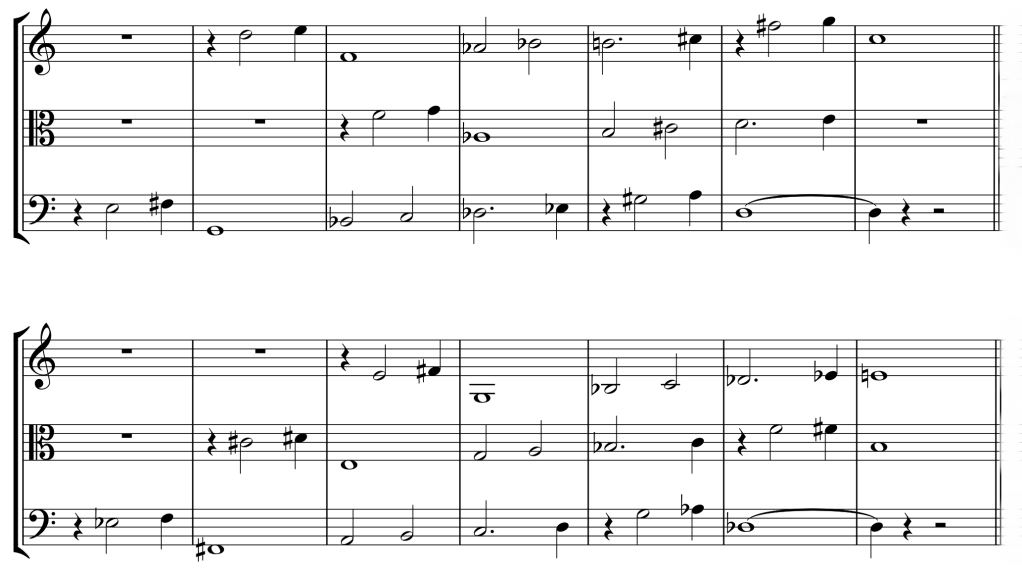
In this successful trial, the first system’s added middle voice transposes from the lead’s E up 13 semitones (minor 9th), and later in the second system the added upper voice transposes up also 13 semitones from the lead’s Eb to a second answer starting on E. The minor 9th is unusual, unorthodox, chromatic, not a solution we might predict . . . but it works!
4. Rhythmic alternation
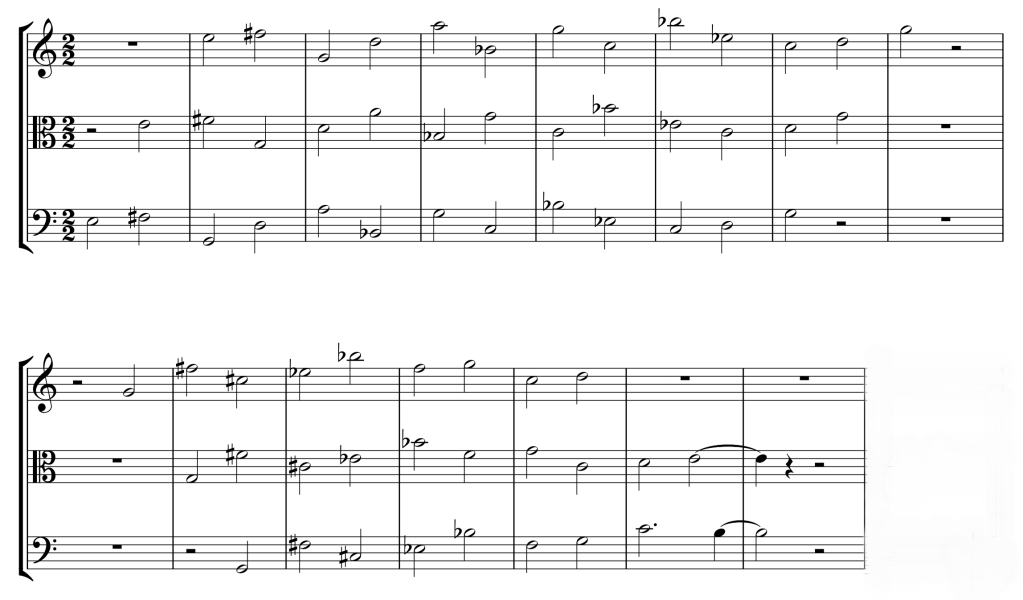
This will be like Fux’s Fourth Species. The lead subject is best with some long note values, leaving ample time for answering voices to present pitches when it is not moving. Transpositional choices for entering answers become fixed as predominant vertical intervals throughout the canon. In this example, the first answer chooses down 11 semitones plus an octave, and the second answer enters up 7 semitones (Perfect 5th) from the first answer, which is down a Major 10th (14 semitones) from the lead line. Thus vertical (harmonic) intervals of 11, 7, and 14 semitones end up projecting harmonies based on the 7 4 array: G up 7 to D up 4 to F#, which is up 11 from G. That sets the harmonic character of pitch constellations throughout the canon.
5. Stretto echo
Stretto is the term used in fugue structure for when an answer to the subject happens before the subject is finished, sometimes with a delay as short as only one or two beats. For a canon, this offers an interesting strategy for choosing pitches to shape a subject that makes its own arpeggiated harmony as it goes. The answers at unison (not transposed) are literally echoes. Even with answers octave-transposed, the effect is a multivoice arpeggiation. The fascinating wrinkle, however, is that the “chord” being arpeggiated is constantly evolving, dropping one pitch and adding one new at each note of the lead line.
Though this setup can work with other rhythmic “species” of lines, it is particularly interesting in the note-against-note conforming rhythms of “First Species.”
Here is how it can work, using the canon above as a straightforward example.
This analysis sounds as a rather nice progression of arpeggiated chords and simple flute line! The important point, though, is that this progression did not come first. It was built by the canonic subject line as each new pitch was chosen to make a certain array with the previous two pitches in an ongoing, evolving flow. Magic!
6. Spin a piece
For our example, we’ll follow the order of the example techniques:
two-voice zigzag canon
add a third voice by trial and error
stretto echo of the same subject
Rhythmically spacious subject allowing non-synchronous timing of answers
Recapitulation of the stretto echo canon
The result is a fuller working out of No. 10 of the 14 specimens in my Book of Canons:
Black Canyon
The title comes from my photographic memories of the Black Canyon of the Gunnison River, named for the ever-present shadows the narrow canyon’s steep, sheer, tall rock walls cast on the river flowing far below. The sheer cliffs of the Black Canyon are metamorphic Precambrian gneiss and schist, streaked with thin, brighter-colored layers of pegmatite. These streaks sketched on the darker rock look like maps of ancient contrapuntal lines.
Rhythmic intensity is an important factor in shaping musical form. A former research project “Density Functions in the Structure of Modern Music” in the 1970s sought to quantify it along with several other core aspects of structure at play in shaping large-scale form.
In the TIME chapters, we previously mentioned pace and showed how it can accelerate or decelerate in a line while tempo remains steady. (The Beethoven string quartet example Op. 135 illustrated that.) We have now also defined composite rhythm as an intersecting sum of rhythmic time points of lines, the layers of a textural fabric.
Density
In physical terms, density is a ratio comparing the amount of mass to the amount of space it takes up. Measuring time space, tempo (expressed in “M.M.” beats per minute) can convert a count of beats into a time-length in seconds:
DURATION(in seconds) — multiply BEATS times 60, then divide by TEMPO
Now we’re ready to measure the pace of a line for a bar or a whole phrase:
PACE(Notes Per Second) — number of notes divided by the duration of the stream
And then to quantify for a whole texture of rhythmic activity:
RHYTHMIC DENSITY(Attack-Points Per Second) — number of note-starting time-points in the composite rhythm of the whole texture divided by the duration of the stream
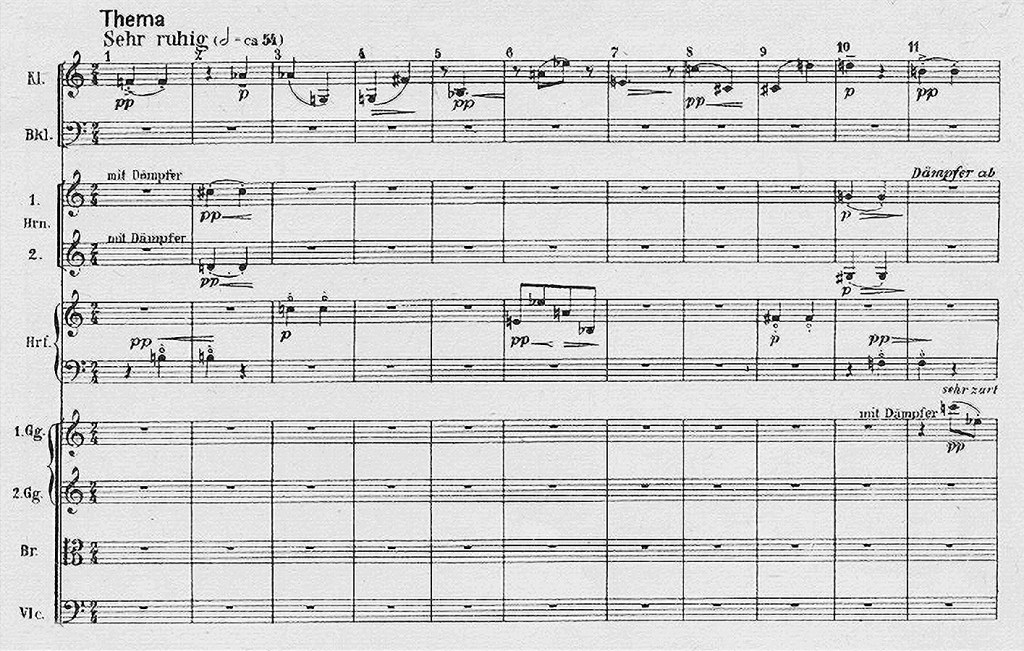
Let’s go back to the Webern Symphonie Op. 21. Though called a symphony, it has only two movements. The second movement is a theme and variations with coda, each exactly 11 bars long in two-four meter. Here’s the theme:
Op. 21, II — theme
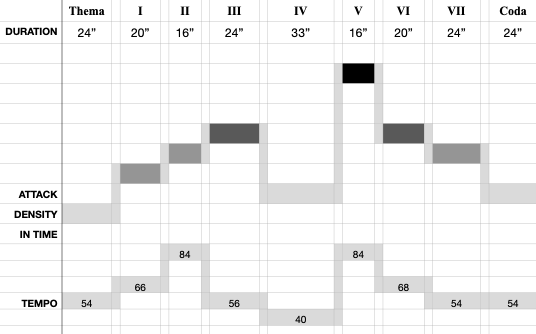
Each variation, though 11 bars long like the theme, is in a different marked tempo. Each is distinguished by a contrasting degree of rhythmic density. And though the theme is a sparse (pointillistic) fabric, some variations are contrapuntally thick and intense.
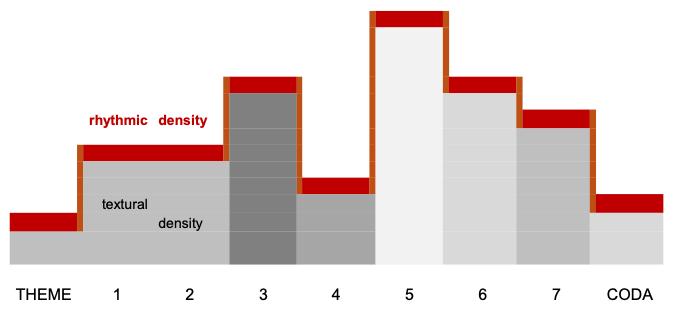
Rhythmic density and what we might define as textural density (how many lines woven into what octave span) basically trace the same unfolding through the variations. The exception is Variation V. There they diverge, intensely active rhythms but only three textural elements in a diffuse pitch span of almost four octaves.
A graph of changing rhythmic density values in each variation highlights rhythmic density as the bolder line:
density graph of Op. 21 II
About broad form, this reveals that from the beginning, rhythmic density increases to a subordinate peak in Variation III and overall peak in Variation V, then variation by variation steps down to a coda that matches how we started with the sparse theme. In rhythmic density, the whole movement is an arch form, with Variation V the “climax.”
In the first “abstract sound mobile” of my 2024 work, FOLIO, it is easier to hear changing density as the changing thickness of clouds of sound, swelling and subsiding.
“Music of the Spheres”
Relativity
Modeling, the process of creating an overall design, can mean creating a new model or expanding the possibilities of an existing model.In Learning to Compose we identified and described three basic musical approaches:
NARRATIVE MODELING — Designing by telling a story, with characters, themes, gestures, suspense. What will happen next?
SPACIAL MODELING — Designing the size, shape, and texture of blocks or sections of material
TEMPORAL MODELING — Designing the flow and momentum of events in the passing of perceived time
Variation and contrast
Contrast is the essential complement to developmental continuity in musical material, driving musical momentum. Theme and variations form is a straightforward, traditional example of narrative modeling balancing contrast and continuity. Each variation preserves some basic element of structure such as harmonic progression (or in the Webern example, the tone row). Each variation presents a setting of that theme element in distinctly different orchestration, texture, mode, tempo, or rhythmic character.
The composer determines not just how and when to make a contrast, but how dramatic the contrast will be. Their fluctuations over time are the core of the composer’s instinctive variation skill. This is the impelling force that gives musical form a sense of going somewhere, of leading up to and flowing away from stable plateaus marking the structural pillars of large-scale form.
FLUCTUATION — Magnitude of contrast from one moment or event to the next
When analytically quantifying fluctuating data, the time scale of measurement matters. In avant-garde or experimental music, a stream of events may be high-contrast on the moment-to-moment scale but steady-state over broader time spans. Conversely and more traditionally, surface events may be continuous, while the bigger chunks of events, like one variation to the next, may pose more dramatic changes in parameters such as rhythmic density.
In typical Beethoven or Brahms variations, material within each variation is continuous, not at all fluctuant. The contrast comes altogether in the next variation.
That consideration plays out differently in Op. 21 II. There is the obvious contrast from one variation to the next; but within each variation, moment-to-moment surface continuity also fluctuates. Surface fluctuation in density factors occurs, especially from one 3-to-4-second “moment” to the next. (We can’t really call them phrases.)
For the Op. 21 II. Theme and Variations, we can now say something deeper about changing rhythmic density as the variations progress. From the Theme through the first two variations, rhythmic density increases gradually to Variation III. But then the fluctuation of rhythmic density spikes, dropping significantly for Variation IV, then suddenly increasing to its highest level in Variation V.
large-scale time form
It is not only Variation V’s greatest rhythmic intensity but also dramatically increased roller-coaster fluctuation, dropping then surging, that makes Variation V the climax of the movement.
Macro-structure
Though Webern may not have thought consciously about Schwankung (fluctuation), this is how composers manipulate momentum to make a climax and shape large-scale form. Likewise, approaching a final ending, not only do fluctuations typically diminish, but also rate of change subsides — the overall change factor levels out to zero. These are examples of temporal modeling.
The parameters of a musical event are numerous, a multidimensional matrix of at least six distinct, interacting qualities: each sound event’s loudness, resonance, timbre or sound color, duration, pitch (frequency), and time point of initiation. Imagine this as a six-dimensional space. In fact, physicists have imagined the structure of matter as exhibiting many more than six dimensions in string theory, M theory, etc.
Musical structure establishes the relativity of these parameters, though not exactly the way Einstein explained time, space, gravity, and energy with mathematical precision. Some structures such as the Schoenberg Farben example relate constellation harmony to sound color. Threnody relates rhythmic activity to fabrics of sound in a broad pitch space (spatial modeling). Counterpoint balances rhythmic relationships, metric placement of lines, and synchronicity with their intervallic relationships of consonance and dissonance. Ostinato music manipulates phase relationships.
And, as observed in Part I, temporal density, the rapidity of fluctuations and larger contrasts in these structures, propels our experience of the whole in time.
In Thinking in Numbers, Daniel Tammet wrote about a mathematical study of poetry,
“The best poems . . . combined in equal parts the predictability of meter with the novelty of unusual words. Too much meter made a poem banal; too much freewheeling . . . rendered it hard to follow. The delicate balance of convention and invention gives meaning to what we say.”
The essence of music’s large-scale temporal form is the relativity of overlapping, fluctuating musical structures in time, repeating, contrasting, interrupting, truncating, expanding, certainly recurring, or simply evolving. Designing a large-scale musical form combines temporal modeling, narrative modeling, and spatial modeling — a pacing plan, a storytelling rhetoric, an architecture of interrelated components.
–
–
Coda
sound mass . . . sound color . . . pitch constellations
ostinato repetition . . . changing density
evolving form . . . cosmic time
In Become Ocean (2013), John Luther Adams takes a deep dive into a serene sound sea, incorporating all of the elements and structures we have explored in our mapping journey.
Imagine a piece of music exploring texture in time, made of single sounds and sonorities occurring one at a time in sustained resonance. Then imagine the points of sound are separated by rests, silence. As the texture drifts in and out of a resonant cloud, the sound events remain unconnected. Suddenly, their pace explodes into a torrent of notes. That describes the following powerful piece by my UNT colleague, Joseph Klein.
Joseph Klein – Pathways IV: Rhymes & Spirals (2024)
Sound color
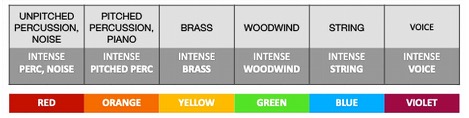
Our next music map shows a simple color-coding graphic system for classifying most musical timbres, informally the tone quality of sounds. The map intuitively chooses colors of the rainbow. While the color spectrum orders the frequencies of light (another manifestation of periodicity), our sound-color classifying map does not imply any ordered quantification of timbral complexity.
instrumental color rainbow
Though we think first of an orchestra for a rainbow of color, chamber music can incorporate a variety of instrumental colors, each produced in vivid isolation by one instrument, standing out or changeably mixed with other colors.
Augusta Read Thomas wrote Dance Mobile in 2021, scored for 13 instruments: Woodwind quartet (Flute, Oboe, Clarinet, Bassoon); Trombone; String quintet: (2 Violins, Viola, Cello, Contrabass); Piano; 2 Percussion (vibraphone/metal, marimba/wood, drums).
The piece starts with a single pitch, blending several colors that swell in intensity. Then ensues a kaleidoscopic dance of at least seven distinct color combinations, of two basic types:
Sustained sounds – strings; high woodwinds; lone brass of the trombone
Sparks – pizzicato strings; ringing metal sounds; drum strokes; staccato piano
Augusta Read Thomas – Dance Mobile (2021)
Though the piece is dedicated “in memoriam Oliver Knussen,” the memory is a joyous dance of color.
Symmetry
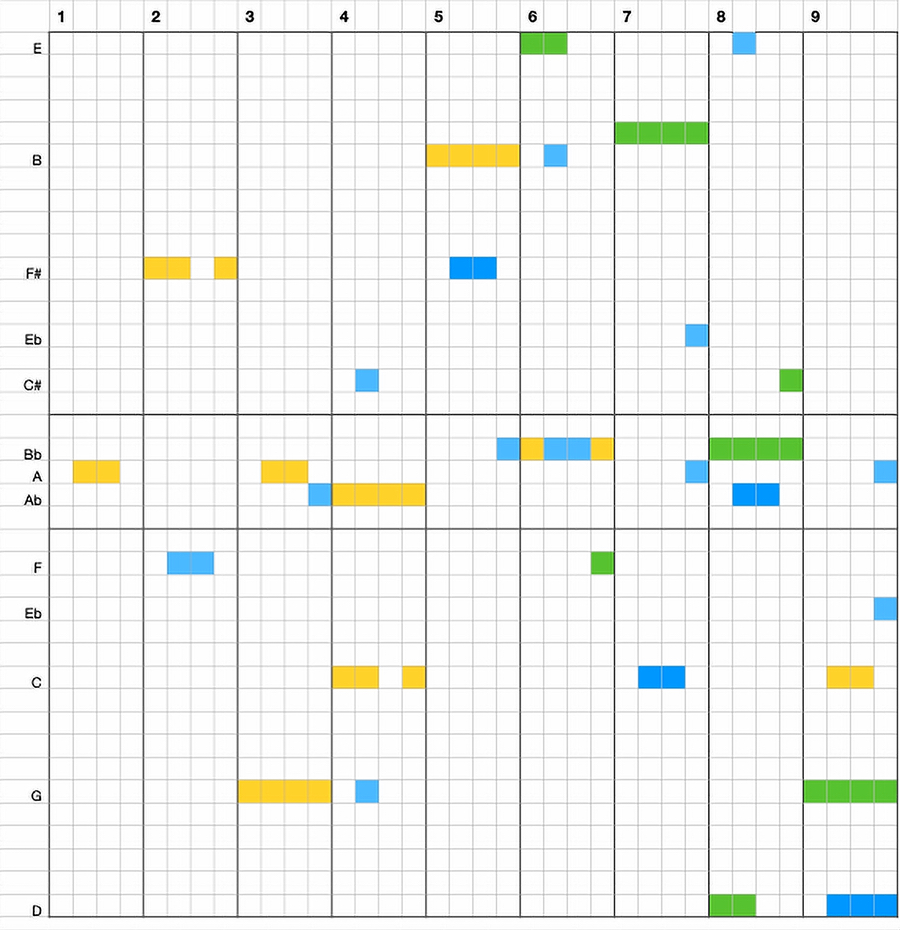
In the exposition of Webern’s Symphony, Op. 21, we saw that each contrapuntal line duplicates the exact rhythm of the lead line, with each entrance one bar later — a classic canon. But each contrapuntal line presents a different succession of instrumental colors:
The German term for this is so elegant, we’ll use it here:
KLANGFARBENMELODIE — melodic or contrapuntal line expressed by a string of changing tone colors
Webern placed each pitch in every line in a particular fixed octave, except Eb that appears in two different octaves. This makes a striking, symmetrical 13-pitch constellation with a palindromic array, the same array going down as going up.
Webern 13-pitch constellation
Not only was he obsessed with symmetry in this piece, but this constellation’s symmetry also proves that he was thinking specifically about the chord voicing in what I have identified in successive interval array form.
We can use this constellation as a Y-axis for a graph mapping the timbres as they appear in the various parts in canonic lines in pitch space for the first 9 bars. This farben color map looks like one of the later geometric paintings of Piet Mondrian.
Op. 21 color map
Pointillism
Though we often share musical terms and concepts with visual art, we sometimes mean different things by the same term. In painting, a technique developed in the Impressionist style period of the late 19th century that became known as pointillism. The most famous example is Georges Seurat’s “A Sunday Afternoon on the Island of La Grande Jatte” at the Chicago Art Institute. Instead of sweeping brush strokes and palette-blended colors, it used small separate spots of subtly varied colors to make a texture that, when viewed from a distance, seems to merge into a color cloud, giving the impression of animated light.
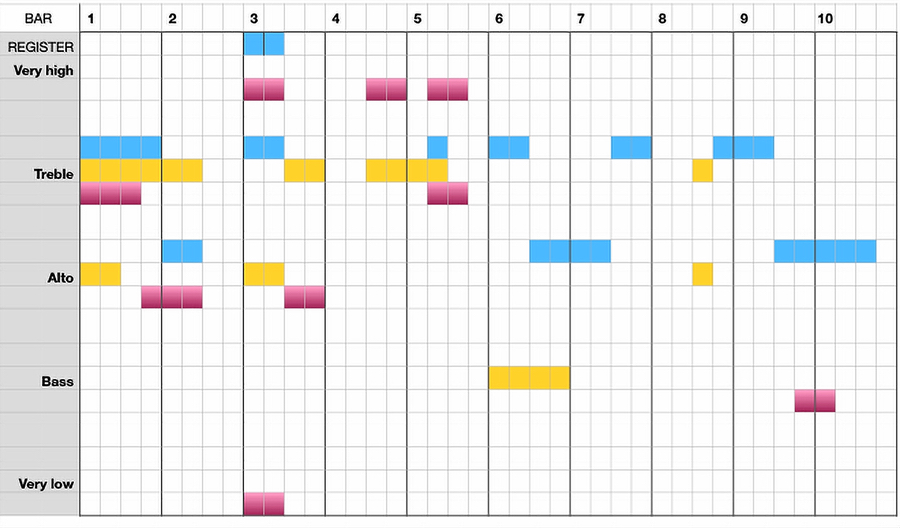
Musical pointillism, unlike painting, separates sounds in time and pitch space, not to blend them into a texture so much as to highlight the different qualities of each unique sound event. Webern was a pioneer of musical pointillism in works such as Op. 21. Let’s graph the first 10 bars of this fabric using our timbre color-coding (BLUE = wind, ORANGE = percussion, VIOLET = plucked string) on a broadly distinguished 6-octave pitch range. We get something as colorful as a Mondrian painting!
Andromeda sound color map
As a musical fabric, isolation — using the vast available range of pitch and the empty time of rests and silence — is a fitting analog for the vast, mostly empty space of a galaxy. Let’s use it for a demonstration etude.
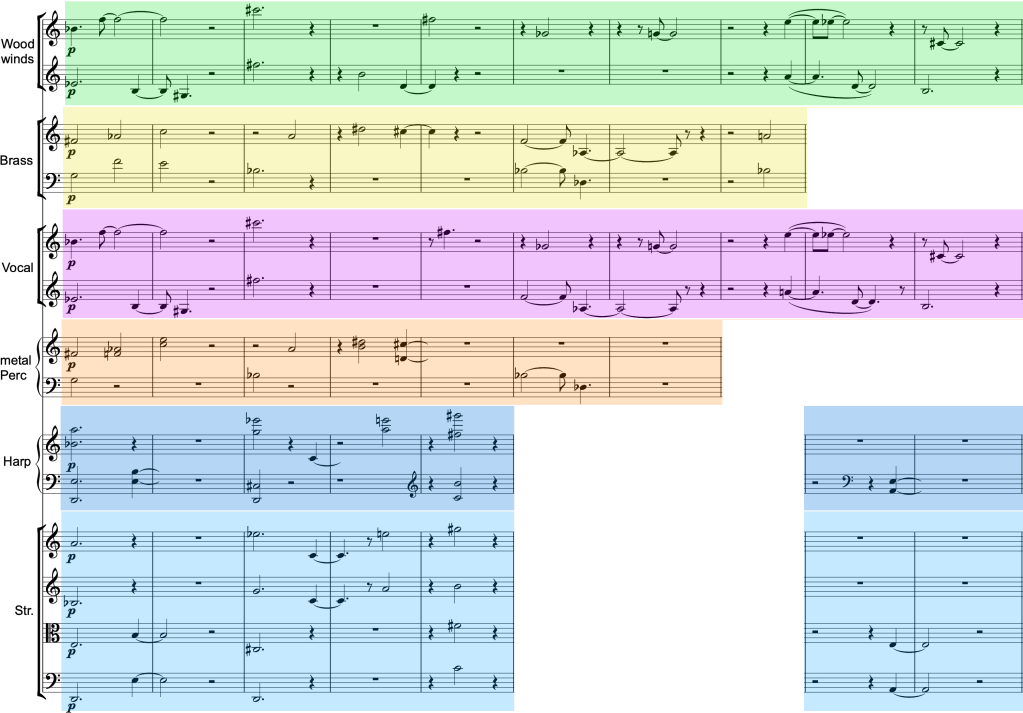
Andromeda is the nearest large galaxy, 2.5 million light-years from our own Milky Way galaxy. Our sound color demonstration study uses every sound quality on our sound color spectrum except red. Here is a score of the first 10 bars.
Notice that the green woodwind notes are doubled with a synthesized vocal-type sound. Yellow brass notes are punctuated by orange metallic percussion attacks. Likewise, blue string notes are articulated by the plucked string sounds of harp.
Here is the whole colorfully pointillistic 3-minute study:
Sound Mass
At a time when electronic music was emerging in the 1950s, new instrumental resources were also developing a new style that was all about animating massive layers of sound.
German experimentalist Karlheinz Stockhausen composed two early, influential sound mass works, Gruppen (1957) for three orchestras, and Carré (1960) for four orchestras and four choirs. The scores were huge, dense, 12-tone, and monolithic in form.
A 2002 piece by John Adams, On the Transmigration of Souls, harkens back to a mid-century masterpiece of the Avant Garde. In 1961, Polish composer Krzysztof Penderecki wrote a piece for a massive score of 52 string instruments. Conceived as an abstract, freeform, dense massing of animated and intense musical fabrics, it represents a pioneer in the genre of sound mass music, winning the UNESCO Prize that year. Only after it was heard in performance, he said, “I was struck by the emotional charge of the work … I searched for associations and decided to dedicate it to the Hiroshima victims” — thus the title, Tren Ofiarom Hiroszimy (translated Threnody for the Victims of Hiroshima).
As a young composer in the ‘70s, I reflected this approach in some pieces titled Animated Landscapes. (The title was inspired by John Cage’s famous Imaginary Landscapes no. 4 for 12 radios.) Beyond referring to the painting genre of landscapes, the title sets the imagination for solid, continuous textures like viewing the shapes of a mountain range, but set into rhythmic motion. (This approach became prevalent in ensemble music, especially of Midwestern composers such as Donald Erb.)
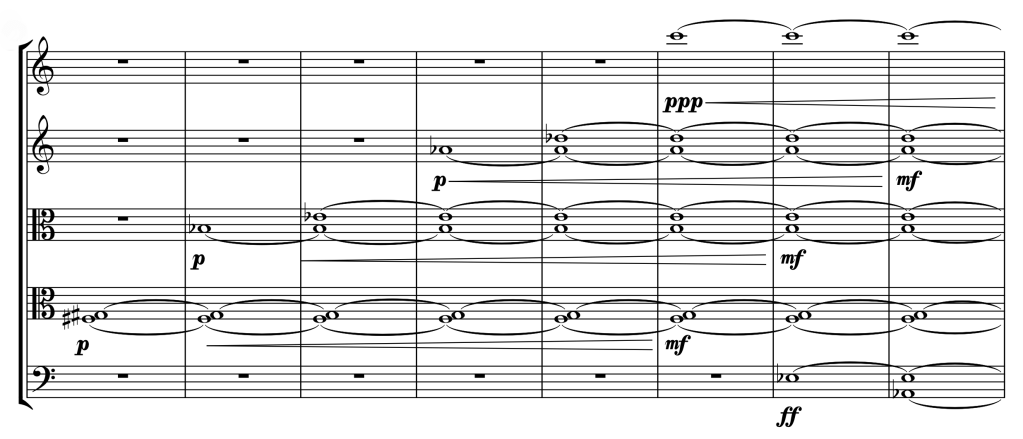
Considerably predating the music mentioned above, Schoenberg’s Fünf Orchesterstücke, Op. 16 (1909), was originally scored for a large orchestra of 37 parts. It is not thought of as sound mass music, as its five movements each have Expressionist or Impressionist titles: “Vorgefühle” (“Premonitions”); “Vergangenes” (“The Past”); “Farben” (“Summer Morning by a Lake”); ”Peripetie” (“Peripeteia”); “Das obligate Rezitativ”(“The Obligato Recitative”). The third movement, Farben, is of special interest not only for its exquisite mixed-palette painting of orchestral timbres, but also for its thick though delicate fabric of sustained sounds. At the start, nothing moves, the subtle shimmer of instrumental colors fading in and out of a continuous fabric of delicate, faint sounds. (A sound mass can be delicate, not necessarily “massive.”)
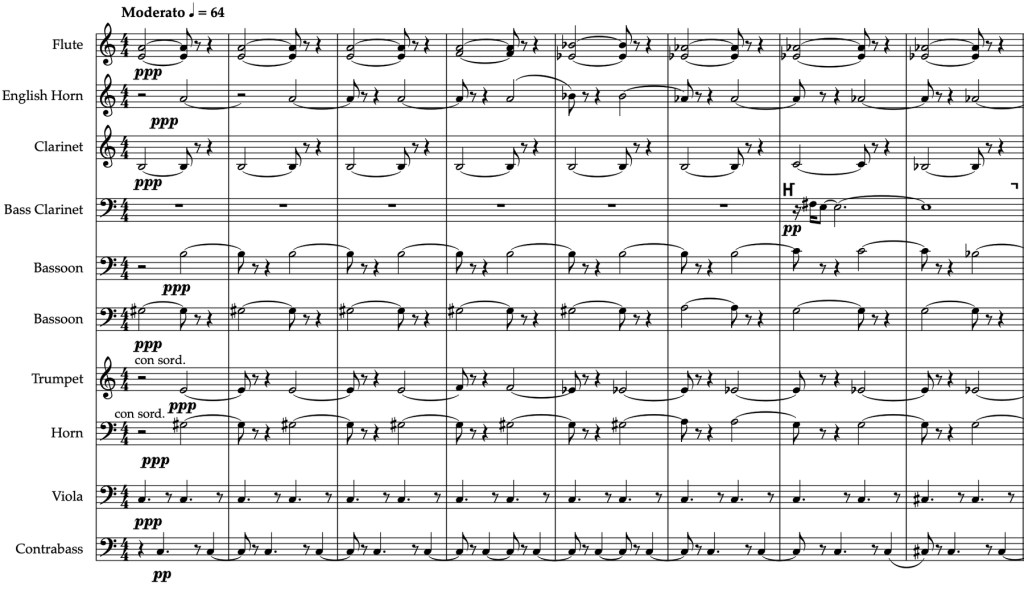
Here is a score of the first page, showing sounding concert pitches for all instruments.
Schoenberg Farben scoring
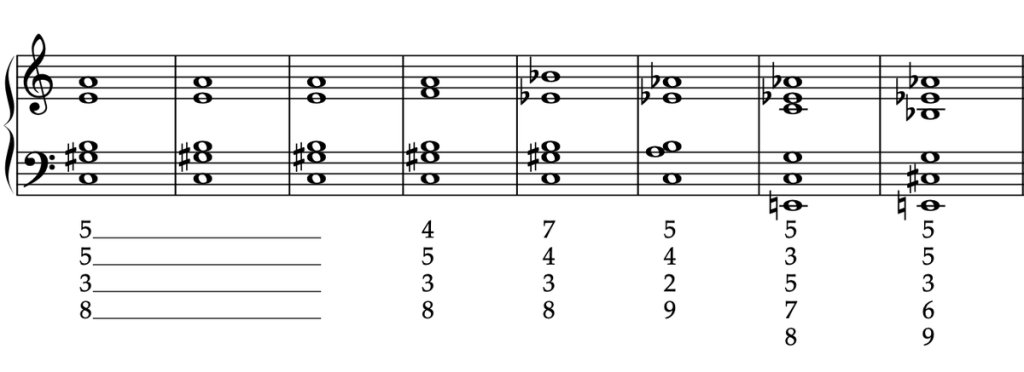
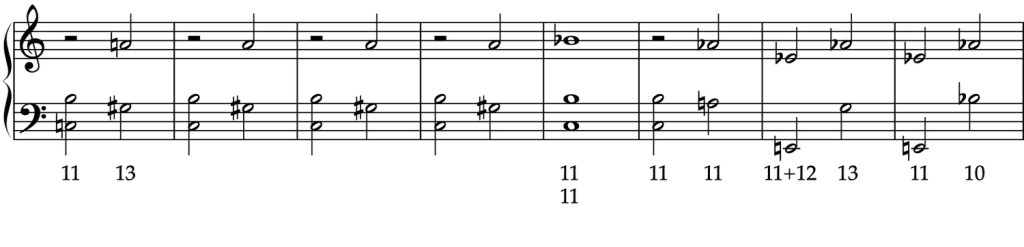
Each measure presents one constellation, recolored with different instruments in the second half of the measure. For the first three bars, the constellation does not change, and then only subtly in the next five bars, maintaining the constant C pedal point in the low strings.
Farben constellations
The bass clarinet’s F3 in bar 7 is considered an ornamental non-harmonic pitch. While you can see many recurring smaller constellations imbedded within these changing large constellations, such as 5 5, 3 5 and its inversion 5 3 (which are triads), and some transformations of smaller constituent constellations: 8 3 redistributed to 9 2, 4 7 shrinking to 4 5 (another triad), and 3 4 (also a triad) shrinking to 2 4.
Though there are many triads embedded in the constellations, the overall quality of the sonorities is complex, as the triads are framed within critical dissonances:
framing dissonances
Foreground / background
Most landscape paintings, distant textures of forest, mountains, sky, waves on the sea, or clouds, have some sharp focal point. Often on the horizon (in itself a focusing anchor of the visual display), it may be a barn, a setting sun, a boat, a farmer and dog. If we consider proportion and symmetry in a visual composition, the focal point is best not dead center. A more interesting balance, according to expert photographers, follows the Rule of Thirds, placed one-third from the left or right, one third from the top, or both. Two-thirds is a ratio of 0.667. The Greeks famously defined the Golden Ratio, an ideal ratio dividing a whole length or height into two parts such that the ratio of the smaller part to the larger is the same as the ratio of the larger part to the whole. The ratio is 1.618:1, the solution to the equation: x2 – x – 1 = 0; a 62% and 38% division.
In a simple traditional musical texture, an accompanying harmonic texture is designed as a background for the focal element of a melody. Sound masses may lack such focus, like the forest or sea waves. When there is to be perceived a standout element of the texture, Schoenberg called this focal element of the musical fabric the Hauptstimme. Though that might translate “highest voice,” the melody or other focal events are not necessary to be higher in the pitch range of the fabric than other elements. But there must be some isolation or distinction setting them off from background in at least one of the parameters mentioned above. The Hauptstimme focal line or textural element can be:
in a pitch range isolated from background
a color isolated as a single timbre, not a mixed diffusion of background colors
slower or faster than background
more rhythmically elastic, varied than background
not synchronized with background
loudest line (the most obvious)
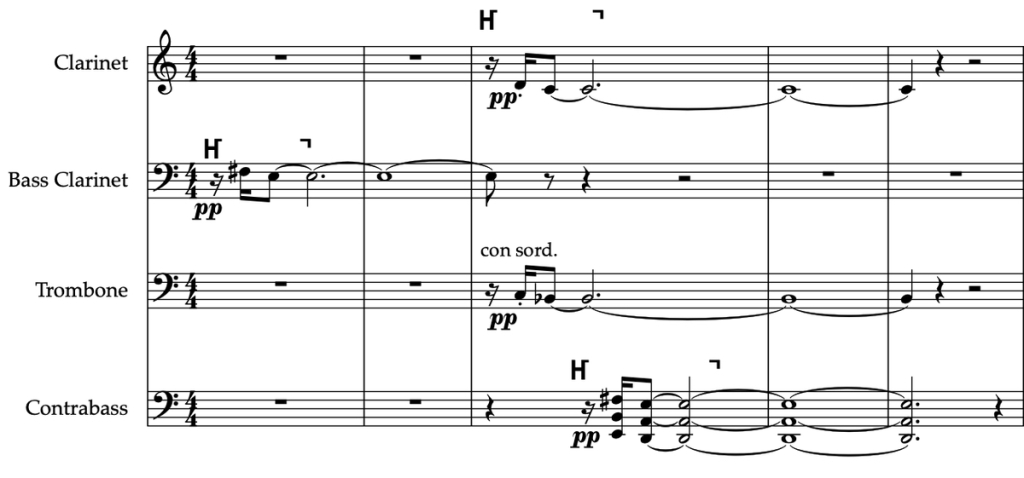
Schoenberg devised a special symbol for the focal Hauptstimme line of a fabric, a boldface stylized capital H, which you see marking the bass clarinet entrance in bar 7 of the Farben example. Here is how that principal Hauptstimme line continues, a Klangfarbenmelodie of changing color, from bass clarinet to clarinet with trombone to three solo contrabasses.
Hauptstimme handoffs
Notice the aggressive rhythmic motive, each time stepping down 2 semitones; and the 7 7 7 quintal-chord constellations in the contrabasses. (The rhythmically aligned clarinet and trombone are separated by 14 semitones, 7 + 7.)
Beyond color isolation, Learning to Compose makes a distinction for a timbre mixed with itself or other colors spread over some pitch register (“diffuse”) or reinforcing itself in a narrow, confined pitch space (“concentrated”). While Farben’sbackground is diffuse, its Hauptstimme color is isolated in the low pitch register of the bass clarinet and then also concentrated with the three solo contrabasses.
In the first movement of Anthracite Fields (2015) by Julia Wolfe, the bass clarinet emerges as a focal sound by its loudness and singularity of pitch in a cloud mass of softer sound. Then aggressively loud clusters suddenly interrupt the steady-state background, yielding eventually to repetitive sung chords and floating vocal duets. The sound fabric maintains a three-dimensional depth of contrasting intensities.
Julia Wolfe – Anthracite Fields I: Foundations (2015)
Galaxy groups
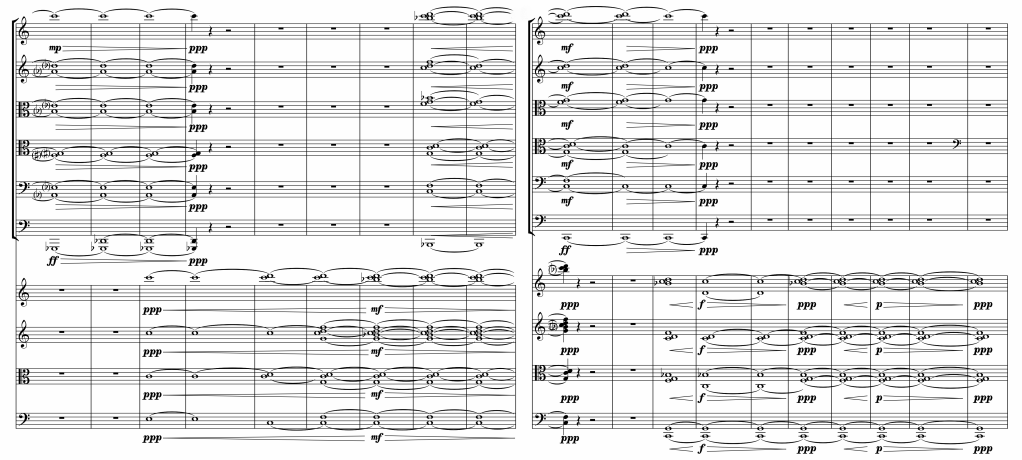
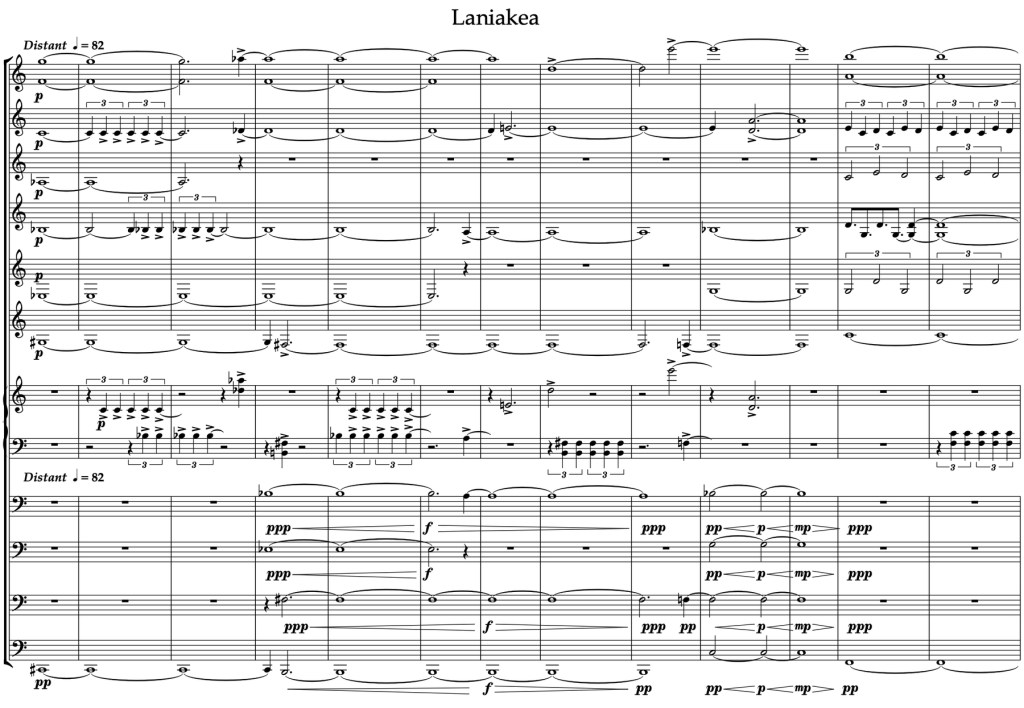
Our sample etude composition for sound mass is a thick score of 10 wind parts and harp, with a fabric the opposite of pointillism: everything sustains and overlaps. There are basically no pauses or holes in the continuous 2-minute sound fabric. Its title, Laniakea, is the name of the supercluster of galaxies that includes the Milky Way.
Laniakea score excerpt
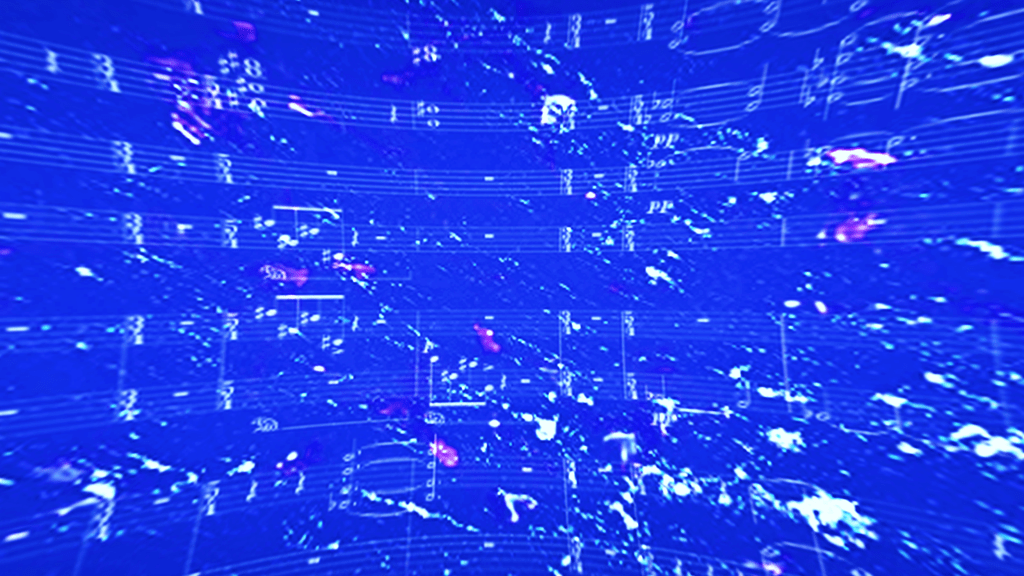
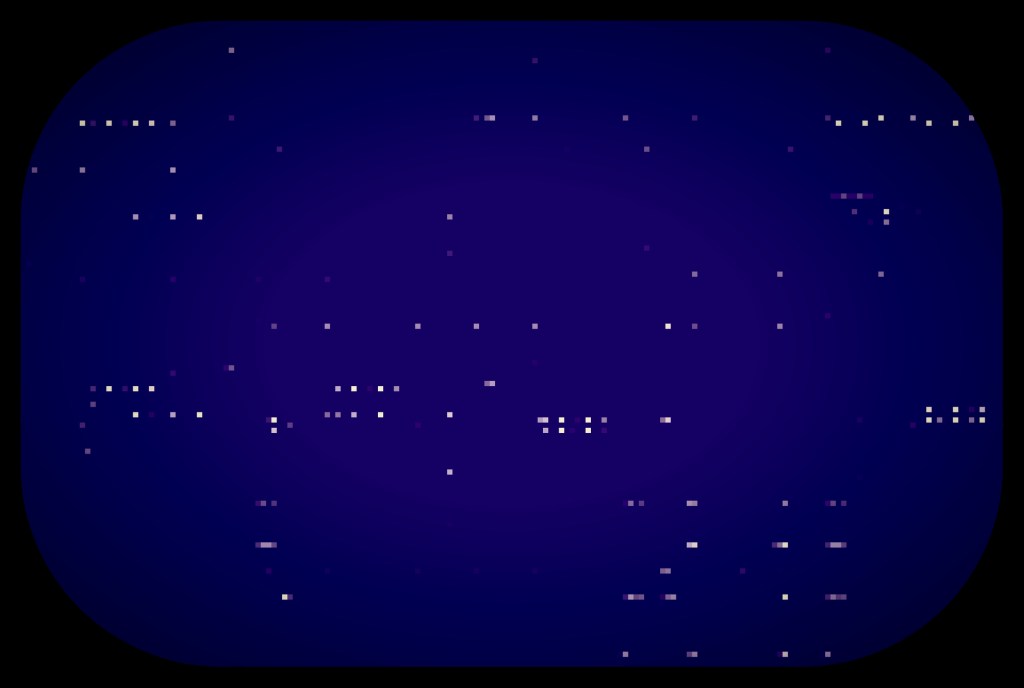
Having shown the score with all its notational details, to better illustrate the main point of the example, sound mass, here is a graphic rendering of that actual second system of notes. We can reveal its pointillism by increasing the contrast in a negative image of light on dark. That makes the attack beginning of each sound show up but not the staff lines or sustained resonances . . . a fanciful art image of Laniakea, a vast empty part of the universe dotted with millions of galaxies.
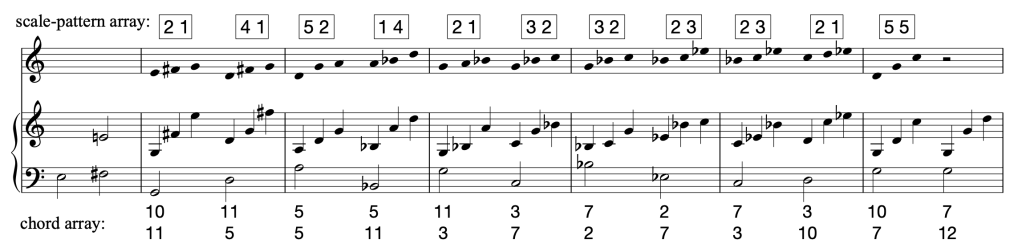
What is a scale? Its essence is an interval pattern, selecting which pitches out of the entire chromatic possibilities become scale steps. Successive interval arrays are a vivid way to describe its pattern:
SCALE PATTERN — periodic interval pattern that cycles through each octave, defining which pitch-classes from the 12 possibilities are degrees of the scale
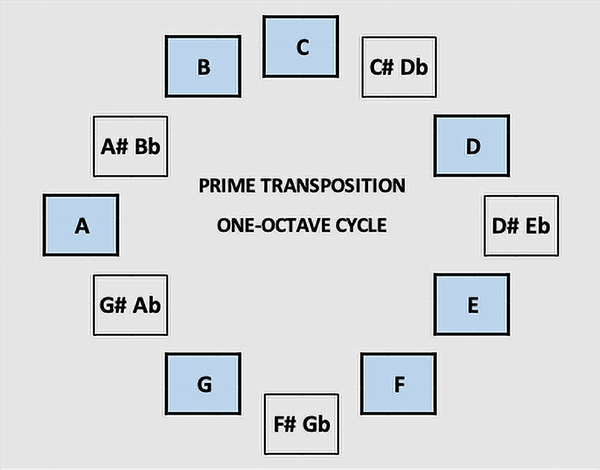
In that sense, it is a theoretical circle, starting over in each octave — or more imaginatively, a spiral. Let’s visualize the natural-note white keys on the keyboard, a prime example of the ubiquitous diatonic scale, as a circle.
diatonic scale circle
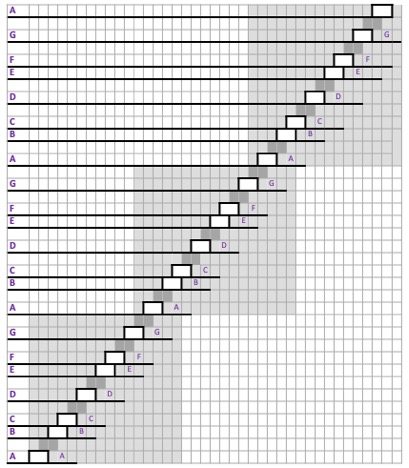
Now an unlooped visualization as stair steps, rungs on a spiral ladder:
diatonic scale cycling through three octaves
Anyone familiar with the white and black keys of a piano will recognize this pattern!
Chroma
Almost all scales in both Western music and other art-music traditions are built on the framework of octave equivalence, the close affinity of two pitches that are one or more octaves apart. We give them the same pitch name – all called “C” or “F#” for example. This makes the circular nature of a scale, that its pitch names and the intervals between them start over at the octave and repeat.
We also have the feature on an equal-tempered piano that one black key produces a pitch with two possible names depending on the scale in which they appear. For example, the D# seventh scale degree in an E Major scale is the same piano key as an Eb, the fourth scale degree in a Bb Major scale. The two pitch names are said to be “enharmonic.”
When a melodic line in an all-white-key C major scale introduces an F# for color or to temporarily alter the interval terrain, we call it a chromatic tone, after the Greek word for color, chroma. Now we have a comprehensive scale of all possible pitches. Going further, theorist Allen Forte defined a way to reduce all the pitches in an entire eight-octave chromatic pitch space into just twelve categories:
PITCH CLASS — a set of all pitches that are octave and/or enharmonically related
He gave them pitch-class numbers 0 through 11.
chromatic scale
In the advent of computer systems to produce, edit, and analyze musical sound, a sound’s identified pitch class is termed its chroma.
Synesthesia – some people, such as the composer Scriabin, actually see a color when they hear a pitch or a tonal key. In his variant of synesthesia, C is red, G is orange, D yellow, and A green. Scriabin’s Promethius: The Poem of Fire (1910) includes a part for “clavier à lumières,” a color organ that emitted light of what he deemed the appropriate color for a pitch instead of sound.
Scale prototypes
When we describe a scale, we name the pitches in order within an octave. Better yet, we name the successive intervals going up within the octave. The classic description of the ubiquitous diatonic scale, in whole-steps or half-steps, in its major mode starting on the tonic pitch, is:
tone / tone / semitone / tone / tone / tone / semitone
In the chromatic 12-tone universe, that scale pattern measuring the intervals in semitone sizes would be:
2 2 1 2 2 2 1
That is what I would call a scale pattern . . . a Successive Upward Interval Sequence in Semitones (SUISS!). But let’s call it a scale pattern array, working exactly like the arrays describing constellations.
Now we can particularize our scale pattern definition to apply to any smaller set of pitch classes, even if they don’t look like a scale:
SCALE ARRAY — successive interval array describing the pitches of a constellation condensed by octave equivalence to their most compact pitch-class-equivalent arrangement within an octave, ordered lowest-to-highest (Forte’s “normal order”)
In this sense, the array of a smaller set or scale fragment is just like a scale pattern.
Successive Interval array is a versatile tool that can apply to any pitch collection, to a linear, scalar pitch pattern as well as to a vertical chord sonority or even an arpeggiated diagonal collection of pitches I call a constellation.
Modes
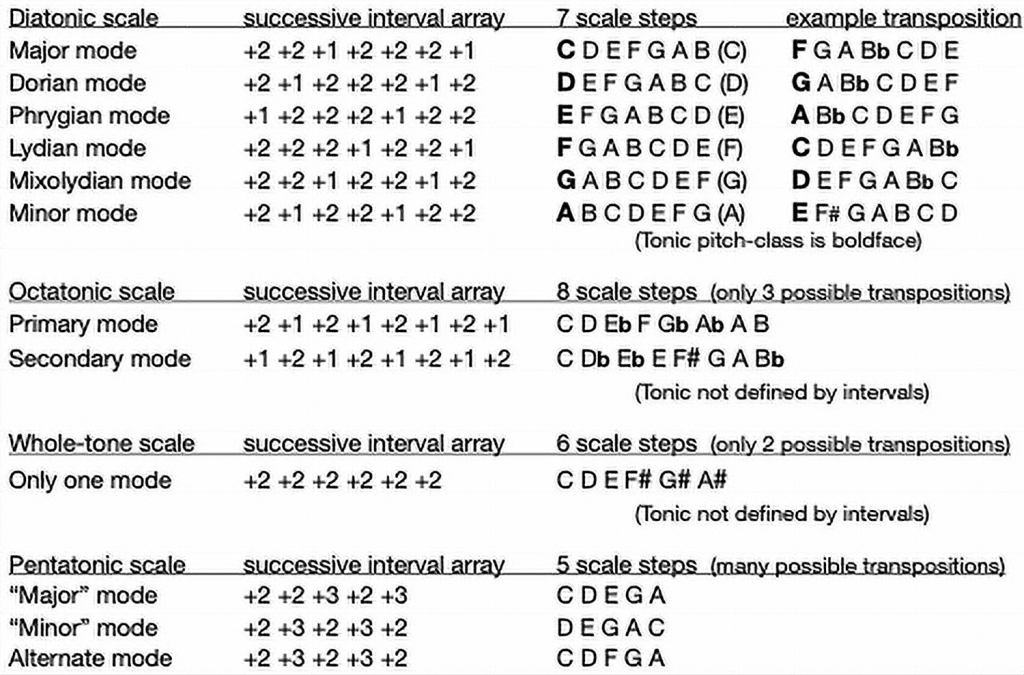
Most of our familiar scales are actually a different mode of the same 7-note diatonic scale, with a different starting and ending point called a tonic establishing the mode.
scale modes
Scale patterns / set classes
We can describe a set of pitches as an octave-compressed abstraction of 3 or 4 pitches as a lowest-to-highest ordering of pitch classes. It doesn’t produce anything like the 7 or so notes per octave we’re used to thinking of as a scale, as those shown above. It is conceptually powerful, nonetheless, to call the successive interval array of this compressed abstraction a scale pattern, even though it’s a scale fragment with no name. Its name can simply be the successive interval array, such as 2 4 2, the array describing a symmetrical pitch-class set called the French Augmented Sixth chord.
[Theoretical aside] In establishing set theory, Forte described these compact arrangements by naming the pitch-classes in order using a mod-12 number system shown above, C=0, C#/Db=1, D=2, etc. He identified twelve 3-note classes, including upside-down inversions reversing the scale pattern, as members of the same class. (Lewin kept these inversions separate, defining instead nineteen 3-note set classes. We’ll use Forte’s; the set classes as generalities are not as crucial to composing as to theoretical analysis.) Forte used cumbersome descriptions employing pitch-class numbers and “normal order.” In the Journal of Music Theory 15 (1971), Richard Chrisman defined and proposed successive interval arrays as a better, more revealing way to characterize the commonality of a family of pitch-class sets that are all related by transposition and/or inversion.
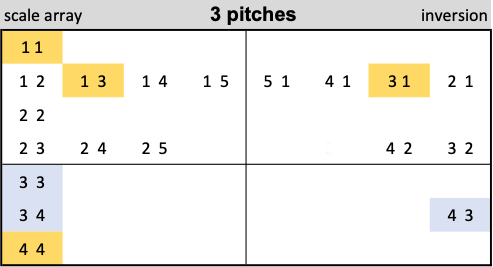
Relating to Forte’s concept of a set class, any set grouping three pitch-classes can be analyzed as an interval array or partial scale pattern.
scale patterns of all 3-pitch-class sets
Sets forming triads (or seventh chords below) are highlighted in BLUE; those that are atonal (cannot be found in a diatonic scale) are highlighted in GOLD.
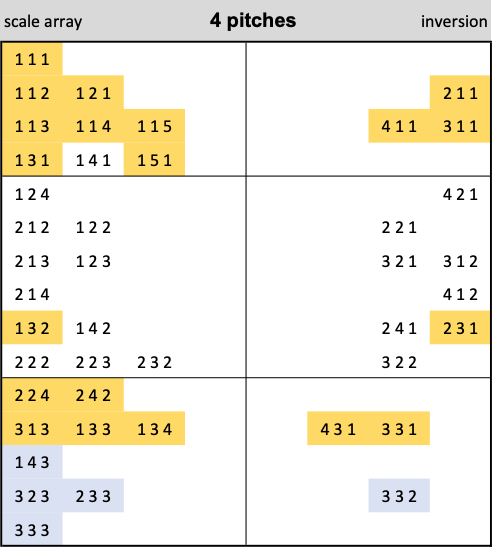
While the number of possible interval arrays for constellations of four pitches is enormous — even if limited to interval stack sizes less than two octaves, there are more than 12,000 possibilities — we can use this scale-pattern abstraction tool to categorize them into forty-three 4-pitch-class families.
scale patterns of all 4-pitch-class sets
The blue-highlighted scale patterns have common triadic chord names:
1 4 3 = “Major Major 7th chord” (in any chord inversion)
3 2 3 = “minor minor 7th chord” (in any chord inversion)
3 3 2 = “dominant 7th chord” (in any chord inversion)
3 3 3 = “fully diminished 7th chord”
The scale pattern 2 4 2 is an interesting symmetrical, non-diatonic pattern called a “French augmented 6th chord”.
Vocabulary
These maps collecting 62 scale-patterns summarize all possible constellations of 3 or 4 unique pitches, our total harmonic vocabulary in the chromatic universe.
think in terms of energy, frequency, and vibration.”
(Nikola Tesla)
We start with time. Everything in music involves time, is of time, sound events occurring in our perceived flow of time.
Sound itself is periodic vibration, a repetition of compression waves of energy in air (or water). Repetition of an event or series of events establishes a frequency of repetition and the period or cycle length, the elapsed time duration from each event’s starting time point (moment) to the starting point (moment) of its repetition.
We perceive the frequency of air-compression waves as pitch if they are faster than 20 per second and slower than about 4,000. Frequency is typically measured in cycles per second, called Hertz. Non-periodic waves faster than about 20 Hz are perceived as noise. Events or time cycles slower than 20 Hz are perceived as pulses, tempo, rhythm, phrase structure, etc. At these slower sub-sonic event speeds, it is more convenient to identify the duration of the cycle, its period, than the frequency.
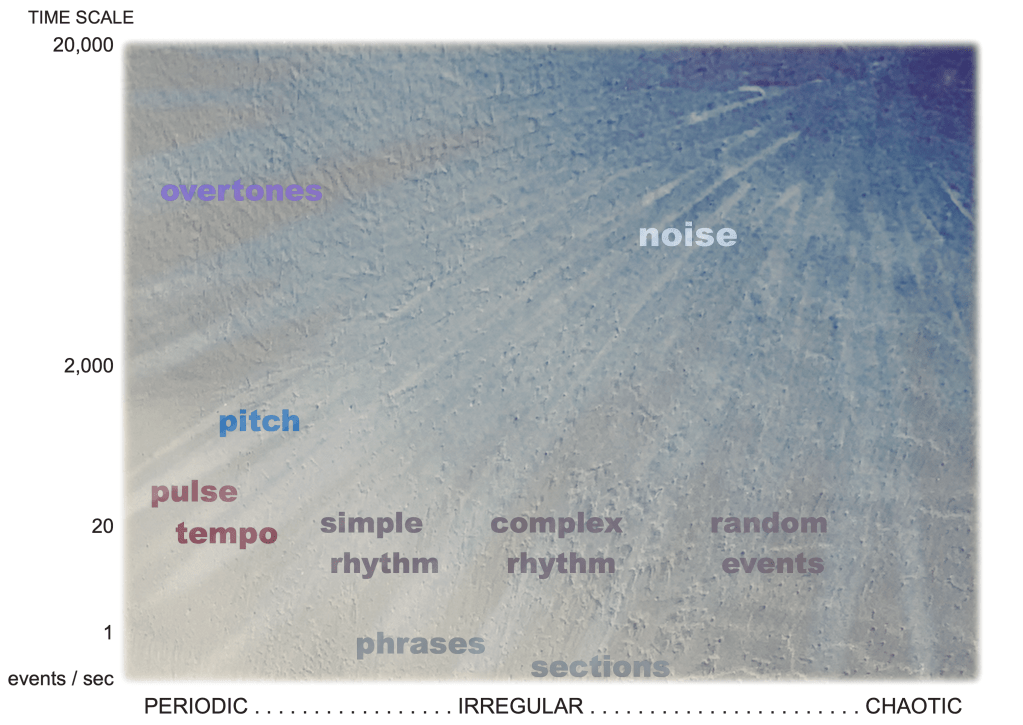
Periodicity, this repetitive aspect of sound events in time, gives us a dimension to map all the possibilities, from extremely fast to almost frozen slowness, and from simple, highly regular repetitions to a very complex succession of variants.
the periodic time/sound universe
In this illustration, the Y-axis is speed/frequency (slowest at bottom, fastest on top), the X-axis is regularity of repetition (perfectly regular at left, randomly sporadic time spans at right). The blocks have sharp rectangular edges; if I were a better artist, the boundaries between descriptive categories would actually be curving and very blurred. Though the graph shows firm straight lines separating pitch and noise, there is actually a fuzzy, curving grayscale continuum from pure, simple pitch through complex, colorful pitched timbres to noise.
Defining time
What is time and how does it work in our lives and in the rhythms that are the fundamental “substance” of music? I say substance metaphorically, because time does not exist as any physical matter. It is a perceptual construct, a complex quilt stitched out of human experience.
Discover magazine ran an article in June of 2007 titled, “Time May Not Exist”.
“Efforts to understand time below the Planck scale have led to an exceedingly strange juncture in physics. The problem, in brief, is that time may not exist at the most fundamental level of physical reality. If so, then what is time? And why is it so obviously and tyrannically omnipresent in our own experience? ‘The meaning of time has become terribly problematic in contemporary physics,’ says Simon Saunders, a philosopher of physics at the University of Oxford. ‘The situation is so uncomfortable that by far the best thing to do is declare oneself an agnostic.’”
The mysteries of time were explored as early as sixteen hundred years ago by the great Saint Augustine of Hippo, in Book XI of his deeply philosophical work, Confessions.
“. . . What is time? Who can give that a brief or easy answer? Who can even form a conception of it to be put in words? Yet what do we mention more often or familiarly in our conversation than time? We must therefore know what we are talking about when we refer to it, or when we hear someone else doing so. But what, exactly, is that? [Book XI, Section 17]
Nicholas Stratas’ thought-provoking article in the July 2007 issue of Wake County Physician, “Time – Continuous Yet Bidimensional” asserts that most of us have a firm concept of Past, Present, and Future. But defining them is challenging, and sorting out how these constructs interact in our consciousness even more so. Michael Spitzer, in The Musical Human (Bloomsbury Publishing, 2021), wrote:
“Musical time is a window into time consciousness in general. We listen to music in the moment, sitting in the saddle of an ever-shifting Now, as the past whizzes by to become memory, and the present anticipates what is just around the corner. Music’s present tense is really a bundle of memories and anticipations . . .”
Many years ago, I first read an article translated from Die Reihe, written by a preeminent avant-garde experimental composer, Karlheinz Stockhausen. “Structure and Experiential Time” described Stockhausen’s view that time does not flow uniformly through the experience of a serious musical composition. It ebbs and surges as the composer shapes not just the tempo but the flow of information in the form of repeated or new musical events, simple or complex musical structures.
“When we hear a piece of music, processes of alteration follow each other at varying speeds; we have now more time to grasp alterations, now less.”
Even tempo, a supposedly steady clock in most music, ebbs and flows. Computer music composers in synthesizing musical sounds have found that a mechanistically rigid clock tempo sounds artificial. Human musicians are constantly flexing tempo in subtle ways to convey almost subliminally where the music is “going” (another metaphor, that of travel through space).
Saint Augustine recognizes the slippery challenge of measuring time:
“ . . . We observe the different ways times lapse, and compare them, and call some longer and some shorter. . . . It is passing time we measure, as we experience it. . . . Time can only be measured as it passes. Once past, it is no longer there to be measured.” [Book XI, Section 21]
“We measure time as it passes . . . . But how can we measure the present, when it has no extent of its own? . . . Time must be measured in something with extent . . . But in what extended thing do we measure time as it passes?” [Book XI, Section 27]
“So time is measured, my mind, in you. Raise no clamor against me—I mean against yourself—out of your jostling reactions. I measure time in you . . . because I measure the reactions that things caused in you by their passage, reactions that remain when the things that occasioned them have passed on. . . . Time has to be these reactions for me to be able to measure it.” [Book XI, Section 36]
Time perception
Pulling all this together, I’d like to suggest several things about time in classical music.
Time is perceptual.
Time is multidimensional.
Time is elastic.
Time is experienced in complex ways as the fundamental basis of music’s richness.
In LEARNING TO COMPOSE, co-author Larry Austin and I begin the chapter titled “Time Streams” with a quote from a philosopher, and then express in our own words the fundamental nature of time.
“ ‘Music makes time audible and its form and continuity sensible.’ —Suzanne Langer
Music exists in time. Time exists as we sense it, articulated on many levels by changing and cyclically recurring events.
As beautiful, colorful and essential as sound is in making music, musical sounds are the means to an end, building blocks for events that primarily mark articulations of time.
We sometimes like to think of music as having two fundamental dimensions, like a graph. The horizontal dimension is the parameter of time. The vertical dimension is the parameter of pitch. But pitch is actually a temporal phenomenon – the frequency (periodic change over time) of sound waves. How amazing are the human ear and human mind to perceive waves of air coming at us a thousand times a second or much faster and distinguish the small differences that make a pitch “in tune” (or not) and the even subtler differences that identify an oboe instead of a violin producing that pitch. All of this from a perception simply of periodic rates in time!
Stockhausen pointed out that in mentally processing all of these sonic distinctions, we are forced to pay more attention to changes in their qualities, combinations, and “spacing” in time. These are his “alterations”.
“The greater the temporal density of unexpected alterations . . . the more time we need to grasp events, and the less time we have for reflection, the quicker time passes; the lower the effective density of alteration (not reduced by recollection or the fact that the alterations coincide with our expectation), the less time the senses need to react, so the greater intervals of experiential time lie between the processes, and the slower time passes.”
The concepts of expectation and information help make some sense of things. “Information” is perceptual data that is similar to what you just heard or logically confirms what you were expecting next. “Entropy” is the opposite perception – surprise, contrast, noticeable change. In musical listening, though we don’t do so consciously, we are constantly “computing,” assessing, retaining, and predicting.
Saint Augustine connects Past, Present, and Future with memory, experience, and expectation:
“What should be clear and obvious by now is that we cannot properly say that the future or the past exist, or that there are three times, past, present, and future. Perhaps we can say that there are three tenses, but that they are the present of the past, the present of the present, and the present of the future. This would correspond, in some sense, with a triad I find in the soul and nowhere else, where the past is present to memory, the present is present to observation, and the future is present to anticipation.” [Confessions, Book XI, Section 26]
And to make matters more complicated, it is not at all a linear process. Let’s take a metaphor. I can’t resist one that Einstein was very fond of in his thought experiments.
As listeners, we’d like to imagine ourselves as a train riding on tracks through time, a train that keeps moving forward and doesn’t back up. The clickety-clack of our wheels is a steady tempo measuring time. We only remember back to the tracks the locomotive has passed but still lie under the wheels of our caboose at the end. And we only look ahead a little bit, as the tree-bordered tracks curve, preventing a longer straight view.
That’s way too simple, a two-dimensional time frame in which we either recall a little of what we just heard or maybe guess a little what might happen next. As Meyers, Stockhausen, Spitzer, and Dr. Stratas all observe, in keen listening to music our minds are filled with memories of not just the previous measure or phrase, but the very beginning of the piece, its theme or launching impetus (Grundgestalt as Schoenberg named it) and, in a more diffuse sense, all that has “happened” up to the present moment. The present moment is not one single phenomenon in time either. Melody, countermelody, bass line, chordal texture, and punctuating sounds are simultaneously tracing distinct paths, each with its own pace through time. At the same time, we are constantly expecting what’s coming, or at least “feeling” where the music might be going. And, as if that weren’t complicated enough, we are busy reevaluating what we just heard in relation to what we had been expecting. Saint Augustine describes it more succinctly:
“Only in the mind can this [the experience of time] be accomplished, because of three activities there—the acts of anticipating, of observing, and of remembering.” [Book XI, Section 37]
None of this is conscious, but in describing it in concrete terms, we recognize the dizzying multidimensionality, time arrows pointing in all directions and curling back on themselves. This is what I believe constitutes deep listening, “getting lost in the music”.
Just one more idea – elasticity. Stockhausen recognizes that in music the sense of time passing changes, stretches or compresses, depending on how much “alteration” is being encountered. This is why music can seem “steady” or “surging ahead” or dissipating and almost “frozen”. It is not at all the tempo that causes this, but rather the rate of change, sharp contrast or subtle evolution, in the harmonies, the melodic character, or the rhythm.
A rhythmic playfulness in modern music stretches our sense of timing. Tempos change, are interrupted, break down, tumble into avalanches, come to rest. Time itself stretches and becomes the titled thematic element in pieces such as Time Cycles (1960) by Lukas Foss. Here is another example titled about time, written at the starting gun of the new millennium.
Fred Lerdahl – Time After Time (2000)
Awe
In his book When (Riverhead Books, 2018) Daniel H. Pink writes,
“I used to believe that timing was everything. Now I believe that timing is everything. . . . The experience of awe changes our perception of time. When we experience awe, time slows down. It expands. We feel like we have more of it. And that sensation lifts our well-being.”
He quotes researchers Rudd, Vohs, and Aaker in Psychological Science 23 No. 10 (2012):
“Experiences of awe bring people into the present moment, and being in the present moment underlies awe’s capacity to adjust time perception.”
In my administrative career, 2001 was a high point, as interim dean of UNT College of Music, then the largest music school in the nation. Though I hired several professors, launched a magazine and Dean’s donor group, and headed up our part of a university capital campaign, I didn’t do any composing.
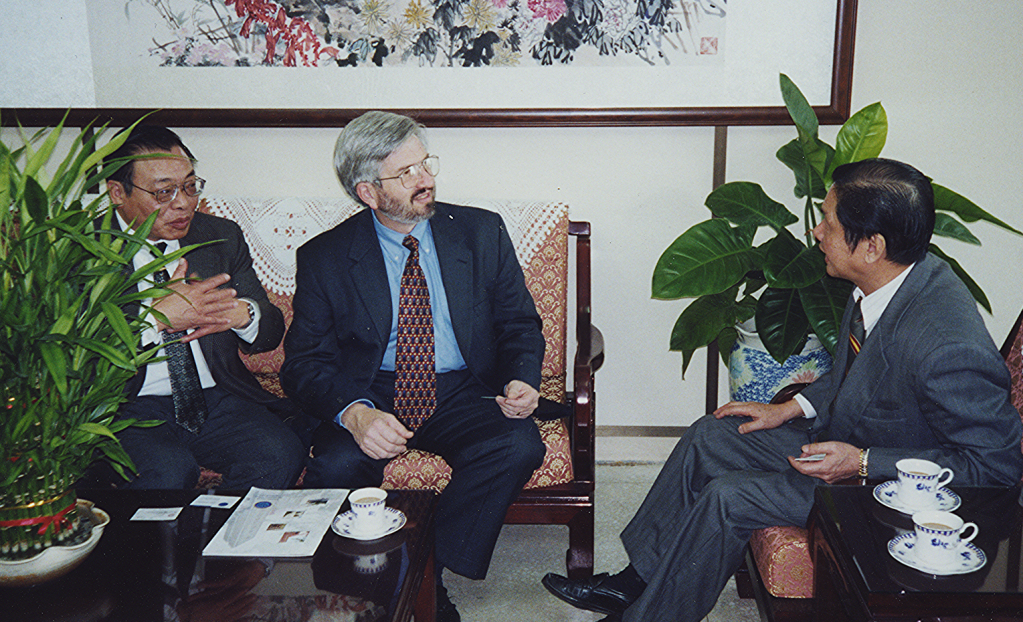
Cho (left) and NTUA president (right)
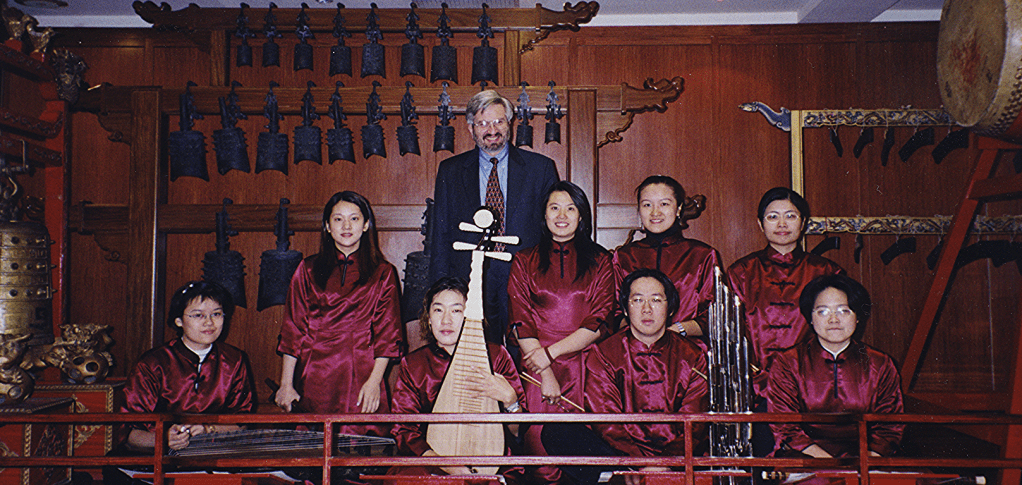
There was international travel, though. My Chinese-American colleague Gene Cho had established an exchange relationship with the National Taiwan University of the Arts, and he guided me to Taipei for the grand ceremony to sign the formal agreement.
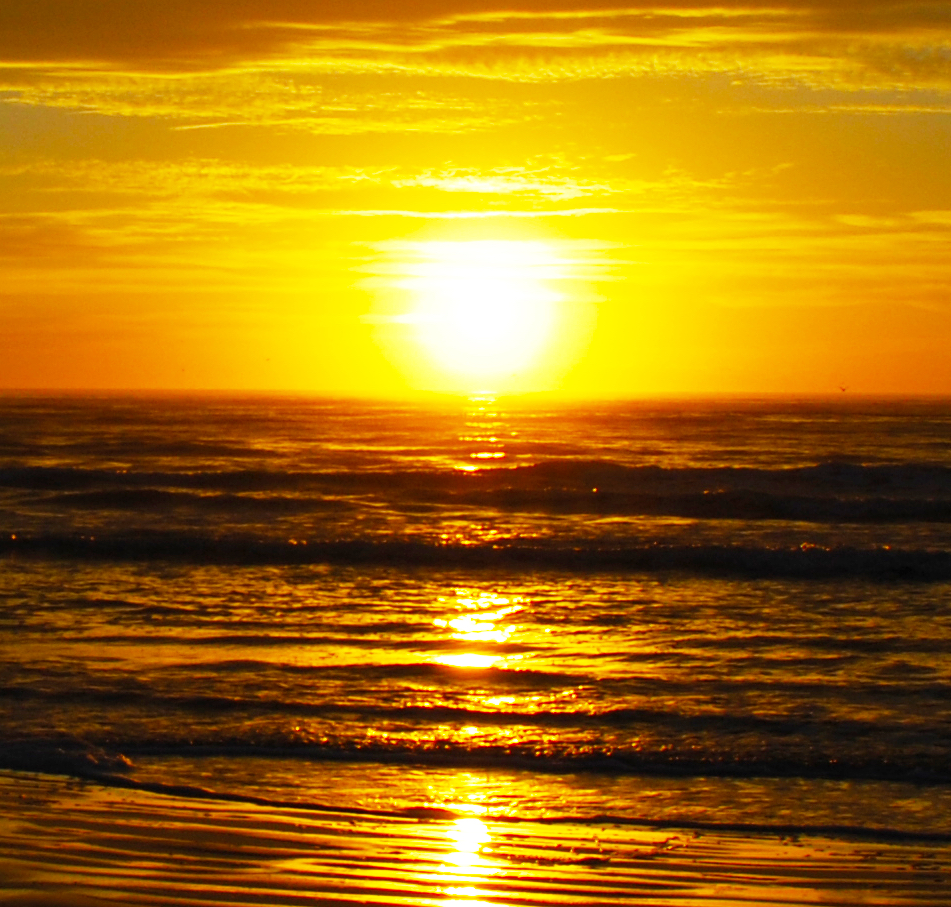
While there, we saw a traveling exhibit of the Qin Shi Huang Terracotta Army, took a train to visit Hsiuping University of Science and Technology in Changhua City, and went by car to the northern tip of the island of Formosa. In a cold mist on the rocky shore, we gazed out at the infinite expanse of the Pacific Ocean.
California composer Robert Erickson wrote that the stimulus for his music “is usually some noise or some non-music sound composing the environment in which I live, its sounds, its ambience.” In 1968 he composed Pacific Sirens (ocean sounds) involving taped sounds gathered from the environment with acoustic instruments.
I was commissioned by North Carolina State University’s Arts Now Series, directed by Dr. Rodney Waschka II, for an artistic contribution to The Ericka Fairchild Symposium on Climate Change. “The Fourth Angel” refers to one of the “seven last plagues” as they were called in the King James Version of the Bible. In the NRSV translation, Revelation 16:8 reads:
“The fourth angel poured his bowl on the sun, and it was allowed to scorch people with fire; they were scorched by the fierce heat.”
The other six angels and their bowls wrought plagues of painful sores, bloody seas, bloody rivers, darkness, a dried up Euphrates, and finally the seventh angel’s loud voice pronounced, “It is done!”
Standing in the middle of the sequence, the prophecy of the fourth angel is a dramatic metaphor for global warming.
The Fourth Angel
Clark 2006 (TC-77)
Though there are some literal sound references, the angel is portrayed more broadly as a metaphor for the forces of nature. Rather than capturing actual samples of nature sounds, the computer-generated sounds are all synthesized, musical objects constructed employing a now-common computing technique called grain-table synthesis. (The choice of machine synthesis over nature sampling suggests a particular belief about the causes of global warming.) These synthetic sound images form a broad range of simple and complex musical rhythms and textures evocative of the natural world:
sunlight reflected off water and ice
glaciers calving and cascading into the ocean
solar radiation
night sounds.
Extending the metaphor, sounds echo and swirl in sound space, just as do the dynamic, powerful weather systems that shape our global climate.
Other angels
Thus pieces about angels began with The Fourth Angel. Portraying imagery from Revelation, the seven angels in chapter 16 inflict suffering upon humanity. Angels of Bright Splendor evokes an equally awesome but more hopeful experience of our life-giving sun.
In Zuni origin mythology, thunder sounded, and The People climbed from darkness, emerging into the daylight world. Seeing the Sun (Awonawilona, they cried, not used to such intense light. Where their tears fell, sunflowers sprang from the earth.
Angels of Bright Splendor
Spirits
Heavenly light, voiced musically with metamorphic chord clusters, became an iconic sound in a famous 1968 movie. György Ligeti describes the technique for his 1966 piece for 16-part mixed choir, Lux Aeterna (“eternal light”):
“The complex polyphony of the individual parts, embodied in a harmonic-musical flow in which the harmonies do not change suddenly, but merge into one another; one clearly discernible interval combination is gradually blurred, and from this cloudiness it is possible to discern a new interval combination taking shape.”
Angels in most world religions and mythologies seem to serve one of two functions: wielding controlling power over the physical world or over human affairs; or making spiritual announcements to humans. The next piece in the angels series, scored for antiphonal double SATB choirs, brass, and strings, gives voice to the unseen voices of angels and other spirits. The choir pronounces the names of Native American and Hebrew spirits representing the power and beauty of nature – wind, moonlight, rainbows.
Gǎoh – chief wind spirit (Iroquois)
Yaogah – bear spirit of the north wind (Iroquois)
Neoga – fawn spirit of the south wind (Iroquois)
Oyandone – moose spirit of the East Wind (Iroquois)
Amitolane – rainbow spirit (Zuni)
Nokomis – daughter of the moon (Algonquin)
Gabriel – archangel of justice, annunciation (Hebrew)
Maris stella – star of the sea (Latin)
Unseen Voices
Clark 2018 (TC-94)
Messengers of peace and assurance . . . and hope for the future of this millenium?
I first visited Czechoslovakia in 1991 to perform at the Brno International Music Festival. How this opportunity came about is a story in itself. My colleague Tom Sovik at the University of North Texas joined a group promoting the City of Dallas as a sister city with Brno, the second largest Czech city and capital of the Moravian province, where he had done his doctoral musicology research. At his suggestion, I wrote a short piece as a gift to Brno. Its mayor turned over the gift score to the secretariat of Brno’s International Music Festival, a distinguished Moravian composer Arnošt Parsch. He invited me to come to the festival and conduct my music. The result was an October 1991 performance in Brno’s New Town Hall of two of my works, ANTIPHONS (1989) and CANZONA, for combined woodwind and brass quintets, which I conducted.
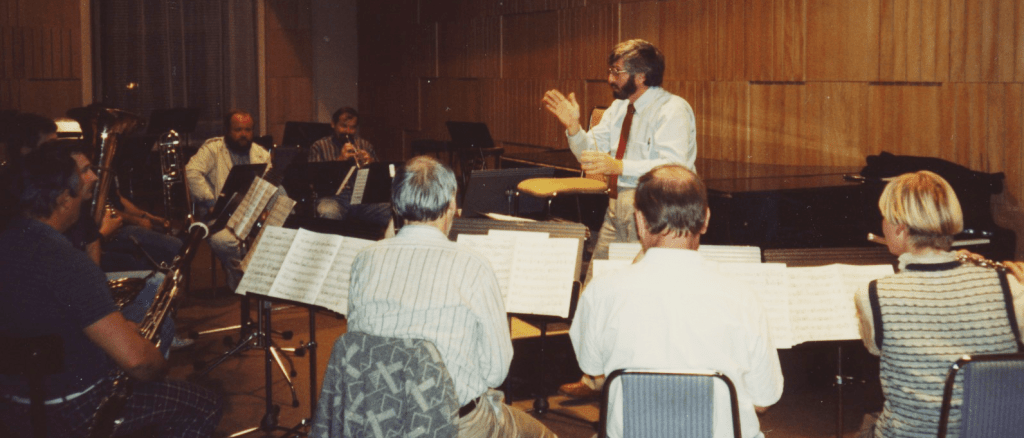
rehearsing with Czech ensemble
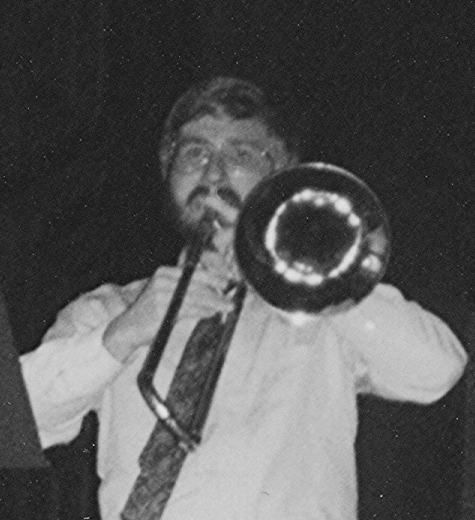
Parsch invited me back in 1992 for the 27th Brno International Festival’s Experimental Music Exposition V. I presented my LIGHTFORMS 2: StarSpectra multimedia computer music and played trombone in an experimental multimedia piece by my friend, Rodney Waschka. I had performed the same program early that fall at the Festival Internacional Alfonso Reyes in Monterrey, Mexico.
While in Brno for the 1991 festival, I met choreographer Hana Smičkova, who invited me to compose a work for her Mimi Fortunae Dance Theater, which rehearsed in the ancient Spilberk Castle. I began studying the great 20th-century Moravian composer Leoš Janáček’s music as background for the ballet’s composition.
PTACí(“Birds”) was premiered in Brno in 1993 by the Moravian Chamber Orchestra, which I conducted. The ballet, choreographed by Smičkova, was performed by Mimi Fortunae in historic Mahunovo Divadlo, the first building in Europe to be equipped by Thomas Edison with electric lights.
During these years, Parsch and I became composer friends. Our visits to each other always included long walks in nature and deep discussions of music, art, and culture. In 1991 I had visited the northern Moravian mountain village of Hukvaldy, the summer home of Janáček. He loved nature walks and studied bird songs.
Hukvaldy Sketches was first a concert suite of PTACI, my set of modern musical impressions of old Moravia, in the ancient heart of Eastern Europe. Scored for a chamber quartet, it was premiered February 6, 2018, at Texas State University Performing Arts Center, by Ian Davidson (oboe), Vanguel Tangarov (clarinet), Ames Asbell (viola), and Kari Klier (marimba).
The final transformation of this work was a re-scoring of Hukvaldy Sketches for the original PTACI orchestration. Its five scenes:
In my intense study of Janácek, I reveled in the expressive depth of his uniquely modern Moravian music. His powerful String Quartet No. 2 and his collection of gentle piano music, Po zarostlém chodníčku, affected me deeply.
In one of my Brno performances, Parsch’s Czech colleagues commented on my music’s affinity to modern Moravian musical style. I was informally dubbed an honorary Moravian Composer, a distinction I proudly took as a high honor of their acceptance. Since then, I have written many pieces with Czech imagery:
Two of these are vocal music that include some Czech lyrics. The treble choir piece A NEW LIDICE begins with “We build a new village, while a just world watches. Stavíme novou vesnici. Spravedlivý svêt bude sledovat.” Children (including my daughter Alison) sang a short phrase in Czech in MORAVIAN MOUNTAIN SONGS, written for the Woodrow Wilson Elementary School Choir in Denton, Texas.
Sinfonietta
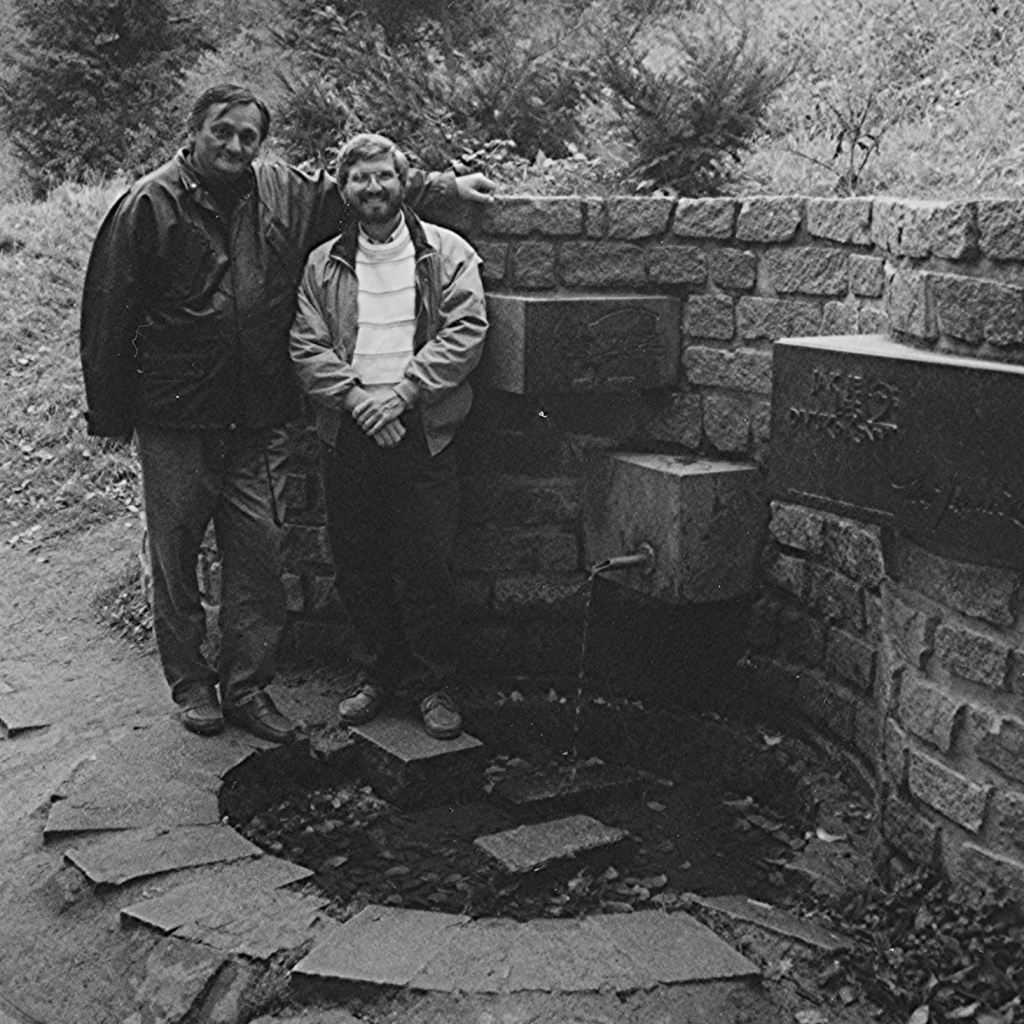
with Parsch at the spring outside Brno
Leos Janácek composed his great concert work, Sinfonietta, in 1926 for the Sokol Gymnastic Festival in Prague. Janáček said it was intended to express “contemporary free man, his spiritual beauty and joy, his strength, courage and determination to fight for victory.” It is what I call musical sketches of his home city, Brno, the largest city in the Moravian east of what was then Czechoslovakia.
I visited Brno several times starting in 1991 to perform my music at its International Music Festival.
The festival traditionally ends with a performance of Sinfonietta by the Brno Philharmonic in Janácek Divadlo (theatre). In 1993 my ballet, PTACI, was premiered at historic Mahunovo Divadlo, across a plaza from Janácek Divadlo.
Though I could have continued my “Sketches” series with a “Brno Sketches,” instead a 2024 work is a set of more abstract variations partly based on and quoting themes from Sinfonietta (in the tradition of Brahms’ Variations on a Theme of Haydn).
Variation 1 “Canon” engages that ancient musical technique, evoking Brno’s medieval history.
Variation 2 “Overtones” explores two harmonic series, C and Bb, painted over each other in layers of color, with hints of fanfare emerging through the clouds.
Variation 3 “Constellations” is a kaleidoscopic succession of large sonorities built on stone-sturdy Perfect Fifth intervals brightened by jazz-like added tones.
Variation 4 “Fanfare” is an ostinato pattern-music fantasia on Sinfonietta‘s grand fanfare themes.