Tag: fugue

  • MapLab 3. Construct a Canon

    Canon is a venerable, centuries-old compositional device, building counterpoint between a melodic line and one or more delayed and possibly transposed echoes of itself. Like a magic trick, it makes a strongly cohesive contrapuntal texture of rhythmically independent lines that are like clones of each other. Canon is more intense than a fugue, which formalizes the echo cloning technique, interspersed with free counterpoint.

    1. Study historical models

    There are many great models to study. Many 16th-century composers (notably Josquin and di Lasso) wrote canonic choral mass movements. Known more for his fugues, the great 18th-century contrapuntal master, Bach, also wrote several intriguing canons in his late work The Musical Offering. No more elegant model exists than the first movement of Anton Webern’s Symphonie Op. 21 (1928), in which four voices are spun out by successions of instruments each in turn differently coloring two to four notes of the same 12-tone line.

    Like every fine magic trick, there are several basic techniques we can learn to construct a canon. I’ll cover three, which I will call Zigzag technique, Trial-and-error technique, Rhythmic alternation, and Stretto echo.

    In 1610, Venetian composer Diruta wrote Il Transilvano analyzed Renaissance polyphonic style by codifying five species of rhythmic relationships between contrapuntal lines. Johann Joseph Fux, in his monumental 1725 pedagogy, Gradus ad Parnassum, explicated 16th-century counterpoint using these rhythmic species, of which the following are of special importance for us in this lab:

    • FIRST Species – note against note
    • FOURTH Species – lines alternating, seldom moving simultaneously
    • FIFTH Species – a mixture of rhythmic values in all lines

    2. Zigzag

    My name for it says it simply, like laying bricks one at a time but staggered to overlap.

    • Compose a few notes of the lead line. (In the example below, it is just three notes in two measures.)
    • ZIG: Establish a time delay. (in the example, one measure of two half-note beats). Duplicate the first notes (rhythm and melodic interval shape) in the following line, starting on a chosen pitch that makes the kind of vertical contrapuntal interval you desire to emphasize.
    • ZAG: Select new notes for the lead line that overlap with the ZIG notes, again making your desired vertical contrapuntal intervals. These ZAG notes need not match one-to-one the rhythms of the ZIG notes, providing the opportunity if desired to establish a Fifth-species rhythmic mixture.
    • The notes of this ZAG now ZIG into the following line, preserving the same transpositional level you established in the first ZIG.
    • Keep going as long as you wish or have stamina for. When ready to cadence, arrive at a longer note of stable pitch-sense in the lead line.

    The canonic material you just contructed can be reused transposed. Just be sure you transpose all lines together by the same transpositional interval.

    In the example below, my seven zigzag-composed measures are transposed down one semitone.

    Starting on Eb might be useful to follow the first statement of the material, which ended on D in the lead (lower) line. Or I could transpose the whole thing up 8 semitones to start on C, eliding with the middle C (bass clef) that ended the following line.
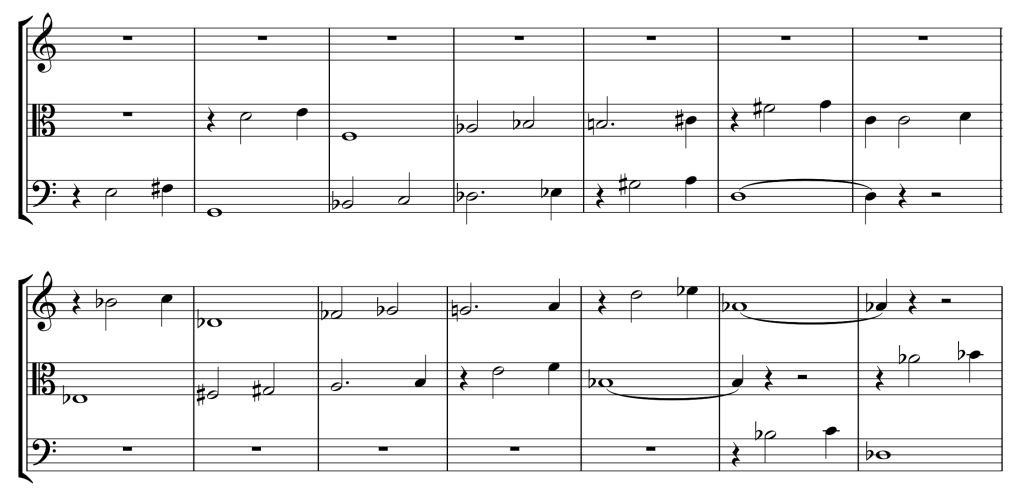
    Adding the third part enables this stair-step sequential transposition of the two-voice canon to go on and on . . .

    3. Trial and error

    Let’s try a different technique to add a canonic answer, one that is facilitated by notation software such as Finale or Sibelius. This way involves

    • copy the whole lead line, not just a head motive
    • choose a time delay or maintain one already established. Paste into the new answering voice the lead line
    • Playback the synthesized audio to test aurally for contrapuntal viability.
    • If it sounds bad, analyze the vertical intervals to discover why.
    • Make a strategic choice of a transposition of the pasted-in answer, then test it aurally.
    • Keep trying different transpositions until you find one you really like.

    For traditional diatonic tonal subjects, common transpositional choices are: unison; octave; Perfect 5th (7 semitones); Perfect 4th (5 semitones).

    In the following examples, I show in the first system a trial of an added third voice in the middle, starting on E (alto clef) transposed an octave up from the lead. For the second system, I tried adding a third voice on top, transposed up a Major 9th (14 semitones) from the lead’s start on Eb to start on F (treble clef).

    Horrible, yes? Why? What vertical contrapuntal invervals are the sour ones to your ear?

    I’ll jump to a better trial that succeeds in both places.
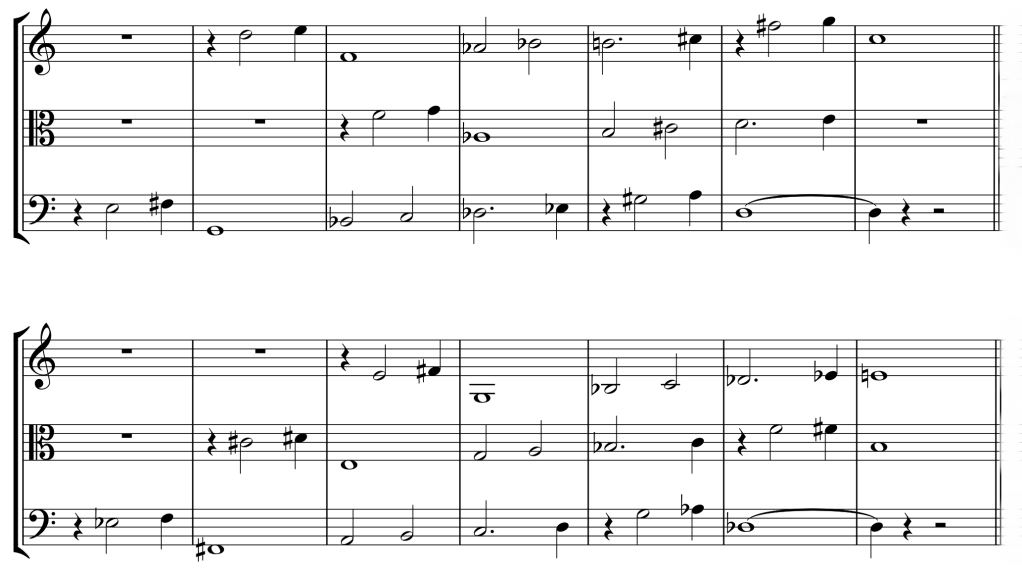
    In this successful trial, the first system’s added middle voice transposes from the lead’s E up 13 semitones (minor 9th), and later in the second system the added upper voice transposes up also 13 semitones from the lead’s Eb to a second answer starting on E. The minor 9th is unusual, unorthodox, chromatic, not a solution we might predict . . . but it works!

    4. Rhythmic alternation

    This will be like Fux’s Fourth Species. The lead subject is best with some long note values, leaving ample time for answering voices to present pitches when it is not moving. Transpositional choices for entering answers become fixed as predominant vertical intervals throughout the canon. In this example, the first answer chooses down 11 semitones plus an octave, and the second answer enters up 7 semitones (Perfect 5th) from the first answer, which is down a Major 10th (14 semitones) from the lead line. Thus vertical (harmonic) intervals of 11, 7, and 14 semitones end up projecting harmonies based on the 7 4 array: G up 7 to D up 4 to F#, which is up 11 from G. That sets the harmonic character of pitch constellations throughout the canon.

    5. Stretto echo

    Stretto is the term used in fugue structure for when an answer to the subject happens before the subject is finished, sometimes with a delay as short as only one or two beats. For a canon, this offers an interesting strategy for choosing pitches to shape a subject that makes its own arpeggiated harmony as it goes. The answers at unison (not transposed) are literally echoes. Even with answers octave-transposed, the effect is a multivoice arpeggiation. The fascinating wrinkle, however, is that the “chord” being arpeggiated is constantly evolving, dropping one pitch and adding one new at each note of the lead line.

    Though this setup can work with other rhythmic “species” of lines, it is particularly interesting in the note-against-note conforming rhythms of “First Species.”
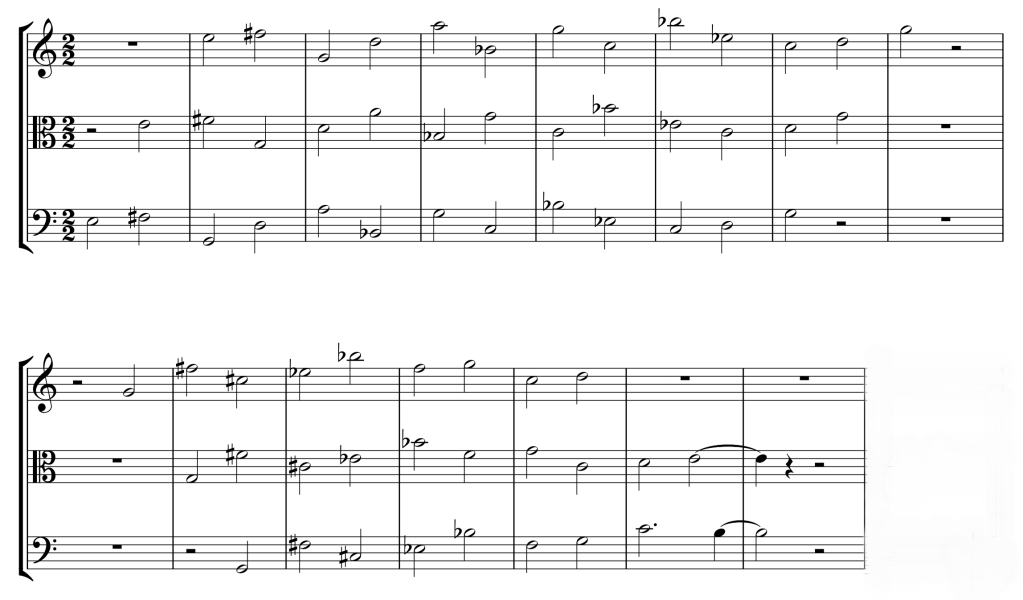
    Here is how it can work, using the canon above as a straightforward example.
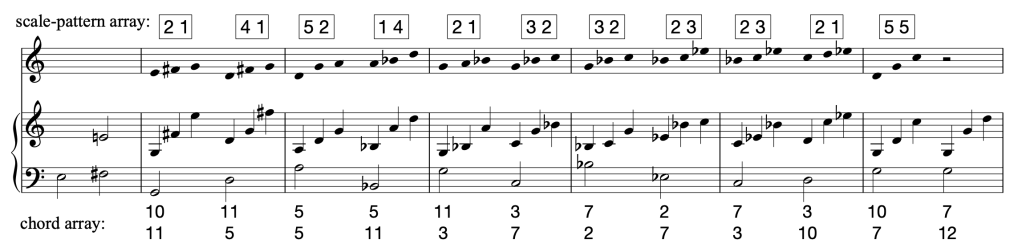
    This analysis sounds as a rather nice progression of arpeggiated chords and simple flute line! The important point, though, is that this progression did not come first. It was built by the canonic subject line as each new pitch was chosen to make a certain array with the previous two pitches in an ongoing, evolving flow. Magic!

    6. Spin a piece

    For our example, we’ll follow the order of the example techniques:

    • two-voice zigzag canon
    • add a third voice by trial and error
    • stretto echo of the same subject
    • Rhythmically spacious subject allowing non-synchronous timing of answers
    • Recapitulation of the stretto echo canon

    The result is a fuller working out of No. 10 of the 14 specimens in my Book of Canons:

    Black Canyon

    The title comes from my photographic memories of the Black Canyon of the Gunnison River, named for the ever-present shadows the narrow canyon’s steep, sheer, tall rock walls cast on the river flowing far below. The sheer cliffs of the Black Canyon are metamorphic Precambrian gneiss and schist, streaked with thin, brighter-colored layers of pegmatite. These streaks sketched on the darker rock look like maps of ancient contrapuntal lines.

    Continue reading Mapping the Music Universe . . .

    MapLab 4. Model a metamorphosis

  • Mapping Music 9. LINE

    Think about levels of structure scientists study in our universe.

    They dive deep into atomic structure, below electrons spinning around a nucleus of protons and neutrons, discovering subatomic particles like the meson and boson. At the other extreme, they gather observations to speculate about the shape of the entire expanding universe. We understand the structure of our planet, of our solar system, and our Milky Way galaxy.

    “We are slowed down sound and light waves,

    a walking bundle of frequencies tuned into the cosmos.”

    — Albert Einstein

    Think about how artists build structures that establish a style  . . .

    Painting engages techniques to create texture, rising to broad descriptions of style that actually describe structure: impressionism, cubism, pointillism. Musically, macro-structure is thought of as texture and form. Texture has been treated in broad descriptive categories: monody, homophony, polyphony, counterpoint, and more recently, sound mass, each focusing on the number of distinct parts, voices, or layers and how they interrelate.

    Structure and Relativity

    Shrinking our metaphor from the vastness of the universe down to the physical immediacy of cloth . . .

    A woven fabric has a longitudinal warp and a perpendicular crossing weft. Part II explored the vertical-pitch “weft” of harmonic design. Now we return to the “warp” in music, longitudinal time streams of events. In keeping with our standard conception of time as horizontal and pitch as vertical, let’s name each longitudinal “warp” element:

    LINE — an element of a musical fabric consisting of a conforming stream in time of similar events (notes, pitches, colors, drum sounds, etc.)

    Now we can go back to “monody, homophony, polyphony” and at least identify how many lines are in a musical fabric, from one (monody) to many (polyphony). But to distinguish between homophony with its matching, rhythmically aligned lines from polyphony with its more diverse set of lines of different nature, we must distinguish different types of lines to determine the extent to which the lines of a polyphonic fabric “match.”

    There are limitless number of combinations of characters for a line and thus an infinite number of fabrics possible. We will stick to six parameters and simple observational characterizations for each parameter. Since we are swimming in the painting and weaving metaphors, we will color-code these six parameters. Each parameter will be distinguished with just two binary descriptors, a simpler or purer character or a more intense or complex character in that parameter.

    distinguishing parameters

    Since there are 7 parameters and two possible descriptors for each parameter, the total number of permutations is 2 to the 7th power = 128 possible combinations. That means, however, if there are two lines in the fabric, the number of possible combinations rises to 16,384 — plenty of choice for creative composing. And with 4 lines, the number of possible combinations explodes to more than 268 billion!

    More simply, with these defined characteristics we can redefine “homophony” to mean more than one line that match characteristics, and typically are in rhythmic alignment (synchronized). Indeed, most musical fabrics involve quite a bit of similarity between multiple lines. In a typical traditional “melody-and-accompaniment” fabric, there are only three distinct lines, melody, bass line, and chords, even if the chords are actually in two or more matching instrumental or vocal parts.

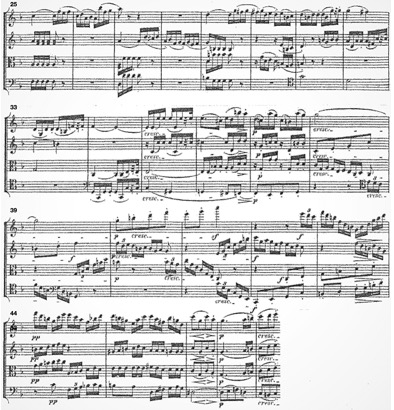
    The following example is taken from the Allegretto movement of Beethoven’s String Quartet Op. 135.

    String Quartet Op. 135 Allegretto, mm. 25-48

    In the first two bars of this example from Op. 135, there are actually only two lines in the fabric, the melody (1st violin) and repeated chord tones (the other three instruments aligned in 16th-notes) — common homophony.

     Op. 135 violin vs. other lines

    Though there is no dynamic marking for the 1st violin, it will be played as a prominent line, what Schoenberg would have called the Hauptstimme. By the third bar of the second system (11th bar of the example), there are three lines, violins / viola / cello, and by the next bar, briefly, all four instruments have distinct fabric threads. By the end of the excerpt, all parts have joined in homophonic unity.

    Melodic shape

    Melodic connotes a singable tune of primary focus; here it is meant simply as any line of successive single pitches. In the general descriptors of texture, we referred to smooth and angular shape. Let’s be more precise. First, there is the general size of melodic intervals. As music practice moved from Medieval/Renaissance through 18th-Century styles, smaller intervals, steps and small skips predominated. 19th-Century styles introduced a greater proportion of larger “leaping” intervals, 6ths, 7ths, 9ths. And those large, disjunct intervals became the norm for much 20th-Cenury music.

    Another important melodic shape factor is directional.

    TURN — a melodic note is approached in one direction (up or down) and left in the opposite direction

    Some turns are trivial and do not complicate melodic shape, such as trills and back-and-forth oscillations.

    turns in Elegy line

    The first phrase, starting on Eb, goes up to E then down to D — turning on the middle note, E. The next two phrases are increasingly complex in shape.

    Elegy 2nd and 3rd phrases

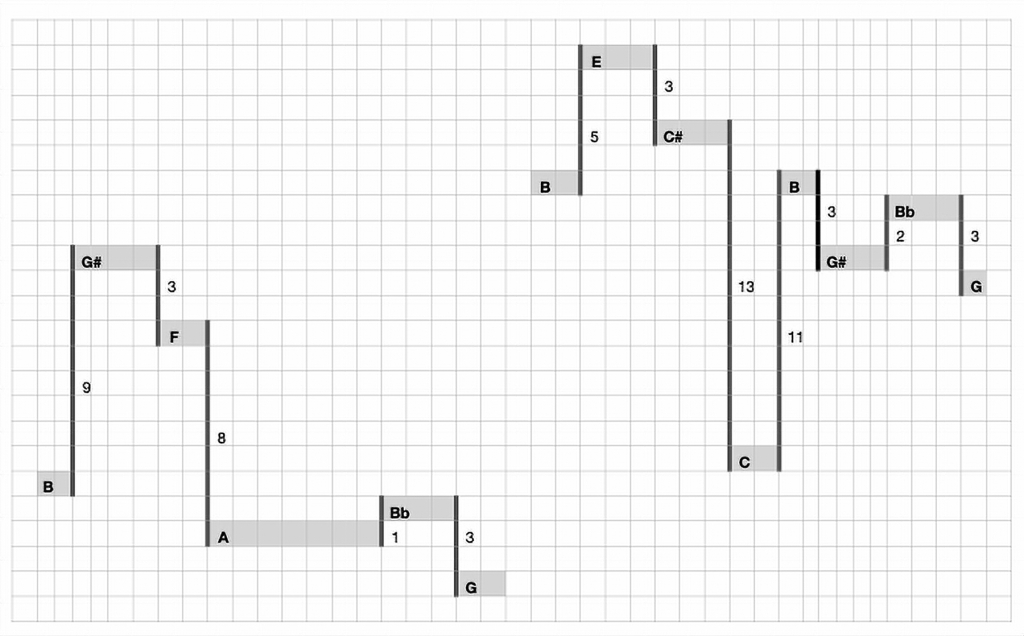
    The phrase starting on the lower B rises to G# then turns down on that G# to A, then back up from A, and finally back down, turning on Bb. There are three turning points, G#, A, and Bb, in a phrase of only six pitches and five melodic intervals. Combined with the fact that each melodic interval is a different size (9 s.t., 3, 8, 1, 3) except the last (reusing the downward 3 semitone interval), this is a rather complex, angular shape.

    The third phrase, starting on the higher B, is even more complex in angular shape: turns on every pitch except the C# — that is five turns in just 7 melodic intervals between 8 pitches.

    A side note of analytic math:

    • Number of pitches (#P) minus 1 = number of melodic intervals
    • Number of melodic intervals minus 1 = number of “opportunities” for the line to turn (#P – 2)
    • Shape complexity = #T / (#P – 2) ranging from zero to 1

    Pitch recurrence

    RETRACING — melodic line returning within a phrase to the same pitch (in the same octave) as previously sounded in the phrase

    Distinguished from a pitch being repeated (immediately), a retracing is a recurrence after other intervening pitches. It contributes to structural stability in the phase, a sense of staying in one place. Conversely, when retracings are avoided in the shape of the line, the sense is more of progressing, even of wandering, as in the Elegy example above. (Use of a 12-tone row to construct a line is a way to methodically avoid retracing any pitch until all 12 pitch classes have been introduced.)

    Back to Bartók — two orchestral lines studied in the Pitch chapter. The first example (from the opening fugue of Music for Strings, Percussion and Celeste) is scored for viola, but here I show it in bass clef for those a bit challenged by alto clef.

    fugue subject

    Mapping the line on a time/pitch graph for analysis, the first phrase avoids any retracing. The next three phrases make only one retracing each: back to Bb in the second phrase (highlighted in blue); back to C# in the third (in red); retracing back to C in the fourth (in green). (There are fainter retracings back to the previous phrase in each not shown.)

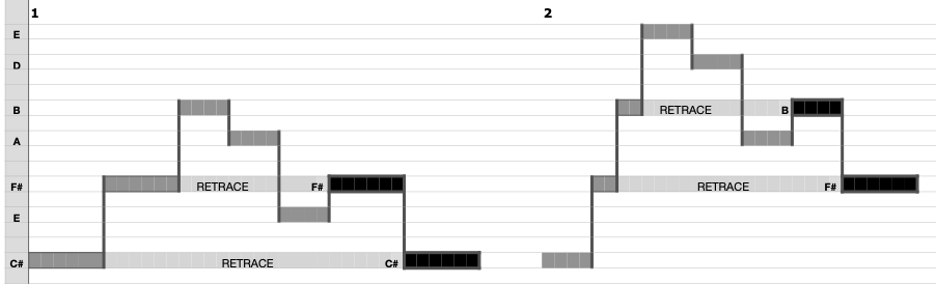
    The second is a low string line from the opening of Concerto for Orchestra.

    Concerto for Orchestra retracings

    In this example, both phrases are built with two retracings, C# and F# in the first phrase, F# and B in the second phrase.

    In this manner, retracing of pitches builds the support structure for the architecture of many lines.

    © 2026 – All Rights Reserved

    Thomas S. Clark

    Continue reading Mapping the Music Universe:

    TClarkArtMusic.com 

  • Book of Canons

    My compositional fascination with musical canons began in the early 1970s with study (at the University of Michigan) of Ockeghem’s 15th-century polyphony, the 10 canons in Bach’s 18th-century The Musical Offering, and Webern’s 20th-century Symphonie Op.21. As a young professor in the 1980s teaching 16th-century counterpoint at what was then North Texas State University (now UNT), I used canon as a challenging contrapuntal writing assignment. In 1985, a wind ensemble piece, Parallel Horizons (Homage to Schoenberg), was my first formal composition constructed by canon. In Dark Matter, other contrapuntal writing surrounds an extended canon. Now canon pervades much of my 21st-century writing, a challenging yet stimulating and gratifying approach to texture and continuity of material.

    The definition of this ancient form of Rumpelstiltskin magic, spinning complex counterpoint out of a single melodic line:

    CANON
    A leading line is echoed after some delay by one or more answering lines of identical rhythmic values and melodic shape (possibly transposed)

    For a collection of 21st-century examples – 14 studies in 3-voice canon – go to my BOOK OF CANONS in the appendices. For pedagogical demonstration purposes, the subject of each is shown, with indications for when and at what pitch level each answer will occur.

    Read more at Mapping the Music Universe: COUNTERPOINT.