Tag: Galileo

  • Mapping Music 4. TUNING

    “To understand the Universe,

    you must understand the language in which it’s written,

    the language of Mathematics.”

    — Stephen Hawking

    Galileo revolutionized astronomy, in part by using a new tool: the telescope.

    Schoenberg revolutionized harmony by evolving an existing concept, the chromatic scale, into a new tool: the 12-tone scale, and devised a new compositional tool of the 12-tone row.

    Allen Forte took Schoenberg’s ideas to another level of abstraction: defining Pitch Class and applying basic math to the 12-tone universe.

    Chrisman focused on the interval essence of pitch patterns: defining the “successive interval array.”

    I am merely another explorer using their maps but choosing my own creative path. In doing so, I will define some of my own terms, while adapting and clarifying some established terms that fit what I’m thinking and expressing.

    From Tuning to Tonality

    We think of traditional common-practice Tonality of the 17th through 19th centuries being synonymous with the major and minor scales. But there’s more to traditional common-practice Tonality than just the scale. Here are the four basic factors that determine any tonal design:

    SOURCE SCALEHARMONIC TYPETONAL CENTER
    ancient modeperfect intervalsfixed by mode
    Major / minortriadmodulatory shifting
    extended chromaticextended triadpolytonal centers
    exotic / syntheticnon-triadestablished contextually
    12-tonediversenone

    tonal design factors

    As you can see, there is much to explore: scales, modes, intervals, consonance . . .

    Tuning

    Taking the overtone series and partial vibrations as a natural acoustical model, Pythagoras identified pitch intervals as simple integer ratios of lengths of a vibrating string. The same ratios describe frequency ratios.
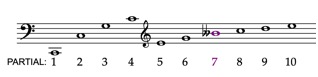
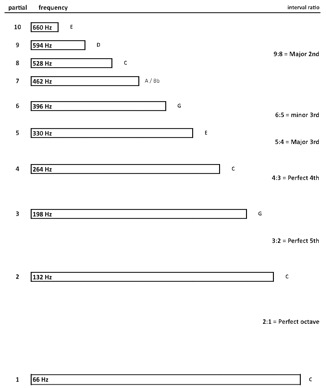
    fundamental pitch C and overtones

    For example, what we call a Perfect Fifth, the interval of the Third Partial to the Second Partial of a natural overtone series, is a 3:2 ratio. Such natural tuning is always employed by orchestras, bands, and a cappella choirs.

    • Octave = 2:1
    • Perfect 5th = 3:2
    • Perfect 4th = 4:3
    • Major 3rd = 5:4
    • Minor 3rd = 6:5
    • Major 6th = 5:3
    • Minor 6th = 8:5
    • Major 2nd = 9:8

    This approach requires, however, that intonation be constantly adjusted as the key changes or tonal context shifts. For a keyboard that can’t make those adjustments, the fixed tuning devised in the 18th century, called Equal Temperament, compromises the Perfect Fifth, shrinking it from a 1.5 ratio to 1.498307 so that it and all other intervals are very slightly but equally mis-tuned in every possible key or tonal context. The ratio for a semitone is derived mathematically from the 12th root of 2: 1.059643094. That ratio, multiplied by itself 12 times, results in 2.000, the ratio of the octave.
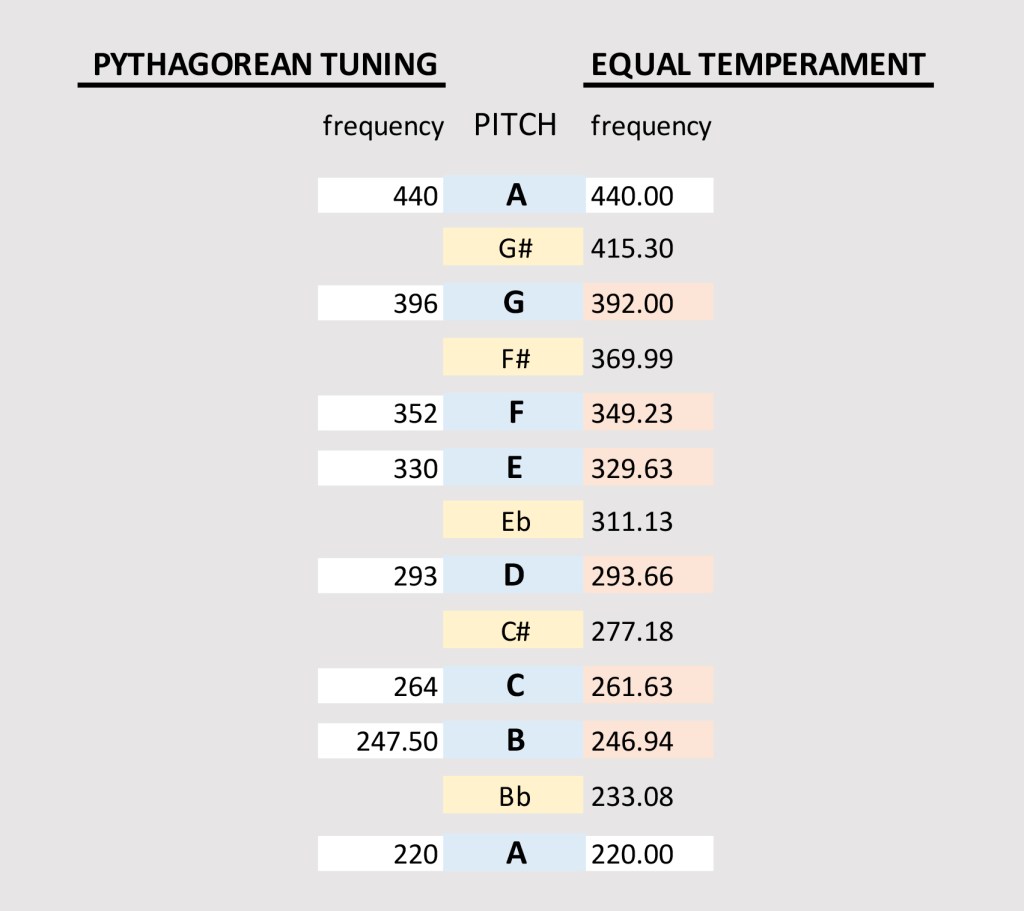
    comparing tuning systems

    While “chromatic” historically meant extending a key with accidentals — temporary extra sharps or flats — now we refer to the 12-half-step scale as the chromatic scale. Two pitch names for the same piano key — C-sharp or D-flat — are said to be enharmonic and considered equivalent, almost interchangeable.

    Equal Temperament became the basis for the 20th-century system of 12 equal semitones per octave, the basis not only for all keyboard instruments but also for harmonic theory in the post-tonal world of 12-tone music. We should not forget, however, that choirs, orchestras and bands still use the purer natural tuning, even with music that has no key signature.

    Other tuning systems

    Long before equal temperament, the Chinese culture developed several systems. A fascinating history is described in Gene Jinsiong Cho’s monograph, LU-LU: A study of Its Historical, Acoustical and Symbolic Signification (Caves Books, Ltd., Taipei, 1989). Cho (a music theory professor colleague at the University of North Texas) explains the LU system from the Chin Dynasty, which extended beyond 12 increments in an octave as far as to the arcane realm of Jing fang’s sixty LU series.

    In the West and into the 20th century, two American composers experimented with microtonal tunings splitting the octave into finer increments than our 12 semitones.

    Working with American Lou Harrison, California composer Harry Partch (1901-1974) devised his own tuning system with 43 increments, described in Genesis of a Music (1947). The system necessitated invention of specialized percussion and string instruments to precisely intone the sounds, which felt exotic both in tuning and sound quality.

    Harry Partch – Castor & Pollux (1952)

    University of Illinois professor Ben Johnston (1926-2019) wrote music for standard orchestral string instruments using the ancient just intonations of Pythagorus. This involved specifying pitches microtonally slightly higher or lower than the equal-tempered standard pitch classes – a notational challenge of pitch-adjustment symbols.  

    Ben Johnston – String Quartet No. 7 (1984)

    In the 21st century, Japanese composer norokusi has produced a broad catalog of microtonal music, apparently using a 17-increment division of the octave.

    norokusi – Piano Sonata n.718 (2018) 17EDO/TET

    Such complex systems as described above never became mainstream. The vast bulk of 20th-century and now 21st-century music is based on the equal-tempered 12-increment system found on a well-tuned piano, with subtle adjustments by orchestral strings, wind bands and a cappella choirs to momentarily purify some sonorities.

  • Mapping Music — PRELUDE

    The heavenly motions are nothing

    but a continuous song for several voices,

    perceived not by the ear but by the intellect,

    music that sets landmarks

    in the immeasurable flow of time.”

    Galileo

    When we gaze at stars and planets, they appear as stationary points of light, fixed in place in what seems a random pattern across the entire night sky visible to our hemisphere. Time stands still.

    Throughout human time, humans have imagined that stars make picture patterns we name as constellations: fish, warriors, goddesses, animals. Only the persistent observers, such as astronomers, identify their nightly march across the sky, rising in the east and disappearing below the western horizon.

    Metaphor

    Musical sounds mark points in time, like stars. They form immediately into recognizable patterns we call chords, melodies, rhythms, memorable themes. They convey a sense of motion, time surging forward or slackening in our perception of their well choreographed parade.

    Astronomers observing and mapping (recording) the myriad points discovered that some of the stars are actually whole galaxies, with exotic forms of spirals and clouds. They observed through the color of the light that all these objects are racing away from us and each other in an expanding universe.

    Mapping music means cataloging many possible patterns, distinguishing their contrasts and commonalities. We will explore how to measure and compare the periodic rhythmic streams of musical events and their changing momentum. We will define and employ a simple but powerful math tool for cataloging and then creatively sculpting with all natures of harmony and melodic line in our 88-key chromatic universe. We will explore how master composers weave colorful fabrics and grand structures from skillfully crafted materials.

    Pursuing periodicity

    My music-mapping Periodicity Project began in 2021 as a comprehensive catalog of musical patterns and processes, meant to provide simple tools for understanding the complexities of modern music. It grew into this book, Mapping the Music Universe, written for anyone who is curious about how music works, especially in the 20th-21st-century modern and “post-modern” eras. For me as a composer, it is also an exploration of how some less traveled conceptual paths lead to interesting creative possibilities.

    In 1989 I co-authored a conceptually ground-breaking composition textbook with Larry Austin, Learning to Compose: Modes, Materials, and Models of Musical Invention. My next book, ARRAYS, was an aural skills workbook covering basic modal, tonal, and “post-tonal” music of the Renaissance through the Twentieth Century. Mapping the Music Universe draws in part on the ideas and approaches of both these now out-of-print publications.

    A common assumption within Western culture is that Science is all about observation, measurement, precision, and mathematical rigor . . . and Art is all about the “i” words: imagination, inspiration, intuition, improvisation. Science is Deductive, art is Creative. Our culture has begun to recognize the commonality of all these intellectual strengths, that the best Science can be creatively intuitive and great Art can be rigorous.

    Pioneer map makers

    As an educated musician and professional composer, I also have long been deeply interested in science, especially astronomy. Having read a great deal of general science writing, I am inspired particularly by ground-breaking pioneers who methodically and comprehensively mapped the possibilities of their particular field.

    Johann Joseph Fux — wrote Gradus ad Parnassum in 1725, codifying basic contrapuntal principles of Renaissance music.

    William Smith — a rural surveyor, in 1799 drew a colorful map of the subterranean rock strata of his county in English coal country, launching the modern science of geology.   

    Meriwether Lewis — kept extensive journals of the 1804-1806 Lewis and Clark Expedition, documenting and illustrating the discovered new world of the Northwest.  

    Dmitri Mendeleev — devised a “periodic table of the chemical elements,” published in 1869, providing a solid basis for modern chemistry through its graphic and organizational genius.

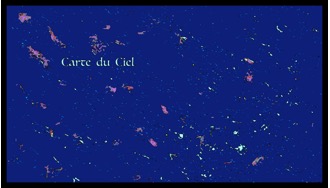
    Amédée Mouchez — launched an ambitious international star-mapping project (Carte du Ciel) in 1887 at the Paris Observatory.

    Henrietta Swan Leavitt — worked at the Harvard College Observatory as a “computer,” examining thousands of photographic plates from telescopes to measure and catalog the brightness of stars, identified 1777 variable stars.

    Lawrence Herbert — invented the Pantone system in 1956 to systematize color for printing ink and fabrics.

    Allen Forte — published an article in 1964 that launched musical set theory, defining, classifying and comparing all possible collections of “pitch classes” drawn from the equal-tempered 12-tone chromatic galaxy.

    The work and insights of the two on the list representing rigorous study of music, Fux and Forte, were part of my formal education in music and later an integral part of my teaching of composition and music theory.

    Maps

    Carte du Ciel was an ambitious second phase of an international star-mapping project initiated in 1887 by Paris Observatory director Amédée Mouchez.  A new photographic process revolutionizing the gathering of telescope images inspired the first phase, the Astrographic Catalogue of a dense, whole-sky array of star positions. Carte du Ciel, never completed after 70 years, used the Catalogue as a reference system for a complex survey of the vast field of even fainter images.

    Celebrating the grand metaphor relating astronomy to art music, here is my 8-minute computer-music sound sculpture. In the music, ghostly wisps of sound are punctuated by brighter bursts, clustered in a natural, not-quite randomly dispersed texture.

    _______________

    Looking ahead

    The blog-post chapters of Mapping the Music Universe will proceed in three broad phases, progressing logically from fundamental — time and periodicity — to pitch space, then to larger structures, texture and form. Within each phase, various topics are presented in a progressive order, but jumping in at any point is fine.

    Terms will sometimes be freshly coined. Graphic figures will include notated musical examples, tables, and graphic illustrations of patterns and their relationships. Big Ideas — Periodicity, Complexity, Symmetry, Relativity — will be explored using precise mathematical arrays as well as broad metaphors. Newly composed sample etudes will illustrate aurally.

    Along the way, “Map Labs” will present step-by-step recipes to compose simple pieces based on models of different compositional genres. Each Lab includes an original sample piece following the Map Lab guidelines, illustrating one possible creative outcome.

    Welcome! Join this creative journey of discovery . . .

    a composer’s expedition.

  • journal 9. Mapping

    Leelanau, 1983 —

    My last summer working at what was then called the National Music Camp in Interlochen, Michigan was 1983. We spent as much time off as possible on the nearby shore of Lake Michigan. Three spots on the western edge of the Leelanau peninsula were favorite magical places. Otter Creek played out into a sandy delta at the beach, perfect for a picnic. Good Harbor Bay was an excellent shore for finding gray Petoskey stones, revealing fascinating hexagonal-shaped fossils when wet. Farther north, the Great Sleeping Bear Sand Dunes rise majestically hundreds of feet above the water’s edge.

    Béla Viktor János Bartók’s monumental 1937 work, Music for Strings, Percussion and Celeste, begins with a mysterious, meandering line played by subdued violas. It sounds to me like walking at the water’s curving edge on a fog-shrouded beach. The line becomes the subject of a gigantic fugue, building to a powerful climax. In my imagination, we reach the sheer cliff of a massive bluff at the end of a Lake Michigan bay.

    Music for Strings, Percussion and Celeste

    Chicago Symphony

    LISTEN > YouTube

    Shores

    Of course, Bartók never saw Lake Michigan. But shorelines are a fascinating kind of fractal patterns in nature.

    In 1980, Larry Austin received a commission from the Canadian Broadcasting System and KPFA for an experimental radiophonic work. For the premiere broadcast, the performers were in three different Canadian cities, synchronized by electronic signals! The mind-boggling result was a piece consisting of

    “a massively contrapuntal texture, with many instruments playing continuous, independent lines, all in different, independent tempos. The contours of each contrapuntal part were determined using maps of Canadian coastlines.”

    [Clark — Larry Austin: Life and Works of an Experimental composer. Borik Press, 2012, p. 40]

    I.C.M.C. 1981, Denton Texas

    LISTEN › YouTube

    Glacially-etched shorelines also inspired sonic imagery for a series of my pieces culminating in PENINSULA. Mappings of the natural contours of the Leelanau Peninsula provided richly varied patterns as basic coordinate numbers for sculpting sound patterns. The piano explores some of the endless possibilities for articulating a spectrum of sonorities. A surrounding environment of synthetic sounds was made by digitally analyzing timbral qualities of acoustic instruments, mostly with percussive articulations (metaphorically the rocky shore). The timbres were modified and resynthesized into a pointillistic sound texture. The density of the sound events rises and falls in waves according to changing values derived from the basic mappings. Larger confluences of waves are located in time by map points of special significance on the graph.

    The coexistence of piano sonorities and synthetic sounds is a metaphorical meeting of seascape and landscape, both animated in time.

    PENINSULA

    Clark 1984 (TC-50) Borik Press

    Clifton Matthews, piano, Winston-Salem NC, Feb. 2007

    There were many other groundbreaking pieces by my late friend and collaborator, Larry Austin. The first, Improvisations for Orchestra and Jazz Soloists, brought him to national prominence in 1964 with highly publicized broadcast performances by Bernstein and the New York Philharmonic.

    As Austin moved into computer music, he began exploring compositional algorithms using mathematical models such as fractals.

    Some of Charles Ives’ sketches for his monumental, never completed Universe Symphony were tracings of the outlines of rock formations. Austin studied deeply this Ives work starting in 1974 and eventually completed a version of Universe Symphony for expanded orchestras in 1993. In Austin’s own work beginning in 1976, mapping contours of mountain ridges and star constellations yielded musical patterns for First Fantasy on Ives’ Universe Symphony, Maroon Bells, and *Stars.

    Constellations

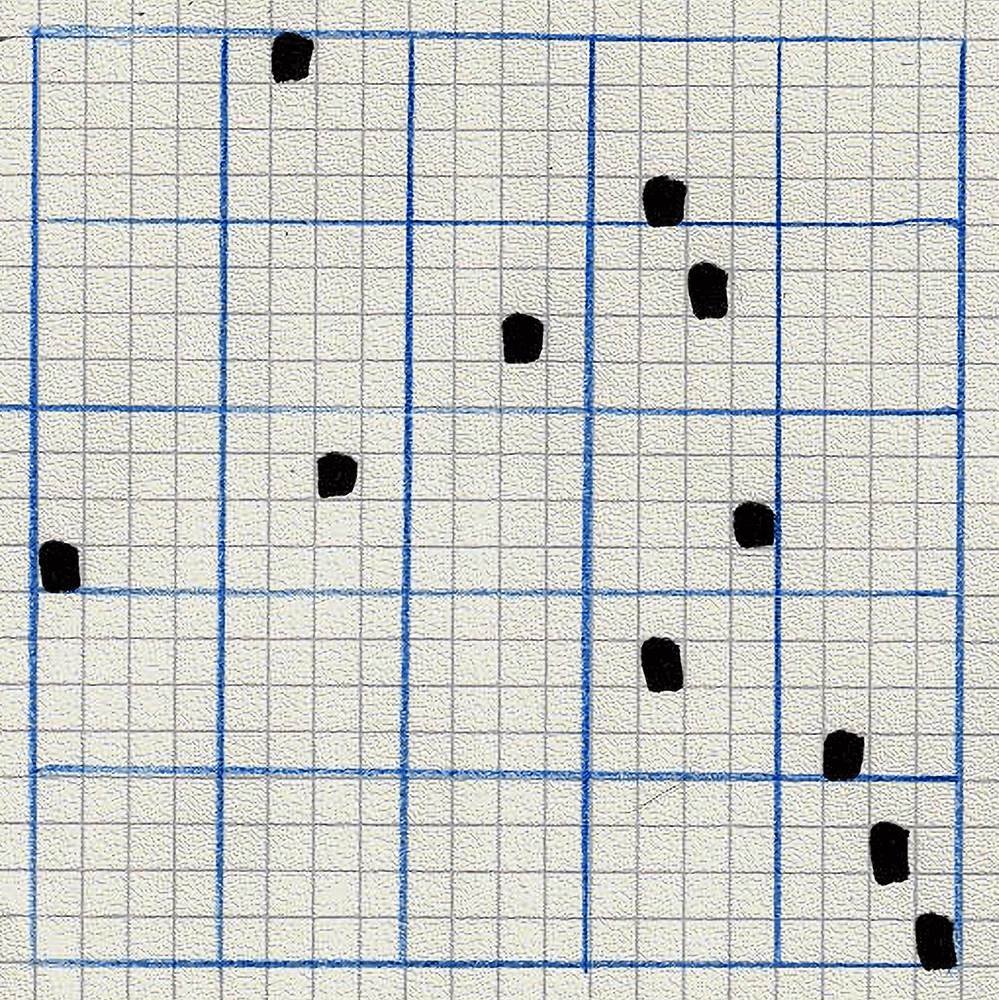
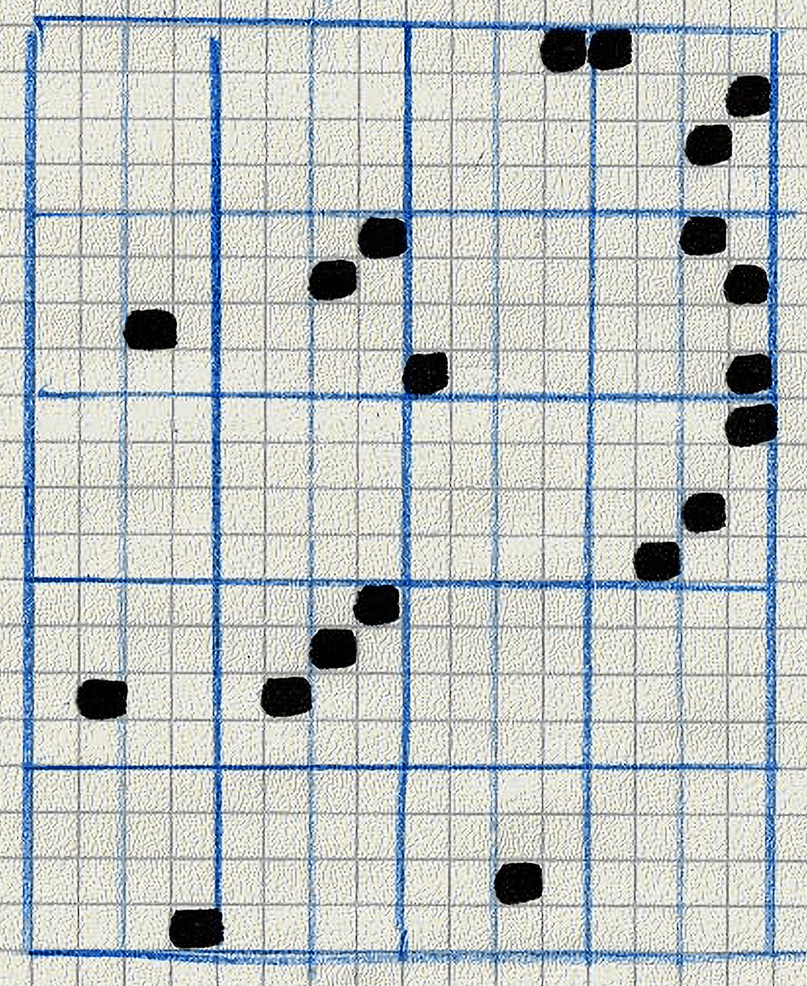
    Always interested in astronomy, I tried plotting star constellations on two-dimensional matrix graphs. The coordinates of each star in a constellation could be interpreted as time-point and pitch information, resulting in a complex arpeggiated group of notes. More intriguing was the capability to rotate the map, resulting in many possible variants that stretch or compress the rhythm and chord structure.

    Cygnus
    Cygnus rotated 90º
    Orion
    Orion rotated 90º

    The first compositional product of this design work, LIGHTFORMS 1 – Constellations (TC-65), scored for piano, was published by Borik Press in 1992. Naming these patterns, pitch-time chord arpeggios, as constellations became a breakthrough concept

    In my book, Mapping the Music Universe, I cite a remarkable pioneer of cartography. “William Smith, a rural surveyor, in 1799 drew a colorful map of the subterranean rock strata of his county in English coal country, launching the modern science of geology.”  The map was extraordinary not only as a scientific breakthrough, but also visually by his hand coloring each huge copy.

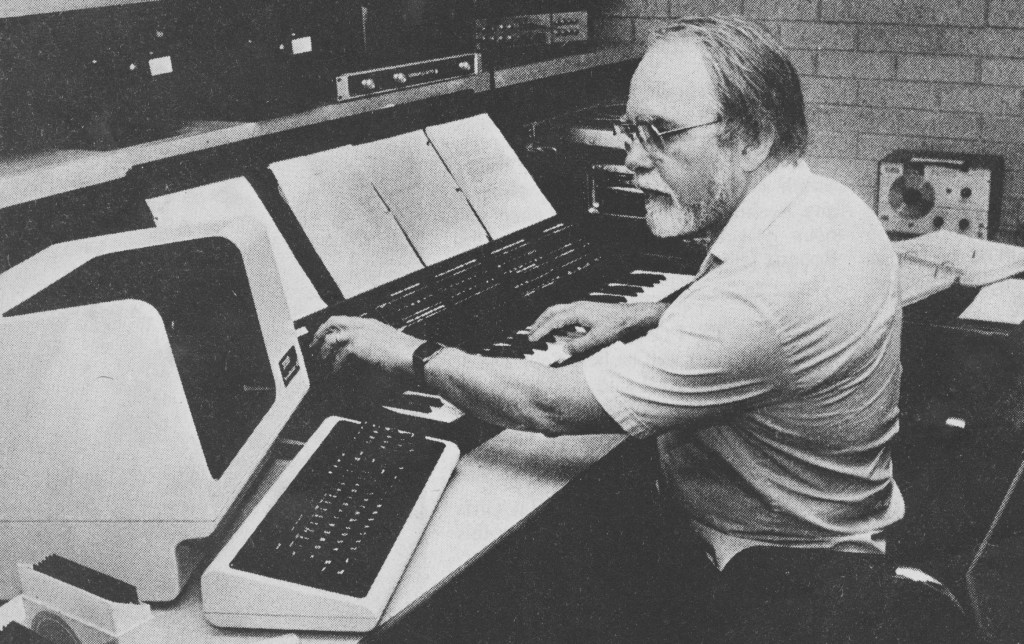
    As digital synthesizers came along, sound making with computers offered more calculated control of the timbral (tone color) spectrum. My astronomical metaphor continued with a 1993 piece, using the then state-of-the-art Synclavier II digital synthesizer to “color” the constellation patterns of LIGHTFORMS 1. Reflecting the varied colors of stars, I built color families of sound, distinguishing unique frequency-modulation ratios for each group.

    LIGHTFORMS 2: StarSpectra

    Clark 1993 (TC-68)

    In 1887, French astronomer Amédée Mouchez launched an ambitious international star-mapping project (Carte du Ciel) at the Paris Observatory. It was never finished, until now the challenge has been taken up by the new Vera C. Rubin Observatory (formerly the Large Synoptic Survey Telescope) in Chile. It is conducting the Legacy Survey of Space and Time, repeated astronomical surveys of the entire southern sky.

    From wandering forest paths to trekking scenic shorelines, my life has always been full of ambient exploration. Mapping has become my grand metaphor for exploring musical territory, culminating in the book, Mapping the Music Universe. It begins:

    “The heavenly motions are nothing
    but a continuous song for several voices,
    perceived not by the ear but by the intellect,
    a figured music that sets landmarks
    in the immeasurable flow of time.”

    — Galileo Galilei

    “When we gaze at stars and planets, they appear as stationary points of light, fixed in place in what seems a random pattern across the entire night sky visible to our hemisphere. Time stands still.

    “Throughout human time, humans have imagined that stars make picture patterns we name as constellations: fish, warriors, goddesses, animals. Only the persistent observers, such as astronomers, identify their nightly march across the sky, rising in the east and disappearing below the western horizon.”

    In Mapping the Music Universe, a studied journey through musical time, pitch, and structure, many composed examples took on characters of named constellations, galaxies, and galaxy clusters. They coalesced into 12 etudes, collected here as “a continuous song.”

    Clark 2021 (TC-114)

    Listen, imagining a 24-hour 360º rotation of our earthbound telescope, viewing the entire cosmos in 24 minutes.

    _____________