“To understand the Universe,
you must understand the language in which it’s written,
the language of Mathematics.”
— Stephen Hawking
Galileo revolutionized astronomy, in part by using a new tool: the telescope.
Schoenberg revolutionized harmony by evolving an existing concept, the chromatic scale, into a new tool: the 12-tone scale, and devised a new compositional tool of the 12-tone row.
Allen Forte took Schoenberg’s ideas to another level of abstraction: defining Pitch Class and applying basic math to the 12-tone universe.
Chrisman focused on the interval essence of pitch patterns: defining the “successive interval array.”
I am merely another explorer using their maps but choosing my own creative path. In doing so, I will define some of my own terms, while adapting and clarifying some established terms that fit what I’m thinking and expressing.
From Tuning to Tonality
We think of traditional common-practice Tonality of the 17th through 19th centuries being synonymous with the major and minor scales. But there’s more to traditional common-practice Tonality than just the scale. Here are the four basic factors that determine any tonal design:
| SOURCE SCALE | HARMONIC TYPE | TONAL CENTER |
| ancient mode | perfect intervals | fixed by mode |
| Major / minor | triad | modulatory shifting |
| extended chromatic | extended triad | polytonal centers |
| exotic / synthetic | non-triad | established contextually |
| 12-tone | diverse | none |
tonal design factors
As you can see, there is much to explore: scales, modes, intervals, consonance . . .
Tuning
Taking the overtone series and partial vibrations as a natural acoustical model, Pythagoras identified pitch intervals as simple integer ratios of lengths of a vibrating string. The same ratios describe frequency ratios.
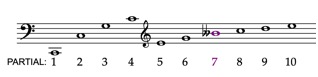
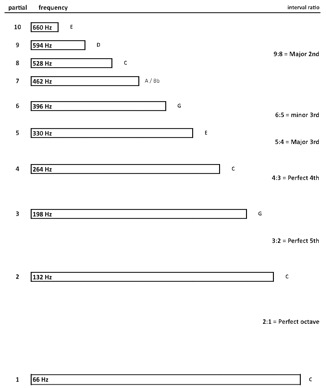
fundamental pitch C and overtones
For example, what we call a Perfect Fifth, the interval of the Third Partial to the Second Partial of a natural overtone series, is a 3:2 ratio. Such natural tuning is always employed by orchestras, bands, and a cappella choirs.
- Octave = 2:1
- Perfect 5th = 3:2
- Perfect 4th = 4:3
- Major 3rd = 5:4
- Minor 3rd = 6:5
- Major 6th = 5:3
- Minor 6th = 8:5
- Major 2nd = 9:8
This approach requires, however, that intonation be constantly adjusted as the key changes or tonal context shifts. For a keyboard that can’t make those adjustments, the fixed tuning devised in the 18th century, called Equal Temperament, compromises the Perfect Fifth, shrinking it from a 1.5 ratio to 1.498307 so that it and all other intervals are very slightly but equally mis-tuned in every possible key or tonal context. The ratio for a semitone is derived mathematically from the 12th root of 2: 1.059643094. That ratio, multiplied by itself 12 times, results in 2.000, the ratio of the octave.
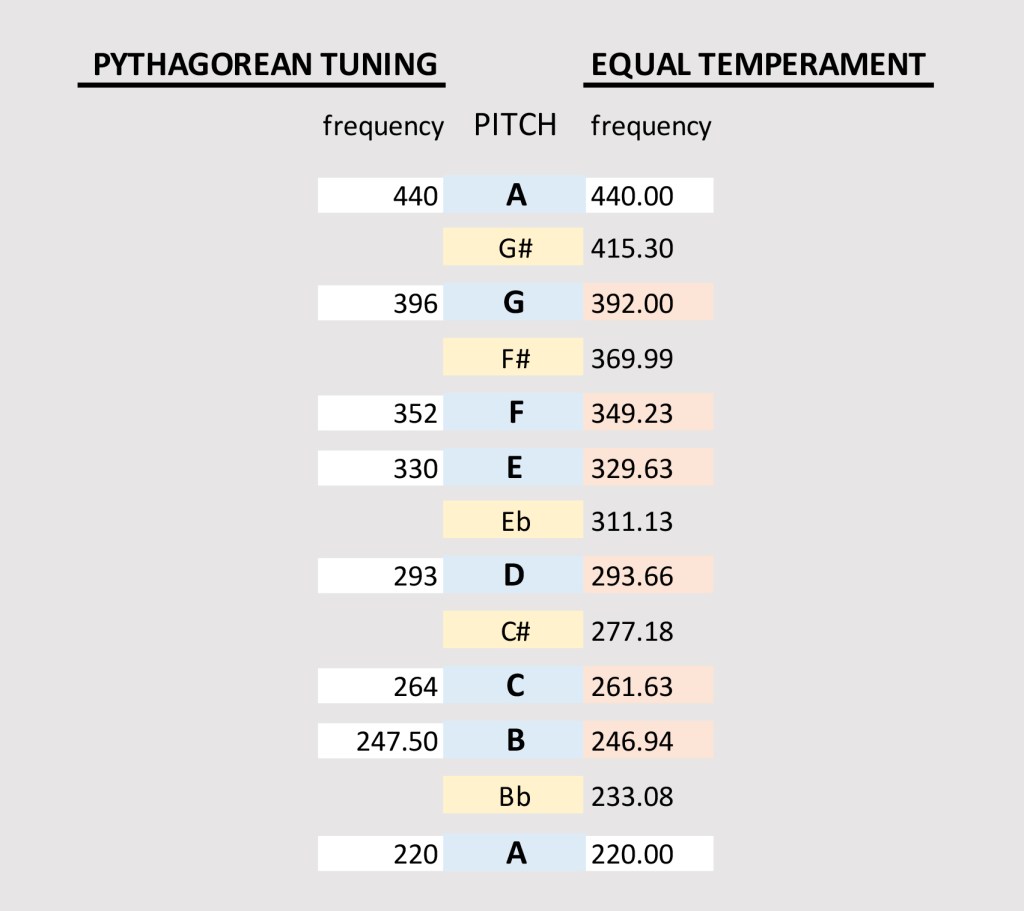
comparing tuning systems
While “chromatic” historically meant extending a key with accidentals — temporary extra sharps or flats — now we refer to the 12-half-step scale as the chromatic scale. Two pitch names for the same piano key — C-sharp or D-flat — are said to be enharmonic and considered equivalent, almost interchangeable.
Equal Temperament became the basis for the 20th-century system of 12 equal semitones per octave, the basis not only for all keyboard instruments but also for harmonic theory in the post-tonal world of 12-tone music. We should not forget, however, that choirs, orchestras and bands still use the purer natural tuning, even with music that has no key signature.
Other tuning systems
Long before equal temperament, the Chinese culture developed several systems. A fascinating history is described in Gene Jinsiong Cho’s monograph, LU-LU: A study of Its Historical, Acoustical and Symbolic Signification (Caves Books, Ltd., Taipei, 1989). Cho (a music theory professor colleague at the University of North Texas) explains the LU system from the Chin Dynasty, which extended beyond 12 increments in an octave as far as to the arcane realm of Jing fang’s sixty LU series.
In the West and into the 20th century, two American composers experimented with microtonal tunings splitting the octave into finer increments than our 12 semitones.
Working with American Lou Harrison, California composer Harry Partch (1901-1974) devised his own tuning system with 43 increments, described in Genesis of a Music (1947). The system necessitated invention of specialized percussion and string instruments to precisely intone the sounds, which felt exotic both in tuning and sound quality.
Harry Partch – Castor & Pollux (1952)
University of Illinois professor Ben Johnston (1926-2019) wrote music for standard orchestral string instruments using the ancient just intonations of Pythagorus. This involved specifying pitches microtonally slightly higher or lower than the equal-tempered standard pitch classes – a notational challenge of pitch-adjustment symbols.
Ben Johnston – String Quartet No. 7 (1984)
In the 21st century, Japanese composer norokusi has produced a broad catalog of microtonal music, apparently using a 17-increment division of the octave.
norokusi – Piano Sonata n.718 (2018) 17EDO/TET
Such complex systems as described above never became mainstream. The vast bulk of 20th-century and now 21st-century music is based on the equal-tempered 12-increment system found on a well-tuned piano, with subtle adjustments by orchestral strings, wind bands and a cappella choirs to momentarily purify some sonorities.

© 2026 – All Rights Reserved
Thomas S. Clark
–
Continue reading Mapping the Music Universe:
–
_____________
 MAPPING MUSIC