Think about levels of structure scientists study in our universe.
They dive deep into atomic structure, below electrons spinning around a nucleus of protons and neutrons, discovering subatomic particles like the meson and boson. At the other extreme, they gather observations to speculate about the shape of the entire expanding universe. We understand the structure of our planet, of our solar system, and our Milky Way galaxy.
“We are slowed down sound and light waves,
a walking bundle of frequencies tuned into the cosmos.”
— Albert Einstein
Think about how artists build structures that establish a style . . .
Painting engages techniques to create texture, rising to broad descriptions of style that actually describe structure: impressionism, cubism, pointillism. Musically, macro-structure is thought of as texture and form. Texture has been treated in broad descriptive categories: monody, homophony, polyphony, counterpoint, and more recently, sound mass, each focusing on the number of distinct parts, voices, or layers and how they interrelate.
Structure and Relativity
Shrinking our metaphor from the vastness of the universe down to the physical immediacy of cloth . . .
A woven fabric has a longitudinal warp and a perpendicular crossing weft. Part II explored the vertical-pitch “weft” of harmonic design. Now we return to the “warp” in music, longitudinal time streams of events. In keeping with our standard conception of time as horizontal and pitch as vertical, let’s name each longitudinal “warp” element:
LINE — an element of a musical fabric consisting of a conforming stream in time of similar events (notes, pitches, colors, drum sounds, etc.)
Now we can go back to “monody, homophony, polyphony” and at least identify how many lines are in a musical fabric, from one (monody) to many (polyphony). But to distinguish between homophony with its matching, rhythmically aligned lines from polyphony with its more diverse set of lines of different nature, we must distinguish different types of lines to determine the extent to which the lines of a polyphonic fabric “match.”
There are limitless number of combinations of characters for a line and thus an infinite number of fabrics possible. We will stick to six parameters and simple observational characterizations for each parameter. Since we are swimming in the painting and weaving metaphors, we will color-code these six parameters. Each parameter will be distinguished with just two binary descriptors, a simpler or purer character or a more intense or complex character in that parameter.

distinguishing parameters
Since there are 7 parameters and two possible descriptors for each parameter, the total number of permutations is 2 to the 7th power = 128 possible combinations. That means, however, if there are two lines in the fabric, the number of possible combinations rises to 16,384 — plenty of choice for creative composing. And with 4 lines, the number of possible combinations explodes to more than 268 billion!
More simply, with these defined characteristics we can redefine “homophony” to mean more than one line that match characteristics, and typically are in rhythmic alignment (synchronized). Indeed, most musical fabrics involve quite a bit of similarity between multiple lines. In a typical traditional “melody-and-accompaniment” fabric, there are only three distinct lines, melody, bass line, and chords, even if the chords are actually in two or more matching instrumental or vocal parts.
The following example is taken from the Allegretto movement of Beethoven’s String Quartet Op. 135.
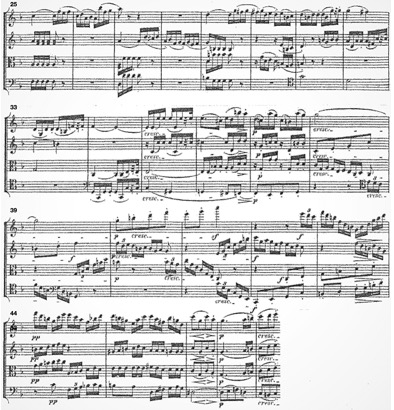
String Quartet Op. 135 Allegretto, mm. 25-48
In the first two bars of this example from Op. 135, there are actually only two lines in the fabric, the melody (1st violin) and repeated chord tones (the other three instruments aligned in 16th-notes) — common homophony.

Op. 135 violin vs. other lines
Though there is no dynamic marking for the 1st violin, it will be played as a prominent line, what Schoenberg would have called the Hauptstimme. By the third bar of the second system (11th bar of the example), there are three lines, violins / viola / cello, and by the next bar, briefly, all four instruments have distinct fabric threads. By the end of the excerpt, all parts have joined in homophonic unity.
Melodic shape
Melodic connotes a singable tune of primary focus; here it is meant simply as any line of successive single pitches. In the general descriptors of texture, we referred to smooth and angular shape. Let’s be more precise. First, there is the general size of melodic intervals. As music practice moved from Medieval/Renaissance through 18th-Century styles, smaller intervals, steps and small skips predominated. 19th-Century styles introduced a greater proportion of larger “leaping” intervals, 6ths, 7ths, 9ths. And those large, disjunct intervals became the norm for much 20th-Cenury music.
Another important melodic shape factor is directional.
TURN — a melodic note is approached in one direction (up or down) and left in the opposite direction
Some turns are trivial and do not complicate melodic shape, such as trills and back-and-forth oscillations.

turns in Elegy line
The first phrase, starting on Eb, goes up to E then down to D — turning on the middle note, E. The next two phrases are increasingly complex in shape.
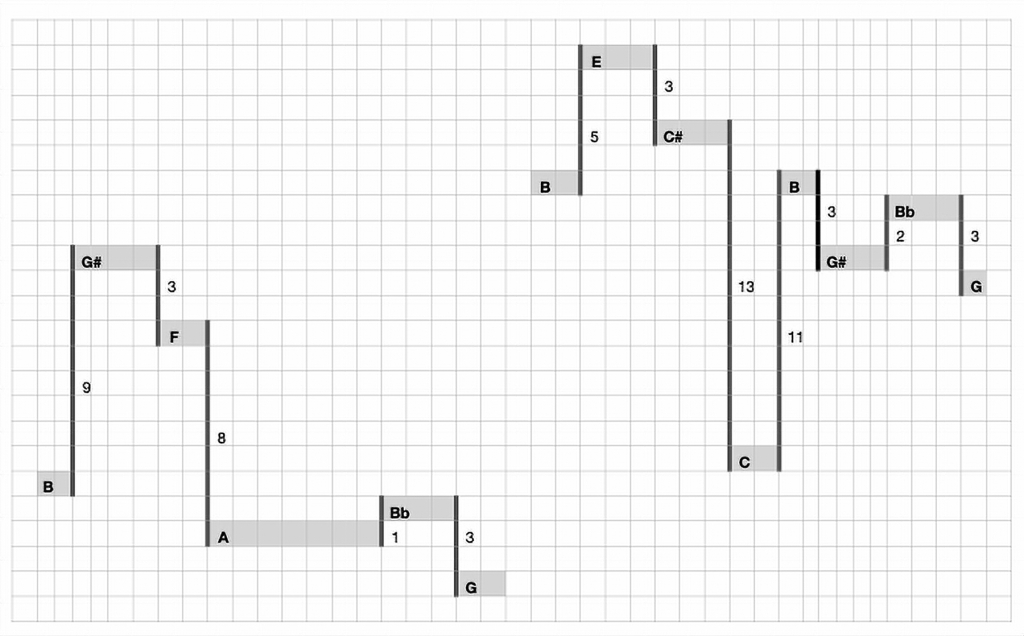
Elegy 2nd and 3rd phrases
The phrase starting on the lower B rises to G# then turns down on that G# to A, then back up from A, and finally back down, turning on Bb. There are three turning points, G#, A, and Bb, in a phrase of only six pitches and five melodic intervals. Combined with the fact that each melodic interval is a different size (9 s.t., 3, 8, 1, 3) except the last (reusing the downward 3 semitone interval), this is a rather complex, angular shape.
The third phrase, starting on the higher B, is even more complex in angular shape: turns on every pitch except the C# — that is five turns in just 7 melodic intervals between 8 pitches.
A side note of analytic math:
- Number of pitches (#P) minus 1 = number of melodic intervals
- Number of melodic intervals minus 1 = number of “opportunities” for the line to turn (#P – 2)
- Shape complexity = #T / (#P – 2) ranging from zero to 1
Pitch recurrence
RETRACING — melodic line returning within a phrase to the same pitch (in the same octave) as previously sounded in the phrase
Distinguished from a pitch being repeated (immediately), a retracing is a recurrence after other intervening pitches. It contributes to structural stability in the phase, a sense of staying in one place. Conversely, when retracings are avoided in the shape of the line, the sense is more of progressing, even of wandering, as in the Elegy example above. (Use of a 12-tone row to construct a line is a way to methodically avoid retracing any pitch until all 12 pitch classes have been introduced.)
Back to Bartók — two orchestral lines studied in the Pitch chapter. The first example (from the opening fugue of Music for Strings, Percussion and Celeste) is scored for viola, but here I show it in bass clef for those a bit challenged by alto clef.

fugue subject

Mapping the line on a time/pitch graph for analysis, the first phrase avoids any retracing. The next three phrases make only one retracing each: back to Bb in the second phrase (highlighted in blue); back to C# in the third (in red); retracing back to C in the fourth (in green). (There are fainter retracings back to the previous phrase in each not shown.)
The second is a low string line from the opening of Concerto for Orchestra.

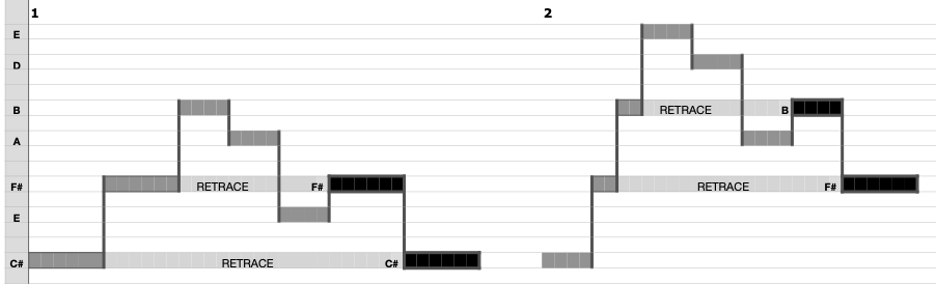
Concerto for Orchestra retracings
In this example, both phrases are built with two retracings, C# and F# in the first phrase, F# and B in the second phrase.
In this manner, retracing of pitches builds the support structure for the architecture of many lines.
–

© 2026 – All Rights Reserved
Thomas S. Clark
–
Continue reading Mapping the Music Universe:
___________

