Tag: Interlochen

  • journal 16. Thermal Energy

    San Marcos, 2012 —

    Pondering the physics of molecular heat energy applied metaphorically to music . . .

    Lower to higher energy of musical masses comes from four factors: Tempo — standing stillness to frenetic pace; Rhythm — regular pulse to unpredictably varied; Textural rhythmic alignment — synchronous to random; Loudness — hushed to explosive.

    Starting with low-energy, low-temperature continuous cool sound, listen to a favorite piece by my late colleague, co-author and friend, Larry Austin. His 1982 score for double bass quartet is“dedicated to my friend and mentor, John Cage, in his seventieth year”. I describe it in my book:

    “The harmonies sounded by ambient counterpoint will all consist of only the pitch classes C, A, G, and E, created by scordatura open strings and harmonics. And the open-ended improvisational nature of the work, expressed by an artistically drawn matrix score, is an obvious and elegant homage to Cage’s deep interest in chance and open form.”

    Thomas Clark —

    Larry Austin: Life and Works of an Experimental Composer

    (Borik Press, 2012)

    In gentle sustained tones, the texture moves continuously through a matrix of sound projecting a subtly changing but almost steady-state sonority. Very low temperature music . . .

    LISTEN ›

    Water sounds

    The many bodies of water figuring prominantly in my life include:

    • Shiawassee (rural Michigan)
    • Huron (Ann Arbor)
    • Lake Michigan (Leelanau)
    • Puget Sound (Seattle)
    • Lake Spanaway (Tacoma)
    • Lake Texoma (Texas)
    • Vltava (the Moldau, Prague)
    • Green Lake and Duck Lake (Interlochen)
    • Lake Ray Roberts (Texas)
    • Albamarle Sound (Outer Banks)
    • Salem Lake (Winston-Salem)
    • Gulf of Mexico (Port Aransas)
    • San Marcos River (San Marcos)

    Inspired by the great serenades for strings of Dvořák and Tchaikovsky, my string serenade explores musical metaphors for the physics of water in interesting atmospheric and geographic settings.

    Three States of Water

    Clark 2021, TC-107

    I. Cold front (VAPOR becomes SOLID)

    In low clouds on mountain tops, water vapor can become super-cooled and become freezing fog, filling the air with small ice crystals and freezing to surfaces, similar to very light snow. In the western United States, the common name for freezing fog is “pogonip.”

    II. Ice Dunes (SOLID)

    In the Leelanau Peninsula of Michigan, the Lake Michigan surf sometimes whips up and freezes in mid-air, forming weird ice caverns and ice dunes.

    III. Nuages (VAPOR)
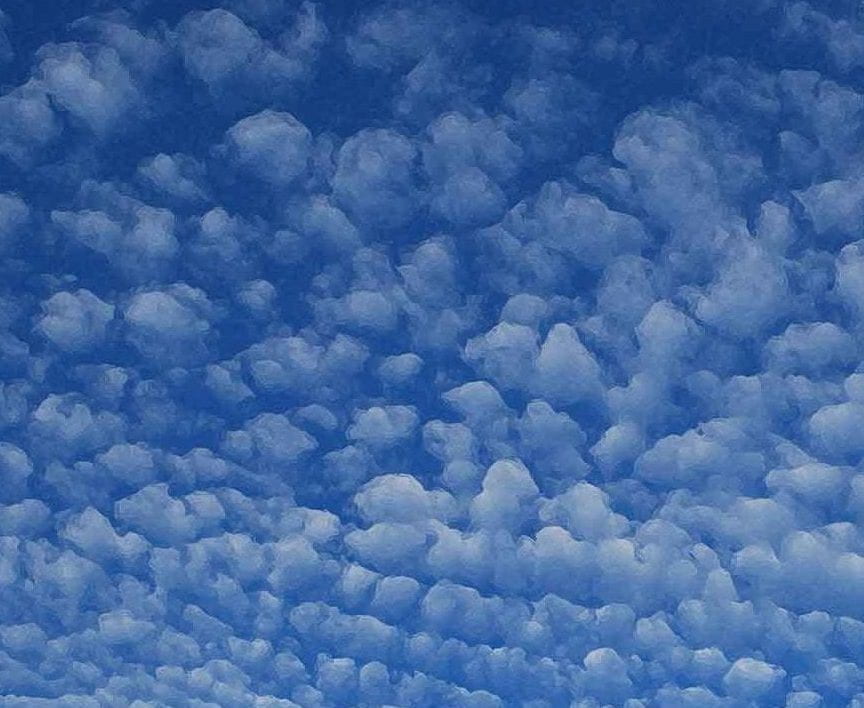
    French for clouds, Nuages is one of Debussy’s three beautiful Nocturnes for orchestra, quoted here as a theme for variations. Water vapor is technically invisible. The clouds we see are actually masses of minute liquid droplets and frozen crystals. Thus this movement embodies all three states of water.

    IV. Vltava (LIQUID)

    The great river Vltava flows majestically through Prague. Smetana’s depiction of it in his monumental Ma Vlast is usually translated as The Moldau.

    Quarks

    The aggressive rhythmic character of the opening part of Joseph Schwantner’s 1980 piece is an opposite to the serenity of Austin’s art is self alteration is cage is . . . Boiling heat:

    LISTEN ›

    U.Mich. Symphony Band

    Modern physics understands that all matter is built up from just five fundamental “particles”: electrons, up quarks and down quarks with electrical charge; and gluons and photons with no electrical charge. They are not exactly particles, though, but infinitesimal points of spin in space/time.

    That’s where the next sound composition experiment began. Two 4-pitch segments of the octatonic scale appear (“quarks”), then spin at their own speeds, while smaller 3-pitch sets (“electrons”) spin above and below them. At times, the sound mass explodes with a shower of electron sparks, then reforms.

    More clouds! We had Nebula, clouds of gas and dust in space, then Nuages, puffy white clouds in a blue sky. Now storm clouds . . .

    Meteorology

    Clark 2022 (TC-121)

    Nimbus
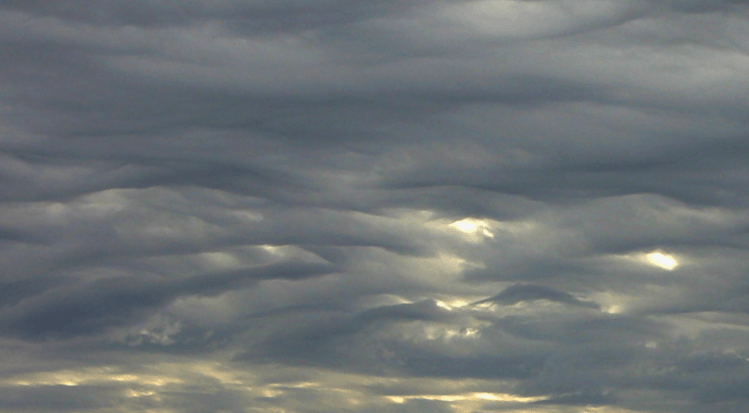
    While quarks are hard to imagine and impossible to visualize, we love to watch puffy white cumulus clouds. Their kinetic energy becomes more visible when they grow into dark, precipitation-bearing cumulonimbus storm clouds, bringing rain and crackling electricity.

    Squall

    A tree limb branching out from a trunk, then smaller limbs branching from it, again and again to smaller and smaller branches — a classic example of a recursive process. Sometimes lightning shows this same recursive branching process. While the tree branches take years to fill out, lightning is a sudden explosion of electricity over a split second. Thunder, as sound travels much slower than light, is heard later than the lightning flash is seen — unless, of course, it is very close by!

    ______________

  • journal 2. Musique Française

    Ann Arbor, 1968 —

    Having begun composing in 1963, I started formal composition study in 1968 at the University of Michigan in Ann Arbor. American composer Eugene Kurtz, based in Paris but filling in that semester at Michigan, was assigned to teach the new freshman. A proponent of modern French music, his compositional models included Debussy and Ravel.

    Sonatine

    Kurtz assigned me to immerse myself in deep study of their music, in particular Ravel’s Sonatine (1905).

    Ravel: Sonatine

    Judith Valerie Engel on YouTube

    Fifty years later in my career as a more experimental composer, my compositional style began to mellow toward a gentler Impressionistic approach and a lush, bright harmonic language reminiscent of Debussy and Ravel.

    Homage to Ravel, my new Sonatine is spun from a single harmonic progression, seven chords each stacking a Perfect Fifth interval high above another.

    This material (what Schoenberg would call a Grundgestalt) generates melodic lines and many arpeggiation patterns, in successive variations of changing register, intensity, and rhythmic pace.

    Sonatine

    Clark 2025 (TC-155)

    Nocturnes

    In 1907, French composer Claude Debussy wrote, “I am more and more convinced that music, by its very nature, is something that cannot be cast into a traditional and fixed form. It is made up of colors and rhythms”. Color, light, and texture were also the hallmarks of a new style of painting developed by French artists — Impressionism.

    At the threshold of the 20th century on 15 December 1899, Debussy completed the first of his Impressionist masterpieces for orchestra, Trois Nocturnes. He avoided labeling it “symphony” or “tone poem” by calling the movements “three symphonic sketches”. The first sketch of Nocturnes is subtitled “Nuages,” premiered on 9 December 1900 in Paris.

    Debussy’s biography describes the genesis of the piece while crossing the Pont de la Concorde in Paris in stormy weather. The composer’s notes say, “‘Nuages’ renders the immutable aspect of the sky and the slow, solemn motion of the clouds, fading away in grey tones lightly tinged with white.”

    Debussy: Trois Nocturnes

    Vienna Philharmonic on Youtube

    Adopting the French language and musical style recognizes the early French explorers of the Great Lakes region of North America. The first decades of my life began there in Michigan’s Lower Peninsula (the “mitten”). It has its own smaller Leelanau Peninsula in the northwest corner (the mitten’s “little finger”) near Interlochen’s National Music Camp, where I spent many summers. Nearby Grand Traverse Bay has its own even smaller Old Mission peninsula, where I loved to visit its lighthouse. The Leelanau has a grand lighthouse at its northern tip and a scenic drive, state highway M21, winding for 64 miles all the way around the peninsula’s shoreline, through forests and past the Great Sleeping Bear Sand Dunes.

    In 1984 my piece titled PENINSULA for piano and sound synthesis was a more experimental work that traced a map of the Leelanau and its landmarks to determine by their spatial coordinates the timing and pitches of sound constellations.

    Moving forward from that mapping phase of my compositions, my Impressionistic phase produced the sound sculpture Leelanau Sketches in 2022. Some of its musical material reappears now in five symphonic sketches, Belle Péninsule. Here is the fourth movement, which quotes Debussy’s “Nuages.”

    Belle Péninsule

    IV. “Nuages blanc

    Clark 2024 (TC-147)

    La Mer

    Debussy’s completed his second composition of three symphonic sketches for orchestra, La Mer, in 1905. It is a monumental work of Impressionist sound-painted textures and a textbook model of lush, beautiful orchestration. The three sketches are titled:

    “De l’aube à midi sur la mer”

    “From dawn to midday on the sea”

    Jeux de vagues”

    “Play of the Waves”

    “Dialogue du vent et de la mer”

    “Dialogue of the wind and the sea”

    Debussy: La Mer

    Orchestre national de France

    My homage to La Mer, Sea Sketches, sound-paints waves, deep currents, wind, and sun-sparkling surfaces, employing swelling sound colors and post-modern cyclic techniques in a pan-diatonic tonal setting. The end briefly quotes the opening arpeggio of Debussy’s “La fille aux cheveux de lin” (“The Girl with the Flaxen Hair”) from Book I of his Préludes for piano (1909-1910).

    Sea Sketches

    Clark 2023 (TC-132)

    ________