Tag: John Cage

  • MapLab 6. Paint a Landscape

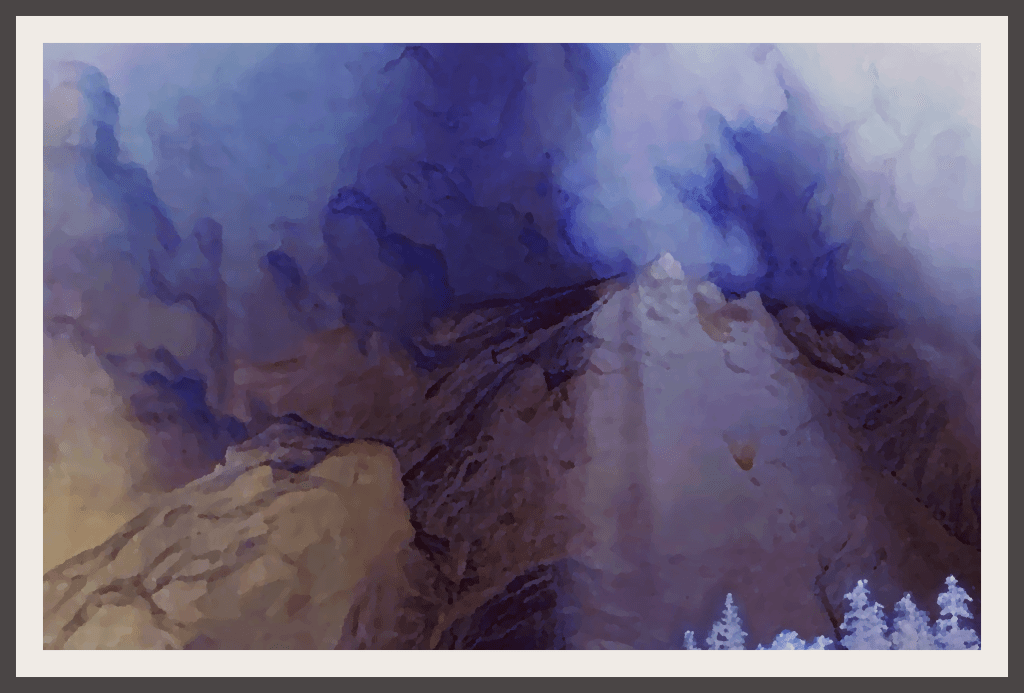
    Many 19th cen. American landscape artists painted fascinating panoramic scenes, including Albert Bierstadt, who captured the grandeur of Western, mountainous landscapes.

    Much mid-20th-cen. large ensemble music “painted” with sound masses, animated and evolving instead of harmonically progressing — notablyVariations for Orchestra” (Bassett),The Seventh Trumpet (Erb),Aftertones of Infinity (Schwantner). My “Animated Landscapes” (1973) for orchestra was titled echoing Cage’s“Imaginary Landscapes.”

    1. Establish a model

    Albert Bierstadt: Passing Storm over the Sierra Nevadas (1870) – San Antonio Museum of Art

    Choosing one of Bierstadt’s finest works, you can see stark contrasts in brightness and in sense of motion between the mirror-smooth water and roiling clouds. Even the word “passing” in the title suggests change, a necessary ingredient of an analog musical landscape.

    2. Build big constellations

    The fixed, stationary nature of a landscape painting suggests a static harmonic approach, projecting and prolonging one constellation as an underlying sonority for the whole musical “canvas.”

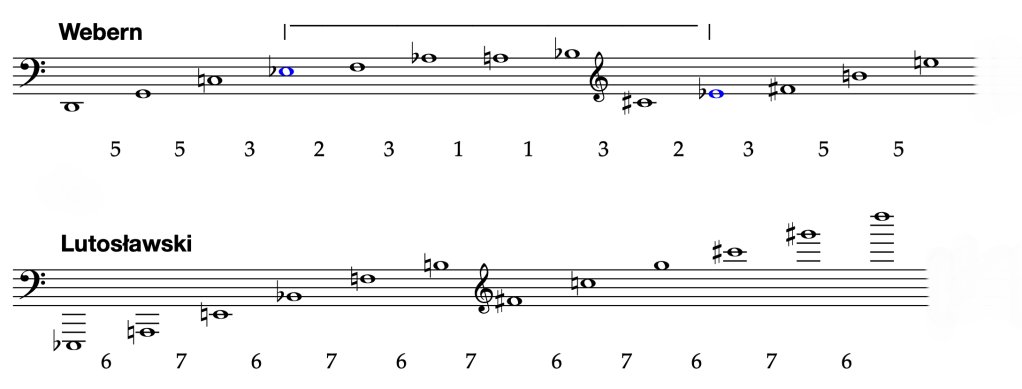
    Here are two examples of a 12-tone constellation. The first was used as the underlying sonority of the pointillistic first movement of Anton Webern’s Symphonie Op. 21 (1929). Note that to accomplish the palindromic symmetry of the interval array, Eb is placed in two different octaves, thus 13 pitches total.

    Another example of placing all 12 pitch classes in particular octaves is from Witold Lutosławski’s Jeux vénitiens (1961):
    TC example

    A large register-spanning constellation need not be 12-tone. Building a sonority of very different (less dissonant) quality, let’s start with just octave C’s and their fifths, G. Pitches a whole step away from these tonal pillars are added. The result is 13 pitches only from the F major scale. Then their complement, a big 8-pitch constellation of similar array, is built from the pentatonic scale of the flats, the other “black keys” .

    3. Animations

    Different basic techniques for animating in time a large constellation of pitches . . .

    Arpeggio – one note at a time in any order, is a kind of stacking.
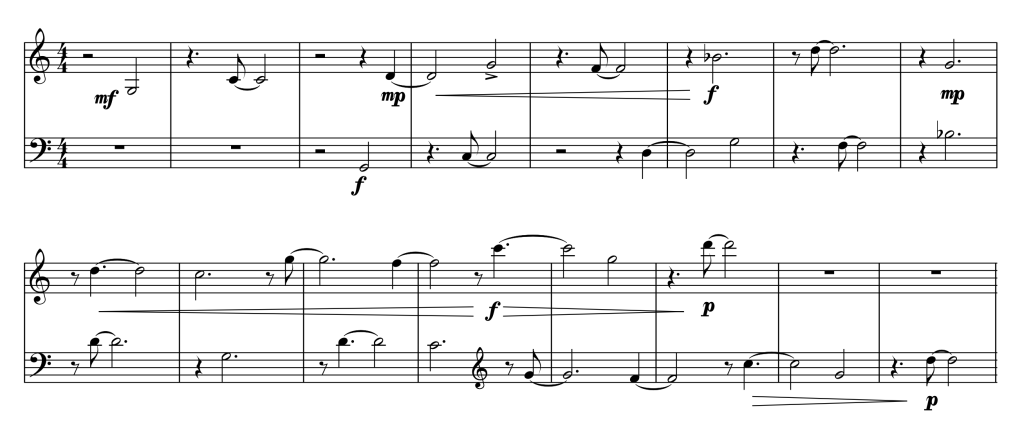
    Stacking – introduce sustained tones one or two at a time. The reverse, unstacking, works too.

    Swells – crescendo/diminuendo the whole sonority (think ocean waves in Debussy’s La Mer)
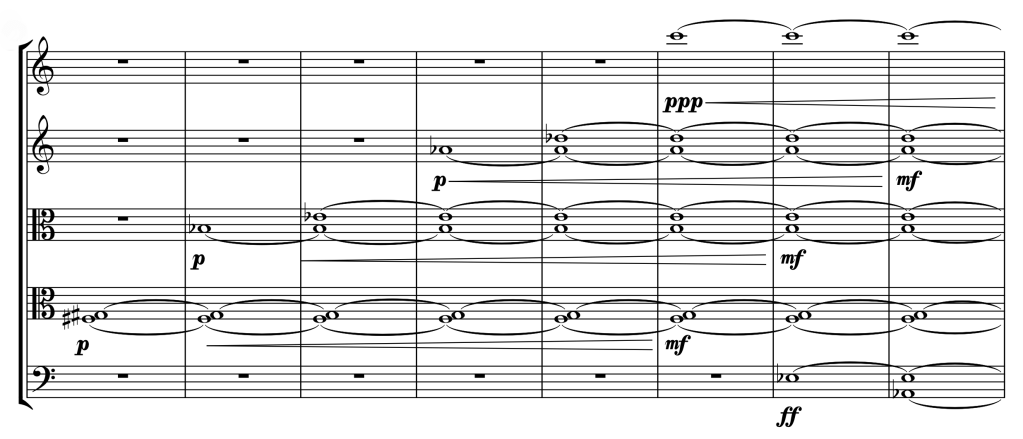
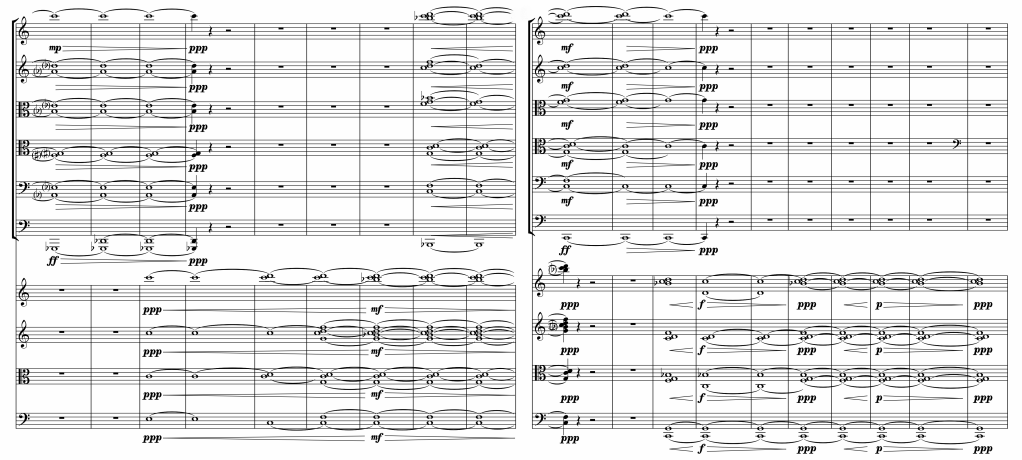
    Pointillism – a more complex texture of distinct sound points separated by registral and rhythmic spacing. Although they can be different sound colors, in this example they are all the same timbre:

    4. Develop a sound palette

    Larger ensembles can be good for musical landscapes, offering a varied palette of instrumental timbres. Like pigments, these sound colors group in hues: the

    • double reeds
    • other woodwinds
    • cylindrical brass (trumpet, trombone)
    • conical brass (horn, euphonium, tuba)
    • bowed strings
    • plucked strings (harp)
    • metal pitched percussion
    • wood percussion; drums; exotic gongs, etc.

    For synthesized sounds, beyond emulating these instrumental timbres, envelope and spectrum distinguish the sounds:

    • sharply accented or gradually emerging sound onset
    • bright metallic to dark hums
    • reverberation.

    For Passing Storm, I chose three “choirs” with distinct sound qualities:
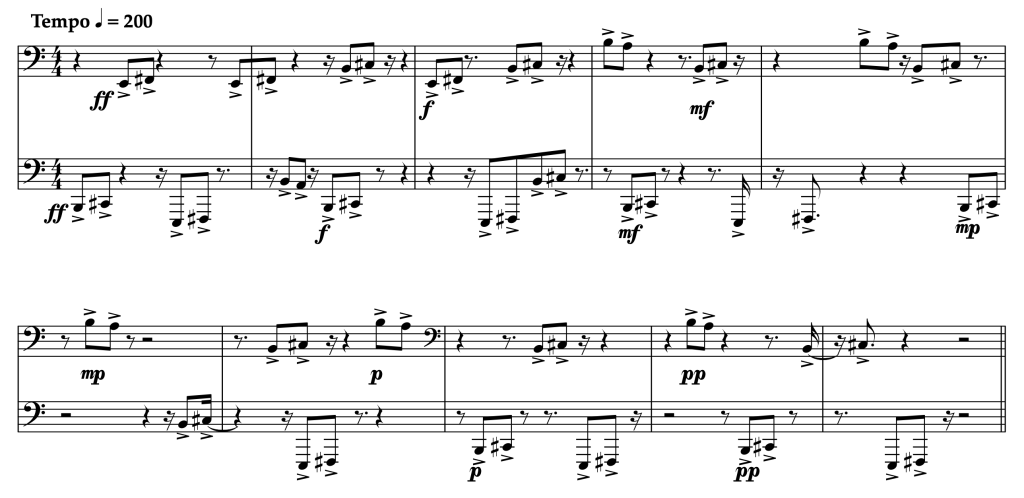
    • Clanging percussion and plucky harp
    • Gentler emerging-onset sounds (Sibelius Pad 2 – warm) functioning like woodwinds
    • Brighter sustained sounds (Sibelius FX4 – atmosphere) in the orchestral role of bowed strings

    5. Compose the whole canvas

    In painting, “composition” refers to the main parts of an image and how they are arranged with each other in two-dimensional and the illusion of three-dimensional space. For music, we might call this the macro form. As with most landscape paintings, the musical textures may overlap in continuous sound. There may be sectional divisions, analogous to strong demarcation lines like a horizon. The sense of broad, distant scale of view will be best captured with extended textures of expansive rhythm and even with reverberation.

    While not trying to actually map the physical composition of a painting, we can get musical inspiration from considering the painting’s features of background, foreground, and highlights of strong visual focus. My example was coming together starting with distant swelling sonorities, which as they crescendo feel like they are emerging forward toward us.

    After deciding to name the piece Passing Storm after the Bierstadt painting, however, I realized I had no storm in the music, just gentle sprinkles. Thus was created a stronger sonic rendering of the sprinkles to provide a more aggressive introduction. The proceeding four minutes overlaps sound masses exhibiting the various animations in time we explored earlier. Dark and light in a painting are portrayed by loud and soft, timeless sustained sound vs. busy points of sound.

    Animated Landscape No. 4: Passing Storm
    Continue reading Mapping the Music Universe . . .

    MapLab 7. Twelve-Tone Trichords in a Ternary Trio

  • journal 16. Thermal Energy

    San Marcos, 2012 —

    Pondering the physics of molecular heat energy applied metaphorically to music . . .

    Lower to higher energy of musical masses comes from four factors: Tempo — standing stillness to frenetic pace; Rhythm — regular pulse to unpredictably varied; Textural rhythmic alignment — synchronous to random; Loudness — hushed to explosive.

    Starting with low-energy, low-temperature continuous cool sound, listen to a favorite piece by my late colleague, co-author and friend, Larry Austin. His 1982 score for double bass quartet is“dedicated to my friend and mentor, John Cage, in his seventieth year”. I describe it in my book:

    “The harmonies sounded by ambient counterpoint will all consist of only the pitch classes C, A, G, and E, created by scordatura open strings and harmonics. And the open-ended improvisational nature of the work, expressed by an artistically drawn matrix score, is an obvious and elegant homage to Cage’s deep interest in chance and open form.”

    Thomas Clark —

    Larry Austin: Life and Works of an Experimental Composer

    (Borik Press, 2012)

    In gentle sustained tones, the texture moves continuously through a matrix of sound projecting a subtly changing but almost steady-state sonority. Very low temperature music . . .

    LISTEN ›

    Water sounds

    The many bodies of water figuring prominantly in my life include:

    • Shiawassee (rural Michigan)
    • Huron (Ann Arbor)
    • Lake Michigan (Leelanau)
    • Puget Sound (Seattle)
    • Lake Spanaway (Tacoma)
    • Lake Texoma (Texas)
    • Vltava (the Moldau, Prague)
    • Green Lake and Duck Lake (Interlochen)
    • Lake Ray Roberts (Texas)
    • Albamarle Sound (Outer Banks)
    • Salem Lake (Winston-Salem)
    • Gulf of Mexico (Port Aransas)
    • San Marcos River (San Marcos)

    Inspired by the great serenades for strings of Dvořák and Tchaikovsky, my string serenade explores musical metaphors for the physics of water in interesting atmospheric and geographic settings.

    Three States of Water

    Clark 2021, TC-107

    I. Cold front (VAPOR becomes SOLID)

    In low clouds on mountain tops, water vapor can become super-cooled and become freezing fog, filling the air with small ice crystals and freezing to surfaces, similar to very light snow. In the western United States, the common name for freezing fog is “pogonip.”

    II. Ice Dunes (SOLID)

    In the Leelanau Peninsula of Michigan, the Lake Michigan surf sometimes whips up and freezes in mid-air, forming weird ice caverns and ice dunes.

    III. Nuages (VAPOR)

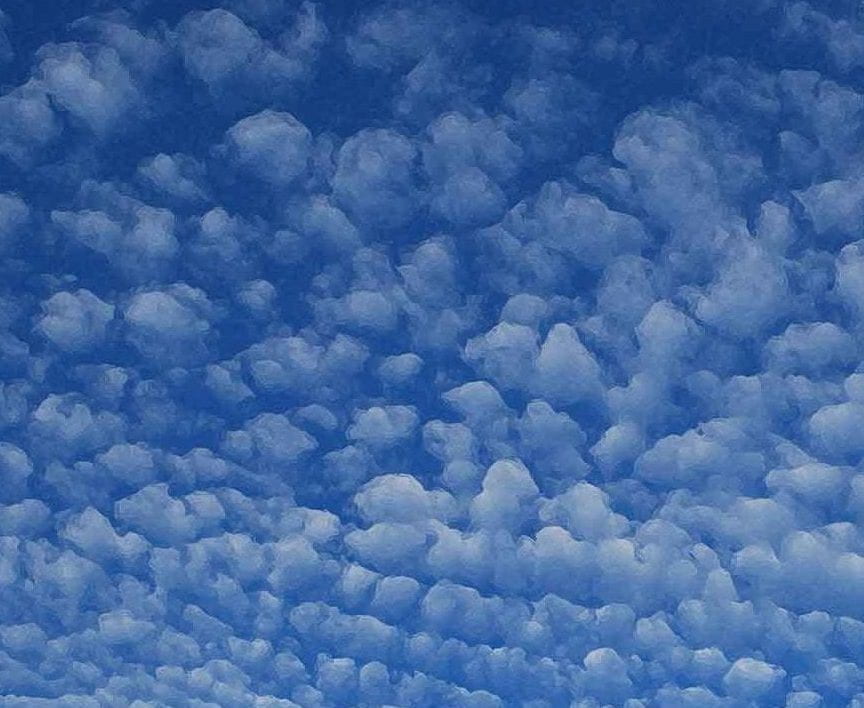
    French for clouds, Nuages is one of Debussy’s three beautiful Nocturnes for orchestra, quoted here as a theme for variations. Water vapor is technically invisible. The clouds we see are actually masses of minute liquid droplets and frozen crystals. Thus this movement embodies all three states of water.

    IV. Vltava (LIQUID)

    The great river Vltava flows majestically through Prague. Smetana’s depiction of it in his monumental Ma Vlast is usually translated as The Moldau.

    Quarks

    The aggressive rhythmic character of the opening part of Joseph Schwantner’s 1980 piece is an opposite to the serenity of Austin’s art is self alteration is cage is . . . Boiling heat:

    LISTEN ›

    U.Mich. Symphony Band

    Modern physics understands that all matter is built up from just five fundamental “particles”: electrons, up quarks and down quarks with electrical charge; and gluons and photons with no electrical charge. They are not exactly particles, though, but infinitesimal points of spin in space/time.

    That’s where the next sound composition experiment began. Two 4-pitch segments of the octatonic scale appear (“quarks”), then spin at their own speeds, while smaller 3-pitch sets (“electrons”) spin above and below them. At times, the sound mass explodes with a shower of electron sparks, then reforms.

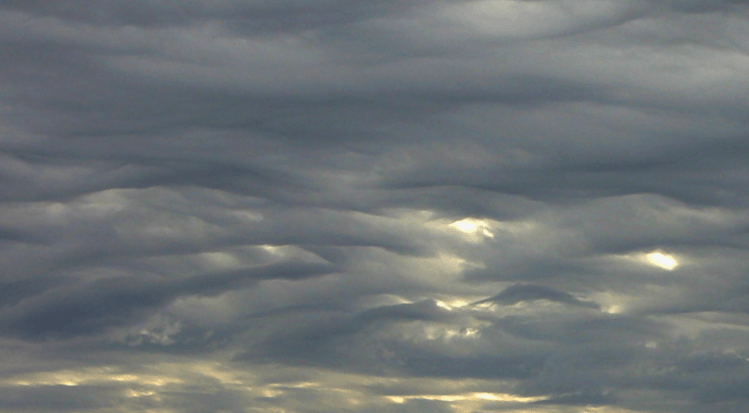
    More clouds! We had Nebula, clouds of gas and dust in space, then Nuages, puffy white clouds in a blue sky. Now storm clouds . . .

    Meteorology

    Clark 2022 (TC-121)

    Nimbus

    While quarks are hard to imagine and impossible to visualize, we love to watch puffy white cumulus clouds. Their kinetic energy becomes more visible when they grow into dark, precipitation-bearing cumulonimbus storm clouds, bringing rain and crackling electricity.

    Squall

    A tree limb branching out from a trunk, then smaller limbs branching from it, again and again to smaller and smaller branches — a classic example of a recursive process. Sometimes lightning shows this same recursive branching process. While the tree branches take years to fill out, lightning is a sudden explosion of electricity over a split second. Thunder, as sound travels much slower than light, is heard later than the lightning flash is seen — unless, of course, it is very close by!

    ______________