Tag: Karlheinz Stockhausen

  • Mapping Music 11. TEXTURE

    Imagine a piece of music exploring texture in time, made of single sounds and sonorities occurring one at a time in sustained resonance. Then imagine the points of sound are separated by rests, silence. As the texture drifts in and out of a resonant cloud, the sound events remain unconnected. Suddenly, their pace explodes into a torrent of notes. That describes the following powerful piece by my UNT colleague, Joseph Klein.

    Joseph Klein – Pathways IV: Rhymes & Spirals (2024)

    Sound color

    Our next music map shows a simple color-coding graphic system for classifying most musical timbres, informally the tone quality of sounds. The map intuitively chooses colors of the rainbow. While the color spectrum orders the frequencies of light (another manifestation of periodicity), our sound-color classifying map does not imply any ordered quantification of timbral complexity.
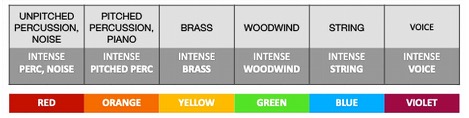
    instrumental color rainbow

    Though we think first of an orchestra for a rainbow of color, chamber music can incorporate a variety of instrumental colors, each produced in vivid isolation by one instrument, standing out or changeably mixed with other colors.

    Augusta Read Thomas wrote Dance Mobile in 2021, scored for 13 instruments: Woodwind quartet (Flute, Oboe, Clarinet, Bassoon); Trombone; String quintet: (2 Violins, Viola, Cello, Contrabass); Piano; 2 Percussion (vibraphone/metal, marimba/wood, drums).

    The piece starts with a single pitch, blending several colors that swell in intensity. Then ensues a kaleidoscopic dance of at least seven distinct color combinations, of two basic types:

    Sustained sounds – strings; high woodwinds; lone brass of the trombone

    Sparks – pizzicato strings; ringing metal sounds; drum strokes; staccato piano

    Augusta Read Thomas – Dance Mobile (2021)

    Though the piece is dedicated “in memoriam Oliver Knussen,” the memory is a joyous dance of color.

    Symmetry

    In the exposition of Webern’s Symphony, Op. 21, we saw that each contrapuntal line duplicates the exact rhythm of the lead line, with each entrance one bar later — a classic canon. But each contrapuntal line presents a different succession of instrumental colors:

    Horn . . . . . . . . . Clar. . . . Cello
          . . . Harp . . . Cello pizz. . . . Cello arco . . . Violin . . . Harp . . . Horn . . . Harp
          . . . . . . Horn . . . . . . . . . Bass Clar. . . . Viola
           . . . . . . . . . Harp . . . Viola pizz . . . Viola arco . . . Violin . . . Harp . . . Horn . . . Harp

    The German term for this is so elegant, we’ll use it here:

    KLANGFARBENMELODIE — melodic or contrapuntal line expressed by a string of changing tone colors

    Webern placed each pitch in every line in a particular fixed octave, except Eb that appears in two different octaves. This makes a striking, symmetrical 13-pitch constellation with a palindromic array, the same array going down as going up.

    Webern 13-pitch constellation

    Not only was he obsessed with symmetry in this piece, but this constellation’s symmetry also proves that he was thinking specifically about the chord voicing in what I have identified in successive interval array form.

    We can use this constellation as a Y-axis for a graph mapping the timbres as they appear in the various parts in canonic lines in pitch space for the first 9 bars. This farben color map looks like one of the later geometric paintings of Piet Mondrian.
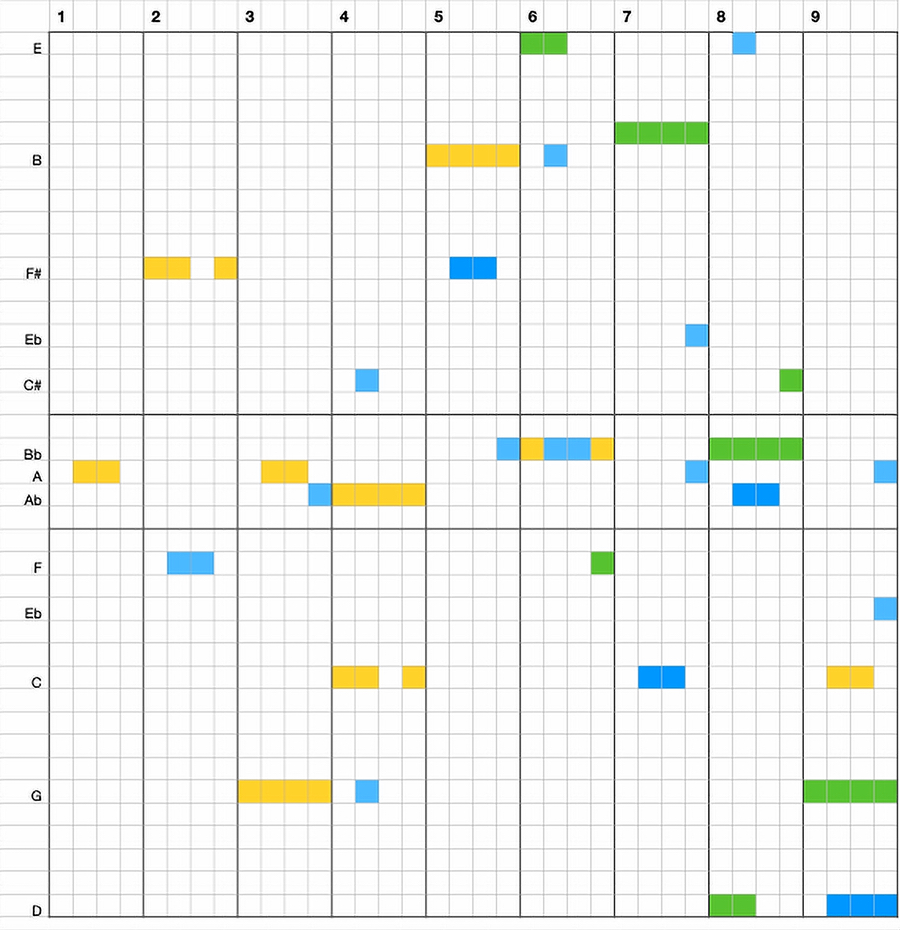
    Op. 21 color map

    Pointillism

    Though we often share musical terms and concepts with visual art, we sometimes mean different things by the same term. In painting, a technique developed in the Impressionist style period of the late 19th century that became known as pointillism. The most famous example is Georges Seurat’s “A Sunday Afternoon on the Island of La Grande Jatte” at the Chicago Art Institute. Instead of sweeping brush strokes and palette-blended colors, it used small separate spots of subtly varied colors to make a texture that, when viewed from a distance, seems to merge into a color cloud, giving the impression of animated light.

    Musical pointillism, unlike painting, separates sounds in time and pitch space, not to blend them into a texture so much as to highlight the different qualities of each unique sound event. Webern was a pioneer of musical pointillism in works such as Op. 21. Let’s graph the first 10 bars of this fabric using our timbre color-coding (BLUE = wind, ORANGE = percussion, VIOLET = plucked string) on a broadly distinguished 6-octave pitch range. We get something as colorful as a Mondrian painting!
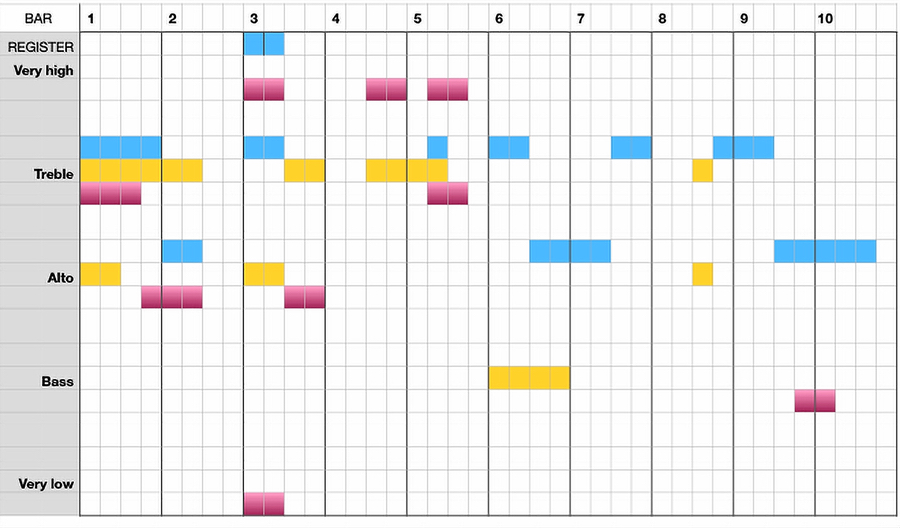
    Andromeda sound color map

    As a musical fabric, isolation — using the vast available range of pitch and the empty time of rests and silence — is a fitting analog for the vast, mostly empty space of a galaxy. Let’s use it for a demonstration etude.

    Andromeda is the nearest large galaxy, 2.5 million light-years from our own Milky Way galaxy. Our sound color demonstration study uses every sound quality on our sound color spectrum except red. Here is a score of the first 10 bars.
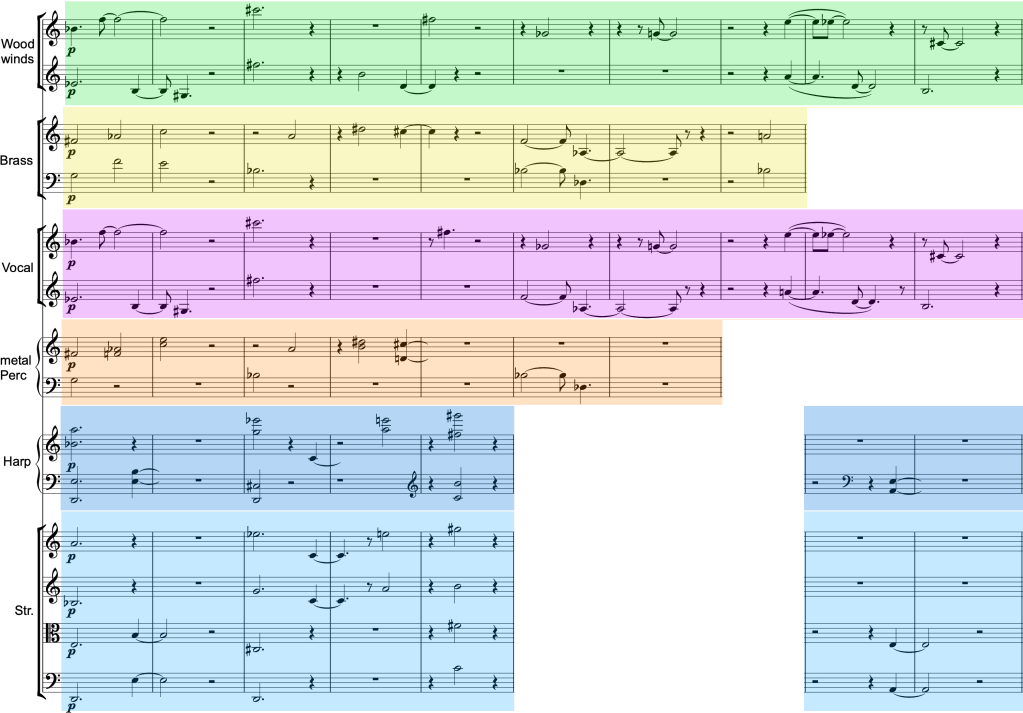
    Notice that the green woodwind notes are doubled with a synthesized vocal-type sound. Yellow brass notes are punctuated by orange metallic percussion attacks. Likewise, blue string notes are articulated by the plucked string sounds of harp.

    Here is the whole colorfully pointillistic 3-minute study:

    Sound Mass

    At a time when electronic music was emerging in the 1950s, new instrumental resources were also developing a new style that was all about animating massive layers of sound.

    German experimentalist Karlheinz Stockhausen composed two early, influential sound mass works, Gruppen (1957) for three orchestras, and Carré (1960) for four orchestras and four choirs. The scores were huge, dense, 12-tone, and monolithic in form.

    A 2002 piece by John Adams, On the Transmigration of Souls, harkens back to a mid-century masterpiece of the Avant Garde. In 1961, Polish composer Krzysztof Penderecki wrote a piece for a massive score of 52 string instruments. Conceived as an abstract, freeform, dense massing of animated and intense musical fabrics, it represents a pioneer in the genre of sound mass music, winning the UNESCO Prize that year. Only after it was heard in performance, he said, “I was struck by the emotional charge of the work … I searched for associations and decided to dedicate it to the Hiroshima victims” — thus the title, Tren Ofiarom Hiroszimy (translated Threnody for the Victims of Hiroshima).

    As a young composer in the ‘70s, I reflected this approach in some pieces titled Animated Landscapes. (The title was inspired by John Cage’s famous Imaginary Landscapes no. 4 for 12 radios.) Beyond referring to the painting genre of landscapes, the title sets the imagination for solid, continuous textures like viewing the shapes of a mountain range, but set into rhythmic motion. (This approach became prevalent in ensemble music, especially of Midwestern composers such as Donald Erb.)

    Considerably predating the music mentioned above, Schoenberg’s Fünf Orchesterstücke, Op. 16 (1909), was originally scored for a large orchestra of 37 parts. It is not thought of as sound mass music, as its five movements each have Expressionist or Impressionist titles: “Vorgefühle” (“Premonitions”); “Vergangenes” (“The Past”); “Farben” (“Summer Morning by a Lake”); ”Peripetie” (“Peripeteia”); “Das obligate Rezitativ”(“The Obligato Recitative”). The third movement, Farben, is of special interest not only for its exquisite mixed-palette painting of orchestral timbres, but also for its thick though delicate fabric of sustained sounds. At the start, nothing moves, the subtle shimmer of instrumental colors fading in and out of a continuous fabric of delicate, faint sounds. (A sound mass can be delicate, not necessarily “massive.”)

    Here is a score of the first page, showing sounding concert pitches for all instruments.
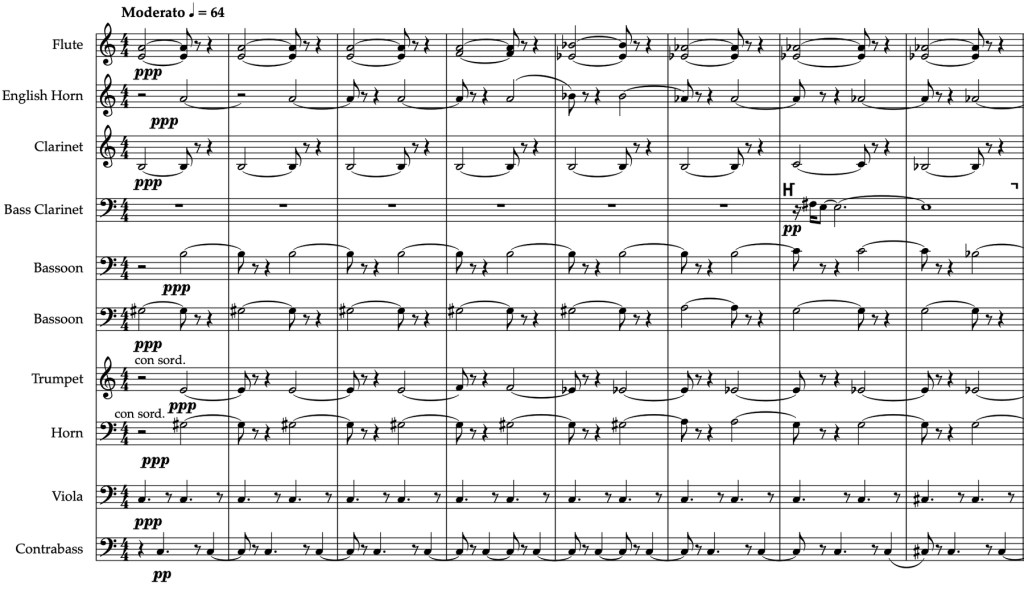
    Schoenberg Farben scoring

    Each measure presents one constellation, recolored with different instruments in the second half of the measure. For the first three bars, the constellation does not change, and then only subtly in the next five bars, maintaining the constant C pedal point in the low strings.
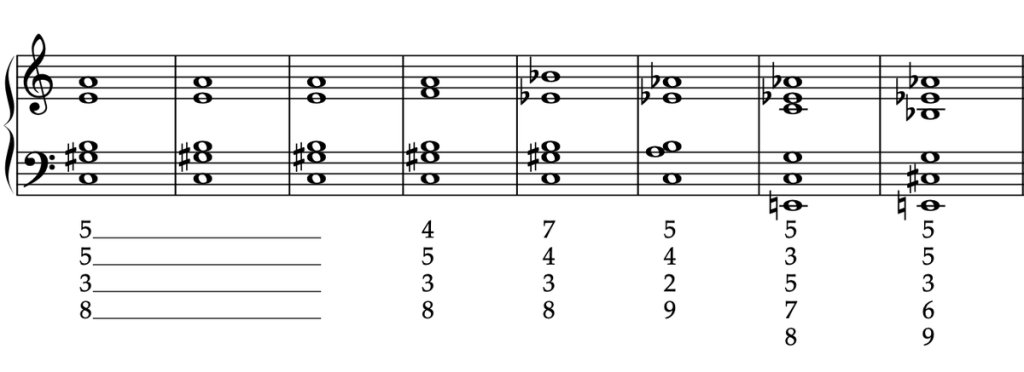
    Farben constellations

    The bass clarinet’s F3 in bar 7 is considered an ornamental non-harmonic pitch. While you can see many recurring smaller constellations imbedded within these changing large constellations, such as 5 5, 3 5 and its inversion 5 3 (which are triads), and some transformations of smaller constituent constellations: 8 3 redistributed to 9 2, 4 7 shrinking to 4 5 (another triad), and 3 4 (also a triad) shrinking to 2 4.

    Though there are many triads embedded in the constellations, the overall quality of the sonorities is complex, as the triads are framed within critical dissonances:
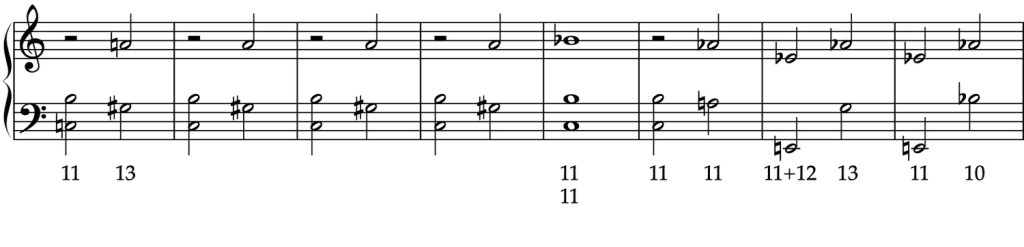
    framing dissonances

    Foreground / background

    Most landscape paintings, distant textures of forest, mountains, sky, waves on the sea, or clouds, have some sharp focal point. Often on the horizon (in itself a focusing anchor of the visual display), it may be a barn, a setting sun, a boat, a farmer and dog. If we consider proportion and symmetry in a visual composition, the focal point is best not dead center. A more interesting balance, according to expert photographers, follows the Rule of Thirds, placed one-third from the left or right, one third from the top, or both. Two-thirds is a ratio of 0.667. The Greeks famously defined the Golden Ratio, an ideal ratio dividing a whole length or height into two parts such that the ratio of the smaller part to the larger is the same as the ratio of the larger part to the whole. The ratio is 1.618:1, the solution to the equation: x2 – x – 1 = 0; a 62% and 38% division.

    In a simple traditional musical texture, an accompanying harmonic texture is designed as a background for the focal element of a melody. Sound masses may lack such focus, like the forest or sea waves. When there is to be perceived a standout element of the texture, Schoenberg called this focal element of the musical fabric the Hauptstimme. Though that might translate “highest voice,” the melody or other focal events are not necessary to be higher in the pitch range of the fabric than other elements. But there must be some isolation or distinction setting them off from background in at least one of the parameters mentioned above. The Hauptstimme focal line or textural element can be:

    • in a pitch range isolated from background
    • a color isolated as a single timbre, not a mixed diffusion of background colors
    • slower or faster than background
    • more rhythmically elastic, varied than background
    • not synchronized with background
    • loudest line (the most obvious)

    Schoenberg devised a special symbol for the focal Hauptstimme line of a fabric, a boldface stylized capital H, which you see marking the bass clarinet entrance in bar 7 of the Farben example. Here is how that principal Hauptstimme line continues, a Klangfarbenmelodie of changing color, from bass clarinet to clarinet with trombone to three solo contrabasses.
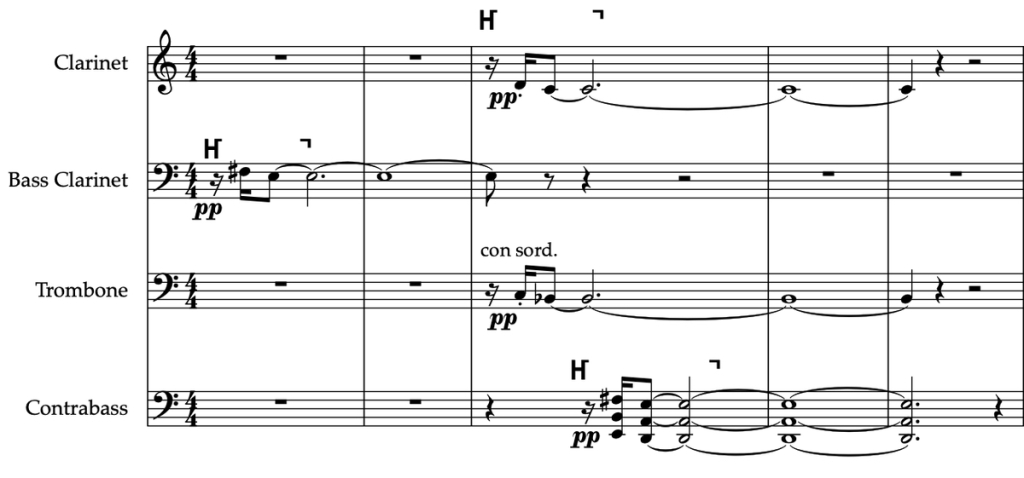
    Hauptstimme handoffs

    Notice the aggressive rhythmic motive, each time stepping down 2 semitones; and the  7 7 7 quintal-chord constellations in the contrabasses. (The rhythmically aligned clarinet and trombone are separated by 14 semitones, 7 + 7.)

    Beyond color isolation, Learning to Compose makes a distinction for a timbre mixed with itself or other colors spread over some pitch register (“diffuse”) or reinforcing itself in a narrow, confined pitch space (“concentrated”). While Farben’sbackground is diffuse, its Hauptstimme color is isolated in the low pitch register of the bass clarinet and then also concentrated with the three solo contrabasses.

    In the first movement of Anthracite Fields (2015) by Julia Wolfe, the bass clarinet emerges as a focal sound by its loudness and singularity of pitch in a cloud mass of softer sound. Then aggressively loud clusters suddenly interrupt the steady-state background, yielding eventually to repetitive sung chords and floating vocal duets. The sound fabric maintains a three-dimensional depth of contrasting intensities.

    Julia Wolfe – Anthracite Fields I: Foundations (2015)  

    Galaxy groups

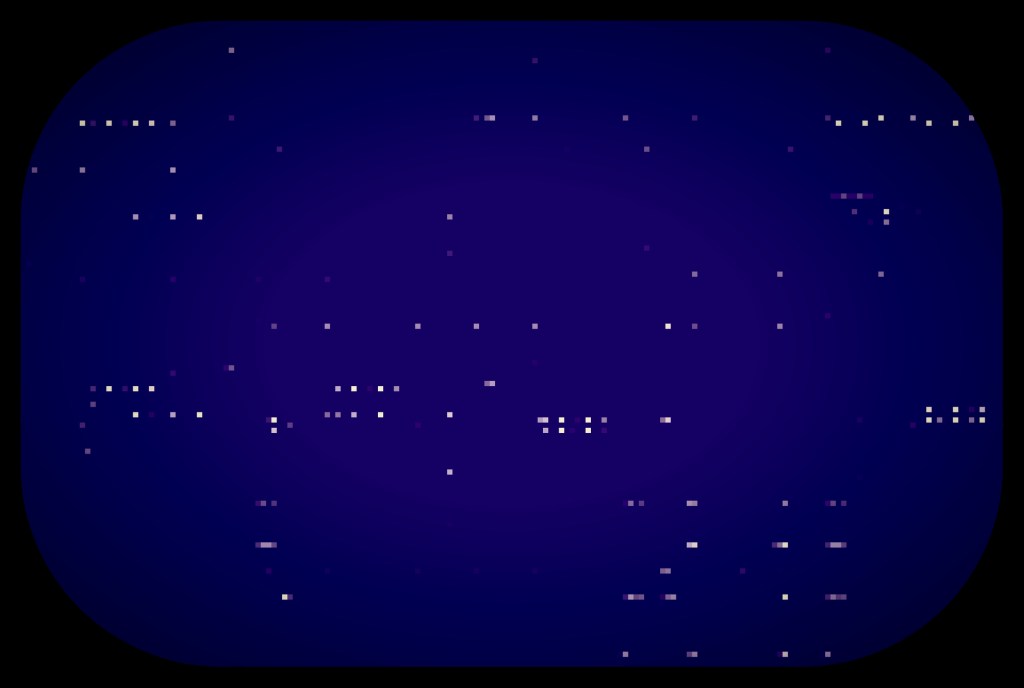
    Our sample etude composition for sound mass is a thick score of 10 wind parts and harp, with a fabric the opposite of pointillism: everything sustains and overlaps. There are basically no pauses or holes in the continuous 2-minute sound fabric. Its title, Laniakea, is the name of the supercluster of galaxies that includes the Milky Way.
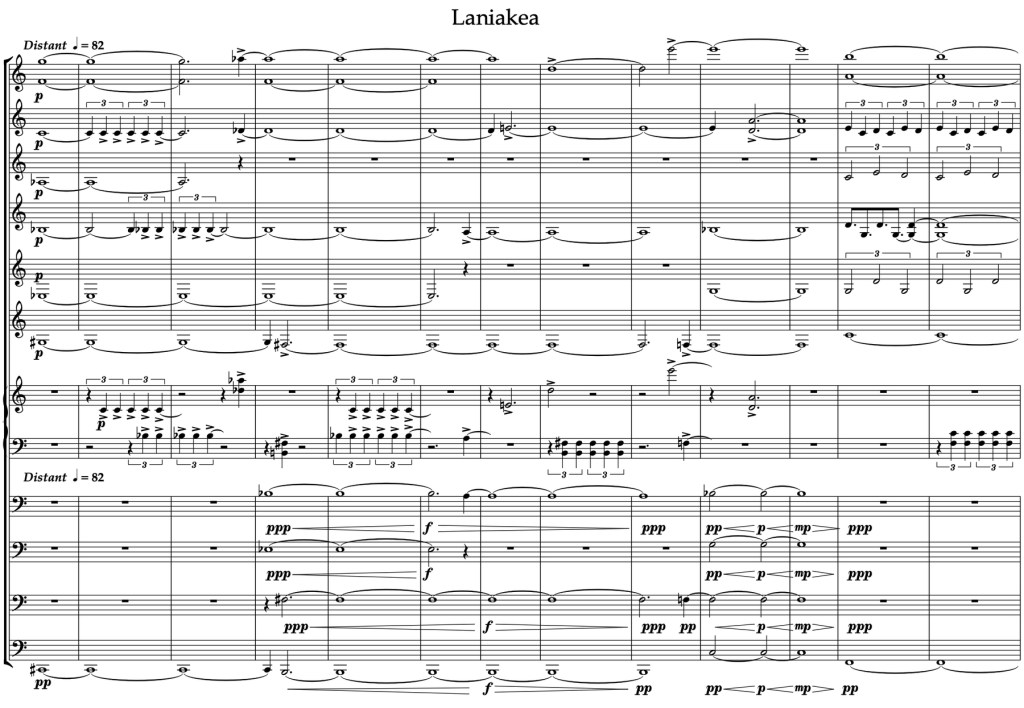
    Laniakea score excerpt

    Having shown the score with all its notational details, to better illustrate the main point of the example, sound mass, here is a graphic rendering of that actual second system of notes. We can reveal its pointillism by increasing the contrast in a negative image of light on dark. That makes the attack beginning of each sound show up but not the staff lines or sustained resonances . . . a fanciful art image of Laniakea, a vast empty part of the universe dotted with millions of galaxies.
    Laniakea score abstracted

    © 2026 – All Rights Reserved

    Thomas S. Clark

    Continue reading Mapping the Music Universe:

    TClarkArtMusic.com

  • Mapping Music 1. TIME

    “If you want to find the secrets of the universe,

    think in terms of energy, frequency, and vibration.”

    (Nikola Tesla)

    We start with time. Everything in music involves time, is of time, sound events occurring in our perceived flow of time.

    Sound itself is periodic vibration, a repetition of compression waves of energy in air (or water). Repetition of an event or series of events establishes a frequency of repetition and the period or cycle length, the elapsed time duration from each event’s starting time point (moment) to the starting point (moment) of its repetition.

    We perceive the frequency of air-compression waves as pitch if they are faster than 20 per second and slower than about 4,000. Frequency is typically measured in cycles per second, called Hertz. Non-periodic waves faster than about 20 Hz are perceived as noise. Events or time cycles slower than 20 Hz are perceived as pulses, tempo, rhythm, phrase structure, etc. At these slower sub-sonic event speeds, it is more convenient to identify the duration of the cycle, its period, than the frequency.

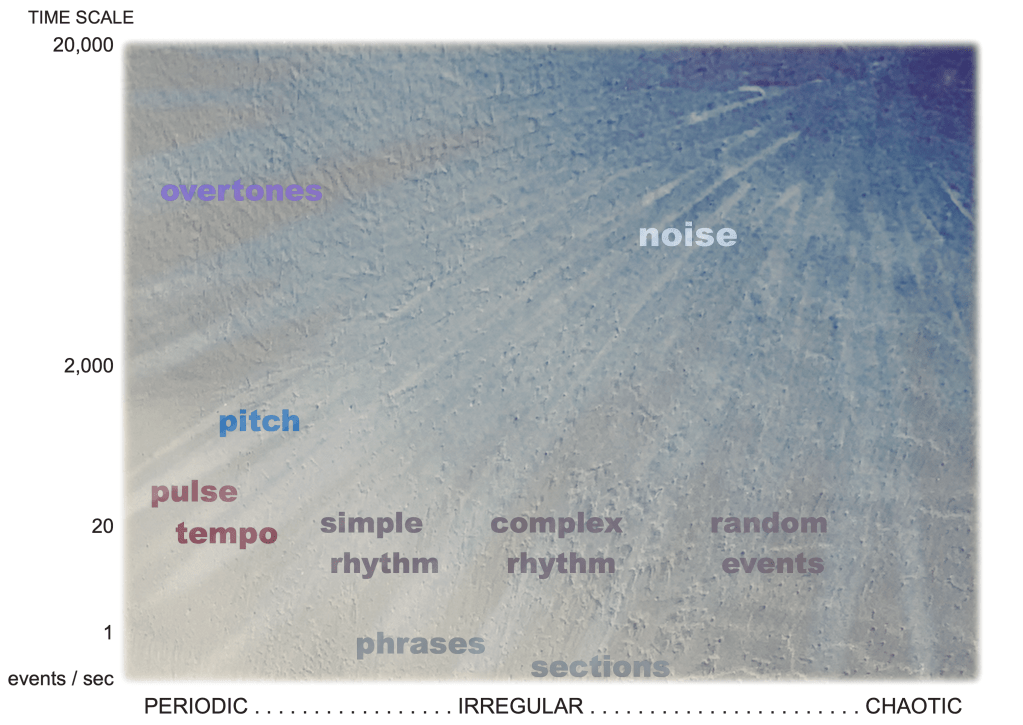
    Periodicity, this repetitive aspect of sound events in time, gives us a dimension to map all the possibilities, from extremely fast to almost frozen slowness, and from simple, highly regular repetitions to a very complex succession of variants.

    the periodic time/sound universe

    In this illustration, the Y-axis is speed/frequency (slowest at bottom, fastest on top), the X-axis is regularity of repetition (perfectly regular at left, randomly sporadic time spans at right). The blocks have sharp rectangular edges; if I were a better artist, the boundaries between descriptive categories would actually be curving and very blurred. Though the graph shows firm straight lines separating pitch and noise, there is actually a fuzzy, curving grayscale continuum from pure, simple pitch through complex, colorful pitched timbres to noise.

    Defining time

    What is time and how does it work in our lives and in the rhythms that are the fundamental “substance” of music? I say substance metaphorically, because time does not exist as any physical matter. It is a perceptual construct, a complex quilt stitched out of human experience.

    Discover magazine ran an article in June of 2007 titled, “Time May Not Exist”.

    “Efforts to understand time below the Planck scale have led to an exceedingly strange juncture in physics. The problem, in brief, is that time may not exist at the most fundamental level of physical reality. If so, then what is time? And why is it so obviously and tyrannically omnipresent in our own experience? ‘The meaning of time has become terribly problematic in contemporary physics,’ says Simon Saunders, a philosopher of physics at the University of Oxford. ‘The situation is so uncomfortable that by far the best thing to do is declare oneself an agnostic.’”

    The mysteries of time were explored as early as sixteen hundred years ago by the great Saint Augustine of Hippo, in Book XI of his deeply philosophical work, Confessions.

    “. . . What is time? Who can give that a brief or easy answer? Who can even form a conception of it to be put in words? Yet what do we mention more often or familiarly in our conversation than time? We must therefore know what we are talking about when we refer to it, or when we hear someone else doing so. But what, exactly, is that? [Book XI, Section 17]

    Nicholas Stratas’ thought-provoking article in the July 2007 issue of Wake County Physician, “Time – Continuous Yet Bidimensional” asserts that most of us have a firm concept of Past, Present, and Future. But defining them is challenging, and sorting out how these constructs interact in our consciousness even more so. Michael Spitzer, in The Musical Human (Bloomsbury Publishing, 2021), wrote:

    “Musical time is a window into time consciousness in general. We listen to music in the moment, sitting in the saddle of an ever-shifting Now, as the past whizzes by to become memory, and the present anticipates what is just around the corner. Music’s present tense is really a bundle of memories and anticipations . . .”

    Many years ago, I first read an article translated from Die Reihe, written by a preeminent avant-garde experimental composer, Karlheinz Stockhausen. “Structure and Experiential Time” described Stockhausen’s view that time does not flow uniformly through the experience of a serious musical composition. It ebbs and surges as the composer shapes not just the tempo but the flow of information in the form of repeated or new musical events, simple or complex musical structures.

    “When we hear a piece of music, processes of alteration follow each other at varying speeds; we have now more time to grasp alterations, now less.”

    Even tempo, a supposedly steady clock in most music, ebbs and flows. Computer music composers in synthesizing musical sounds have found that a mechanistically rigid clock tempo sounds artificial. Human musicians are constantly flexing tempo in subtle ways to convey almost subliminally where the music is “going” (another metaphor, that of travel through space).

    Saint Augustine recognizes the slippery challenge of measuring time:

    “ . . . We observe the different ways times lapse, and compare them, and call some longer and some shorter. . . . It is passing time we measure, as we experience it. . . . Time can only be measured as it passes. Once past, it is no longer there to be measured.” [Book XI, Section 21]

    “We measure time as it passes . . . . But how can we measure the present, when it has no extent of its own? . . . Time must be measured in something with extent . . . But in what extended thing do we measure time as it passes?” [Book XI, Section 27]

    “So time is measured, my mind, in you. Raise no clamor against me—I mean against yourself—out of your jostling reactions. I measure time in you . . . because I measure the reactions that things caused in you by their passage, reactions that remain when the things that occasioned them have passed on. . . . Time has to be these reactions for me to be able to measure it.” [Book XI, Section 36]

    Time perception

    Pulling all this together, I’d like to suggest several things about time in classical music.

    • Time is perceptual.
    • Time is multidimensional.
    • Time is elastic.
    • Time is experienced in complex ways as the fundamental basis of music’s richness.

    In LEARNING TO COMPOSE, co-author Larry Austin and I begin the chapter titled “Time Streams” with a quote from a philosopher, and then express in our own words the fundamental nature of time.

    “ ‘Music makes time audible and its form and continuity sensible.’
    —Suzanne Langer

    Music exists in time. Time exists as we sense it, articulated on many levels by changing and cyclically recurring events.

    As beautiful, colorful and essential as sound is in making music, musical sounds are the means to an end, building blocks for events that primarily mark articulations of time.

    We sometimes like to think of music as having two fundamental dimensions, like a graph. The horizontal dimension is the parameter of time. The vertical dimension is the parameter of pitch. But pitch is actually a temporal phenomenon – the frequency (periodic change over time) of sound waves. How amazing are the human ear and human mind to perceive waves of air coming at us a thousand times a second or much faster and distinguish the small differences that make a pitch “in tune” (or not) and the even subtler differences that identify an oboe instead of a violin producing that pitch. All of this from a perception simply of periodic rates in time!

    Stockhausen pointed out that in mentally processing all of these sonic distinctions, we are forced to pay more attention to changes in their qualities, combinations, and “spacing” in time. These are his “alterations”.

    “The greater the temporal density of unexpected alterations . . . the more time we need to grasp events, and the less time we have for reflection, the quicker time passes; the lower the effective density of alteration (not reduced by recollection or the fact that the alterations coincide with our expectation), the less time the senses need to react, so the greater intervals of experiential time lie between the processes, and the slower time passes.”

    The concepts of expectation and information help make some sense of things. “Information” is perceptual data that is similar to what you just heard or logically confirms what you were expecting next. “Entropy” is the opposite perception – surprise, contrast, noticeable change. In musical listening, though we don’t do so consciously, we are constantly “computing,” assessing, retaining, and predicting.

    Saint Augustine connects Past, Present, and Future with memory, experience, and expectation:

    “What should be clear and obvious by now is that we cannot properly say that the future or the past exist, or that there are three times, past, present, and future. Perhaps we can say that there are three tenses, but that they are the present of the past, the present of the present, and the present of the future. This would correspond, in some sense, with a triad I find in the soul and nowhere else, where the past is present to memory, the present is present to observation, and the future is present to anticipation.” [Confessions, Book XI, Section 26]

    And to make matters more complicated, it is not at all a linear process. Let’s take a metaphor. I can’t resist one that Einstein was very fond of in his thought experiments.

    As listeners, we’d like to imagine ourselves as a train riding on tracks through time, a train that keeps moving forward and doesn’t back up. The clickety-clack of our wheels is a steady tempo measuring time. We only remember back to the tracks the locomotive has passed but still lie under the wheels of our caboose at the end. And we only look ahead a little bit, as the tree-bordered tracks curve, preventing a longer straight view.

    That’s way too simple, a two-dimensional time frame in which we either recall a little of what we just heard or maybe guess a little what might happen next. As Meyers, Stockhausen, Spitzer, and Dr. Stratas all observe, in keen listening to music our minds are filled with memories of not just the previous measure or phrase, but the very beginning of the piece, its theme or launching impetus (Grundgestalt as Schoenberg named it) and, in a more diffuse sense, all that has “happened” up to the present moment. The present moment is not one single phenomenon in time either. Melody, countermelody, bass line, chordal texture, and punctuating sounds are simultaneously tracing distinct paths, each with its own pace through time. At the same time, we are constantly expecting what’s coming, or at least “feeling” where the music might be going. And, as if that weren’t complicated enough, we are busy reevaluating what we just heard in relation to what we had been expecting. Saint Augustine describes it more succinctly:

    “Only in the mind can this [the experience of time] be accomplished, because of three activities there—the acts of anticipating, of observing, and of remembering.” [Book XI, Section 37]

    None of this is conscious, but in describing it in concrete terms, we recognize the dizzying multidimensionality, time arrows pointing in all directions and curling back on themselves. This is what I believe constitutes deep listening, “getting lost in the music”.

    Just one more idea – elasticity. Stockhausen recognizes that in music the sense of time passing changes, stretches or compresses, depending on how much “alteration” is being encountered. This is why music can seem “steady” or “surging ahead” or dissipating and almost “frozen”. It is not at all the tempo that causes this, but rather the rate of change, sharp contrast or subtle evolution, in the harmonies, the melodic character, or the rhythm.

    A rhythmic playfulness in modern music stretches our sense of timing. Tempos change, are interrupted, break down, tumble into avalanches, come to rest. Time itself stretches and becomes the titled thematic element in pieces such as Time Cycles (1960) by Lukas Foss. Here is another example titled about time, written at the starting gun of the new millennium.

    Fred Lerdahl – Time After Time (2000)

    Awe

    In his book When (Riverhead Books, 2018) Daniel H. Pink writes,

    “I used to believe that timing was everything. Now I believe that timing is everything. . . . The experience of awe changes our perception of time. When we experience awe, time slows down. It expands. We feel like we have more of it. And that sensation lifts our well-being.”

    He quotes researchers Rudd, Vohs, and Aaker in Psychological Science 23 No. 10 (2012):

    “Experiences of awe bring people into the present moment, and being in the present moment underlies awe’s capacity to adjust time perception.”

    © 2026 – All Rights Reserved

    Thomas S. Clark

    Continue reading Mapping the Music Universe:

    TClarkArtMusic.com