Pursuing our grand space metaphor, here is an important new term:
CONSTELLATION — a group of pitches occurring in a perceived relationship, either vertical (a chord simultaneity), horizontal (a segment of a melodic line), or diagonal, a combined collection of pitches from various lines sounding in temporal proximity.
This is intentionally a broadly inclusive concept. Larry Austin and I first coined the term in our 1989 book, Learning to Compose. A constellation can be any number of pitches, but those of three to six pitches are most manageable to analyze, categorize, and manipulate.
In Mapping Music 5. SCALES, we explored pitch classes (all the D’s in any octave, for example). For now, let’s not go there. A constellation can be very tall, spanning even five octaves, or very narrow, as in three or four close-together pitches well within one octave. (As a chord, we might call these a “cluster.”)
Common names for types of pitch grouping, “sonority,” “chord,” “harmony,” “melodic motive,” “arpeggio,” or “chord voicing” will all be considered manifestations of a pitch constellation.
Jennifer Higdon’s 2007 work, Percussion Concerto, driven by rhythmic vitality, romps through a dazzling variety of pitch constellations. Most are more complex sonorities consisting of 4 different pitches, drawn from diatonic scales but extending beyond the basic triads of the scale’s traditional harmony.
Jennifer Higdon – Percussion Concerto (2007)
Interval arrays
NOTE: In place of traditional interval names, which literally don’t add up, we will consistently measure every interval by how many chromatic semitones (half-steps) it spans.
When pitches of a constellation are considered out of time, like a chord, and rearranged from lowest to highest, we can study their harmonic structure. The stack of intervals makes a successive interval array of semitones from lowest to next, on up to the top.
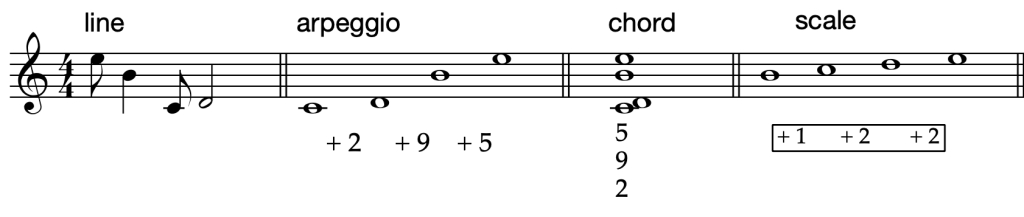
For example, the following line of four pitches, in order E – B – C – D, rearranged lowest to highest, yields C – D – B – E. Its interval stack = 2 9 5. (Going back to 5. SCALES, the four pitch classes can be derived from the set / diatonic scale-pattern 1 2 2.)
sample constellation 2 9 5
This constellation’s particular pitch-pattern shape shows a stack of successive intervals from lowest to highest: 2 9 5.
INTERVAL ARRAY — stack of intervals that identifies the constellation’s particular intervallic shape in vertical pitch space, listing the successive, additive upward intervals from lowest to highest pitch
Note: I tend to use “interval stack” and “successive upward interval array” interchangeably. If we wanted an acronym, how about Successive Upward Interval Series Stack — SUISS? No, maybe Vertical Interval Array — VIA? But vertical is not quite right, as the pitches might occur in musical context diagonally in 2-D pitch-time space and only be vertical when theoretically aligned as a chord stack. So let’s stick with interval array — and since conventional music theory doesn’t use the word for anything else, let’s just call it an ARRAY.
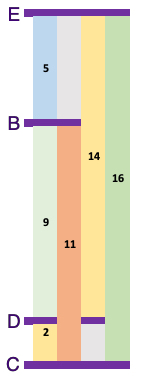
The constellation above also contains a “Major 7th” 11-semitone interval (+2+9=11), C up to B; a 14-semitone Major 9th, D up to E; and one very large interval of 16 semitones, C up to E in the next higher octave.
sample constellation 2 9 5
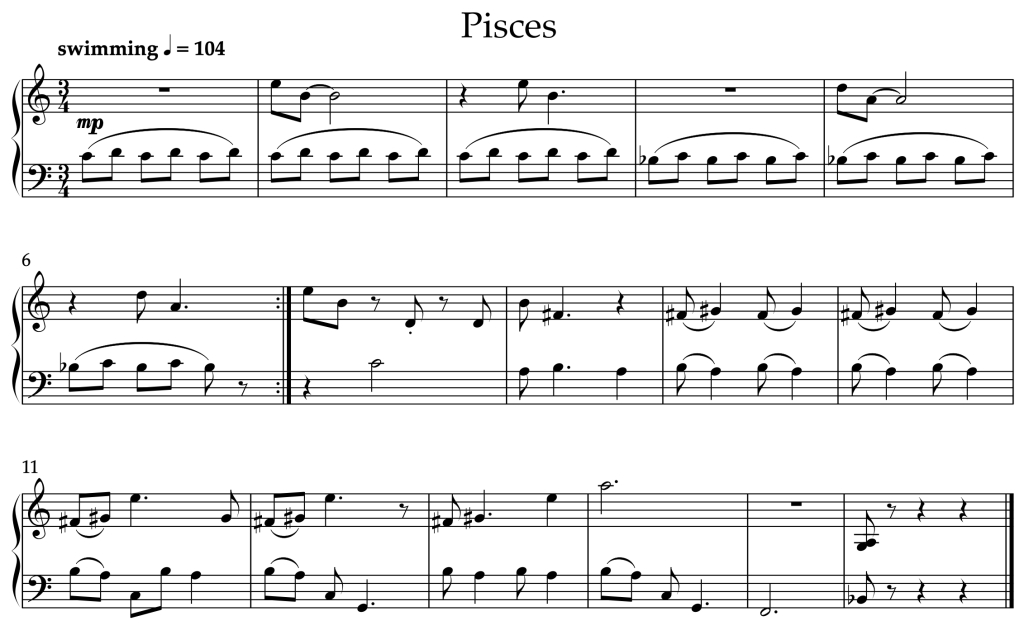
Below is a sample etude made with just this one 4-pitch constellation and its transpositions (bars 4-6 two semitones down), all with the same interval stack, 2 9 5, or its upside-down inversion, 5 9 2 (bars 12-14 bass clef).
Pisces etude
The etude is based on this 2 9 5 array. Bars 11 through 14 in the right hand are a constellation with a slightly altered array: ascending F# G# E A = interval stack 2 8 5, transformed from 2 9 5 by shrinking the middle interval of the stack by one semitone. Why? Sticking with 2 9 5 would have made e# or f and then b-flat on the top, not such great counterpoint against the b-natural in the lower line. And why not? The minor-9th interval A up to B-flat, 13 semitones, is a particularly gritty, unpleasant dissonance.
One example with pitch classes would be [F B E], in which F up to B is 6 semitones, B up to E is 5 semitones, and F up to E is 11 semitones. This example with all three pitch classes drawn from a C major scale illustrates that [6 5] is correctly shown in white as a diatonic pattern, despite the fact that it is not commonly used as a harmony in common-practice tonal music other than as a Mahler-style suspension.
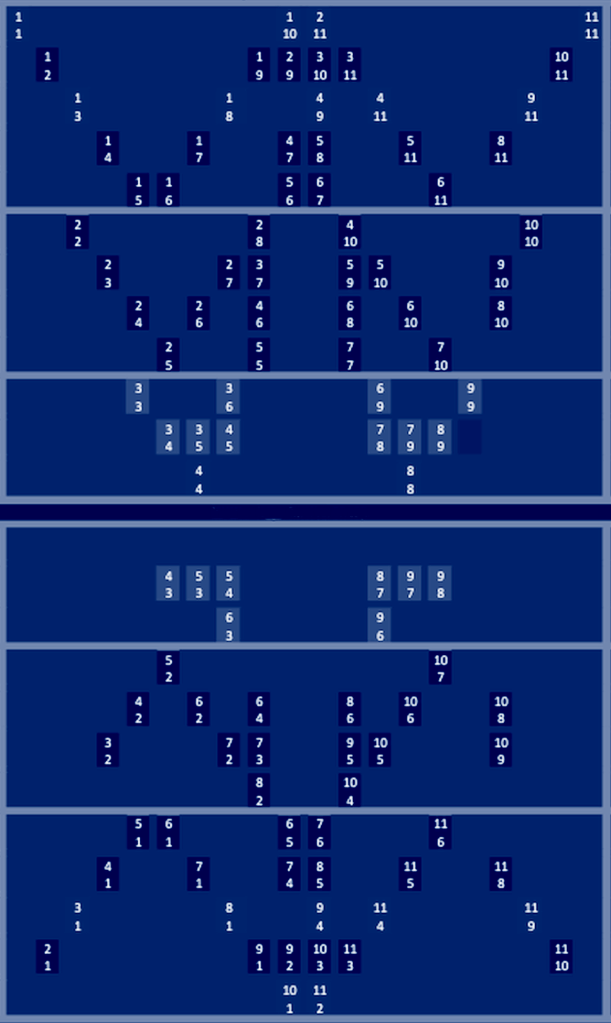
In the table below, each column groups stacks of the same height – each stack also forms a larger interval (not shown) that is the sum of the adjacency intervals shown. For example, reading bottom up, the stack 6 5 also forms an 11-semitone interval, the stack’s total height. All 3-pitch-class interval stacks:
3-pitch interval-stack arrays
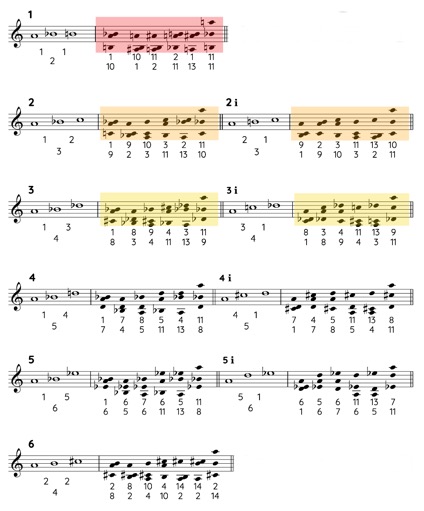
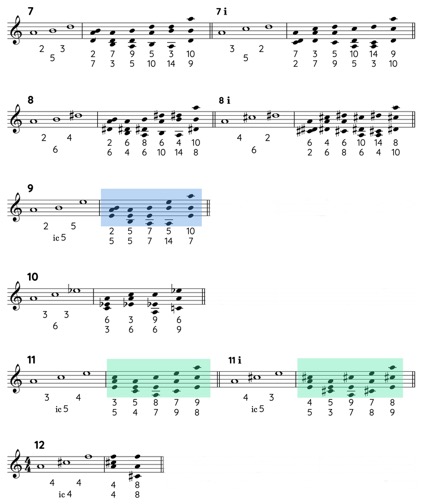
It may be helpful to see example pitches on a staff illustrating all these possibilities. Each line below shows a family, one Forte set class: first Forte’s “best normal order” with example pitches, then their chord voicings with stacked-interval sizes; then the set’s inverse, if there is a unique one.
Here the color shadings denote special degrees of interval complexity: RED = sharply dissonant; ORANGE and YELLOW = mildly dissonant; GREEN = minor and major triads; BLUE = quartal/quintal chords of P4 and P5 intervals.
3-pitch arrays, families 1-6
3-pitch arrays, families 7-12
As with scale-pattern maps, these maps and their notated lists represent the entire chromatic universe of possible constellations within a two-octave range. Each could be expanded by adding an octave to any stacked interval. And of course, each can become a line, a chord, or a temporal proximity of pitches in a texture.
think in terms of energy, frequency, and vibration.”
(Nikola Tesla)
We start with time. Everything in music involves time, is of time, sound events occurring in our perceived flow of time.
Sound itself is periodic vibration, a repetition of compression waves of energy in air (or water). Repetition of an event or series of events establishes a frequency of repetition and the period or cycle length, the elapsed time duration from each event’s starting time point (moment) to the starting point (moment) of its repetition.
We perceive the frequency of air-compression waves as pitch if they are faster than 20 per second and slower than about 4,000. Frequency is typically measured in cycles per second, called Hertz. Non-periodic waves faster than about 20 Hz are perceived as noise. Events or time cycles slower than 20 Hz are perceived as pulses, tempo, rhythm, phrase structure, etc. At these slower sub-sonic event speeds, it is more convenient to identify the duration of the cycle, its period, than the frequency.
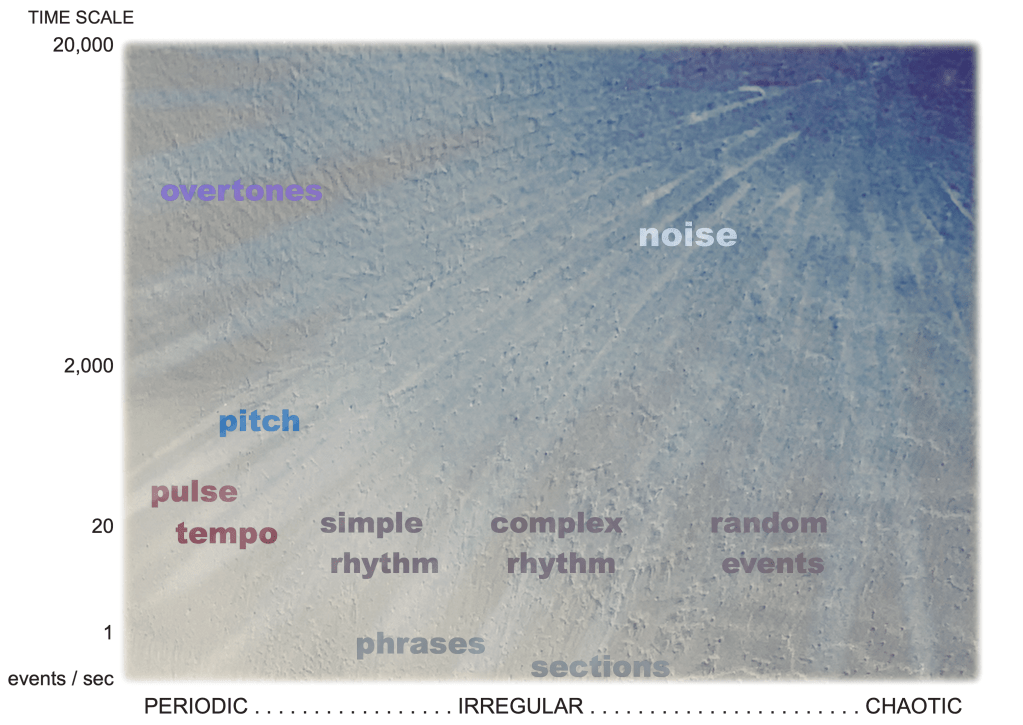
Periodicity, this repetitive aspect of sound events in time, gives us a dimension to map all the possibilities, from extremely fast to almost frozen slowness, and from simple, highly regular repetitions to a very complex succession of variants.
the periodic time/sound universe
In this illustration, the Y-axis is speed/frequency (slowest at bottom, fastest on top), the X-axis is regularity of repetition (perfectly regular at left, randomly sporadic time spans at right). The blocks have sharp rectangular edges; if I were a better artist, the boundaries between descriptive categories would actually be curving and very blurred. Though the graph shows firm straight lines separating pitch and noise, there is actually a fuzzy, curving grayscale continuum from pure, simple pitch through complex, colorful pitched timbres to noise.
Defining time
What is time and how does it work in our lives and in the rhythms that are the fundamental “substance” of music? I say substance metaphorically, because time does not exist as any physical matter. It is a perceptual construct, a complex quilt stitched out of human experience.
Discover magazine ran an article in June of 2007 titled, “Time May Not Exist”.
“Efforts to understand time below the Planck scale have led to an exceedingly strange juncture in physics. The problem, in brief, is that time may not exist at the most fundamental level of physical reality. If so, then what is time? And why is it so obviously and tyrannically omnipresent in our own experience? ‘The meaning of time has become terribly problematic in contemporary physics,’ says Simon Saunders, a philosopher of physics at the University of Oxford. ‘The situation is so uncomfortable that by far the best thing to do is declare oneself an agnostic.’”
The mysteries of time were explored as early as sixteen hundred years ago by the great Saint Augustine of Hippo, in Book XI of his deeply philosophical work, Confessions.
“. . . What is time? Who can give that a brief or easy answer? Who can even form a conception of it to be put in words? Yet what do we mention more often or familiarly in our conversation than time? We must therefore know what we are talking about when we refer to it, or when we hear someone else doing so. But what, exactly, is that? [Book XI, Section 17]
Nicholas Stratas’ thought-provoking article in the July 2007 issue of Wake County Physician, “Time – Continuous Yet Bidimensional” asserts that most of us have a firm concept of Past, Present, and Future. But defining them is challenging, and sorting out how these constructs interact in our consciousness even more so. Michael Spitzer, in The Musical Human (Bloomsbury Publishing, 2021), wrote:
“Musical time is a window into time consciousness in general. We listen to music in the moment, sitting in the saddle of an ever-shifting Now, as the past whizzes by to become memory, and the present anticipates what is just around the corner. Music’s present tense is really a bundle of memories and anticipations . . .”
Many years ago, I first read an article translated from Die Reihe, written by a preeminent avant-garde experimental composer, Karlheinz Stockhausen. “Structure and Experiential Time” described Stockhausen’s view that time does not flow uniformly through the experience of a serious musical composition. It ebbs and surges as the composer shapes not just the tempo but the flow of information in the form of repeated or new musical events, simple or complex musical structures.
“When we hear a piece of music, processes of alteration follow each other at varying speeds; we have now more time to grasp alterations, now less.”
Even tempo, a supposedly steady clock in most music, ebbs and flows. Computer music composers in synthesizing musical sounds have found that a mechanistically rigid clock tempo sounds artificial. Human musicians are constantly flexing tempo in subtle ways to convey almost subliminally where the music is “going” (another metaphor, that of travel through space).
Saint Augustine recognizes the slippery challenge of measuring time:
“ . . . We observe the different ways times lapse, and compare them, and call some longer and some shorter. . . . It is passing time we measure, as we experience it. . . . Time can only be measured as it passes. Once past, it is no longer there to be measured.” [Book XI, Section 21]
“We measure time as it passes . . . . But how can we measure the present, when it has no extent of its own? . . . Time must be measured in something with extent . . . But in what extended thing do we measure time as it passes?” [Book XI, Section 27]
“So time is measured, my mind, in you. Raise no clamor against me—I mean against yourself—out of your jostling reactions. I measure time in you . . . because I measure the reactions that things caused in you by their passage, reactions that remain when the things that occasioned them have passed on. . . . Time has to be these reactions for me to be able to measure it.” [Book XI, Section 36]
Time perception
Pulling all this together, I’d like to suggest several things about time in classical music.
Time is perceptual.
Time is multidimensional.
Time is elastic.
Time is experienced in complex ways as the fundamental basis of music’s richness.
In LEARNING TO COMPOSE, co-author Larry Austin and I begin the chapter titled “Time Streams” with a quote from a philosopher, and then express in our own words the fundamental nature of time.
“ ‘Music makes time audible and its form and continuity sensible.’ —Suzanne Langer
Music exists in time. Time exists as we sense it, articulated on many levels by changing and cyclically recurring events.
As beautiful, colorful and essential as sound is in making music, musical sounds are the means to an end, building blocks for events that primarily mark articulations of time.
We sometimes like to think of music as having two fundamental dimensions, like a graph. The horizontal dimension is the parameter of time. The vertical dimension is the parameter of pitch. But pitch is actually a temporal phenomenon – the frequency (periodic change over time) of sound waves. How amazing are the human ear and human mind to perceive waves of air coming at us a thousand times a second or much faster and distinguish the small differences that make a pitch “in tune” (or not) and the even subtler differences that identify an oboe instead of a violin producing that pitch. All of this from a perception simply of periodic rates in time!
Stockhausen pointed out that in mentally processing all of these sonic distinctions, we are forced to pay more attention to changes in their qualities, combinations, and “spacing” in time. These are his “alterations”.
“The greater the temporal density of unexpected alterations . . . the more time we need to grasp events, and the less time we have for reflection, the quicker time passes; the lower the effective density of alteration (not reduced by recollection or the fact that the alterations coincide with our expectation), the less time the senses need to react, so the greater intervals of experiential time lie between the processes, and the slower time passes.”
The concepts of expectation and information help make some sense of things. “Information” is perceptual data that is similar to what you just heard or logically confirms what you were expecting next. “Entropy” is the opposite perception – surprise, contrast, noticeable change. In musical listening, though we don’t do so consciously, we are constantly “computing,” assessing, retaining, and predicting.
Saint Augustine connects Past, Present, and Future with memory, experience, and expectation:
“What should be clear and obvious by now is that we cannot properly say that the future or the past exist, or that there are three times, past, present, and future. Perhaps we can say that there are three tenses, but that they are the present of the past, the present of the present, and the present of the future. This would correspond, in some sense, with a triad I find in the soul and nowhere else, where the past is present to memory, the present is present to observation, and the future is present to anticipation.” [Confessions, Book XI, Section 26]
And to make matters more complicated, it is not at all a linear process. Let’s take a metaphor. I can’t resist one that Einstein was very fond of in his thought experiments.
As listeners, we’d like to imagine ourselves as a train riding on tracks through time, a train that keeps moving forward and doesn’t back up. The clickety-clack of our wheels is a steady tempo measuring time. We only remember back to the tracks the locomotive has passed but still lie under the wheels of our caboose at the end. And we only look ahead a little bit, as the tree-bordered tracks curve, preventing a longer straight view.
That’s way too simple, a two-dimensional time frame in which we either recall a little of what we just heard or maybe guess a little what might happen next. As Meyers, Stockhausen, Spitzer, and Dr. Stratas all observe, in keen listening to music our minds are filled with memories of not just the previous measure or phrase, but the very beginning of the piece, its theme or launching impetus (Grundgestalt as Schoenberg named it) and, in a more diffuse sense, all that has “happened” up to the present moment. The present moment is not one single phenomenon in time either. Melody, countermelody, bass line, chordal texture, and punctuating sounds are simultaneously tracing distinct paths, each with its own pace through time. At the same time, we are constantly expecting what’s coming, or at least “feeling” where the music might be going. And, as if that weren’t complicated enough, we are busy reevaluating what we just heard in relation to what we had been expecting. Saint Augustine describes it more succinctly:
“Only in the mind can this [the experience of time] be accomplished, because of three activities there—the acts of anticipating, of observing, and of remembering.” [Book XI, Section 37]
None of this is conscious, but in describing it in concrete terms, we recognize the dizzying multidimensionality, time arrows pointing in all directions and curling back on themselves. This is what I believe constitutes deep listening, “getting lost in the music”.
Just one more idea – elasticity. Stockhausen recognizes that in music the sense of time passing changes, stretches or compresses, depending on how much “alteration” is being encountered. This is why music can seem “steady” or “surging ahead” or dissipating and almost “frozen”. It is not at all the tempo that causes this, but rather the rate of change, sharp contrast or subtle evolution, in the harmonies, the melodic character, or the rhythm.
A rhythmic playfulness in modern music stretches our sense of timing. Tempos change, are interrupted, break down, tumble into avalanches, come to rest. Time itself stretches and becomes the titled thematic element in pieces such as Time Cycles (1960) by Lukas Foss. Here is another example titled about time, written at the starting gun of the new millennium.
Fred Lerdahl – Time After Time (2000)
Awe
In his book When (Riverhead Books, 2018) Daniel H. Pink writes,
“I used to believe that timing was everything. Now I believe that timing is everything. . . . The experience of awe changes our perception of time. When we experience awe, time slows down. It expands. We feel like we have more of it. And that sensation lifts our well-being.”
He quotes researchers Rudd, Vohs, and Aaker in Psychological Science 23 No. 10 (2012):
“Experiences of awe bring people into the present moment, and being in the present moment underlies awe’s capacity to adjust time perception.”
Retiring as a college music dean in 2020, I turned to writing. Long interested in astronomy, and reading about various sciences, I discovered ground-breaking pioneers who had methodically and comprehensively mapped the possibilities of their particular field — cartography, astronomy, chemistry — and the meticulous journals of Lewis and Clark’s Expedition of Discovery. Inspired by them, my music-mapping Periodicity Project began in 2021 as a comprehensive catalog of musical patterns and processes, meant to provide simple tools for understanding the complexities of modern music. It grew into a book, Mapping the Music Universe, written for anyone curious about how music works, especially in the 20th-21st-century modern and post-modern eras. It is my exploration of how some less traveled conceptual paths lead to musically interesting creative possibilities.
Mapping the Cosmos
Along the way, Mapping the Music Universe produced several small etudes to illustrate the compositional potential of musical patterns explained in the book. The inspiration to collect them into a series came from many years of fascination with Bartók’s wonderful Mikrokosmos series of piano pieces in modern styles. Here are two of my favorites to play and to teach:
Book I of my Mapping the Cosmos contained sevenetudes originally sketched for piano. The five in Book II were adapted from more complex textures. The seven of Book I are simpler, each etude titled with an astronomical entity named for a mythological character.
Here are four from Book I that are named for constellations.
Pisces – The Fish; 12th constellation of the Zodiac
Pleiades – Seven Daughters of sea-nymph Pleione; an open star cluster
Scorpius – The Scorpion; 8th constellation of the Zodiac
Here are all seven in more colorful sound synthesis:
Mapping the Cosmos – Book I
Clark 2023 (TC-114)
all seven synthesized
Cassiopeia
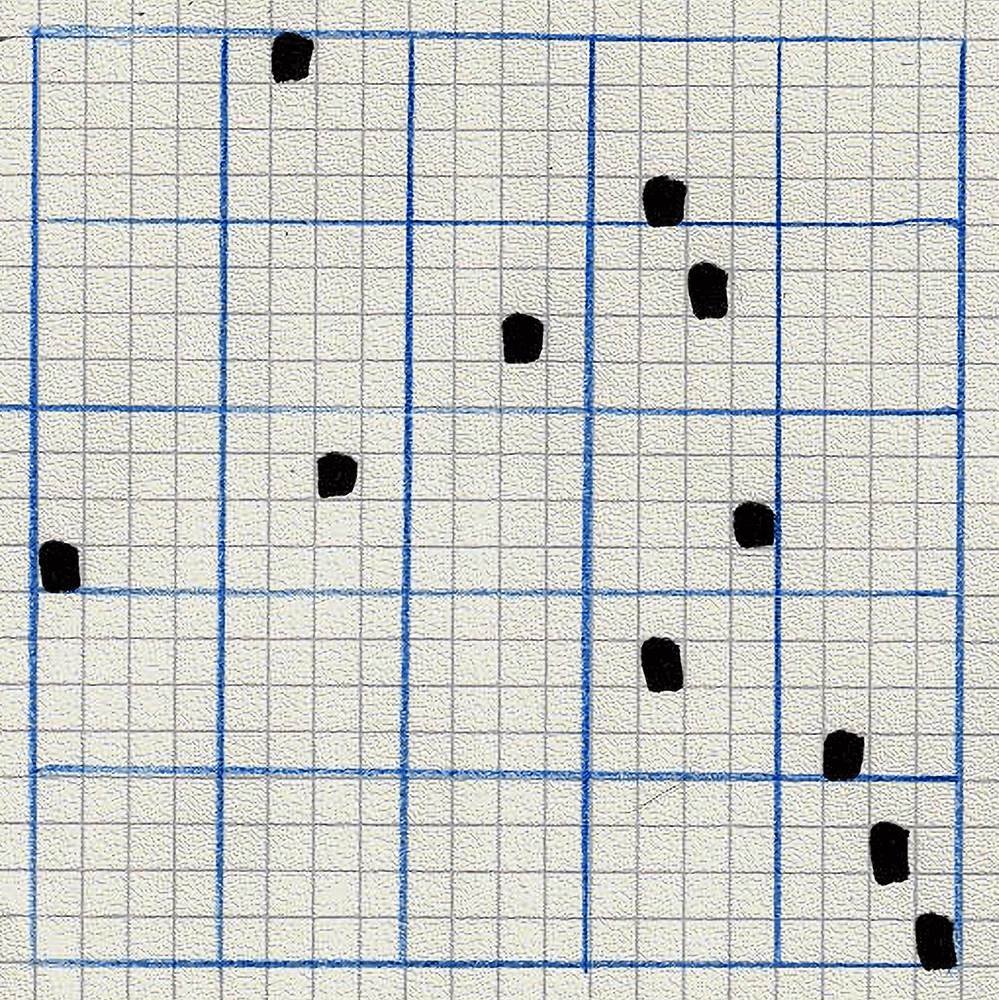
In Journal episode 9, I described a compositional process I began exploring in the 1980s. Inspired by Larry Austin’s groundbreaking Canadian Coastlines, I began tracing natural patterns onto graph paper. Particular points on the graph yielded 2-dimensional coordinate values that could be interpreted as timing and pitch information. The first patterns were shorelines, making the initial sketches for PENINSULA (1984, TC-50).
Having always been interested in astronomy, I then tried plotting star constellations on two-dimensional matrix graphs. The coordinates of each star in a constellation could be interpreted as time-point and pitch information, resulting in a complex arpeggiated group of notes. More intriguing was the capability to rotate the map, resulting in many possible variants that stretch or compress the rhythm and chord structure.
The first compositional product of the star map work, LIGHTFORMS 1 – Constellations (TC-65), scored for piano, was published by Borik Press in 1992. Naming these patterns, pitch-time chord arpeggios, as constellations became a breakthrough concept.
Arvo Pärt: Für Alina (1976)
The constellation Cassiopeia in the northern sky is named after the vain queen Cassiopeia, mother of Andromeda in Greek mythology. One of 48 constellations listed by the ancient astronomer Ptolemy, its distinctive ‘W‘ shape is formed by five bright stars. Cassiopeia contains some of the most luminous stars known, including three hypergiants. Its brightest star, Cassiopeia A (“Schedar”), is a supernova remnant and bright radio source.
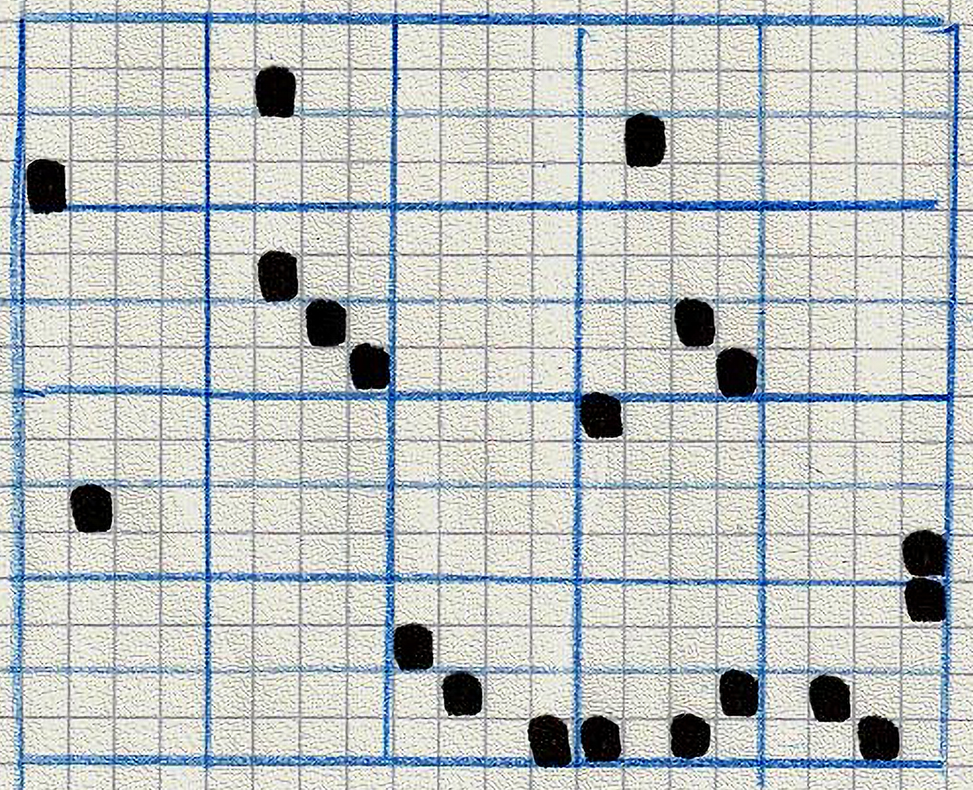
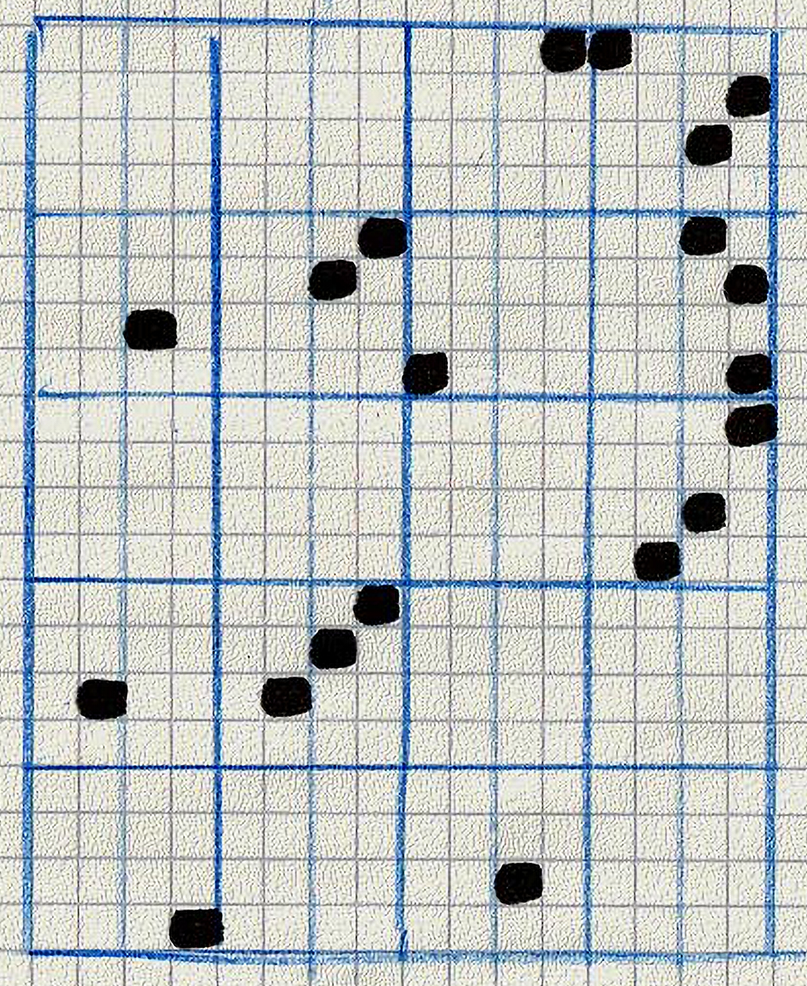
The music arose from tracing a map of its brightest points of light. The coordinates of these points on a two-dimensional graph were converted into time and pitch patterns articulating a grand sonority. The graph can be rotated, kaleidoscopically transforming the pattern into similar sonorities.
PERSEUS
CASSIOPEIA
CEPHEUS
ROTATED 90 degrees
The same treatment applied to Cassiopeia’s constellation neighbors Perseus and Cepheus builds a denser field of sounds. All this elaborate graphing and plotting may seem too complex and too abstract. The process, however, resulted in an intentionally abstract musical experience that metaphorically echoes the awe of viewing the brilliant star-studded dark sky through a powerful telescope.
Pondering the physics of molecular heat energy applied metaphorically to music . . .
Lower to higher energy of musical masses comes from four factors: Tempo — standing stillness to frenetic pace; Rhythm — regular pulse to unpredictably varied; Textural rhythmic alignment — synchronous to random; Loudness — hushed to explosive.
Starting with low-energy, low-temperature continuous cool sound, listen to a favorite piece by my late colleague, co-author and friend, Larry Austin. His 1982 score for double bass quartet is“dedicated to my friend and mentor, John Cage, in his seventieth year”. I describe it in my book:
“The harmonies sounded by ambient counterpoint will all consist of only the pitch classes C, A, G, and E, created by scordatura open strings and harmonics. And the open-ended improvisational nature of the work, expressed by an artistically drawn matrix score, is an obvious and elegant homage to Cage’s deep interest in chance and open form.”
Thomas Clark —
Larry Austin: Life and Works of an Experimental Composer
(Borik Press, 2012)
In gentle sustained tones, the texture moves continuously through a matrix of sound projecting a subtly changing but almost steady-state sonority. Very low temperature music . . .
The many bodies of water figuring prominantly in my life include:
Shiawassee (rural Michigan)
Huron (Ann Arbor)
Lake Michigan (Leelanau)
Puget Sound (Seattle)
Lake Spanaway (Tacoma)
Lake Texoma (Texas)
Vltava (the Moldau, Prague)
Green Lake and Duck Lake (Interlochen)
Lake Ray Roberts (Texas)
Albamarle Sound (Outer Banks)
Salem Lake (Winston-Salem)
Gulf of Mexico (Port Aransas)
San Marcos River (San Marcos)
Inspired by the great serenades for strings of Dvořák and Tchaikovsky, my string serenade explores musical metaphors for the physics of water in interesting atmospheric and geographic settings.
Three States of Water
Clark 2021, TC-107
I. Cold front (VAPOR becomes SOLID)
In low clouds on mountain tops, water vapor can become super-cooled and become freezing fog, filling the air with small ice crystals and freezing to surfaces, similar to very light snow. In the western United States, the common name for freezing fog is “pogonip.”
II. Ice Dunes (SOLID)
In the Leelanau Peninsula of Michigan, the Lake Michigan surf sometimes whips up and freezes in mid-air, forming weird ice caverns and ice dunes.
III. Nuages (VAPOR)
French for clouds, Nuages is one of Debussy’s three beautiful Nocturnes for orchestra, quoted here as a theme for variations. Water vapor is technically invisible. The clouds we see are actually masses of minute liquid droplets and frozen crystals. Thus this movement embodies all three states of water.
IV. Vltava (LIQUID)
The great river Vltava flows majestically through Prague. Smetana’s depiction of it in his monumental Ma Vlast is usually translated as The Moldau.
Quarks
The aggressive rhythmic character of the opening part of Joseph Schwantner’s 1980 piece is an opposite to the serenity of Austin’s art is self alteration is cage is . . . Boiling heat:
Modern physics understands that all matter is built up from just five fundamental “particles”: electrons, up quarks and down quarks with electrical charge; and gluons and photons with no electrical charge. They are not exactly particles, though, but infinitesimal points of spin in space/time.
That’s where the next sound composition experiment began. Two 4-pitch segments of the octatonic scale appear (“quarks”), then spin at their own speeds, while smaller 3-pitch sets (“electrons”) spin above and below them. At times, the sound mass explodes with a shower of electron sparks, then reforms.
More clouds! We had Nebula, clouds of gas and dust in space, then Nuages, puffy white clouds in a blue sky. Now storm clouds . . .
Meteorology
Clark 2022 (TC-121)
Nimbus
While quarks are hard to imagine and impossible to visualize, we love to watch puffy white cumulus clouds. Their kinetic energy becomes more visible when they grow into dark, precipitation-bearing cumulonimbus storm clouds, bringing rain and crackling electricity.
Squall
A tree limb branching out from a trunk, then smaller limbs branching from it, again and again to smaller and smaller branches — a classic example of a recursive process. Sometimes lightning shows this same recursive branching process. While the tree branches take years to fill out, lightning is a sudden explosion of electricity over a split second. Thunder, as sound travels much slower than light, is heard later than the lightning flash is seen — unless, of course, it is very close by!
My last summer working at what was then called the National Music Camp in Interlochen, Michigan was 1983. We spent as much time off as possible on the nearby shore of Lake Michigan. Three spots on the western edge of the Leelanau peninsula were favorite magical places. Otter Creek played out into a sandy delta at the beach, perfect for a picnic. Good Harbor Bay was an excellent shore for finding gray Petoskey stones, revealing fascinating hexagonal-shaped fossils when wet. Farther north, the Great Sleeping Bear Sand Dunes rise majestically hundreds of feet above the water’s edge.
Béla Viktor János Bartók’s monumental 1937 work, Music for Strings, Percussion and Celeste, begins with a mysterious, meandering line played by subdued violas. It sounds to me like walking at the water’s curving edge on a fog-shrouded beach. The line becomes the subject of a gigantic fugue, building to a powerful climax. In my imagination, we reach the sheer cliff of a massive bluff at the end of a Lake Michigan bay.
Of course, Bartók never saw Lake Michigan. But shorelines are a fascinating kind of fractal patterns in nature.
In 1980, Larry Austin received a commission from the Canadian Broadcasting System and KPFA for an experimental radiophonic work. For the premiere broadcast, the performers were in three different Canadian cities, synchronized by electronic signals! The mind-boggling result was a piece consisting of
“a massively contrapuntal texture, with many instruments playing continuous, independent lines, all in different, independent tempos. The contours of each contrapuntal part were determined using maps of Canadian coastlines.”
[Clark — Larry Austin: Life and Works of an Experimental composer. Borik Press, 2012, p. 40]
Glacially-etched shorelines also inspired sonic imagery for a series of my pieces culminating in PENINSULA. Mappings of the natural contours of the Leelanau Peninsula provided richly varied patterns as basic coordinate numbers for sculpting sound patterns. The piano explores some of the endless possibilities for articulating a spectrum of sonorities. A surrounding environment of synthetic sounds was made by digitally analyzing timbral qualities of acoustic instruments, mostly with percussive articulations (metaphorically the rocky shore). The timbres were modified and resynthesized into a pointillistic sound texture. The density of the sound events rises and falls in waves according to changing values derived from the basic mappings. Larger confluences of waves are located in time by map points of special significance on the graph.
The coexistence of piano sonorities and synthetic sounds is a metaphorical meeting of seascape and landscape, both animated in time.
There were many other groundbreaking pieces by my late friend and collaborator, Larry Austin. The first, Improvisationsfor Orchestra and Jazz Soloists, brought him to national prominence in 1964 with highly publicized broadcast performances by Bernstein and the New York Philharmonic.
As Austin moved into computer music, he began exploring compositional algorithms using mathematical models such as fractals.
Some of Charles Ives’ sketches for his monumental, never completed Universe Symphony were tracings of the outlines of rock formations. Austin studied deeply this Ives work starting in 1974 and eventually completed a version of Universe Symphony for expanded orchestras in 1993. In Austin’s own work beginning in 1976, mapping contours of mountain ridges and star constellations yielded musical patterns for First Fantasy on Ives’ Universe Symphony, Maroon Bells, and *Stars.
Constellations
Always interested in astronomy, I tried plotting star constellations on two-dimensional matrix graphs. The coordinates of each star in a constellation could be interpreted as time-point and pitch information, resulting in a complex arpeggiated group of notes. More intriguing was the capability to rotate the map, resulting in many possible variants that stretch or compress the rhythm and chord structure.
Cygnus
Cygnus rotated 90º
Orion
Orion rotated 90º
The first compositional product of this design work, LIGHTFORMS 1 – Constellations (TC-65), scored for piano, was published by Borik Press in 1992. Naming these patterns, pitch-time chord arpeggios, as constellations became a breakthrough concept
In my book, Mapping the Music Universe, I cite a remarkable pioneer of cartography. “William Smith, a rural surveyor, in 1799 drew a colorful map of the subterranean rock strata of his county in English coal country, launching the modern science of geology.” The map was extraordinary not only as a scientific breakthrough, but also visually by his hand coloring each huge copy.
As digital synthesizers came along, sound making with computers offered more calculated control of the timbral (tone color) spectrum. My astronomical metaphor continued with a 1993 piece, using the then state-of-the-art Synclavier II digital synthesizer to “color” the constellation patterns of LIGHTFORMS 1. Reflecting the varied colors of stars, I built color families of sound, distinguishing unique frequency-modulation ratios for each group.
LIGHTFORMS 2: StarSpectra
Clark 1993 (TC-68)
In 1887, French astronomer Amédée Mouchez launched an ambitious international star-mapping project (Carte du Ciel) at the Paris Observatory. It was never finished, until now the challenge has been taken up by the new Vera C. Rubin Observatory (formerly the Large Synoptic Survey Telescope) in Chile. It is conducting the Legacy Survey of Space and Time, repeated astronomical surveys of the entire southern sky.
From wandering forest paths to trekking scenic shorelines, my life has always been full of ambient exploration. Mapping has become my grand metaphor for exploring musical territory, culminating in the book, Mapping the Music Universe. It begins:
“The heavenly motions are nothing but a continuous song for several voices, perceived not by the ear but by the intellect, a figured music that sets landmarks in the immeasurable flow of time.”
— Galileo Galilei
“When we gaze at stars and planets, they appear as stationary points of light, fixed in place in what seems a random pattern across the entire night sky visible to our hemisphere. Time stands still.
“Throughout human time, humans have imagined that stars make picture patterns we name as constellations: fish, warriors, goddesses, animals. Only the persistent observers, such as astronomers, identify their nightly march across the sky, rising in the east and disappearing below the western horizon.”
In Mapping the Music Universe, a studied journey through musical time, pitch, and structure, many composed examples took on characters of named constellations, galaxies, and galaxy clusters. They coalesced into 12 etudes, collected here as “a continuous song.”