For this first mapping lab, a basic experimental process is outlined step-by-step and demonstrated with examples from a sample composition. Once you’ve studied the example piece, you can start over and craft your own experiment using the same open steps. General instructions leave you free to openly consider and choose from many musical possibilities.
1. Choose a model
Trois Gymnopédies (1888) by Erik Satie
Simple in harmony, meter, melody, texture, repetitive form.
2. Design a theme
Start with a pair of 4-note constellations of considerable interest due to their symmetrical interval stacks and “perfect fifth” 7-semitone interval separated by a smaller interval. (See “Symmetrical interval arrays.”)
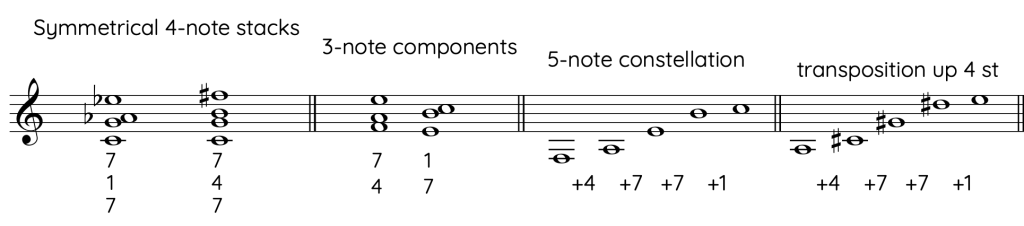
We’ve made two chords, both with the same identical interval stack.
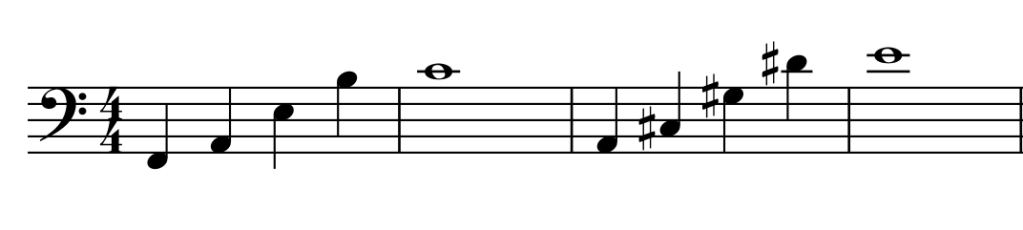
3. Choose a meter and rhythm/tempo character.
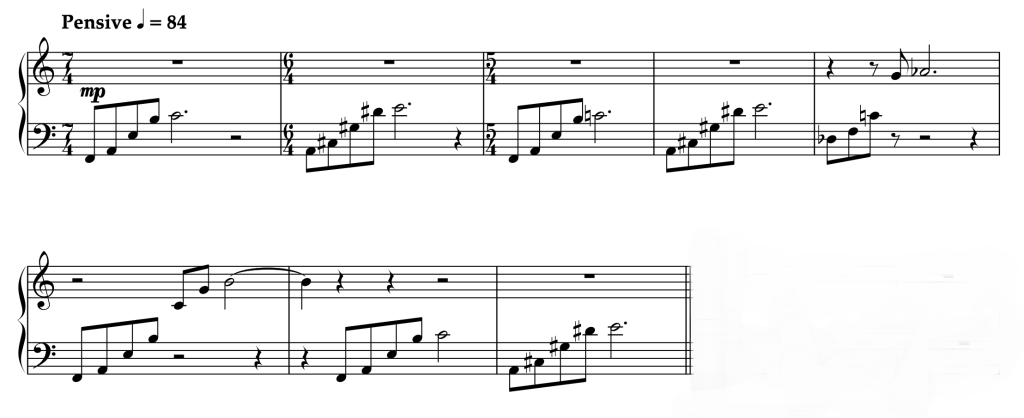
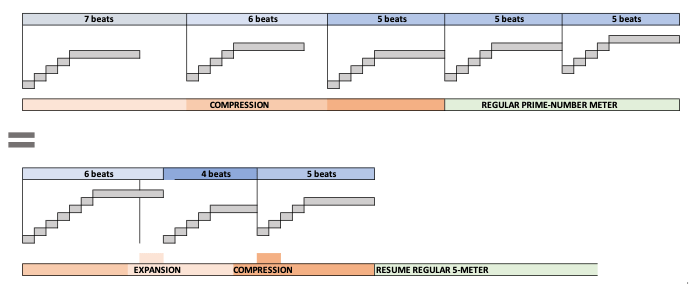
A prime-number meter (such as the 7 4 meter used for the Finale of Stravinsky’s Firebird) can have a more “timeless” quality, due to its lack of layers of nested pulse between beats and bars. The prime number of beats prevents them from grouping into regular sub-measure groupings.
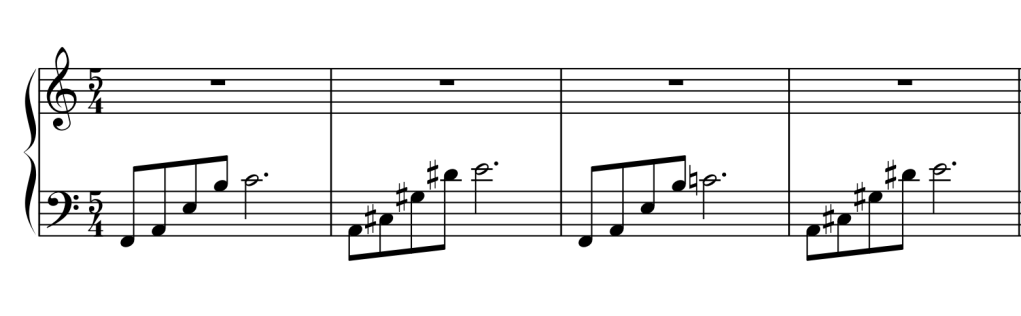
To follow through further on the floating feel of lacking groupings, let’s stretch the timings a bit between arpeggios.
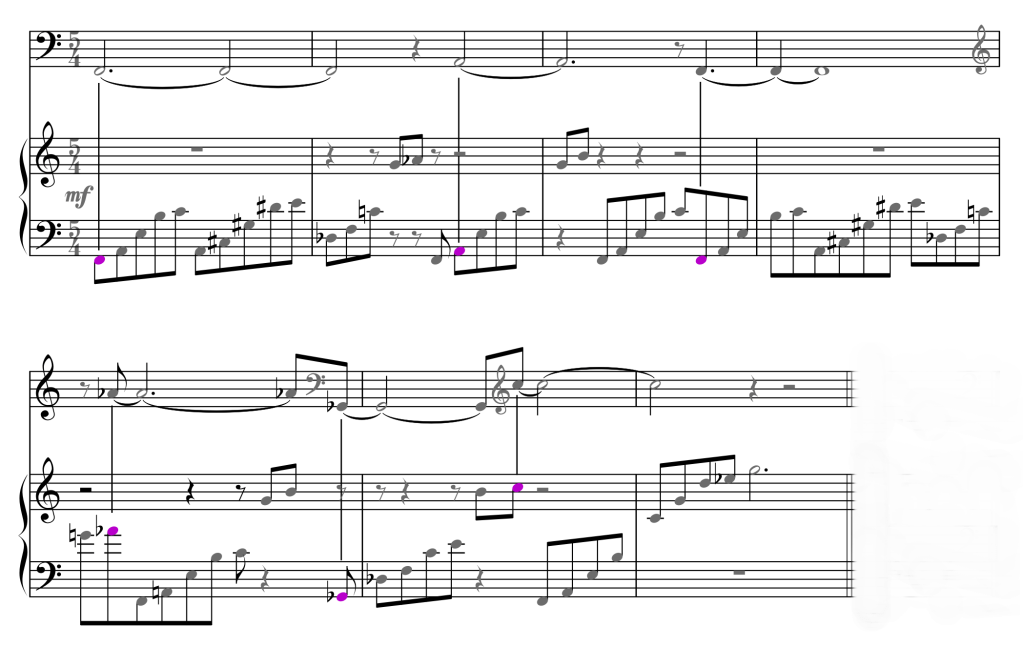
4. Add a line and sound color to the texture
I call this technique extraction or refraction, pulling selected tones of a complex line into a separate voice:
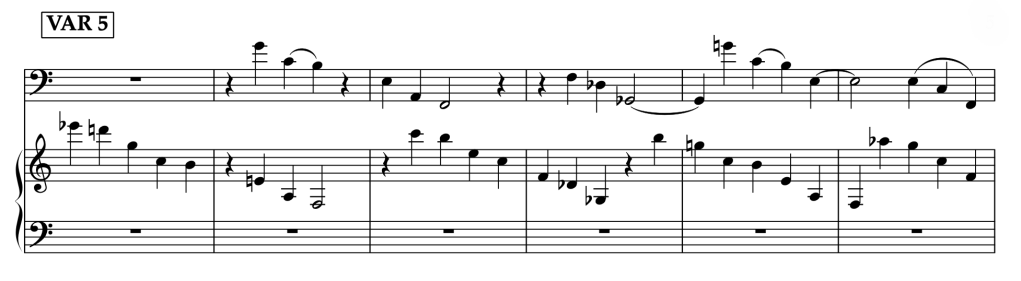
5. Make variations
Arpeggios with refracted color line:
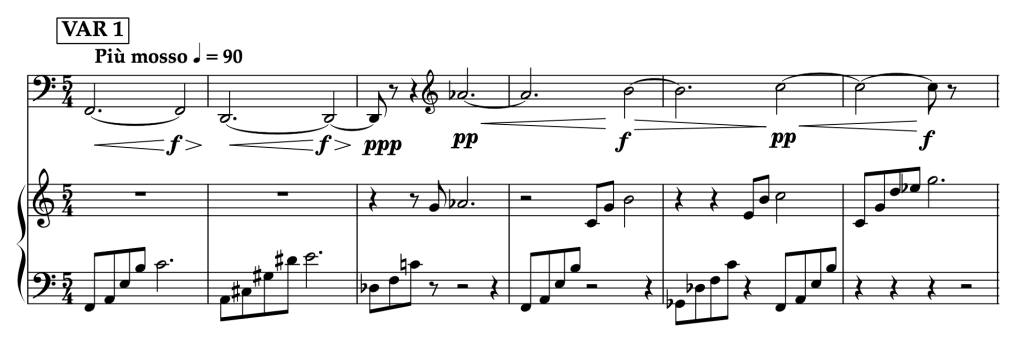
Pull the 8th-note arpeggios into a continuous stream:
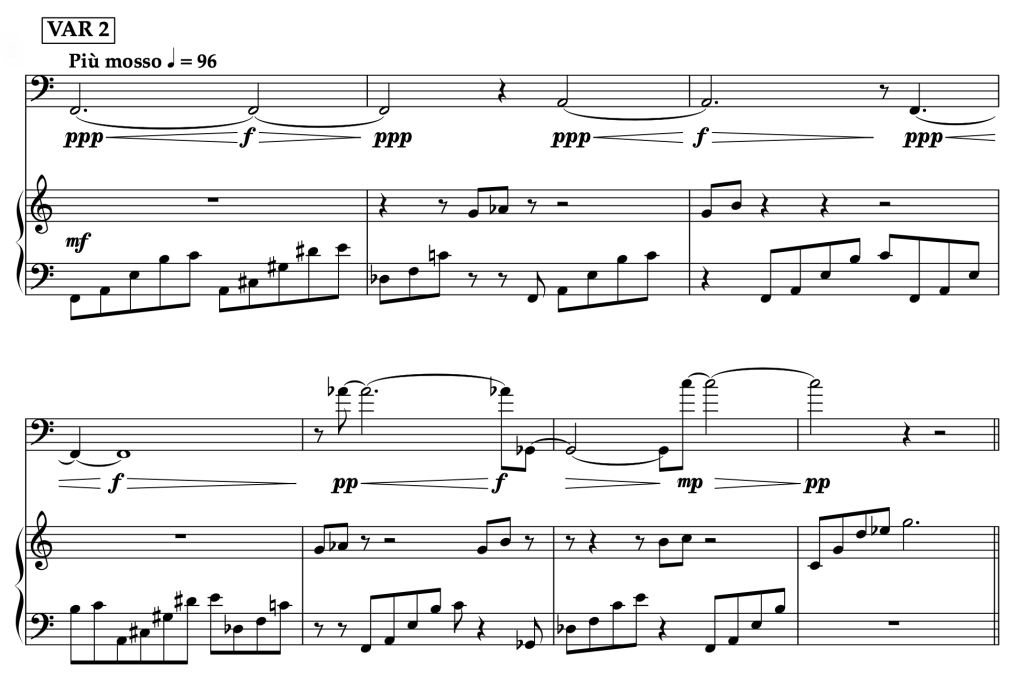
Canon at the octave:
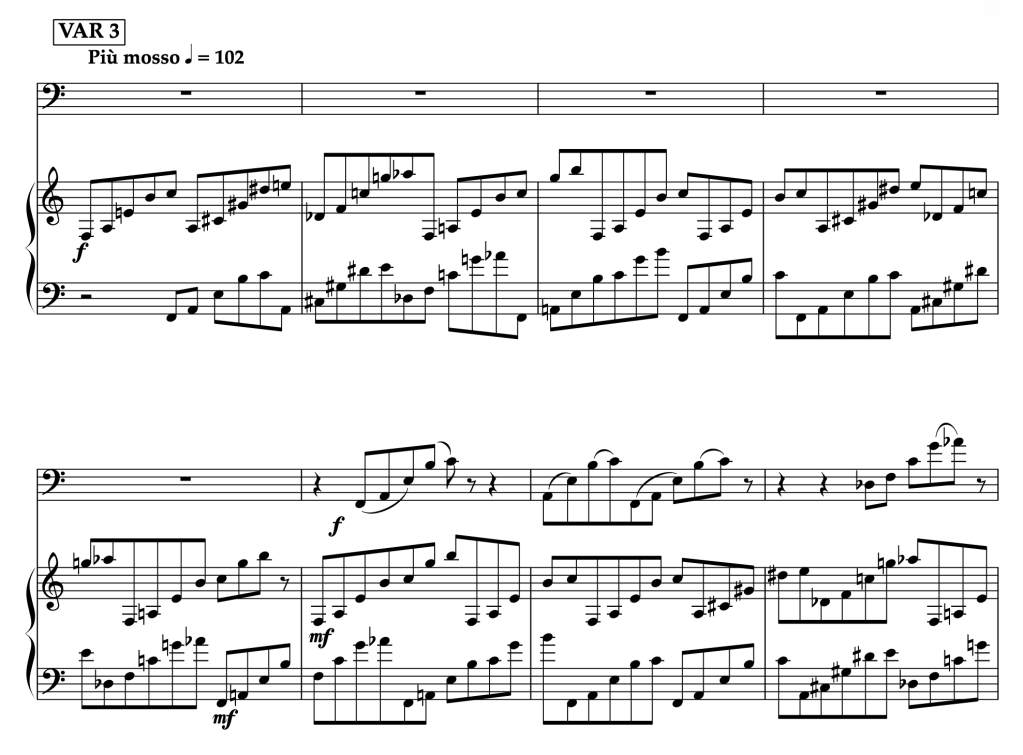
Rhythmic augmentation, without then with the refracted color line:
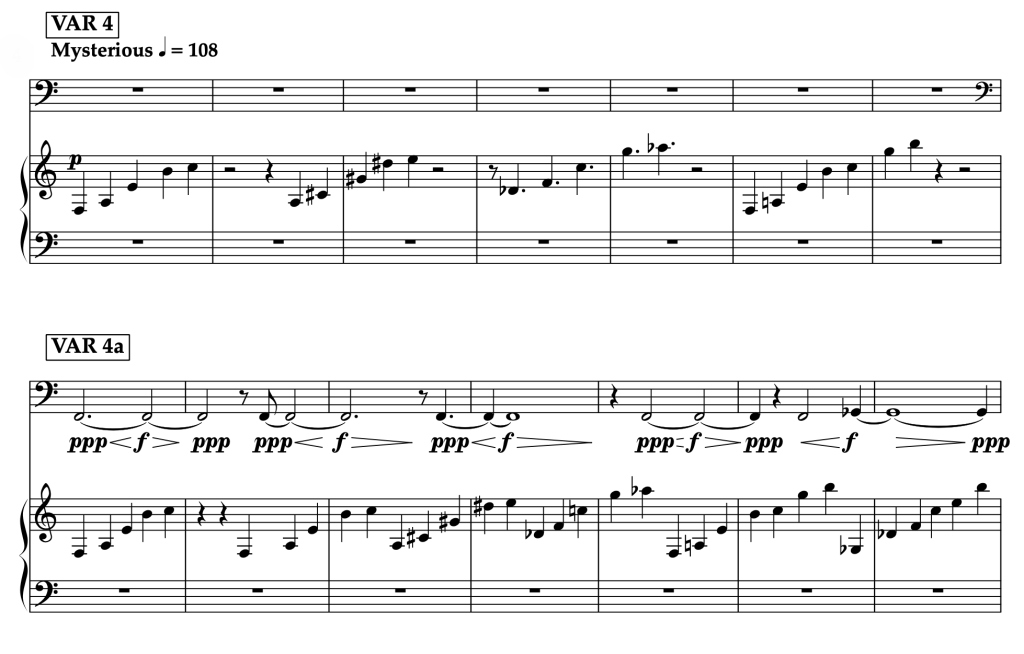
Mirror inversion of augmentation, canon:
6. Assemble the large-scale form
The theme and each variation end with a clear cadence, a sustained final note and pause in rhythmic activity . . . except Variation 3, the continuous 8th notes. It morphs into a transition that both interrupts the 8th-note flow and slows the tempo, preparing for calmer, much less dense quarter-note variation:
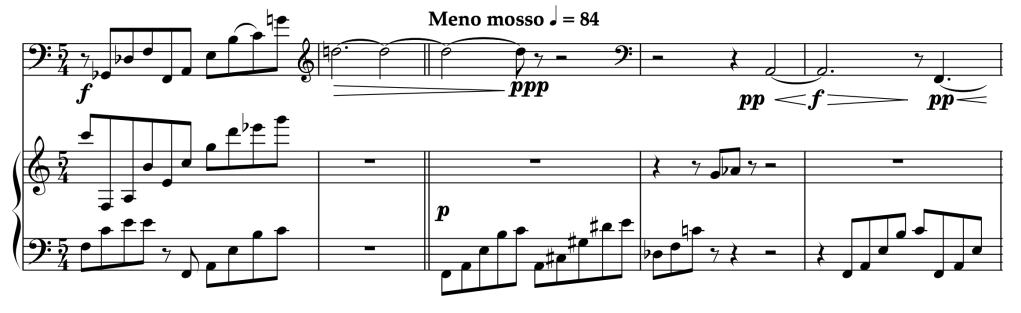
The variation process is serial, each one progressing from the previous idea, rather than “starting over” each time. Thus the overall unfolding form feels evolutionary rather than episodic. Then a kind of recap does start over with a return to the opening idea, making a rather traditional coda ending,
6. Title
This musical sketch, like most of my pieces, was composed without a title or guiding image. The compositional process began with the basic challenge to make a small piece out of simple, limited material. The adopted model was Satie’s radically sparse, (one could even say) minimalist style in his Trois Gymnopédies for piano (1888), Its title may have been taken from a French poem by J. P. Contamine de Latour — the poem ends with the word gymnopédie:
Oblique et coupant l’ombre un torrent éclatant
Ruisselait en flots d’or sur la dalle polie
Où les atomes d’ambre au feu se miroitant
Mêlaient leur sarabande à la gymnopédie
Slanting and shadow-cutting a bursting stream
Trickled in gusts of gold on the shiny flagstone
Where the amber atoms in the fire gleaming
Mingled their sarabande with the gymnopaedia.
My title will adopt the English translation of one selected metaphor: Amber Atoms in the Fire Gleaming.
7. The finished piece
In keeping with the Satie models, this study generates entirely from one modern harmonic constellation, arpeggiated repeatedly in a gentle, almost imperceptible meter, then growing colorful “amber” sustained highlight sounds. Eventually the arpeggios begin to spin and swirl in a layered, kaleidoscopic texture that is “minimalist” in the 20th-century usage as the description for repetitive ostinato music.
8. Test sample
Listen without looking at a score, the best way to first sample created art:
Amber Atoms in the Fire Gleaming
–
Continue reading Mapping the Music Universe . . .
MapLab 2. Sketch a Song
–