Tag: nebula

  • 17. First Light

    McDonald Observatory, 2010 —

    When a new telescope is commissioned and opens its optics for the first time, it captures its “first light.” I got up close below the 10-meter Hobby-Eberly Telescope on Mt. Fowlkes at the McDonald Observatory in the Davis Mountains just a few years after it was commissioned.

    When Texas State University opened its new Performing Arts Center, the 2015 inaugural concert in the acoustically splendid Recital Hall was a program metaphorically titled “First Light.”

    Magic song

    An older “First Light” reference is to native American mythology, which tells origin stories of the First People who emerge from the Dark World into the light of the rising sun (the Blackfoot sun god is called Natosi). In Navajo mythology, “Early on the morning of the fourth day, Little Dawn Boy began to sing his magic song. As he finished the song, an arch of shimmering light, all rose, violet, blue, and every color, and delicate as a veil, began to stretch from the summit of the purple mountain to the top of the white cliff. He then saw a bright rainbow bridge grow before his eyes. Singing with delight, he hastened over the Rainbow Bridge. As he ran a wind sprang up and blew a many-colored mist to the top of the cliff.” [First People: American Indian Legends]

    First Light

    Clark 2018 (TC-93)

    Gas giants

    Gustav Holst’s The Planets (1917) is revered for its masterful orchestration evoking the majesty of the solar system. The final movement portrays the dim, distant last light we can see in it — the planet Neptune’s pure, mystical light.

    LISTEN ›

    Royal Liverpool Philharmonic

    We all enjoy the mysterious splendor of moon rise, large and deeply-hued in the eastern evening sky. My sonic metaphor for that visual phenomenon portrays instead the rising of Jupiter, the largest object in the solar system other than the sun itself. It only looks much, much smaller to us than the moon because it is so much farther away.

    One of my favorite Mozart symphonies is Symphony No. 41 in C Major, K.551. His longest and last symphony, it is nicknamed “Jupiter” — fitting that his lengthiest and greatest symphony is named for the largest planet, a great gas giant. A vivid musical motive begins and generates the majestic final movement.

    I relentlessly deploy that motive as the canonic subject for Jupiter Rising. My rhythmic setting of the motive is designed irregularly, so that the two lines seldom move at the same time in what I would call a contrapuntal accent. This creates a floating quality of the contrapuntal rhythm. At some moments, as many as eight contrapuntal soundings overlap each other in a cloud-like texture.

    One refreshing feature of a sound sculpture is this freedom from the metric march of time. The music does not progress, but instead creates a sonic cloud to be experienced by relaxed absorption and contemplation.

    Jupiter Rising

    Clark 2020 (TC-103)
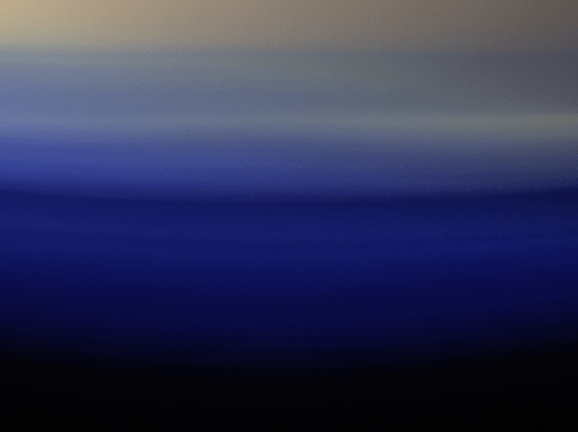
    The largest of Saturn’s moons is also the second largest moon in the Solar System. Its dense atmosphere obscures a unique feature: it is the only place beyond Earth on which clear evidence has been found of stable bodies of surface liquid.

    That may be partly why an experimental extreme-depth earth-ocean submersible vehicle was named for it. The Titan submersible famously imploded in 2023 while headed down to view the shipwreck of the Titanic in the cold North Atlantic.

    Our imaginary musical exploration of the moon Titan, its atmosphere and ocean depths, is completely tranquil, experiencing only gentle waves and currents of dark and brighter sonorities.

    Titan Sea

    Clark 2023 (TC-135)
    Nebula

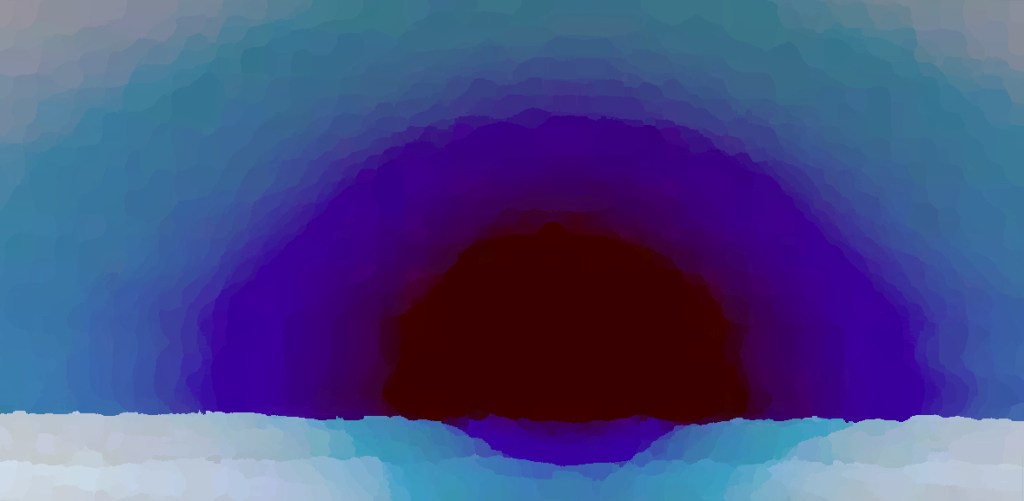
    Far beyond our solar system, nebulae are where other stars and planetary systems are formed from collapsing clouds of gas and dust. One of the most familiar and well studied objects in space, the Orion Nebula is enormous, 24 light-years across with a mass of about 2,000 times that of the Sun.

    Debussy’s “Nuages” (Trois Nocturnes, 1892-99) depicts earthly clouds as gently undulating, colorful orchestral lines and chords. For a soundscape of cosmic nebulae, my generating concept is similar: a slow, almost timeless metamorphosis of complex 4-pitch constellations, some bright, some darker “celestial” harmonies.

    NEBULA

    Clark 2024 (TC-139)

    ______________

  • 16. Thermal Energy

    San Marcos, 2012 —

    Pondering the physics of molecular heat energy applied metaphorically to music . . .

    Lower to higher energy of musical masses comes from four factors: Tempo — standing stillness to frenetic pace; Rhythm — regular pulse to unpredictably varied; Textural rhythmic alignment — synchronous to random; Loudness — hushed to explosive.

    Starting with low-energy, low-temperature continuous cool sound, listen to a favorite piece by my late colleague, co-author and friend, Larry Austin. His 1982 score for double bass quartet is“dedicated to my friend and mentor, John Cage, in his seventieth year”. I describe it in my book:

    “The harmonies sounded by ambient counterpoint will all consist of only the pitch classes C, A, G, and E, created by scordatura open strings and harmonics. And the open-ended improvisational nature of the work, expressed by an artistically drawn matrix score, is an obvious and elegant homage to Cage’s deep interest in chance and open form.”

    Thomas Clark —

    Larry Austin: Life and Works of an Experimental Composer

    (Borik Press, 2012)

    In gentle sustained tones, the texture moves continuously through a matrix of sound projecting a subtly changing but almost steady-state sonority. Very low temperature music . . .

    LISTEN ›

    Water sounds

    The many bodies of water figuring prominantly in my life include:

    • Shiawassee (rural Michigan)
    • Huron (Ann Arbor)
    • Lake Michigan (Leelanau)
    • Puget Sound (Seattle)
    • Lake Spanaway (Tacoma)
    • Lake Texoma (Texas)
    • Vltava (the Moldau, Prague)
    • Green Lake and Duck Lake (Interlochen)
    • Lake Ray Roberts (Texas)
    • Albamarle Sound (Outer Banks)
    • Salem Lake (Winston-Salem)
    • Gulf of Mexico (Port Aransas)
    • San Marcos River (San Marcos)

    Inspired by the great serenades for strings of Dvořák and Tchaikovsky, my string serenade explores musical metaphors for the physics of water in interesting atmospheric and geographic settings.

    Three States of Water

    Clark 2021, TC-107

    I. Cold front (VAPOR becomes SOLID)

    In low clouds on mountain tops, water vapor can become super-cooled and become freezing fog, filling the air with small ice crystals and freezing to surfaces, similar to very light snow. In the western United States, the common name for freezing fog is “pogonip.”

    II. Ice Dunes (SOLID)

    In the Leelanau Peninsula of Michigan, the Lake Michigan surf sometimes whips up and freezes in mid-air, forming weird ice caverns and ice dunes.

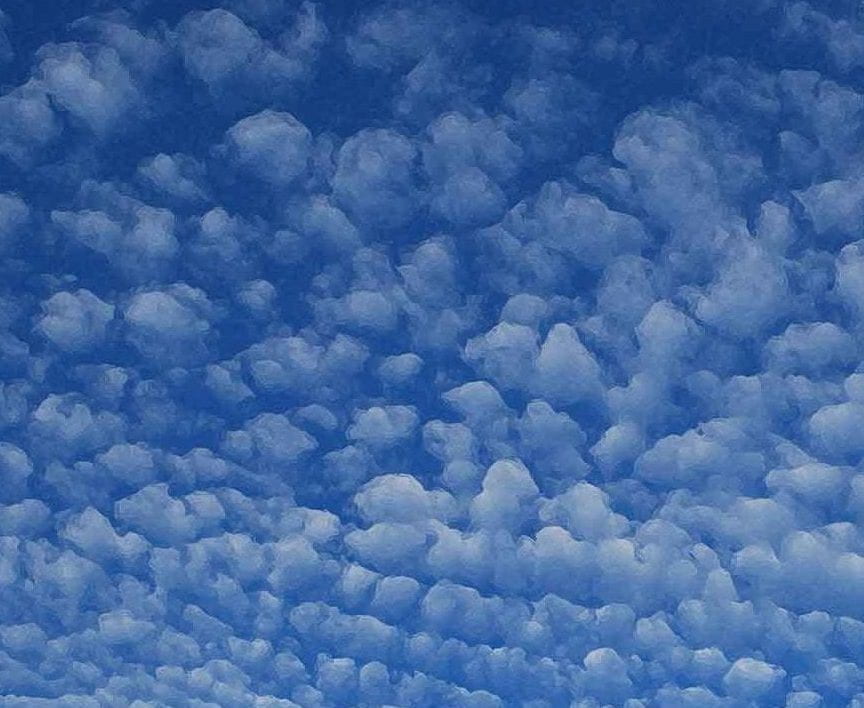
    III. Nuages (VAPOR)

    French for clouds, Nuages is one of Debussy’s three beautiful Nocturnes for orchestra, quoted here as a theme for variations. Water vapor is technically invisible. The clouds we see are actually masses of minute liquid droplets and frozen crystals. Thus this movement embodies all three states of water.

    IV. Vltava (LIQUID)

    The great river Vltava flows majestically through Prague. Smetana’s depiction of it in his monumental Ma Vlast is usually translated as The Moldau.

    Quarks

    The aggressive rhythmic character of the opening part of Joseph Schwantner’s 1980 piece is an opposite to the serenity of Austin’s art is self alteration is cage is . . . Boiling heat:

    LISTEN ›

    U.Mich. Symphony Band

    Modern physics understands that all matter is built up from just five fundamental “particles”: electrons, up quarks and down quarks with electrical charge; and gluons and photons with no electrical charge. They are not exactly particles, though, but infinitesimal points of spin in space/time.

    That’s where the next sound composition experiment began. Two 4-pitch segments of the octatonic scale appear (“quarks”), then spin at their own speeds, while smaller 3-pitch sets (“electrons”) spin above and below them. At times, the sound mass explodes with a shower of electron sparks, then reforms.

    More clouds! We had Nebula, clouds of gas and dust in space, then Nuages, puffy white clouds in a blue sky. Now storm clouds . . .

    Meteorology

    Clark 2022 (TC-121)

    Nimbus

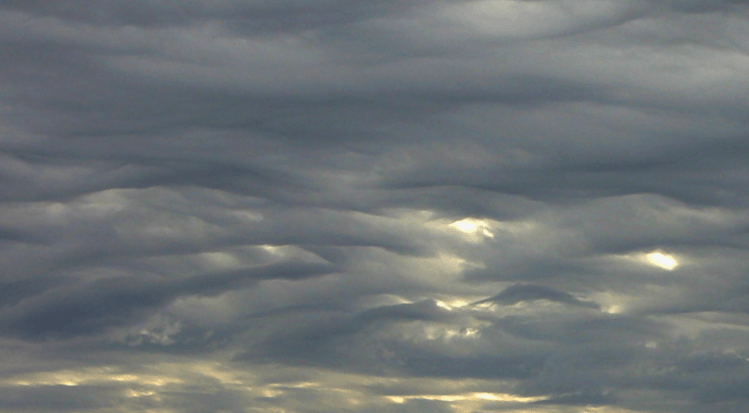
    While quarks are hard to imagine and impossible to visualize, we love to watch puffy white cumulus clouds. Their kinetic energy becomes more visible when they grow into dark, precipitation-bearing cumulonimbus storm clouds, bringing rain and crackling electricity.

    Squall

    A tree limb branching out from a trunk, then smaller limbs branching from it, again and again to smaller and smaller branches — a classic example of a recursive process. Sometimes lightning shows this same recursive branching process. While the tree branches take years to fill out, lightning is a sudden explosion of electricity over a split second. Thunder, as sound travels much slower than light, is heard later than the lightning flash is seen — unless, of course, it is very close by!

    ______________