What is a scale? Its essence is an interval pattern, selecting which pitches out of the entire chromatic possibilities become scale steps. Successive interval arrays are a vivid way to describe its pattern:
SCALE PATTERN — periodic interval pattern that cycles through each octave, defining which pitch-classes from the 12 possibilities are degrees of the scale
In that sense, it is a theoretical circle, starting over in each octave — or more imaginatively, a spiral. Let’s visualize the natural-note white keys on the keyboard, a prime example of the ubiquitous diatonic scale, as a circle.
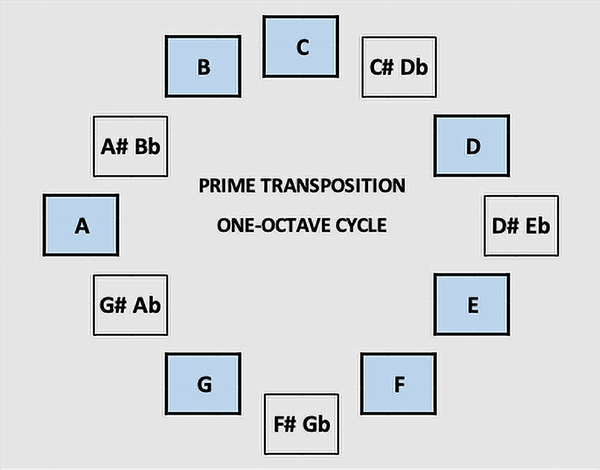
diatonic scale circle
Now an unlooped visualization as stair steps, rungs on a spiral ladder:
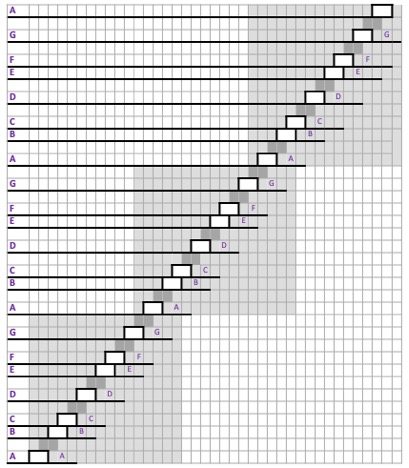

diatonic scale cycling through three octaves
Anyone familiar with the white and black keys of a piano will recognize this pattern!
Chroma
Almost all scales in both Western music and other art-music traditions are built on the framework of octave equivalence, the close affinity of two pitches that are one or more octaves apart. We give them the same pitch name – all called “C” or “F#” for example. This makes the circular nature of a scale, that its pitch names and the intervals between them start over at the octave and repeat.
We also have the feature on an equal-tempered piano that one black key produces a pitch with two possible names depending on the scale in which they appear. For example, the D# seventh scale degree in an E Major scale is the same piano key as an Eb, the fourth scale degree in a Bb Major scale. The two pitch names are said to be “enharmonic.”
When a melodic line in an all-white-key C major scale introduces an F# for color or to temporarily alter the interval terrain, we call it a chromatic tone, after the Greek word for color, chroma. Now we have a comprehensive scale of all possible pitches. Going further, theorist Allen Forte defined a way to reduce all the pitches in an entire eight-octave chromatic pitch space into just twelve categories:
PITCH CLASS — a set of all pitches that are octave and/or enharmonically related
He gave them pitch-class numbers 0 through 11.

chromatic scale
In the advent of computer systems to produce, edit, and analyze musical sound, a sound’s identified pitch class is termed its chroma.
Synesthesia – some people, such as the composer Scriabin, actually see a color when they hear a pitch or a tonal key. In his variant of synesthesia, C is red, G is orange, D yellow, and A green. Scriabin’s Promethius: The Poem of Fire (1910) includes a part for “clavier à lumières,” a color organ that emitted light of what he deemed the appropriate color for a pitch instead of sound.
Scale prototypes
When we describe a scale, we name the pitches in order within an octave. Better yet, we name the successive intervals going up within the octave. The classic description of the ubiquitous diatonic scale, in whole-steps or half-steps, in its major mode starting on the tonic pitch, is:
whole / whole / half / whole / whole / whole / half
[octave repeats the cycle]
Or in British terms:
tone / tone / semitone / tone / tone / tone / semitone
In the chromatic 12-tone universe, that scale pattern measuring the intervals in semitone sizes would be:
2 2 1 2 2 2 1
That is what I would call a scale pattern . . . a Successive Upward Interval Sequence in Semitones (SUISS!). But let’s call it a scale pattern array, working exactly like the arrays describing constellations.
Now we can particularize our scale pattern definition to apply to any smaller set of pitch classes, even if they don’t look like a scale:
SCALE ARRAY — successive interval array describing the pitches of a constellation condensed by octave equivalence to their most compact pitch-class-equivalent arrangement within an octave, ordered lowest-to-highest (Forte’s “normal order”)
In this sense, the array of a smaller set or scale fragment is just like a scale pattern.
Successive Interval array is a versatile tool that can apply to any pitch collection, to a linear, scalar pitch pattern as well as to a vertical chord sonority or even an arpeggiated diagonal collection of pitches I call a constellation.
Modes
Most of our familiar scales are actually a different mode of the same 7-note diatonic scale, with a different starting and ending point called a tonic establishing the mode.
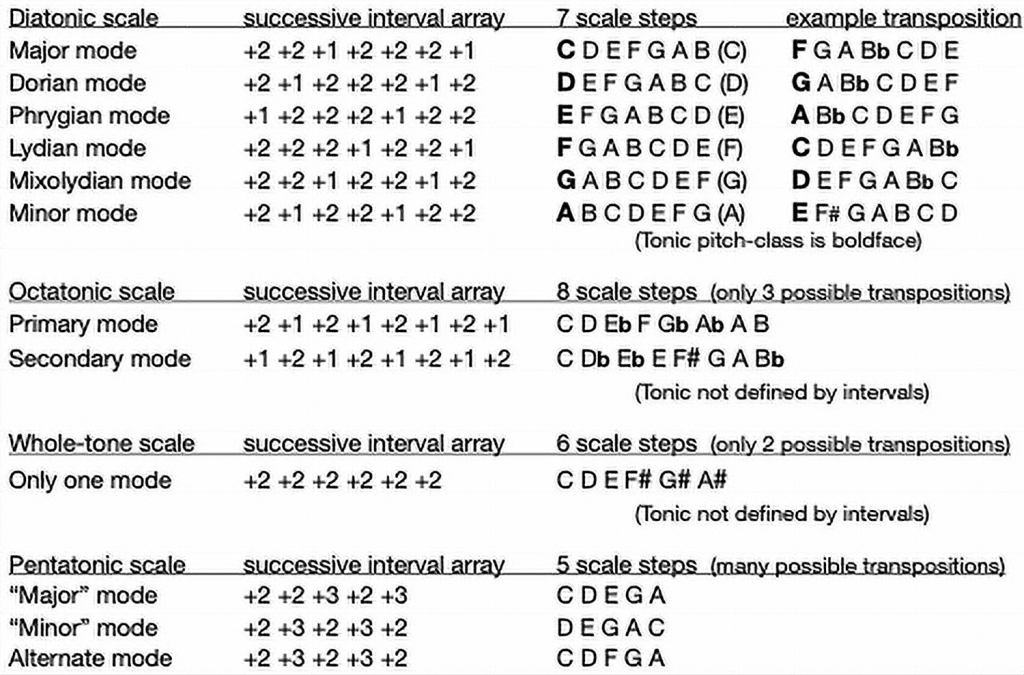
scale modes
Scale patterns / set classes
We can describe a set of pitches as an octave-compressed abstraction of 3 or 4 pitches as a lowest-to-highest ordering of pitch classes. It doesn’t produce anything like the 7 or so notes per octave we’re used to thinking of as a scale, as those shown above. It is conceptually powerful, nonetheless, to call the successive interval array of this compressed abstraction a scale pattern, even though it’s a scale fragment with no name. Its name can simply be the successive interval array, such as 2 4 2, the array describing a symmetrical pitch-class set called the French Augmented Sixth chord.
[Theoretical aside] In establishing set theory, Forte described these compact arrangements by naming the pitch-classes in order using a mod-12 number system shown above, C=0, C#/Db=1, D=2, etc. He identified twelve 3-note classes, including upside-down inversions reversing the scale pattern, as members of the same class. (Lewin kept these inversions separate, defining instead nineteen 3-note set classes. We’ll use Forte’s; the set classes as generalities are not as crucial to composing as to theoretical analysis.) Forte used cumbersome descriptions employing pitch-class numbers and “normal order.” In the Journal of Music Theory 15 (1971), Richard Chrisman defined and proposed successive interval arrays as a better, more revealing way to characterize the commonality of a family of pitch-class sets that are all related by transposition and/or inversion.
Relating to Forte’s concept of a set class, any set grouping three pitch-classes can be analyzed as an interval array or partial scale pattern.
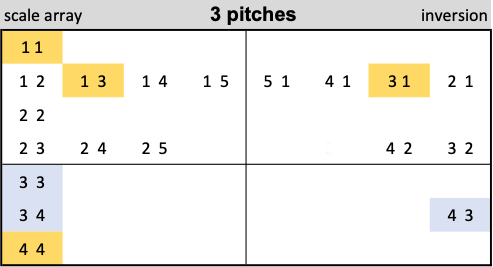
scale patterns of all 3-pitch-class sets
Sets forming triads (or seventh chords below) are highlighted in BLUE; those that are atonal (cannot be found in a diatonic scale) are highlighted in GOLD.
While the number of possible interval arrays for constellations of four pitches is enormous — even if limited to interval stack sizes less than two octaves, there are more than 12,000 possibilities — we can use this scale-pattern abstraction tool to categorize them into forty-three 4-pitch-class families.
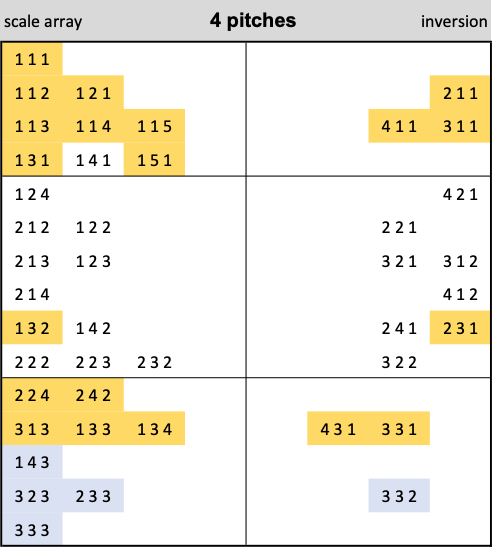
scale patterns of all 4-pitch-class sets
The blue-highlighted scale patterns have common triadic chord names:
- 1 4 3 = “Major Major 7th chord” (in any chord inversion)
- 3 2 3 = “minor minor 7th chord” (in any chord inversion)
- 3 3 2 = “dominant 7th chord” (in any chord inversion)
- 3 3 3 = “fully diminished 7th chord”
The scale pattern 2 4 2 is an interesting symmetrical, non-diatonic pattern called a “French augmented 6th chord”.
Vocabulary
These maps collecting 62 scale-patterns summarize all possible constellations of 3 or 4 unique pitches, our total harmonic vocabulary in the chromatic universe.


