Blue Ridge Mountains, 2005 —
In 2005 through 2008, I lived in North Carolina only an hour away from the Parkway. October Saturdays always involved a scenic drive up to the Parkway to absorb the glorious fall colors and trickling of secret waterfalls. So many wonderful waterfalls, I recorded many videos, mostly for the sound.
Falling Water
Clark 2016 (TC-82)

Concrète
Some of the earliest electronic music compositions in the 1950s were called “Musique concrète” because they used recorded “real” sounds instead of electronically produced ones.
LISTEN ›
Pierre Schaeffer (1959)
Back to planets, spheres . . .
Ever since it was viewed and photographed from space by Apollo 17 in 1972, Planet Earth has become known as the Blue Planet.

Such a distant perspective reveals the pervasive blue water of oceans, brilliant white of cloud layers, and some brown/green shapes of land masses beneath.
Magic of Pi
It also reveals the spherical shape of our globe. (Euclid said a sphere is a hollow 3-dimensional rotation of a circle, and scientists have measured that Earth is not a perfectly round ball but a solid ellipsoid.) Nonetheless, the eternal, perfect rotating sphere is our iconic notion of Earth’s shape.
Spheres and the Euclidean circle that generates them in three dimensions are governed by the mathematical constant π, defined in Euclidean geometry as the ratio of a circle’s circumference to its diameter.
Pi is magic, an irrational number that cannot be expressed as a common fraction. Its decimal calculation never ends, never settling into a repeating pattern of digits, which appear to be random . . . and infinite. It starts 3.1415926535897932384626433 . . .
The beginning of its decimal expression — 3 1 4 1 5 9 — was used in composing Blue Sphere as both a rhythmic timing pattern and a corresponding dance of the lowest 9 pitches of a Pythagorean overtone series.

This is one way to literally hear π, expressing musically the eternal restlessness of our rotating blue sphere, its tides, weather, techtonic plates, etc.
Blue Sphere
Clark 2022 (TC-119)

Prime numbers
Back to the “real” sounds of musical instruments . . .
Included in my “Animated Landscapes” Sketchbook for small orchestra, Appalachian Autumn (2024, TC-142) by its title pays homage to Copland’s 1944 masterpiece, Appalachian Spring. My currently developed harmonic sensibilities resemble Copland’s open, bold sonorities. In my composition studies in the 1970s, I was fascinated by Appalachian Spring the ballet as originally scored for only 12 orchestral instruments. This original scoring was a masterpiece of orchestral painting blended with the clear contrapuntal lines of chamber music, highlighting each instrument’s colorful voice.
LISTEN ›
Perspectives Ensemble
The number 12 is interesting in that it is readily divisible in four different ways with just whole numbers (integers). A set of 12 items can be divided neatly into two groups of 6 items each, three groups of 4 each, four groups of 3, or six pairs. That relates to common musical meter signatures of 2, 3, 4, or 6 beats per measure that break down into equal subdivisions.
A prime number is interesting in that it cannot be divided without fraction by any whole number. There are theoretically an infinite number of prime numbers, but the smallest that are useful for our pattern purposes are 1, 2, 3, 5, 7, 11, 13, 17, 19, etc. The only even prime number is 2; taken out, it leaves an interesting set of odd primes, 1 3 5 7 11, that as time chunks make rhythms that do not break down into subgroups, seeming to float rather than march.
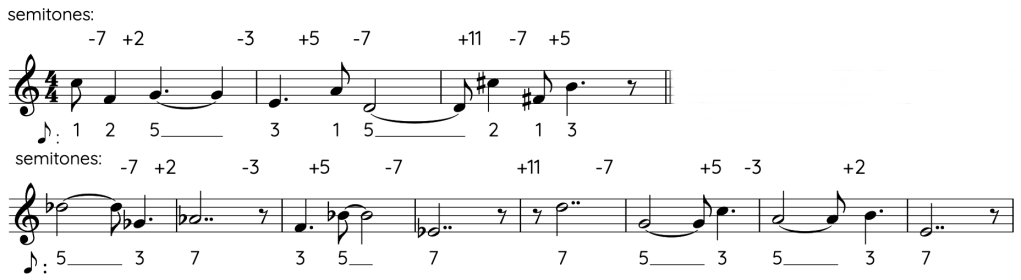
In this illustration, the durational note values are measured below in number of eighth-notes of time. Melodic intervals are measured above in number of semitones (“half steps”). Both the intervals and the duration values measure in only prime numbers. That means though the passage is written in 4 4 time, no measure breaks down into half-measure subunits; and no duration note value is immediately repeated. The rhythm cannot be felt as marching quarter notes in half-note pairs, and even some of the downbeats avoid being moments marked by a new note. The rhythm floats, like the curving Blue Ridge Mountains skyline.
Palindromes
The basis for pitch organization in Appalachian Autumn is the following 12-tone row:

Identified above the line, the serial intervals from one pitch to the next measured in semitones, form a symmetrical pattern. The sequence is identical backwards as forwards — a palindrome!
By this calculated means, melodic lines and sonorities float through different pitch-set collections suggestive of different scales and tonalities. This continually morphing tonal feel is an Impressionistic reflection of the many shapes and hues of that famous blue skyline on the Blue Ridge Parkway.

Appalachian Autumn
Clark 2024 (TC-142)


