Many great art-song models . . .
Schubert‘s famous lied, Erlkönig — a dramatic setting of Goethe’s poem with a hammering piano ostinato as the running horse’s hooves, it uses tonal changes and vocal tessitura to draw distinctions between four dramatic voices.
Or Charles Ives‘ “The Cage” — utilizes whole-tone scales and “quartal chords” to depict the restless pacing of a leopard in its cage.
2. Find simple lyrics
A short poem or single stanza that evokes colorful or dramatic images — or write your own. Limit the total number of syllables so that the vocal line isn’t forced to be too “note-busy” just to cover each syllable. This leaves room for some syllables to have more than one pitch, a melisma that extends the duration of an important syllable’s vowel with beautiful melodic curves.
TC example
Speaking of curves, a recent visit to the shores of Michigan’s Leelanau Peninsula inspired me to write a poem:
Yin Yang
Peninsula upon peninsula upon grand peninsula,
Lee upon Leelanau upon Lower.
Cove from bay from great lake,
Suttons Bay off Grand Traverse Bay off Lake Michigan.
Land curves in myriad shore shapes,
Reaching out to blue water.
Fresh wind weds the land and water,
Sun warms bright sails and sailor.
That is a total of 76 syllables. Though it does not rhyme, there is a simple poetic structure. Each stanza has two 2-line sentences. In both sentences of the first stanza, the first line describes a general recursive process, then the following line particularizes that with geographic names. The second stanza follows this same two 2-line sentences pattern. Land touches water in the first 2-line sentence. The last sentence, like a traditional sonnet-ending couplet, introduces the melding elements of wind and sun.
3. Design tonal material
For this lab, let’s start with a scale pattern, something different than a major or minor scale. Let’s limit it to a pattern of no more than 6 pitches in an octave.
TC example
I am choosing a six-note pattern, array 2 2 2 1 2, that is actually a truncated Lydian mode scale:

It also has a similarity to a whole-tone scale, with three consecutive array intervals of 2 semitones (the “whole-tones”). Both the Lydian and whole-tone characters are exotic sounding, conducive to the Impressionistic landscape painting quality I want.
It also interests me from the remarkable standpoint that its complement, the six other pitch-classes of a 12-tone scale not included, make an incomplete Dorian scale pattern whose array, 2 1 2 2 2, is just the reverse/inverse of the incomplete Lydian. Cool!
4. Make a melodic theme or motive
Think about shape: a line can step through the scale pattern or skip or leap to non-adjacent tones of the scale. A line can go straight up or down (like an arpeggio), or it can turn (change direction) occasionally or frequently, or even incessantly (making a stationary oscillation).
TC example

This melodic shape has three turns in direction, on the F then on D then on B. (Only the A is not a turning point.) It also uses five different melodic interval sizes, each only once. The mirror inversion has these same features, here starting on G#.
5. Construct prototype constellations
Drawing pitches from the chosen scale, establish preferred harmonic interval arrays.
TC example
Mine emphasize the intervals 2, 5, 7, and 10, setting a harmonic character

5. Build the song’s form
The large-scale form of a song will usually be prescribed by the nature of the lyrics, such as the stanza structure of a poem. The music’s sectional form may use changes in tonality, tempo, or rhythmic character to parallel changes of tone or image in the lyrics.
TC example
Instead of marking sections or stanzas by tonality, I will choose to differentiate with tempo and rhythmic fabric. Bright introductory chords are sustained for different prime numbers of 8th-notes — 7 then 5 then 3 then 7.

The land sentence will be set in continuous quarter-notes. Pitches are again drawn from our primary Lydian-and-Dorian scale patterns but with varying orders and octave placements.

In a faster tempo and pace, water will be set in continuous flowing 8th-notes.

The second stanza will transition from the 8th-note flow to slower, more mixed rhythms and, finally, back to an echo of the static chords from the beginning.

6. Shape vocal melodies to lyrics
For singing, multi-syllable words should be divided the way a singer would sustain the vowel before ending the syllable with the consonant initiating the next syllable.
Vocal range should be considered and the pitch space used limited to the likely capabilities of the kind of singer you’re writing for. The higher tessitura (portion of the range) might be reserved to effect a climax if appropriate to the lyrics.
In determining rhythmic values for the melodic vocal pitches, it is important to recognize the accent pattern of the words, giving accented syllables a musical accent, either by:
- metric — placing them on a beat or strong beat
- agogic — sustaining them for longer duration
- contour — placing the accented syllables on pitch high or low arrival points
- combination of any of these emphases
TC example
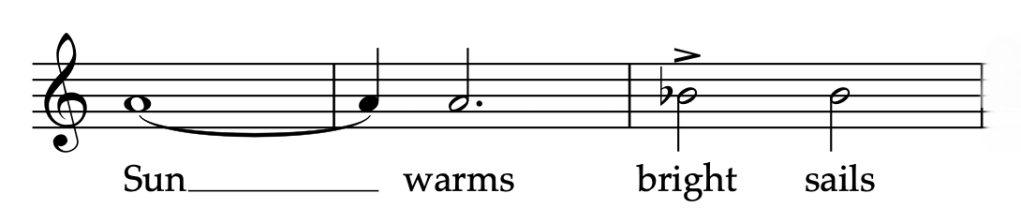
Trying to limit the vocal range required to sing this simple song, Yin Yang extends from middle C to the D an octave and a step higher . . . except saving an Eb yet one semitone higher for the dramatic last note on the last word.
Pe-nin-su-la u-pon pe-nin-su-la u-pon grand pe-nin-su-la,
Lee u-pon Lee-la-nau u-pon Lo-wer.
Cove from bay from great lake,
Sut-tons Bay off Grand Tra-verse Bay off Lake Mi-chi-gan.

Land curves in my-ri-ad shore shapes,
Rea-ching out to blue wa-ter.
Fresh wind weds the land and wa-ter,
Sun warms bright sails and sai-lor.
Notice how the incidence of consecutive stressed syllables increases toward the end.
7. Fit the melodic and accompanying lines together
Melodic pitches can be drawn from the underlying chord. Or they can represent “non-harmonic tones” forming a dissonance against some pitch of the harmony.
TC example
My Peninsula melodic pitches are taken from the underlying chord.
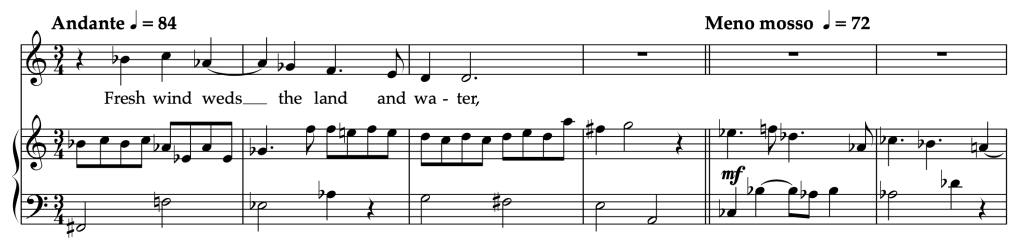
Since the piano presents the chord as a moving line, vocal pitches often are a simultaneous with the same piano pitch, as in “Fresh” and “weds” above. Melodic tones can also occur not at the same time as the matching harmonic pitch, but instead make a contrapuntal (vertical) interval between the two parts. Under each new vocal pitch below, I’ve indicated the contrapuntal interval it forms with the differing piano pitch of that moment.

You can see a contrapuntal interval consistency between the voice and piano, even as their rhythmic streams contrast.
8. Assemble the song
Now it’s time to put everything together. A traditional approach will include a piano-only introduction and at least one interlude without the voice.
Normally I suggest listening to a whole piece without watching a score. Since my synthesized rendering here cannot pronounce the words in the synthetic voice, however, I suggest watching below to get the feel of the lyrics that, after all, drive the whole song.
Yin Yang

–
–
Continue reading Mapping the Music Universe . . .
MapLab 3. Construct a canon
–