Tag: pitch class

  • MapLab 7. Twelve-Tone Trichords in a Ternary Trio

    Schoenberg’s famous twelve-tone row technique, devised in the early 20th century, prescribed a compositional method to order choice of pitches in the dense forest of possibilities with 12 chromatic scale steps. Music composed in this manner was called “atonal,” but this Lab will create a distinctive individual tonality from a 12-tone series of four trichords.

    The sample piece, in a classic ternary form, will be scored for a chamber trio of three different instruments.

    The so-called atonal music was complex and mostly dark and dissonant. Can a technique like this also be used to methodically create coherent tonal characters of brighter, simpler sonority?

    1. Choose a model

    One of my favorite 12-tone pieces is Schoenberg’s Wind Quintet, Op. 26. Premiered in 1924 on Schoenberg’s fiftieth birthday, it was dedicated to Schoenberg’s young grandson Arnold. In four movements, it has a graceful neo-classical Viennese quality. It also is historically only the second piece ever (after his Suite for Piano, Op. 25) composed with Schoenberg’s new 12-tone row technique.

    The slow third movement, tempo marked “Etwas langsam,” displays a clear use of a 12-tone row in graceful counterpoint between the five instruments. The facile scoring of these instruments explores textures ranging from isolated solo to duos, trios, and even dense five-part counterpoint.

    2. Design a 12-tone series

    I imagine the typical way composers design a 12-tone row is by writing a line, choosing the interval from one pitch class to the next while not reusing any pitch class, until all 12 are included. That leads readily to a linear, contrapuntal approach.

    For our example in this lab, we’ll work instead with trichords, each a group of three pitch classes making a three-note array and set of three intervals. Here is such a row (A) and a slight variation of it (B):
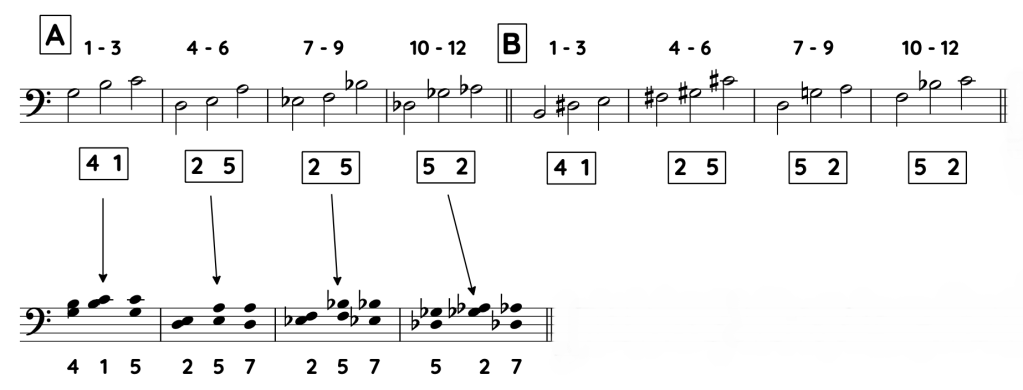
    The A version also shows the three intervals in each trichord.

    Note that the 2 5 and 5 2 scale patterns are the same, representing a set that is inversionally symmetrical. (That is not true of 4 1 and its unique inversion, 1 4.) Its complete-octave array is 2 5 5. Think of it as a circle of the twelve semitones in an octave. Unwinding the circle through octaves looks like: 2 5 5 2 5 5 2 5 5 2 . . . etc. This is a palindrome, reading backwards the same as forwards.

    Here is a voicing into 3-voice chords:
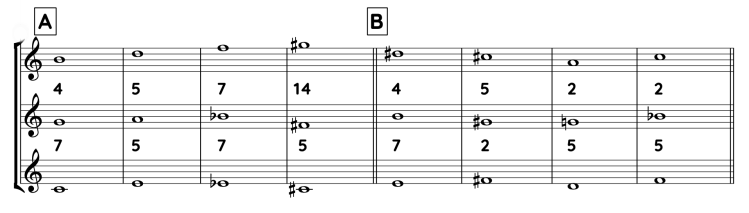
    You can see (and hear) that the voiced-out trichords can make constellations predominantly of 5-semitone and 7-semitone intervals. This is what makes the sound of the progression coherent and somewhat more like Copland than Schoenberg in character.

    3. Twelve-tone rows

    Now we can delve into the linear potential of the series we’ve constructed. I’ll call my principal row P in keeping with standard theory, designating the transposition by the name of the starting pitch class. (Standard theory uses pitch class numbers — C = 0 — to designate the starting pitch.)
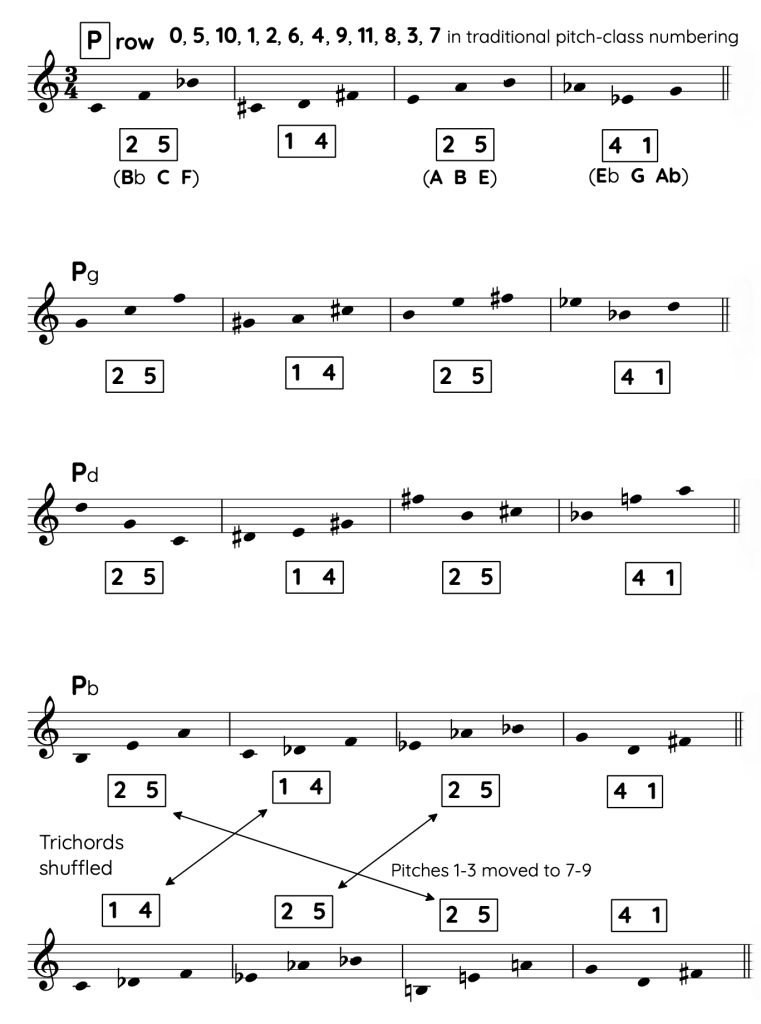
    Serial technique is just a box of 12-tone tools, which you can use in any way you wish. For the last row above, I shuffled the order of the trichords. The shuffle puts the trichords inside out, with the 1 4 array now at the beginning. This gives me more options when building counterpoint between two lines with each its own row form. Like rearranging four toy blocks, the shuffling still builds a 12-tone aggregate collection no matter the order of trichords or pitches within the trichords.

    4. Imitative lines

    As we observed earlier in Opus 26, a row is a natural material for building contrapuntal lines that are similar in interval shape. When these similar shapes are reinforced with similar or identical rhythmic patterns, the lines mimic each other in their back-and-forth conversation.

    5. Ternary form

    Of all the classic form models, ternary is one of the simplest in concept and strongest to perceive. Opening material is contrasted with a middle section of different tempo, texture, register, rhythmic pace, etc., followed by a return to the opening material: A B A. (Several familiar classic model forms are ternary, including Sonata Allegro, Da Capo Aria, and Minuet and Trio.) Often the returning opening material of the third section is embellished or varied in some way while not clouding recognition that it is a recurrence of the opening.

    For Schoenberg’s Etwas langsam third movement of the Wind Quintet, the opening material consists of two-part counterpoint between horn, marked as the Hauptstimme preeminent line, and bassoon (Fg) marked as the Nebenstimme subordinate line.

    Opus 26 middle section is faster flowing, with much more rapid, complex rhythms in a denser four-part counterpoint:

    The third section brings back but alters the opening’s two lines, moved from horn and bassoon to oboe and bassoon, with the addition of a third contrapuntal voice in the clarinet.
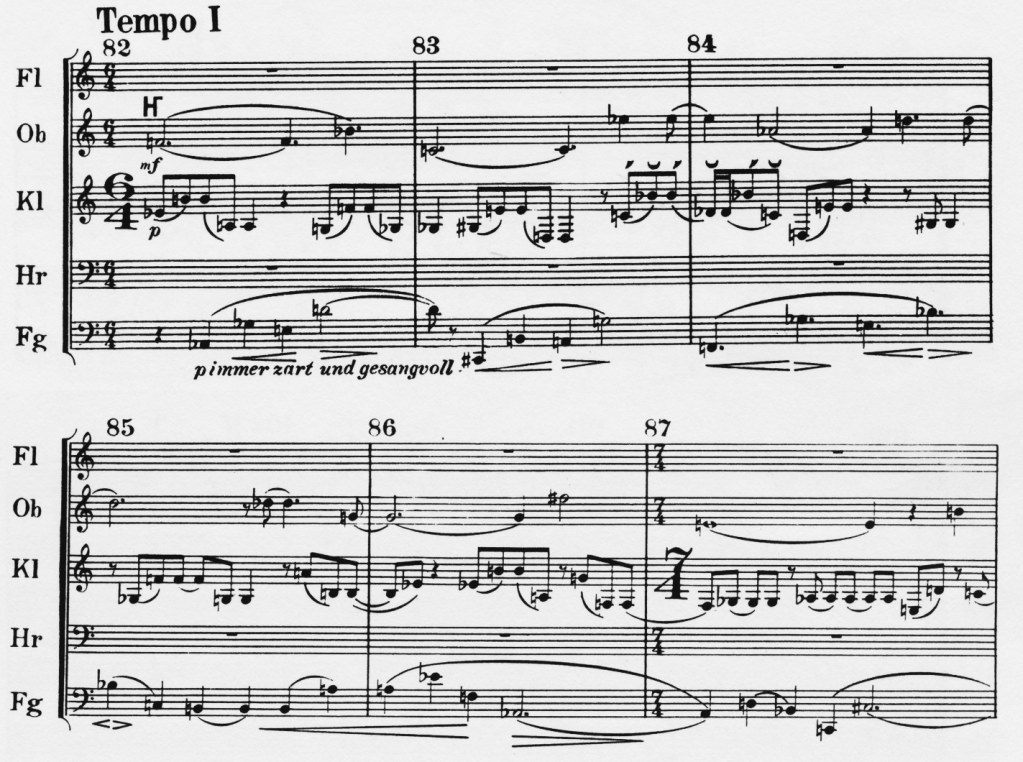
    For our MapLab example, the chorale-like chordal setting of the trichords we’ve already seen will be the serene opening and ending material. Imitative contrapuntal setting of the row in a faster tempo and much faster pace make the contrasting middle. (Many classic three-part forms, by the way, are the converse, fast – slow – fast.)

    Opening:
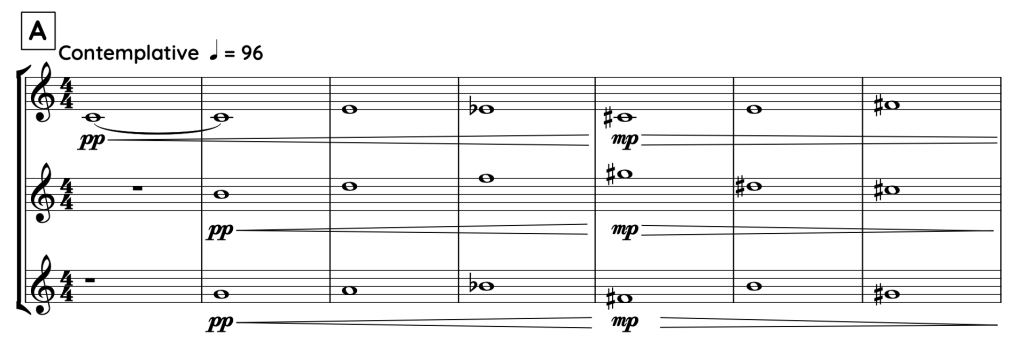
    The opening material continues with a variation of the chords, transposing them and adding rhythmic interest with single 8th-notes each arpeggiating a pitch of the chord.

    Contrasting middle:
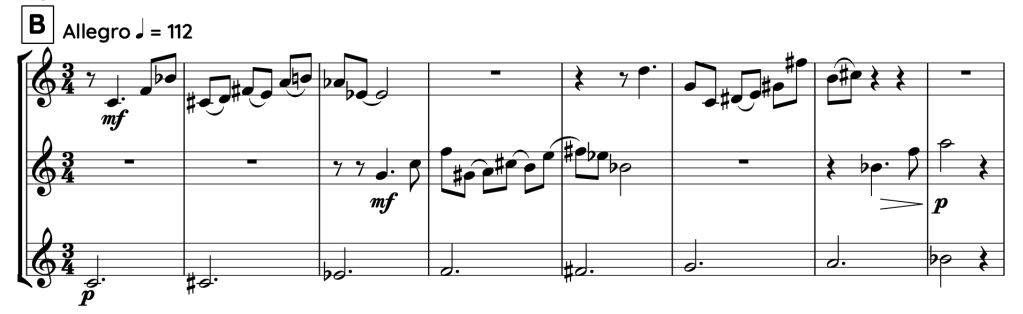
    Note: if you’re wondering how I pulled the lower line of dotted-half-note steps from the row, I didn’t. It is free counterpoint for a simple supporting “bass line.” Those pitches are drawn from the trichords expressed above them, as unison or octave “doubling” of single pitches from the upper lines.

    The recap first brings back the opening’s single-8th-note arpeggiations then proceeds back to the still chords of the very beginning.
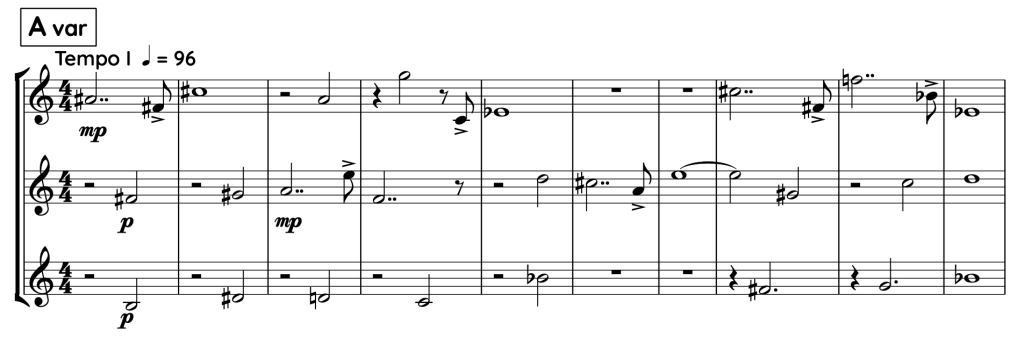
    6. Scoring the trio

    For this lab, choose any three different instruments. They can be in the same instrument family, like a brass trio of trumpet, horn, and trombone. Or it can mix instruments from different families, like flute, horn, and cello. You can guess from the audio above, I choose a woodwind trio of flute, oboe, and Bb clarinet.

    Get to know your chosen instruments, not only their overall range but also the particular characteristics of sub-registers. For orchestral string instruments, it is good to know their open string tunings and recognize those strings’ different qualities; the lowest string of each instrument is thicker and produces a thicker, grittier timbre. For my chosen three, flute and clarinet have wonderfully rich, dark lower registers, while the lowest few pitches of the oboe’s range are squawky. Each of the three instruments have upper ranges that thin a bit in timbre but can be elegant or powerful.
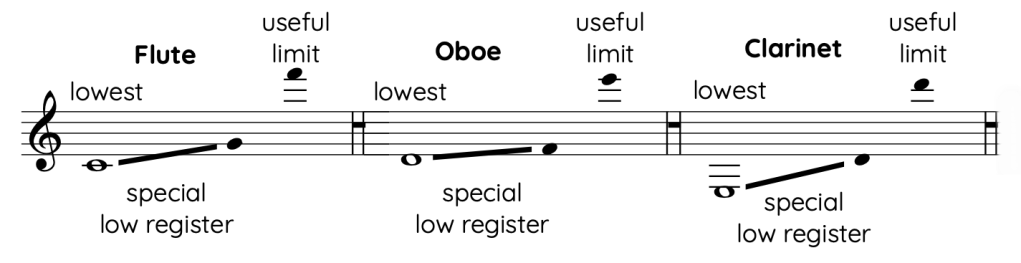
    My scoring will emphasize use of those rich low registers of the flute and clarinet. Many chords will be voiced with oboe on top, flute in the middle, and clarinet lowest. Nonetheless, the score will show them in standard score order with flute at the top. Also, the clarinet is a Bb transposing instrument. That means in the score and player’s part, a written C will sound one whole step lower as a concert Bb. When I want, say, an F to sound, the clarinet part will show a written pitch one whole step higher, G.

    For a well-balanced chamber-music trio should balance how much time each instrument gets as the active, preeminent voice in the texture (which Schoenberg would call the Hauptstimme).

    7. Finished score

    Tempo and dynamics are essential to vividly portray where the music is going — launching, growing, swelling, subsiding, approaching a cadence or climax. Articulation marks will be particular to each instrument type. Rehearsal letters or measure numbers will be helpful in rehearsal.

    Since my finished example has a childlike playful curiosity, its title follows Schoenberg’s Opus 26 dedication to his grandson. Imagine a child in a sunny garden.

    For Little Arnold

    Continue reading Mapping the Music Universe . . .

    MapLab 8. A Small Sonata

  • Mapping Music 5. SCALES

    What is a scale? Its essence is an interval pattern, selecting which pitches out of the entire chromatic possibilities become scale steps. Successive interval arrays are a vivid way to describe its pattern:

    SCALE PATTERN — periodic interval pattern that cycles through each octave, defining which pitch-classes from the 12 possibilities are degrees of the scale

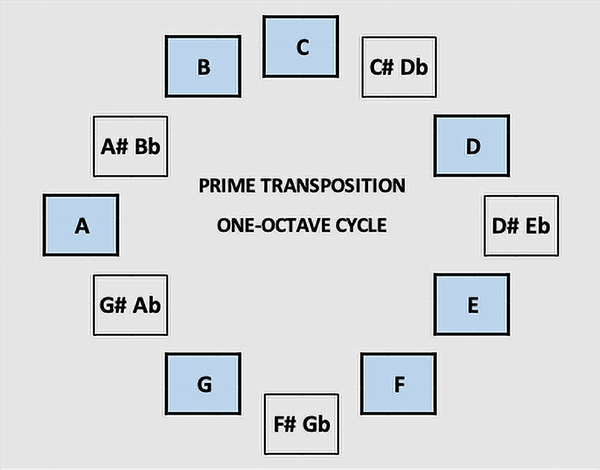
    In that sense, it is a theoretical circle, starting over in each octave — or more imaginatively, a spiral. Let’s visualize the natural-note white keys on the keyboard, a prime example of the ubiquitous diatonic scale, as a circle.

    diatonic scale circle

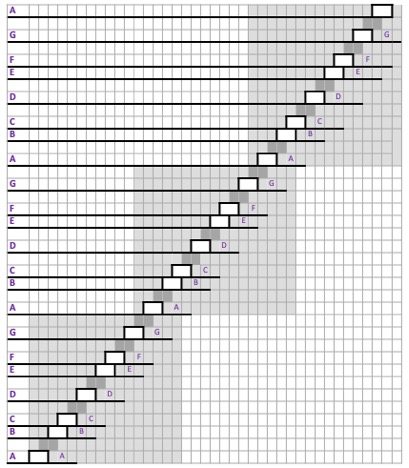
    Now an unlooped visualization as stair steps, rungs on a spiral ladder:

    diatonic scale cycling through three octaves

    Anyone familiar with the white and black keys of a piano will recognize this pattern!

    Chroma

    Almost all scales in both Western music and other art-music traditions are built on the framework of octave equivalence, the close affinity of two pitches that are one or more octaves apart. We give them the same pitch name – all called “C” or “F#” for example. This makes the circular nature of a scale, that its pitch names and the intervals between them start over at the octave and repeat.

    We also have the feature on an equal-tempered piano that one black key produces a pitch with two possible names depending on the scale in which they appear. For example, the D# seventh scale degree in an E Major scale is the same piano key as an Eb, the fourth scale degree in a Bb Major scale. The two pitch names are said to be “enharmonic.”

    When a melodic line in an all-white-key C major scale introduces an F# for color or to temporarily alter the interval terrain, we call it a chromatic tone, after the Greek word for color, chroma. Now we have a comprehensive scale of all possible pitches. Going further, theorist Allen Forte defined  a way to reduce all the pitches in an entire eight-octave chromatic pitch space into just twelve categories:

    PITCH CLASS — a set of all pitches that are octave and/or enharmonically related

    He gave them pitch-class numbers 0 through 11.

    chromatic scale

    In the advent of computer systems to produce, edit, and analyze musical sound, a sound’s identified pitch class is termed its chroma.  

    Synesthesia – some people, such as the composer Scriabin, actually see a color when they hear a pitch or a tonal key. In his variant of synesthesia, C is red, G is orange, D yellow, and A green. Scriabin’s Promethius: The Poem of Fire (1910) includes a part for “clavier à lumières,” a color organ that emitted light of what he deemed the appropriate color for a pitch instead of sound.  

    Scale prototypes

    When we describe a scale, we name the pitches in order within an octave. Better yet, we name the successive intervals going up within the octave. The classic description of the ubiquitous diatonic scale, in whole-steps or half-steps, in its major mode starting on the tonic pitch, is:

    whole / whole / half / whole / whole / whole / half

    [octave repeats the cycle]

    Or in British terms:

    tone / tone / semitone / tone / tone / tone / semitone

    In the chromatic 12-tone universe, that scale pattern measuring the intervals in semitone sizes would be:

    2 2 1 2 2 2 1

    That is what I would call a scale pattern . . . a Successive Upward Interval Sequence in Semitones (SUISS!). But let’s call it a scale pattern array, working exactly like the arrays describing constellations.

    Now we can particularize our scale pattern definition to apply to any smaller set of pitch classes, even if they don’t look like a scale:

    SCALE ARRAY — successive interval array describing the pitches of a constellation condensed by octave equivalence to their most compact pitch-class-equivalent arrangement within an octave, ordered lowest-to-highest (Forte’s “normal order”)

    In this sense, the array of a smaller set or scale fragment is just like a scale pattern.

    Successive Interval array is a versatile tool that can apply to any pitch collection, to a linear, scalar pitch pattern as well as to a vertical chord sonority or even an arpeggiated diagonal collection of pitches I call a constellation.

    Modes

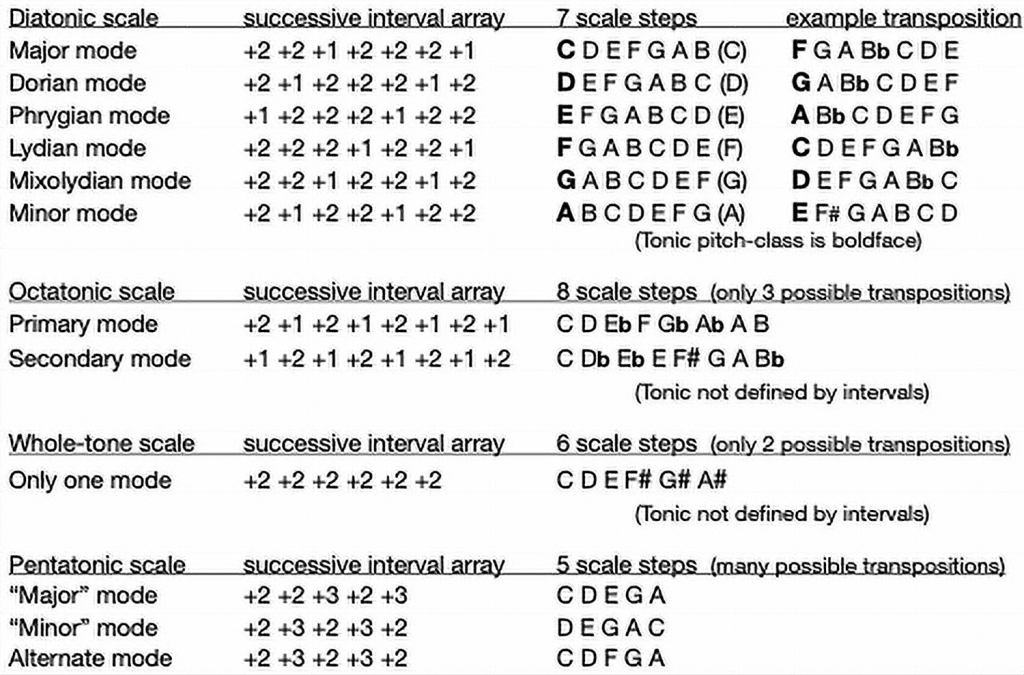
    Most of our familiar scales are actually a different mode of the same 7-note diatonic scale, with a different starting and ending point called a tonic establishing the mode.

    scale modes

    Scale patterns / set classes

    We can describe a set of pitches as an octave-compressed abstraction of 3 or 4 pitches as a lowest-to-highest ordering of pitch classes. It doesn’t produce anything like the 7 or so notes per octave we’re used to thinking of as a scale, as those shown above. It is conceptually powerful, nonetheless, to call the successive interval array of this compressed abstraction a scale pattern, even though it’s a scale fragment with no name. Its name can simply be the successive interval array, such as 2 4 2, the array describing a symmetrical pitch-class set called the French Augmented Sixth chord.

    [Theoretical aside] In establishing set theory, Forte described these compact arrangements by naming the pitch-classes in order using a mod-12 number system shown above, C=0, C#/Db=1, D=2, etc. He identified twelve 3-note classes, including upside-down inversions reversing the scale pattern, as members of the same class. (Lewin kept these inversions separate, defining instead nineteen 3-note set classes. We’ll use Forte’s; the set classes as generalities are not as crucial to composing as to theoretical analysis.) Forte used cumbersome descriptions employing pitch-class numbers and “normal order.” In the Journal of Music Theory 15 (1971), Richard Chrisman defined and proposed successive interval arrays as a better, more revealing way to characterize the commonality of a family of pitch-class sets that are all related by transposition and/or inversion.

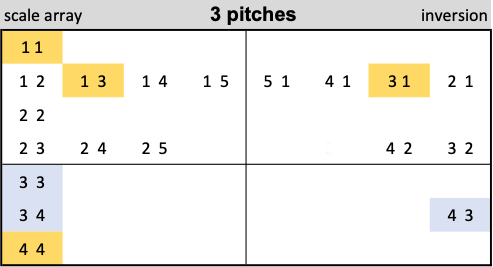
    Relating to Forte’s concept of a set class, any set grouping three pitch-classes can be analyzed as an interval array or partial scale pattern.  

    scale patterns of all 3-pitch-class sets

    Sets forming triads (or seventh chords below) are highlighted in BLUE; those that are atonal (cannot be found in a diatonic scale) are highlighted in GOLD.

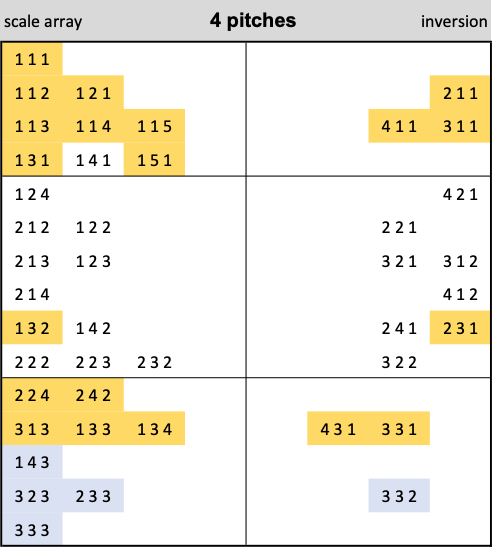
    While the number of possible interval arrays for constellations of four pitches is enormous — even if limited to interval stack sizes less than two octaves, there are more than 12,000 possibilities — we can use this scale-pattern abstraction tool to categorize them into forty-three 4-pitch-class families. 

    scale patterns of all 4-pitch-class sets

    The blue-highlighted scale patterns have common triadic chord names:

    • 1 4 3 = “Major Major 7th chord” (in any chord inversion)
    • 3 2 3 = “minor minor 7th chord” (in any chord inversion)
    • 3 3 2 = “dominant 7th chord” (in any chord inversion)
    • 3 3 3 = “fully diminished 7th chord”

    The scale pattern 2 4 2 is an interesting symmetrical, non-diatonic pattern called a “French augmented 6th chord”.

    Vocabulary

    These maps collecting 62 scale-patterns summarize all possible constellations of 3 or 4 unique pitches, our total harmonic vocabulary in the chromatic universe.

    © 2026 – All Rights Reserved

    Thomas S. Clark

    TClarkArtMusic.com 

  • CONSTELLATIONS: Pitch Space, Arrays, Tonality

    Introduction

    Galileo revolutionized astronomy, in part by using a new tool: the telescope. Schoenberg revolutionized harmony by evolving an existing concept, the chromatic scale, into a new tool: the 12-tone scale. (He also devised the compositional tool of the 12-tone row — but that’s another story.) Allen Forte took Schoenberg’s ideas to another level of abstraction: defining Pitch Class and applying basic math to the 12-tone universe. Christman focused on intervallic essence of pitch patterns: defining the “successive interval array.” I am merely another explorer using their maps but choosing my own creative path. In doing so, I will define some of my own terms, while adapting and clarifying some established terms that fit what I’m thinking and expressing.

    Topics

    • Tuning
    • Constellations
    • Interval Arrays
    • Scales
    • Scale prototypes
    • Scale patterns and set classes
    • Harmonic complexity
    • Constellation streams
    • Constreams and 12-tone sets
    • Progressive alterations of arrays
    • Clusters
    • Cells – melodic molecules
    • Cell class

    To read more, request a password from tc24@txstate.edu

    Mapping the Music Universe by Thomas S. Clark . . . CONTENTS