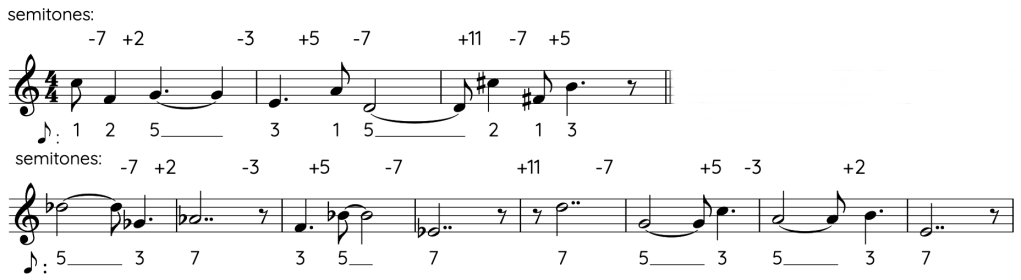
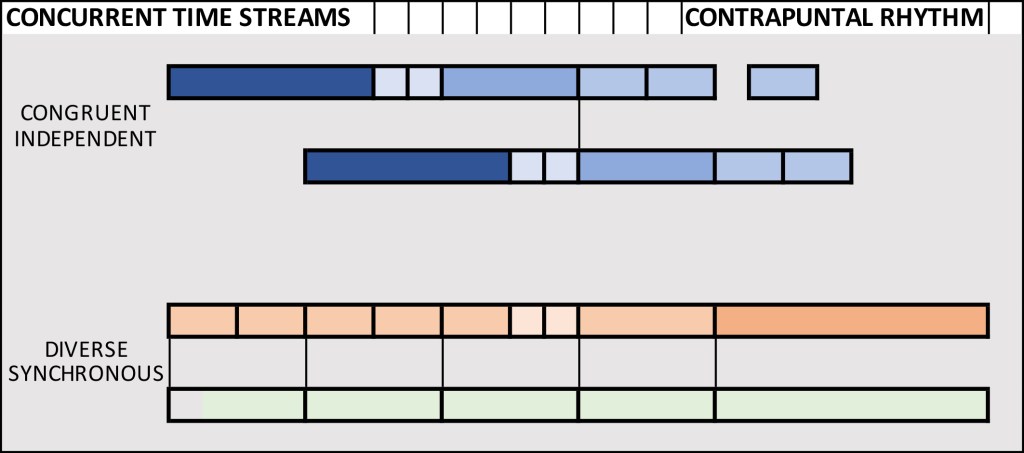
Two lines woven into a shared time stream — counterpoint — can be relatively more or less independent. How similar or diverse are their rhythmic patterns (congruent or diverse)? How often do their note-initiating time points “line up” (synchronous or independent)?
In an example of congruent, matching rhythmic material, the upper line’s rhythm is echoed in the trailing lower line in the first five bars below. But the lines are rhythmically independent, sharing only one time point, the downbeat of bar 4. This echo process is known as . . .
CANON — leading line is echoed after some delay by one or more answering lines of identical rhythmic values and melodic shape (possibly transposed)
For more on canons, go to BOOK OF CANONS, 14 short 3-part canonic studies.
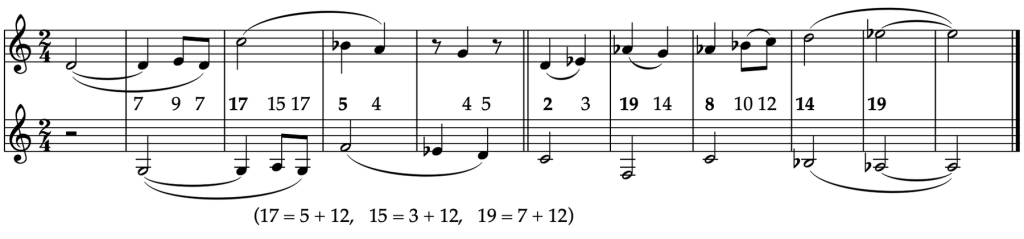
example of two-voice counterpoint
Bars 6-11 show diverse rhythms (the upper line in mostly shorter durations than the lower), and not in canon but synchronized at most of their time points.
Rhythmic alignment
Johann Joseph Fux established a theoretical construct for pedagogical purposes in which contrapuntal lines in a 16th-century style progressed from congruent, synchronous rhythms (“First Species”) to one line twice the pace of the other (“Second Species”), and so on. Only in Fourth Species was the relationship reversed, back to matching, congruent rhythmic values but in studied alternation avoiding synchrony.
COMPOSITE RHYTHM — stream of durations between time points marked by an attack of a note in one or more lines of the fabric
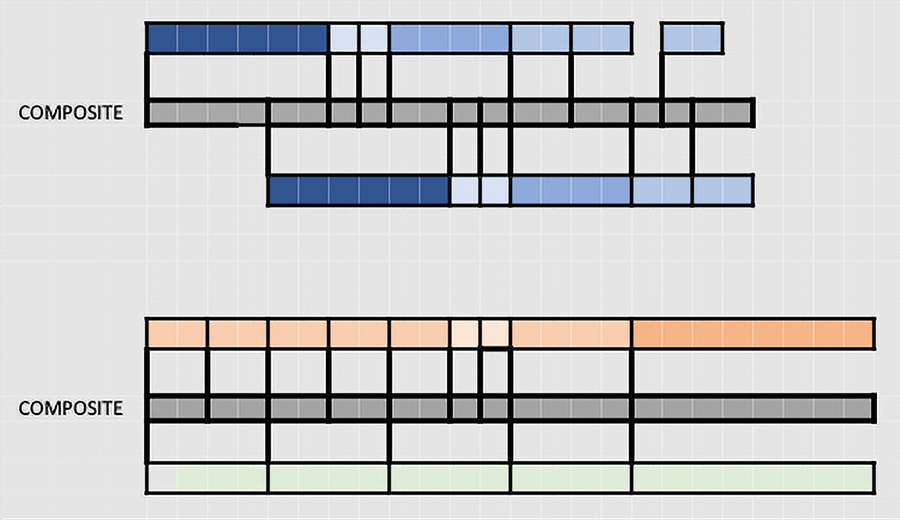
Here is a graphic identification of the composite rhythm of each contrapuntal phrase above.
composite rhythm
You can see in the first example that there are 7 notes in the upper line and the same 7 rhythmic values in the lower line. But the composite rhythm shows 12 durational values, due to the non-synchrony of the lines. In the second example, the upper line has 9 notes, but the lower line’s 5 notes all align with them. The “sum” of the two lines is a composite rhythm of only 9 durational values, identical to the upper line.
Contrapuntal intervals (in number of semitones) are identified between the staves. The time points of the composite rhythm, moments when both lines are starting a note, are contrapuntally accented and emphasize the contrapuntal intervals (boldface) formed at those points. The consistency — in this example the contrapuntally accented intervals of 7, 8, 2 (and 2+octave), and 5 (and 5+octave).
CONTRAPUNTAL ACCENT — prominence of contrapuntal intervals formed by notes starting together on a time-point
Refraction
This term refers to the metaphor of light going through a prism or drop of water, revealing a spectrum of colors. In that sense, a musical refraction might refer to a line presented by instruments of changing sound color. (See Klangfarbenmelodie below.) But let’s apply the refraction concept to pitches in a line of consistent color.
Refraction can also be a simple way to make two lines out of one, splitting up its notes into two lines shared by alternation or some other less strict pattern. The pitch assigned to one line can be sustained to make a companion pitch to the pitch or pitches that come next in the other line. In this way, the vertical intervals can be strategically controlled to generate a coherent contrapuntal harmonic flow.
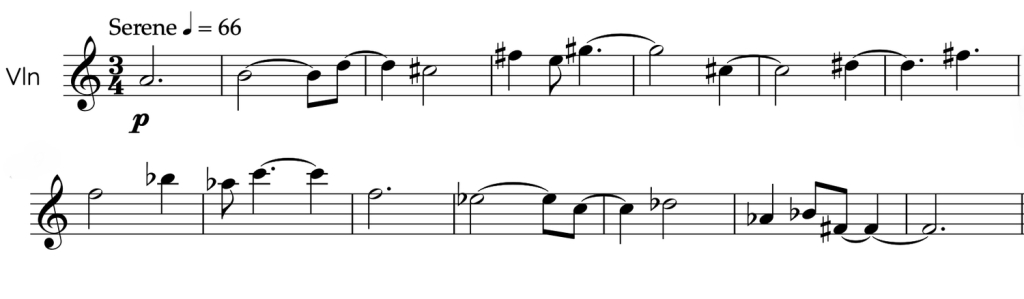
To demonstrate, here is the opening theme to Jupiter Rising:
Jupiter Rising theme
Now splitting this violin line into two violin parts:

Jupiter theme refracted
Identifying the contrapuntal intervals (by number of semitones) that are formed reveals a preference for contrapuntal intervals of 2, 4, and 5 semitones.
Some might say this is not real counterpoint, but the total rhythmic independence of the lines argues for that distinction. Mandelbrot, pioneer of fractal mathematics, described fractional spatial dimensions. Maybe we can call our refraction one-and-a-half voice counterpoint.
Canon
Repeating the definition of this ancient form of Rumpelstiltskin magic, spinning complex counterpoint out of a single melodic line:
CANON — leading line is echoed after some delay by one or more answering lines of identical rhythmic values and melodic shape (possibly transposed)
For a collection of 21st-century examples, 14 studies in 3-voice canon, go to BOOK OF CANONS.
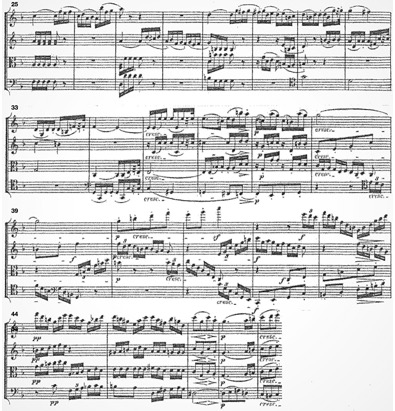
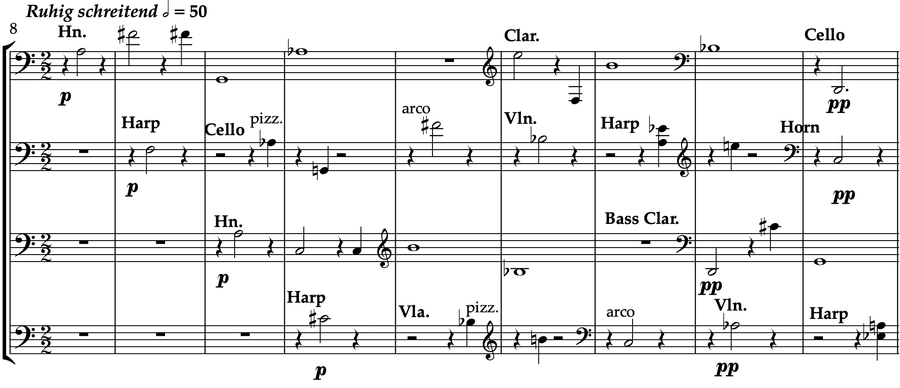
Now let’s look closely at a more famous canon, in four parts scored for seven different instruments. Here is a contrapuntal example of canonic threads expressed through changing instrumental colors, the opening of the first movement of Webern’s Symphonie Op. 21:
Webern Symphony opening
Instead of showing each instrument’s part, I have rearranged the score so that each staff line strings together the successive pitches of a 12-tone row:
- On the top staff, A F# G Ab played by horn; E F B Bb played by clarinet; then D by cello, continuing past this excerpt to complete the 12-tone row with C# C Eb.
- The second staff answers in canon one bar later, starting on F plucked by harp and proceeding with a mirror inversion of the lead-line row: F Ab G F# Bb A Eb E C C# D B.
- The third staff is also an inversion of the row starting on A.
- The fourth staff, entering last, is a transposition of the original lead-line row starting on C#.
Repetition
Any musical element can be repeated — a note, an arpeggio, a measure, a phrase, a whole section of a form, as in the baroque rounded-binary model or the exposition of a classical sonata-allegro form. When a melodic motive or molecule is continuously repeated many times, it is called an ostinato, usually forming a background to some changing line or evolving stream of events. We can analyze two critical factors:
CYCLE — duration length of a repeating pattern
PHASE — time point at the start of a cyclic repetition
Some 20th-century composers, especially Americans, started to bring background patterns or structures into the foreground, as primary objects rather than accompaniments. The incessant repetition of an ostinato, often a chord arpeggio, became the basis for simple structures. With a relentless pulse at its rhythmic core, most ostinato music generates simple highly congruent rhythmic lines in simple or no counterpoint.
Classic works by composer Philip Glass, such as the ‘70s pieces Music in Twelve Parts, are continual repetition of chord arpeggios, with the chord changing gradually and subtly over many repetitions. This has two effects: making a very slow harmonic change rhythm and time flow under an animated surface; and creating a broad time form that is monolithic and metamorphic, rather than a more traditional multi-section recurrence form.
John Adams brought this relentlessly repetitive approach to appealing prominence in symphonic music. His Fearful Symmetries (1988) has a pulsing persistence reminiscent of the great Stravinsky ballets, such as Le Sacre du Printemps (1913).
John Adams – Fearful Symmetries (1988)
Steve Reich continued this energetic vein of repetitive rhythmic construction into the 21st century with works such as Double Sextet (2008).
Steve Reich – Double Sextet (2008)
Despite its sometimes lush fabric of harmony and animated rhythmic activity, persistent-repetition music has unfortunately been labeled “Minimalist,” often having no melody, no sense of harmonic progression or tonal modulation, no themes, no sectional cadences and divisions, and no discernable large-scale recurrence form. (A music more truly described as Minimalist can be found in the more radical works of John Cage, with sparse sounds — or no prescribed sounds at all — in a time-space of mostly “silence.”)
Phasing
Back to ostinato — what about more than one ostinato layered into a more complex texture? Even if the ostinato patterns are of the same length, it is possible for their repetitions at different times to not synchronize but overlap. We would say their repetitions are out of phase.
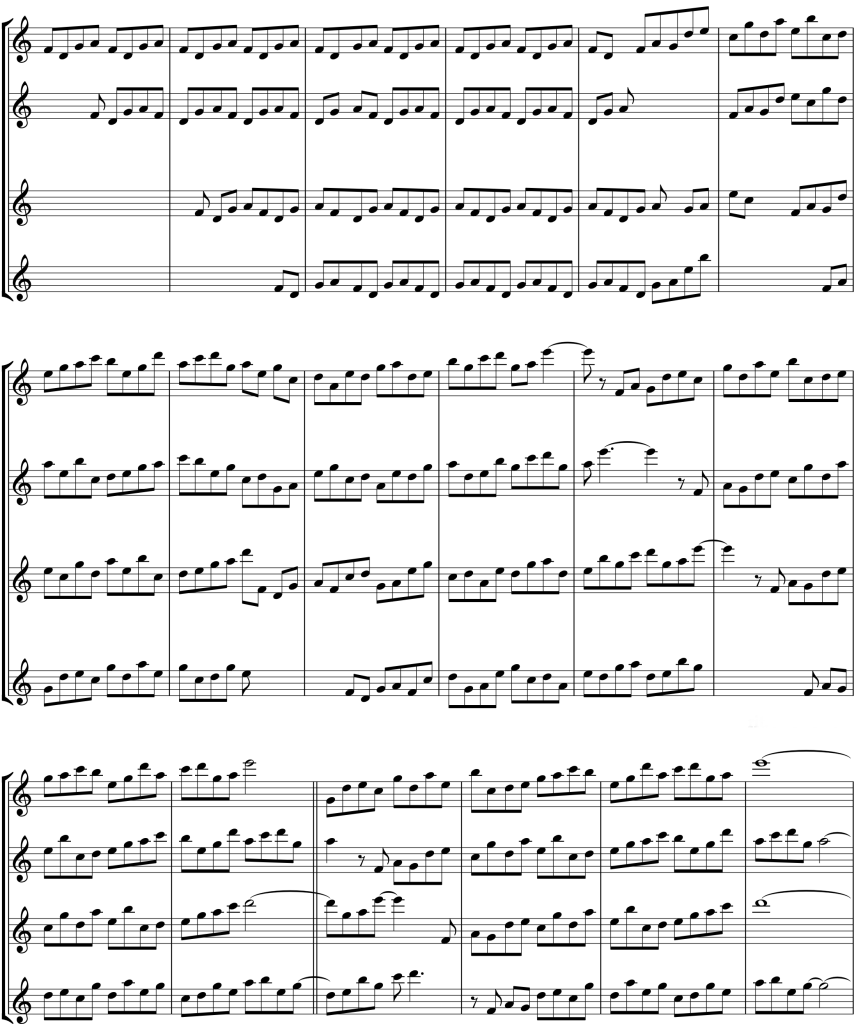
Using Webern’s canon technique to place identical lines out of phase:
Milky Way score excerpt
The Milky Way is our own barred spiral galaxy. The musical fabric is adapted closely from Buckingham Fountain, the third movement of my Chicago Sketches for flute choir.
There is also the potential for each ostinato pattern to have its own cycle length of repetition. And if the lines repeat different cycle lengths, their phase, the start of another repetition, cannot always align in synchrony. This can be described as multi-cycle/multi-phase ostinato music, pioneered among others by American composer Terry Riley.
Inspired by tape loops continuously replaying recorded sequences of sounds, in 1968 Riley produced a massive (45- to 90-minute length) multi-phase ostinato work, In C. Becoming iconic, it has been recorded commercially more than 36 times and performed by countless new music ensembles, finding its improvisatory freedom and large flexible instrumentation attractive. (A 2006 performance at the Walt Disney Concert Hall featured 124 musicians.) It consists of 53 ordered patterns of specified, notated rhythm and pitch, to be continually repeated against a steady eight-note pulse. The patterns range in length from only 4 eighth-notes to extended phrases sprawling across a part’s entire manuscript line (without bar lines). Thus the variety of repetition cycle lengths is enormous. And because each musician chooses when to start and how many times to repeat each pattern, multiple phases are also guaranteed.
Rather than analyze this iconic piece, I will show and explore a piece of mine inspired by In C, originally composed in 1984. It employs the canon technique and differing-length patterns to create the constant overlapping of patterns out of phase with other lines, This makes it difficult to express all the patterns in one common meter signature. Riley’s solution, and mine, is to use no meter signature, with all lines (parts) aligning only with a constant eighth-note pulse.
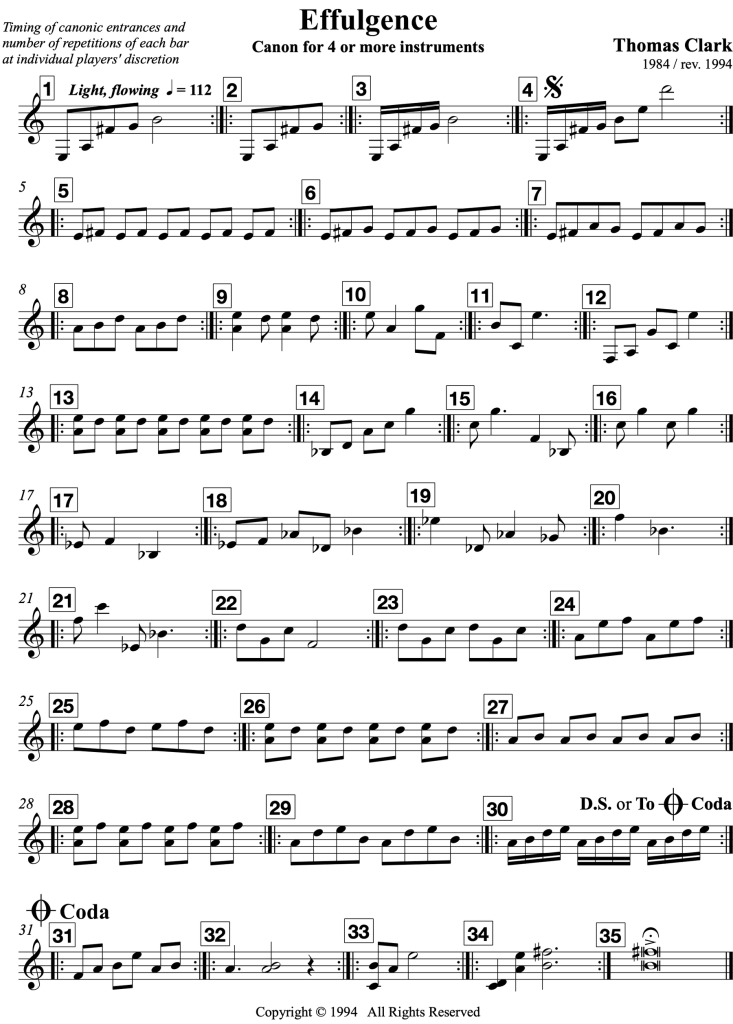
Effulgence improv score
Before we dive into its structure, let’s listen to its beginning.
The surface rhythmic relationship of overlapping patterns is simple, all conforming to a common eighth-note pulse, as in Riley’s In C. The differing bar lengths, however, produce different periodicities, different repetition cycles. Patterns of 2, 4, 6 or 8 eighth-notes relate to each other to establish a common quarter-note based meter, a feel of 2/4, 3/4 or 4/4 meter. But the patterns of a prime number of eighth-notes, 3, 5 or 7, oppose the sense of a quarter-note beat.
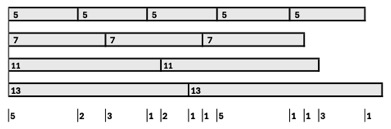
The prime numbers mean also that the repetition cycles will rarely synchronize, creating a more complex, floating or flying fluidity of motion. Three against four is fairly simple, as with Patterns 6 and 7. Repetition of primes seven against five, as in Patterns 19 and 20, make a much more complex composite, taking some 35 eighth-note pulses to return to a synchronous starting point.
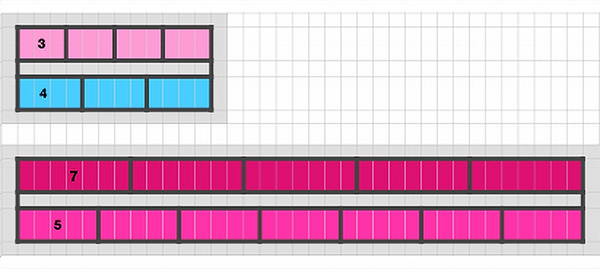
multi-phase combinations
To control the interaction between successive patterns that will overlap in canonic lines, each pattern’s pitch content must work with the pitches of patterns before and after it. By “work” means that the collective, cumulative constellation should be of an intervallic character, an array, that conforms with the overall harmonic character desired.
Assuming a performance spread of three patterns, here is a sample analysis of the middle, Patterns 16 through 21, showing the three-pattern collective constellation. Each pattern intersects with common pitches of its neighbor patterns, adding pitches to the sonority that will eventually disappear.
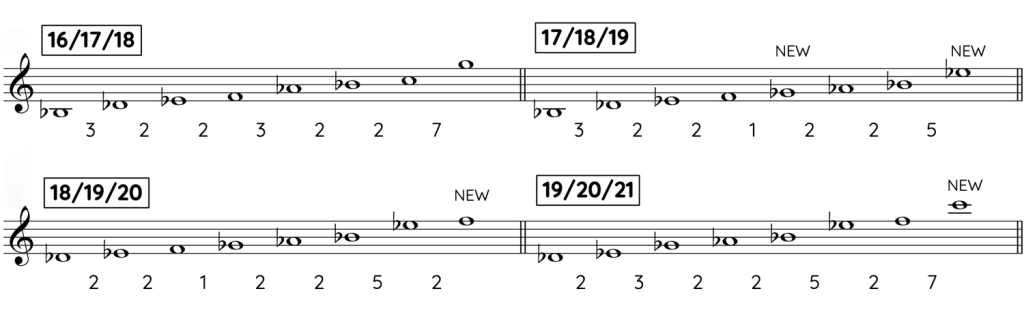
intersecting pitch collections
This is the mechanics of a metamorphic harmonic process that gives multi-phase ostinato music its graceful evolving form.
Now let’s listen to the complete composition from 1984 (revised 1994), one of my personal favorites.
Effulgence

–

© 2026 – All Rights Reserved
Thomas S. Clark
–
Continue reading Mapping the Music Universe:
___________