Tag: Sequenza

  • MapLab 5. Spin a Solo

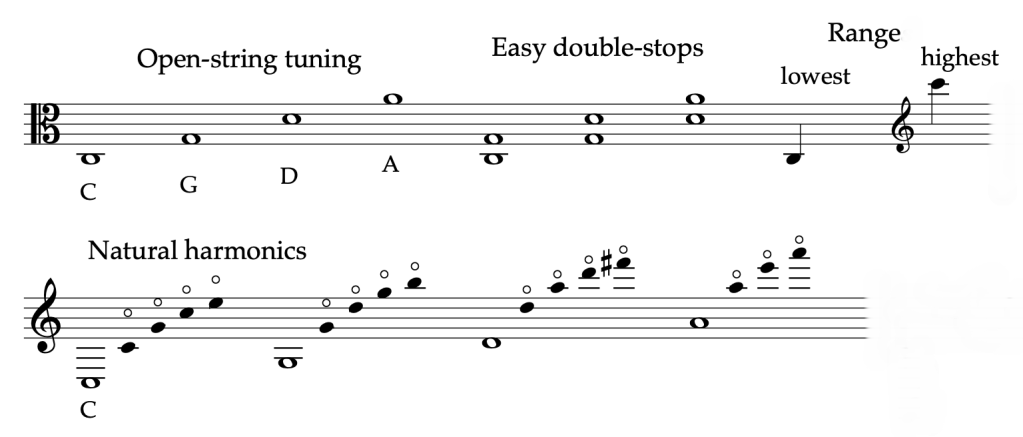
    Unaccompanied instrumental solos go back at least to the 18th Century, such as Bach’s violin partitas and cello suites. In the late 19th century, Debussy’s Syrinx for solo flute met the challenge of making a piece with just one wind instrument, not capable of the double-stops that complicate the rich textures of Bach’s string writing.

    1. Choose a model

    Syrinx launched a whole genre of unaccompanied flute solos, with Density 21.5 (1927) by Edgard Varèse and Sequenza (1958) by Luciano Berio leading the way to experimentation with virtually every wind instrument. My Night Songs (1969) for solo trombone is very much within the tradition of this genre. As a trombonist and undergraduate composition student, I used my intimate knowledge of the instrument to select gestures and techniques to experiment with compositionally.

    2. Choose an instrument

    I also love the viola, so I readily agreed to write an unaccompanied solo for each member of the Pleasant Street Players, including violist Ames Asbell.
    3. Sketch idiomatic gestures

    Before I Sleep is inspired by a famous, beautiful Robert Frost poem, “Stopping By Woods.” Its snowy scene tempted me to quote a Mahler’s Symphony No. 4 (1900) that starts with sleigh bells and flutes doing something like the A gesture. (Sul ponticello is a special string technique to brighten tone by moving the bow closer than normal to the bridge.)
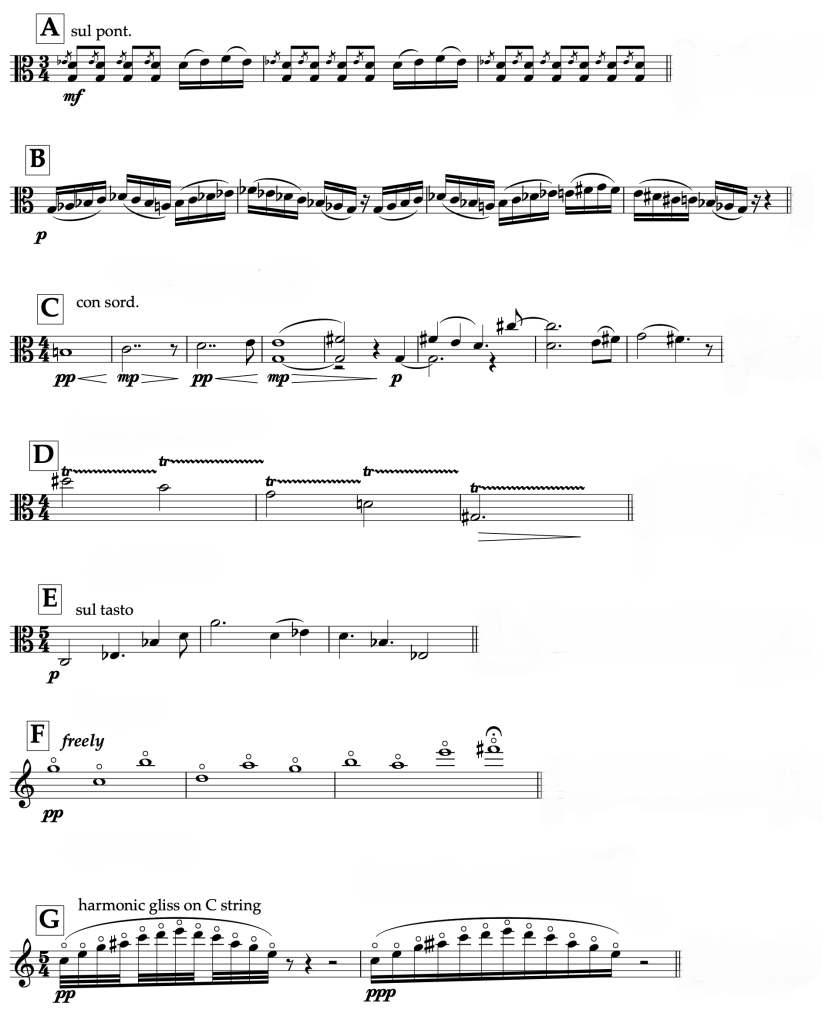
    B features the quick scale patterns so indigenous to orchestral strings.

    C uses a mute, attached to the bridge to subdue the tone. It also uses double-stops, drawing the bow across two adjacent strings together, making two-pitch diads and even two-voice counterpoint. These use an open string and the next string a perfect-fifth higher or fingering a pitch more than a perfect-fifth higher.

    D makes bird-like trills.

    E uses sul tasto, the reverse effect of sul pont, drawing the bow closer to or over the fingerboard for a darker, warmer sound.

    F makes the high, glass-like sounds of natural harmonics, produced by touching a string lightly at one of its partial-vibration nodes while drawing the bow on it. (harmonics, like open strings, have no vibrato. Sorry my synthesizer insists on applying vibrato anyway.)

    G is a very special effect used by George Crumb in his early chamber music. Sometimes called a seagull effect, it produces a quick arpeggiated succession of natural harmonics by running a finger lightly up and down across the partial-vibration nodes of the string.

    The gestures sketched above show a wide variety of pace and rhythmic characters.

    4. Interval language

    The B idea is scalar, running around through an unusual scale. It is almost an octatonic wholetone-halftone scale, but modified by an Ab, making the lower tetrachord the start of a Phrygian mode scale.

    For the rising and falling landscape of melodic lines, choice of pitches and the cumulative constellations they form can be freely crafted the old fashioned way, plunking out pitches on a piano (or on the actual instrument of the piece) in a trial-and-error search for pleasing pitch streams. Identifying one’s favorite intervals can lead to using a more organized cell approach, limiting melodic interval choices to only two or three sizes.

    In the TC example, an interesting constellation is established and simply arpeggiated in various shapes.
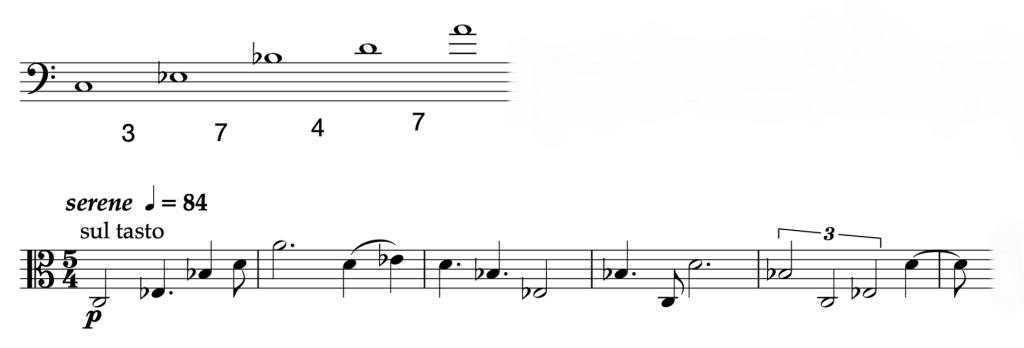
    This produces a single, stable harmonic prolongation, a calming stasis in which the line keeps retracing recently touched pitches.

    5. Edit the notation

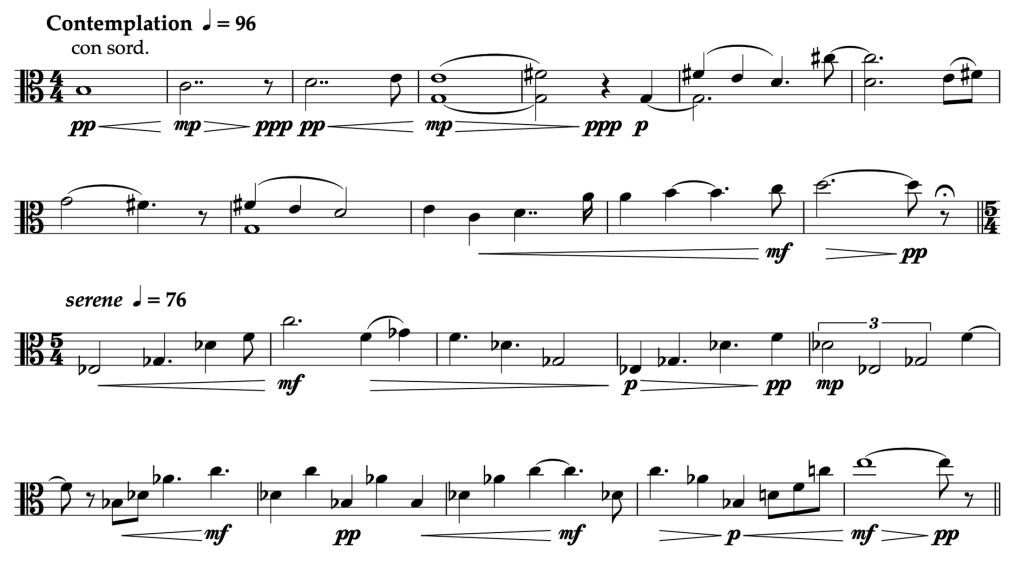
    The score is not finished until all details are included, showing clear information and intent. A solo line especially needs strong dynamic shaping to be interesting as a solitary musical voice. The following example from the viola solo notates many of the necessities on this checklist:

    • timing information, including tempo, rallentando, fermata
    • expressive indications
    • dynamics, including ample changes, crescendos, diminuendos
    • phrasing such as slurs
    • special techniques such as con sordino, sul pont, sul tasto, harmonics
    6. Overall form

    An unaccompanied solo is a soliloquy. The dramatic tone can vary: a rage; a contemplation; or a story. The form can be a continuous flow of development of a single, persistent gesture, as in Berio’s Sequenza series. Or it can be sectional, a story told in short chapters, a poem divided into stanzas.

    The TC example, actually a previously composed 2018 piece titled Before I Sleep, was written for my colleague Ames Asbell of the Texas State music faculty and Pleasant Street Players, an outstanding artist and player of one of my favorite instruments. The title is a quote from the last lines of Robert Frost’s famous poem “Stopping by Woods,” a contemplation of death on a nocturnal sleigh ride in the snow. The lead motive is a quote from Mahler’s Symphony No. 4, which open with flutes and sleigh bells jingling what is called the “bell theme.” My musical form follows the poem, in three sections:

    • sleigh bells and a trotting horse (gestures A and B)
    • snowflakes (a variation of B transitioning into D and F)
    • contemplation (C and E)

    The poem ends famously with a direct repetition of the last line, “and miles to go before I sleep.” That could have been the going-to-sleep hypnotic musical ending as well, but the poet is not ready to die. My musical ending instead is not a coda but a brief tag, gesture G, the horse gently shaking his bells in the glistening moonlight.

    Before I Sleep

    Continue reading Mapping the Music Universe . . .

    MapLab 6. Paint a landscape

  • journal 5. Dusty Dusk

    Tacoma, 1974 —

    As a teenager, I was into all kinds of art — sketching, painting, reading plays, and writing poetry. Lots of poems, my way of a kind of diary writing, expressing to myself the places, relationships, and feelings. (I won’t reveal any of this naive creative work here.)

    Later, two poems in particular were written at major turning points in my professional and personal life. That’s when I started setting poems as art song lyrics. Some of the musical material for what became Landscapes in Motion was first set in the 1970s, and some in the 1990s, now reworked with a more mature 21st-century craft, while preserving the original dark suppleness of tonality and time.

    Upon completing my master’s degree at Michigan in 1972, I taught music theory as a one-year lecturer at Indiana University in Bloomington. Another one-year fill-in position took me to Pacific Lutheran University in Tacoma, Washington, where I got great experience teaching music theory, composition, new music performance ensemble, and even trombone!

    Without a doctorate, however, there was no real prospect of winning a permanent professor position anywhere. And continuing a succession of one-year gigs moving all over the country was not sustainable. What to do?

    I had taken my sailboat with me all the way out to Tacoma from Interlochen. After a beautiful sunset sail on Lake Spanaway in my little 15-foot “Butterfly” dinghy, I wrote a poem.

                            “Sailing at sunset”  (1974)

    Dusty dusk settling silk on dying silver of wave-modulated water,
    the sail still silently searching for a departing breeze,
    swinging gently its boom and softly rattling its blocks
    in confounded cross-rhythms to the lapping shore.
    Streams of crimson flowing dust streak the sky
    above looming shadowed firs.
    Deepening shadows settle dark dust on the deck
    while still the mast peak rages red and soars into a deepening sky.
    Scorched face soothed by the oncoming night breeze,
    eyes searching the sunset sky for sign of tomorrow’s wind.
    Where will we sail then? Wherever wind wills . . .
    and a new dusk consume our shadows.

    A New Dusk

    Clark 1974 (TC-28)

    Afterglow

    Turns out, I went back to Michigan for doctoral studies, and went back to working at Interlochen as assistant to the director of Michigan’s university-level program there. In that 1975 summer, I met Beth, a journalist working a temp gig on the camp’s publicity staff.

    We fell in love, and I spent many weekends of the following academic year riding the Amtrak Turboliner from Ann Arbor to Chicago to be with her. I wrote a poem on one of those train rides, again uncertain about my (our) future.

                            “Riding backwards on a train”   (1976)

    The cider mill beside the river,
    cows grazing by a dead tree,
    a red barn stuffed with hay.
    An old square house alone on a hilltop,
    a church’s silent steeple above the trees,
    a country cemetery, old stone crosses guarding against oblivion.
    Then the sun is gone,
    storm clouds ripple across meadow skies,
    the river turns away.
    Riding backwards on a train, frozen fields float by.
    Glossy sheets of white ice glow with winter sun.
    Dead brown stubble breaks the mirror, patchy footprints of autumn’s retreat.
    Pale late light of afternoon flickering
    through leafless trees that line the lifeless fields in rows,
    through fields of withered cornstalks.
    Leap into brown dry woods, plunge past barren trees,
    spray a wake of fallen leaves, lunge into holy autumn stillness,
    riding backwards on a train, headed east into a frozen future.

    Shortly before his death, Charles Ives published a collection of 114 Songs in 1922. Many have become exemplars of his iconic 20th-century American style. Here are two that fit our tender twilight theme.

    Paul Sperry, Irma Vallecillo

    LISTEN > YouTube

    Paul Sperry, Irma Vallecillo

    LISTEN > YouTube

    Before night

    So far, I haven’t mentioned an important influence on my ’60s and ’70s immersion into the mid-century Avant Garde. In the 1960s, Luciano Berio wrote an influential, frequently performed series of unaccompanied solos for varied instruments. All are tour-de-force virtuosic technical displays with a theatrical impact. I performed Sequenza V for trombone on a Contemporary Directions concert in Rackham Lecture Hall (Ann Arbor). It was commissioned by and written for virtuoso trombonist Stuart Dempster, with whom I later briefly studied.

    I said instruments, but Sequenza III (1965) is for unaccompanied voice, drastically different than a typical “song.” Berio explains:

    “In Sequenza III the emphasis is given to the sound symbolism of vocal and sometimes visual gestures, with their accompanying ‘shadows of meaning,’ and the associations and conflicts suggested by them. For this reason, Sequenza III can also be considered as a dramatic essay whose story is the relationship between the soloist and her own voice.”

    Sequenza III was written in 1965 for Cathy Berberian. The “modular” text is by Markus Kutter:

    Give me a few words for a woman
    to sing a truth allowing us
    to build a house without worrying before night comes

    Laura Catrani, soprano

    Ice

    In 1983, teaching grad courses and still directing the New Music Performance Lab. Musicology master’s student Robert Nasow played cello in the ensemble, but he was also an avid and talented poet.

    When his fellow grad music student David Lynn Kennedy was killed, Robert wrote a heartfelt elegy for him.

                            “Ice Floe

    by Robert Nasow

    Yes, I am cold . . .
    my hands are cold to the touch.
    Something must fill this hollow at the center of my body.
    Untouched, no one will long remember your face . . .
    She withdraws to contemplate the child,
    her voice breaks into emerald light, effulgent pure water,
    sings unknown distances of sleep.
    Brittle, come break off my hand,
    this glazed stem of Queen Anne’s lace.
    There are ways of living we have never dreamed of.

    His poem became a lovely vehicle for a memorial song, which was premiered by UNT grad students who were also involved in new music with me.

    Ice Floe

    R. Nasow / Clark 1983 (TC-46)

    Jing Ling Tam, soprano

    Paul LeBlanc, guitar