Pursuing our grand space metaphor, here is an important new term:
CONSTELLATION — a group of pitches occurring in a perceived relationship, either vertical (a chord simultaneity), horizontal (a segment of a melodic line), or diagonal, a combined collection of pitches from various lines sounding in temporal proximity.
This is intentionally a broadly inclusive concept. Larry Austin and I first coined the term in our 1989 book, Learning to Compose. A constellation can be any number of pitches, but those of three to six pitches are most manageable to analyze, categorize, and manipulate.
In Mapping Music 5. SCALES, we explored pitch classes (all the D’s in any octave, for example). For now, let’s not go there. A constellation can be very tall, spanning even five octaves, or very narrow, as in three or four close-together pitches well within one octave. (As a chord, we might call these a “cluster.”)
Common names for types of pitch grouping, “sonority,” “chord,” “harmony,” “melodic motive,” “arpeggio,” or “chord voicing” will all be considered manifestations of a pitch constellation.
Jennifer Higdon’s 2007 work, Percussion Concerto, driven by rhythmic vitality, romps through a dazzling variety of pitch constellations. Most are more complex sonorities consisting of 4 different pitches, drawn from diatonic scales but extending beyond the basic triads of the scale’s traditional harmony.
Jennifer Higdon – Percussion Concerto (2007)
Interval arrays
NOTE: In place of traditional interval names, which literally don’t add up, we will consistently measure every interval by how many chromatic semitones (half-steps) it spans.
When pitches of a constellation are considered out of time, like a chord, and rearranged from lowest to highest, we can study their harmonic structure. The stack of intervals makes a successive interval array of semitones from lowest to next, on up to the top.
For example, the following line of four pitches, in order E – B – C – D, rearranged lowest to highest, yields C – D – B – E. Its interval stack = 2 9 5. (Going back to 5. SCALES, the four pitch classes can be derived from the set / diatonic scale-pattern 1 2 2.)
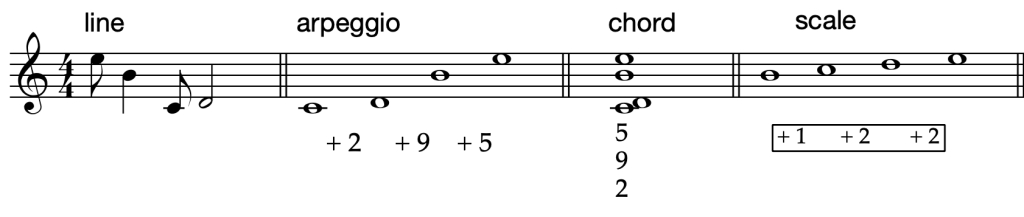
sample constellation 2 9 5
This constellation’s particular pitch-pattern shape shows a stack of successive intervals from lowest to highest: 2 9 5.
INTERVAL ARRAY — stack of intervals that identifies the constellation’s particular intervallic shape in vertical pitch space, listing the successive, additive upward intervals from lowest to highest pitch
Note: I tend to use “interval stack” and “successive upward interval array” interchangeably. If we wanted an acronym, how about Successive Upward Interval Series Stack — SUISS? No, maybe Vertical Interval Array — VIA? But vertical is not quite right, as the pitches might occur in musical context diagonally in 2-D pitch-time space and only be vertical when theoretically aligned as a chord stack. So let’s stick with interval array — and since conventional music theory doesn’t use the word for anything else, let’s just call it an ARRAY.
The constellation above also contains a “Major 7th” 11-semitone interval (+2+9=11), C up to B; a 14-semitone Major 9th, D up to E; and one very large interval of 16 semitones, C up to E in the next higher octave.
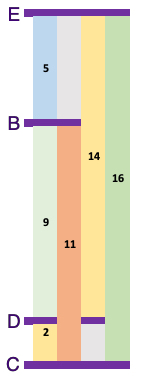
sample constellation 2 9 5
Below is a sample etude made with just this one 4-pitch constellation and its transpositions (bars 4-6 two semitones down), all with the same interval stack, 2 9 5, or its upside-down inversion, 5 9 2 (bars 12-14 bass clef).
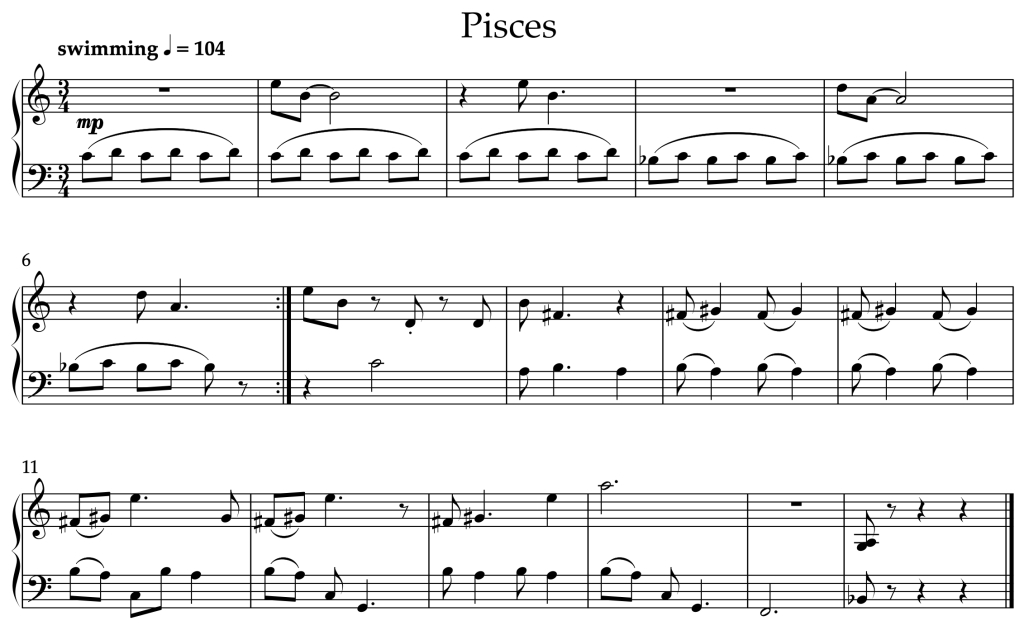
Pisces etude
The etude is based on this 2 9 5 array. Bars 11 through 14 in the right hand are a constellation with a slightly altered array: ascending F# G# E A = interval stack 2 8 5, transformed from 2 9 5 by shrinking the middle interval of the stack by one semitone. Why? Sticking with 2 9 5 would have made e# or f and then b-flat on the top, not such great counterpoint against the b-natural in the lower line. And why not? The minor-9th interval A up to B-flat, 13 semitones, is a particularly gritty, unpleasant dissonance.
One example with pitch classes would be [F B E], in which F up to B is 6 semitones, B up to E is 5 semitones, and F up to E is 11 semitones. This example with all three pitch classes drawn from a C major scale illustrates that [6 5] is correctly shown in white as a diatonic pattern, despite the fact that it is not commonly used as a harmony in common-practice tonal music other than as a Mahler-style suspension.
In the table below, each column groups stacks of the same height – each stack also forms a larger interval (not shown) that is the sum of the adjacency intervals shown. For example, reading bottom up, the stack 6 5 also forms an 11-semitone interval, the stack’s total height. All 3-pitch-class interval stacks:
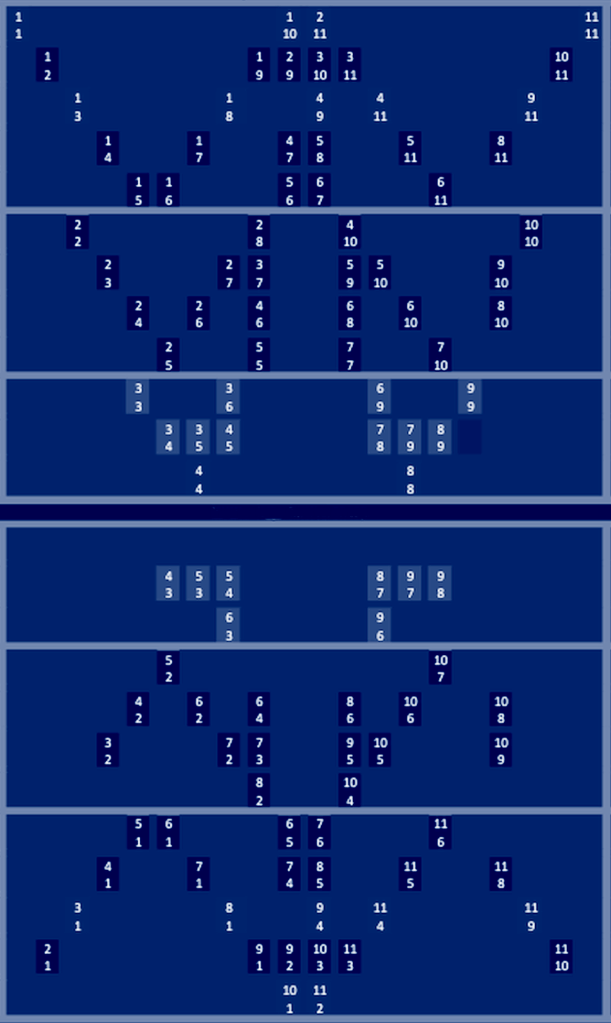
3-pitch interval-stack arrays
It may be helpful to see example pitches on a staff illustrating all these possibilities. Each line below shows a family, one Forte set class: first Forte’s “best normal order” with example pitches, then their chord voicings with stacked-interval sizes; then the set’s inverse, if there is a unique one.
Here the color shadings denote special degrees of interval complexity: RED = sharply dissonant; ORANGE and YELLOW = mildly dissonant; GREEN = minor and major triads; BLUE = quartal/quintal chords of P4 and P5 intervals.
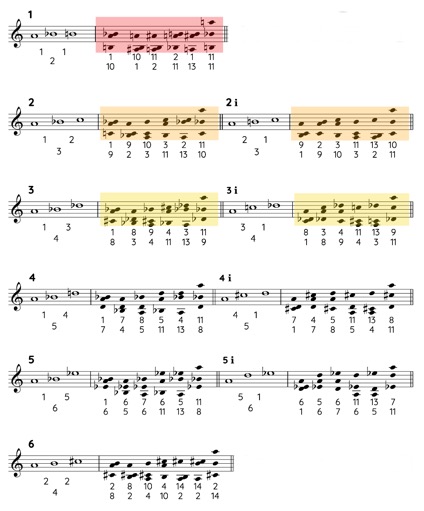
3-pitch arrays, families 1-6
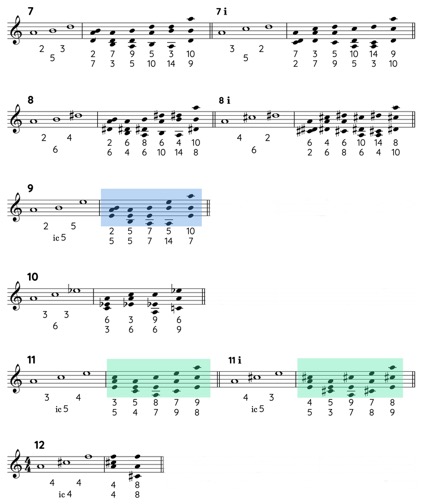
3-pitch arrays, families 7-12
As with scale-pattern maps, these maps and their notated lists represent the entire chromatic universe of possible constellations within a two-octave range. Each could be expanded by adding an octave to any stacked interval. And of course, each can become a line, a chord, or a temporal proximity of pitches in a texture.

© 2026 – All Rights Reserved
Thomas S. Clark
–
Continue reading Mapping the Music Universe:
–
_____________

