Tag: Stopping by Woods

  • MapLab 5. Spin a Solo

    Unaccompanied instrumental solos go back at least to the 18th Century, such as Bach’s violin partitas and cello suites. In the late 19th century, Debussy’s Syrinx for solo flute met the challenge of making a piece with just one wind instrument, not capable of the double-stops that complicate the rich textures of Bach’s string writing.

    1. Choose a model

    Syrinx launched a whole genre of unaccompanied flute solos, with Density 21.5 (1927) by Edgard Varèse and Sequenza (1958) by Luciano Berio leading the way to experimentation with virtually every wind instrument. My Night Songs (1969) for solo trombone is very much within the tradition of this genre. As a trombonist and undergraduate composition student, I used my intimate knowledge of the instrument to select gestures and techniques to experiment with compositionally.

    2. Choose an instrument

    I also love the viola, so I readily agreed to write an unaccompanied solo for each member of the Pleasant Street Players, including violist Ames Asbell.
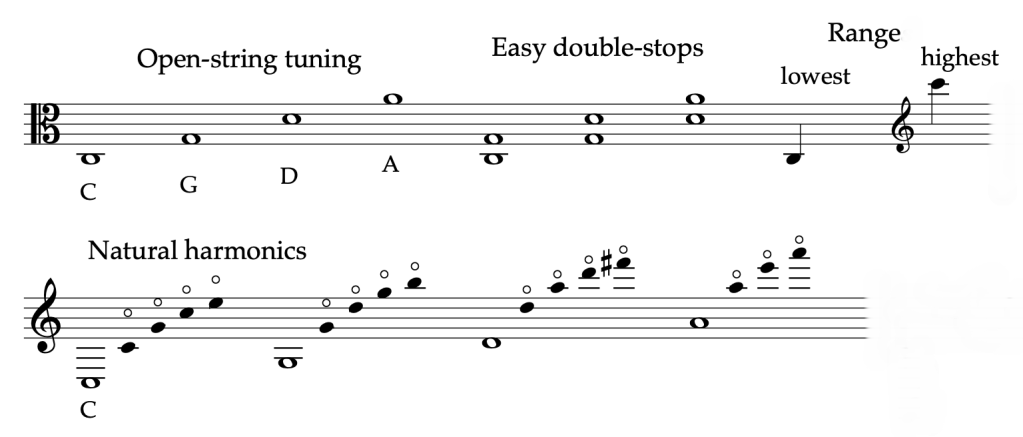
    3. Sketch idiomatic gestures

    Before I Sleep is inspired by a famous, beautiful Robert Frost poem, “Stopping By Woods.” Its snowy scene tempted me to quote a Mahler’s Symphony No. 4 (1900) that starts with sleigh bells and flutes doing something like the A gesture. (Sul ponticello is a special string technique to brighten tone by moving the bow closer than normal to the bridge.)
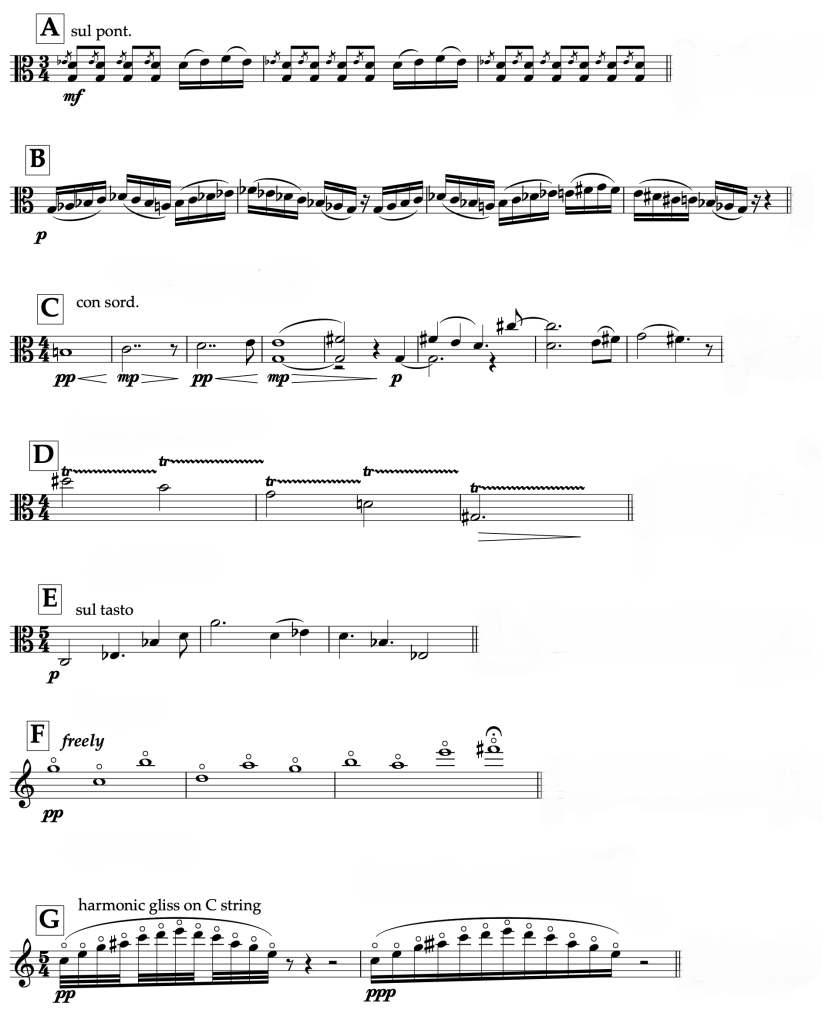
    B features the quick scale patterns so indigenous to orchestral strings.

    C uses a mute, attached to the bridge to subdue the tone. It also uses double-stops, drawing the bow across two adjacent strings together, making two-pitch diads and even two-voice counterpoint. These use an open string and the next string a perfect-fifth higher or fingering a pitch more than a perfect-fifth higher.

    D makes bird-like trills.

    E uses sul tasto, the reverse effect of sul pont, drawing the bow closer to or over the fingerboard for a darker, warmer sound.

    F makes the high, glass-like sounds of natural harmonics, produced by touching a string lightly at one of its partial-vibration nodes while drawing the bow on it. (harmonics, like open strings, have no vibrato. Sorry my synthesizer insists on applying vibrato anyway.)

    G is a very special effect used by George Crumb in his early chamber music. Sometimes called a seagull effect, it produces a quick arpeggiated succession of natural harmonics by running a finger lightly up and down across the partial-vibration nodes of the string.

    The gestures sketched above show a wide variety of pace and rhythmic characters.

    4. Interval language

    The B idea is scalar, running around through an unusual scale. It is almost an octatonic wholetone-halftone scale, but modified by an Ab, making the lower tetrachord the start of a Phrygian mode scale.

    For the rising and falling landscape of melodic lines, choice of pitches and the cumulative constellations they form can be freely crafted the old fashioned way, plunking out pitches on a piano (or on the actual instrument of the piece) in a trial-and-error search for pleasing pitch streams. Identifying one’s favorite intervals can lead to using a more organized cell approach, limiting melodic interval choices to only two or three sizes.

    In the TC example, an interesting constellation is established and simply arpeggiated in various shapes.
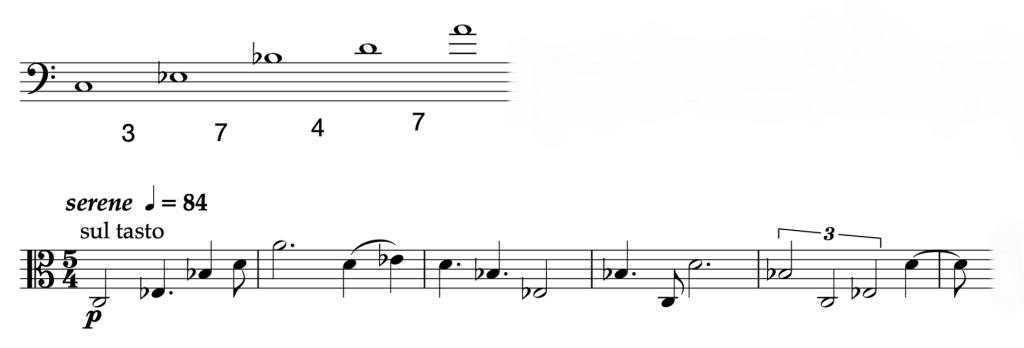
    This produces a single, stable harmonic prolongation, a calming stasis in which the line keeps retracing recently touched pitches.

    5. Edit the notation

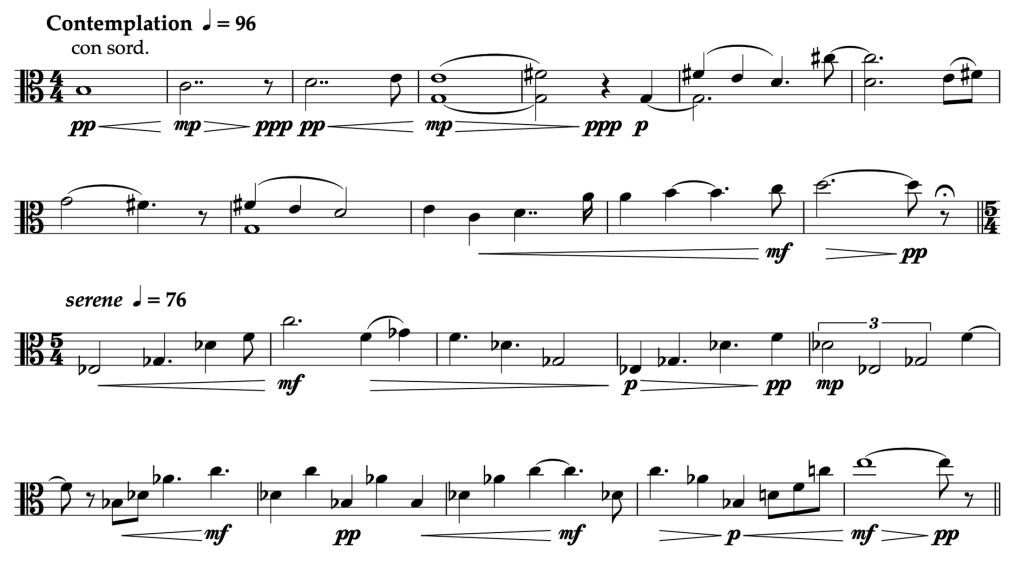
    The score is not finished until all details are included, showing clear information and intent. A solo line especially needs strong dynamic shaping to be interesting as a solitary musical voice. The following example from the viola solo notates many of the necessities on this checklist:

    • timing information, including tempo, rallentando, fermata
    • expressive indications
    • dynamics, including ample changes, crescendos, diminuendos
    • phrasing such as slurs
    • special techniques such as con sordino, sul pont, sul tasto, harmonics
    6. Overall form

    An unaccompanied solo is a soliloquy. The dramatic tone can vary: a rage; a contemplation; or a story. The form can be a continuous flow of development of a single, persistent gesture, as in Berio’s Sequenza series. Or it can be sectional, a story told in short chapters, a poem divided into stanzas.

    The TC example, actually a previously composed 2018 piece titled Before I Sleep, was written for my colleague Ames Asbell of the Texas State music faculty and Pleasant Street Players, an outstanding artist and player of one of my favorite instruments. The title is a quote from the last lines of Robert Frost’s famous poem “Stopping by Woods,” a contemplation of death on a nocturnal sleigh ride in the snow. The lead motive is a quote from Mahler’s Symphony No. 4, which open with flutes and sleigh bells jingling what is called the “bell theme.” My musical form follows the poem, in three sections:

    • sleigh bells and a trotting horse (gestures A and B)
    • snowflakes (a variation of B transitioning into D and F)
    • contemplation (C and E)

    The poem ends famously with a direct repetition of the last line, “and miles to go before I sleep.” That could have been the going-to-sleep hypnotic musical ending as well, but the poet is not ready to die. My musical ending instead is not a coda but a brief tag, gesture G, the horse gently shaking his bells in the glistening moonlight.

    Before I Sleep

    Continue reading Mapping the Music Universe . . .

    MapLab 6. Paint a landscape

  • journal 18. Autumn Rain

    San Marcos, 2016 —

    The style that we now hear as the sound of America in the 20th century — where did it come from? Before Henry Cowell or Aaron Copland, before Lou Harrison or John Cage, it came from the bold, eccentric music of Charles Ives.

    Ives not only created the musical sound of 20th-century America, he wrote about American life, literature, and places. His Piano Sonata No. 2, Concord, Mass., 1840–60 (1915)explores the ethos of New England writers in its four movements:

    1. “Emerson” (after Ralph Waldo Emerson)
    2. “Hawthorne” (after Nathaniel Hawthorne)
    3. “The Alcotts” (after Bronson Alcott and Louisa May Alcott)
    4. “Thoreau” (after Henry David Thoreau)
    LISTEN ›

    Stephen Drury on YouTube

    One of Ives’ most performed and well-known works is Three Places in New England (1914) for orchestra. Each “place” is a musical sketch of a place’s unique atmosphere, painting a picture of life at the dawn of 20th-century America. It epitomizes the unique style that established Ives as an icon of American music in the 20th century.

    That style, which built what became the defining sound of American music, featured:

    • sound masses of dissonant tone clusters
    • chaotic layering of multiple simultaneous tunes
    • huge, sudden contrasts of loudness and texture

    The movement sketches are subtitled:

    1. The “St. Gaudens” in Boston Common (Col. Shaw and his Colored Regiment)
    2. Putnam’s Camp, Redding, Connecticut
    3. The Housatonic at Stockbridge
    LISTEN ›

    Cleveland Orchestra on YouTube

    Frost

    If Charles Ives is the iconic composer of 20th-century America, Robert Frost is the iconic poet. I became an ardent admirer of Frost’s writing as early as 1966, reading his complete works by the time I was in grad school. Two poems had a profound early impact on my spirit and sense of artistic possibility. “Mending Wall” (1914) and “The Road not Taken” (1916). To me, the latter is wondering about looking into the uncertain future, expressed in a woodland metaphor typical of Frost that resonated with my rural Michigan youth. (That is probably why I quoted it in my very first public speech, my valedictory address at the 1967 Howell High School commencement ceremony.)

    THE ROAD NOT TAKEN” excerpt

    Two roads diverged in a wood,
    And sorry I could not travel both
    And be one traveler, long I stood
    And looked down one as far as I could
    To where it bent in the undergrowth;

    Fast forward to 2016, when my colleagues Ian Davidson, Ames Asbell, and Vanguel Tangarov at Texas State asked me to write an unaccompanied solo for each of their instruments, oboe, viola, and clarinet. As the Pleasant Street Players, they recorded what was to be a whole album of my music, including a duo, two quartets, and a quintet for their trio plus guest colleagues. The recording project was exciting and bore excellent musical results. But it slammed into the COVID epidemic and could never be finished and published.

    Here is what its roster of 7 tracks would have been:

    Snow and rain

    Two memories of walking in the snow stand out in long-term memory. In about 1965, one recreation of a restless Michigan teenager on winter nights was to put on boots and parka and hike through snow-covered fields and forest in the moonlight. In 1992, my composer friend Arnošt Parsch led me on a walk into the logging forest above his Moravian village, Bílovice nad Svitavou. Through late-fall snowflakes, we retraced the steps of Janácek, passed the natural-spring well and the Sokol tavern up to a beautiful promontory view of the snow-covered village below.

    Sur la Neige is a snow fantasy on three quoted musical ideas. The work begins with an obscure quote from Stravinsky’s L’Histoire du Soldat, elaborated and then transitioning into a quote from Debussy’s Prelude No. 6 in his Préludes, Book I, subtitled “de pas sur la neige.” Eventually, a small decorative figure from Janácek’s Sinfonietta appears and quickly disappears like a scurrying bystroušky (fox).

    In each poem below, I will boldface some of the imagery that particularly inspired ideas for sounds, rhythms, and mood.

    Frost’s first poem that I set to instrumental music in 1973 was his 1913 “My Noember Guest,” an exquisite expression of loss and sadness.

    MY NOVEMBER GUEST” excerpt

    My sorrow, when she’s here with me,
         Thinks these dark days of autumn rain
    Are beautiful as days can be;
    She loves the bare, the withered tree;
         She walks the sodden pasture lane.

    She’s glad the birds are gone away,
    She’s glad her simple worsted grey
         Is silver now with clinging mist.

    The desolate, deserted trees,
         The faded earth, the heavy sky,

    In 1971 in Ann Arbor, I wrote Autumn Rain for oboe and piano. Much of its melodic material was incorporated into the solo English horn piece for Ian in 2016. Its four movements:

    • “these dark days of autumn rain”
    • “my sorrow” (remembering Lidice)
    • “the bare, the withered tree”
    • “the sodden pasture lane”

    The second movement’s memorial to the atrocity of Lidice quotes the Czech national anthem Kde domov můj (“Where My Home Is”). Other musical material expressing darkness, death, and perseverence is a quote from the Lux aeterna of Mozart’s Requiem.

    Clark 1971 / 2024 (TC-85)

    The solo clarinet piece was based on this Frost poem:

    BIRCHES” excerpt

    I’d like to go by climbing a birch tree,
    And climb black branches up a snow-white trunk
    Toward heaven, till the tree could bear no more,
    But dipped its top and set me down again.
    That would be good both going and coming back.

    Musical material quotes the beginning of Bartok’s powerful fugue in Music for Strings, Percussion and Celeste. The fugue theme is scored for the orchestra’s viola section, but in Bending Birches I’ve placed in the beautifully dark chalumeau register of the clarinet.

    Clark 2018 (TC-89)

    The viola piece, Before I Sleep, began as a solo based on this 1922 poem:

    Stopping by Woods on a Snowy Evening

    Whose woods these are I think I know.
    His house is in the village though;
    He will not see me stopping here
    To watch his woods fill up with snow.

    My little horse must think it queer
    To stop without a farmhouse near
    Between the woods and frozen lake
    The darkest evening of the year.

    He gives his harness bells a shake
    To ask if there is some mistake.
    The only other sound’s the sweep
    Of easy wind and downy flake.

    The woods are lovely, dark and deep,
    But I have promises to keep,
    And miles to go before I sleep,
    And miles to go before I sleep.

    Some of the imagery (again boldfaced above) lends itself to ideas for sounds, rhythms, and mood. The solo viola piece is titled Before I Sleep.

    Clark 2018 (TC-90)

    Concord

    If Charles Ives was unapologetically brash, his music could also be lyric and transcendent, a gentleness akin to the contemplative voice of Robert Frost. Back to Concord . . .

    After the demise of the Pleasant Street album project, the three solo pieces began to come together, merging into a single piece for viola and strings. The result embodies the expressive and sonorous essence of the whole Frost stream of work from 1973 to now.

    Clark 2024 (TC-145)

    ___________