Rhythm is a stream of event durations. Often repetitive but potentially elastic, rhythm can be steady, as a simple march, or volatile, as a melody that hovers, trots, then suddenly starts running.
Defining some basic terms:
TIME POINT — a precise moment in time marking the beginning of a span of time extending until a comparable event marks the next time point
TIME SPAN — the duration of time from one point to the next point marking a comparable event
STREAM — a series of events formed by the elements of consecutive groups
PERIODIC — a stream of events whose elements exhibit equivalent time spans
PULSE — ungrouped periodic time marking in a speed of about 48 to 1,000 per minute (above 1000 per minute becomes pitch)
METER — a nested hierarchy of periodic streams of of time points
Nested means that two or more time-spans at a quicker level are synchronized with the next longer durational level. Two eighth-notes “fit” within the metric time-span of one quarter-note, for example. Meter creates the perception/expectation of events happening at periodic time points on more than one level of speed/duration.
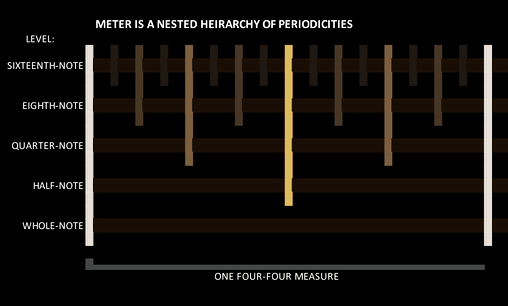
BEAT — pulse that constitutes the primary level of a meter’s hierarchy, the connector between both quicker subdivided and slower grouped levels
PACE — general quickness / slowness of rhythmic activity in a line or whole fabric
HYPERMEASURE — extension of metric hierarchy grouping measures, typically in two- or three-measure units
PHRASE — grouping of molecules, shapes, motives, chord changes, etc. in a coherent stream, typically the length of the human breath
PERIOD — grouping of phrases, typically concluded with a significant harmonic cadence and/or melodic sense of arrival
Pulse and Beat
Underneath the sense of a beat, pulse is primordial periodicity – clapping hands, stomping feet, banging rocks, running strides – features we inherit from our primitive musical ancestry and still use to organize our musical actions.
Susie Ibarra – Sky Islands (2025)
A rapid pulse can drive music with frenetic motion. Much of jazz relies on this power source. The tension between a fast, steady pulse vs. unpredictable accents (syncopations) and other turbulence generates energy and excitement.
SYNCOPATION — an accent not synchronized with the beats, or a note length shifted from its regular metric starting point
Listen to how a relentless, fast pulse drives this music.
Julia Wolfe – Believing (2012)
Rhythm makes meter, Meter drives rhythm
Rhythm first generates meter by marking periodic time points at different levels of speed. The marking is just the moment of initiation of each note but also accents, chord changes, etc. at broader time levels. As a great example, let’s use a famous theme from a piece nicknamed for a planet:
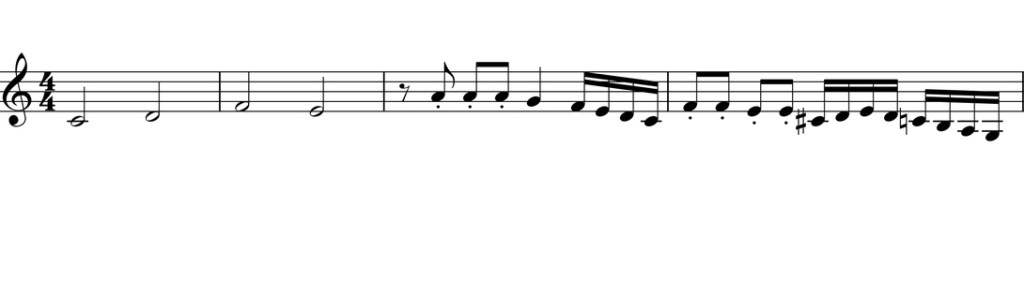
Jupiter Symphony theme
This melody first establishes periodicity of half-notes but nothing shorter for a while. This could be any duple meter. Once we hear these first four equal notes, we tend to perceive them as two pairs, establishing the whole-note measure-level meter. We feel the time point that begins the third measure on two levels of periodicity even though no note happens to mark it. In this third measure, eighth-notes then divide those half-note time spans into four parts. In the middle of measure 3, a quarter-note fills in the missing level of meter. Finally, in the last beat of the measure, a burst of sixteenth-notes establishes the fourth, quickest periodicity of the nested hierarchy. This example extends the hierarchy to show 2-bar hypermeasures in a 4-bar phrase.
Once the tune repeats, our sense of that nested hierarchy of speeds is in full cognitive play. While jumping from metric level to level, half-notes to eighth-notes to quarter-notes then 16th-notes, the melodic rhythm undergoes a compression of pace, moving from longer rhythmic values to quicker and quickest, while the Allegro tempo does not change.
More definitions
CYCLE — the duration of equivalent time spans in a periodic stream of events
ELEMENT — a point and following time span of an event or group of events, relating to other consecutive elements to form a group at a broader (slower) level of time
COMPRESSION — an element of a group or stream is a shorter span than the previous element
Example: rhythm changing from half-notes to quarter-notes to eighth-notes, compression of pace.
EXPANSION — opposite of compression, elements of a group or stream are longer spans than previous elements
ACCELERATION — consistent successive small compressions of beat or pulse
PROPORTION — relationship of time spans expressed as a ratio, reduced to smallest-possible integers (whole numbers)
RHYTHMIC GROUP — consecutive related elements, with a point of initiation and accumulated durational span
RHYTHMIC RANGE — ratio of longest duration to the shortest
In the Mozart Jupiter example above, the rhythmic range is 1:1 conformity for the first two bars, then 4:1 with three different note values in the third and fourth bars.)
RHYTHMIC VARIETY — number of different note values in a stream of notes
In the Mozart Jupiter example above, the rhythmic variety is 4 (halfs, quarters, eighths, sixteenths).
Stress and accent
Classic poetry classifies each syllable grouping (a “foot”) in a line of poetry according to which syllable in the grouping is stressed or longer length (agogic stress). (The last, a “reversibrach,” is my addition to complete the set of possibilities for musical purposes.)
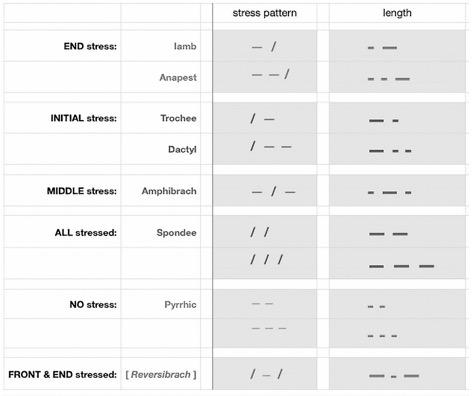
Metric “feet” in poetry
Rhythmic molecules, groupings of two or more notes, can be similarly characterized, though with more stress possibilities:
- Strength (accent) stress
- Length (agogic) stress
- Metric stress (strong beat vs. weak beat; on the beat vs. off-beat)
A molecule can have one stress pattern in accent contradicting a different stress pattern in length or metric placement. Another familiar Mozart example: the opening themes of the first movement of Mozart’s Symphony No. 40 in G Minor. The first theme is fast (allegro) but steady (low elasticity).
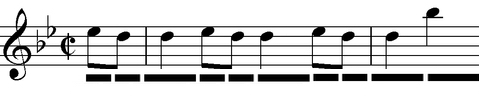
Symphony No.40 1st theme
Analyzed as three rhythmic molecules:
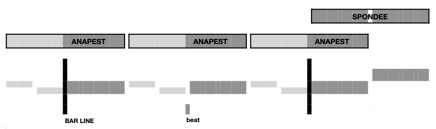
Three quick, predictable anapests, in which the longer, metrically-accented note is precisely the same length as the pair of shorter notes that lead to it. It also shows a narrow rhythmic range, 2:1, and little rhythmic variety, with only two rhythmic values, the eighth-note and quarter-note.
Now the contrasting second theme, a soaring oboe line, highly elastic in rhythm.

Symphony No.40 2nd theme
This phrase launches with a long trochee, beginning-stressed in both length and metric placement. This rhythm uses four different note values, the longest of which is 12 times the length of the shortest. The first note sounds stretched, like an elastic band that is then released after the third note, unleashing the quick notes that scamper to the last.
This is just a glimpse on the micro-level of rhythmic contrasts and a temporal elasticity that propels the exciting roller-coaster allegro opening of this great symphony. All our perceptual and gestalt faculties are engaged in a grand game of play with time.
Molecules
Here are the opening notes of three famous 20th-century unaccompanied flute pieces, by Debussy, Varese, and Berio, respectively.
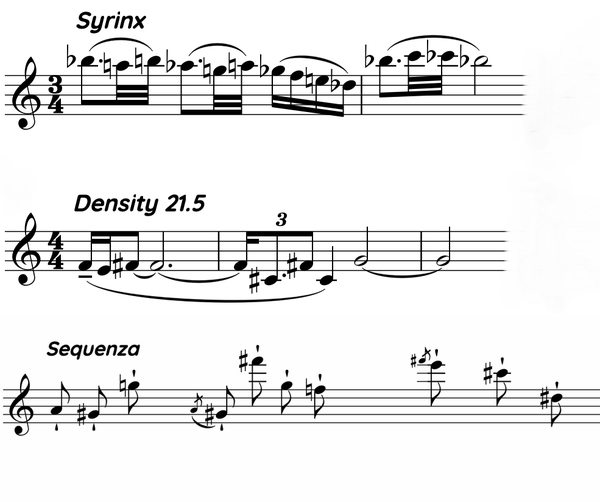
Each uses a three-pitch motive that, when analyzed as a pitch-class set, is a segment of the chromatic scale.
- Syrinx: A Bb B = +1 +1 semitones chromatic scale pattern
- Density 21.5: E F F# = +1 +1 semitones, same scale pattern
- Sequenza: G G# A = same +1 +1 chromatic scale pattern (G displaced by an octave)
Shown above in their chronological order of writing, it is likely that one influenced the next, and it the next in a chain of evolving variation. While this shared pitch-class-set characteristic is the usual basis for comparison, it is also interesting to compare the rhythmic molecules of their generating motives.
Syrinx starts with a clear front-stressed dactyl, repeated then echoed in bar 2.
The Density 21.5 motive is more complicated. Its opening three notes, from a short/long durational standpoint, is an end-stressed anapest. But the first note, though short, has the metric accent, being the only note of the three written on a beat. That first note is also emphasized by the tenuto mark. Those accent factors point toward a front-stressed dactyl like Syrinx. The next three notes starting with the C# are a more ambiguous stress shape.
The opening three notes of Sequenza have no clear metric or dynamic accent difference; they are all strong. But by duration, the third note is “longer” in effect in the time stream (agogic stress), as the silent time after it, before the next note comes along,is longer. Also the third pitch, G, is much higher, giving it a registral or contour accent. This 3-note molecule is an end-stressed anapest.
In all three pieces, however, the sense of simple repetition of matching poetic feet is not established or maintained. It is more productive to understand throughout each piece how rhythmic range and variety expand and contract and pace intensifies or subsides.

© 2026 – All Rights Reserved
Thomas S. Clark
–
Continue reading Mapping the Music Universe:
_____________

