“If you want to find the secrets of the universe,
think in terms of energy, frequency, and vibration.”
(Nikola Tesla)
We start with time. Everything in music involves time, is of time, sound events occurring in our perceived flow of time.
Sound itself is periodic vibration, a repetition of compression waves of energy in air (or water). Repetition of an event or series of events establishes a frequency of repetition and the period or cycle length, the elapsed time duration from each event’s starting time point (moment) to the starting point (moment) of its repetition.
We perceive the frequency of air-compression waves as pitch if they are faster than 20 per second and slower than about 4,000. Frequency is typically measured in cycles per second, called Hertz. Non-periodic waves faster than about 20 Hz are perceived as noise. Events or time cycles slower than 20 Hz are perceived as pulses, tempo, rhythm, phrase structure, etc. At these slower sub-sonic event speeds, it is more convenient to identify the duration of the cycle, its period, than the frequency.
Periodicity, this repetitive aspect of sound events in time, gives us a dimension to map all the possibilities, from extremely fast to almost frozen slowness, and from simple, highly regular repetitions to a very complex succession of variants.
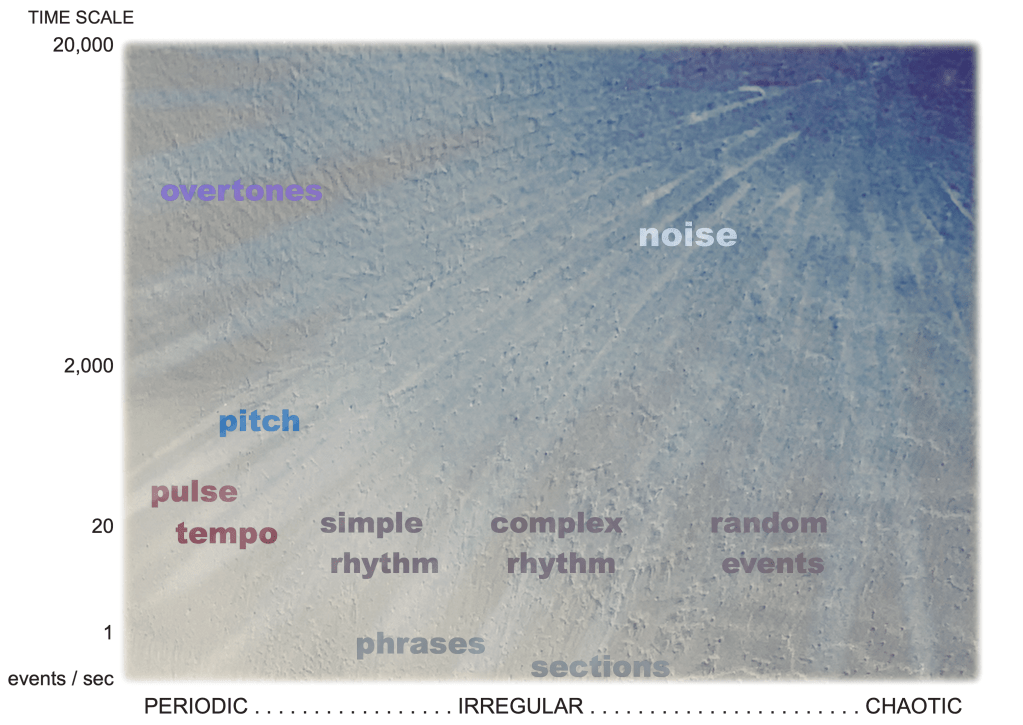
the periodic time/sound universe
In this illustration, the Y-axis is speed/frequency (slowest at bottom, fastest on top), the X-axis is regularity of repetition (perfectly regular at left, randomly sporadic time spans at right). The blocks have sharp rectangular edges; if I were a better artist, the boundaries between descriptive categories would actually be curving and very blurred. Though the graph shows firm straight lines separating pitch and noise, there is actually a fuzzy, curving grayscale continuum from pure, simple pitch through complex, colorful pitched timbres to noise.
Defining time
What is time and how does it work in our lives and in the rhythms that are the fundamental “substance” of music? I say substance metaphorically, because time does not exist as any physical matter. It is a perceptual construct, a complex quilt stitched out of human experience.
Discover magazine ran an article in June of 2007 titled, “Time May Not Exist”.
“Efforts to understand time below the Planck scale have led to an exceedingly strange juncture in physics. The problem, in brief, is that time may not exist at the most fundamental level of physical reality. If so, then what is time? And why is it so obviously and tyrannically omnipresent in our own experience? ‘The meaning of time has become terribly problematic in contemporary physics,’ says Simon Saunders, a philosopher of physics at the University of Oxford. ‘The situation is so uncomfortable that by far the best thing to do is declare oneself an agnostic.’”
The mysteries of time were explored as early as sixteen hundred years ago by the great Saint Augustine of Hippo, in Book XI of his deeply philosophical work, Confessions.
“. . . What is time? Who can give that a brief or easy answer? Who can even form a conception of it to be put in words? Yet what do we mention more often or familiarly in our conversation than time? We must therefore know what we are talking about when we refer to it, or when we hear someone else doing so. But what, exactly, is that? [Book XI, Section 17]
Nicholas Stratas’ thought-provoking article in the July 2007 issue of Wake County Physician, “Time – Continuous Yet Bidimensional” asserts that most of us have a firm concept of Past, Present, and Future. But defining them is challenging, and sorting out how these constructs interact in our consciousness even more so. Michael Spitzer, in The Musical Human (Bloomsbury Publishing, 2021), wrote:
“Musical time is a window into time consciousness in general. We listen to music in the moment, sitting in the saddle of an ever-shifting Now, as the past whizzes by to become memory, and the present anticipates what is just around the corner. Music’s present tense is really a bundle of memories and anticipations . . .”
Many years ago, I first read an article translated from Die Reihe, written by a preeminent avant-garde experimental composer, Karlheinz Stockhausen. “Structure and Experiential Time” described Stockhausen’s view that time does not flow uniformly through the experience of a serious musical composition. It ebbs and surges as the composer shapes not just the tempo but the flow of information in the form of repeated or new musical events, simple or complex musical structures.
“When we hear a piece of music, processes of alteration follow each other at varying speeds; we have now more time to grasp alterations, now less.”
Even tempo, a supposedly steady clock in most music, ebbs and flows. Computer music composers in synthesizing musical sounds have found that a mechanistically rigid clock tempo sounds artificial. Human musicians are constantly flexing tempo in subtle ways to convey almost subliminally where the music is “going” (another metaphor, that of travel through space).
Saint Augustine recognizes the slippery challenge of measuring time:
“ . . . We observe the different ways times lapse, and compare them, and call some longer and some shorter. . . . It is passing time we measure, as we experience it. . . . Time can only be measured as it passes. Once past, it is no longer there to be measured.” [Book XI, Section 21]
“We measure time as it passes . . . . But how can we measure the present, when it has no extent of its own? . . . Time must be measured in something with extent . . . But in what extended thing do we measure time as it passes?” [Book XI, Section 27]
“So time is measured, my mind, in you. Raise no clamor against me—I mean against yourself—out of your jostling reactions. I measure time in you . . . because I measure the reactions that things caused in you by their passage, reactions that remain when the things that occasioned them have passed on. . . . Time has to be these reactions for me to be able to measure it.” [Book XI, Section 36]
Time perception
Pulling all this together, I’d like to suggest several things about time in classical music.
- Time is perceptual.
- Time is multidimensional.
- Time is elastic.
- Time is experienced in complex ways as the fundamental basis of music’s richness.
In LEARNING TO COMPOSE, co-author Larry Austin and I begin the chapter titled “Time Streams” with a quote from a philosopher, and then express in our own words the fundamental nature of time.
“ ‘Music makes time audible and its form and continuity sensible.’
—Suzanne Langer
Music exists in time. Time exists as we sense it, articulated on many levels by changing and cyclically recurring events.
As beautiful, colorful and essential as sound is in making music, musical sounds are the means to an end, building blocks for events that primarily mark articulations of time.
We sometimes like to think of music as having two fundamental dimensions, like a graph. The horizontal dimension is the parameter of time. The vertical dimension is the parameter of pitch. But pitch is actually a temporal phenomenon – the frequency (periodic change over time) of sound waves. How amazing are the human ear and human mind to perceive waves of air coming at us a thousand times a second or much faster and distinguish the small differences that make a pitch “in tune” (or not) and the even subtler differences that identify an oboe instead of a violin producing that pitch. All of this from a perception simply of periodic rates in time!
Stockhausen pointed out that in mentally processing all of these sonic distinctions, we are forced to pay more attention to changes in their qualities, combinations, and “spacing” in time. These are his “alterations”.
“The greater the temporal density of unexpected alterations . . . the more time we need to grasp events, and the less time we have for reflection, the quicker time passes; the lower the effective density of alteration (not reduced by recollection or the fact that the alterations coincide with our expectation), the less time the senses need to react, so the greater intervals of experiential time lie between the processes, and the slower time passes.”
The concepts of expectation and information help make some sense of things. “Information” is perceptual data that is similar to what you just heard or logically confirms what you were expecting next. “Entropy” is the opposite perception – surprise, contrast, noticeable change. In musical listening, though we don’t do so consciously, we are constantly “computing,” assessing, retaining, and predicting.
Saint Augustine connects Past, Present, and Future with memory, experience, and expectation:
“What should be clear and obvious by now is that we cannot properly say that the future or the past exist, or that there are three times, past, present, and future. Perhaps we can say that there are three tenses, but that they are the present of the past, the present of the present, and the present of the future. This would correspond, in some sense, with a triad I find in the soul and nowhere else, where the past is present to memory, the present is present to observation, and the future is present to anticipation.” [Confessions, Book XI, Section 26]
And to make matters more complicated, it is not at all a linear process. Let’s take a metaphor. I can’t resist one that Einstein was very fond of in his thought experiments.
As listeners, we’d like to imagine ourselves as a train riding on tracks through time, a train that keeps moving forward and doesn’t back up. The clickety-clack of our wheels is a steady tempo measuring time. We only remember back to the tracks the locomotive has passed but still lie under the wheels of our caboose at the end. And we only look ahead a little bit, as the tree-bordered tracks curve, preventing a longer straight view.
That’s way too simple, a two-dimensional time frame in which we either recall a little of what we just heard or maybe guess a little what might happen next. As Meyers, Stockhausen, Spitzer, and Dr. Stratas all observe, in keen listening to music our minds are filled with memories of not just the previous measure or phrase, but the very beginning of the piece, its theme or launching impetus (Grundgestalt as Schoenberg named it) and, in a more diffuse sense, all that has “happened” up to the present moment. The present moment is not one single phenomenon in time either. Melody, countermelody, bass line, chordal texture, and punctuating sounds are simultaneously tracing distinct paths, each with its own pace through time. At the same time, we are constantly expecting what’s coming, or at least “feeling” where the music might be going. And, as if that weren’t complicated enough, we are busy reevaluating what we just heard in relation to what we had been expecting. Saint Augustine describes it more succinctly:
“Only in the mind can this [the experience of time] be accomplished, because of three activities there—the acts of anticipating, of observing, and of remembering.” [Book XI, Section 37]
None of this is conscious, but in describing it in concrete terms, we recognize the dizzying multidimensionality, time arrows pointing in all directions and curling back on themselves. This is what I believe constitutes deep listening, “getting lost in the music”.
Just one more idea – elasticity. Stockhausen recognizes that in music the sense of time passing changes, stretches or compresses, depending on how much “alteration” is being encountered. This is why music can seem “steady” or “surging ahead” or dissipating and almost “frozen”. It is not at all the tempo that causes this, but rather the rate of change, sharp contrast or subtle evolution, in the harmonies, the melodic character, or the rhythm.
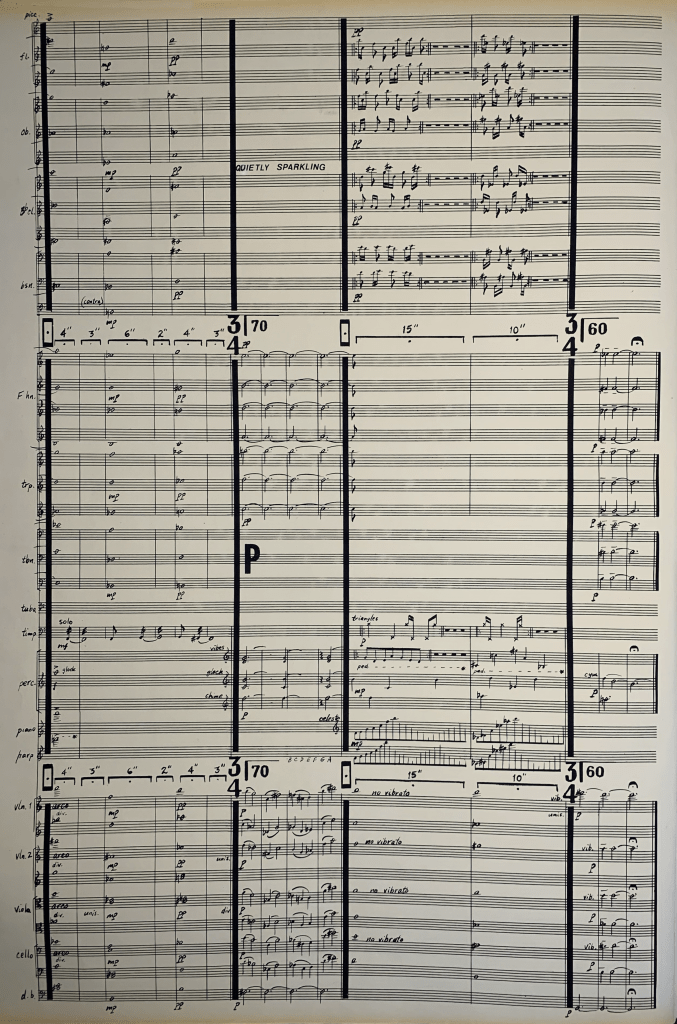
A rhythmic playfulness in modern music stretches our sense of timing. Tempos change, are interrupted, break down, tumble into avalanches, come to rest. Time itself stretches and becomes the titled thematic element in pieces such as Time Cycles (1960) by Lukas Foss. Here is another example titled about time, written at the starting gun of the new millennium.
Fred Lerdahl – Time After Time (2000)
Awe
In his book When (Riverhead Books, 2018) Daniel H. Pink writes,
“I used to believe that timing was everything. Now I believe that timing is everything. . . . The experience of awe changes our perception of time. When we experience awe, time slows down. It expands. We feel like we have more of it. And that sensation lifts our well-being.”
He quotes researchers Rudd, Vohs, and Aaker in Psychological Science 23 No. 10 (2012):
“Experiences of awe bring people into the present moment, and being in the present moment underlies awe’s capacity to adjust time perception.”

© 2026 – All Rights Reserved
Thomas S. Clark
–
Continue reading Mapping the Music Universe:
_____________