Tag: travel

  • Mapping Music 11. TEXTURE

    Imagine a piece of music exploring texture in time, made of single sounds and sonorities occurring one at a time in sustained resonance. Then imagine the points of sound are separated by rests, silence. As the texture drifts in and out of a resonant cloud, the sound events remain unconnected. Suddenly, their pace explodes into a torrent of notes. That describes the following powerful piece by my UNT colleague, Joseph Klein.

    Joseph Klein – Pathways IV: Rhymes & Spirals (2024)

    Sound color

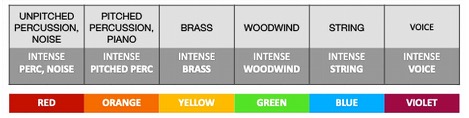
    Our next music map shows a simple color-coding graphic system for classifying most musical timbres, informally the tone quality of sounds. The map intuitively chooses colors of the rainbow. While the color spectrum orders the frequencies of light (another manifestation of periodicity), our sound-color classifying map does not imply any ordered quantification of timbral complexity.

    instrumental color rainbow

    Though we think first of an orchestra for a rainbow of color, chamber music can incorporate a variety of instrumental colors, each produced in vivid isolation by one instrument, standing out or changeably mixed with other colors.

    Augusta Read Thomas wrote Dance Mobile in 2021, scored for 13 instruments: Woodwind quartet (Flute, Oboe, Clarinet, Bassoon); Trombone; String quintet: (2 Violins, Viola, Cello, Contrabass); Piano; 2 Percussion (vibraphone/metal, marimba/wood, drums).

    The piece starts with a single pitch, blending several colors that swell in intensity. Then ensues a kaleidoscopic dance of at least seven distinct color combinations, of two basic types:

    Sustained sounds – strings; high woodwinds; lone brass of the trombone

    Sparks – pizzicato strings; ringing metal sounds; drum strokes; staccato piano

    Augusta Read Thomas – Dance Mobile (2021)

    Though the piece is dedicated “in memoriam Oliver Knussen,” the memory is a joyous dance of color.

    Symmetry

    In the exposition of Webern’s Symphony, Op. 21, we saw that each contrapuntal line duplicates the exact rhythm of the lead line, with each entrance one bar later — a classic canon. But each contrapuntal line presents a different succession of instrumental colors:

    Horn . . . . . . . . . Clar. . . . Cello
          . . . Harp . . . Cello pizz. . . . Cello arco . . . Violin . . . Harp . . . Horn . . . Harp
          . . . . . . Horn . . . . . . . . . Bass Clar. . . . Viola
           . . . . . . . . . Harp . . . Viola pizz . . . Viola arco . . . Violin . . . Harp . . . Horn . . . Harp

    The German term for this is so elegant, we’ll use it here:

    KLANGFARBENMELODIE — melodic or contrapuntal line expressed by a string of changing tone colors

    Webern placed each pitch in every line in a particular fixed octave, except Eb that appears in two different octaves. This makes a striking, symmetrical 13-pitch constellation with a palindromic array, the same array going down as going up.

    Webern 13-pitch constellation

    Not only was he obsessed with symmetry in this piece, but this constellation’s symmetry also proves that he was thinking specifically about the chord voicing in what I have identified in successive interval array form.

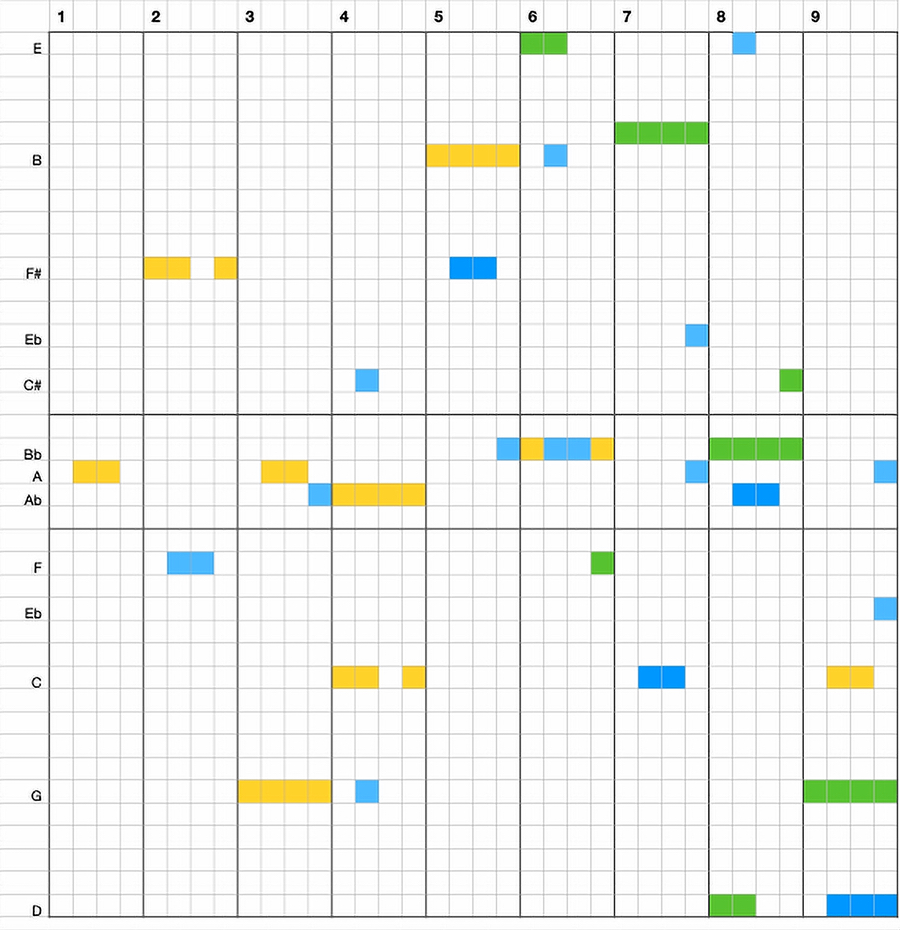
    We can use this constellation as a Y-axis for a graph mapping the timbres as they appear in the various parts in canonic lines in pitch space for the first 9 bars. This farben color map looks like one of the later geometric paintings of Piet Mondrian.

    Op. 21 color map

    Pointillism

    Though we often share musical terms and concepts with visual art, we sometimes mean different things by the same term. In painting, a technique developed in the Impressionist style period of the late 19th century that became known as pointillism. The most famous example is Georges Seurat’s “A Sunday Afternoon on the Island of La Grande Jatte” at the Chicago Art Institute. Instead of sweeping brush strokes and palette-blended colors, it used small separate spots of subtly varied colors to make a texture that, when viewed from a distance, seems to merge into a color cloud, giving the impression of animated light.

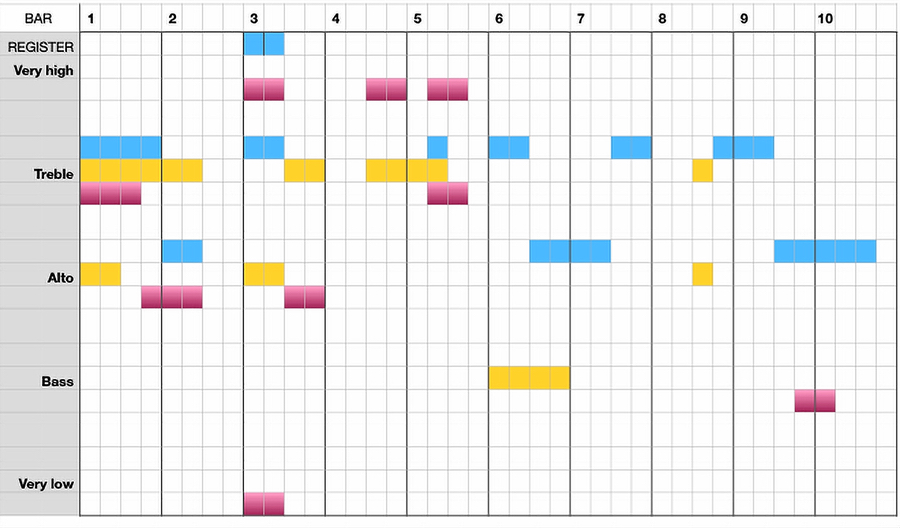
    Musical pointillism, unlike painting, separates sounds in time and pitch space, not to blend them into a texture so much as to highlight the different qualities of each unique sound event. Webern was a pioneer of musical pointillism in works such as Op. 21. Let’s graph the first 10 bars of this fabric using our timbre color-coding (BLUE = wind, ORANGE = percussion, VIOLET = plucked string) on a broadly distinguished 6-octave pitch range. We get something as colorful as a Mondrian painting!

    Andromeda sound color map

    As a musical fabric, isolation — using the vast available range of pitch and the empty time of rests and silence — is a fitting analog for the vast, mostly empty space of a galaxy. Let’s use it for a demonstration etude.

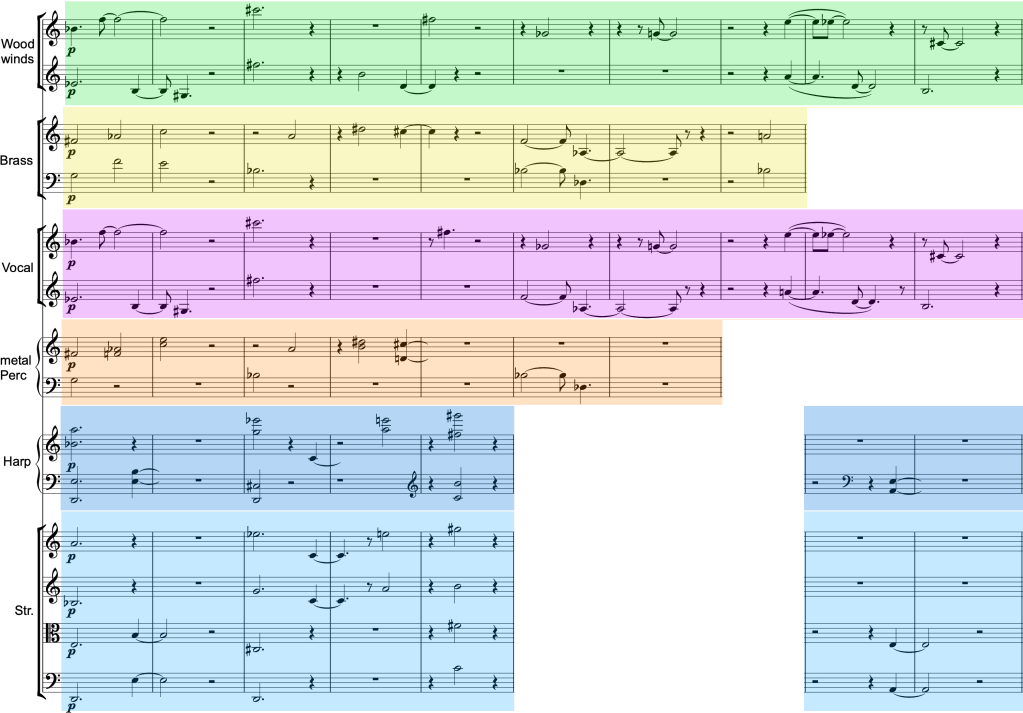
    Andromeda is the nearest large galaxy, 2.5 million light-years from our own Milky Way galaxy. Our sound color demonstration study uses every sound quality on our sound color spectrum except red. Here is a score of the first 10 bars.

    Notice that the green woodwind notes are doubled with a synthesized vocal-type sound. Yellow brass notes are punctuated by orange metallic percussion attacks. Likewise, blue string notes are articulated by the plucked string sounds of harp.

    Here is the whole colorfully pointillistic 3-minute study:

    Sound Mass

    At a time when electronic music was emerging in the 1950s, new instrumental resources were also developing a new style that was all about animating massive layers of sound.

    German experimentalist Karlheinz Stockhausen composed two early, influential sound mass works, Gruppen (1957) for three orchestras, and Carré (1960) for four orchestras and four choirs. The scores were huge, dense, 12-tone, and monolithic in form.

    A 2002 piece by John Adams, On the Transmigration of Souls, harkens back to a mid-century masterpiece of the Avant Garde. In 1961, Polish composer Krzysztof Penderecki wrote a piece for a massive score of 52 string instruments. Conceived as an abstract, freeform, dense massing of animated and intense musical fabrics, it represents a pioneer in the genre of sound mass music, winning the UNESCO Prize that year. Only after it was heard in performance, he said, “I was struck by the emotional charge of the work … I searched for associations and decided to dedicate it to the Hiroshima victims” — thus the title, Tren Ofiarom Hiroszimy (translated Threnody for the Victims of Hiroshima).

    As a young composer in the ‘70s, I reflected this approach in some pieces titled Animated Landscapes. (The title was inspired by John Cage’s famous Imaginary Landscapes no. 4 for 12 radios.) Beyond referring to the painting genre of landscapes, the title sets the imagination for solid, continuous textures like viewing the shapes of a mountain range, but set into rhythmic motion. (This approach became prevalent in ensemble music, especially of Midwestern composers such as Donald Erb.)

    Considerably predating the music mentioned above, Schoenberg’s Fünf Orchesterstücke, Op. 16 (1909), was originally scored for a large orchestra of 37 parts. It is not thought of as sound mass music, as its five movements each have Expressionist or Impressionist titles: “Vorgefühle” (“Premonitions”); “Vergangenes” (“The Past”); “Farben” (“Summer Morning by a Lake”); ”Peripetie” (“Peripeteia”); “Das obligate Rezitativ”(“The Obligato Recitative”). The third movement, Farben, is of special interest not only for its exquisite mixed-palette painting of orchestral timbres, but also for its thick though delicate fabric of sustained sounds. At the start, nothing moves, the subtle shimmer of instrumental colors fading in and out of a continuous fabric of delicate, faint sounds. (A sound mass can be delicate, not necessarily “massive.”)

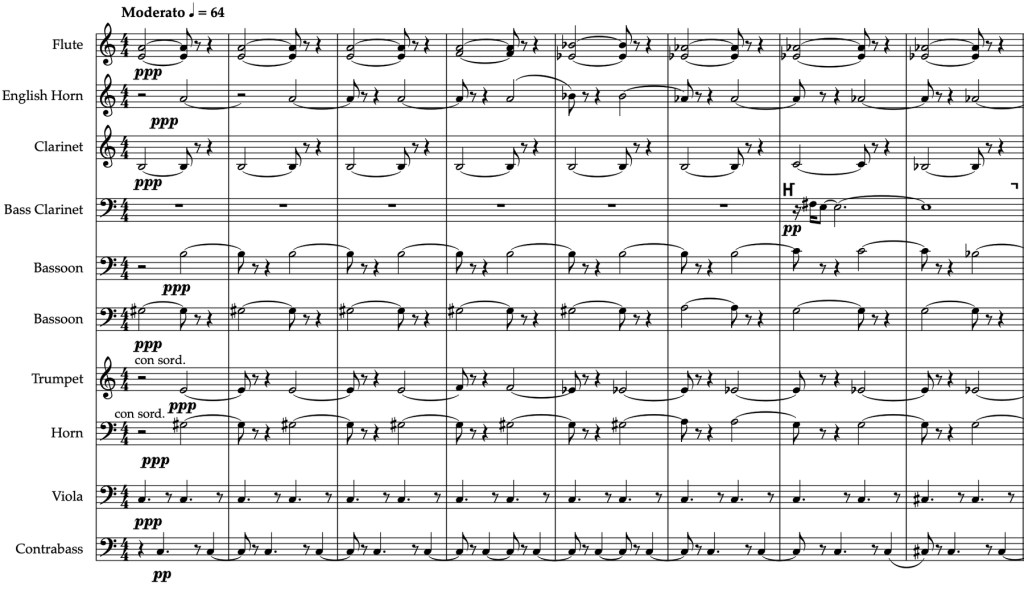
    Here is a score of the first page, showing sounding concert pitches for all instruments.

    Schoenberg Farben scoring

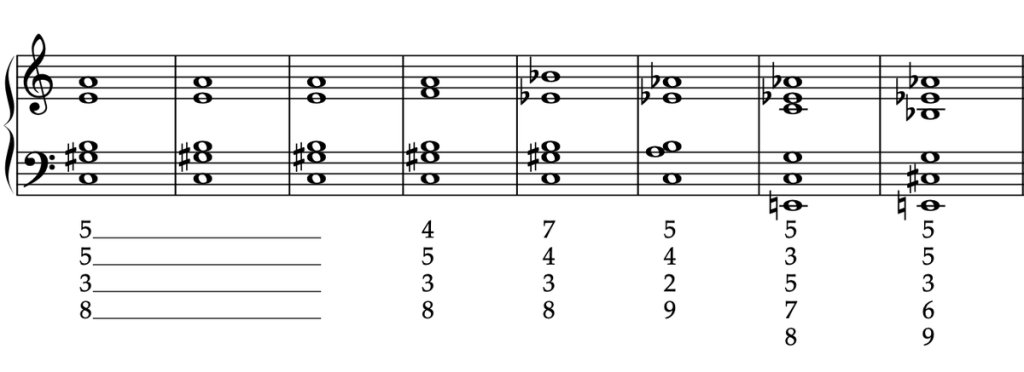
    Each measure presents one constellation, recolored with different instruments in the second half of the measure. For the first three bars, the constellation does not change, and then only subtly in the next five bars, maintaining the constant C pedal point in the low strings.

    Farben constellations

    The bass clarinet’s F3 in bar 7 is considered an ornamental non-harmonic pitch. While you can see many recurring smaller constellations imbedded within these changing large constellations, such as 5 5, 3 5 and its inversion 5 3 (which are triads), and some transformations of smaller constituent constellations: 8 3 redistributed to 9 2, 4 7 shrinking to 4 5 (another triad), and 3 4 (also a triad) shrinking to 2 4.

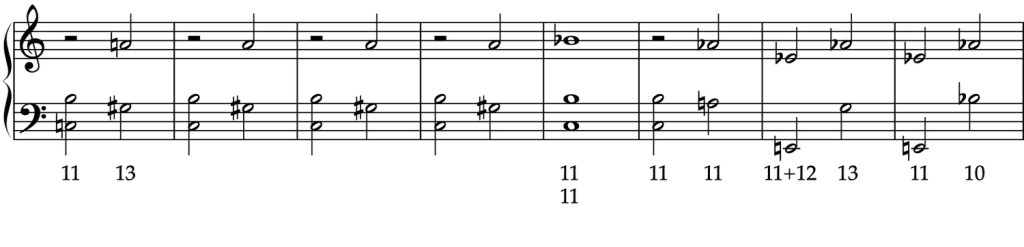
    Though there are many triads embedded in the constellations, the overall quality of the sonorities is complex, as the triads are framed within critical dissonances:

    framing dissonances

    Foreground / background

    Most landscape paintings, distant textures of forest, mountains, sky, waves on the sea, or clouds, have some sharp focal point. Often on the horizon (in itself a focusing anchor of the visual display), it may be a barn, a setting sun, a boat, a farmer and dog. If we consider proportion and symmetry in a visual composition, the focal point is best not dead center. A more interesting balance, according to expert photographers, follows the Rule of Thirds, placed one-third from the left or right, one third from the top, or both. Two-thirds is a ratio of 0.667. The Greeks famously defined the Golden Ratio, an ideal ratio dividing a whole length or height into two parts such that the ratio of the smaller part to the larger is the same as the ratio of the larger part to the whole. The ratio is 1.618:1, the solution to the equation: x2 – x – 1 = 0; a 62% and 38% division.

    In a simple traditional musical texture, an accompanying harmonic texture is designed as a background for the focal element of a melody. Sound masses may lack such focus, like the forest or sea waves. When there is to be perceived a standout element of the texture, Schoenberg called this focal element of the musical fabric the Hauptstimme. Though that might translate “highest voice,” the melody or other focal events are not necessary to be higher in the pitch range of the fabric than other elements. But there must be some isolation or distinction setting them off from background in at least one of the parameters mentioned above. The Hauptstimme focal line or textural element can be:

    • in a pitch range isolated from background
    • a color isolated as a single timbre, not a mixed diffusion of background colors
    • slower or faster than background
    • more rhythmically elastic, varied than background
    • not synchronized with background
    • loudest line (the most obvious)

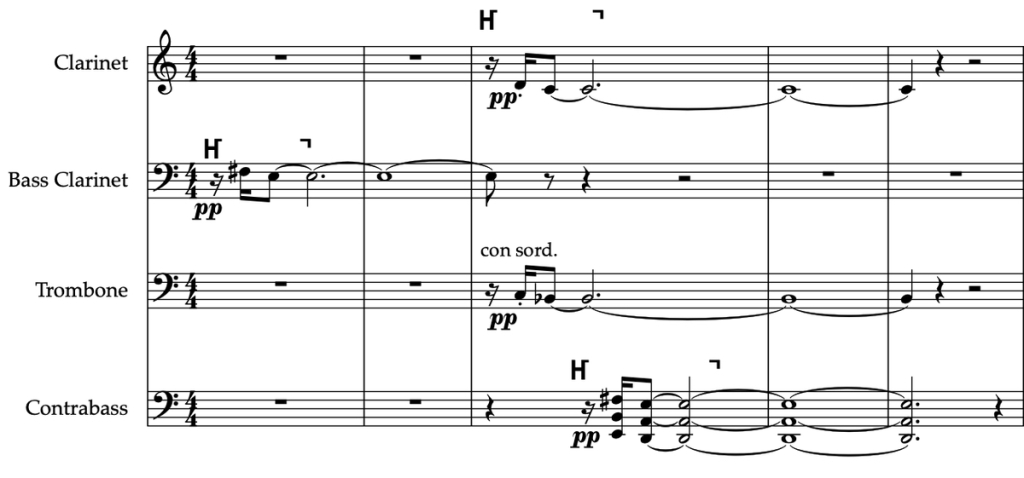
    Schoenberg devised a special symbol for the focal Hauptstimme line of a fabric, a boldface stylized capital H, which you see marking the bass clarinet entrance in bar 7 of the Farben example. Here is how that principal Hauptstimme line continues, a Klangfarbenmelodie of changing color, from bass clarinet to clarinet with trombone to three solo contrabasses.

    Hauptstimme handoffs

    Notice the aggressive rhythmic motive, each time stepping down 2 semitones; and the  7 7 7 quintal-chord constellations in the contrabasses. (The rhythmically aligned clarinet and trombone are separated by 14 semitones, 7 + 7.)

    Beyond color isolation, Learning to Compose makes a distinction for a timbre mixed with itself or other colors spread over some pitch register (“diffuse”) or reinforcing itself in a narrow, confined pitch space (“concentrated”). While Farben’sbackground is diffuse, its Hauptstimme color is isolated in the low pitch register of the bass clarinet and then also concentrated with the three solo contrabasses.

    In the first movement of Anthracite Fields (2015) by Julia Wolfe, the bass clarinet emerges as a focal sound by its loudness and singularity of pitch in a cloud mass of softer sound. Then aggressively loud clusters suddenly interrupt the steady-state background, yielding eventually to repetitive sung chords and floating vocal duets. The sound fabric maintains a three-dimensional depth of contrasting intensities.

    Julia Wolfe – Anthracite Fields I: Foundations (2015)  

    Galaxy groups

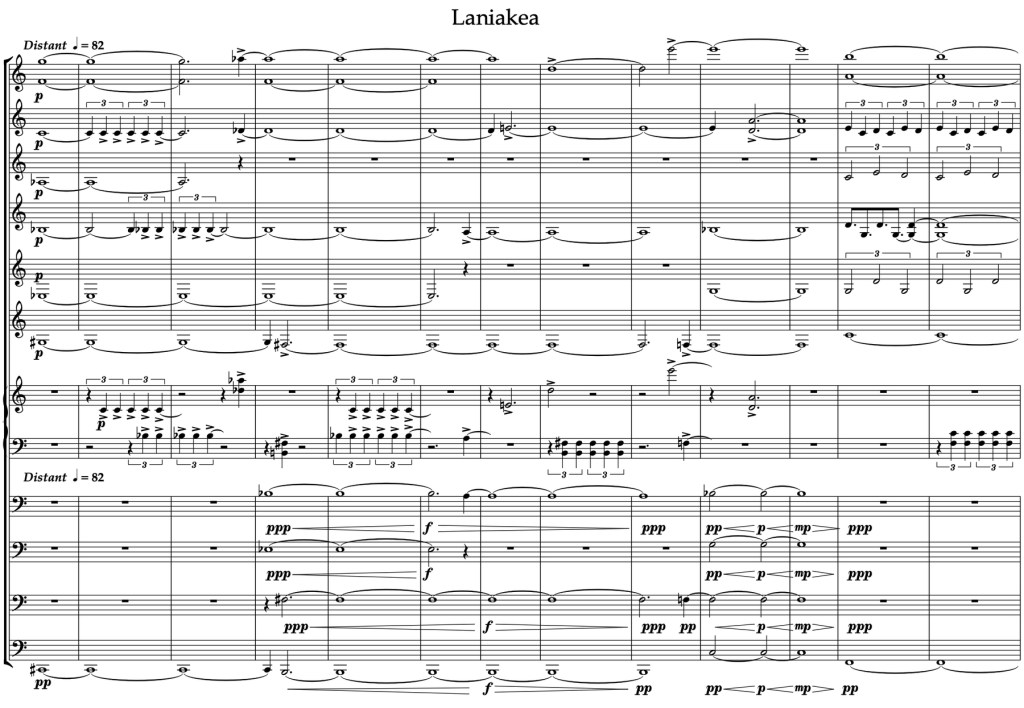
    Our sample etude composition for sound mass is a thick score of 10 wind parts and harp, with a fabric the opposite of pointillism: everything sustains and overlaps. There are basically no pauses or holes in the continuous 2-minute sound fabric. Its title, Laniakea, is the name of the supercluster of galaxies that includes the Milky Way.

    Laniakea score excerpt

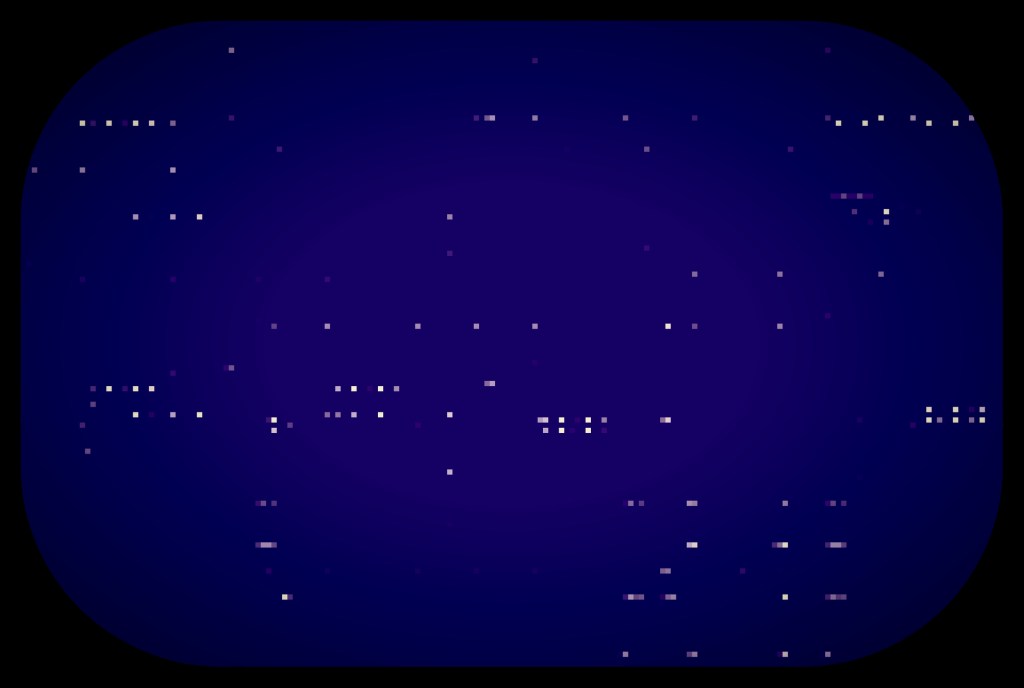
    Having shown the score with all its notational details, to better illustrate the main point of the example, sound mass, here is a graphic rendering of that actual second system of notes. We can reveal its pointillism by increasing the contrast in a negative image of light on dark. That makes the attack beginning of each sound show up but not the staff lines or sustained resonances . . . a fanciful art image of Laniakea, a vast empty part of the universe dotted with millions of galaxies.

    Laniakea score abstracted

    © 2026 – All Rights Reserved

    Thomas S. Clark

    Continue reading Mapping the Music Universe:

    TClarkArtMusic.com

  • journal 13. Millennium

    Taiwan, 2001 —

    In my administrative career, 2001 was a high point, as interim dean of UNT College of Music, then the largest music school in the nation. Though I hired several professors, launched a magazine and Dean’s donor group, and headed up our part of a university capital campaign, I didn’t do any composing.

    Cho (left) and NTUA president (right)

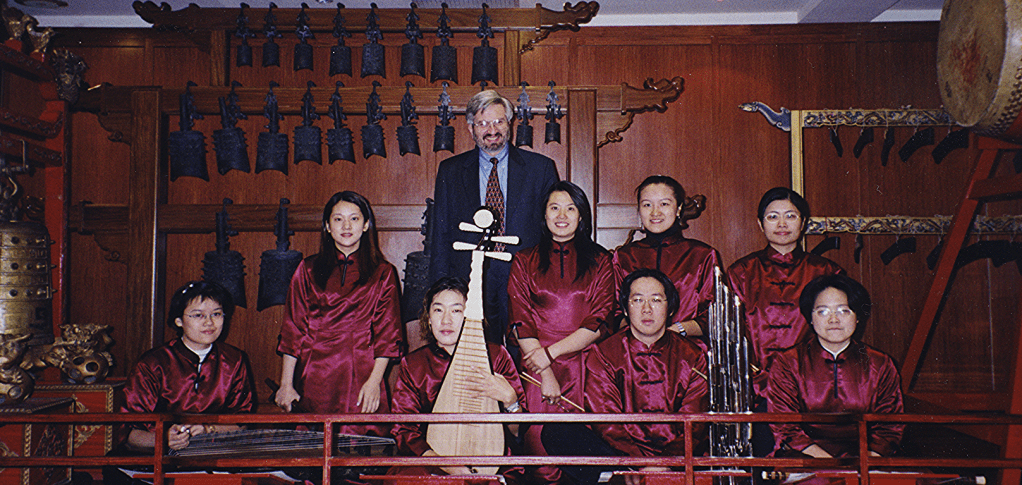
    There was international travel, though. My Chinese-American colleague Gene Cho had established an exchange relationship with the National Taiwan University of the Arts, and he guided me to Taipei for the grand ceremony to sign the formal agreement.

    While there, we saw a traveling exhibit of the Qin Shi Huang Terracotta Army, took a train to visit Hsiuping University of Science and Technology in Changhua City, and went by car to the northern tip of the island of Formosa. In a cold mist on the rocky shore, we gazed out at the infinite expanse of the Pacific Ocean.

    California composer Robert Erickson wrote that the stimulus for his music “is usually some noise or some non-music sound composing the environment in which I live, its sounds, its ambience.” In 1968 he composed Pacific Sirens (ocean sounds) involving taped sounds gathered from the environment with acoustic instruments.

    LISTEN ›

    GreyWing Ensemble

    Global warming

    I was commissioned by North Carolina State University’s Arts Now Series, directed by Dr. Rodney Waschka II, for an artistic contribution to The Ericka Fairchild Symposium on Climate Change. “The Fourth Angel” refers to one of the “seven last plagues” as they were called in the King James Version of the Bible. In the NRSV translation, Revelation 16:8 reads:

    “The fourth angel poured his bowl on the sun, and it was allowed to scorch people with fire; they were scorched by the fierce heat.”

    The other six angels and their bowls wrought plagues of painful sores, bloody seas, bloody rivers, darkness, a dried up Euphrates, and finally the seventh angel’s loud voice pronounced, “It is done!”

    Standing in the middle of the sequence, the prophecy of the fourth angel is a dramatic metaphor for global warming.

    The Fourth Angel

    Clark 2006 (TC-77)

    Though there are some literal sound references, the angel is portrayed more broadly as a metaphor for the forces of nature. Rather than capturing actual samples of nature sounds, the computer-generated sounds are all synthesized, musical objects constructed employing a now-common computing technique called grain-table synthesis. (The choice of machine synthesis over nature sampling suggests a particular belief about the causes of global warming.) These synthetic sound images form a broad range of simple and complex musical rhythms and textures evocative of the natural world:

    • sunlight reflected off water and ice
    • glaciers calving and cascading into the ocean
    • solar radiation
    • night sounds.

    Extending the metaphor, sounds echo and swirl in sound space, just as do the dynamic, powerful weather systems that shape our global climate.

    Other angels

    Thus pieces about angels began with The Fourth Angel. Portraying imagery from Revelation, the seven angels in chapter 16 inflict suffering upon humanity. Angels of Bright Splendor evokes an equally awesome but more hopeful experience of our life-giving sun.

    In Zuni origin mythology, thunder sounded, and The People climbed from darkness, emerging into the daylight world. Seeing the Sun (Awonawilona, they cried, not used to such intense light. Where their tears fell, sunflowers sprang from the earth.

    Angels of Bright Splendor

    Spirits

    Heavenly light, voiced musically with metamorphic chord clusters, became an iconic sound in a famous 1968 movie. György Ligeti describes the technique for his 1966 piece for 16-part mixed choir, Lux Aeterna (“eternal light”):

    “The complex polyphony of the individual parts, embodied in a harmonic-musical flow in which the harmonies do not change suddenly, but merge into one another; one clearly discernible interval combination is gradually blurred, and from this cloudiness it is possible to discern a new interval combination taking shape.”

    LISTEN ›

    A Cappella Amsterdam

    Angels in most world religions and mythologies seem to serve one of two functions: wielding controlling power over the physical world or over human affairs; or making spiritual announcements to humans. The next piece in the angels series, scored for antiphonal double SATB choirs, brass, and strings, gives voice to the unseen voices of angels and other spirits. The choir pronounces the names of Native American and Hebrew spirits representing the power and beauty of nature – wind, moonlight, rainbows.

    •   Gǎoh – chief wind spirit (Iroquois)
    •   Yaogah – bear spirit of the north wind (Iroquois)
    •   Neoga – fawn spirit of the south wind (Iroquois)
    •   Oyandone – moose spirit of the East Wind (Iroquois)
    •   Amitolane – rainbow spirit (Zuni)
    •   Nokomis – daughter of the moon (Algonquin)
    •   Gabriel – archangel of justice, annunciation (Hebrew)
    •   Maris stellastar of the sea (Latin)

    Unseen Voices

    Clark 2018 (TC-94)

    Messengers of peace and assurance . . . and hope for the future of this millenium?

    ___________