Unaccompanied instrumental solos go back at least to the 18th Century, such as Bach’s violin partitas and cello suites. In the late 19th century, Debussy’s Syrinx for solo flute met the challenge of making a piece with just one wind instrument, not capable of the double-stops that complicate the rich textures of Bach’s string writing.
1. Choose a model
Syrinx launched a whole genre of unaccompanied flute solos, with Density 21.5 (1927) by Edgard Varèse and Sequenza (1958) by Luciano Berio leading the way to experimentation with virtually every wind instrument. My Night Songs (1969) for solo trombone is very much within the tradition of this genre. As a trombonist and undergraduate composition student, I used my intimate knowledge of the instrument to select gestures and techniques to experiment with compositionally.
2. Choose an instrument
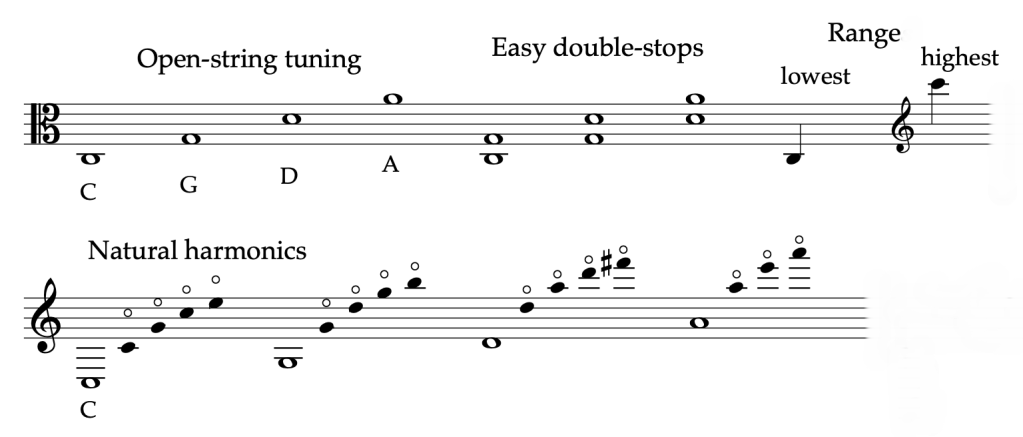
I also love the viola, so I readily agreed to write an unaccompanied solo for each member of the Pleasant Street Players, including violist Ames Asbell.
3. Sketch idiomatic gestures
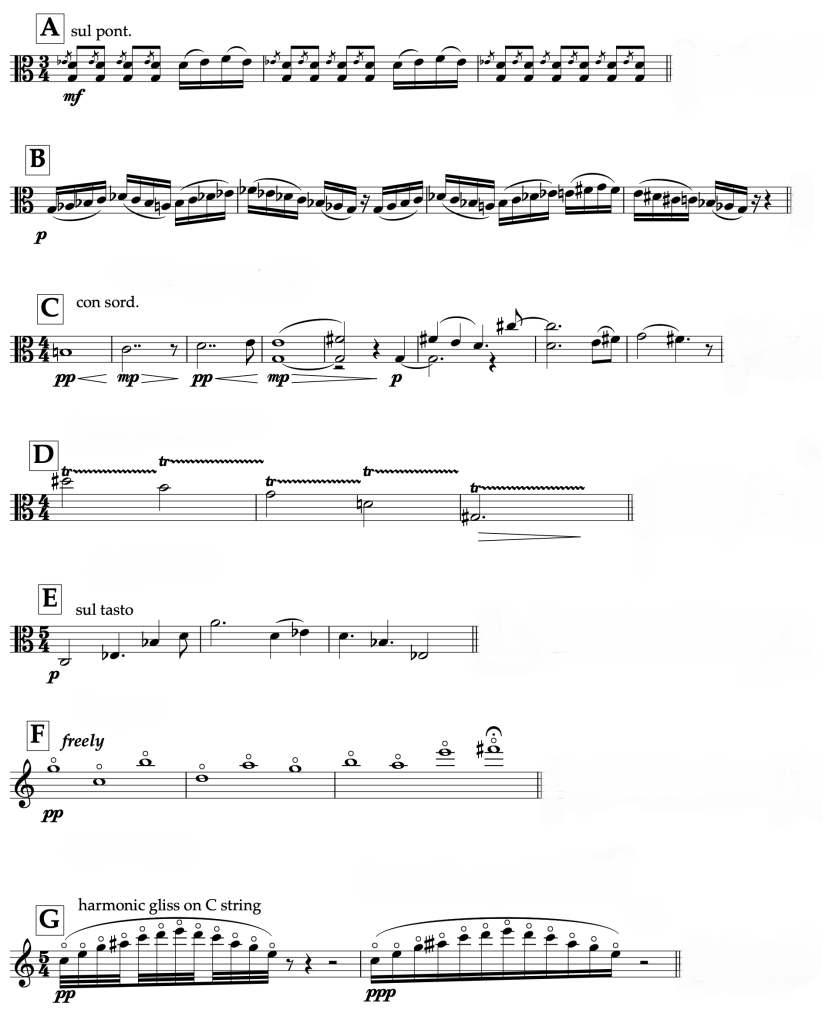
Before I Sleep is inspired by a famous, beautiful Robert Frost poem, “Stopping By Woods.” Its snowy scene tempted me to quote a Mahler’s Symphony No. 4 (1900) that starts with sleigh bells and flutes doing something like the A gesture. (Sul ponticello is a special string technique to brighten tone by moving the bow closer than normal to the bridge.)
B features the quick scale patterns so indigenous to orchestral strings.
C uses a mute, attached to the bridge to subdue the tone. It also uses double-stops, drawing the bow across two adjacent strings together, making two-pitch diads and even two-voice counterpoint. These use an open string and the next string a perfect-fifth higher or fingering a pitch more than a perfect-fifth higher.
D makes bird-like trills.
E uses sul tasto, the reverse effect of sul pont, drawing the bow closer to or over the fingerboard for a darker, warmer sound.
F makes the high, glass-like sounds of natural harmonics, produced by touching a string lightly at one of its partial-vibration nodes while drawing the bow on it. (harmonics, like open strings, have no vibrato. Sorry my synthesizer insists on applying vibrato anyway.)
G is a very special effect used by George Crumb in his early chamber music. Sometimes called a seagull effect, it produces a quick arpeggiated succession of natural harmonics by running a finger lightly up and down across the partial-vibration nodes of the string.
The gestures sketched above show a wide variety of pace and rhythmic characters.
4. Interval language
The B idea is scalar, running around through an unusual scale. It is almost an octatonic wholetone-halftone scale, but modified by an Ab, making the lower tetrachord the start of a Phrygian mode scale.
For the rising and falling landscape of melodic lines, choice of pitches and the cumulative constellations they form can be freely crafted the old fashioned way, plunking out pitches on a piano (or on the actual instrument of the piece) in a trial-and-error search for pleasing pitch streams. Identifying one’s favorite intervals can lead to using a more organized cell approach, limiting melodic interval choices to only two or three sizes.
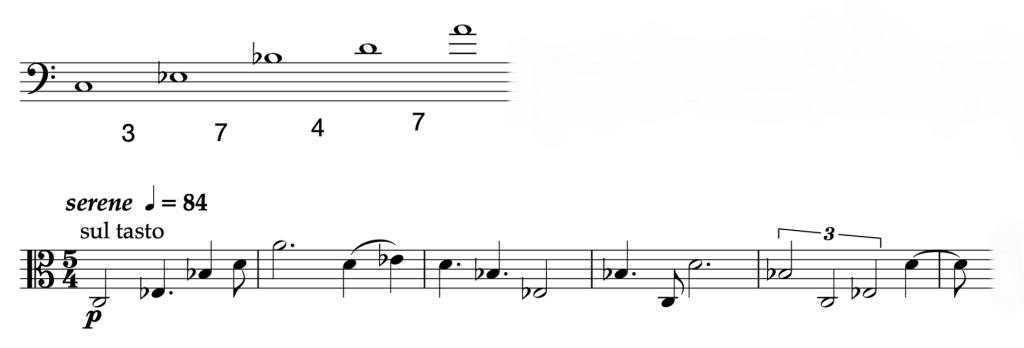
In the TC example, an interesting constellation is established and simply arpeggiated in various shapes.
This produces a single, stable harmonic prolongation, a calming stasis in which the line keeps retracing recently touched pitches.
5. Edit the notation
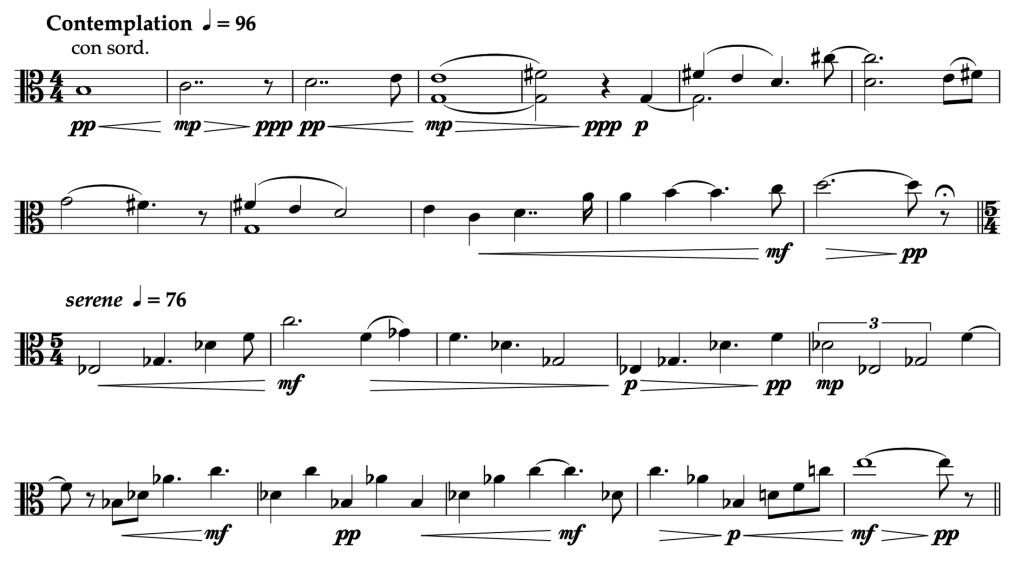
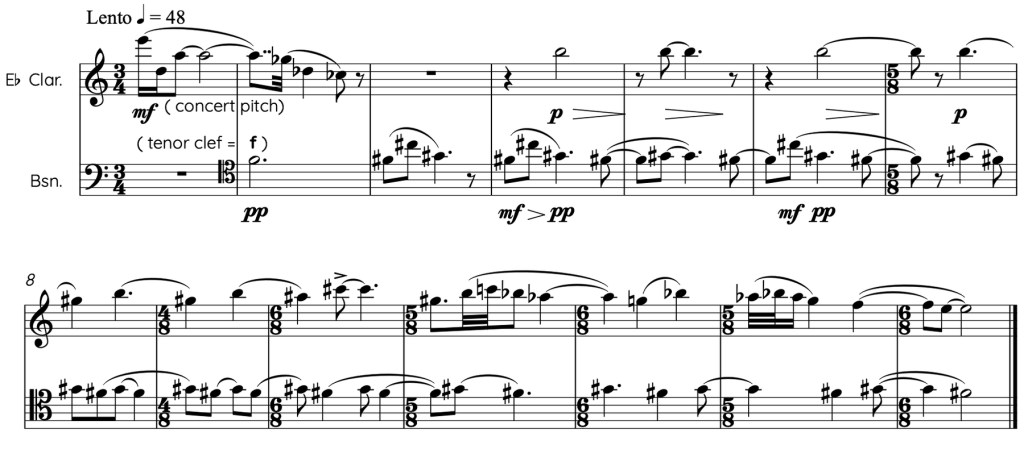
The score is not finished until all details are included, showing clear information and intent. A solo line especially needs strong dynamic shaping to be interesting as a solitary musical voice. The following example from the viola solo notates many of the necessities on this checklist:
timing information, including tempo, rallentando, fermata
expressive indications
dynamics, including ample changes, crescendos, diminuendos
phrasing such as slurs
special techniques such as con sordino, sul pont, sul tasto, harmonics
6. Overall form
An unaccompanied solo is a soliloquy. The dramatic tone can vary: a rage; a contemplation; or a story. The form can be a continuous flow of development of a single, persistent gesture, as in Berio’s Sequenza series. Or it can be sectional, a story told in short chapters, a poem divided into stanzas.
The TC example, actually a previously composed 2018 piece titled Before I Sleep, was written for my colleague Ames Asbell of the Texas State music faculty and Pleasant Street Players, an outstanding artist and player of one of my favorite instruments. The title is a quote from the last lines of Robert Frost’s famous poem “Stopping by Woods,” a contemplation of death on a nocturnal sleigh ride in the snow. The lead motive is a quote from Mahler’s Symphony No. 4, which open with flutes and sleigh bells jingling what is called the “bell theme.” My musical form follows the poem, in three sections:
sleigh bells and a trotting horse (gestures A and B)
snowflakes (a variation of B transitioning into D and F)
contemplation (C and E)
The poem ends famously with a direct repetition of the last line, “and miles to go before I sleep.” That could have been the going-to-sleep hypnotic musical ending as well, but the poet is not ready to die. My musical ending instead is not a coda but a brief tag, gesture G, the horse gently shaking his bells in the glistening moonlight.
Schubert‘s famous lied, Erlkönig — a dramatic setting of Goethe’s poem with a hammering piano ostinato as the running horse’s hooves, it uses tonal changes and vocal tessitura to draw distinctions between four dramatic voices.
Or Charles Ives‘ “The Cage” — utilizes whole-tone scales and “quartal chords” to depict the restless pacing of a leopard in its cage.
2. Find simple lyrics
A short poem or single stanza that evokes colorful or dramatic images — or write your own. Limit the total number of syllables so that the vocal line isn’t forced to be too “note-busy” just to cover each syllable. This leaves room for some syllables to have more than one pitch, a melisma that extends the duration of an important syllable’s vowel with beautiful melodic curves.
TC example
Speaking of curves, a recent visit to the shores of Michigan’s Leelanau Peninsula inspired me to write a poem:
Yin Yang
Peninsula upon peninsula upon grand peninsula, Lee upon Leelanau upon Lower. Cove from bay from great lake, Suttons Bay off Grand Traverse Bay off Lake Michigan.
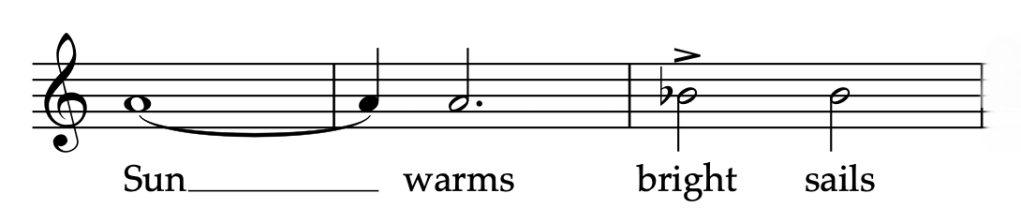
Land curves in myriad shore shapes, Reaching out to blue water. Fresh wind weds the land and water, Sun warms bright sails and sailor.
That is a total of 76 syllables. Though it does not rhyme, there is a simple poetic structure. Each stanza has two 2-line sentences. In both sentences of the first stanza, the first line describes a general recursive process, then the following line particularizes that with geographic names. The second stanza follows this same two 2-line sentences pattern. Land touches water in the first 2-line sentence. The last sentence, like a traditional sonnet-ending couplet, introduces the melding elements of wind and sun.
3. Design tonal material
For this lab, let’s start with a scale pattern, something different than a major or minor scale. Let’s limit it to a pattern of no more than 6 pitches in an octave.
TC example
I am choosing a six-note pattern, array 2 2 2 1 2, that is actually a truncated Lydian mode scale:
It also has a similarity to a whole-tone scale, with three consecutive array intervals of 2 semitones (the “whole-tones”). Both the Lydian and whole-tone characters are exotic sounding, conducive to the Impressionistic landscape painting quality I want.
It also interests me from the remarkable standpoint that its complement, the six other pitch-classes of a 12-tone scale not included, make an incomplete Dorian scale pattern whose array, 2 1 2 2 2, is just the reverse/inverse of the incomplete Lydian. Cool!
4. Make a melodic theme or motive
Think about shape: a line can step through the scale pattern or skip or leap to non-adjacent tones of the scale. A line can go straight up or down (like an arpeggio), or it can turn (change direction) occasionally or frequently, or even incessantly (making a stationary oscillation).
TC example
This melodic shape has three turns in direction, on the F then on D then on B. (Only the A is not a turning point.) It also uses five different melodic interval sizes, each only once. The mirror inversion has these same features, here starting on G#.
5. Construct prototype constellations
Drawing pitches from the chosen scale, establish preferred harmonic interval arrays.
TC example
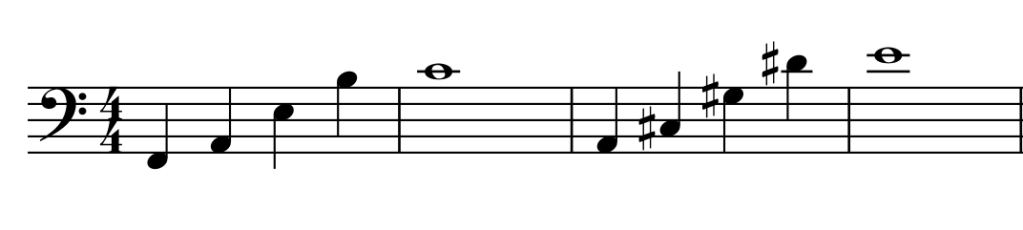
Mine emphasize the intervals 2, 5, 7, and 10, setting a harmonic character
5. Build the song’s form
The large-scale form of a song will usually be prescribed by the nature of the lyrics, such as the stanza structure of a poem. The music’s sectional form may use changes in tonality, tempo, or rhythmic character to parallel changes of tone or image in the lyrics.
TC example
Instead of marking sections or stanzas by tonality, I will choose to differentiate with tempo and rhythmic fabric. Bright introductory chords are sustained for different prime numbers of 8th-notes — 7 then 5 then 3 then 7.
The land sentence will be set in continuous quarter-notes. Pitches are again drawn from our primary Lydian-and-Dorian scale patterns but with varying orders and octave placements.
In a faster tempo and pace, water will be set in continuous flowing 8th-notes.
The second stanza will transition from the 8th-note flow to slower, more mixed rhythms and, finally, back to an echo of the static chords from the beginning.
6. Shape vocal melodies to lyrics
For singing, multi-syllable words should be divided the way a singer would sustain the vowel before ending the syllable with the consonant initiating the next syllable.
Vocal range should be considered and the pitch space used limited to the likely capabilities of the kind of singer you’re writing for. The higher tessitura (portion of the range) might be reserved to effect a climax if appropriate to the lyrics.
In determining rhythmic values for the melodic vocal pitches, it is important to recognize the accent pattern of the words, giving accented syllables a musical accent, either by:
metric — placing them on a beat or strong beat
agogic — sustaining them for longer duration
contour — placing the accented syllables on pitch high or low arrival points
combination of any of these emphases
TC example
Trying to limit the vocal range required to sing this simple song, Yin Yang extends from middle C to the D an octave and a step higher . . . except saving an Eb yet one semitone higher for the dramatic last note on the last word.
Pe-nin-su-la u-pon pe-nin-su-la u-pongrand pe-nin-su-la, Lee u-ponLee-la-nau u-ponLo-wer. Cove from bay from great lake, Sut-tons Bay off GrandTra-verse Bay off Lake Mi-chi-gan.
Land curves in my-ri-ad shore shapes, Rea-ching out to bluewa-ter. Fresh wind weds the land and wa-ter, Sun warms bright sails and sai-lor.
Notice how the incidence of consecutive stressed syllables increases toward the end.
7. Fit the melodic and accompanying lines together
Melodic pitches can be drawn from the underlying chord. Or they can represent “non-harmonic tones” forming a dissonance against some pitch of the harmony.
TC example
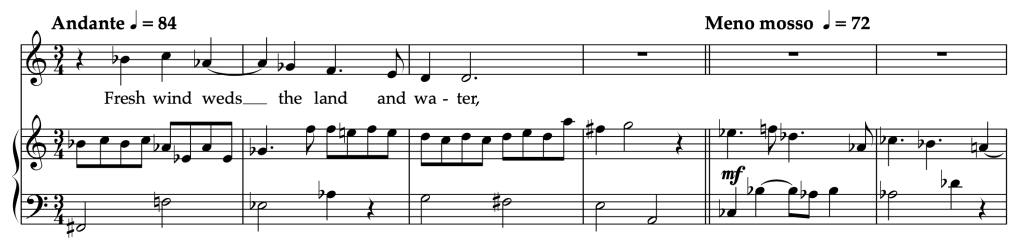
My Peninsula melodic pitches are taken from the underlying chord.
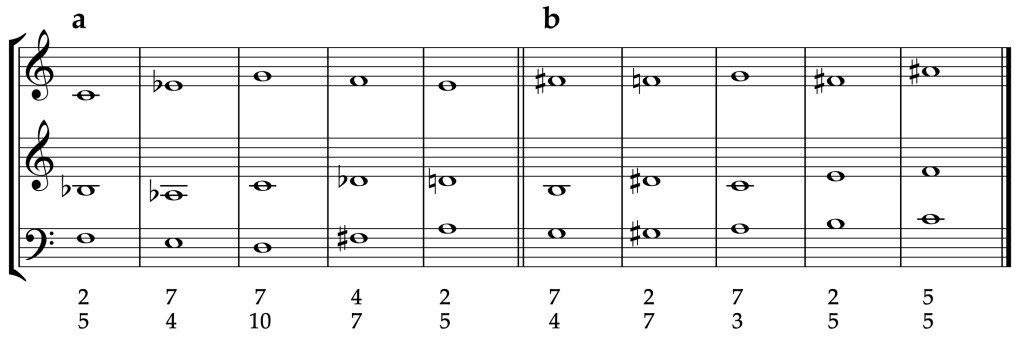
Since the piano presents the chord as a moving line, vocal pitches often are a simultaneous with the same piano pitch, as in “Fresh” and “weds” above. Melodic tones can also occur not at the same time as the matching harmonic pitch, but instead make a contrapuntal (vertical) interval between the two parts. Under each new vocal pitch below, I’ve indicated the contrapuntal interval it forms with the differing piano pitch of that moment.
You can see a contrapuntal interval consistency between the voice and piano, even as their rhythmic streams contrast.
8. Assemble the song
Now it’s time to put everything together. A traditional approach will include a piano-only introduction and at least one interlude without the voice.
Normally I suggest listening to a whole piece without watching a score. Since my synthesized rendering here cannot pronounce the words in the synthetic voice, however, I suggest watching below to get the feel of the lyrics that, after all, drive the whole song.
For this first mapping lab, a basic experimental process is outlined step-by-step and demonstrated with examples from a sample composition. Once you’ve studied the example piece, you can start over and craft your own experiment using the same open steps. General instructions leave you free to openly consider and choose from many musical possibilities.
1. Choose a model
Trois Gymnopédies (1888) by Erik Satie
Simple in harmony, meter, melody, texture, repetitive form.
2. Design a theme
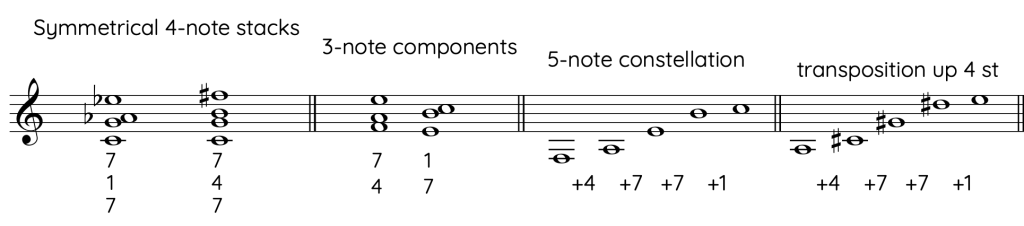
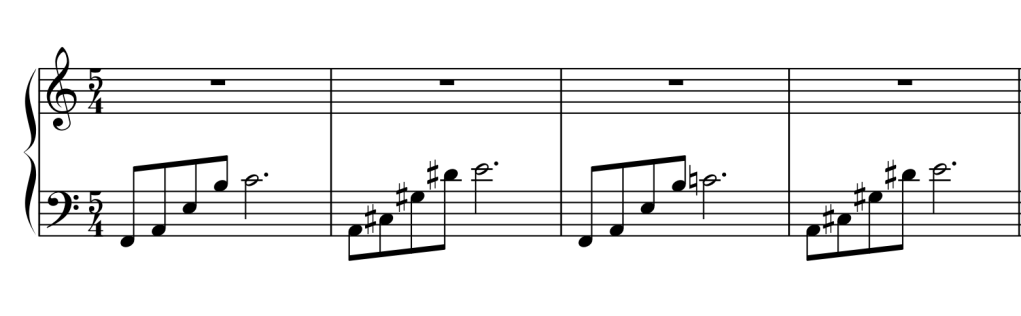
Start with a pair of 4-note constellations of considerable interest due to their symmetrical interval stacks and “perfect fifth” 7-semitone interval separated by a smaller interval. (See “Symmetrical interval arrays.”)
We’ve made two chords, both with the same identical interval stack.
3. Choose a meter and rhythm/tempo character.
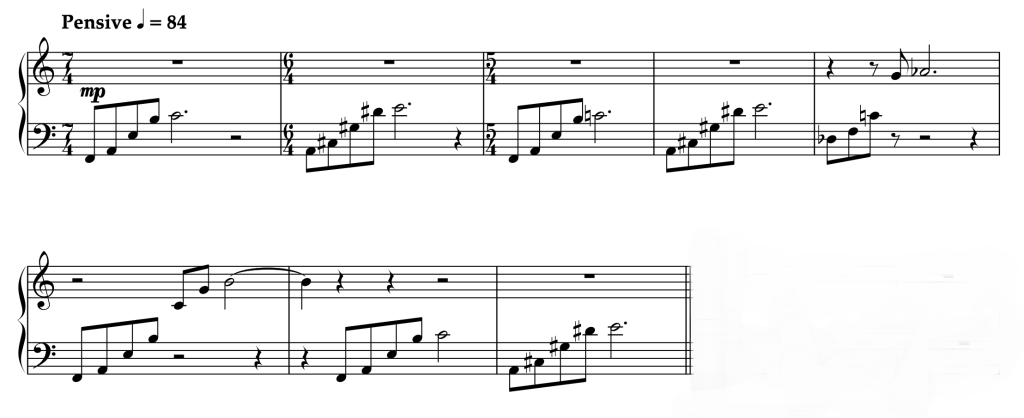
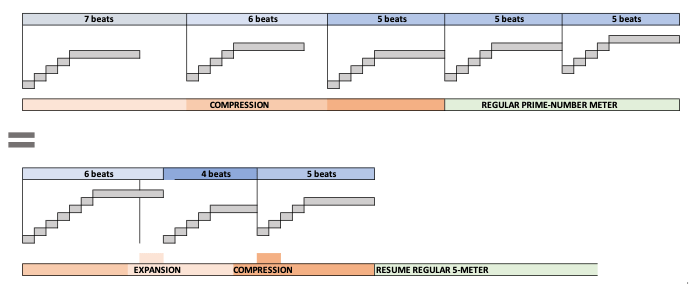
A prime-number meter (such as the 7 4 meter used for the Finale of Stravinsky’s Firebird) can have a more “timeless” quality, due to its lack of layers of nested pulse between beats and bars. The prime number of beats prevents them from grouping into regular sub-measure groupings.
To follow through further on the floating feel of lacking groupings, let’s stretch the timings a bit between arpeggios.
4. Add a line and sound color to the texture
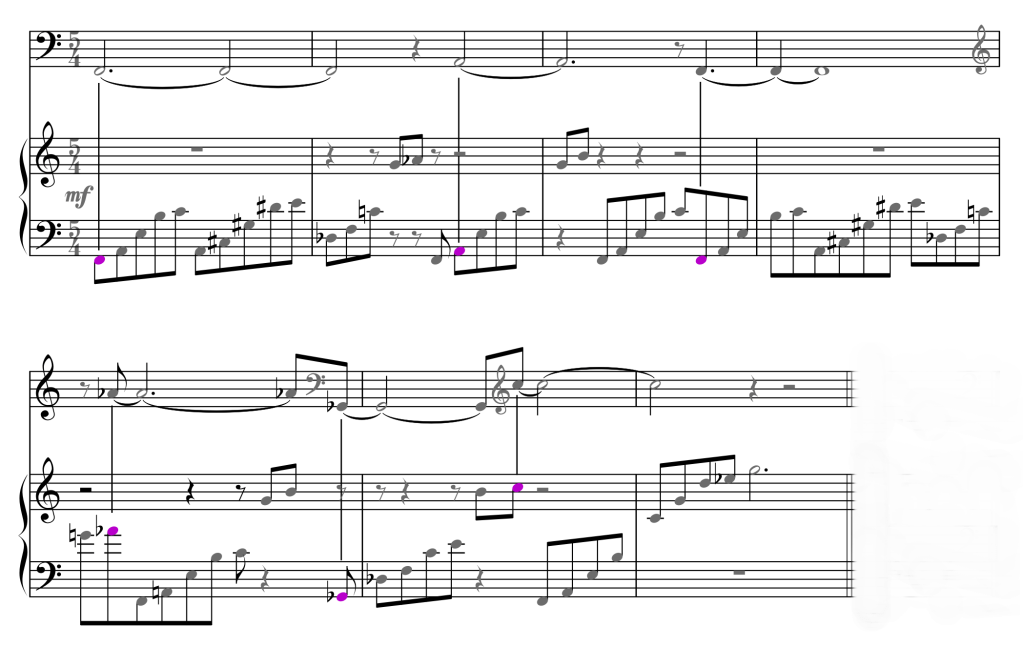
I call this technique extraction or refraction, pulling selected tones of a complex line into a separate voice:
5. Make variations
Arpeggios with refracted color line:
Pull the 8th-note arpeggios into a continuous stream:
Canon at the octave:
Rhythmic augmentation, without then with the refracted color line:
Mirror inversion of augmentation, canon:
6. Assemble the large-scale form
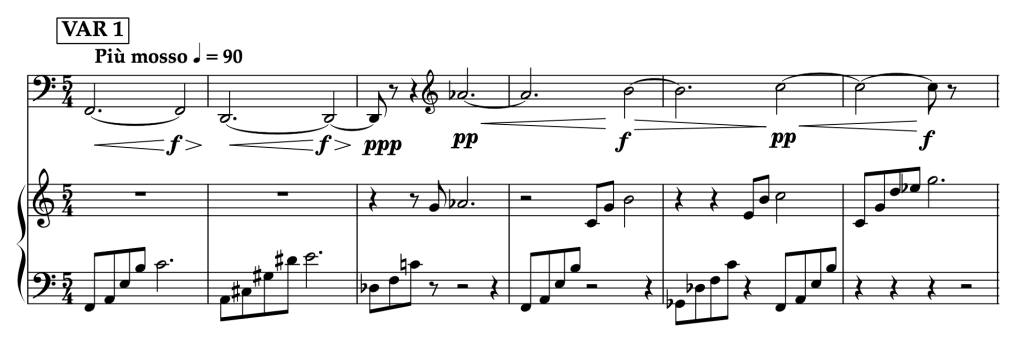
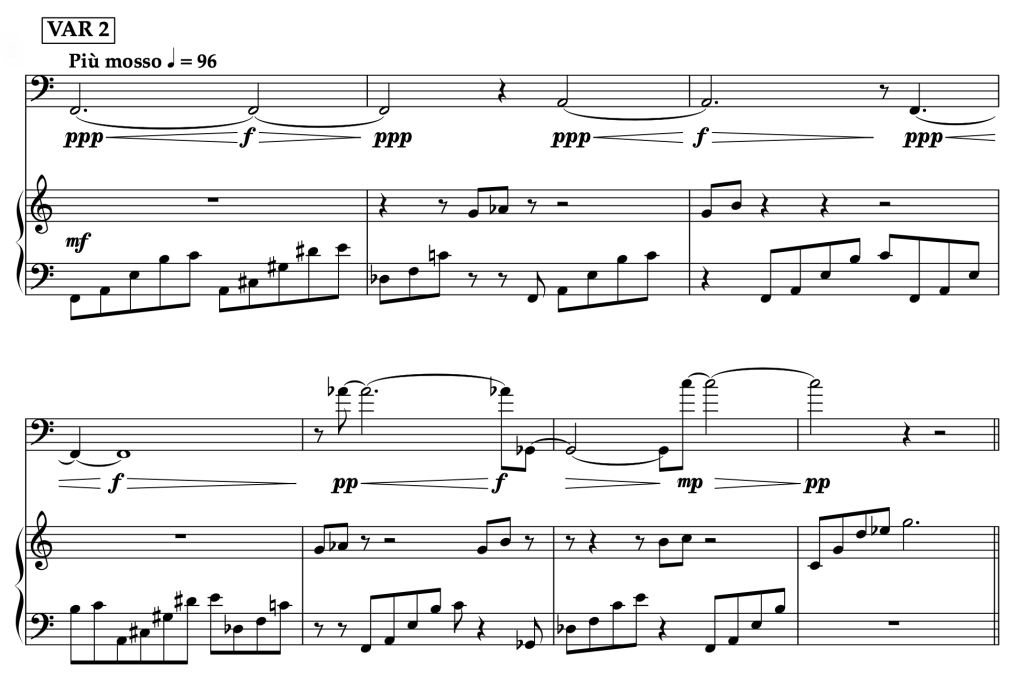
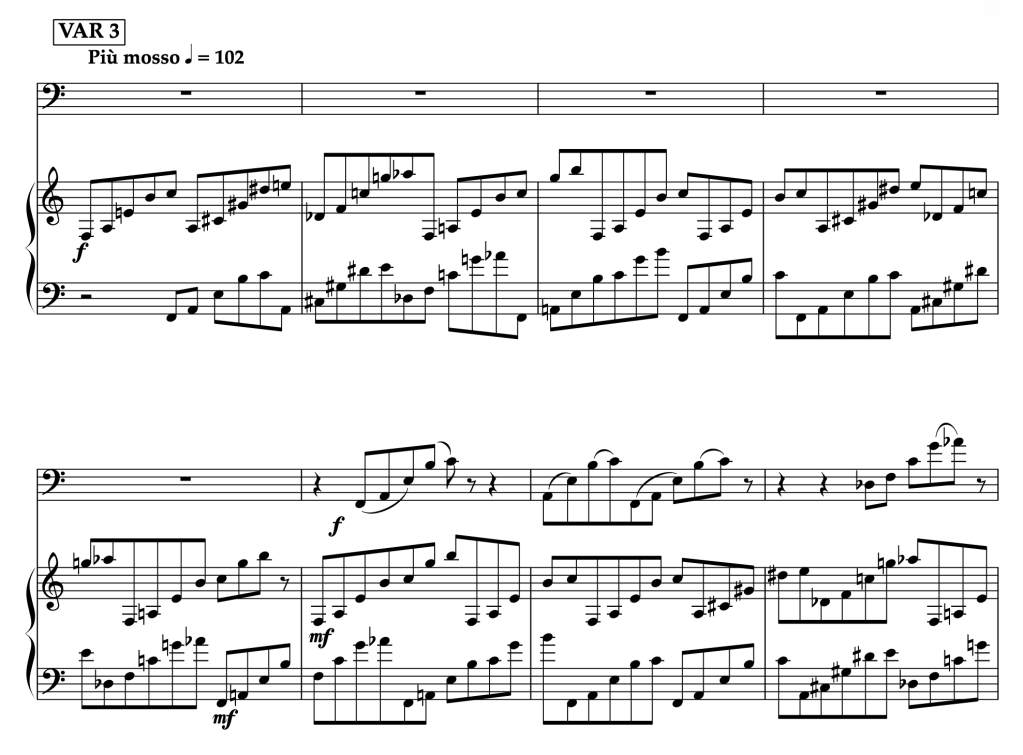
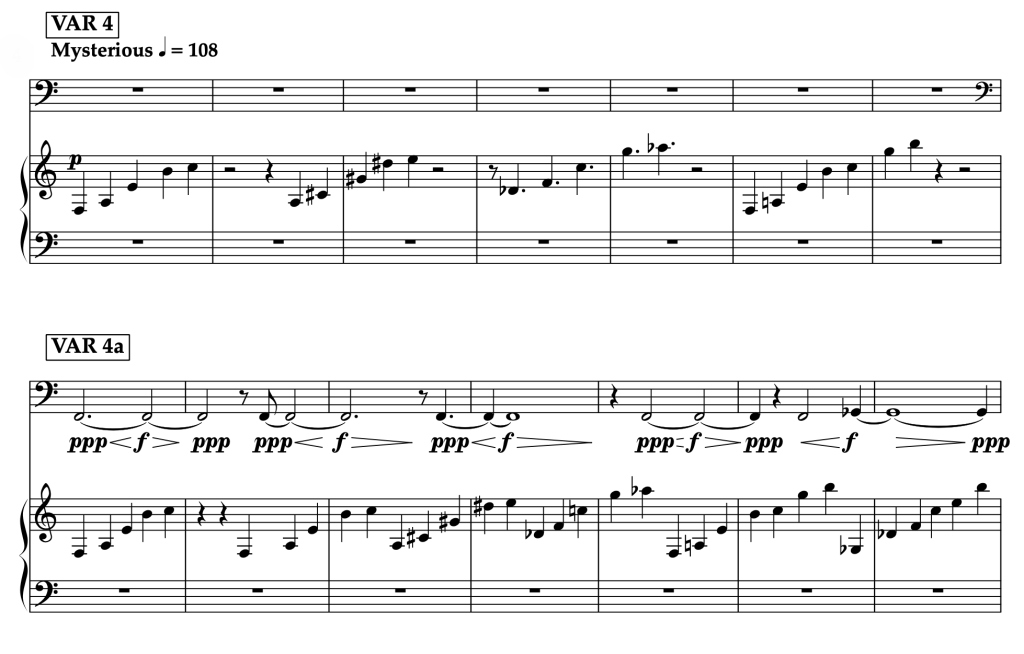
The theme and each variation end with a clear cadence, a sustained final note and pause in rhythmic activity . . . except Variation 3, the continuous 8th notes. It morphs into a transition that both interrupts the 8th-note flow and slows the tempo, preparing for calmer, much less dense quarter-note variation:
The variation process is serial, each one progressing from the previous idea, rather than “starting over” each time. Thus the overall unfolding form feels evolutionary rather than episodic. Then a kind of recap does start over with a return to the opening idea, making a rather traditional coda ending,
6. Title
This musical sketch, like most of my pieces, was composed without a title or guiding image. The compositional process began with the basic challenge to make a small piece out of simple, limited material. The adopted model was Satie’s radically sparse, (one could even say) minimalist style in his Trois Gymnopédies for piano (1888), Its title may have been taken from a French poem by J. P. Contamine de Latour — the poem ends with the word gymnopédie:
Oblique et coupant l’ombre un torrent éclatant Ruisselait en flots d’or sur la dalle polie Où les atomes d’ambre au feu se miroitant Mêlaient leur sarabande à la gymnopédie
Slanting and shadow-cutting a bursting stream Trickled in gusts of gold on the shiny flagstone Where the amber atoms in the fire gleaming Mingled their sarabande with the gymnopaedia.
My title will adopt the English translation of one selected metaphor: Amber Atoms in the Fire Gleaming.
7. The finished piece
In keeping with the Satie models, this study generates entirely from one modern harmonic constellation, arpeggiated repeatedly in a gentle, almost imperceptible meter, then growing colorful “amber” sustained highlight sounds. Eventually the arpeggios begin to spin and swirl in a layered, kaleidoscopic texture that is “minimalist” in the 20th-century usage as the description for repetitive ostinato music.
8. Test sample
Listen without looking at a score, the best way to first sample created art:
“Mapping” has double meaning. A road atlas measures and records all the routes through a given territory. But we also call “mapping” the creative act of planning out a journey, using map information to choose between many possible routes. Composers use an array of processes to map out a musical journey. Designing a piece entails making a storytelling rhetoric, a pacing plan, and an architecture of interrelated components.
Each Map Lab in Mapping the Music Universe presents step-by-step recipes to compose simple pieces based on models of different musical genres. Each lab also includes an original sample piece following the Map Lab guidelines, illustrating one possible creative path and outcome.
Try your own experiment with any of these lab projects:
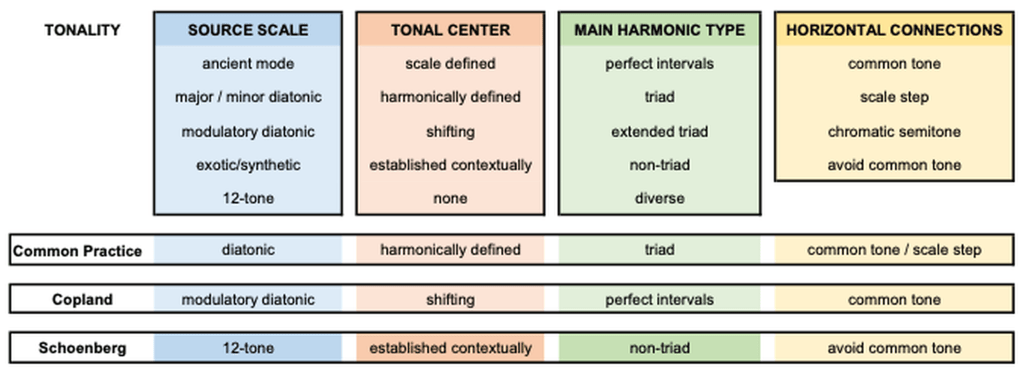
In traditional tonal music, or for a composer’s personal design, there are four main factors defining a tonal language: source scale (covered in Mapping Music 5); harmonic type; horizontal (voicing) connection; and tonal center, a basic concept for Common-Practice tonal music.
A diatonic major or minor scale and harmonic structures built from it define a key and “tonic” home-base tonal center. (In the ancient modal music of the monophonic Gregorian chant it was called the “finalis,” as it was the expected final arrival destination of an extended melody.) Triads taken from the scale build a scaffold of harmonies, featuring the dominant chord (scale degrees 5, 7, 2, and sometimes 4) with its scale-degree 7 “leading tone” propelling a progression to resolve back to the tonic chord (scale degrees 1, 3, 5).
In 20th-century music, some composers (notably Bartók) began to define tonal center contextually rather than by scale-and-key, writing melodic patterns and counterpoint that branched out from and converged back to a core base (but not necessarily bass) pitch. Twelve-tone music, derived from the full chromatic scale, would seem to be avoiding any tonal center, but some composers still built textures whose lines and counterpoint would emphasize one focal pitch-class.
A matrix of choices
In forging a tonal language, the composer develops preferences in each of these factors. Choices from each factor column can be mixed in a variety of ways. The composer designs by delving into more specific patterns, especially for the source scale (possibly, say, a six-note pitch-class set) and the harmonic type, establishing a preference for certain harmonic intervals (such as my favoritism for 7-semitone Perfect 5ths and 11-semitone Major 7ths).
There are, of course, thousands if not millions of possible combinations of all these factors, a universe of tonal possibilities for the individual composer and a particular piece.
Next, let’s dive more deeply into harmonic types and the factor of horizontal connections between successive harmonies.
Constellation streams
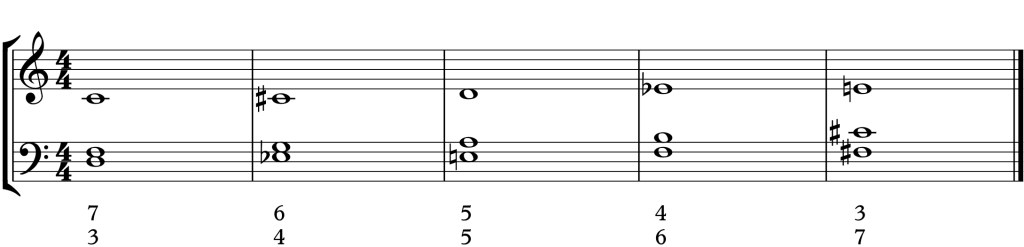
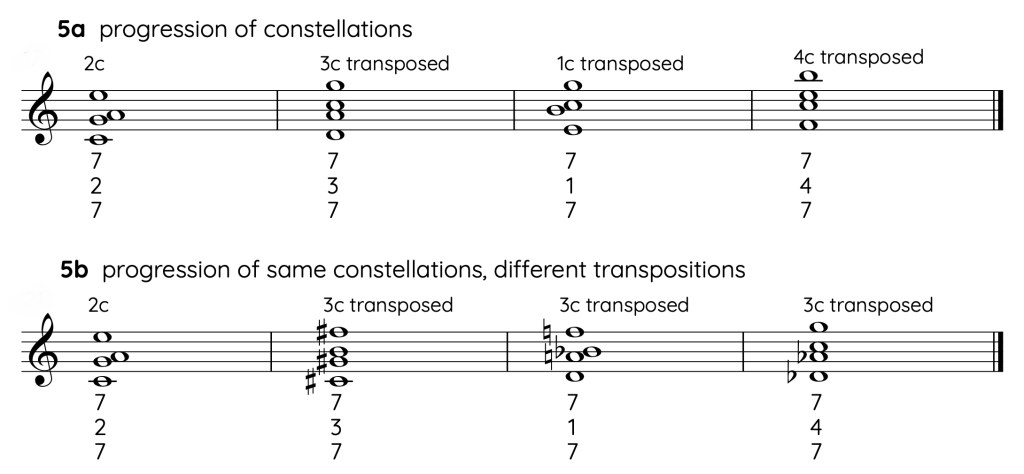
A stream of successive constellations, which we might nickname a “constream,” would traditionally be called a chord progression. In the following example, all stacks are 10 semitones tall; no common tones in the transposition choices.
no common-tone connections
In the next example, stacks of differing heights, with constellations that reduce to three different scale patterns: scale array 5 2, then 2 3, back to 5 2, then 4 1, and finally 2 5, inversion of 5 2.
common-tone connection
Now a longer, more mixed succession of interval stacks of constellations belonging to these same three scale patterns (2 5 or 5 2; 1 4 or 4 1; and 2 3).
extended constreams
Back to my constellation friends of Mapping Music 6, we can make some constreams with them.
diatonic and chromatic successions of symmetrical constellations
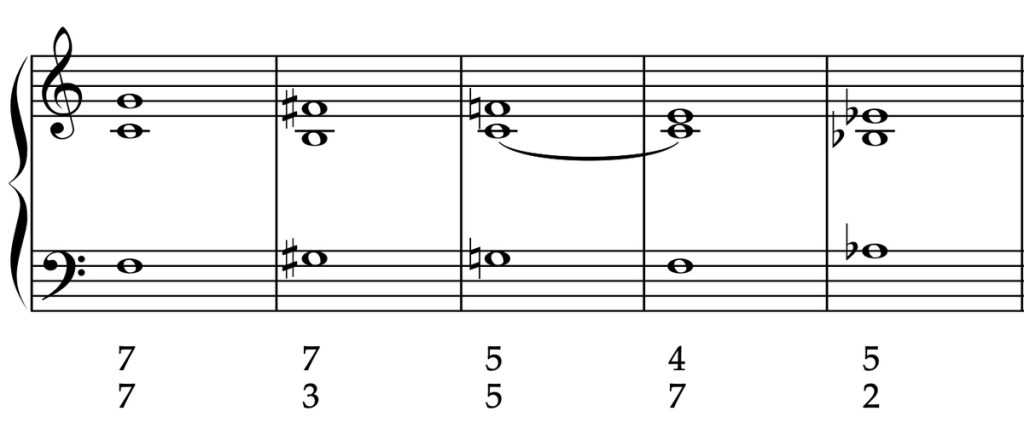
An intriguing example from the literature of great early modern music, an interlude near the beginning of Stravinsky’s L’Histoire du Soldat:
L’Histoire du Soldat excerpt
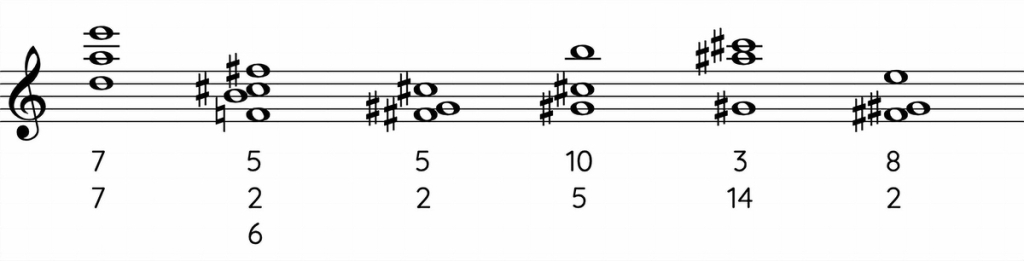
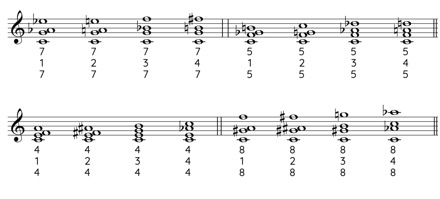
This passage is intriguing in many ways. It looks like counterpoint between two woodwind instruments in high register. But both lines are quite simple and don’t seem to go anywhere. (In our GALAXIES: Structure chapter, we’ll discuss these questions of texture and counterpoint.) Introducing it here raises the question of harmony, of constellations and their arrays, though the passage doesn’t look at all chordal. Here is an array analysis of the constellations formed in the first through fourth bars then jumping to bar 10 and, finally, bar 14.
L’Histoire du Soldat constellations
Now you can see and hear more clearly the role played by array interval of 7 semitones (“Perfect 5th” as in above examples) and also 5, and 2 semitones in the harmonic continuity of the passage. (Also note 7 + 7 = 14; 5 + 2 = 7; 5 +5 = 10; 2 + 12 = 14; etc.)
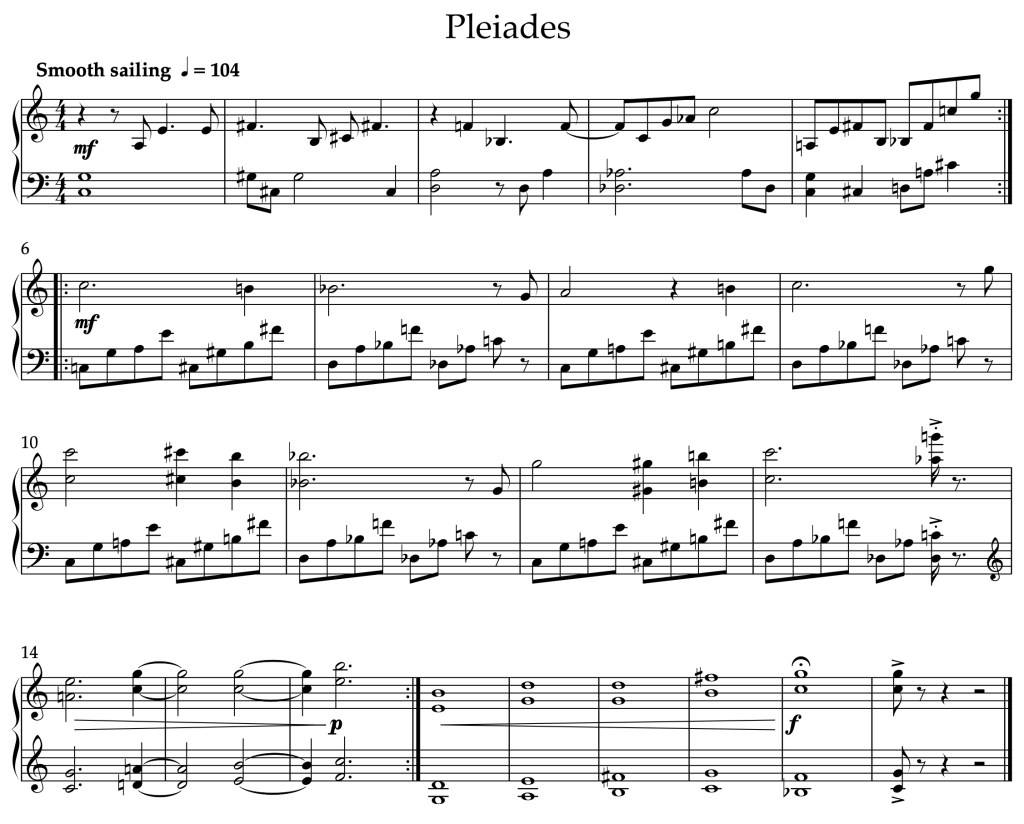
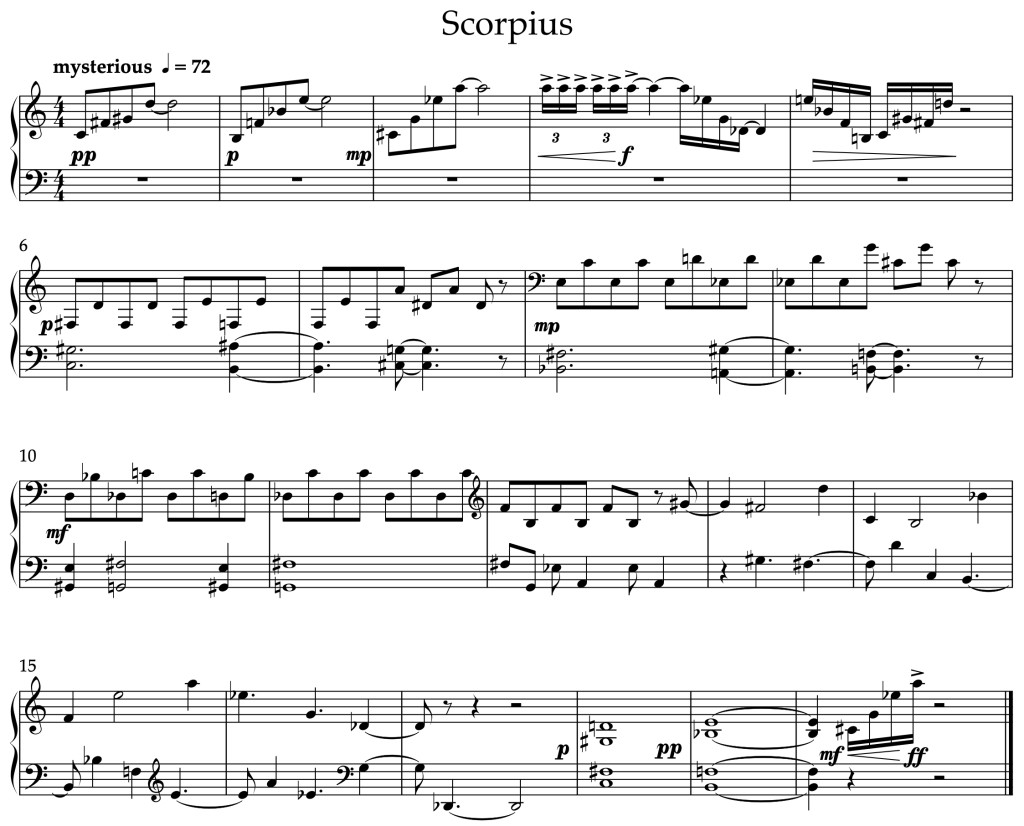
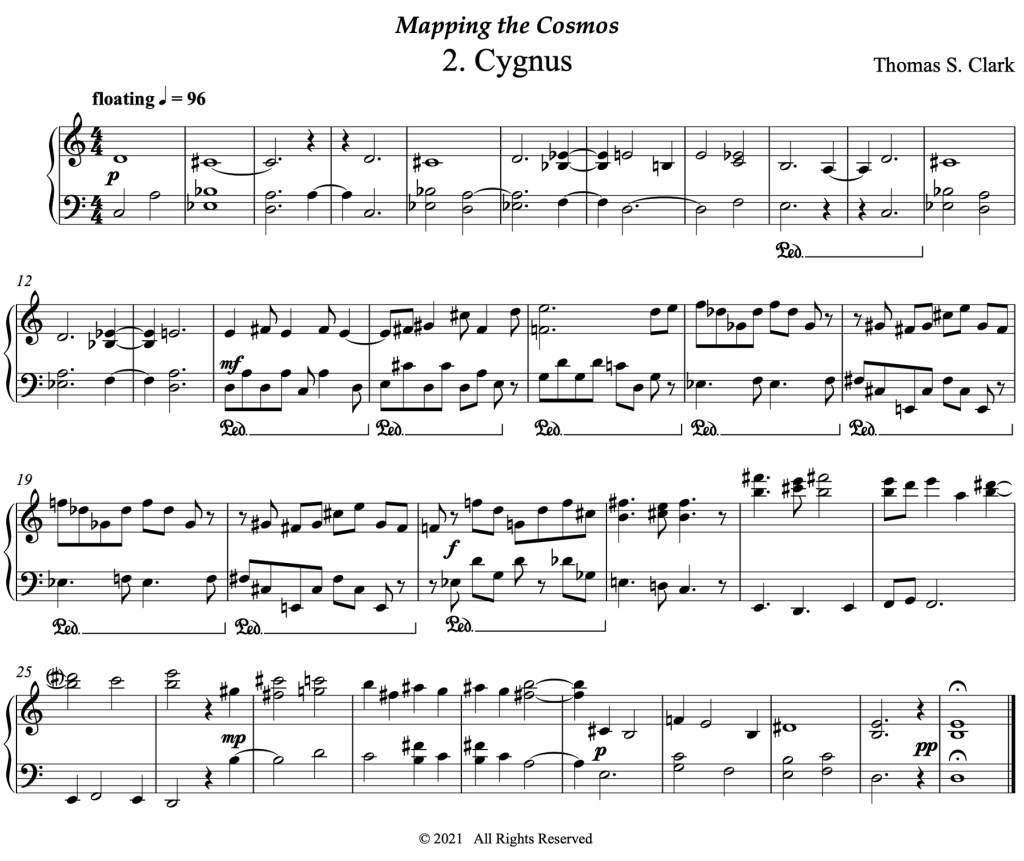
To illustrate that this is not all just theoretical, here is a simple etude composed using exactly the constellations and successions explored in Examples 12 and 17. It took only about an hour to compose this minute and a half in Sibelius. The title: the constellation Pleiades (“Seven Sisters”) is a tight cluster of 7 stars tagging along in the winter sky with Taurus as the Zodiac sails westward every night.
12-tone sets
Let’s keep going. How about designing a succession of three four-pitch constellations, so that all 12 pitch classes of the chromatic scale are included but none repeated? (Traditional terminology calls such a set a 12-tone aggregate.)
three sets make a row
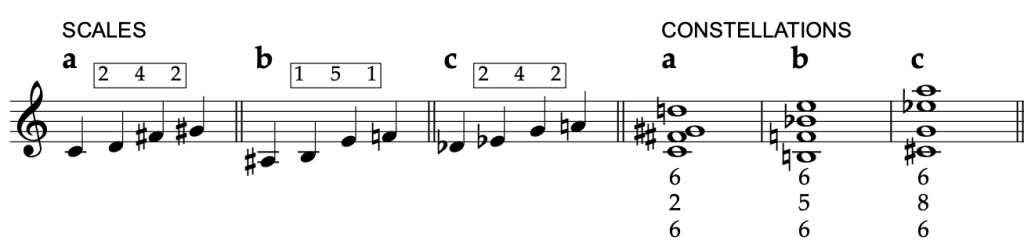
Constellations a) and c) are different “chord voicing” of the same scale pattern, 2 4 2 . Both scale patterns and all three interval stacks are symmetrical. And they all contain two 6-semitone “tritones,” giving the whole succession the tritone’s quality of ambiguity and the character of the succession a feeling of mystery.
Altering arrays
Similarity of interval patterns can build coherence in a stream of constellations. Beyond functional common-practice harmony, this is a kind of process that composers of the 20th century and today can use to create a “new tonality”.
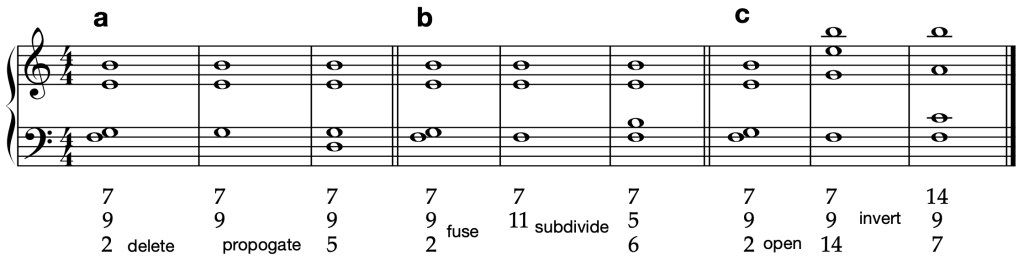
Possible operations to transform an interval array into a closely related array:
OPEN — Expand an interval by an octave, adding 12 semitones
FUSE — Join two adjacent intervals to make a larger interval, the sum of their sizes
DELETE — Remove an interval, shortening the stack’s height
SUBDIVIDE — Insert a pitch to divide an interval into two smaller intervals, whose sum equals the original interval
PROPOGATE — Append or insert an interval of a size already present into the stack
INVERT — Reverse the registrar order of the stack — turn it upside down
alteration examples
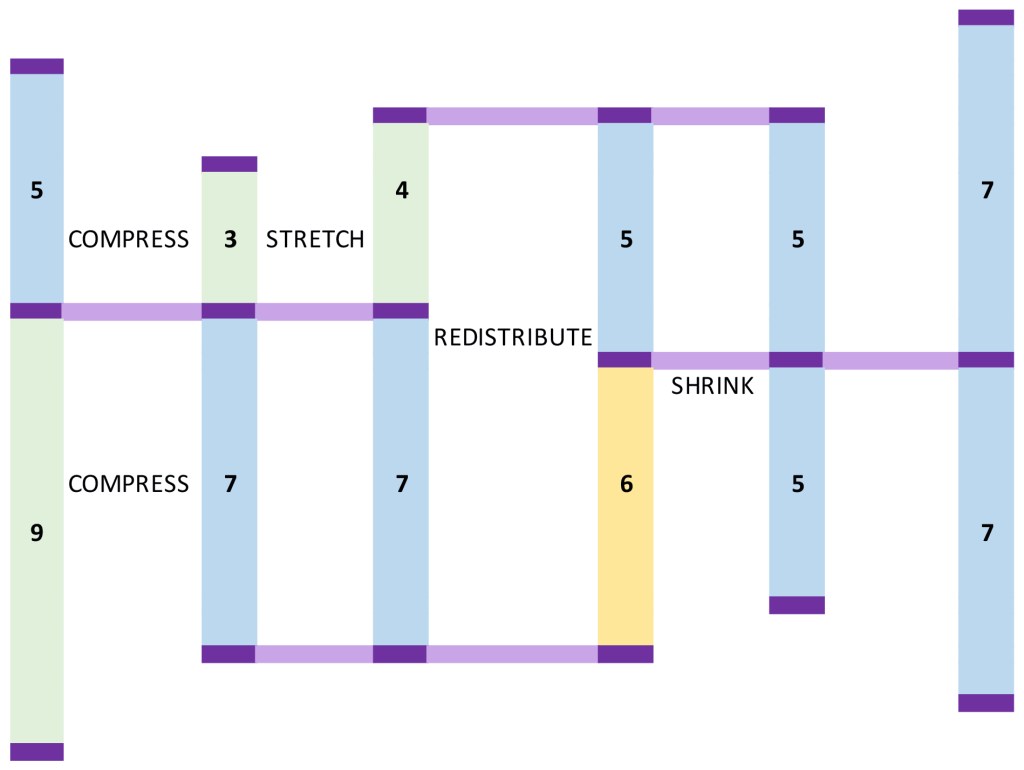
There are operations that more significantly alter the character of the interval array.
REDISTRIBUTE — Fuse two adjacent intervals into one larger interval then re-subdivide it into two different smaller intervals
SHRINK / STRETCH — Alter one interval size by other than an octave, leaving others unchanged
COMPRESS / EXPAND — Alter all intervals in the stack by adding or subtracting each by the same number of semitones, or multiplying each by a constant
These alterations are listed in order, from the mildest alteration producing a similar array (redistribution) to the most dramatic producing a substantially different array, compression or expansion of the whole array (preserving little from the original but its symmetry). Here is an example employing these altering transformations.
more alterations, with common-tone connections
The other element of coherence in this example is the many common-tone connections between one chord and the next, establishing a slow-moving stability. Another example of the same interval stacks, same succession of alterations, but choosing transpositional level of each constellation to create as many 1-semitone voicing connections as possible (10 such voicing connections in the following example) makes the con stream’s sense of progressive change stronger.
more alterations, with semitone connections
Finally, another example etude, using this last constream . . .
Some points of starlight are actually double stars or star clusters, as revealed through a sufficiently powerful telescope. Borrowing that term, one particular type of musical pitch constellation arising in the 20th century involves sounding adjacent scale steps together as a simultaneity.
CLUSTER — a constellation presented harmonically consisting of adjacent scale steps separated by small scalar intervals of one or two semitones.
If the intervals are one-semitone half-steps from the chromatic scale, the resulting harmony is intense, dark, dissonant. If the separating intervals are mostly whole steps, the quality can tend to be like bright glowing light.
It turns out that the diatonic scale is rich with cluster possibilities.
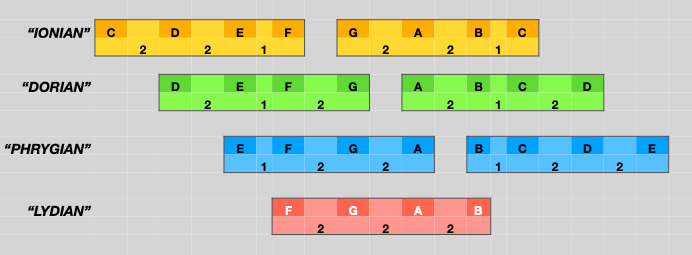
diatonic clusters
The names are borrowed from the Greek names of modes. One cluster array that can be readily found throughout the octatonic scale but not possible within a diatonic scale is the 1 2 1 array, since the diatonic scale has no one-semitone intervals that close to each other. One other cluster array not found in the diatonic scale is the intense, gritty 1 1 1 chromatic-scale array described above.
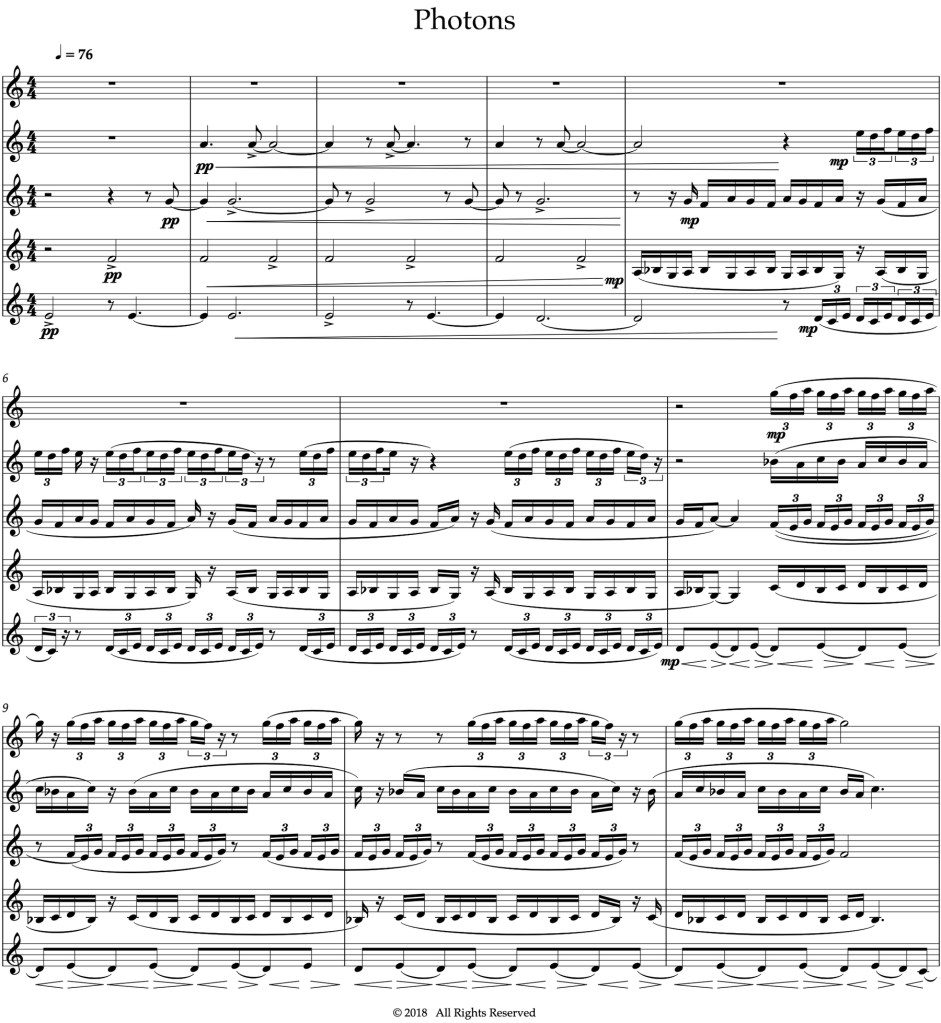
Harmonic constellations built from clusters can be still and radiant or animated by rhythmically active lines close together in pitch space. Here is a composed example that does both.
Photons excerpt
Symmetrical arrays
Dorian and Lydian clusters are symmetrical. Their scale-pattern arrays — 2 1 2 and 2 2 2, respectively — are the same when inverted or reversed. Many other interesting pitch constellations have this property.
Here is a sampling of other, taller symmetrical constellation arrays, reading the same from top to bottom as bottom to top:
many symmetrical arrays
Note that although each is a 4-pitch constellation, two of them (4 4 4 and 8 4 8) contain an octave and thus only three unique pitch classes.
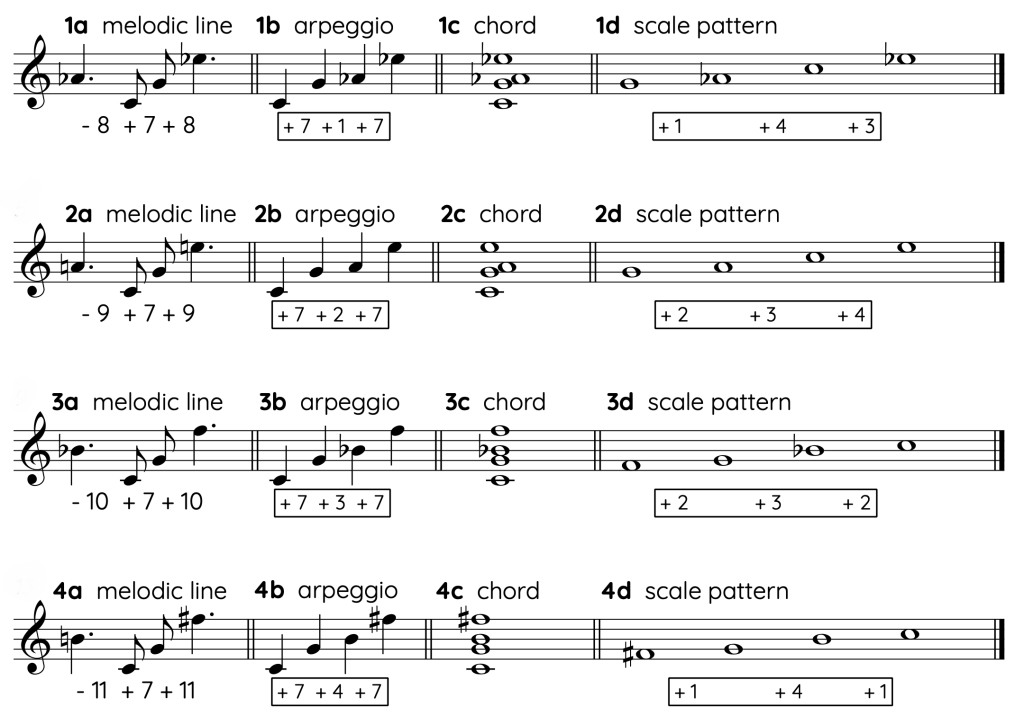
The example below explores the first four arrays listed above. The stacked interval array of 4d is: 7 4 7. Note too that this constellation contains two 11-semitone intervals (+7+4 and +4+7) — in example 4d C up to B and G up to F#; and one very large interval of 18 semitones, C up to F# in the higher octave.
four symmetrical arrays
Three of the four could be analyzed in triadic harmony: 1c as an Ab Major-Major 7th chord in first inversion; 2c as an A minor-minor 7th in first inversion, or a C Major triad with jazz added 6; and 4c as a C Major 11th chord with 3rd and 9th missing! And 3c could be seen as a rearranged voicing of a segment of the “Circle of Fifths”! Obviously, I don’t recommend such contortions of traditional harmonic analysis to explain these beautiful, symmetrical constellations.
Each constellation’s successive-interval array, its stack, is symmetrical under mirror-inversion or palindromic — that is, its interval stack reads the same lowest-to-highest or highest-to-lowest: 7 1 7 and 7 4 7 are two of my favorite constellation stacks.
These interval stacks were chosen here for two of my particular interests. Each features the “Perfect-5th” 7-semitone interval at top or bottom, with a smaller interval in the middle. The Perfect 5th has a stable, rooted quality, but with two “roots” in the harmony, the overall stability of the sonority is compromised — complex yet balanced. It is like a “double star” in astronomy, to further pursue my constellation metaphor.
Acoustic quality
We started with clusters, sonorities that would be traditionally considered highly dissonant. To assess a constellation’s quality or sound character, we will transition from the concept of consonance and dissonance to an assessment of acoustical complexity.
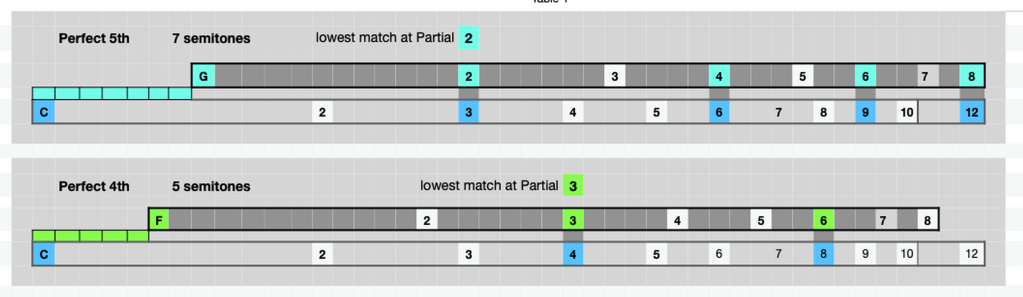
When two pitches sound together, they make a harmonic interval, but also their distinct overtone series are interacting. In the purer sounding intervals, this interaction is mainly a closely compatible one, with some overtones matching. An example, take a Perfect 5th, C up to G. Their overtones are:
overtone match for a Perfect Fifth
The matching or interfering overtones make more of a difference with the lowest partials, as the higher overtones are fainter and fainter higher up in the series. So the c’ 4th partial of C interferes with the 5th partial b’ of the G overtones; but that interference is fainter than the lower g-to-g match. This gets scientifically and mathematically complex to calculate, as we will tackle in a while below.
For now, the ancient classification for counterpoint is accurate enough to adapt: Perfect Consonance, Imperfect Consonance, Dissonance . . . though I will distinguish between mild dissonance and strong dissonance.
PERFECT CONSONANCE — intervals P8, P5 and P4 (12, 7 and 5 semitones) — “pure”
IMPERFECT CONSONANCE — intervals of major and minor 3rds and 6ths (3, 4, 8 or 9 semitones) — “triadic”
MILD DISSONANCE — intervals 2 semitones different in size from a unison, octave, or double octave (2, 10, 14, 22, 26 semitones) and the tritone (6 semitones)
We can use these distinctions to come up with an assessment of the general harmonic complexity of a constellation’s intervals.
PURE — containing no intervals except perfect consonances
SIMPLE — containing no mild or strong dissonances
MODERATE COMPLEXITY — containing at least one mild dissonance but no strong dissonance
STRONGLY COMPLEX — containing at least one strong dissonance
Examples of increasing complexity:
It is important to note that strongly complex does not mean “unpleasantly dissonant.” The Major-Major 7th chord in this category (C E G B) is quite a beautiful harmony. And the last two complex examples, quartal and quintal chords, are the sturdy mainstay of 20th-century American composers such as Copland.
In a recorded excerpt of Tyshawn Sorey’s Pulitzer Prize-winning Adagio (2023) for saxophone and orchestra, beautiful sonorities are quietly complex, tensely dissonant, dark and mysterious in their lyric unfolding. Like dark clouds, some morph to reveal brighter sounds, even simple triads. While there is no sense of any “chord progression,” there is a feeling of impending change in the air.
In notes on a recent composition, Frost Serenade, I described “changing tonal temperature.” Here is a deep dive into what that meant.
The metaphor of tonal color and temperature has to do with what we normally call consonance and dissonance in a chord or other harmonic entity. Centuries-old tradition classified musical pitch-intervals as pure, perfect consonances (“Perfect Fifth” and “Perfect Octave” for example); major or minor (exp. “Major Third” or “minor Sixth”); or problematic (“Augmented Fourth” and “diminished Fifth”). Some major and minor intervals (thirds and sixths) were considered imperfect consonances; the others (seconds and sevenths) were considered dissonant. Every music student learns these categories while studying 16th-century model counterpoint.
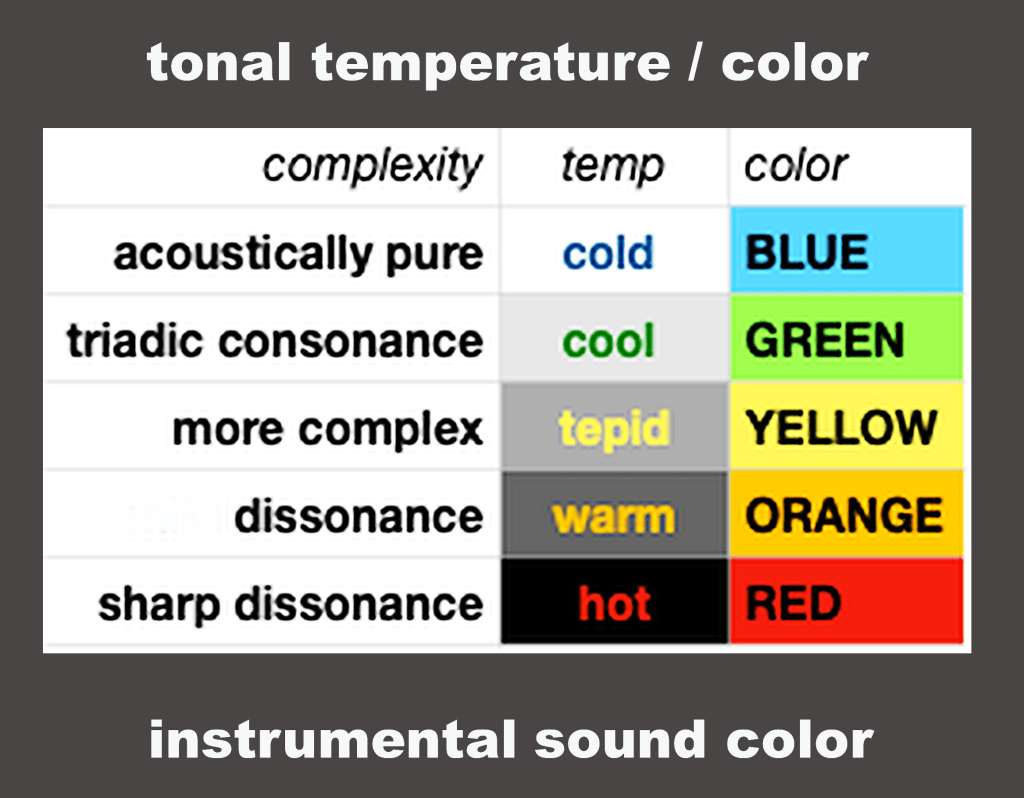
Using the color spectrum in temperature order:
harmonic color spectrum
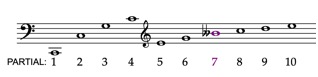
Let’s convert the consonance/dissonance concept, going back to a pitch-interval’s acoustic complexity. Reviewing what was explained above: every musical tone has a fundamental pitch, plus faint overtones that give the sound its color. They are of fading intensity and felt (as color) more than actually heard as distinct pitches. Discovered by Pythagoras as partial vibrations in whole-number fractions, the overtones are always in a fixed interval ladder, rising from the fundamental: Up an octave, then a Perfect Fifth, then a Perfect Fourth, a Major third, minorthird, then to the eccentric seventh partial, which is out of tune by our scale-trained pitch perception (and shown a pale gray below), and on to the eighth partial, which is three octaves above the fundamental. (An octave is a multiply-by-2 operator, so partials 2, 4, 8, and 16 of the C overtone series are also the pitch-class C. Likewise, partials 3, 6, and 12 are all octave related.)
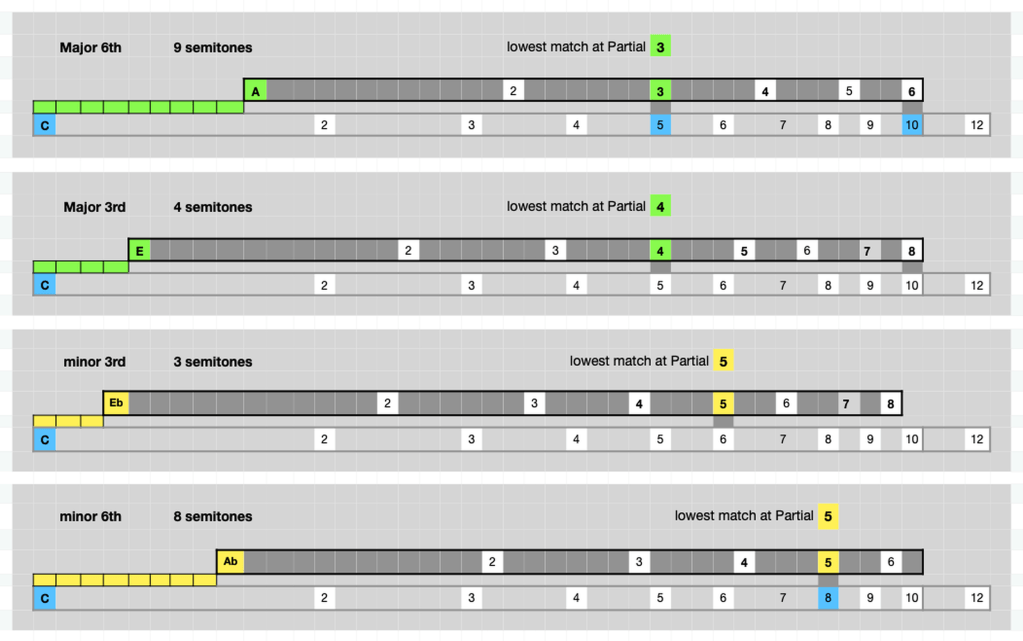
Two different fundamental pitches sounding together each bring into the acoustical mix their distinct overtones. The overtones from one either match (simple) or clash with (complex) overtones of the other. This is what makes the sonic complexity or perceived purity of the interval between two fundamental pitches. Using this relationship, we theorize that the higher we need to go to start finding matching overtones between the two pitches, the more complex is the interval. Following this logic, here is an overtone-match analysis of all harmonic intervals smaller than an octave. (We’ll show these horizontally to fit better what would otherwise be very tall slender graphics!) Each interval is shown from a fundamental pitch C up to a higher pitch.
PERFECT CONSONANCES
overtone match for perfect consonances
The rather pure Perfect Fifth interval between fundamental pitches, C up to G, matches overtones at G’s partial 2, a low level in the series, matching the C’s partial 3. The interval makes four such matches in this lowest-two-octaves span. The pitch match up of the G’s 2nd partial with the C’s 3rd partial (both are the same pitch, G) will be duplicated in all higher octaves, making this an acoustically simple interval. The two pitches’ overtones mostly match and don’t interfere with each other much.
IMPERFECT CONSONANCES
overtone match for imperfect consonances
The triadic consonant Major 3rd interval between fundamental pitches, C up to E, matches overtones at a somewhat higher level in the series, partial 4, and makes two matches in this lowest-two-octaves comparison.
DISSONANCES
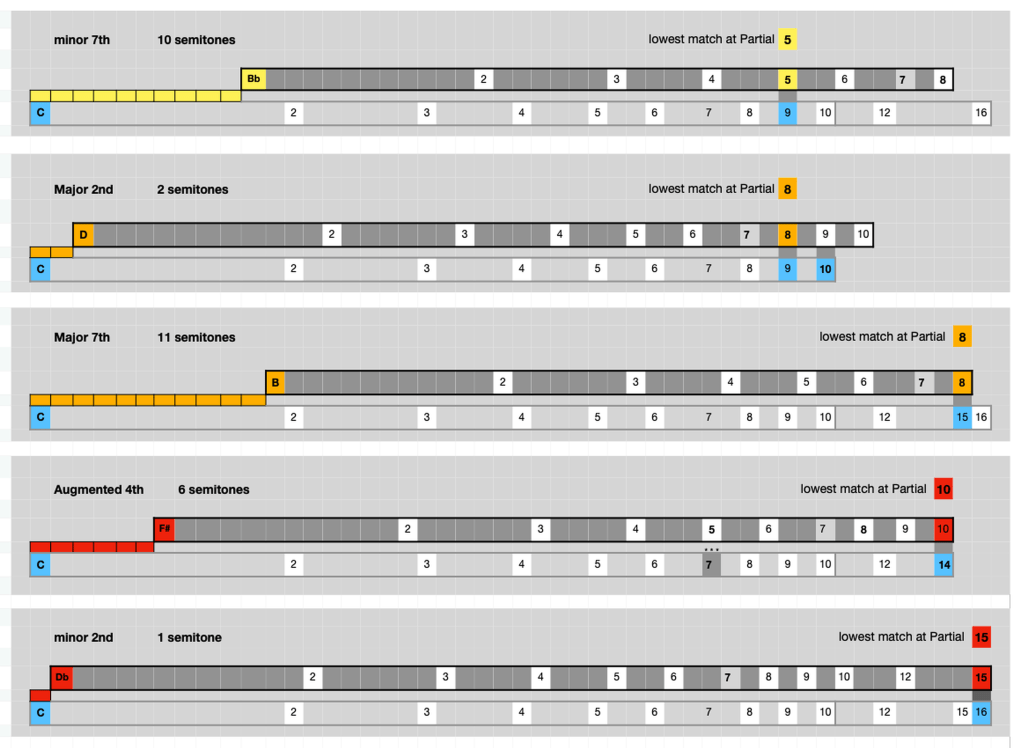
overtone match for dissonances
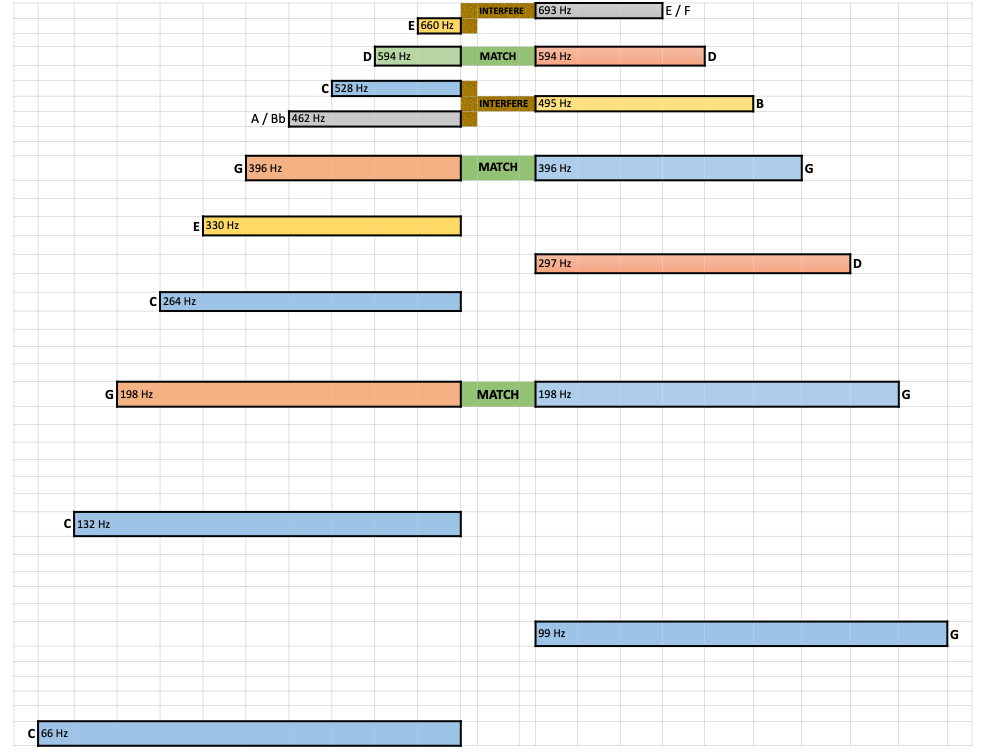
The dissonant minor 7th interval between fundamental pitches, C up to Bb, matches overtones makes only one match in this lowest-two-octaves comparison, at partial 5. That means its harmonic quality is more complex, with most of the lower overtones interfering, not matching. Not a strong dissonance, but more complex than the others.
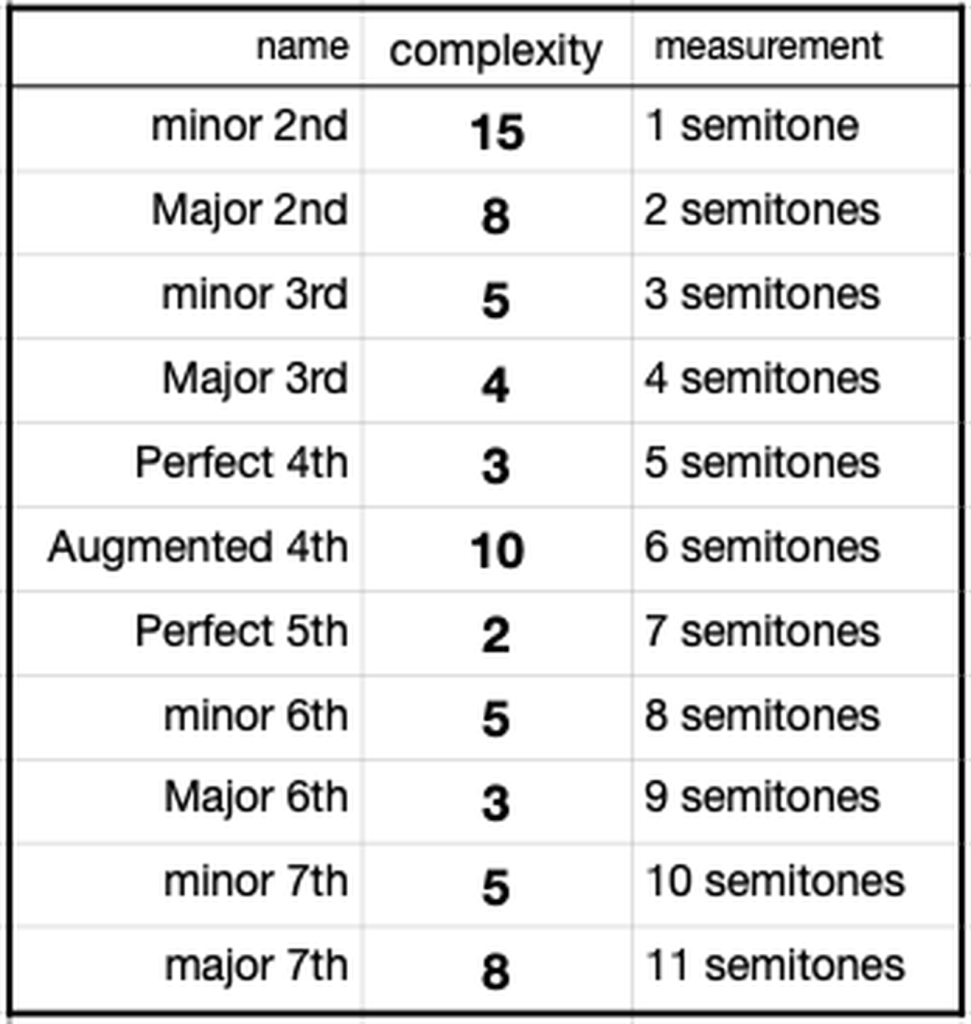
By contrast, with the more complex Major Seventh interval (ex. C up to B), you have to go all the way up three octaves to the B’s 8th partial (matching the C’s 15th partial!) to find an overtone that matches and doesn’t conflict/interfere. The Major 7th interval can be considered much more complex at a rating of 8 than a Perfect 5th at rating 2.
The most complex interval analyzed, the minor 2nd, clashes all the way up until the 15th partial.
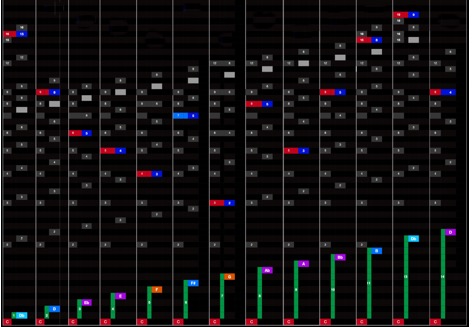
A colorful summary depiction of this Pythagorean analysis of harmonic intervals looks rather like a modern-day sound mixing board.
overtone matching for 13 intervals
Summarizing the analysis with a complexity rating number for each interval:
interval complexity ratings
Now we can add up the ratings of each interval in a chord and take an average complexity quotient. And we can think of complex as darker than simple, or we can invoke the color spectrum. In digital photo imaging, we use a temperature metaphor, seeing red as warmest (infrared heat) down through orange, yellow, green, down to blue, the coolest. The “hottest,” most complex harmonic interval is the minor 2nd. The “coolest,” purest (other than the octave) is the Perfect 5th.
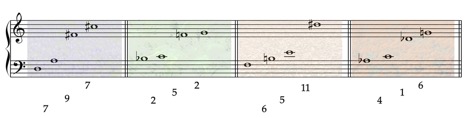
The intervals in the following example are shown in semitones. Each chord has four pitch classes and six intervals between them. The Blue chord has an average complexity rating of 3.8. Green chord is slightly more complex, at 4.3. Yellow, which includes the more complex 11-semitone Major 7ths, rates 5.5. And Orange, with the only minor 2nd 1-semitone hot dissonance, is warmest at 6.2. Try to hear the differences. (No attempt here to demonstrate the red-hot complexity of 10 or higher for a cluster chord!)
examples of four temperatures
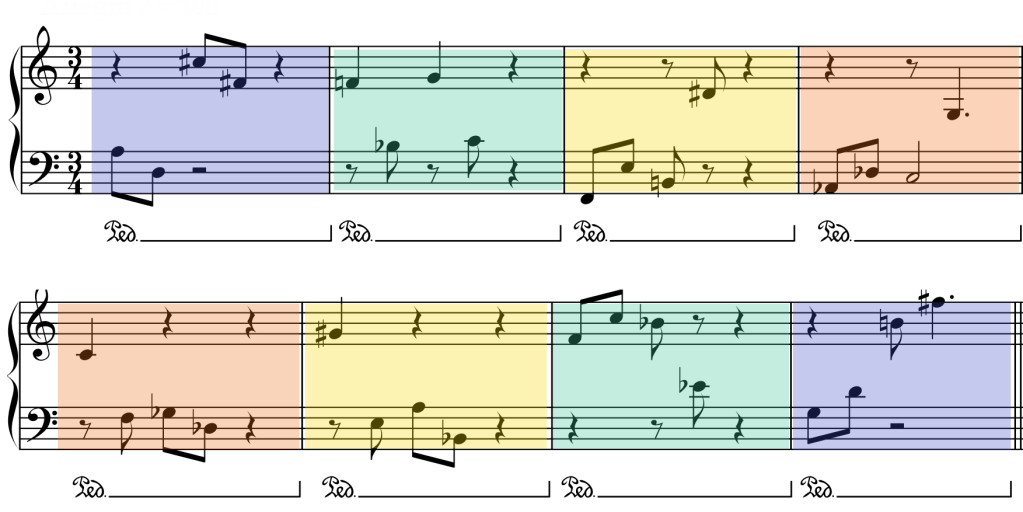
The following demonstration phrase uses hose four chord types to build a progression of tonal temperature colors. Again, as you listen, try to feel the temperature warm up then cool back down.
Pursuing our grand space metaphor, here is an important new term:
CONSTELLATION — a group of pitches occurring in a perceived relationship, either vertical (a chord simultaneity), horizontal (a segment of a melodic line), or diagonal, a combined collection of pitches from various lines sounding in temporal proximity.
This is intentionally a broadly inclusive concept. Larry Austin and I first coined the term in our 1989 book, Learning to Compose. A constellation can be any number of pitches, but those of three to six pitches are most manageable to analyze, categorize, and manipulate.
In Mapping Music 5. SCALES, we explored pitch classes (all the D’s in any octave, for example). For now, let’s not go there. A constellation can be very tall, spanning even five octaves, or very narrow, as in three or four close-together pitches well within one octave. (As a chord, we might call these a “cluster.”)
Common names for types of pitch grouping, “sonority,” “chord,” “harmony,” “melodic motive,” “arpeggio,” or “chord voicing” will all be considered manifestations of a pitch constellation.
Jennifer Higdon’s 2007 work, Percussion Concerto, driven by rhythmic vitality, romps through a dazzling variety of pitch constellations. Most are more complex sonorities consisting of 4 different pitches, drawn from diatonic scales but extending beyond the basic triads of the scale’s traditional harmony.
Jennifer Higdon – Percussion Concerto (2007)
Interval arrays
NOTE: In place of traditional interval names, which literally don’t add up, we will consistently measure every interval by how many chromatic semitones (half-steps) it spans.
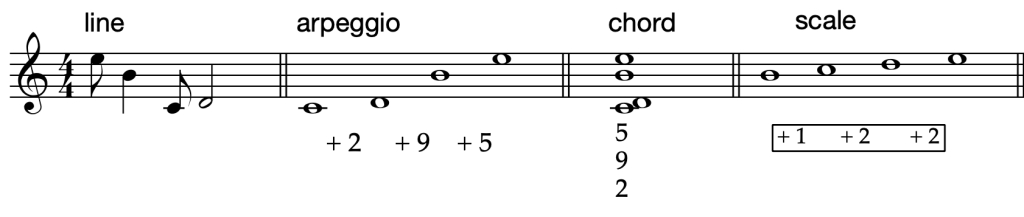
When pitches of a constellation are considered out of time, like a chord, and rearranged from lowest to highest, we can study their harmonic structure. The stack of intervals makes a successive interval array of semitones from lowest to next, on up to the top.
For example, the following line of four pitches, in order E – B – C – D, rearranged lowest to highest, yields C – D – B – E. Its interval stack = 2 9 5. (Going back to 5. SCALES, the four pitch classes can be derived from the set / diatonic scale-pattern 1 2 2.)
sample constellation 2 9 5
This constellation’s particular pitch-pattern shape shows a stack of successive intervals from lowest to highest: 2 9 5.
INTERVAL ARRAY — stack of intervals that identifies the constellation’s particular intervallic shape in vertical pitch space, listing the successive, additive upward intervals from lowest to highest pitch
Note: I tend to use “interval stack” and “successive upward interval array” interchangeably. If we wanted an acronym, how about Successive Upward Interval Series Stack — SUISS? No, maybe Vertical Interval Array — VIA? But vertical is not quite right, as the pitches might occur in musical context diagonally in 2-D pitch-time space and only be vertical when theoretically aligned as a chord stack. So let’s stick with interval array — and since conventional music theory doesn’t use the word for anything else, let’s just call it an ARRAY.
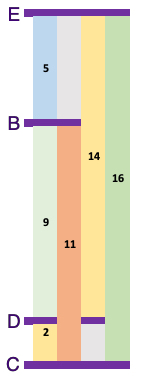
The constellation above also contains a “Major 7th” 11-semitone interval (+2+9=11), C up to B; a 14-semitone Major 9th, D up to E; and one very large interval of 16 semitones, C up to E in the next higher octave.
sample constellation 2 9 5
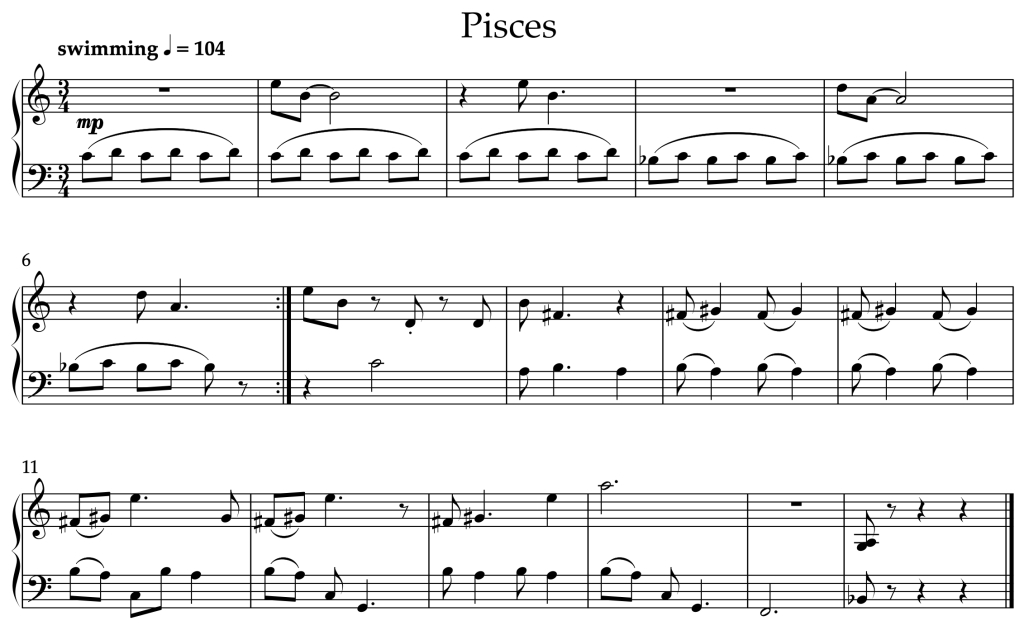
Below is a sample etude made with just this one 4-pitch constellation and its transpositions (bars 4-6 two semitones down), all with the same interval stack, 2 9 5, or its upside-down inversion, 5 9 2 (bars 12-14 bass clef).
Pisces etude
The etude is based on this 2 9 5 array. Bars 11 through 14 in the right hand are a constellation with a slightly altered array: ascending F# G# E A = interval stack 2 8 5, transformed from 2 9 5 by shrinking the middle interval of the stack by one semitone. Why? Sticking with 2 9 5 would have made e# or f and then b-flat on the top, not such great counterpoint against the b-natural in the lower line. And why not? The minor-9th interval A up to B-flat, 13 semitones, is a particularly gritty, unpleasant dissonance.
One example with pitch classes would be [F B E], in which F up to B is 6 semitones, B up to E is 5 semitones, and F up to E is 11 semitones. This example with all three pitch classes drawn from a C major scale illustrates that [6 5] is correctly shown in white as a diatonic pattern, despite the fact that it is not commonly used as a harmony in common-practice tonal music other than as a Mahler-style suspension.
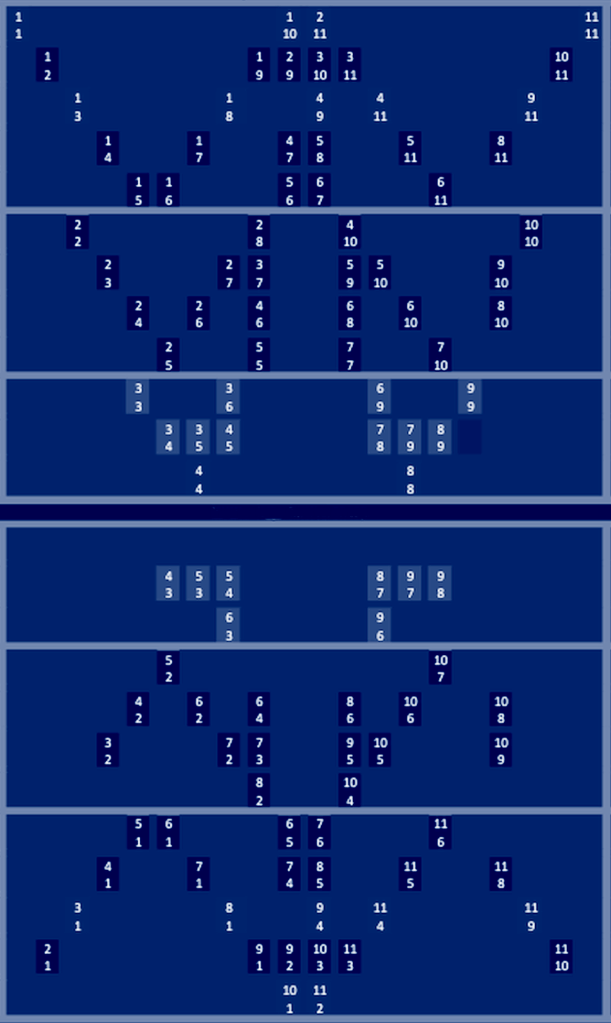
In the table below, each column groups stacks of the same height – each stack also forms a larger interval (not shown) that is the sum of the adjacency intervals shown. For example, reading bottom up, the stack 6 5 also forms an 11-semitone interval, the stack’s total height. All 3-pitch-class interval stacks:
3-pitch interval-stack arrays
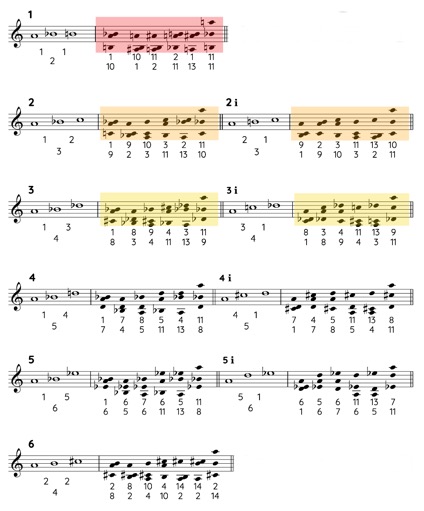
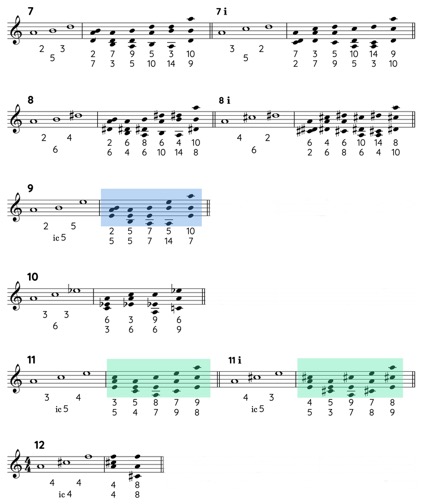
It may be helpful to see example pitches on a staff illustrating all these possibilities. Each line below shows a family, one Forte set class: first Forte’s “best normal order” with example pitches, then their chord voicings with stacked-interval sizes; then the set’s inverse, if there is a unique one.
Here the color shadings denote special degrees of interval complexity: RED = sharply dissonant; ORANGE and YELLOW = mildly dissonant; GREEN = minor and major triads; BLUE = quartal/quintal chords of P4 and P5 intervals.
3-pitch arrays, families 1-6
3-pitch arrays, families 7-12
As with scale-pattern maps, these maps and their notated lists represent the entire chromatic universe of possible constellations within a two-octave range. Each could be expanded by adding an octave to any stacked interval. And of course, each can become a line, a chord, or a temporal proximity of pitches in a texture.
What is a scale? Its essence is an interval pattern, selecting which pitches out of the entire chromatic possibilities become scale steps. Successive interval arrays are a vivid way to describe its pattern:
SCALE PATTERN — periodic interval pattern that cycles through each octave, defining which pitch-classes from the 12 possibilities are degrees of the scale
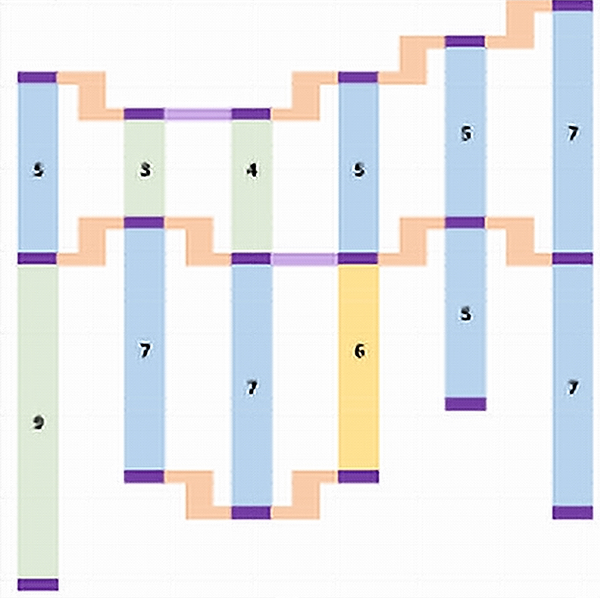
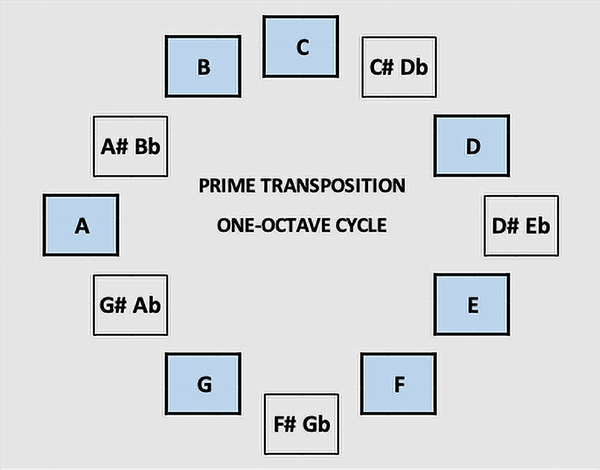
In that sense, it is a theoretical circle, starting over in each octave — or more imaginatively, a spiral. Let’s visualize the natural-note white keys on the keyboard, a prime example of the ubiquitous diatonic scale, as a circle.
diatonic scale circle
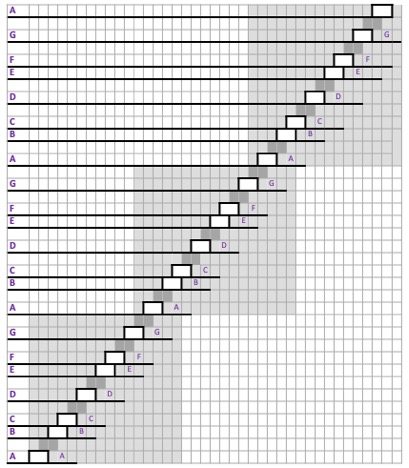
Now an unlooped visualization as stair steps, rungs on a spiral ladder:
diatonic scale cycling through three octaves
Anyone familiar with the white and black keys of a piano will recognize this pattern!
Chroma
Almost all scales in both Western music and other art-music traditions are built on the framework of octave equivalence, the close affinity of two pitches that are one or more octaves apart. We give them the same pitch name – all called “C” or “F#” for example. This makes the circular nature of a scale, that its pitch names and the intervals between them start over at the octave and repeat.
We also have the feature on an equal-tempered piano that one black key produces a pitch with two possible names depending on the scale in which they appear. For example, the D# seventh scale degree in an E Major scale is the same piano key as an Eb, the fourth scale degree in a Bb Major scale. The two pitch names are said to be “enharmonic.”
When a melodic line in an all-white-key C major scale introduces an F# for color or to temporarily alter the interval terrain, we call it a chromatic tone, after the Greek word for color, chroma. Now we have a comprehensive scale of all possible pitches. Going further, theorist Allen Forte defined a way to reduce all the pitches in an entire eight-octave chromatic pitch space into just twelve categories:
PITCH CLASS — a set of all pitches that are octave and/or enharmonically related
He gave them pitch-class numbers 0 through 11.
chromatic scale
In the advent of computer systems to produce, edit, and analyze musical sound, a sound’s identified pitch class is termed its chroma.
Synesthesia – some people, such as the composer Scriabin, actually see a color when they hear a pitch or a tonal key. In his variant of synesthesia, C is red, G is orange, D yellow, and A green. Scriabin’s Promethius: The Poem of Fire (1910) includes a part for “clavier à lumières,” a color organ that emitted light of what he deemed the appropriate color for a pitch instead of sound.
Scale prototypes
When we describe a scale, we name the pitches in order within an octave. Better yet, we name the successive intervals going up within the octave. The classic description of the ubiquitous diatonic scale, in whole-steps or half-steps, in its major mode starting on the tonic pitch, is:
tone / tone / semitone / tone / tone / tone / semitone
In the chromatic 12-tone universe, that scale pattern measuring the intervals in semitone sizes would be:
2 2 1 2 2 2 1
That is what I would call a scale pattern . . . a Successive Upward Interval Sequence in Semitones (SUISS!). But let’s call it a scale pattern array, working exactly like the arrays describing constellations.
Now we can particularize our scale pattern definition to apply to any smaller set of pitch classes, even if they don’t look like a scale:
SCALE ARRAY — successive interval array describing the pitches of a constellation condensed by octave equivalence to their most compact pitch-class-equivalent arrangement within an octave, ordered lowest-to-highest (Forte’s “normal order”)
In this sense, the array of a smaller set or scale fragment is just like a scale pattern.
Successive Interval array is a versatile tool that can apply to any pitch collection, to a linear, scalar pitch pattern as well as to a vertical chord sonority or even an arpeggiated diagonal collection of pitches I call a constellation.
Modes
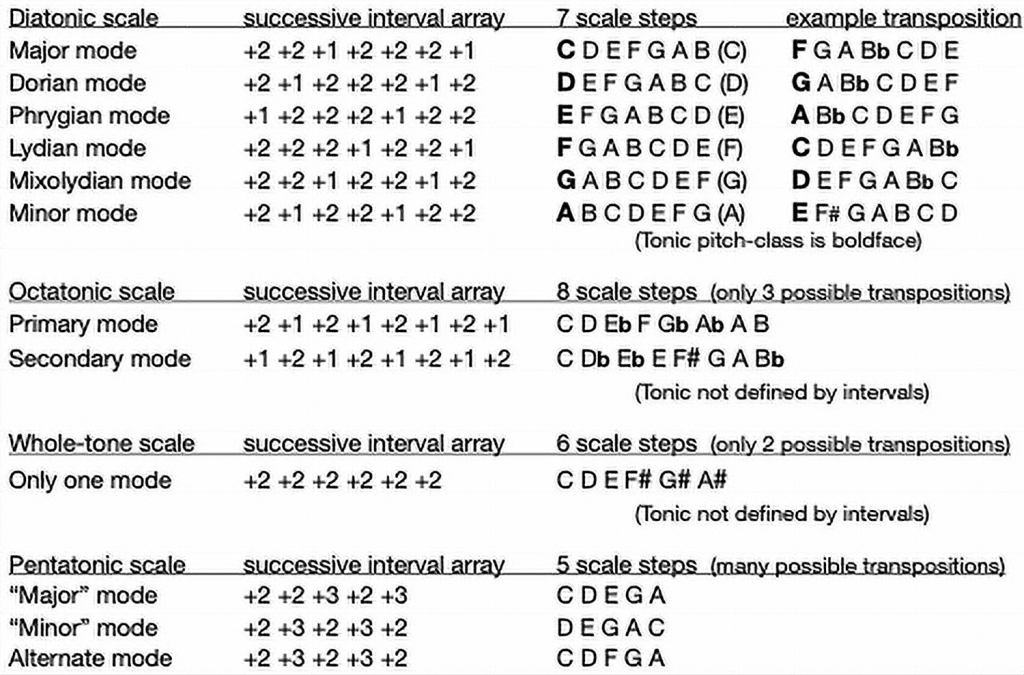
Most of our familiar scales are actually a different mode of the same 7-note diatonic scale, with a different starting and ending point called a tonic establishing the mode.
scale modes
Scale patterns / set classes
We can describe a set of pitches as an octave-compressed abstraction of 3 or 4 pitches as a lowest-to-highest ordering of pitch classes. It doesn’t produce anything like the 7 or so notes per octave we’re used to thinking of as a scale, as those shown above. It is conceptually powerful, nonetheless, to call the successive interval array of this compressed abstraction a scale pattern, even though it’s a scale fragment with no name. Its name can simply be the successive interval array, such as 2 4 2, the array describing a symmetrical pitch-class set called the French Augmented Sixth chord.
[Theoretical aside] In establishing set theory, Forte described these compact arrangements by naming the pitch-classes in order using a mod-12 number system shown above, C=0, C#/Db=1, D=2, etc. He identified twelve 3-note classes, including upside-down inversions reversing the scale pattern, as members of the same class. (Lewin kept these inversions separate, defining instead nineteen 3-note set classes. We’ll use Forte’s; the set classes as generalities are not as crucial to composing as to theoretical analysis.) Forte used cumbersome descriptions employing pitch-class numbers and “normal order.” In the Journal of Music Theory 15 (1971), Richard Chrisman defined and proposed successive interval arrays as a better, more revealing way to characterize the commonality of a family of pitch-class sets that are all related by transposition and/or inversion.
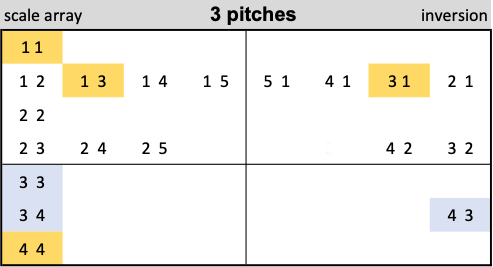
Relating to Forte’s concept of a set class, any set grouping three pitch-classes can be analyzed as an interval array or partial scale pattern.
scale patterns of all 3-pitch-class sets
Sets forming triads (or seventh chords below) are highlighted in BLUE; those that are atonal (cannot be found in a diatonic scale) are highlighted in GOLD.
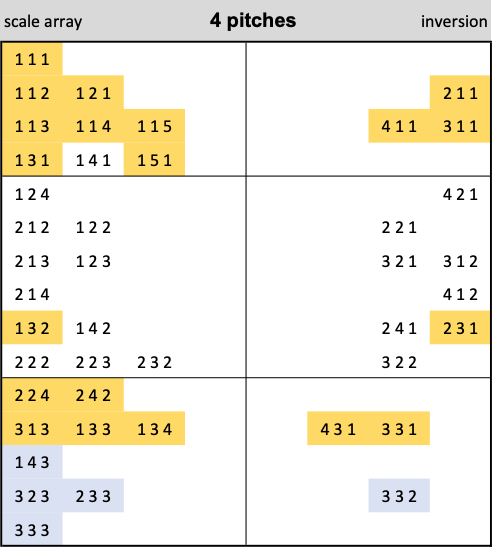
While the number of possible interval arrays for constellations of four pitches is enormous — even if limited to interval stack sizes less than two octaves, there are more than 12,000 possibilities — we can use this scale-pattern abstraction tool to categorize them into forty-three 4-pitch-class families.
scale patterns of all 4-pitch-class sets
The blue-highlighted scale patterns have common triadic chord names:
1 4 3 = “Major Major 7th chord” (in any chord inversion)
3 2 3 = “minor minor 7th chord” (in any chord inversion)
3 3 2 = “dominant 7th chord” (in any chord inversion)
3 3 3 = “fully diminished 7th chord”
The scale pattern 2 4 2 is an interesting symmetrical, non-diatonic pattern called a “French augmented 6th chord”.
Vocabulary
These maps collecting 62 scale-patterns summarize all possible constellations of 3 or 4 unique pitches, our total harmonic vocabulary in the chromatic universe.
you must understandthe language in which it’s written,
the language of Mathematics.”
— Stephen Hawking
Galileo revolutionized astronomy, in part by using a new tool: the telescope.
Schoenberg revolutionized harmony by evolving an existing concept, the chromatic scale, into a new tool: the 12-tone scale, and devised a new compositional tool of the 12-tone row.
Allen Forte took Schoenberg’s ideas to another level of abstraction: defining Pitch Class and applying basic math to the 12-tone universe.
Chrisman focused on the interval essence of pitch patterns: defining the “successive interval array.”
I am merely another explorer using their maps but choosing my own creative path. In doing so, I will define some of my own terms, while adapting and clarifying some established terms that fit what I’m thinking and expressing.
From Tuning to Tonality
We think of traditional common-practice Tonality of the 17th through 19th centuries being synonymous with the major and minor scales. But there’s more to traditional common-practice Tonality than just the scale. Here are the four basic factors that determine any tonal design:
SOURCE SCALE
HARMONIC TYPE
TONAL CENTER
ancient mode
perfect intervals
fixed by mode
Major / minor
triad
modulatory shifting
extended chromatic
extended triad
polytonal centers
exotic / synthetic
non-triad
established contextually
12-tone
diverse
none
tonal design factors
As you can see, there is much to explore: scales, modes, intervals, consonance . . .
Tuning
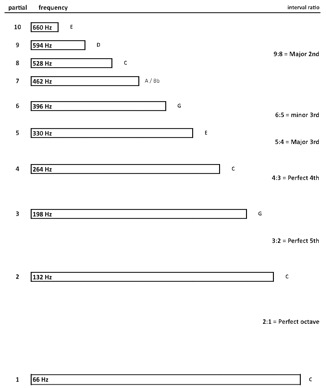
Taking the overtone series and partial vibrations as a natural acoustical model, Pythagoras identified pitch intervals as simple integer ratios of lengths of a vibrating string. The same ratios describe frequency ratios.
fundamental pitch C and overtones
For example, what we call a Perfect Fifth, the interval of the Third Partial to the Second Partial of a natural overtone series, is a 3:2 ratio. Such natural tuning is always employed by orchestras, bands, and a cappella choirs.
Octave = 2:1
Perfect 5th = 3:2
Perfect 4th = 4:3
Major 3rd = 5:4
Minor 3rd = 6:5
Major 6th = 5:3
Minor 6th = 8:5
Major 2nd = 9:8
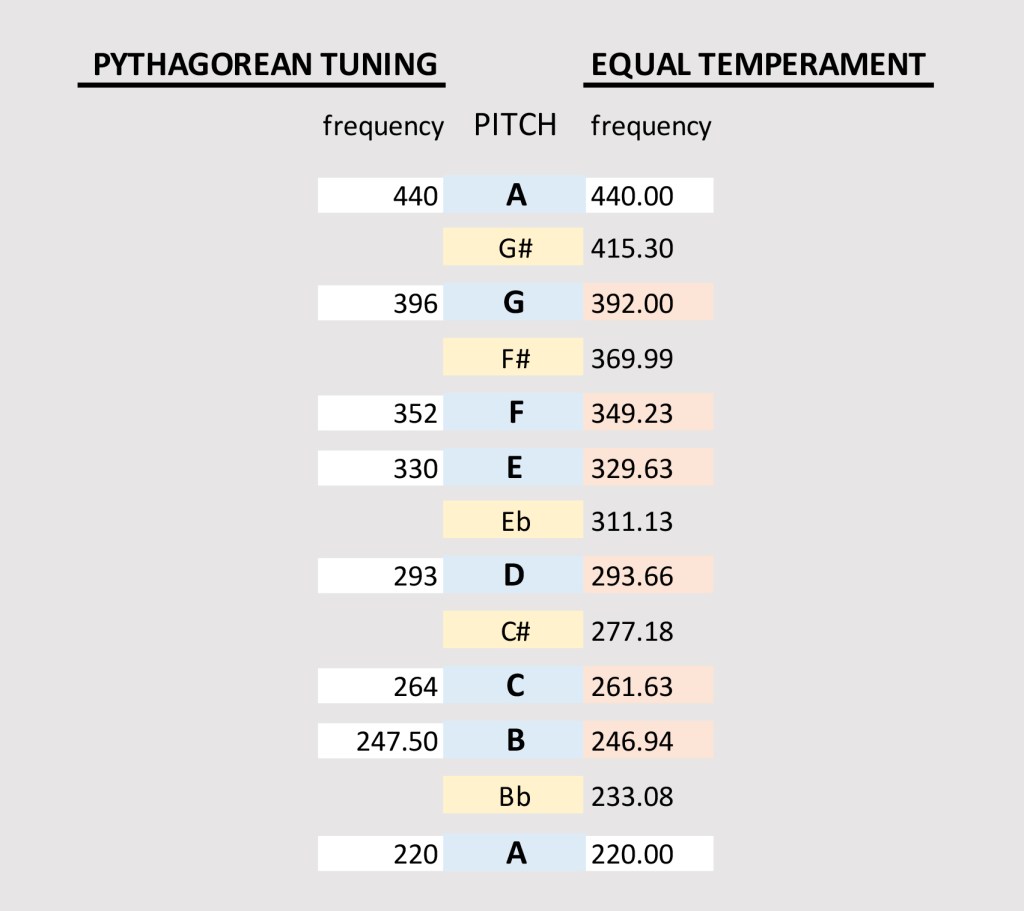
This approach requires, however, that intonation be constantly adjusted as the key changes or tonal context shifts. For a keyboard that can’t make those adjustments, the fixed tuning devised in the 18th century, called Equal Temperament, compromises the Perfect Fifth, shrinking it from a 1.5 ratio to 1.498307 so that it and all other intervals are very slightly but equally mis-tuned in every possible key or tonal context. The ratio for a semitone is derived mathematically from the 12th root of 2: 1.059643094. That ratio, multiplied by itself 12 times, results in 2.000, the ratio of the octave.
comparing tuning systems
While “chromatic” historically meant extending a key with accidentals — temporary extra sharps or flats — now we refer to the 12-half-step scale as the chromatic scale. Two pitch names for the same piano key — C-sharp or D-flat — are said to be enharmonic and considered equivalent, almost interchangeable.
Equal Temperament became the basis for the 20th-century system of 12 equal semitones per octave, the basis not only for all keyboard instruments but also for harmonic theory in the post-tonal world of 12-tone music. We should not forget, however, that choirs, orchestras and bands still use the purer natural tuning, even with music that has no key signature.
Other tuning systems
Long before equal temperament, the Chinese culture developed several systems. A fascinating history is described in Gene Jinsiong Cho’s monograph, LU-LU: A study of Its Historical, Acoustical and Symbolic Signification (Caves Books, Ltd., Taipei, 1989). Cho (a music theory professor colleague at the University of North Texas) explains the LU system from the Chin Dynasty, which extended beyond 12 increments in an octave as far as to the arcane realm of Jing fang’s sixty LU series.
In the West and into the 20th century, two American composers experimented with microtonal tunings splitting the octave into finer increments than our 12 semitones.
Working with American Lou Harrison, California composer Harry Partch (1901-1974) devised his own tuning system with 43 increments, described in Genesis of a Music (1947). The system necessitated invention of specialized percussion and string instruments to precisely intone the sounds, which felt exotic both in tuning and sound quality.
Harry Partch – Castor & Pollux (1952)
University of Illinois professor Ben Johnston (1926-2019) wrote music for standard orchestral string instruments using the ancient just intonations of Pythagorus. This involved specifying pitches microtonally slightly higher or lower than the equal-tempered standard pitch classes – a notational challenge of pitch-adjustment symbols.
Ben Johnston – String Quartet No. 7 (1984)
In the 21st century, Japanese composer norokusi has produced a broad catalog of microtonal music, apparently using a 17-increment division of the octave.
norokusi – Piano Sonata n.718 (2018) 17EDO/TET
Such complex systems as described above never became mainstream. The vast bulk of 20th-century and now 21st-century music is based on the equal-tempered 12-increment system found on a well-tuned piano, with subtle adjustments by orchestral strings, wind bands and a cappella choirs to momentarily purify some sonorities.
My compositional fascination with musical canons began in the early 1970s with study (at the University of Michigan) of Ockeghem’s 15th-century polyphony, the 10 canons in Bach’s 18th-century The Musical Offering, and Webern’s 20th-century Symphonie Op.21. As a young professor in the 1980s teaching 16th-century counterpoint at what was then North Texas State University (now UNT), I used canon as a challenging contrapuntal writing assignment. In 1985, a wind ensemble piece, Parallel Horizons (Homage to Schoenberg), was my first formal composition constructed by canon. In Dark Matter, other contrapuntal writing surrounds an extended canon. Now canon pervades much of my 21st-century writing, a challenging yet stimulating and gratifying approach to texture and continuity of material.
The definition of this ancient form of Rumpelstiltskin magic, spinning complex counterpoint out of a single melodic line:
CANON A leading line is echoed after some delay by one or more answering lines of identical rhythmic values and melodic shape (possibly transposed)
For a collection of 21st-century examples – 14 studies in 3-voice canon – go to my BOOK OF CANONS in the appendices. For pedagogical demonstration purposes, the subject of each is shown, with indications for when and at what pitch level each answer will occur.
Read more at Mapping the Music Universe: COUNTERPOINT.



















 MAPPING MUSIC