In traditional tonal music, or for a composer’s personal design, there are four main factors defining a tonal language: source scale (covered in Mapping Music 5); harmonic type; horizontal (voicing) connection; and tonal center, a basic concept for Common-Practice tonal music.
A diatonic major or minor scale and harmonic structures built from it define a key and “tonic” home-base tonal center. (In the ancient modal music of the monophonic Gregorian chant it was called the “finalis,” as it was the expected final arrival destination of an extended melody.) Triads taken from the scale build a scaffold of harmonies, featuring the dominant chord (scale degrees 5, 7, 2, and sometimes 4) with its scale-degree 7 “leading tone” propelling a progression to resolve back to the tonic chord (scale degrees 1, 3, 5).
In 20th-century music, some composers (notably Bartók) began to define tonal center contextually rather than by scale-and-key, writing melodic patterns and counterpoint that branched out from and converged back to a core base (but not necessarily bass) pitch. Twelve-tone music, derived from the full chromatic scale, would seem to be avoiding any tonal center, but some composers still built textures whose lines and counterpoint would emphasize one focal pitch-class.
A matrix of choices
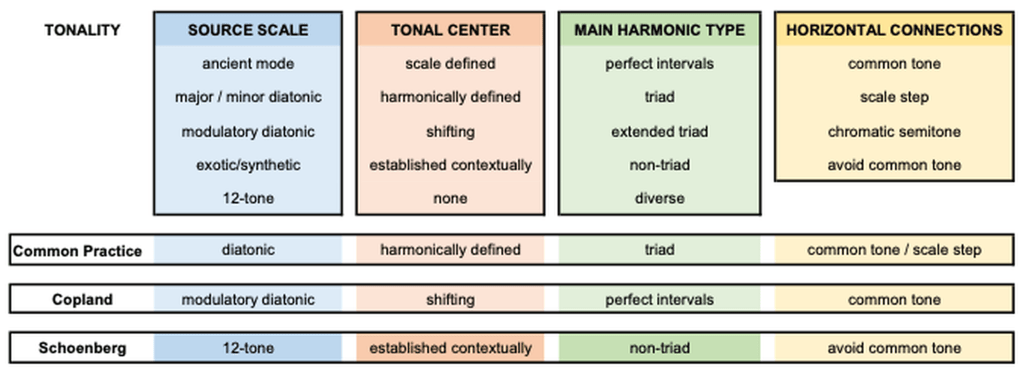
In forging a tonal language, the composer develops preferences in each of these factors. Choices from each factor column can be mixed in a variety of ways. The composer designs by delving into more specific patterns, especially for the source scale (possibly, say, a six-note pitch-class set) and the harmonic type, establishing a preference for certain harmonic intervals (such as my favoritism for 7-semitone Perfect 5ths and 11-semitone Major 7ths).
There are, of course, thousands if not millions of possible combinations of all these factors, a universe of tonal possibilities for the individual composer and a particular piece.
Next, let’s dive more deeply into harmonic types and the factor of horizontal connections between successive harmonies.
Constellation streams
A stream of successive constellations, which we might nickname a “constream,” would traditionally be called a chord progression. In the following example, all stacks are 10 semitones tall; no common tones in the transposition choices.
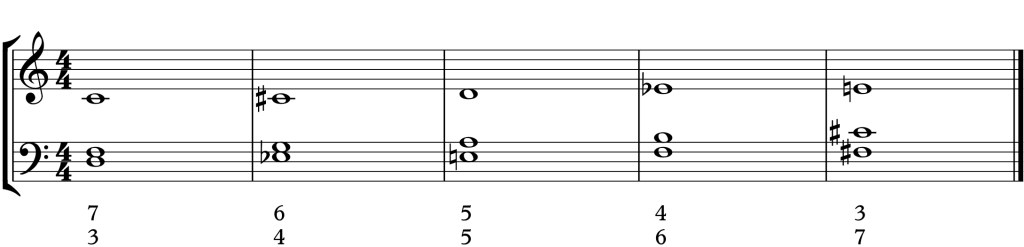
no common-tone connections
In the next example, stacks of differing heights, with constellations that reduce to three different scale patterns: scale array 5 2, then 2 3, back to 5 2, then 4 1, and finally 2 5, inversion of 5 2.
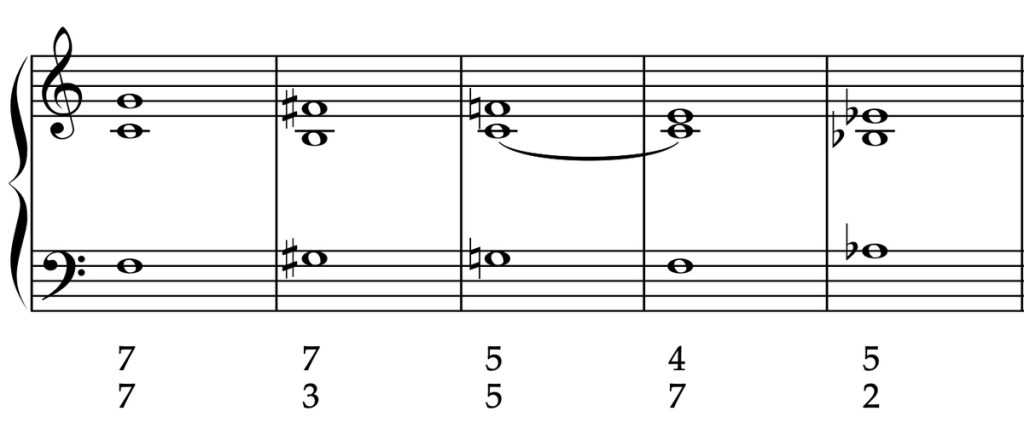
common-tone connection
Now a longer, more mixed succession of interval stacks of constellations belonging to these same three scale patterns (2 5 or 5 2; 1 4 or 4 1; and 2 3).
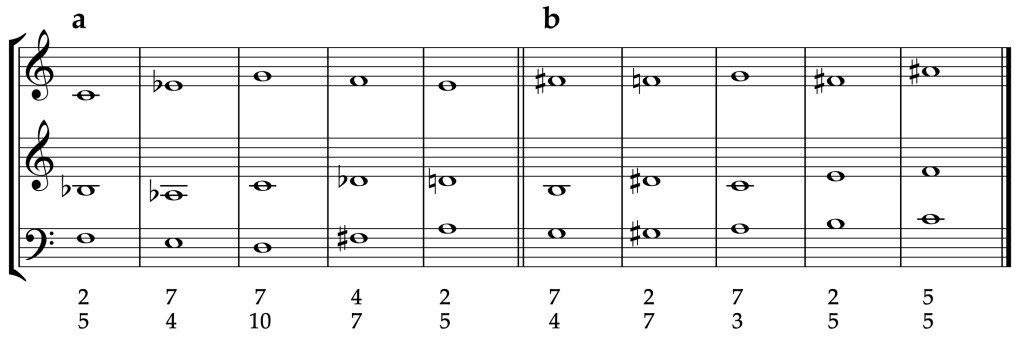
extended constreams
Back to my constellation friends of Mapping Music 6, we can make some constreams with them.
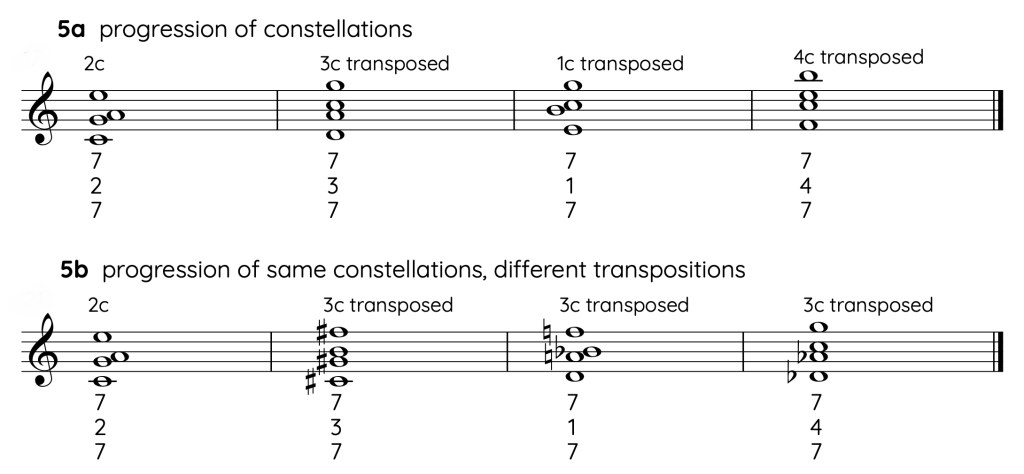
diatonic and chromatic successions of symmetrical constellations
An intriguing example from the literature of great early modern music, an interlude near the beginning of Stravinsky’s L’Histoire du Soldat:
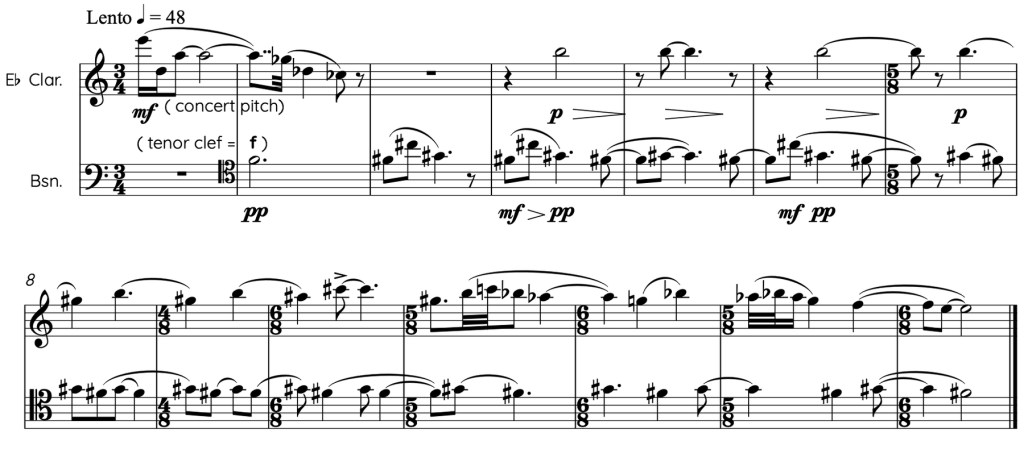
L’Histoire du Soldat excerpt
This passage is intriguing in many ways. It looks like counterpoint between two woodwind instruments in high register. But both lines are quite simple and don’t seem to go anywhere. (In our GALAXIES: Structure chapter, we’ll discuss these questions of texture and counterpoint.) Introducing it here raises the question of harmony, of constellations and their arrays, though the passage doesn’t look at all chordal. Here is an array analysis of the constellations formed in the first through fourth bars then jumping to bar 10 and, finally, bar 14.
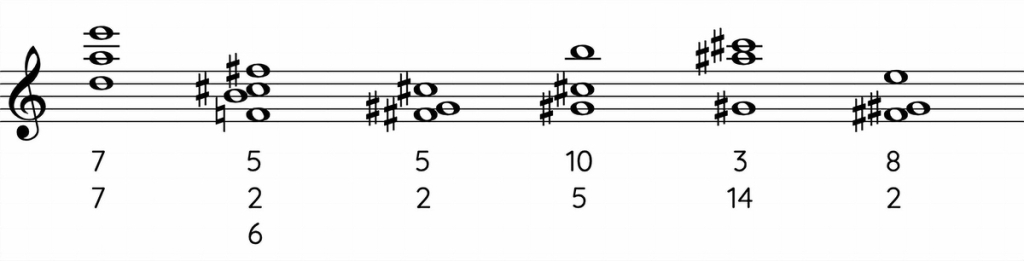
L’Histoire du Soldat constellations
Now you can see and hear more clearly the role played by array interval of 7 semitones (“Perfect 5th” as in above examples) and also 5, and 2 semitones in the harmonic continuity of the passage. (Also note 7 + 7 = 14; 5 + 2 = 7; 5 +5 = 10; 2 + 12 = 14; etc.)
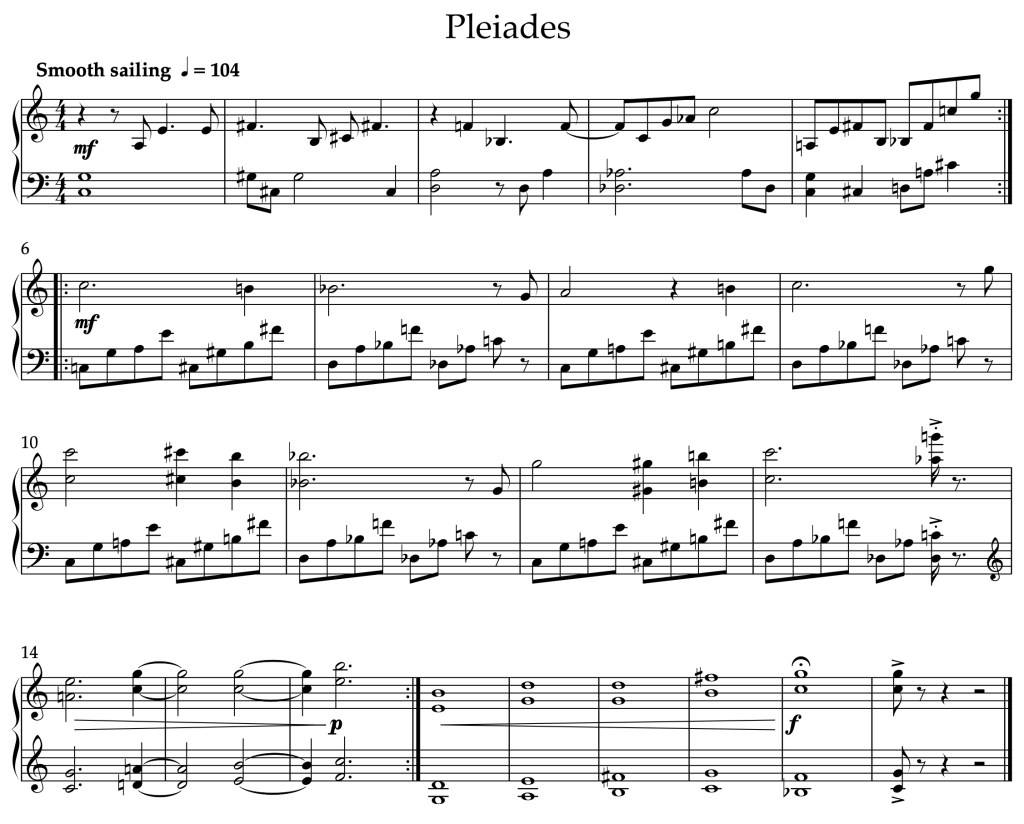
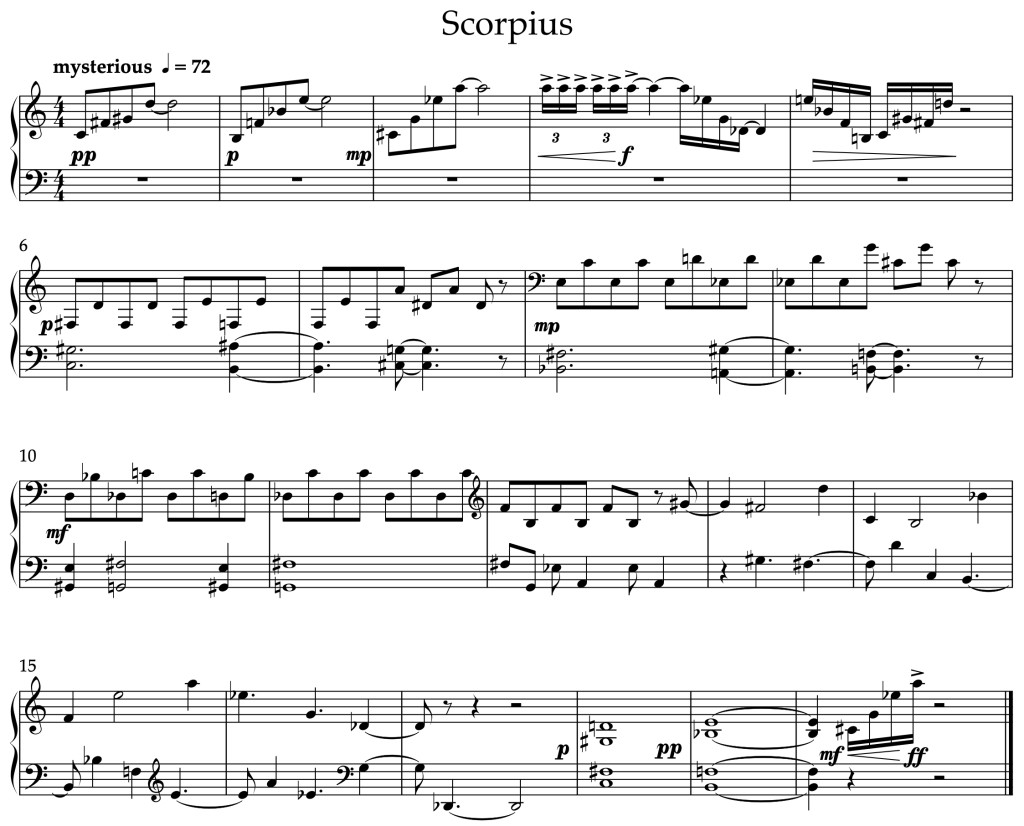
To illustrate that this is not all just theoretical, here is a simple etude composed using exactly the constellations and successions explored in Examples 12 and 17. It took only about an hour to compose this minute and a half in Sibelius. The title: the constellation Pleiades (“Seven Sisters”) is a tight cluster of 7 stars tagging along in the winter sky with Taurus as the Zodiac sails westward every night.
12-tone sets
Let’s keep going. How about designing a succession of three four-pitch constellations, so that all 12 pitch classes of the chromatic scale are included but none repeated? (Traditional terminology calls such a set a 12-tone aggregate.)
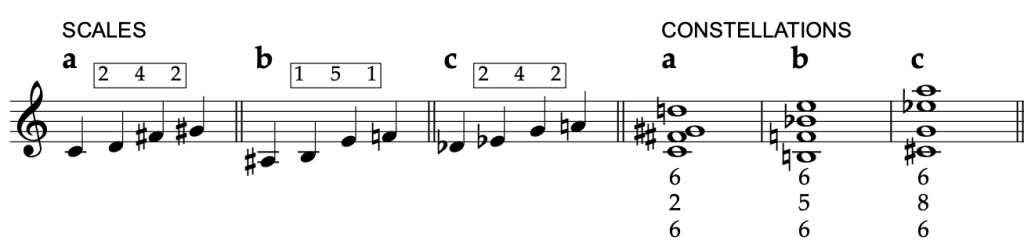
three sets make a row
Constellations a) and c) are different “chord voicing” of the same scale pattern, 2 4 2 . Both scale patterns and all three interval stacks are symmetrical. And they all contain two 6-semitone “tritones,” giving the whole succession the tritone’s quality of ambiguity and the character of the succession a feeling of mystery.
Altering arrays
Similarity of interval patterns can build coherence in a stream of constellations. Beyond functional common-practice harmony, this is a kind of process that composers of the 20th century and today can use to create a “new tonality”.
Possible operations to transform an interval array into a closely related array:
OPEN — Expand an interval by an octave, adding 12 semitones
FUSE — Join two adjacent intervals to make a larger interval, the sum of their sizes
DELETE — Remove an interval, shortening the stack’s height
SUBDIVIDE — Insert a pitch to divide an interval into two smaller intervals, whose sum equals the original interval
PROPOGATE — Append or insert an interval of a size already present into the stack
INVERT — Reverse the registrar order of the stack — turn it upside down
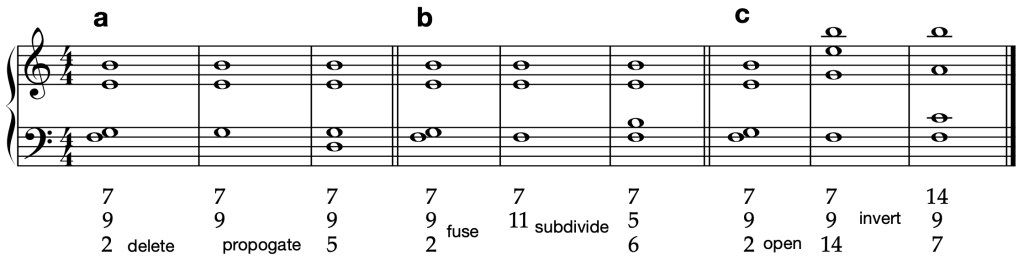
alteration examples
There are operations that more significantly alter the character of the interval array.
REDISTRIBUTE — Fuse two adjacent intervals into one larger interval then re-subdivide it into two different smaller intervals
SHRINK / STRETCH — Alter one interval size by other than an octave, leaving others unchanged
COMPRESS / EXPAND — Alter all intervals in the stack by adding or subtracting each by the same number of semitones, or multiplying each by a constant
These alterations are listed in order, from the mildest alteration producing a similar array (redistribution) to the most dramatic producing a substantially different array, compression or expansion of the whole array (preserving little from the original but its symmetry). Here is an example employing these altering transformations.

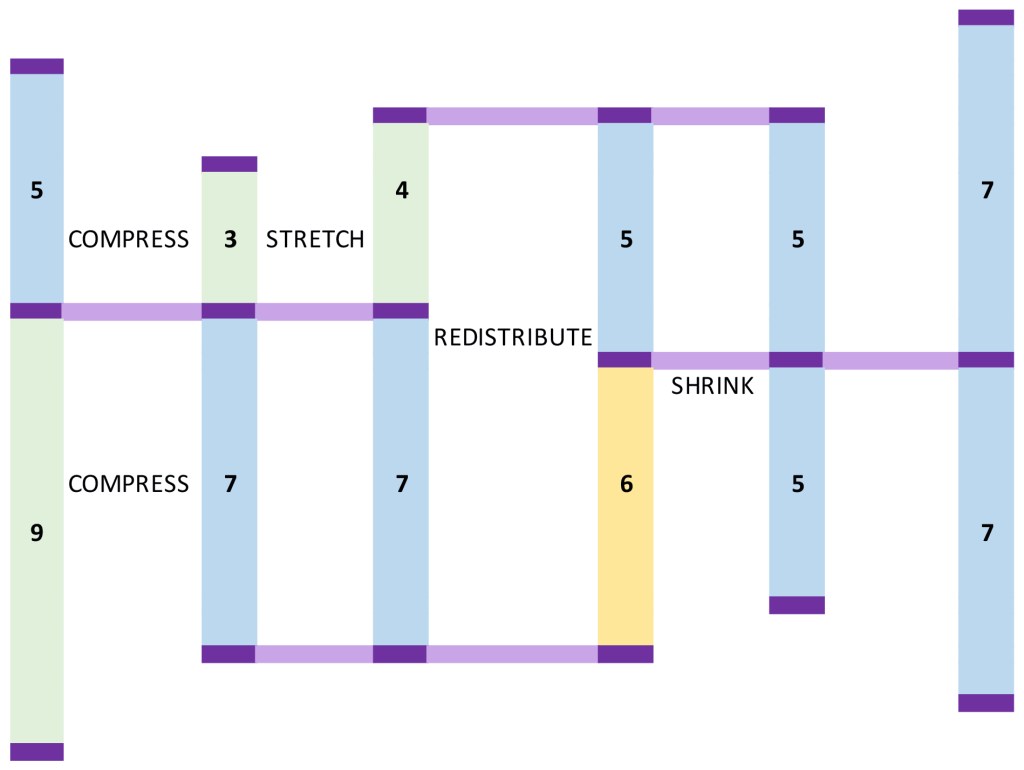
more alterations, with common-tone connections
The other element of coherence in this example is the many common-tone connections between one chord and the next, establishing a slow-moving stability. Another example of the same interval stacks, same succession of alterations, but choosing transpositional level of each constellation to create as many 1-semitone voicing connections as possible (10 such voicing connections in the following example) makes the con stream’s sense of progressive change stronger.

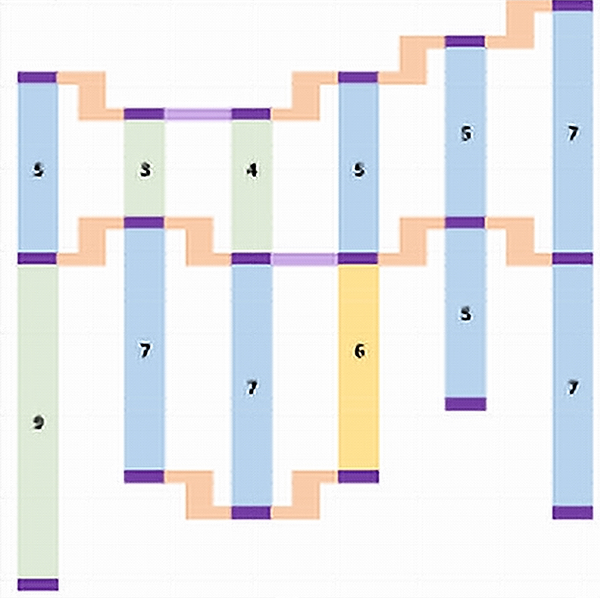
more alterations, with semitone connections
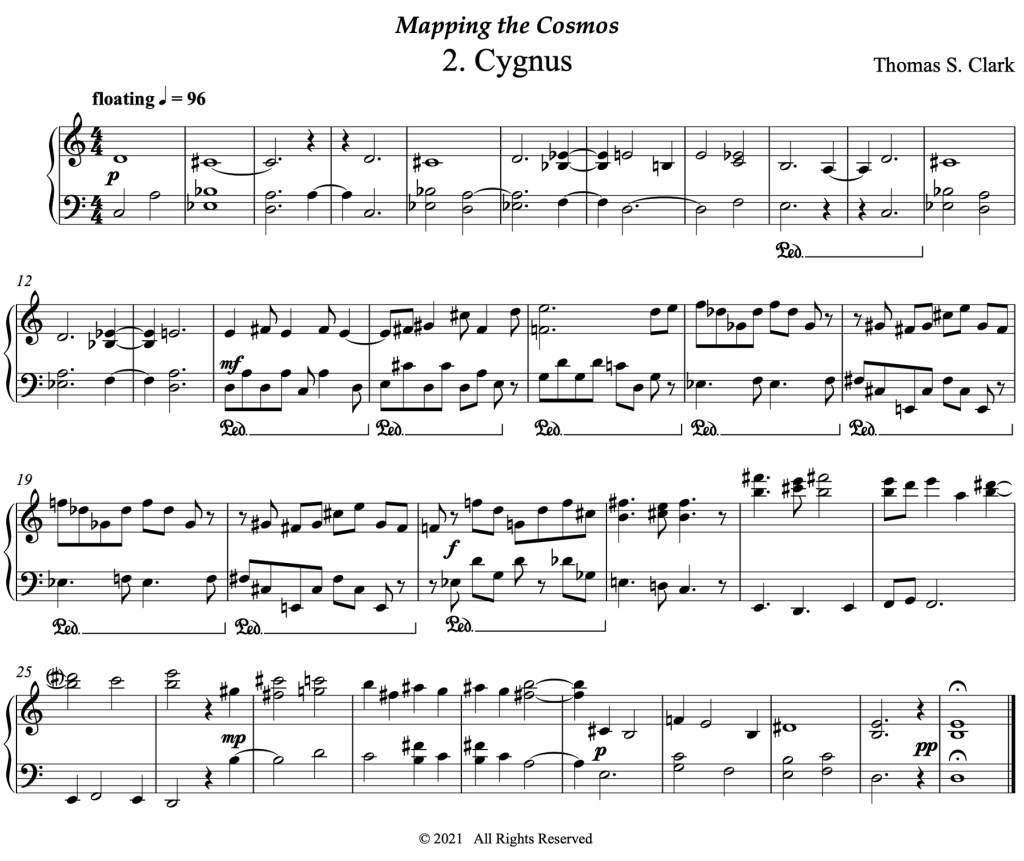
Finally, another example etude, using this last constream . . .

© 2026 – All Rights Reserved
Thomas S. Clark
–
Continue reading Mapping the Music Universe:
___________


Leave a Reply