Tag: classical-music

  • Mapping Music 12. FORM

    Rhythmic intensity is an important factor in shaping musical form. A former research project “Density Functions in the Structure of Modern Music” in the 1970s sought to quantify it along with several other core aspects of structure at play in shaping large-scale form.

    In the TIME chapters, we previously mentioned pace and showed how it can accelerate or decelerate in a line while tempo remains steady. (The Beethoven string quartet example Op. 135 illustrated that.) We have now also defined composite rhythm as an intersecting sum of rhythmic time points of lines, the layers of a textural fabric.

    Density

    In physical terms, density is a ratio comparing the amount of mass to the amount of space it takes up. Measuring time space, tempo (expressed in “M.M.” beats per minute) can convert a count of beats into a time-length in seconds:

    DURATION (in seconds) — multiply BEATS times 60, then divide by TEMPO

    Now we’re ready to measure the pace of a line for a bar or a whole phrase:

    PACE (Notes Per Second) — number of notes divided by the duration of the stream

    And then to quantify for a whole texture of rhythmic activity:

    RHYTHMIC DENSITY (Attack-Points Per Second) — number of note-starting time-points in the composite rhythm of the whole texture divided by the duration of the stream

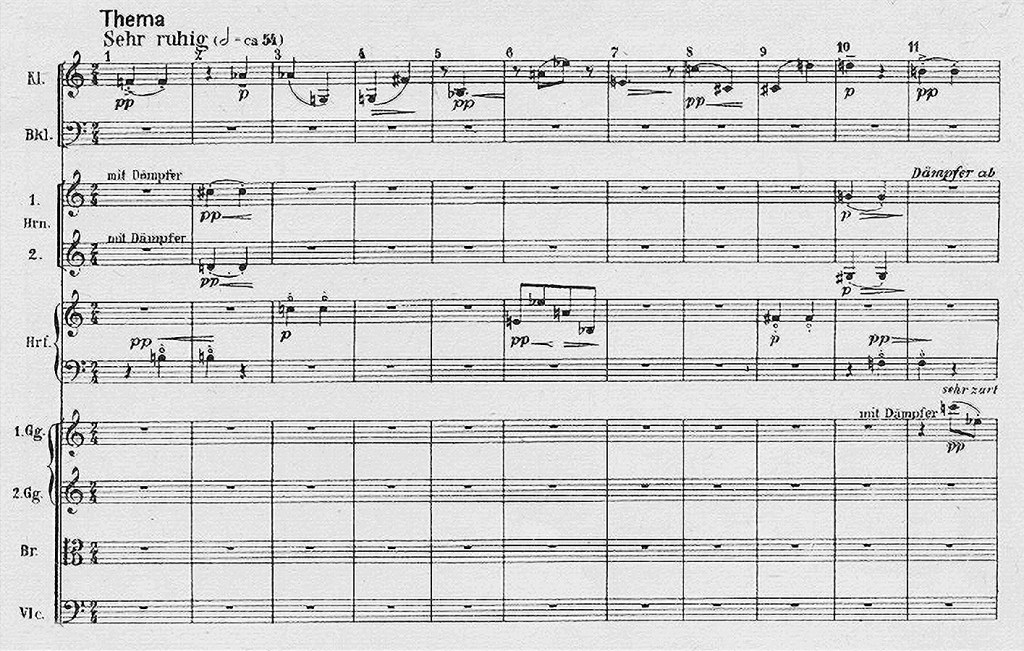
    Let’s go back to the Webern Symphonie Op. 21. Though called a symphony, it has only two movements. The second movement is a theme and variations with coda, each exactly 11 bars long in two-four meter. Here’s the theme:

    Op. 21, II — theme

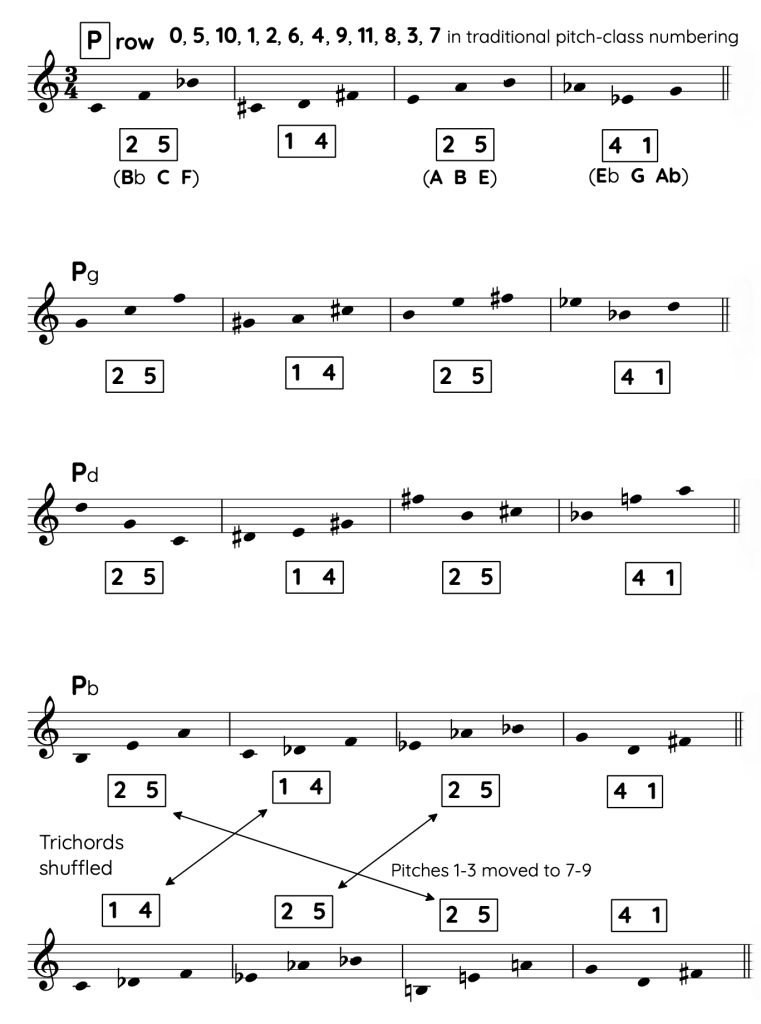
    Each variation, though 11 bars long like the theme, is in a different marked tempo. Each is distinguished by a contrasting degree of rhythmic density. And though the theme is a sparse (pointillistic) fabric, some variations are contrapuntally thick and intense.

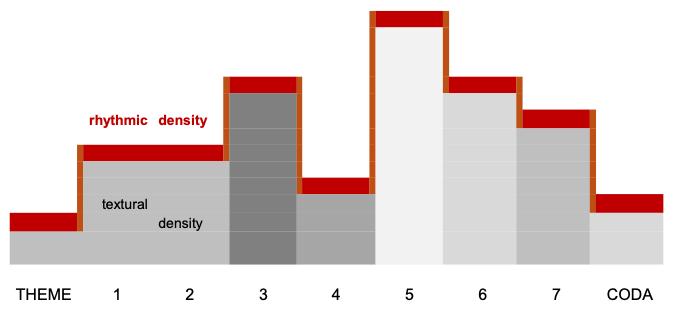
    Rhythmic density and what we might define as textural density (how many lines woven into what octave span) basically trace the same unfolding through the variations. The exception is Variation V. There they diverge, intensely active rhythms but only three textural elements in a diffuse pitch span of almost four octaves.

    A graph of changing rhythmic density values in each variation highlights rhythmic density as the bolder line:

    density graph of Op. 21 II

    About broad form, this reveals that from the beginning, rhythmic density increases to a subordinate peak in Variation III and overall peak in Variation V, then variation by variation steps down to a coda that matches how we started with the sparse theme. In rhythmic density, the whole movement is an arch form, with Variation V the “climax.”

    In the first “abstract sound mobile” of my 2024 work, FOLIO, it is easier to hear changing density as the changing thickness of clouds of sound, swelling and subsiding.

    “Music of the Spheres”

    Relativity

    Modeling, the process of creating an overall design, can mean creating a new model or expanding the possibilities of an existing model. In Learning to Compose we identified and described three basic musical approaches:

    NARRATIVE MODELING — Designing by telling a story, with characters, themes, gestures, suspense. What will happen next?

    SPACIAL MODELING — Designing the size, shape, and texture of blocks or sections of material

    TEMPORAL MODELING — Designing the flow and momentum of events in the passing of perceived time

    Variation and contrast

    Contrast is the essential complement to developmental continuity in musical material, driving musical momentum. Theme and variations form is a straightforward, traditional example of narrative modeling balancing contrast and continuity. Each variation preserves some basic element of structure such as harmonic progression (or in the Webern example, the tone row). Each variation presents a setting of that theme element in distinctly different orchestration, texture, mode, tempo, or rhythmic character.

    The composer determines not just how and when to make a contrast, but how dramatic the contrast will be. Their fluctuations over time are the core of the composer’s instinctive variation skill. This is the impelling force that gives musical form a sense of going somewhere, of leading up to and flowing away from stable plateaus marking the structural pillars of large-scale form.

    FLUCTUATION — Magnitude of contrast from one moment or event to the next

    When analytically quantifying fluctuating data, the time scale of measurement matters. In avant-garde or experimental music, a stream of events may be high-contrast on the moment-to-moment scale but steady-state over broader time spans. Conversely and more traditionally, surface events may be continuous, while the bigger chunks of events, like one variation to the next, may pose more dramatic changes in parameters such as rhythmic density.

    In typical Beethoven or Brahms variations, material within each variation is continuous, not at all fluctuant. The contrast comes altogether in the next variation.

    That consideration plays out differently in Op. 21 II. There is the obvious contrast from one variation to the next; but within each variation, moment-to-moment surface continuity also fluctuates. Surface fluctuation in density factors occurs, especially from one 3-to-4-second “moment” to the next. (We can’t really call them phrases.)

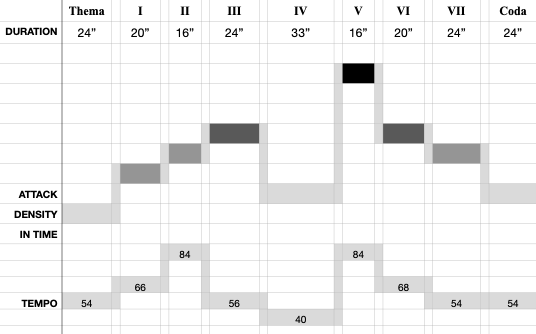
    For the Op. 21 II. Theme and Variations, we can now say something deeper about changing rhythmic density as the variations progress. From the Theme through the first two variations, rhythmic density increases gradually to Variation III. But then the fluctuation of rhythmic density spikes, dropping significantly for Variation IV, then suddenly increasing to its highest level in Variation V.

    large-scale time form

    It is not only Variation V’s greatest rhythmic intensity but also dramatically increased roller-coaster fluctuation, dropping then surging, that makes Variation V the climax of the movement. 

    Macro-structure

    Though Webern may not have thought consciously about Schwankung (fluctuation), this is how composers manipulate momentum to make a climax and shape large-scale form. Likewise, approaching a final ending, not only do fluctuations typically diminish, but also rate of change subsides — the overall change factor levels out to zero. These are examples of temporal modeling.

    The parameters of a musical event are numerous, a multidimensional matrix of at least six distinct, interacting qualities: each sound event’s loudness, resonance, timbre or sound color, duration, pitch (frequency), and time point of initiation. Imagine this as a six-dimensional space. In fact, physicists have imagined the structure of matter as exhibiting many more than six dimensions in string theory, M theory, etc.

    Musical structure establishes the relativity of these parameters, though not exactly the way Einstein explained time, space, gravity, and energy with mathematical precision. Some structures such as the Schoenberg Farben example relate constellation harmony to sound color. Threnody relates rhythmic activity to fabrics of sound in a broad pitch space (spatial modeling). Counterpoint balances rhythmic relationships, metric placement of lines, and synchronicity with their intervallic relationships of consonance and dissonance. Ostinato music manipulates phase relationships.

    And, as observed in Part I, temporal density, the rapidity of fluctuations and larger contrasts in these structures, propels our experience of the whole in time.

    In Thinking in Numbers, Daniel Tammet wrote about a mathematical study of poetry,

    “The best poems . . . combined in equal parts the predictability of meter with the novelty of unusual words. Too much meter made a poem banal; too much freewheeling . . . rendered it hard to follow. The delicate balance of convention and invention gives meaning to what we say.”

    The essence of music’s large-scale temporal form is the relativity of overlapping, fluctuating musical structures in time, repeating, contrasting, interrupting, truncating, expanding, certainly recurring, or simply evolving. Designing a large-scale musical form combines temporal modeling, narrative modeling, and spatial modeling — a pacing plan, a storytelling rhetoric, an architecture of interrelated components. 

    Coda

    sound mass . . . sound color . . . pitch constellations

    ostinato repetition . . . changing density

    evolving form . . . cosmic time

    In Become Ocean (2013), John Luther Adams takes a deep dive into a serene sound sea, incorporating all of the elements and structures we have explored in our mapping journey.

    John Luther Adams – Become Ocean (2013)

    . . . and we have just begun gazing into

    the vast space of color and complexity

    in the Music Universe . . .

    © 2026 – All Rights Reserved

    Thomas S. Clark

    Continue reading Mapping the Music Universe . . .

    MapLab 1. Generate a Gymnopédie

    TClarkArtMusic.com

  • Mapping Music 10. COUNTERPOINT

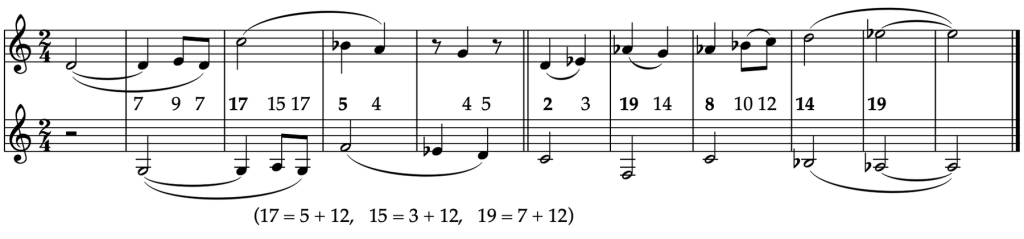
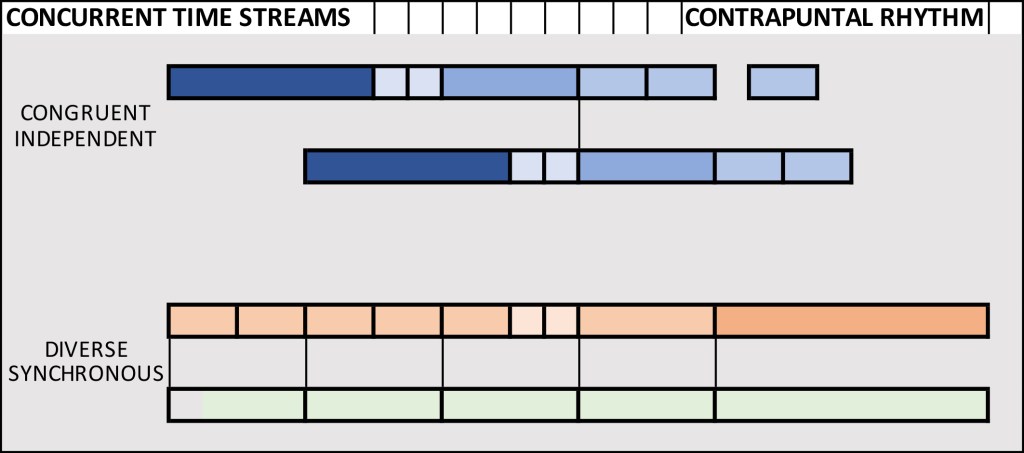
    Two lines woven into a shared time stream — counterpoint — can be relatively more or less independent. How similar or diverse are their rhythmic patterns (congruent or diverse)? How often do their note-initiating time points “line up” (synchronous or independent)?

    In an example of congruent, matching rhythmic material, the upper line’s rhythm is echoed in the trailing lower line in the first five bars below. But the lines are rhythmically independent, sharing only one time point, the downbeat of bar 4. This echo process is known as . . .

    CANON — leading line is echoed after some delay by one or more answering lines of identical rhythmic values and melodic shape (possibly transposed)

    For more on canons, go to BOOK OF CANONS, 14 short 3-part canonic studies.

    example of two-voice counterpoint

    Bars 6-11 show diverse rhythms (the upper line in mostly shorter durations than the lower), and not in canon but synchronized at most of their time points.

    Rhythmic alignment

    Johann Joseph Fux established a theoretical construct for pedagogical purposes in which contrapuntal lines in a 16th-century style progressed from congruent, synchronous rhythms (“First Species”) to one line twice the pace of the other (“Second Species”), and so on. Only in Fourth Species was the relationship reversed, back to matching, congruent rhythmic values but in studied alternation avoiding synchrony.

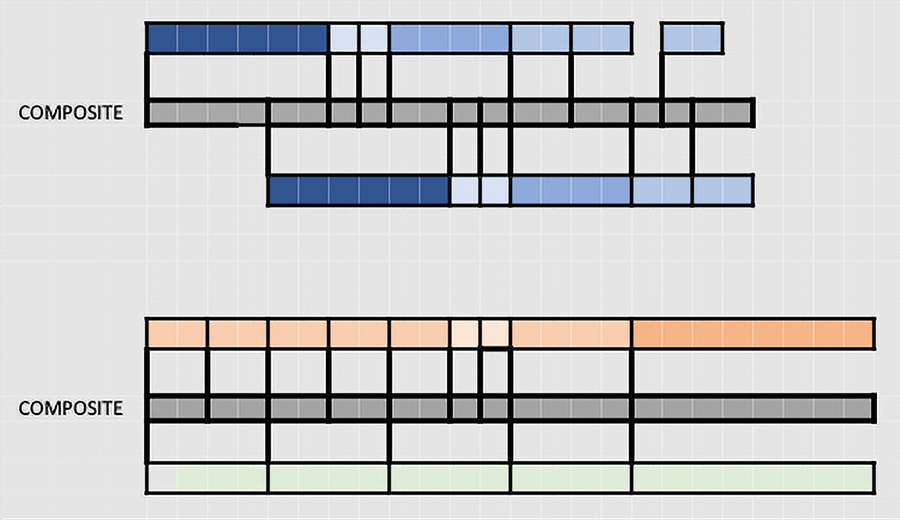
    COMPOSITE RHYTHM — stream of durations between time points marked by an attack of a note in one or more lines of the fabric

    Here is a graphic identification of the composite rhythm of each contrapuntal phrase above.

    composite rhythm

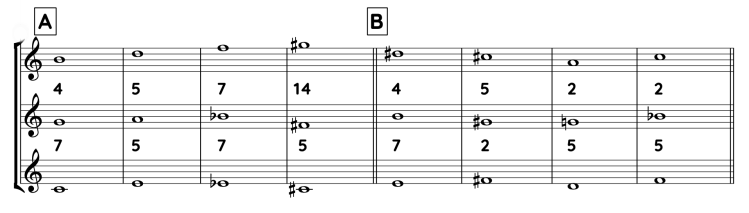
    You can see in the first example that there are 7 notes in the upper line and the same 7 rhythmic values in the lower line. But the composite rhythm shows 12 durational values, due to the non-synchrony of the lines. In the second example, the upper line has 9 notes, but the lower line’s 5 notes all align with them. The “sum” of the two lines is a composite rhythm of only 9 durational values, identical to the upper line.

    Contrapuntal intervals (in number of semitones) are identified between the staves. The time points of the composite rhythm, moments when both lines are starting a note, are contrapuntally accented and emphasize the contrapuntal intervals (boldface) formed at those points. The consistency — in this example the contrapuntally accented intervals of 7, 8, 2 (and 2+octave), and 5 (and 5+octave).


    CONTRAPUNTAL ACCENT — prominence of contrapuntal intervals formed by notes starting together on a time-point

    Refraction

    This term refers to the metaphor of light going through a prism or drop of water, revealing a spectrum of colors. In that sense, a musical refraction might refer to a line presented by instruments of changing sound color. (See Klangfarbenmelodie below.) But let’s apply the refraction concept to pitches in a line of consistent color.

    Refraction can also be a simple way to make two lines out of one, splitting up its notes into two lines shared by alternation or some other less strict pattern. The pitch assigned to one line can be sustained to make a companion pitch to the pitch or pitches that come next in the other line. In this way, the vertical intervals can be strategically controlled to generate a coherent contrapuntal harmonic flow.

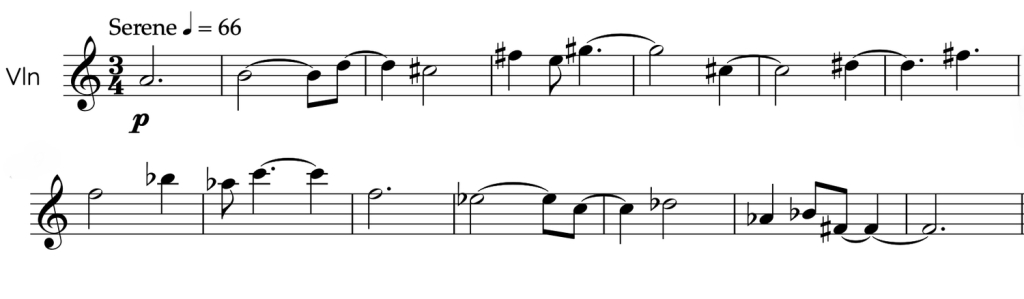
    To demonstrate, here is the opening theme to Jupiter Rising:

    Jupiter Rising theme

    Now splitting this violin line into two violin parts:

    Jupiter theme refracted

    Identifying the contrapuntal intervals (by number of semitones) that are formed reveals a preference for contrapuntal intervals of 2, 4, and 5 semitones.

    Some might say this is not real counterpoint, but the total rhythmic independence of the lines argues for that distinction. Mandelbrot, pioneer of fractal mathematics, described fractional spatial dimensions. Maybe we can call our refraction one-and-a-half voice counterpoint.

    Canon

    Repeating the definition of this ancient form of Rumpelstiltskin magic, spinning complex counterpoint out of a single melodic line:

    CANON — leading line is echoed after some delay by one or more answering lines of identical rhythmic values and melodic shape (possibly transposed)

    For a collection of 21st-century examples, 14 studies in 3-voice canon, go to BOOK OF CANONS.

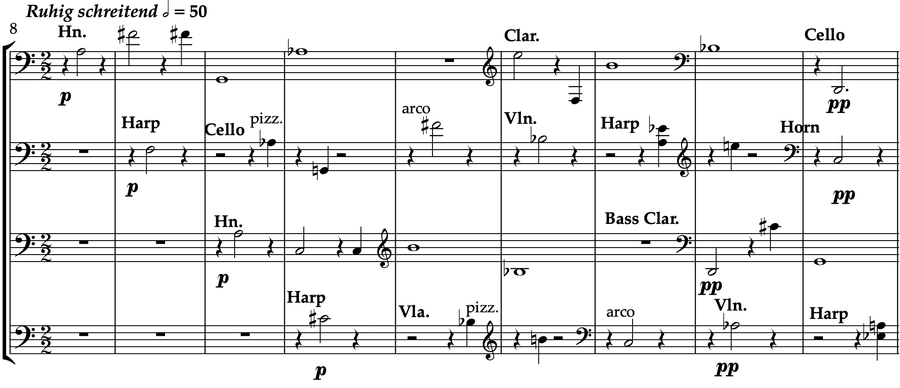
    Now let’s look closely at a more famous canon, in four parts scored for seven different instruments. Here is a contrapuntal example of canonic threads expressed through changing instrumental colors, the opening of the first movement of Webern’s Symphonie Op. 21:

    Webern Symphony opening

    Instead of showing each instrument’s part, I have rearranged the score so that each staff line strings together the successive pitches of a 12-tone row:

    • On the top staff, A F# G Ab played by horn; E F B Bb played by clarinet; then D by cello, continuing past this excerpt to complete the 12-tone row with C# C Eb.
    • The second staff answers in canon one bar later, starting on F plucked by harp and proceeding with a mirror inversion of the lead-line row: F Ab G F# Bb A Eb E C C# D B.
    • The third staff is also an inversion of the row starting on A.
    • The fourth staff, entering last, is a transposition of the original lead-line row starting on C#.

    Repetition

    Any musical element can be repeated — a note, an arpeggio, a measure, a phrase, a whole section of a form, as in the baroque rounded-binary model or the exposition of a classical sonata-allegro form. When a melodic motive or molecule is continuously repeated many times, it is called an ostinato, usually forming a background to some changing line or evolving stream of events. We can analyze two critical factors:

    CYCLE — duration length of a repeating pattern

     PHASE — time point at the start of a cyclic repetition

    Some 20th-century composers, especially Americans, started to bring background patterns or structures into the foreground, as primary objects rather than accompaniments. The incessant repetition of an ostinato, often a chord arpeggio, became the basis for simple structures. With a relentless pulse at its rhythmic core, most ostinato music generates simple highly congruent rhythmic lines in simple or no counterpoint.

    Classic works by composer Philip Glass, such as the ‘70s pieces Music in Twelve Parts, are continual repetition of chord arpeggios, with the chord changing gradually and subtly over many repetitions. This has two effects: making a very slow harmonic change rhythm and time flow under an animated surface; and creating a broad time form that is monolithic and metamorphic, rather than a more traditional multi-section recurrence form.

    John Adams brought this relentlessly repetitive approach to appealing prominence in symphonic music. His Fearful Symmetries (1988) has a pulsing persistence reminiscent of the great Stravinsky ballets, such as Le Sacre du Printemps (1913).

    John Adams – Fearful Symmetries (1988)

    Steve Reich continued this energetic vein of repetitive rhythmic construction into the 21st century with works such as Double Sextet (2008).

    Steve Reich – Double Sextet (2008)

    Despite its sometimes lush fabric of harmony and animated rhythmic activity, persistent-repetition music has unfortunately been labeled “Minimalist,” often having no melody, no sense of harmonic progression or tonal modulation, no themes, no sectional cadences and divisions, and no discernable large-scale recurrence form. (A music more truly described as Minimalist can be found in the more radical works of John Cage, with sparse sounds — or no prescribed sounds at all — in a time-space of mostly “silence.”)

    Phasing

    Back to ostinato — what about more than one ostinato layered into a more complex texture? Even if the ostinato patterns are of the same length, it is possible for their repetitions at different times to not synchronize but overlap. We would say their repetitions are out of phase.

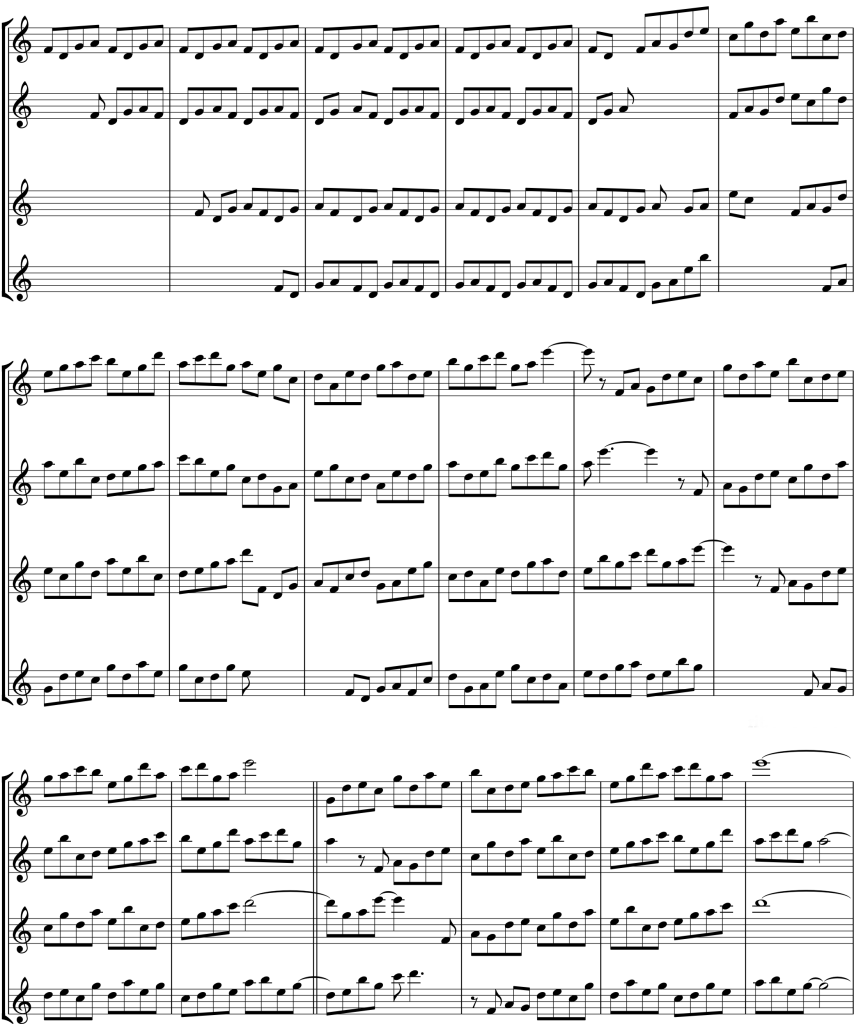
    Using Webern’s canon technique to place identical lines out of phase:

    Milky Way score excerpt

    The Milky Way is our own barred spiral galaxy. The musical fabric is adapted closely from Buckingham Fountain, the third movement of my Chicago Sketches for flute choir.

    There is also the potential for each ostinato pattern to have its own cycle length of repetition. And if the lines repeat different cycle lengths, their phase, the start of another repetition, cannot always align in synchrony. This can be described as multi-cycle/multi-phase ostinato music, pioneered among others by American composer Terry Riley.

    Inspired by tape loops continuously replaying recorded sequences of sounds, in 1968 Riley produced a massive (45- to 90-minute length) multi-phase ostinato work, In C. Becoming iconic, it has been recorded commercially more than 36 times and performed by countless new music ensembles, finding its improvisatory freedom and large flexible instrumentation attractive. (A 2006 performance at the Walt Disney Concert Hall featured 124 musicians.) It consists of 53 ordered patterns of specified, notated rhythm and pitch, to be continually repeated against a steady eight-note pulse. The patterns range in length from only 4 eighth-notes to extended phrases sprawling across a part’s entire manuscript line (without bar lines). Thus the variety of repetition cycle lengths is enormous. And because each musician chooses when to start and how many times to repeat each pattern, multiple phases are also guaranteed.

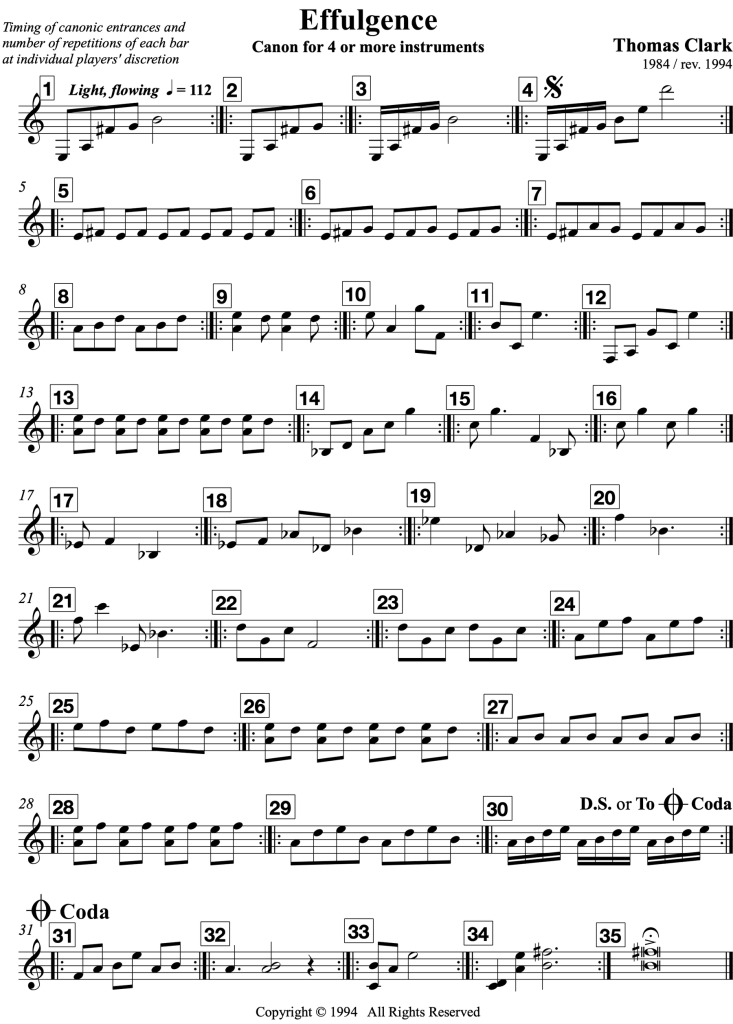
    Rather than analyze this iconic piece, I will show and explore a piece of mine inspired by In C, originally composed in 1984. It employs the canon technique and differing-length patterns to create the constant overlapping of patterns out of phase with other lines, This makes it difficult to express all the patterns in one common meter signature. Riley’s solution, and mine, is to use no meter signature, with all lines (parts) aligning only with a constant eighth-note pulse.

    Effulgence improv score

    Before we dive into its structure, let’s listen to its beginning.

    The surface rhythmic relationship of overlapping patterns is simple, all conforming to a common eighth-note pulse, as in Riley’s In C. The differing bar lengths, however, produce different periodicities, different repetition cycles. Patterns of 2, 4, 6 or 8 eighth-notes relate to each other to establish a common quarter-note based meter, a feel of 2/4, 3/4 or 4/4 meter. But the patterns of a prime number of eighth-notes, 3, 5 or 7, oppose the sense of a quarter-note beat.

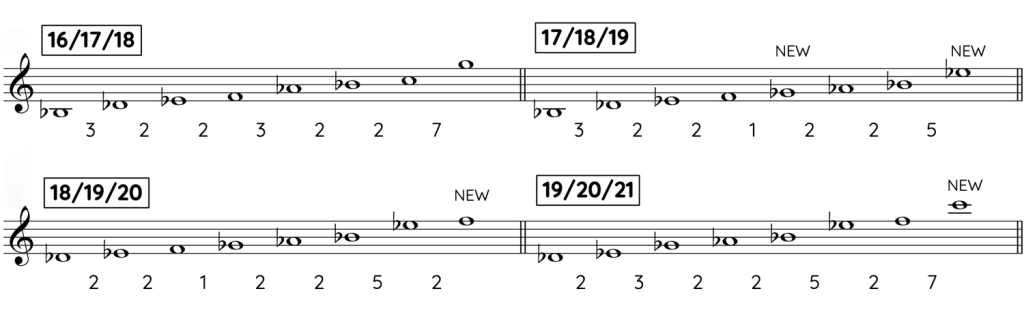
    The prime numbers mean also that the repetition cycles will rarely synchronize, creating a more complex, floating or flying fluidity of motion. Three against four is fairly simple, as with Patterns 6 and 7. Repetition of primes seven against five, as in Patterns 19 and 20, make a much more complex composite, taking some 35 eighth-note pulses to return to a synchronous starting point.

    multi-phase combinations

    To control the interaction between successive patterns that will overlap in canonic lines, each pattern’s pitch content must work with the pitches of patterns before and after it. By “work” means that the collective, cumulative constellation should be of an intervallic character, an array, that conforms with the overall harmonic character desired.

     Assuming a performance spread of three patterns, here is a sample analysis of the middle, Patterns 16 through 21, showing the three-pattern collective constellation. Each pattern intersects with common pitches of its neighbor patterns, adding pitches to the sonority that will eventually disappear.

    intersecting pitch collections

    This is the mechanics of a metamorphic harmonic process that gives multi-phase ostinato music its graceful evolving form.

    Now let’s listen to the complete composition from 1984 (revised 1994), one of my personal favorites.

    Effulgence

    © 2026 – All Rights Reserved

    Thomas S. Clark

    Continue reading Mapping the Music Universe:

    TClarkArtMusic.com 

  • Mapping Music 8. TONALITY

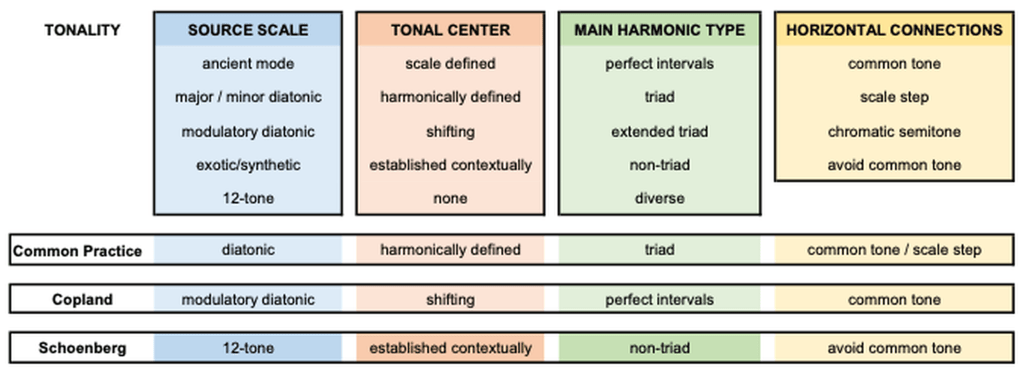
    In traditional tonal music, or for a composer’s personal design, there are four main factors defining a tonal language: source scale (covered in Mapping Music 5); harmonic type; horizontal (voicing) connection; and tonal center, a basic concept for Common-Practice tonal music.

    A diatonic major or minor scale and harmonic structures built from it define a key and “tonic” home-base tonal center. (In the ancient modal music of the monophonic Gregorian chant it was called the “finalis,” as it was the expected final arrival destination of an extended melody.) Triads taken from the scale build a scaffold of harmonies, featuring the dominant chord (scale degrees 5, 7, 2, and sometimes 4) with its scale-degree 7 “leading tone” propelling a progression to resolve back to the tonic chord (scale degrees 1, 3, 5).

    In 20th-century music, some composers (notably Bartók) began to define tonal center contextually rather than by scale-and-key, writing melodic patterns and counterpoint that branched out from and converged back to a core base (but not necessarily bass) pitch. Twelve-tone music, derived from the full chromatic scale, would seem to be avoiding any tonal center, but some composers still built textures whose lines and counterpoint would emphasize one focal pitch-class.

    A matrix of choices

    In forging a tonal language, the composer develops preferences in each of these factors. Choices from each factor column can be mixed in a variety of ways. The composer designs by delving into more specific patterns, especially for the source scale (possibly, say, a six-note pitch-class set) and the harmonic type, establishing a preference for certain harmonic intervals (such as my favoritism for 7-semitone Perfect 5ths and 11-semitone Major 7ths).

    There are, of course, thousands if not millions of possible combinations of all these factors, a universe of tonal possibilities for the individual composer and a particular piece.

    Next, let’s dive more deeply into harmonic types and the factor of horizontal connections between successive harmonies.

    Constellation streams

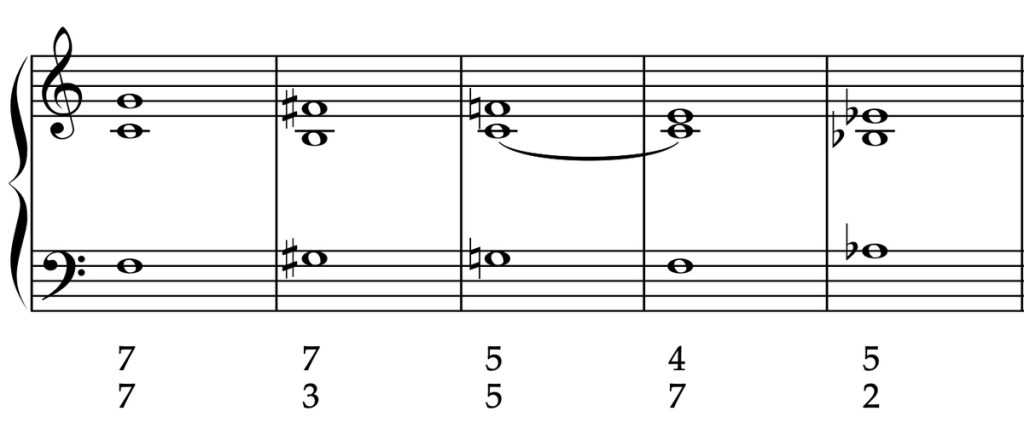
    A stream of successive constellations, which we might nickname a “constream,” would traditionally be called a chord progression. In the following example, all stacks are 10 semitones tall; no common tones in the transposition choices.

    no common-tone connections

    In the next example, stacks of differing heights, with constellations that reduce to three different scale patterns: scale array 5 2, then 2 3, back to 5 2, then 4 1, and finally 2 5, inversion of 5 2.

    common-tone connection

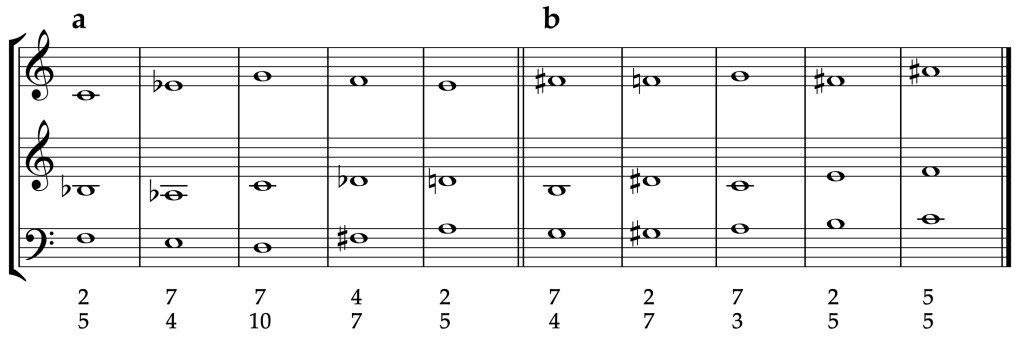
    Now a longer, more mixed succession of interval stacks of constellations belonging to these same three scale patterns (2 5 or 5 2; 1 4 or 4 1; and 2 3).

    extended constreams

    Back to my constellation friends of Mapping Music 6, we can make some constreams with them.

    diatonic and chromatic successions of symmetrical constellations

    An intriguing example from the literature of great early modern music, an interlude near the beginning of Stravinsky’s L’Histoire du Soldat:

    L’Histoire du Soldat excerpt

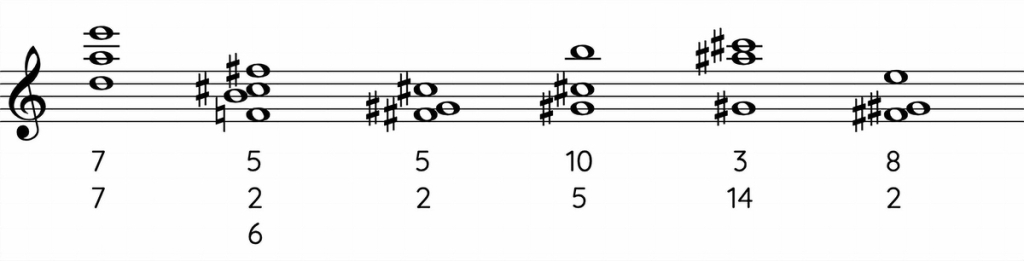
    This passage is intriguing in many ways. It looks like counterpoint between two woodwind instruments in high register. But both lines are quite simple and don’t seem to go anywhere. (In our GALAXIES: Structure chapter, we’ll discuss these questions of texture and counterpoint.) Introducing it here raises the question of harmony, of constellations and their arrays, though the passage doesn’t look at all chordal. Here is an array analysis of the constellations formed in the first through fourth bars then jumping to bar 10 and, finally, bar 14.

    L’Histoire du Soldat constellations

    Now you can see and hear more clearly the role played by array interval of 7 semitones (“Perfect 5th” as in above examples) and also 5, and 2 semitones in the harmonic continuity of the passage. (Also note 7 + 7 = 14; 5 + 2 = 7; 5 +5 = 10; 2 + 12 = 14; etc.)

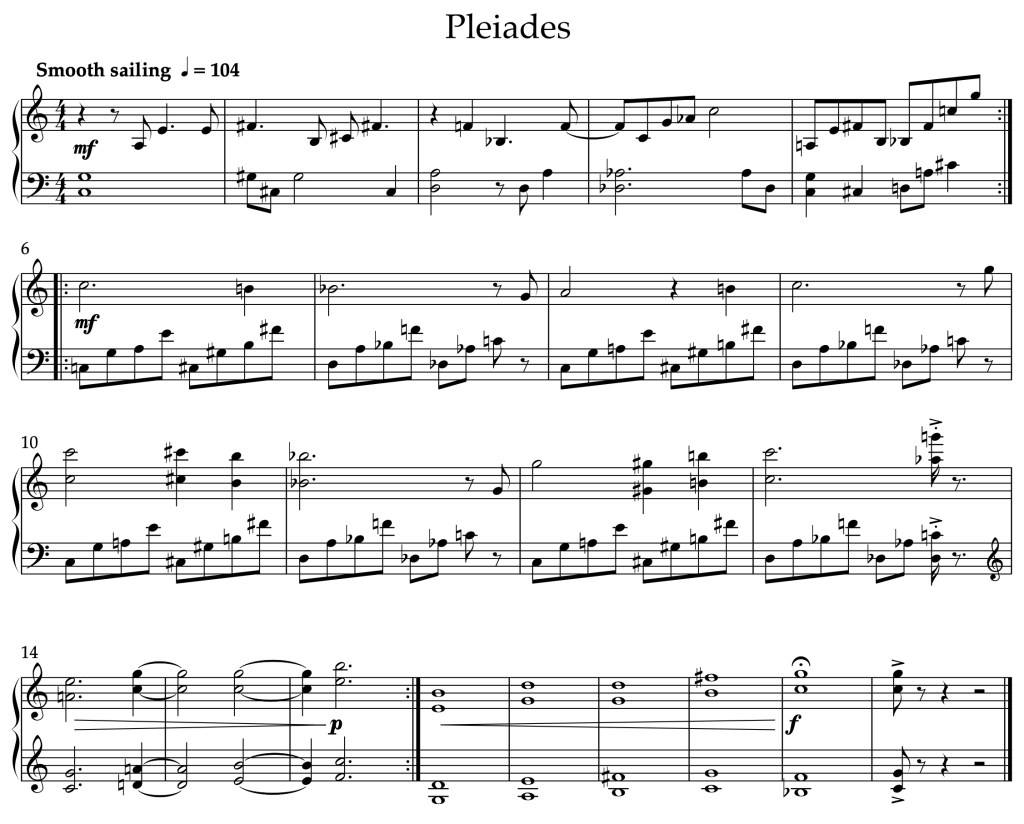
    To illustrate that this is not all just theoretical, here is a simple etude composed using exactly the constellations and successions explored in Examples 12 and 17. It took only about an hour to compose this minute and a half in Sibelius. The title: the constellation Pleiades (“Seven Sisters”) is a tight cluster of 7 stars tagging along in the winter sky with Taurus as the Zodiac sails westward every night.

    12-tone sets

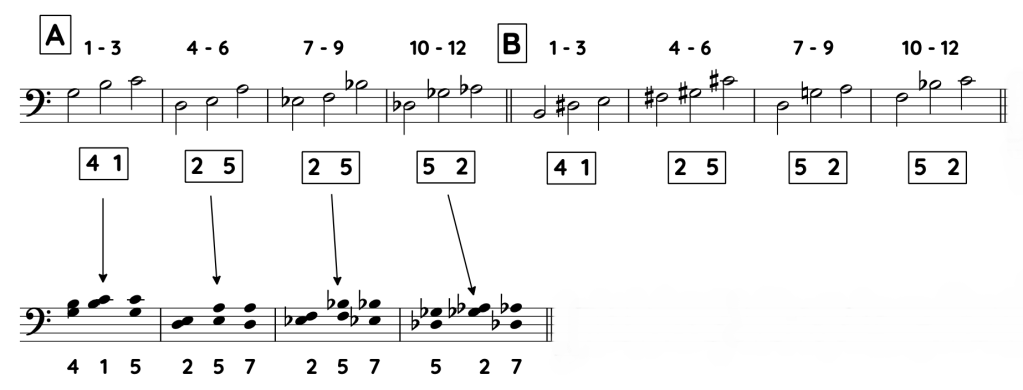
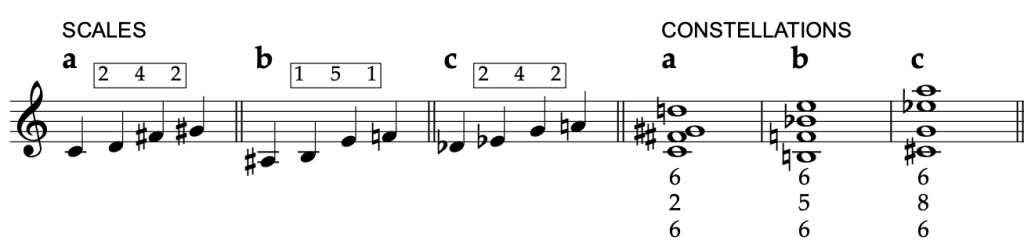
    Let’s keep going. How about designing a succession of three four-pitch constellations, so that all 12 pitch classes of the chromatic scale are included but none repeated? (Traditional terminology calls such a set a 12-tone aggregate.)

    three sets make a row

    Constellations a) and c) are different “chord voicing” of the same scale pattern, 2 4 2 . Both scale patterns and all three interval stacks are symmetrical. And they all contain two 6-semitone “tritones,” giving the whole succession the tritone’s quality of ambiguity and the character of the succession a feeling of mystery.

    Altering arrays

    Similarity of interval patterns can build coherence in a stream of constellations. Beyond functional common-practice harmony, this is a kind of process that composers of the 20th century and today can use to create a “new tonality”.

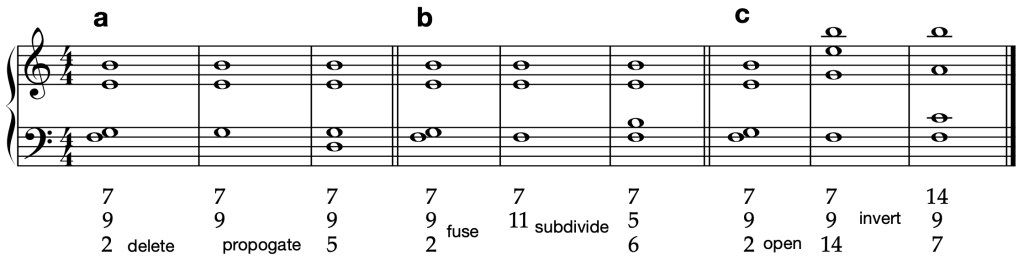
    Possible operations to transform an interval array into a closely related array:

    OPEN — Expand an interval by an octave, adding 12 semitones

    FUSE — Join two adjacent intervals to make a larger interval, the sum of their sizes

    DELETE — Remove an interval, shortening the stack’s height

    SUBDIVIDE — Insert a pitch to divide an interval into two smaller intervals, whose sum equals the original interval

    PROPOGATE — Append or insert an interval of a size already present into the stack

    INVERT — Reverse the registrar order of the stack — turn it upside down

    alteration examples

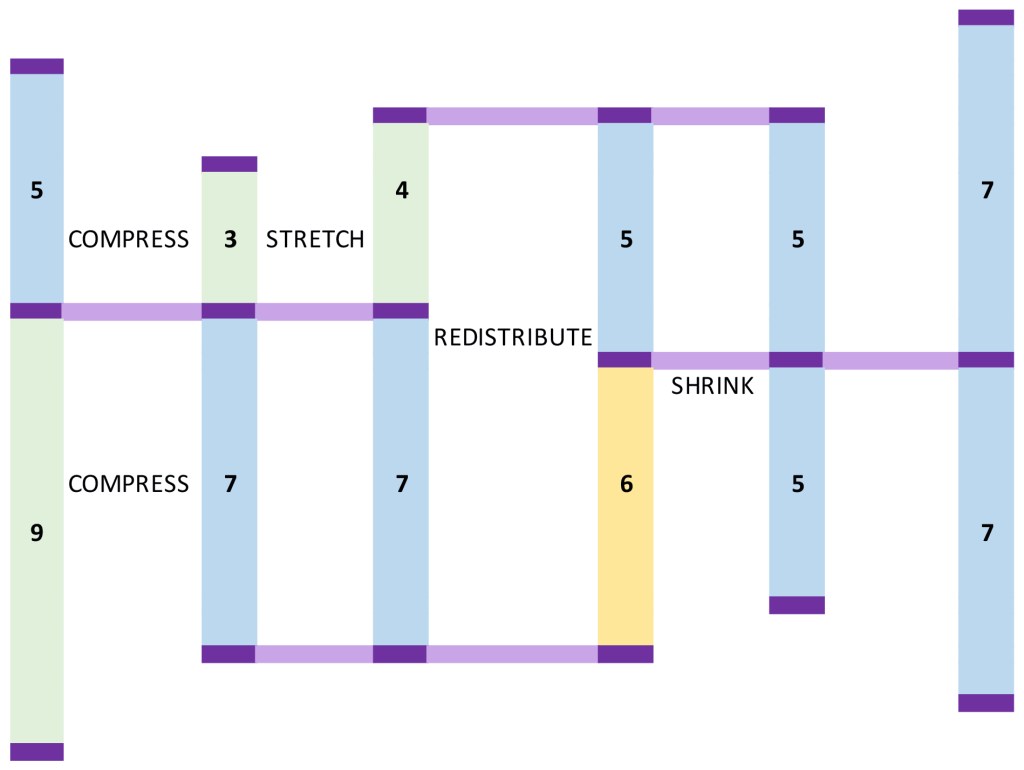
    There are operations that more significantly alter the character of the interval array.

    REDISTRIBUTE — Fuse two adjacent intervals into one larger interval then re-subdivide it into two different smaller intervals

    SHRINK / STRETCH — Alter one interval size by other than an octave, leaving others unchanged

    COMPRESS / EXPAND — Alter all intervals in the stack by adding or subtracting each by the same number of semitones, or multiplying each by a constant

    These alterations are listed in order, from the mildest alteration producing a similar array (redistribution) to the most dramatic producing a substantially different array, compression or expansion of the whole array (preserving little from the original but its symmetry). Here is an example employing these altering transformations.

    more alterations, with common-tone connections

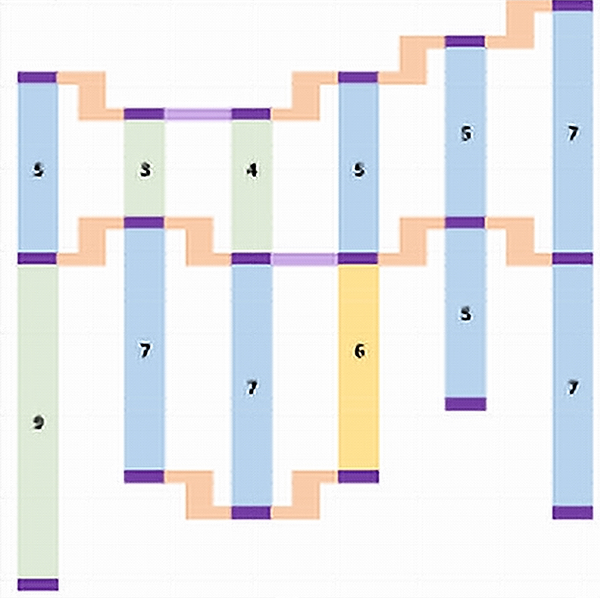
    The other element of coherence in this example is the many common-tone connections between one chord and the next, establishing a slow-moving stability. Another example of the same interval stacks, same succession of alterations, but choosing transpositional level of each constellation to create as many 1-semitone voicing connections as possible (10 such voicing connections in the following example) makes the con stream’s sense of progressive change stronger.

    more alterations, with semitone connections

    Finally, another example etude, using this last constream . . .

    © 2026 – All Rights Reserved

    Thomas S. Clark

    Continue reading Mapping the Music Universe:

    TClarkArtMusic.com 

  • Mapping Music 5. SCALES

    What is a scale? Its essence is an interval pattern, selecting which pitches out of the entire chromatic possibilities become scale steps. Successive interval arrays are a vivid way to describe its pattern:

    SCALE PATTERN — periodic interval pattern that cycles through each octave, defining which pitch-classes from the 12 possibilities are degrees of the scale

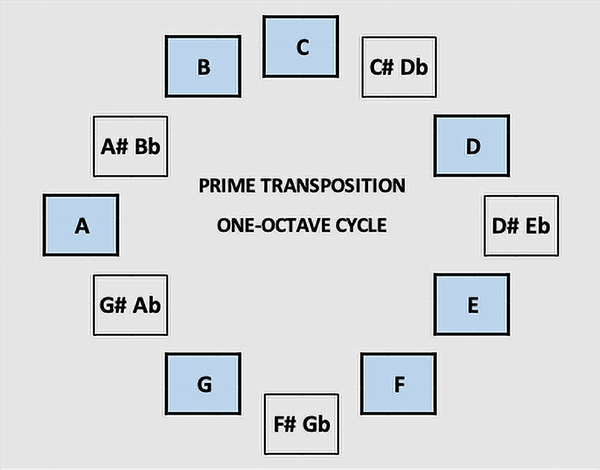
    In that sense, it is a theoretical circle, starting over in each octave — or more imaginatively, a spiral. Let’s visualize the natural-note white keys on the keyboard, a prime example of the ubiquitous diatonic scale, as a circle.

    diatonic scale circle

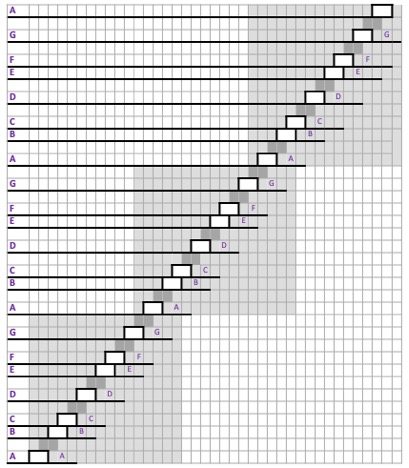
    Now an unlooped visualization as stair steps, rungs on a spiral ladder:

    diatonic scale cycling through three octaves

    Anyone familiar with the white and black keys of a piano will recognize this pattern!

    Chroma

    Almost all scales in both Western music and other art-music traditions are built on the framework of octave equivalence, the close affinity of two pitches that are one or more octaves apart. We give them the same pitch name – all called “C” or “F#” for example. This makes the circular nature of a scale, that its pitch names and the intervals between them start over at the octave and repeat.

    We also have the feature on an equal-tempered piano that one black key produces a pitch with two possible names depending on the scale in which they appear. For example, the D# seventh scale degree in an E Major scale is the same piano key as an Eb, the fourth scale degree in a Bb Major scale. The two pitch names are said to be “enharmonic.”

    When a melodic line in an all-white-key C major scale introduces an F# for color or to temporarily alter the interval terrain, we call it a chromatic tone, after the Greek word for color, chroma. Now we have a comprehensive scale of all possible pitches. Going further, theorist Allen Forte defined  a way to reduce all the pitches in an entire eight-octave chromatic pitch space into just twelve categories:

    PITCH CLASS — a set of all pitches that are octave and/or enharmonically related

    He gave them pitch-class numbers 0 through 11.

    chromatic scale

    In the advent of computer systems to produce, edit, and analyze musical sound, a sound’s identified pitch class is termed its chroma.  

    Synesthesia – some people, such as the composer Scriabin, actually see a color when they hear a pitch or a tonal key. In his variant of synesthesia, C is red, G is orange, D yellow, and A green. Scriabin’s Promethius: The Poem of Fire (1910) includes a part for “clavier à lumières,” a color organ that emitted light of what he deemed the appropriate color for a pitch instead of sound.  

    Scale prototypes

    When we describe a scale, we name the pitches in order within an octave. Better yet, we name the successive intervals going up within the octave. The classic description of the ubiquitous diatonic scale, in whole-steps or half-steps, in its major mode starting on the tonic pitch, is:

    whole / whole / half / whole / whole / whole / half

    [octave repeats the cycle]

    Or in British terms:

    tone / tone / semitone / tone / tone / tone / semitone

    In the chromatic 12-tone universe, that scale pattern measuring the intervals in semitone sizes would be:

    2 2 1 2 2 2 1

    That is what I would call a scale pattern . . . a Successive Upward Interval Sequence in Semitones (SUISS!). But let’s call it a scale pattern array, working exactly like the arrays describing constellations.

    Now we can particularize our scale pattern definition to apply to any smaller set of pitch classes, even if they don’t look like a scale:

    SCALE ARRAY — successive interval array describing the pitches of a constellation condensed by octave equivalence to their most compact pitch-class-equivalent arrangement within an octave, ordered lowest-to-highest (Forte’s “normal order”)

    In this sense, the array of a smaller set or scale fragment is just like a scale pattern.

    Successive Interval array is a versatile tool that can apply to any pitch collection, to a linear, scalar pitch pattern as well as to a vertical chord sonority or even an arpeggiated diagonal collection of pitches I call a constellation.

    Modes

    Most of our familiar scales are actually a different mode of the same 7-note diatonic scale, with a different starting and ending point called a tonic establishing the mode.

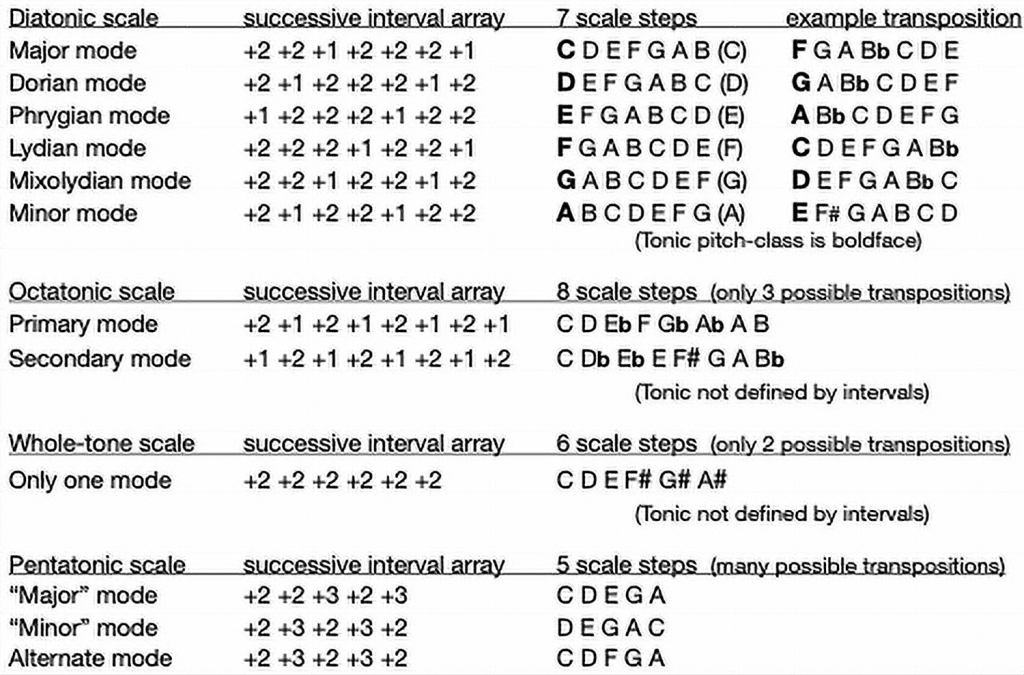
    scale modes

    Scale patterns / set classes

    We can describe a set of pitches as an octave-compressed abstraction of 3 or 4 pitches as a lowest-to-highest ordering of pitch classes. It doesn’t produce anything like the 7 or so notes per octave we’re used to thinking of as a scale, as those shown above. It is conceptually powerful, nonetheless, to call the successive interval array of this compressed abstraction a scale pattern, even though it’s a scale fragment with no name. Its name can simply be the successive interval array, such as 2 4 2, the array describing a symmetrical pitch-class set called the French Augmented Sixth chord.

    [Theoretical aside] In establishing set theory, Forte described these compact arrangements by naming the pitch-classes in order using a mod-12 number system shown above, C=0, C#/Db=1, D=2, etc. He identified twelve 3-note classes, including upside-down inversions reversing the scale pattern, as members of the same class. (Lewin kept these inversions separate, defining instead nineteen 3-note set classes. We’ll use Forte’s; the set classes as generalities are not as crucial to composing as to theoretical analysis.) Forte used cumbersome descriptions employing pitch-class numbers and “normal order.” In the Journal of Music Theory 15 (1971), Richard Chrisman defined and proposed successive interval arrays as a better, more revealing way to characterize the commonality of a family of pitch-class sets that are all related by transposition and/or inversion.

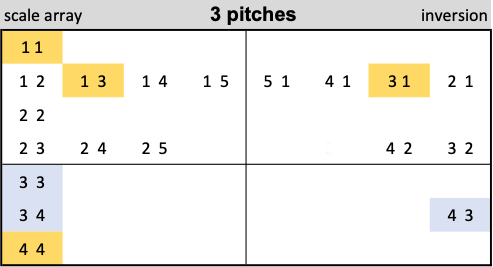
    Relating to Forte’s concept of a set class, any set grouping three pitch-classes can be analyzed as an interval array or partial scale pattern.  

    scale patterns of all 3-pitch-class sets

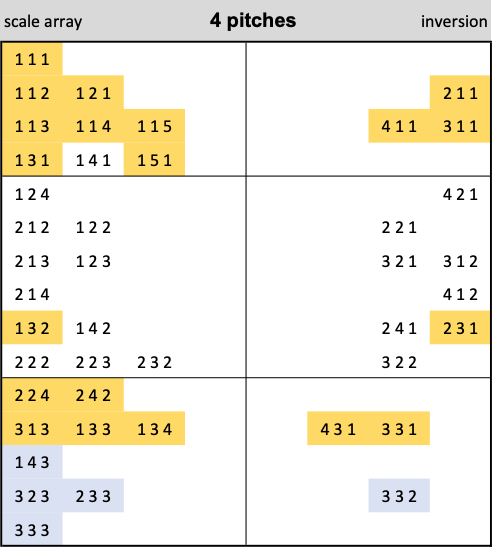
    Sets forming triads (or seventh chords below) are highlighted in BLUE; those that are atonal (cannot be found in a diatonic scale) are highlighted in GOLD.

    While the number of possible interval arrays for constellations of four pitches is enormous — even if limited to interval stack sizes less than two octaves, there are more than 12,000 possibilities — we can use this scale-pattern abstraction tool to categorize them into forty-three 4-pitch-class families. 

    scale patterns of all 4-pitch-class sets

    The blue-highlighted scale patterns have common triadic chord names:

    • 1 4 3 = “Major Major 7th chord” (in any chord inversion)
    • 3 2 3 = “minor minor 7th chord” (in any chord inversion)
    • 3 3 2 = “dominant 7th chord” (in any chord inversion)
    • 3 3 3 = “fully diminished 7th chord”

    The scale pattern 2 4 2 is an interesting symmetrical, non-diatonic pattern called a “French augmented 6th chord”.

    Vocabulary

    These maps collecting 62 scale-patterns summarize all possible constellations of 3 or 4 unique pitches, our total harmonic vocabulary in the chromatic universe.

    © 2026 – All Rights Reserved
    Thomas S. Clark

    TClarkArtMusic.com 

  • journal 12. Zweite Wiener Schule

    Vienna, 1992 —

    The so-called “Second Viennese School” consisted of influential master composer Arnold Schoenberg and his protegés, Alban Berg and Anton Webern in early 20th-century Vienna. They pioneered a compositional approach described succinctly by Wikipedia as “totally chromatic expressionism without a firm tonal centre, often referred to as atonality; and later, Schoenberg’s serial twelve-tone technique.”

    When I began studying composition at Michigan in 1968, I quickly became immersed in exploration of pitch structure and broader tonality freed from the long-traditional restrictive limits of tonality: diatonic major and minor keys and their chromatic extensions, triadic sonorities and tonal centers. The complexity of this new musical realm is not truly “atonal” but rather an opening to a universe of fascinating, colorful possibility.

    Three pieces of the early 20th century, which I studied deeply in the 1970s and later used extensively in my teaching of modern music, were each masterful explorations of musical sound color.

    • Claude Debussy’s La Mer (1905), an iconic tone poem of Impressionistic musical painting, was discussed in Journal 1. Musique Française.
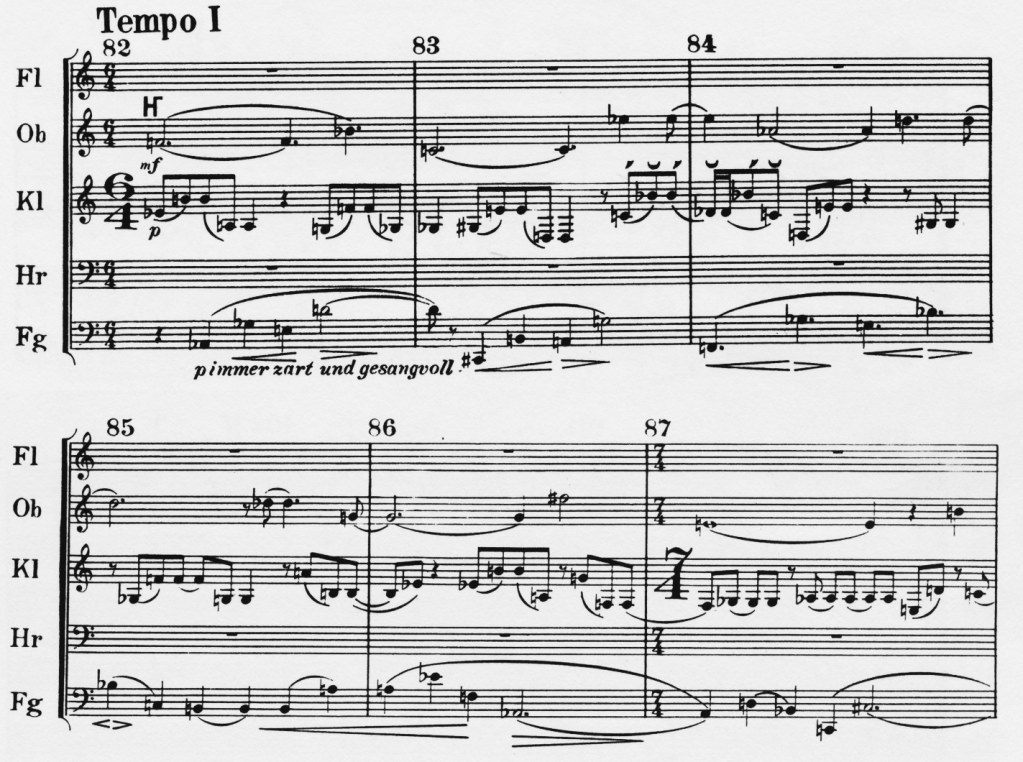
    • Anton Webern’s Symphony, Op. 21 (1928) is maybe the briefest piece ever titled as a symphony, a succinct, two-movement work whose first movement is a delicate gem of pointillistic color and complex 12-tone harmony.
    • Arnold Schoenberg’s Five Pieces for Orchestra, Op. 16 (1909); the third piece is a gentle study of orchestral sound color titled “Sommermorgen an einem See (Farben)” — (Summer Morning by a Lake: Colors”.

    After fifty years, these works are embedded more deeply than ever in my musical consciousness.

    It was only in 1992, on a side trip by bus from Brno, that I visited Vienna, the great musical city of Haydn, Beethoven, and Mozart in his last years. Mozart’s grave, not in the main cemetery but on the edge of the city, was hard to find but emotionally powerful to visit.

    Farben

    Farben” is an early Schoenberg piece that is all about instrumental sound color and exotic harmonic color. The chords are not triads but rather atonally “dissonant” sonorities that place the instrumental colors in close, glowing pitch-interval proximity.

    LISTEN ›

    Five Pieces for OrchIII (Farben)

    Chicago Symphony on YouTube

    My recent piece, Farben, pays special homage to Schoenberg’s masterpiece, layering kaleidoscopic wind-instrument colors to build massive, morphing constellations, echoing Webern’s hidden chord-color symmetry.

    FARBEN

    Clark 2025 (TC-149)

    I have long admired and been influenced by the music of Anton Webern. Known historically as a member of the Second Viennese School with Alban Berg and mentor Arnold Schoenberg, the three were pioneers of so-called atonal music and 12-tone-row serial harmonic organization. I find the term “atonal” misleading and negative, as their 12-tone processes achieved new “12-tone tonalities” — not simply a rejection of traditional tonal harmony but also striving to create new and more complex tonalities.

    What I admire about Webern’s mostly-quiet instrumental miniatures (his Symphonie Op. 21 has only two sparsely-scored movements) is the delicate, crystalline quality of his pitch constellations; and their gently lyric, precious setting into transparent, pointillistic textures, pearl-strings of separate, delicate instrumental colors (called Klangfarbenmelodie). The first movement is built on one enormous, static, 13-pitch chord containing all 12 pitch classes of the chromatic universe in a symmetrical interval pattern, a palindrome interval pattern, the same top to bottom as bottom to top.

    Todesfall in Mittersill

    Webern’s mentor, Schoenberg, as a Jew was compelled to emigrate to the U.S. in 1933 before it was too late. Webern, not Jewish, stayed in Vienna, where he was born, suffered through and survived World War II, only to be fatally shot by a U.S. Army soldier during the Allied occupation of Austria in 1945. My homage to this beautiful musical mind tries to capture his music’s “lyrical, poetic concision” (Wikipedia).

    WEBERN ELEGY

    Clark 2024 (TC-115)

    Neue Tonalität

    My compositional excursions in 12-tone tonality traverse many of my compositions. One that sums it up well, if not succinctly, is VIENNESE SKETCHES. A set of “Twelve Miniatures in Twelve Tones,” parts I through IV are adapted from Webern Elegy , and V through XII from MapLab7For Little Arnold from my book, Mapping the Music Universe.

    Not intended to portray the historical European city, VIENNESE SKETCHES instead explores various textures and tonalities using the musical techniques of the Second Viennese School. My goal was to create a complex counterpoint of sound constellations that is less dissonant and more sonorous — my sense of a new tonality.

    VIENNESE SKETCHES

    Clark 2023 (TC-131)

    ___________

  • journal 11. Moravská Hudba

    Brno, 1991 —

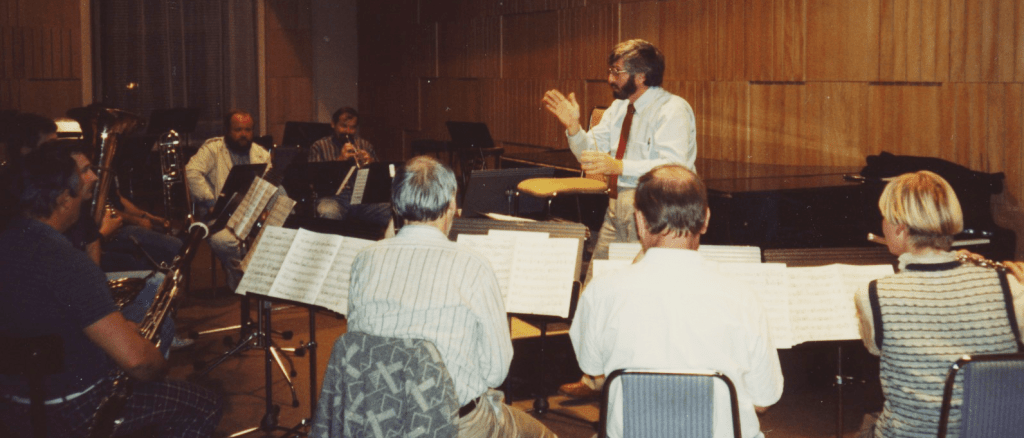
    I first visited Czechoslovakia in 1991 to perform at the Brno International Music Festival. How this opportunity came about is a story in itself. My colleague Tom Sovik at the University of North Texas joined a group promoting the City of Dallas as a sister city with Brno, the second largest Czech city and capital of the Moravian province, where he had done his doctoral musicology research. At his suggestion, I wrote a short piece as a gift to Brno. Its mayor turned over the gift score to the secretariat of Brno’s International Music Festival, a distinguished Moravian composer Arnošt Parsch. He invited me to come to the festival and conduct my music. The result was an October 1991 performance in Brno’s New Town Hall of two of my works, ANTIPHONS (1989) and CANZONA, for combined woodwind and brass quintets, which I conducted.

    rehearsing with Czech ensemble

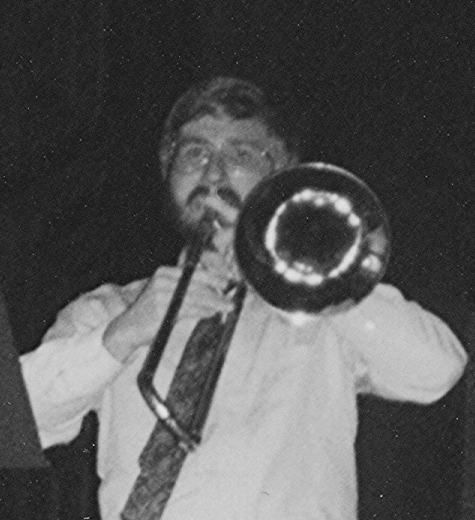
    Parsch invited me back in 1992 for the 27th Brno International Festival’s Experimental Music Exposition V. I presented my LIGHTFORMS 2: StarSpectra multimedia computer music and played trombone in an experimental multimedia piece by my friend, Rodney Waschka. I had performed the same program early that fall at the Festival Internacional Alfonso Reyes in Monterrey, Mexico.

    PTACí

    While in Brno for the 1991 festival, I met choreographer Hana Smičkova, who invited me to compose a work for her Mimi Fortunae Dance Theater, which rehearsed in the ancient Spilberk Castle. I began studying the great 20th-century Moravian composer Leoš Janáček’s music as background for the ballet’s composition.

    PTACí (“Birds”) was premiered in Brno in 1993 by the Moravian Chamber Orchestra, which I conducted. The ballet, choreographed by Smičkova, was performed by Mimi Fortunae in historic Mahunovo Divadlo, the first building in Europe to be equipped by Thomas Edison with electric lights.

    During these years, Parsch and I became composer friends. Our visits to each other always included long walks in nature and deep discussions of music, art, and culture. In 1991 I had visited the northern Moravian mountain village of Hukvaldy, the summer home of Janáček. He loved nature walks and studied bird songs.

    Hukvaldy Sketches was first a concert suite of PTACI, my set of modern musical impressions of old Moravia, in the ancient heart of Eastern Europe. Scored for a chamber quartet, it was premiered February 6, 2018, at Texas State University Performing Arts Center, by Ian Davidson (oboe), Vanguel Tangarov (clarinet), Ames Asbell (viola), and Kari Klier (marimba).

    The final transformation of this work was a re-scoring of Hukvaldy Sketches for the original PTACI orchestration. Its five scenes:

    Hrad – morning climb to the castle ruins
    Ptáci – watching Leoš’s birds

    Vody – forest streams and shadows

    Bystroušky – mouflons and other mountain wildlife

    Podzim – autumn sunset

    PTACí / Hukvaldy Sketches

    Clark 1993/2016 (TC-69/80)

    Morava

    In my intense study of Janácek, I reveled in the expressive depth of his uniquely modern Moravian music. His powerful String Quartet No. 2 and his collection of gentle piano music, Po zarostlém chodníčku, affected me deeply.

    In one of my Brno performances, Parsch’s Czech colleagues commented on my music’s affinity to modern Moravian musical style. I was informally dubbed an honorary Moravian Composer, a distinction I proudly took as a high honor of their acceptance. Since then, I have written many pieces with Czech imagery:

    Two of these are vocal music that include some Czech lyrics. The treble choir piece A NEW LIDICE begins with “We build a new village, while a just world watches. Stavíme novou vesnici. Spravedlivý svêt bude sledovat.” Children (including my daughter Alison) sang a short phrase in Czech in MORAVIAN MOUNTAIN SONGS, written for the Woodrow Wilson Elementary School Choir in Denton, Texas.

    Sinfonietta

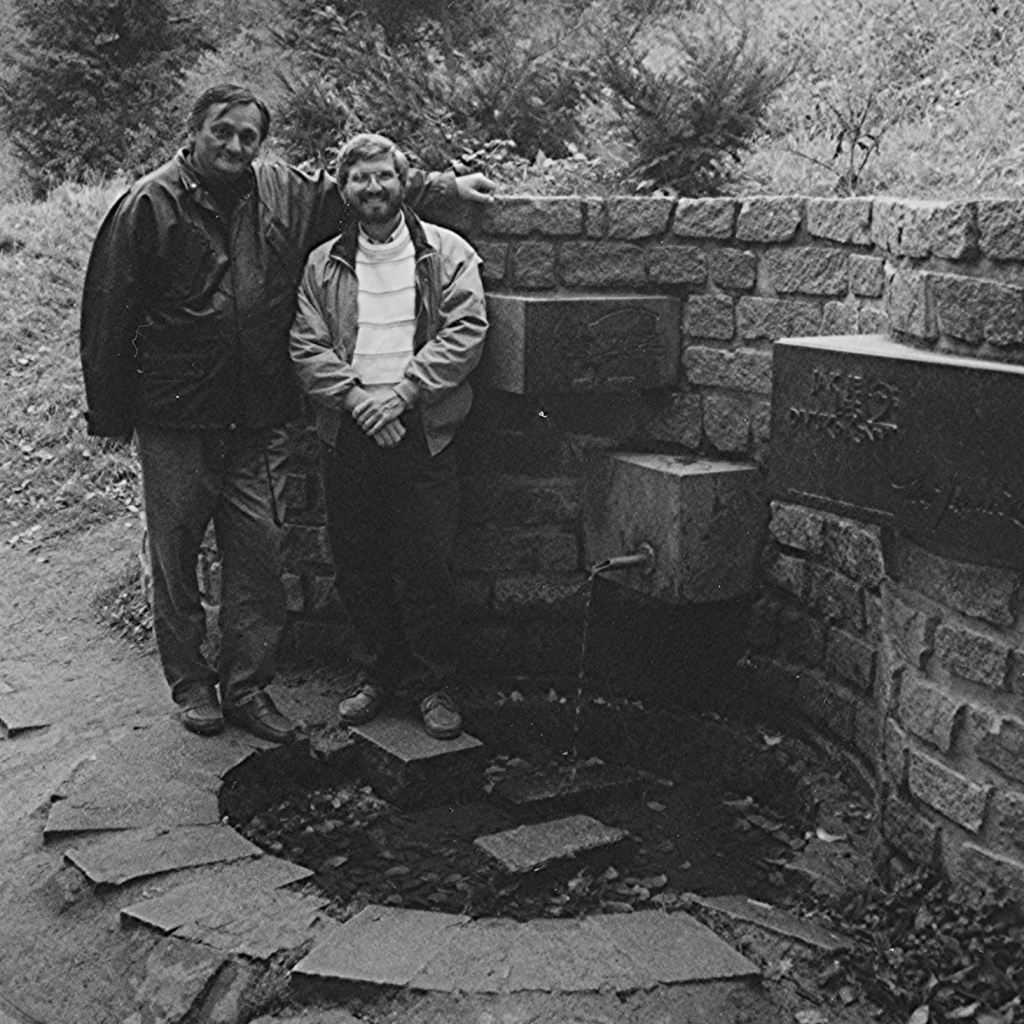
    with Parsch at the spring outside Brno

    Leos Janácek composed his great concert work, Sinfonietta, in 1926 for the Sokol Gymnastic Festival in Prague. Janáček said it was intended to express “contemporary free man, his spiritual beauty and joy, his strength, courage and determination to fight for victory.” It is what I call musical sketches of his home city, Brno, the largest city in the Moravian east of what was then Czechoslovakia.

    I visited Brno several times starting in 1991 to perform my music at its International Music Festival.

    LISTEN ›

    Janácek Sinfonietta

    UNT Symphony Orch. on YouTube

    The festival traditionally ends with a performance of Sinfonietta by the Brno Philharmonic in Janácek Divadlo (theatre). In 1993 my ballet, PTACI, was premiered at historic Mahunovo Divadlo, across a plaza from Janácek Divadlo.

    Though I could have continued my “Sketches” series with a “Brno Sketches,” instead a 2024 work is a set of more abstract variations partly based on and quoting themes from Sinfonietta (in the tradition of Brahms’ Variations on a Theme of Haydn).

    • Variation 1 “Canon” engages that ancient musical technique, evoking Brno’s medieval history.
    • Variation 2 “Overtones” explores two harmonic series, C and Bb, painted over each other in layers of color, with hints of fanfare emerging through the clouds.
    • Variation 3 “Constellations” is a kaleidoscopic succession of large sonorities built on stone-sturdy Perfect Fifth intervals brightened by jazz-like added tones.
    • Variation 4 “Fanfare” is an ostinato pattern-music fantasia on Sinfonietta‘s grand fanfare themes.

    Brno Variations

    Clark 2024 (TC-138)

    ___________

  • journal 9. Mapping

    Leelanau, 1983 —

    My last summer working at what was then called the National Music Camp in Interlochen, Michigan was 1983. We spent as much time off as possible on the nearby shore of Lake Michigan. Three spots on the western edge of the Leelanau peninsula were favorite magical places. Otter Creek played out into a sandy delta at the beach, perfect for a picnic. Good Harbor Bay was an excellent shore for finding gray Petoskey stones, revealing fascinating hexagonal-shaped fossils when wet. Farther north, the Great Sleeping Bear Sand Dunes rise majestically hundreds of feet above the water’s edge.

    Béla Viktor János Bartók’s monumental 1937 work, Music for Strings, Percussion and Celeste, begins with a mysterious, meandering line played by subdued violas. It sounds to me like walking at the water’s curving edge on a fog-shrouded beach. The line becomes the subject of a gigantic fugue, building to a powerful climax. In my imagination, we reach the sheer cliff of a massive bluff at the end of a Lake Michigan bay.

    Music for Strings, Percussion and Celeste

    Chicago Symphony

    LISTEN > YouTube

    Shores

    Of course, Bartók never saw Lake Michigan. But shorelines are a fascinating kind of fractal patterns in nature.

    In 1980, Larry Austin received a commission from the Canadian Broadcasting System and KPFA for an experimental radiophonic work. For the premiere broadcast, the performers were in three different Canadian cities, synchronized by electronic signals! The mind-boggling result was a piece consisting of

    “a massively contrapuntal texture, with many instruments playing continuous, independent lines, all in different, independent tempos. The contours of each contrapuntal part were determined using maps of Canadian coastlines.”

    [Clark — Larry Austin: Life and Works of an Experimental composer. Borik Press, 2012, p. 40]

    I.C.M.C. 1981, Denton Texas

    LISTEN › YouTube

    Glacially-etched shorelines also inspired sonic imagery for a series of my pieces culminating in PENINSULA. Mappings of the natural contours of the Leelanau Peninsula provided richly varied patterns as basic coordinate numbers for sculpting sound patterns. The piano explores some of the endless possibilities for articulating a spectrum of sonorities. A surrounding environment of synthetic sounds was made by digitally analyzing timbral qualities of acoustic instruments, mostly with percussive articulations (metaphorically the rocky shore). The timbres were modified and resynthesized into a pointillistic sound texture. The density of the sound events rises and falls in waves according to changing values derived from the basic mappings. Larger confluences of waves are located in time by map points of special significance on the graph.

    The coexistence of piano sonorities and synthetic sounds is a metaphorical meeting of seascape and landscape, both animated in time.

    PENINSULA

    Clark 1984 (TC-50) Borik Press

    Clifton Matthews, piano, Winston-Salem NC, Feb. 2007

    There were many other groundbreaking pieces by my late friend and collaborator, Larry Austin. The first, Improvisations for Orchestra and Jazz Soloists, brought him to national prominence in 1964 with highly publicized broadcast performances by Bernstein and the New York Philharmonic.

    As Austin moved into computer music, he began exploring compositional algorithms using mathematical models such as fractals.

    Some of Charles Ives’ sketches for his monumental, never completed Universe Symphony were tracings of the outlines of rock formations. Austin studied deeply this Ives work starting in 1974 and eventually completed a version of Universe Symphony for expanded orchestras in 1993. In Austin’s own work beginning in 1976, mapping contours of mountain ridges and star constellations yielded musical patterns for First Fantasy on Ives’ Universe Symphony, Maroon Bells, and *Stars.

    Constellations

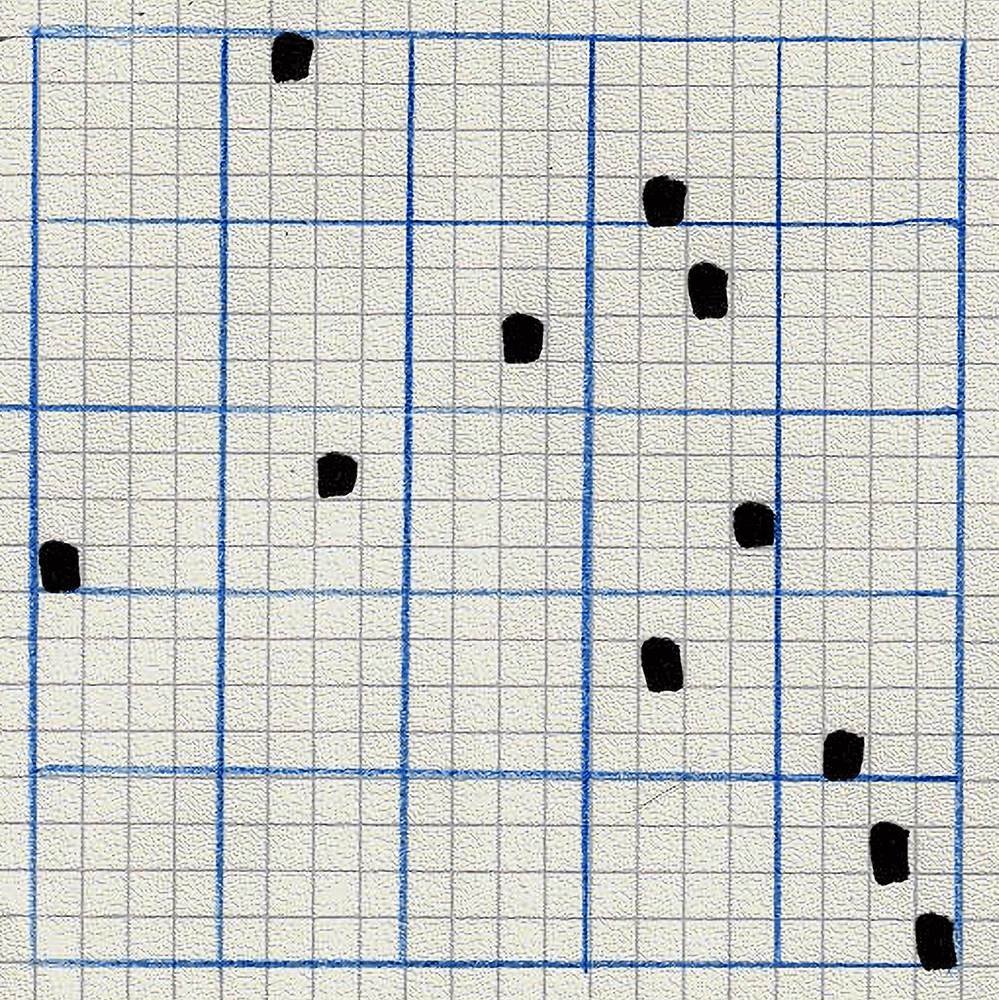
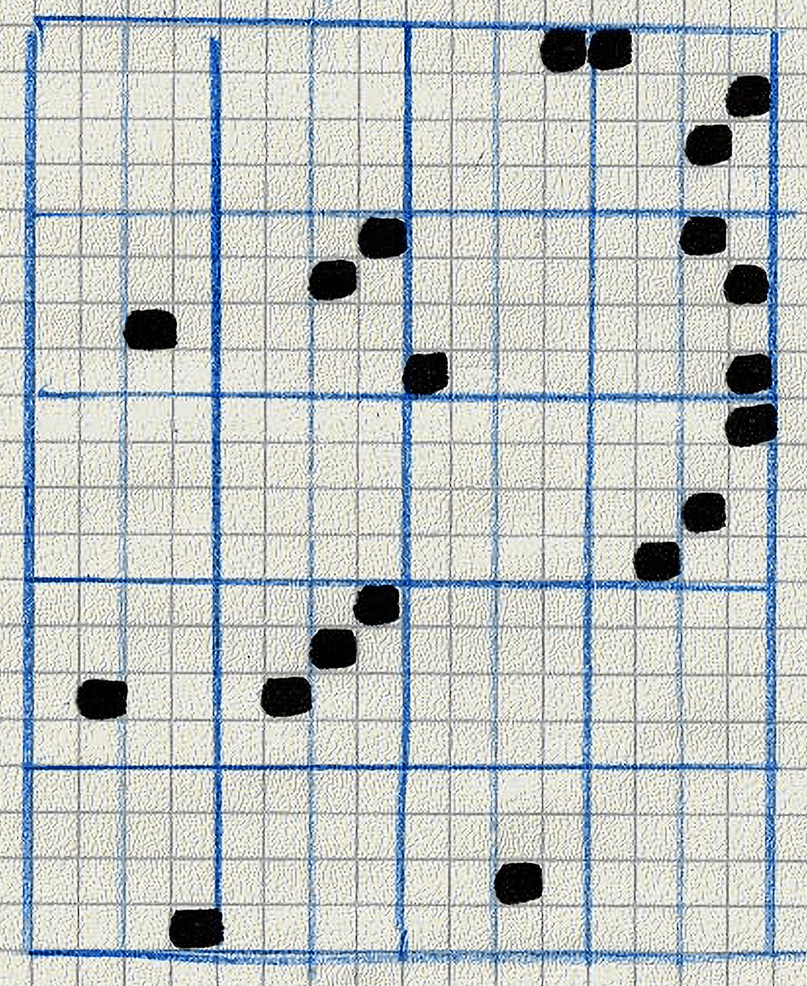
    Always interested in astronomy, I tried plotting star constellations on two-dimensional matrix graphs. The coordinates of each star in a constellation could be interpreted as time-point and pitch information, resulting in a complex arpeggiated group of notes. More intriguing was the capability to rotate the map, resulting in many possible variants that stretch or compress the rhythm and chord structure.

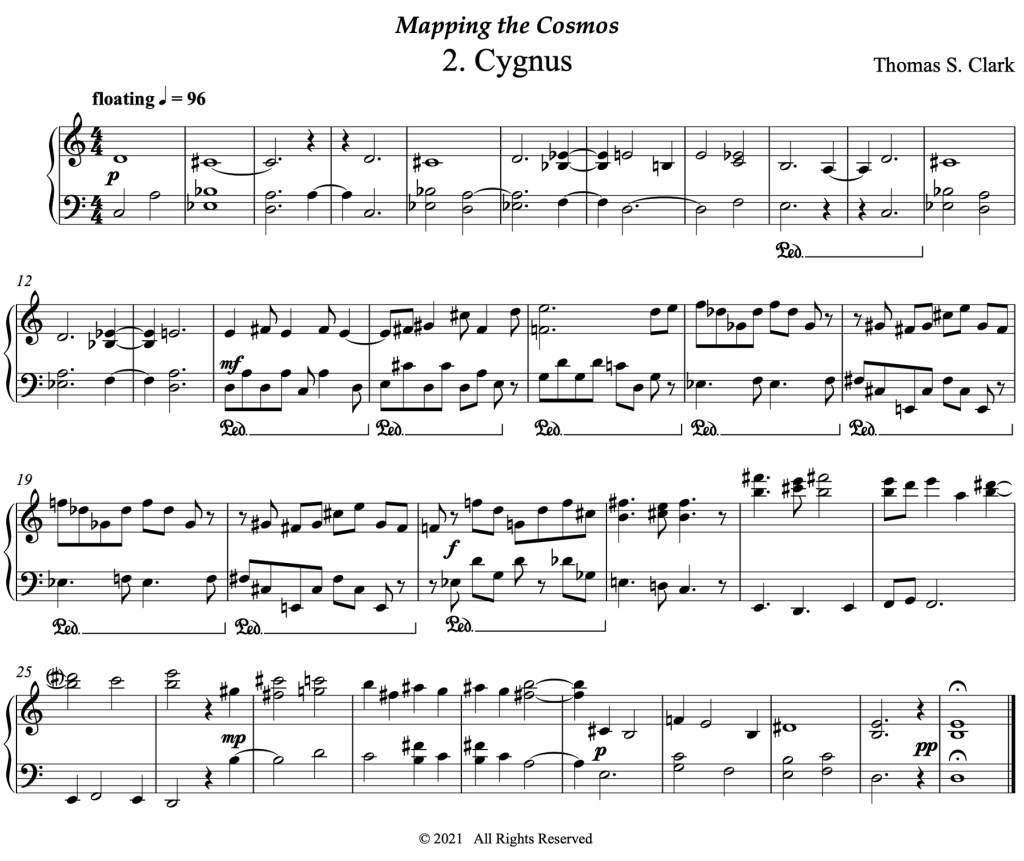
    Cygnus
    Cygnus rotated 90º
    Orion
    Orion rotated 90º

    The first compositional product of this design work, LIGHTFORMS 1 – Constellations (TC-65), scored for piano, was published by Borik Press in 1992. Naming these patterns, pitch-time chord arpeggios, as constellations became a breakthrough concept

    In my book, Mapping the Music Universe, I cite a remarkable pioneer of cartography. “William Smith, a rural surveyor, in 1799 drew a colorful map of the subterranean rock strata of his county in English coal country, launching the modern science of geology.”  The map was extraordinary not only as a scientific breakthrough, but also visually by his hand coloring each huge copy.

    As digital synthesizers came along, sound making with computers offered more calculated control of the timbral (tone color) spectrum. My astronomical metaphor continued with a 1993 piece, using the then state-of-the-art Synclavier II digital synthesizer to “color” the constellation patterns of LIGHTFORMS 1. Reflecting the varied colors of stars, I built color families of sound, distinguishing unique frequency-modulation ratios for each group.

    LIGHTFORMS 2: StarSpectra

    Clark 1993 (TC-68)

    In 1887, French astronomer Amédée Mouchez launched an ambitious international star-mapping project (Carte du Ciel) at the Paris Observatory. It was never finished, until now the challenge has been taken up by the new Vera C. Rubin Observatory (formerly the Large Synoptic Survey Telescope) in Chile. It is conducting the Legacy Survey of Space and Time, repeated astronomical surveys of the entire southern sky.

    From wandering forest paths to trekking scenic shorelines, my life has always been full of ambient exploration. Mapping has become my grand metaphor for exploring musical territory, culminating in the book, Mapping the Music Universe. It begins:

    “The heavenly motions are nothing
    but a continuous song for several voices,
    perceived not by the ear but by the intellect,
    a figured music that sets landmarks
    in the immeasurable flow of time.”

    — Galileo Galilei

    “When we gaze at stars and planets, they appear as stationary points of light, fixed in place in what seems a random pattern across the entire night sky visible to our hemisphere. Time stands still.

    “Throughout human time, humans have imagined that stars make picture patterns we name as constellations: fish, warriors, goddesses, animals. Only the persistent observers, such as astronomers, identify their nightly march across the sky, rising in the east and disappearing below the western horizon.”

    In Mapping the Music Universe, a studied journey through musical time, pitch, and structure, many composed examples took on characters of named constellations, galaxies, and galaxy clusters. They coalesced into 12 etudes, collected here as “a continuous song.”

    Clark 2021 (TC-114)

    Listen, imagining a 24-hour 360º rotation of our earthbound telescope, viewing the entire cosmos in 24 minutes.

    _____________

  • journal 8. Zeitmasse

    Interlochen, 1976 —

    The German word Zeit means “time.” While masse sounds like “masses,” it actually tranlates “measures.” The two together make the musical term “tempos”. Karlheinz Stockhausen composed his “Time Measures” in 1956, N. 5 Zeitmasse for five woodwinds. Time is unmetered, rapidly and unpredictably ebbing and flowing in a dense texture of highly stretchy, elastic rhythms. Instead of predictably placed bricks, musical notes are dancing sparkles or sustained starlight.

    London Sinfonietta

    LISTEN › YouTube

    Compare that time sense with a work of mine composed 67 years later.

    DARK MATTER

    Clark 2023 (TC-133)

    Lucas Foss was among many composing works that were all about time. The opening song of his 1960 work,Time Cycle, for soprano, piano, clarinet, cello, and percussion, sets a poem by W. H. Auden, “We’re Late.” It begins:

    “Clocks cannot tell our time of day
    For what event to pray
    Because we have no time, because
    We have no time until
    We know what time we fill,
    Why time is other than time was.”

    Judith Kelloch, soprano

    LISTEN › YouTube

    Refracting time

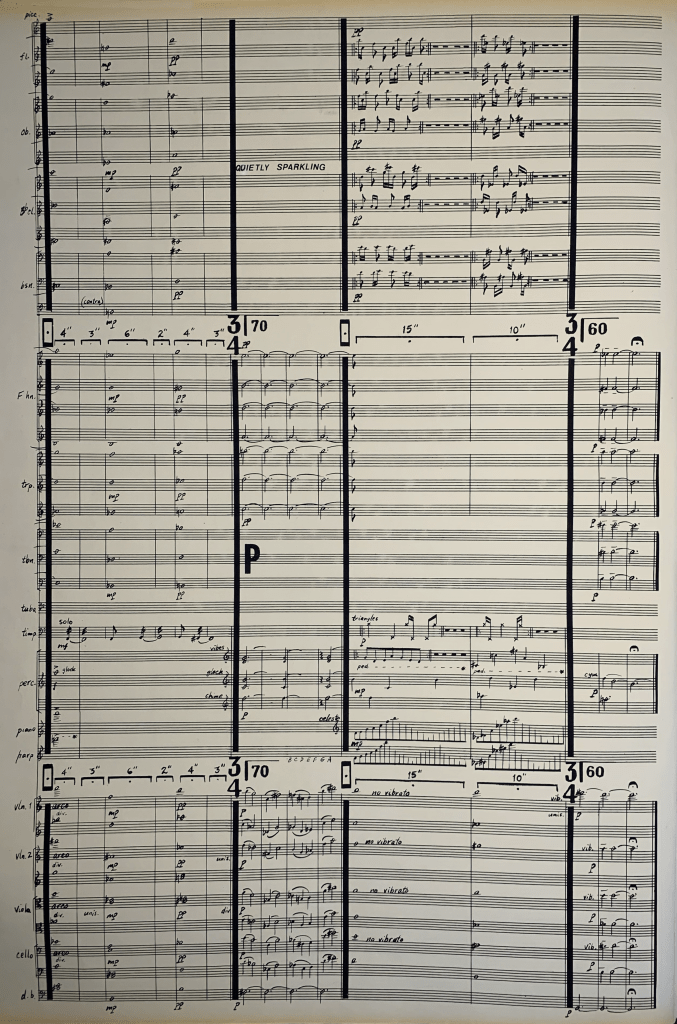
    I met Foss in 1973 or ’75 when he guest conducted at the National Music Camp in Interlochen, Michigan, where I worked as assistant to the director of the university-level program (my first adminstrative gig). Back in Ann Arbor in the fall of 1975, I began writing my doctoral dissertation, a large three-movement score for symphony orchestra. Following the direction of my previous orchestral work, Animated Landscapes: Nocturne (1971), ILLUMINATIONS built sound masses animated in widely varying tempi, meters, and even unmetered free sprays of notes.

    ILLUMINATIONS – Three Refractions of Time

    Clark 1976 (TC-33)

    1. PROJECTION (future)

    2. REFLECTION (past)

    3. EMANATION (present)

    Receiving a Bicentennial commission from the Federation of Women’s Clubs, it was premiered in 1976 by the World Youth Symphony at Interlochen.

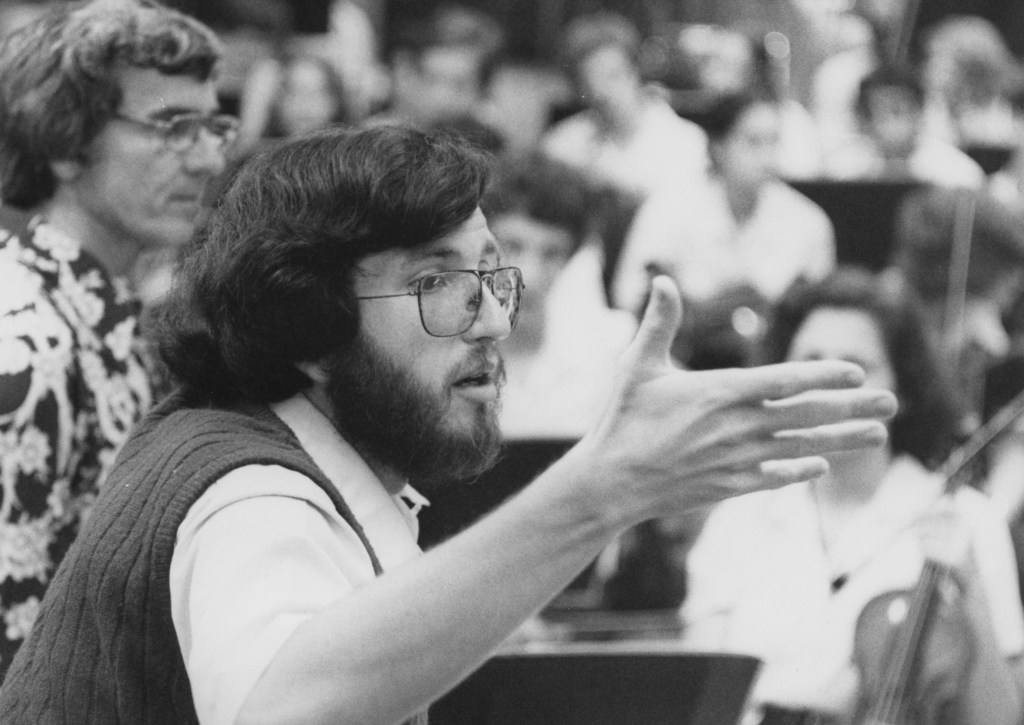
    with conductor and World Youth Sym.
    my prof Leslie Bassett

    Chronos

    Avant garde music in the middle of the 20th century was exploring an exploding range of new tonal possibilities — from by-tonaility to all-chromatic scales, from massive unresolved dissonance to pitchless noise. At the same time, composers were intensely interested in stretching rhythmic possibilities to the extremes of aperiodic time perception.

    The term trope in medieval music was an elaboration inserted into a liturgical passage. In the 20th century, Hauer used it to name an unordered collection of six different pitches (called an unordered hexachord), half of an equal-tempered twelve-tone set. Italian Niccolo Castiglioni’s TROPI (1959) uses this pitch organizing technique, but is more about blocks of contrasting rhythmic texture separated by extended silences. Moment by moment, these blocks succeed each other, recur, combine, and dissapate — a kaleidoscope of sound in time.

    Gruppo “Musica Insieme” di Cremona

    LISTEN › YouTube

    American George Crumb composed ground-breaking works for piano, beginning with Five Pieces for Piano in 1962. With imaginative, free-wheeling non-metric notation, he conjured a menagerie of sound sprites dancing through an ever-changing timescape.

    Thomas Little, piano

    LISTEN › YouTube

    In 1973, he went deeper with the first of four volumes of innovative piano music, Makrokosmos I – Twelve Fantasy Pieces after the Zodiac. Here is Nr. 12:

    Scott Sherman, piano

    LISTEN › YouTube

    In 1975 at Rackham Auditorium on the University of Michigan campus, I heard a live performance of this monumental work by David Burge, for whom the piece was composed. It had a profound impact. My own dive into this sound-in-time cosmos had only four character studies:

    1. precession of the equinoxes
    2. Stonehenge at dawn
    3. Heraclitean vortex
    4. lunar litany

    Geography of the Chronosphere

    Clark 1975 (TC-32)

    Max Lifchitz, piano

    Before Time

    Stephen Hawking, the great theoretical physicist and cosmologist, is famous for solving in 1974 the mind-boggling mathematics of black holes and what became known as their Hawking Radiation. He also wrote a fascinating book, A Brief History of Time. Now, after Hawking’s death, his last collaborator, Thomas Hertog, has published On the Origins of Time explaining Hawking’s theory of how Time itself began at the Hot Big Bang birth of the universe. The idea, in grossly simplified geometry, is that Space and Time were united as one primordial sphere that dramatically split apart at the Big Bang’s initial hyperinflation into expanding Space and progressing Time. Before that moment, there was no time, no before.

    The musical challenge: how to express utter timelessness before the explosion; and how to build a sound space that sits still then explodes. You’ll hear an initial sound space of just one pitch, G, which at first quivers in color but without perceivable rhythm. While standing still, the sound space expands by octaves and eventually explodes with a fuller spectrum of chromatic pitch color.

    Clark 2023 (TC-133)

    ______________

  • MapLab: A Small Sonata

    A sonata is typically a multi-movement piece for solo piano or for an instrument with piano. A shorter form with just three connected sections, the middle slower and quieter, can be called a sonatina. Here is an inside look at how one was composed, step by step. Like the MapLabs in Mapping the Music Universe, this guided tour is in the form of a recipe you can follow to write your own sonata.

    Choose a model

    I started formal composition study in 1968, first with composer Eugene Kurtz, based in Paris but filling in that semester at the University of Michigan. A proponent of modern French music, his compositional models included Debussy and Ravel. He assigned me to immerse myself in deep study of their music, in particular Ravel’s 1905 work, SONATINE.

    I met Beth, a flower lover, in Interlochen in 1975. She had been a promising flute student at Aspen, but was then embarking on a journalism career specializing in horticultural writing.

    The Ravel study came back to me later in my career, as I began to adopt its lush, bright harmonic language and a gentle French Impressionist quality. My SONATINE for Beth (2025) brings together the Ravel study, the flute sound, and (in my video version on YouTube) even the flower motif.

    Start with a generating idea

    The impelling theme can be a melody, a rhythmic pattern, a special kind of chord, or a non-musical image such as a painting or poem.

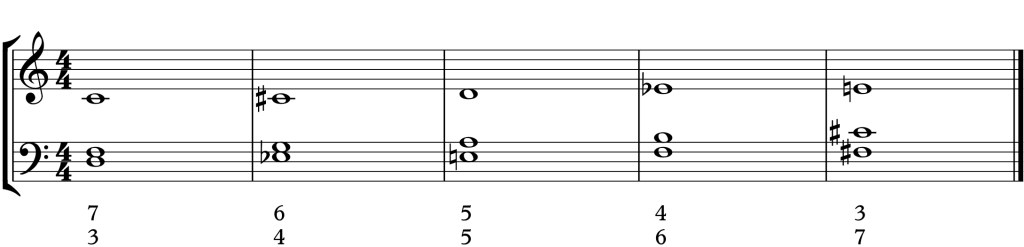
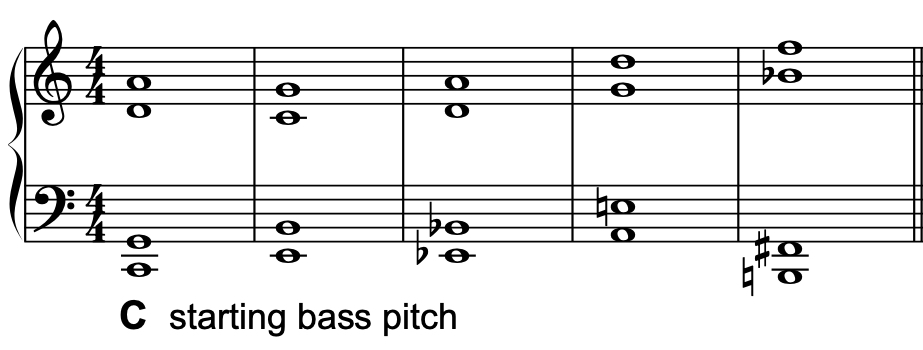
    Sonatine for Beth is spun entirely from a single harmonic progression, seven chords, each stacking one Perfect 5th interval above another.

    The Perfect 5ths in the two hands are separated by one or more octaves, highlighting this strong interval as a characteristic sound for the piece.

    Now some basic tools to develop and vary a generating theme.

    Transposition

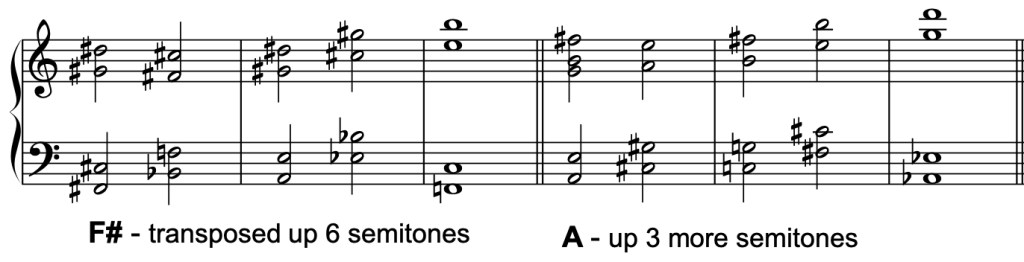
    The whole five-chord progression can be transposed. The harmony is heard plainly in a middle section as ten block chords. The last five chords are a transposition of the first five, up three semitones, starting on the bass pitch Eb instead of C.

    Sequence is successive statements of a pattern transposed by a consistent interval.

    Here is another transposition of the whole ten-chord sequence:

    This harmonic material generates melodic lines and many arpeggio patterns, in successive variations of changing register, intensity, and rhythmic pace. Let’s go through the compositional unfolding of this thematic idea.

    Extract a melody and bass

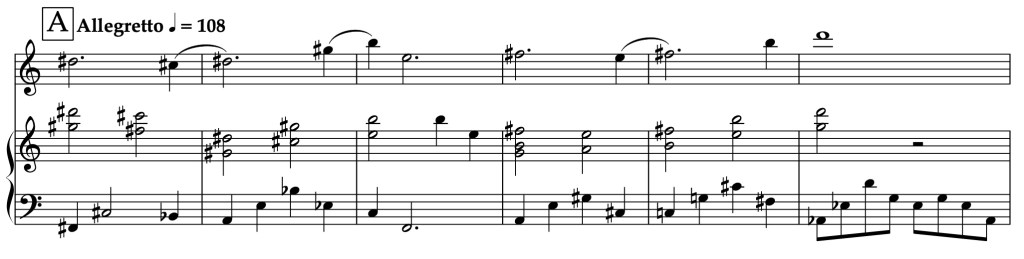
    Since the starting idea is simply a chord progression, we can select individual tones from each chord for a melody. The most obvious selection is the highest pitch of each chord, even if it is not in a soprano singing range.

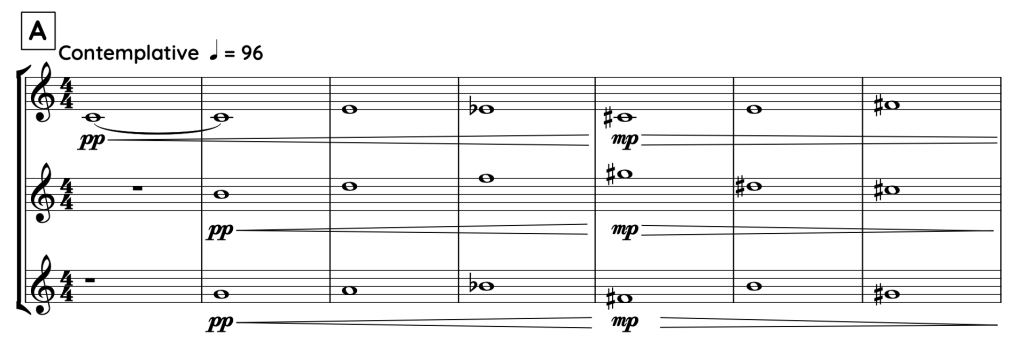
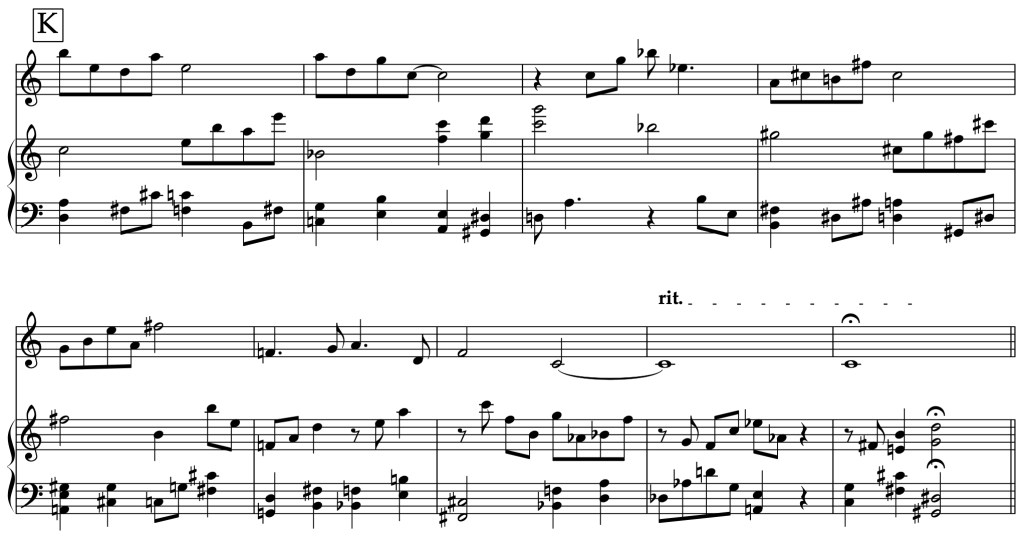
    At letter A the melody is given a slightly independent rhythm to help set it off from the chords, in addition to the different sound color of the flute. Also, the lower chord tones are articulated one at a time, making a bass line also rhythmically distinct, faster than the half-note chords. (The Bb in the bass line’s first bar is a passing tone, not a chord tone.)

    Add arpeggios

    An arpeggio is any pattern articulating chord tones one at a time. Usually in order lowest to highest or back down, the individual chord tones can be articulated in any order. At letter A shown above, we already saw the left hand articulate its chord tones one at a time. In the introduction, the right hand is partially broken up into arpeggios.

    In the next variation below, right-hand treble chord tones and still some bass chord tones are arpeggiated. Now all three lines (flute, right hand, left hand) have distinct rhythmic patterns, though congruent with each other in the established 4 4 meter.

    Next, the flute arpeggiates chord tones in eighth-notes, with the left hand simplified to quarter-notes of two pitches from each chord.

    Rhythmic variations

    Variation D simplifies the flute melody to just two half-note chord tones per bar.

    The two hands reunite rhythmically to place some chords after the downbeat and between flute notes.

    Counterpoint

    The original term, contrapunctus, translates “point against point” — two or more independent lines interacting in time.

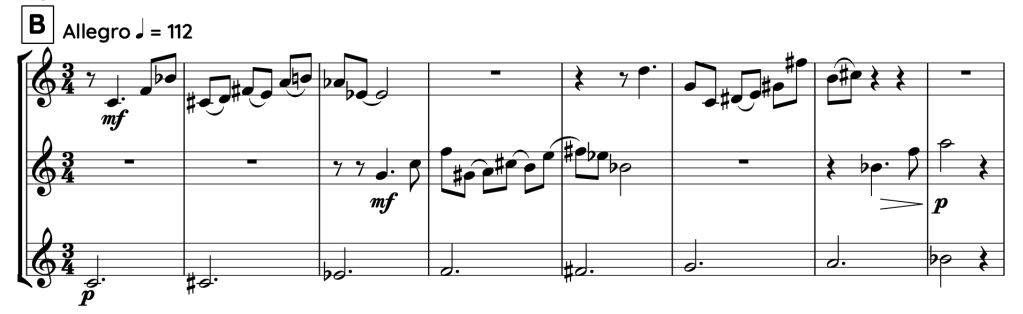
    A more active rhythm for the flute line leaves time gaps that can be filled in by another line. The right hand selects chord tones to make a similarly playful rhythmic line that mostly alternates and sometimes lines up with the flute rhythm.

    The harmonic progression is still there but just hinted at by the chord tones selected for these interacting lines.

    Variation F continues this back-and-forth rhythmic interaction of the flute and piano right hand, now adding back in the left-hand chord-tone pairs with a simple rhythm for a supporting third contrapuntal line.

    Texture

    Having reached a complex level of three rhythmically interacting, independent contrapuntal lines, a nice contrast will be to simplify. Variation G reduces to a lower-register flute line and only a much simplified skeletal supporting line above it in the right hand.

    Then the texture begins to revert rhythmically to a simpler alignment of all chord tones.

    This paves the way back to a simple piano texture revealing the fundamental thematic chord progression.

    Shape a time form

    What is the plan for the whole? How will the various versions of the generating idea unfold in the larger time span of the whole piece?

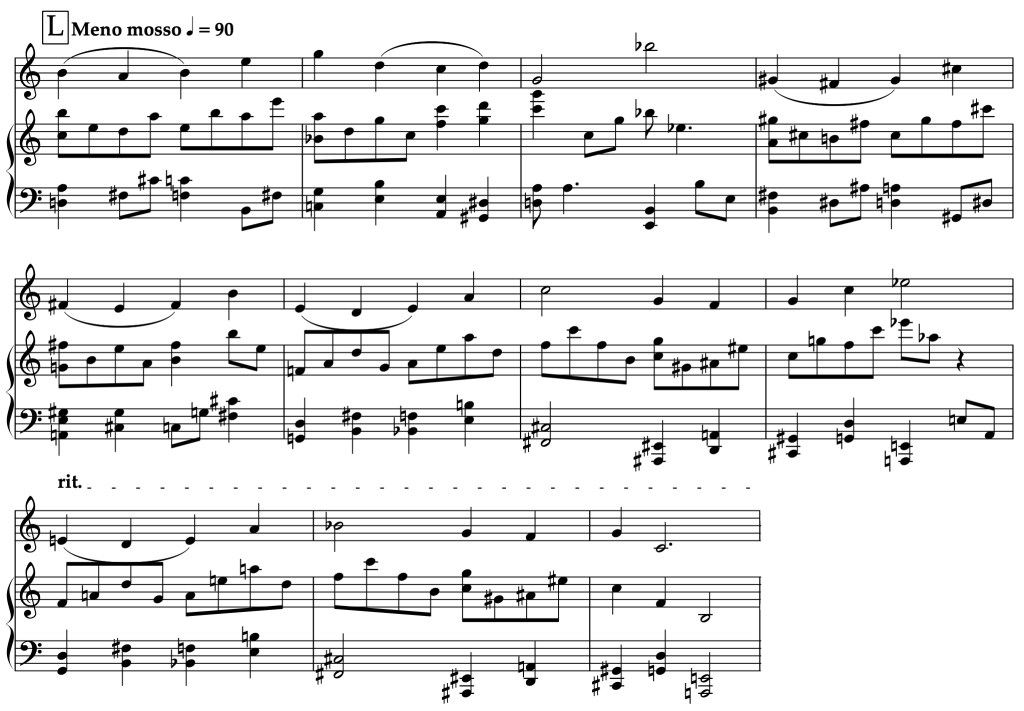
    The quiet letter I variation is the apex of an arch form . . .

    • starting with simple
    • building up more rhythmic and textural complexity
    • reaching a stable plateau
    • subsiding back to what started it all.

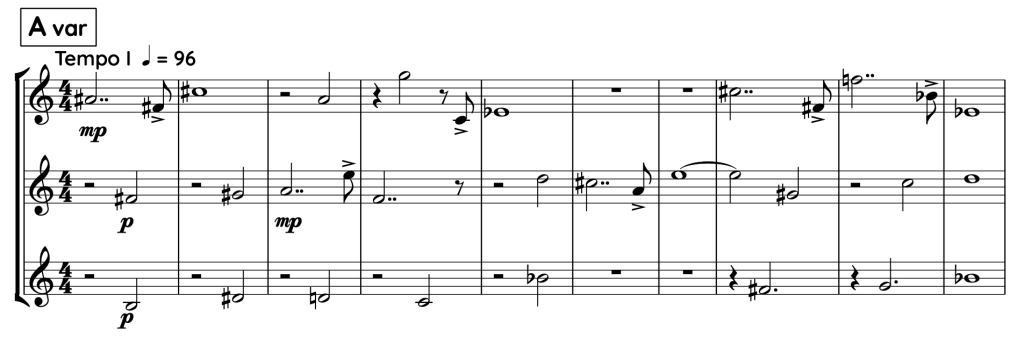
    That sets up a recapitulation of the whole process, building up textural complexity again, first with the high two-part counterpoint:

    Then with three voices:

    Flute line “calming down”:

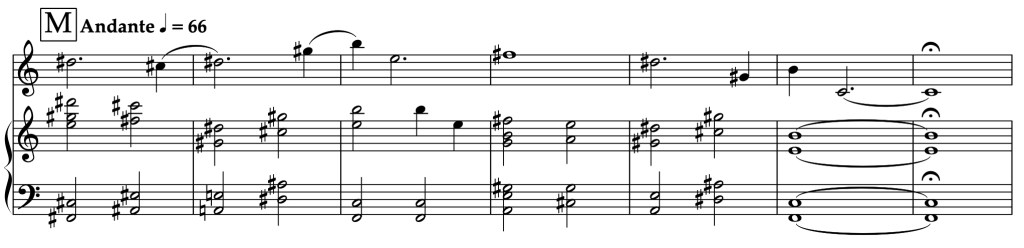
    Coda

    A good essay ends with a conclusion or a summary restatement of the thesis.

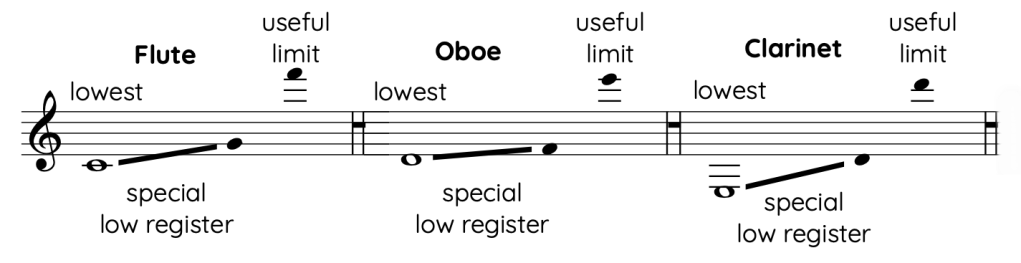
    Our musical coda summarizes with a last return to the beginning. The chords are back to their very low and very high registers. The flute makes a small melodic arch, ascending to the pitch B, then climbing down gently to its lowest possible pitch, C.

    Fine

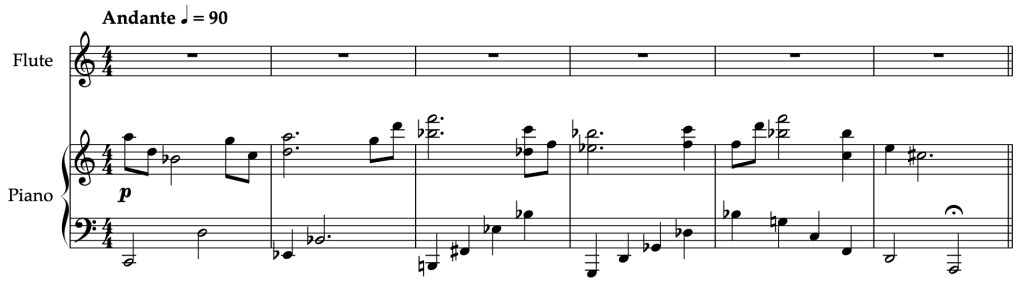
    A final edit and audit are mandatory. In the case of our example, listening revealed that the beginning needed a piano introduction with some rhythmic vitality. Some sections were also reordered to improve the flow. Thus, the piece will not begin with a plain statement of the progression, and there will be a somewhat different order of other events.

    Now listen to the whole 6-minute parade of variations on a single chord progression.

  • journal 5. Dusty Dusk

    Tacoma, 1974 —

    As a teenager, I was into all kinds of art — sketching, painting, reading plays, and writing poetry. Lots of poems, my way of a kind of diary writing, expressing to myself the places, relationships, and feelings. (I won’t reveal any of this naive creative work here.)

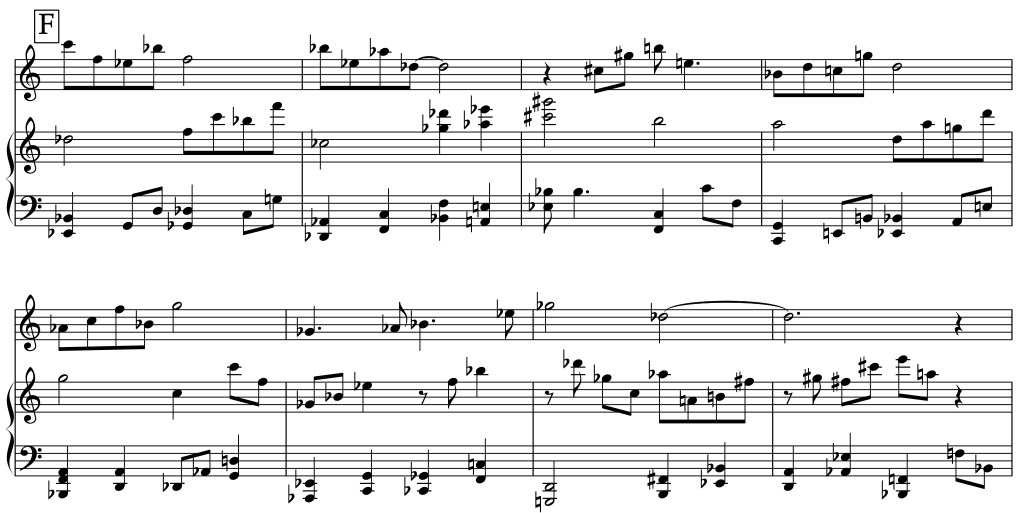
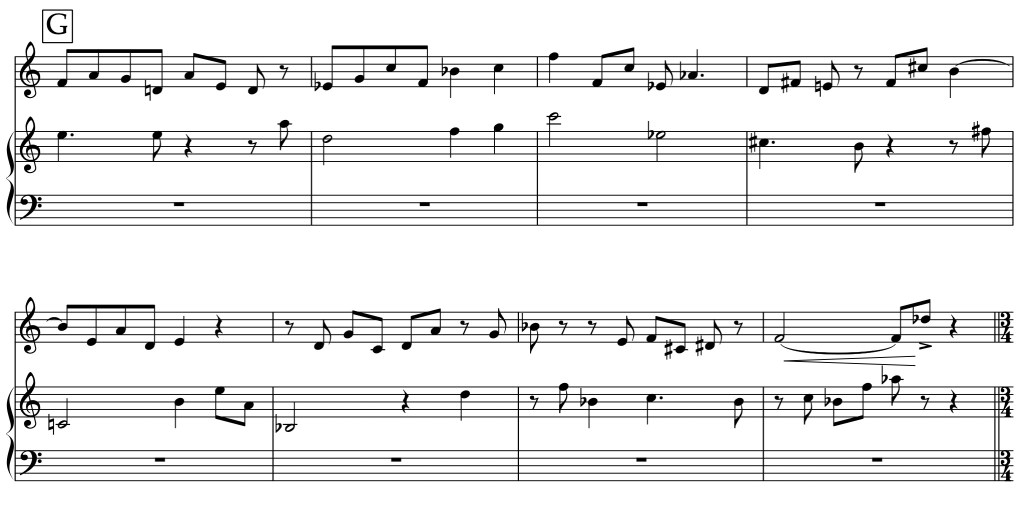
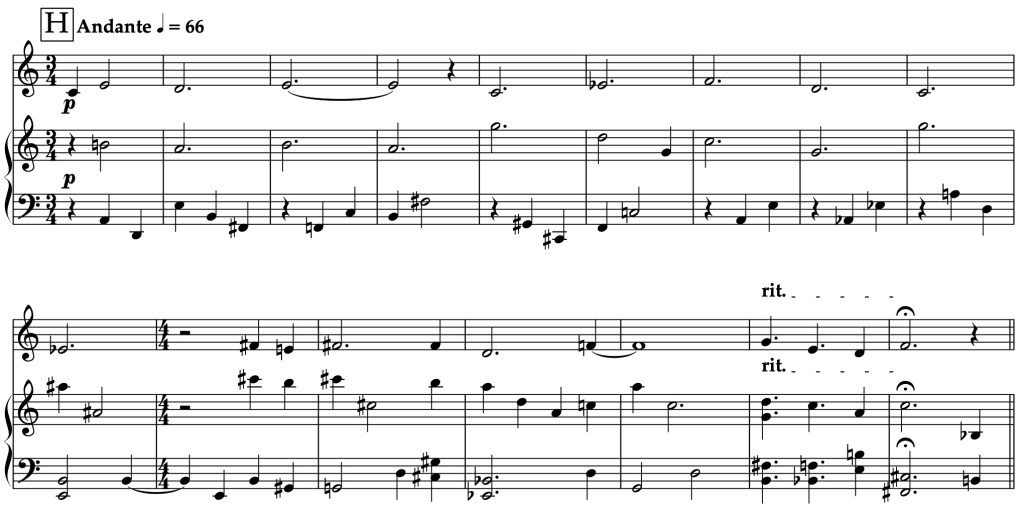
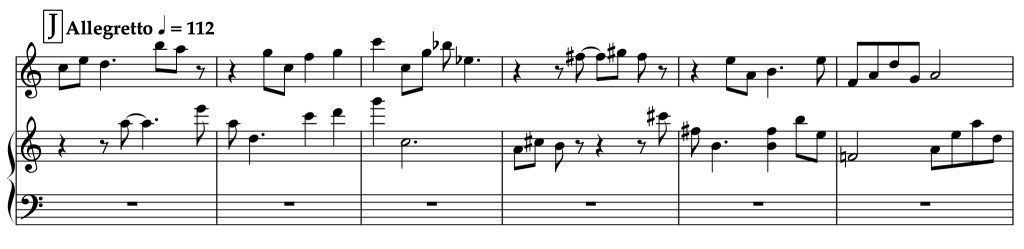
    Later, two poems in particular were written at major turning points in my professional and personal life. That’s when I started setting poems as art song lyrics. Some of the musical material for what became Landscapes in Motion was first set in the 1970s, and some in the 1990s, now reworked with a more mature 21st-century craft, while preserving the original dark suppleness of tonality and time.

    Upon completing my master’s degree at Michigan in 1972, I taught music theory as a one-year lecturer at Indiana University in Bloomington. Another one-year fill-in position took me to Pacific Lutheran University in Tacoma, Washington, where I got great experience teaching music theory, composition, new music performance ensemble, and even trombone!

    Without a doctorate, however, there was no real prospect of winning a permanent professor position anywhere. And continuing a succession of one-year gigs moving all over the country was not sustainable. What to do?

    I had taken my sailboat with me all the way out to Tacoma from Interlochen. After a beautiful sunset sail on Lake Spanaway in my little 15-foot “Butterfly” dinghy, I wrote a poem.

                            “Sailing at sunset”  (1974)

    Dusty dusk settling silk on dying silver of wave-modulated water,
    the sail still silently searching for a departing breeze,
    swinging gently its boom and softly rattling its blocks
    in confounded cross-rhythms to the lapping shore.
    Streams of crimson flowing dust streak the sky
    above looming shadowed firs.
    Deepening shadows settle dark dust on the deck
    while still the mast peak rages red and soars into a deepening sky.
    Scorched face soothed by the oncoming night breeze,
    eyes searching the sunset sky for sign of tomorrow’s wind.
    Where will we sail then? Wherever wind wills . . .
    and a new dusk consume our shadows.

    A New Dusk

    Clark 1974 (TC-28)

    Afterglow

    Turns out, I went back to Michigan for doctoral studies, and went back to working at Interlochen as assistant to the director of Michigan’s university-level program there. In that 1975 summer, I met Beth, a journalist working a temp gig on the camp’s publicity staff.

    We fell in love, and I spent many weekends of the following academic year riding the Amtrak Turboliner from Ann Arbor to Chicago to be with her. I wrote a poem on one of those train rides, again uncertain about my (our) future.

                            “Riding backwards on a train”   (1976)

    The cider mill beside the river,
    cows grazing by a dead tree,
    a red barn stuffed with hay.
    An old square house alone on a hilltop,
    a church’s silent steeple above the trees,
    a country cemetery, old stone crosses guarding against oblivion.
    Then the sun is gone,
    storm clouds ripple across meadow skies,
    the river turns away.
    Riding backwards on a train, frozen fields float by.
    Glossy sheets of white ice glow with winter sun.
    Dead brown stubble breaks the mirror, patchy footprints of autumn’s retreat.
    Pale late light of afternoon flickering
    through leafless trees that line the lifeless fields in rows,
    through fields of withered cornstalks.
    Leap into brown dry woods, plunge past barren trees,
    spray a wake of fallen leaves, lunge into holy autumn stillness,
    riding backwards on a train, headed east into a frozen future.

    Shortly before his death, Charles Ives published a collection of 114 Songs in 1922. Many have become exemplars of his iconic 20th-century American style. Here are two that fit our tender twilight theme.

    Paul Sperry, Irma Vallecillo

    LISTEN > YouTube

    Paul Sperry, Irma Vallecillo

    LISTEN > YouTube

    Before night

    So far, I haven’t mentioned an important influence on my ’60s and ’70s immersion into the mid-century Avant Garde. In the 1960s, Luciano Berio wrote an influential, frequently performed series of unaccompanied solos for varied instruments. All are tour-de-force virtuosic technical displays with a theatrical impact. I performed Sequenza V for trombone on a Contemporary Directions concert in Rackham Lecture Hall (Ann Arbor). It was commissioned by and written for virtuoso trombonist Stuart Dempster, with whom I later briefly studied.

    I said instruments, but Sequenza III (1965) is for unaccompanied voice, drastically different than a typical “song.” Berio explains:

    “In Sequenza III the emphasis is given to the sound symbolism of vocal and sometimes visual gestures, with their accompanying ‘shadows of meaning,’ and the associations and conflicts suggested by them. For this reason, Sequenza III can also be considered as a dramatic essay whose story is the relationship between the soloist and her own voice.”

    Sequenza III was written in 1965 for Cathy Berberian. The “modular” text is by Markus Kutter:

    Give me a few words for a woman
    to sing a truth allowing us
    to build a house without worrying before night comes

    Laura Catrani, soprano

    Ice

    In 1983, teaching grad courses and still directing the New Music Performance Lab. Musicology master’s student Robert Nasow played cello in the ensemble, but he was also an avid and talented poet.

    When his fellow grad music student David Lynn Kennedy was killed, Robert wrote a heartfelt elegy for him.

                            “Ice Floe

    by Robert Nasow

    Yes, I am cold . . .
    my hands are cold to the touch.
    Something must fill this hollow at the center of my body.
    Untouched, no one will long remember your face . . .
    She withdraws to contemplate the child,
    her voice breaks into emerald light, effulgent pure water,
    sings unknown distances of sleep.
    Brittle, come break off my hand,
    this glazed stem of Queen Anne’s lace.
    There are ways of living we have never dreamed of.

    His poem became a lovely vehicle for a memorial song, which was premiered by UNT grad students who were also involved in new music with me.

    Ice Floe

    R. Nasow / Clark 1983 (TC-46)

    Jing Ling Tam, soprano

    Paul LeBlanc, guitar