Tag: counterpoint

  • Mapping Music 8. TONALITY

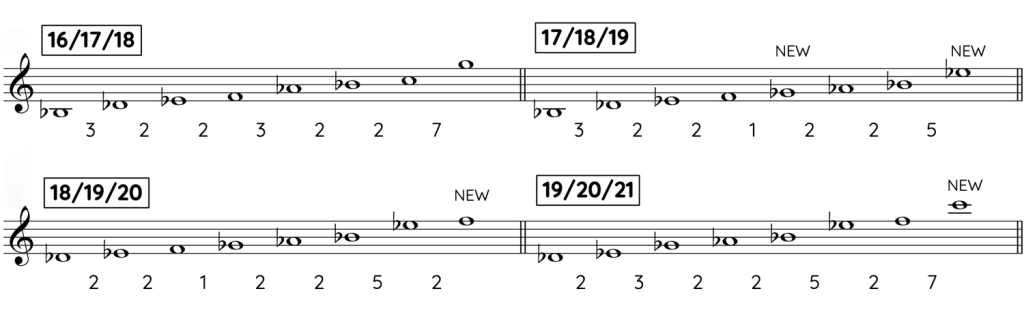
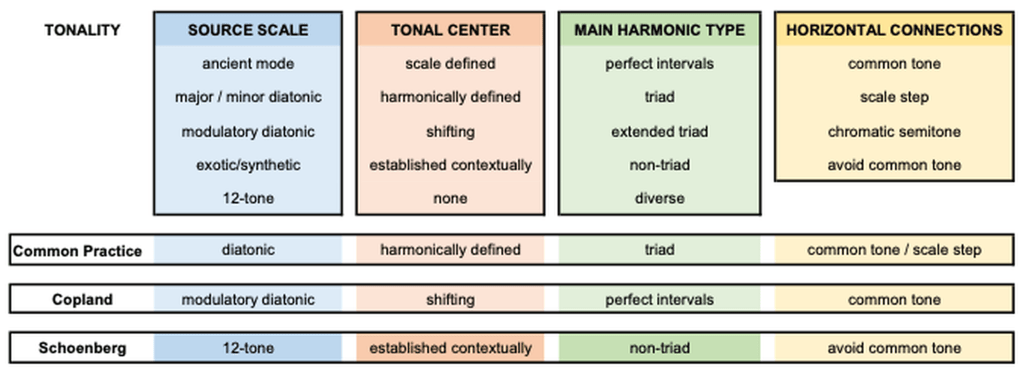
    In traditional tonal music, or for a composer’s personal design, there are four main factors defining a tonal language: source scale (covered in Mapping Music 5); harmonic type; horizontal (voicing) connection; and tonal center, a basic concept for Common-Practice tonal music.

    A diatonic major or minor scale and harmonic structures built from it define a key and “tonic” home-base tonal center. (In the ancient modal music of the monophonic Gregorian chant it was called the “finalis,” as it was the expected final arrival destination of an extended melody.) Triads taken from the scale build a scaffold of harmonies, featuring the dominant chord (scale degrees 5, 7, 2, and sometimes 4) with its scale-degree 7 “leading tone” propelling a progression to resolve back to the tonic chord (scale degrees 1, 3, 5).

    In 20th-century music, some composers (notably Bartók) began to define tonal center contextually rather than by scale-and-key, writing melodic patterns and counterpoint that branched out from and converged back to a core base (but not necessarily bass) pitch. Twelve-tone music, derived from the full chromatic scale, would seem to be avoiding any tonal center, but some composers still built textures whose lines and counterpoint would emphasize one focal pitch-class.

    A matrix of choices

    In forging a tonal language, the composer develops preferences in each of these factors. Choices from each factor column can be mixed in a variety of ways. The composer designs by delving into more specific patterns, especially for the source scale (possibly, say, a six-note pitch-class set) and the harmonic type, establishing a preference for certain harmonic intervals (such as my favoritism for 7-semitone Perfect 5ths and 11-semitone Major 7ths).

    There are, of course, thousands if not millions of possible combinations of all these factors, a universe of tonal possibilities for the individual composer and a particular piece.

    Next, let’s dive more deeply into harmonic types and the factor of horizontal connections between successive harmonies.

    Constellation streams

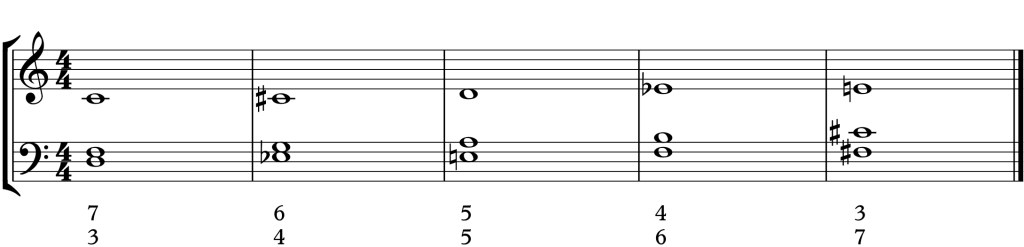
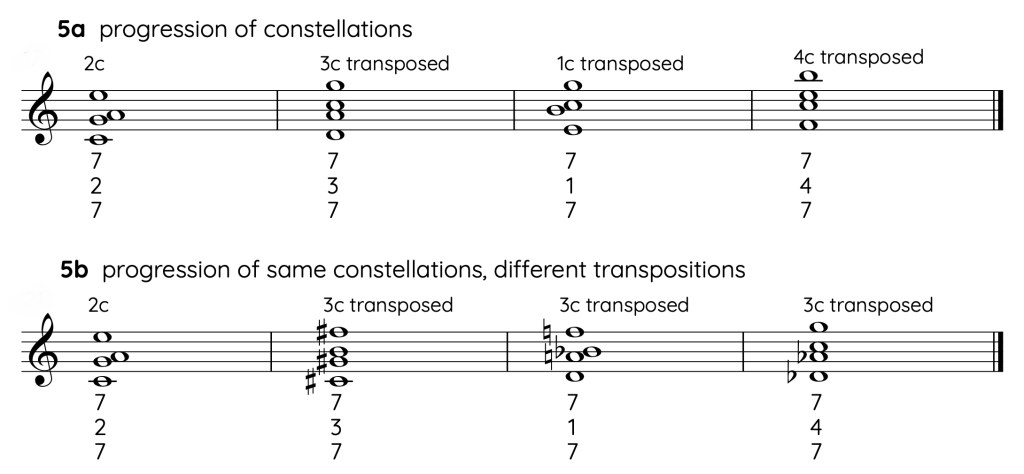
    A stream of successive constellations, which we might nickname a “constream,” would traditionally be called a chord progression. In the following example, all stacks are 10 semitones tall; no common tones in the transposition choices.

    no common-tone connections

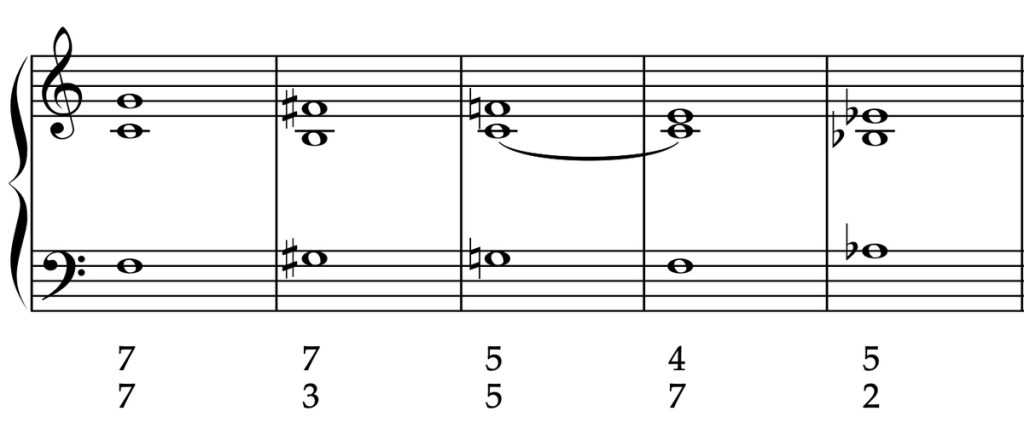
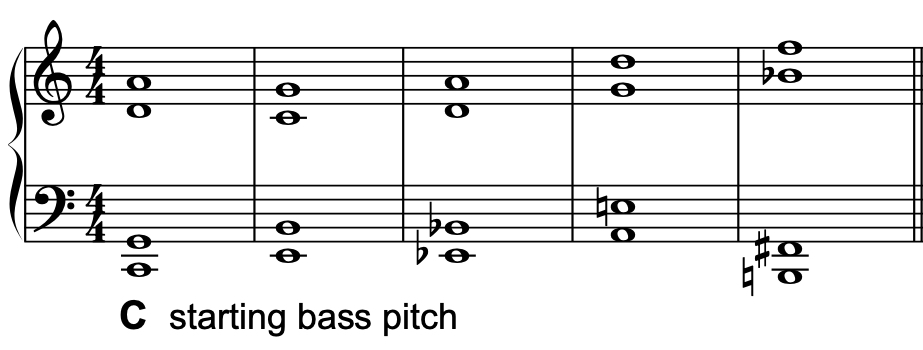
    In the next example, stacks of differing heights, with constellations that reduce to three different scale patterns: scale array 5 2, then 2 3, back to 5 2, then 4 1, and finally 2 5, inversion of 5 2.

    common-tone connection

    Now a longer, more mixed succession of interval stacks of constellations belonging to these same three scale patterns (2 5 or 5 2; 1 4 or 4 1; and 2 3).

    extended constreams

    Back to my constellation friends of Mapping Music 6, we can make some constreams with them.

    diatonic and chromatic successions of symmetrical constellations

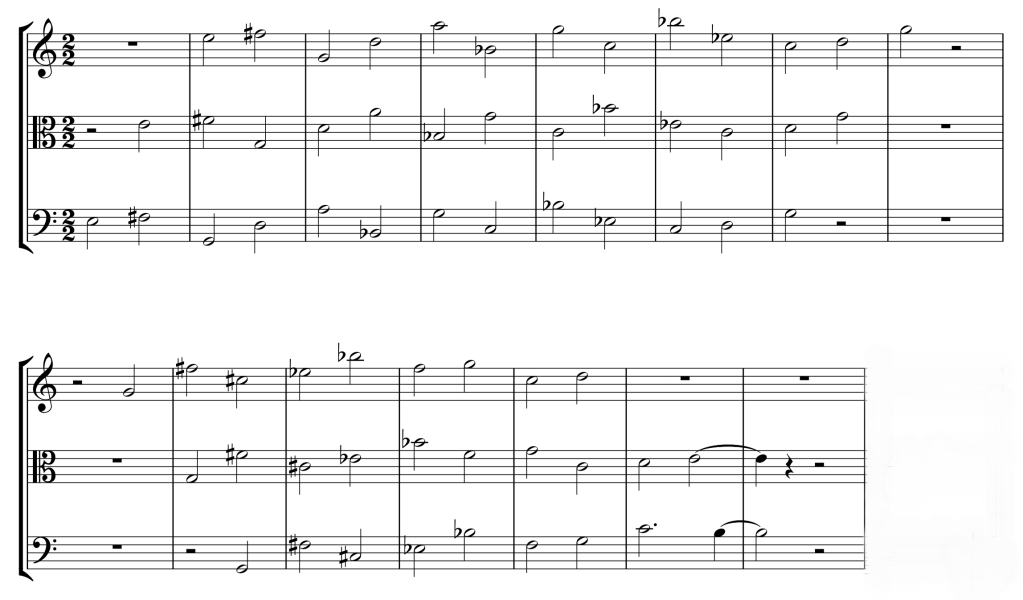
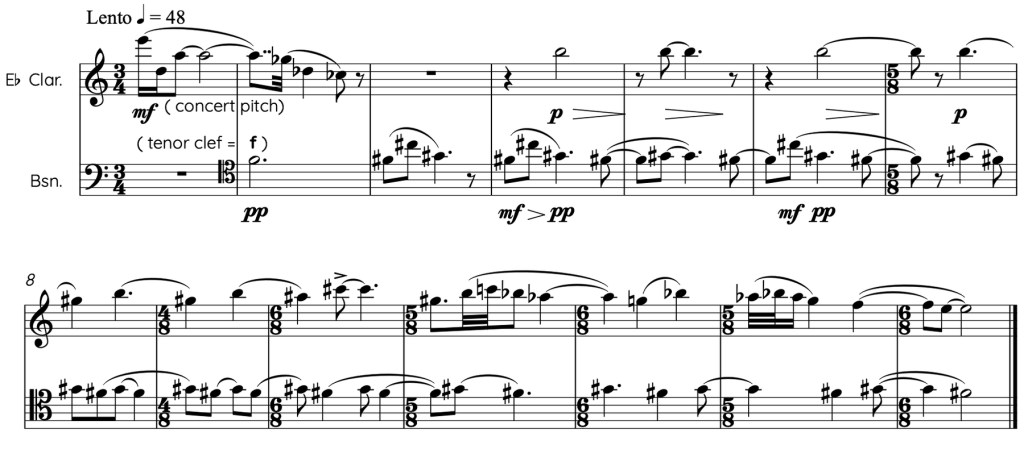
    An intriguing example from the literature of great early modern music, an interlude near the beginning of Stravinsky’s L’Histoire du Soldat:

    L’Histoire du Soldat excerpt

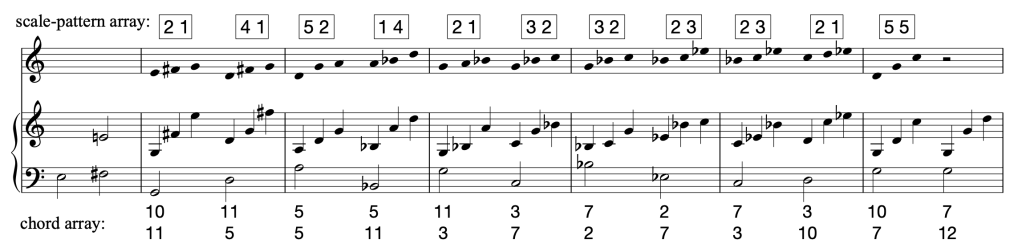
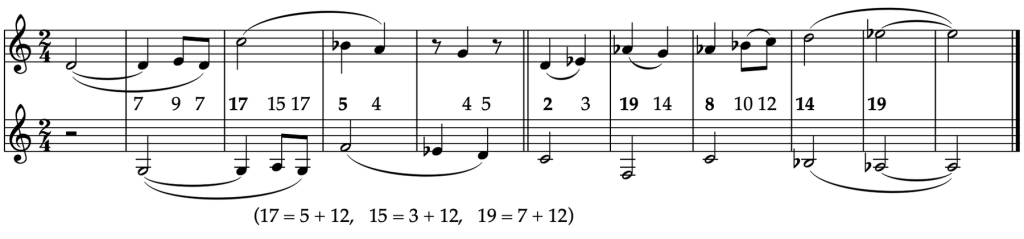
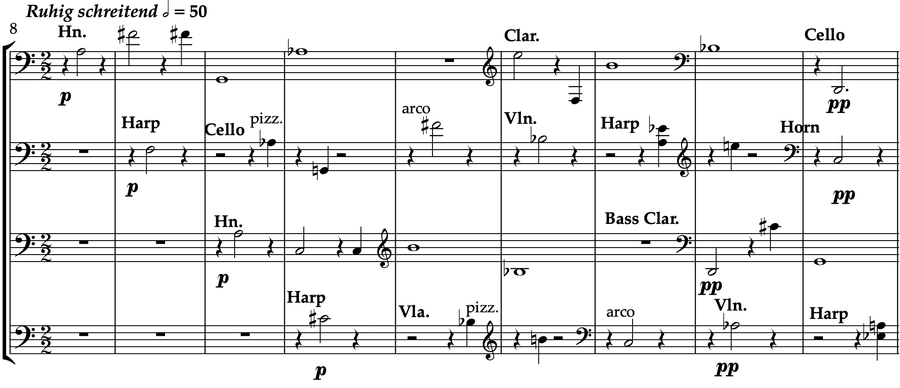
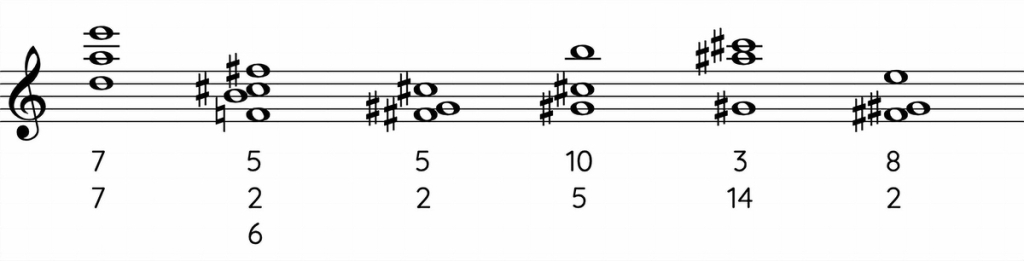
    This passage is intriguing in many ways. It looks like counterpoint between two woodwind instruments in high register. But both lines are quite simple and don’t seem to go anywhere. (In our GALAXIES: Structure chapter, we’ll discuss these questions of texture and counterpoint.) Introducing it here raises the question of harmony, of constellations and their arrays, though the passage doesn’t look at all chordal. Here is an array analysis of the constellations formed in the first through fourth bars then jumping to bar 10 and, finally, bar 14.

    L’Histoire du Soldat constellations

    Now you can see and hear more clearly the role played by array interval of 7 semitones (“Perfect 5th” as in above examples) and also 5, and 2 semitones in the harmonic continuity of the passage. (Also note 7 + 7 = 14; 5 + 2 = 7; 5 +5 = 10; 2 + 12 = 14; etc.)

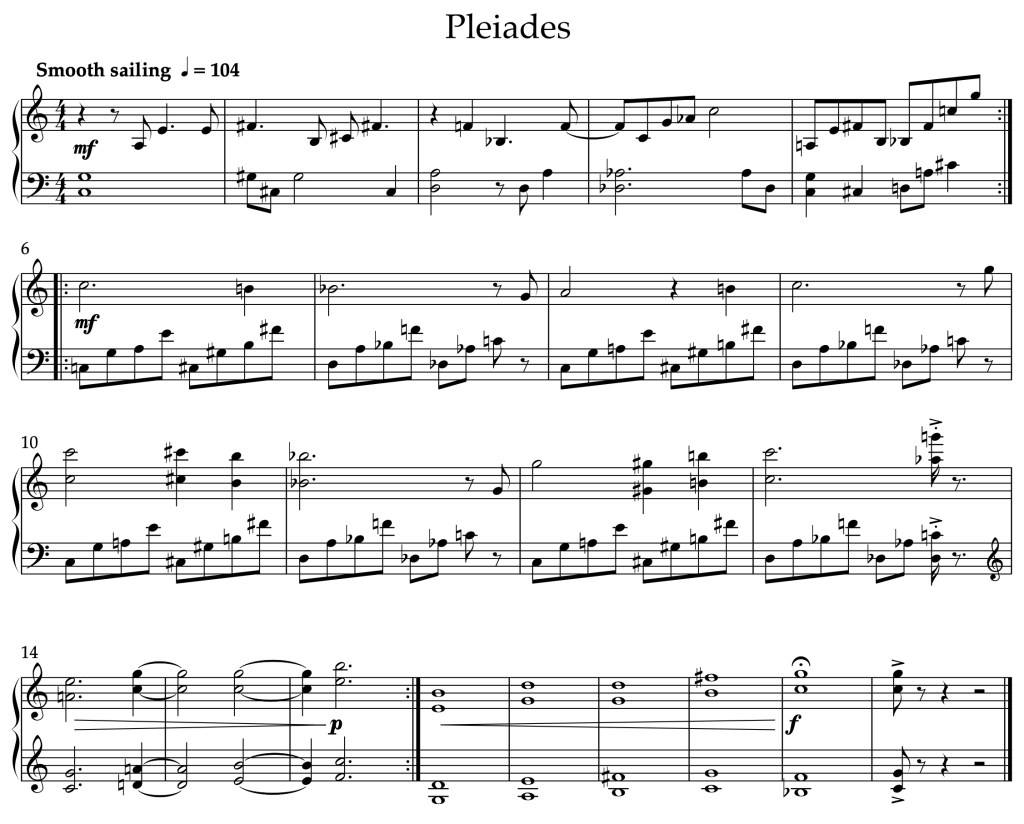
    To illustrate that this is not all just theoretical, here is a simple etude composed using exactly the constellations and successions explored in Examples 12 and 17. It took only about an hour to compose this minute and a half in Sibelius. The title: the constellation Pleiades (“Seven Sisters”) is a tight cluster of 7 stars tagging along in the winter sky with Taurus as the Zodiac sails westward every night.

    Streams and 12-tone sets

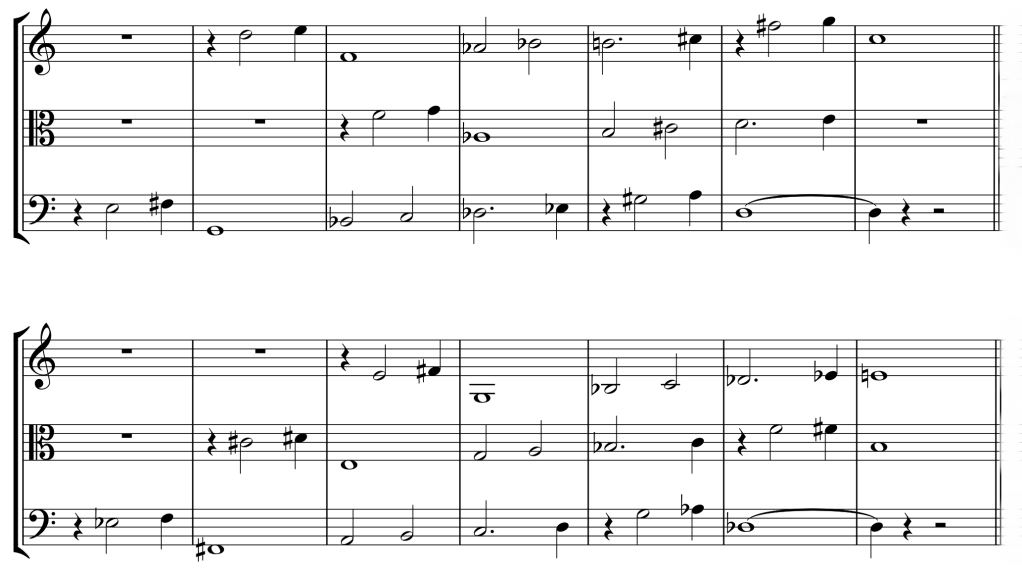
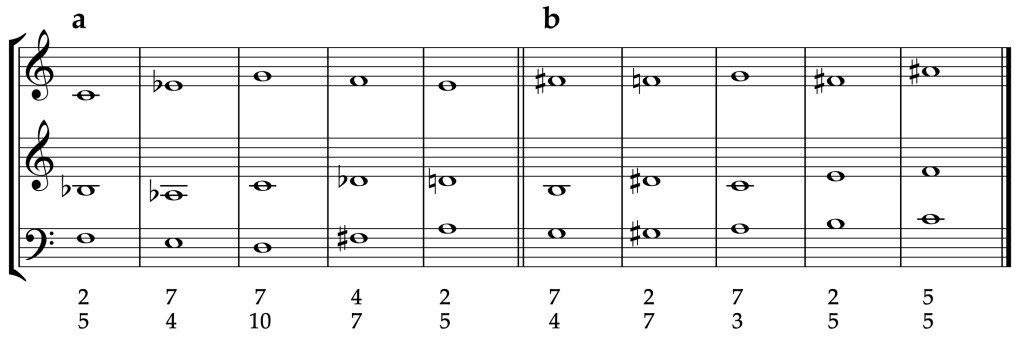
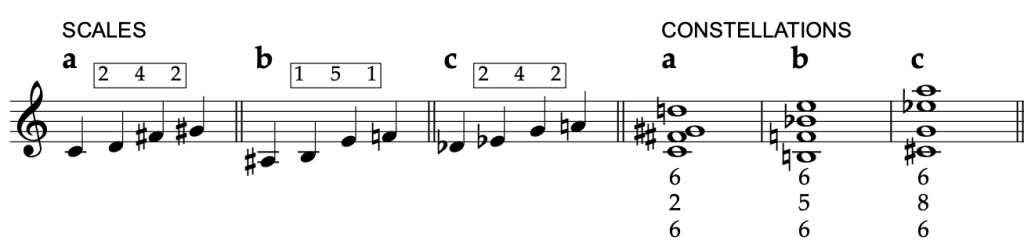
    Let’s keep going. How about designing a succession of three four-pitch constellations, so that all 12 pitch classes of the chromatic scale are included but none repeated? (Traditional terminology calls such a set a 12-tone aggregate.)

    three sets make a row

    Constellations a) and c) are different “chord voicing” of the same scale pattern, 2 4 2 . Both scale patterns and all three interval stacks are symmetrical. And they all contain two 6-semitone “tritones,” giving the whole succession the tritone’s quality of ambiguity and the character of the succession a feeling of mystery.

    Progressive alterations of arrays

    Similarity of interval patterns can build coherence in a stream of constellations. Beyond functional common-practice harmony, this is a kind of process that composers of the 20th century and today can use to create a “new tonality”.

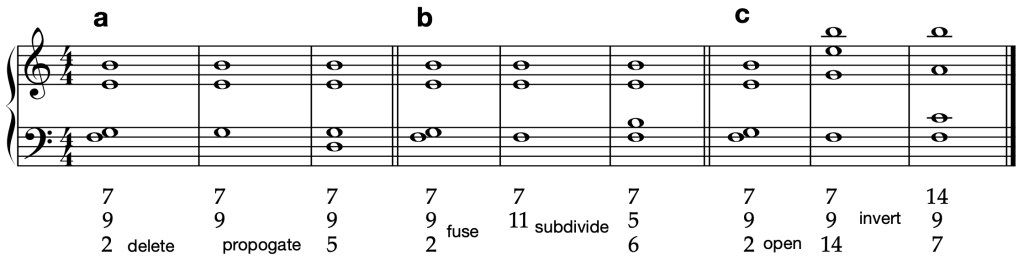
    Possible operations to transform an interval array into a closely related array:

    OPEN — Expand an interval by an octave, adding 12 semitones

    FUSE — Join two adjacent intervals to make a larger interval, the sum of their sizes

    DELETE — Remove an interval, shortening the stack’s height

    SUBDIVIDE — Insert a pitch to divide an interval into two smaller intervals, whose sum equals the original interval

    PROPOGATE — Append or insert an interval of a size already present into the stack

    INVERT — Reverse the registrar order of the stack — turn it upside down

    alteration examples

    There are operations that more significantly alter the character of the interval array.

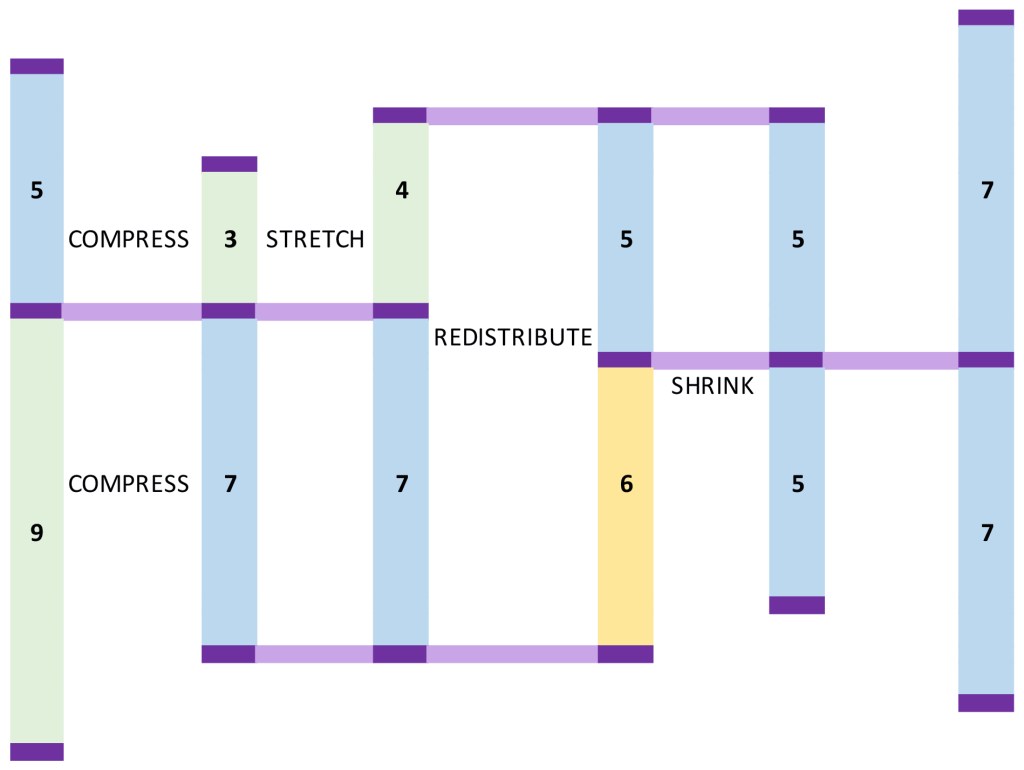
    REDISTRIBUTE — Fuse two adjacent intervals into one larger interval then re-subdivide it into two different smaller intervals

    SHRINK / STRETCH — Alter one interval size by other than an octave, leaving others unchanged

    COMPRESS / EXPAND — Alter all intervals in the stack by adding or subtracting each by the same number of semitones, or multiplying each by a constant

    These alterations are listed in order, from the mildest alteration producing a similar array (redistribution) to the most dramatic producing a substantially different array, compression or expansion of the whole array (preserving little from the original but its symmetry). Here is an example employing these altering transformations.

    more alterations, with common-tone connections

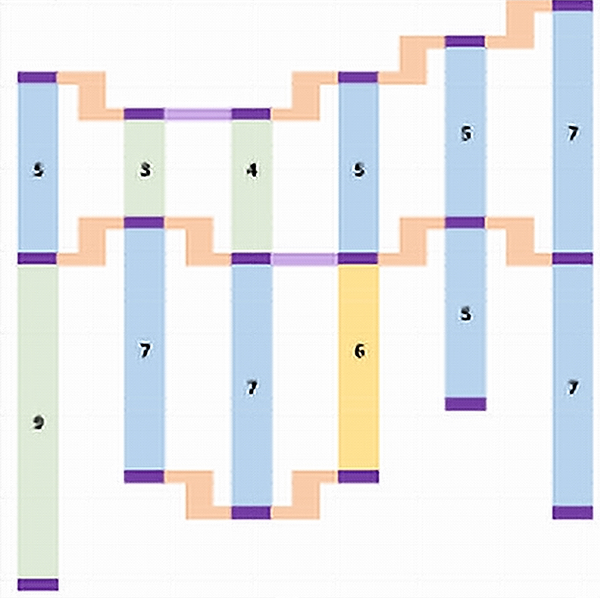
    The other element of coherence in this example is the many common-tone connections between one chord and the next, establishing a slow-moving stability. Another example of the same interval stacks, same succession of alterations, but choosing transpositional level of each constellation to create as many 1-semitone voicing connections as possible (10 such voicing connections in the following example) makes the con stream’s sense of progressive change stronger.

    more alterations, with semitone connections

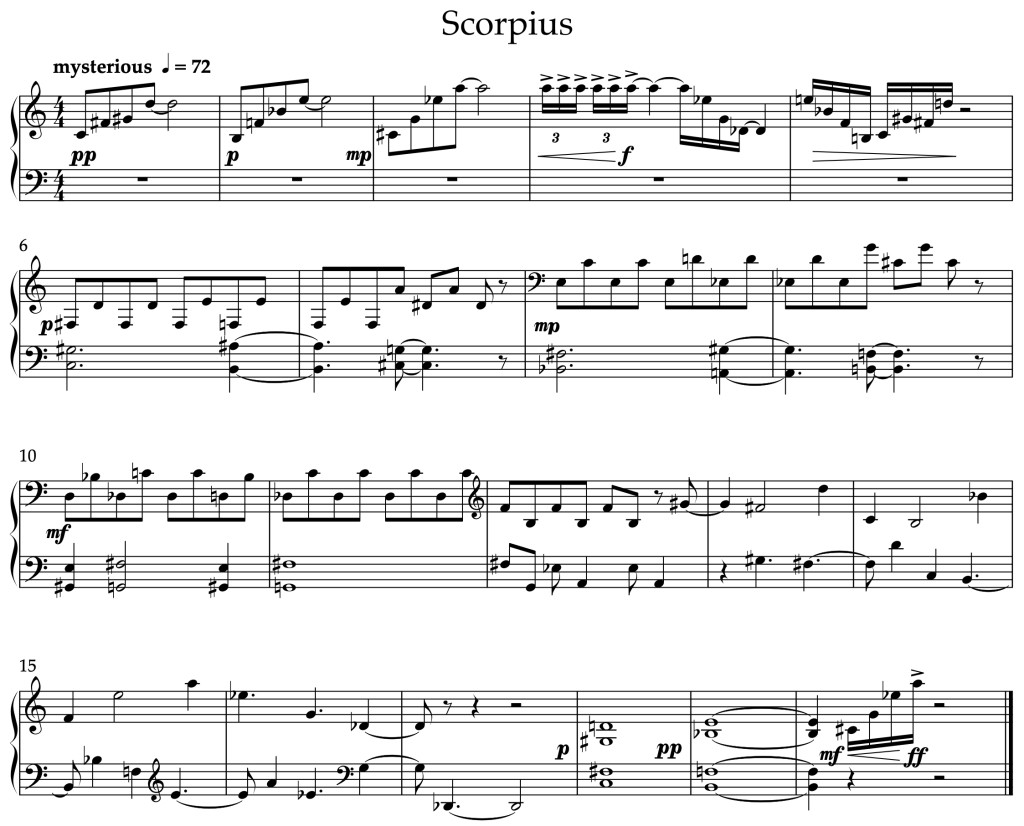
    Finally, another example etude, using this last constream . . .

    © 2026 – All Rights Reserved
    Thomas S. Clark

    TClarkArtMusic.com 

  • MapLab: A Small Sonata

    A sonata is typically a multi-movement piece for solo piano or for an instrument with piano. A shorter form with just three connected sections, the middle slower and quieter, can be called a sonatina. Here is an inside look at how one was composed, step by step. Like the MapLabs in Mapping the Music Universe, this guided tour is in the form of a recipe you can follow to write your own sonata.

    Choose a model

    I started formal composition study in 1968, first with composer Eugene Kurtz, based in Paris but filling in that semester at the University of Michigan. A proponent of modern French music, his compositional models included Debussy and Ravel. He assigned me to immerse myself in deep study of their music, in particular Ravel’s 1905 work, SONATINE.

    I met Beth, a flower lover, in Interlochen in 1975. She had been a promising flute student at Aspen, but was then embarking on a journalism career specializing in horticultural writing.

    The Ravel study came back to me later in my career, as I began to adopt its lush, bright harmonic language and a gentle French Impressionist quality. My SONATINE for Beth (2025) brings together the Ravel study, the flute sound, and (in my video version on YouTube) even the flower motif.

    Start with a generating idea

    The impelling theme can be a melody, a rhythmic pattern, a special kind of chord, or a non-musical image such as a painting or poem.

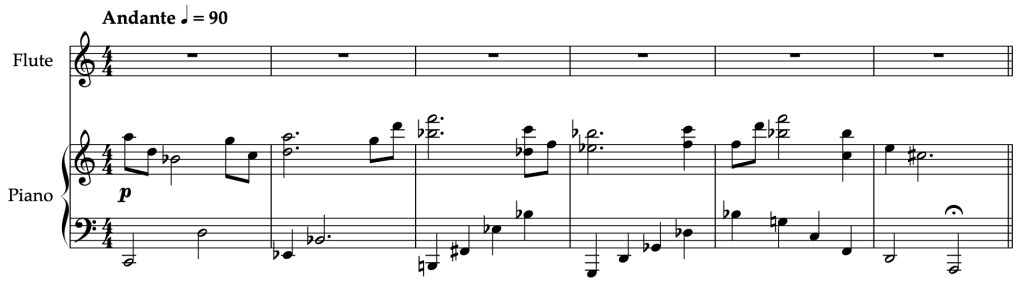
    Sonatine for Beth is spun entirely from a single harmonic progression, seven chords, each stacking one Perfect 5th interval above another.

    The Perfect 5ths in the two hands are separated by one or more octaves, highlighting this strong interval as a characteristic sound for the piece.

    Now some basic tools to develop and vary a generating theme.

    Transposition

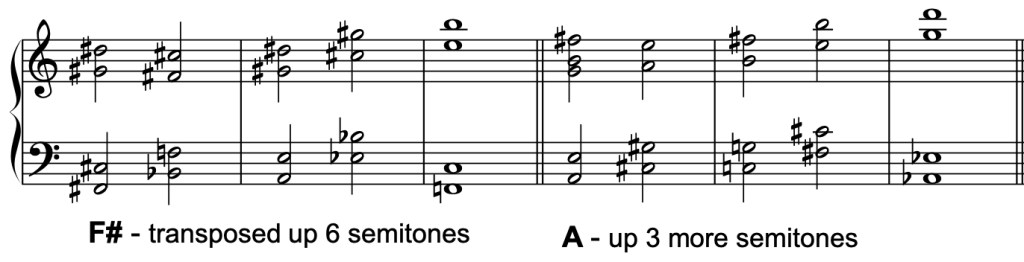
    The whole five-chord progression can be transposed. The harmony is heard plainly in a middle section as ten block chords. The last five chords are a transposition of the first five, up three semitones, starting on the bass pitch Eb instead of C.

    Sequence is successive statements of a pattern transposed by a consistent interval.

    Here is another transposition of the whole ten-chord sequence:

    This harmonic material generates melodic lines and many arpeggio patterns, in successive variations of changing register, intensity, and rhythmic pace. Let’s go through the compositional unfolding of this thematic idea.

    Extract a melody and bass

    Since the starting idea is simply a chord progression, we can select individual tones from each chord for a melody. The most obvious selection is the highest pitch of each chord, even if it is not in a soprano singing range.

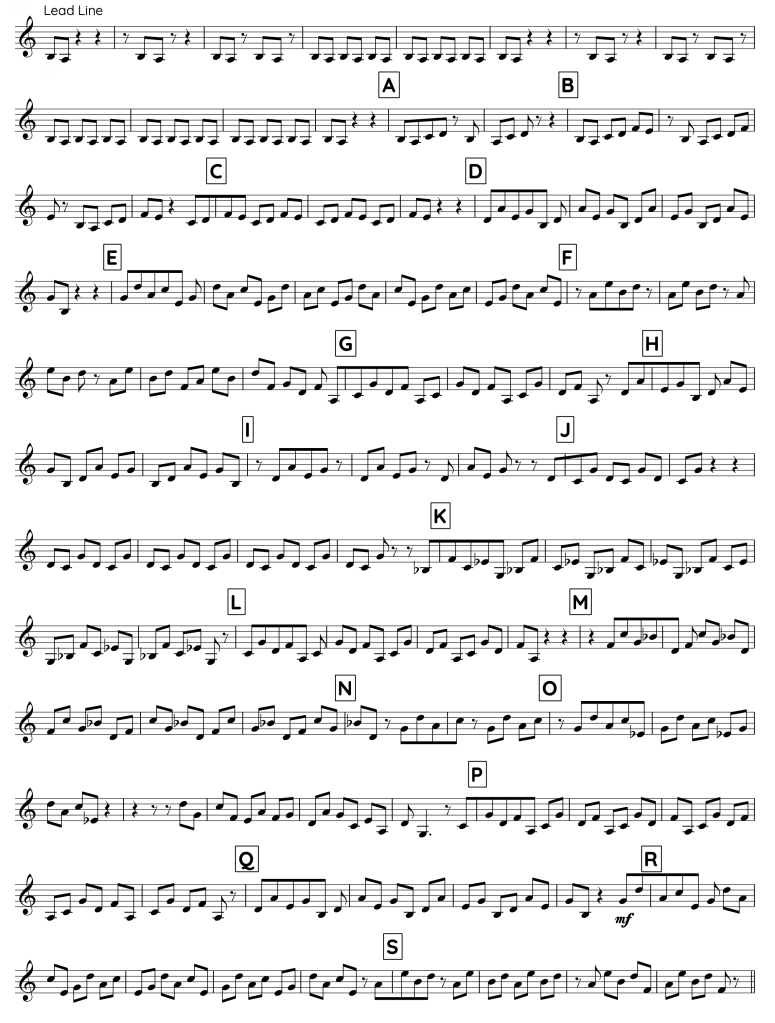
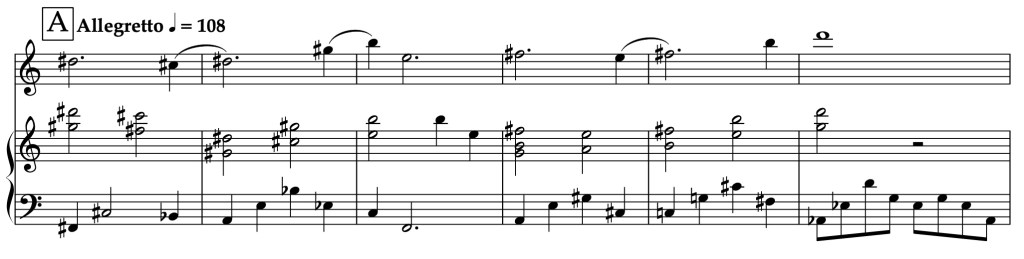
    At letter A the melody is given a slightly independent rhythm to help set it off from the chords, in addition to the different sound color of the flute. Also, the lower chord tones are articulated one at a time, making a bass line also rhythmically distinct, faster than the half-note chords. (The Bb in the bass line’s first bar is a passing tone, not a chord tone.)

    Add arpeggios

    An arpeggio is any pattern articulating chord tones one at a time. Usually in order lowest to highest or back down, the individual chord tones can be articulated in any order. At letter A shown above, we already saw the left hand articulate its chord tones one at a time. In the introduction, the right hand is partially broken up into arpeggios.

    In the next variation below, right-hand treble chord tones and still some bass chord tones are arpeggiated. Now all three lines (flute, right hand, left hand) have distinct rhythmic patterns, though congruent with each other in the established 4 4 meter.

    Next, the flute arpeggiates chord tones in eighth-notes, with the left hand simplified to quarter-notes of two pitches from each chord.

    Rhythmic variations

    Variation D simplifies the flute melody to just two half-note chord tones per bar.

    The two hands reunite rhythmically to place some chords after the downbeat and between flute notes.

    Counterpoint

    The original term, contrapunctus, translates “point against point” — two or more independent lines interacting in time.

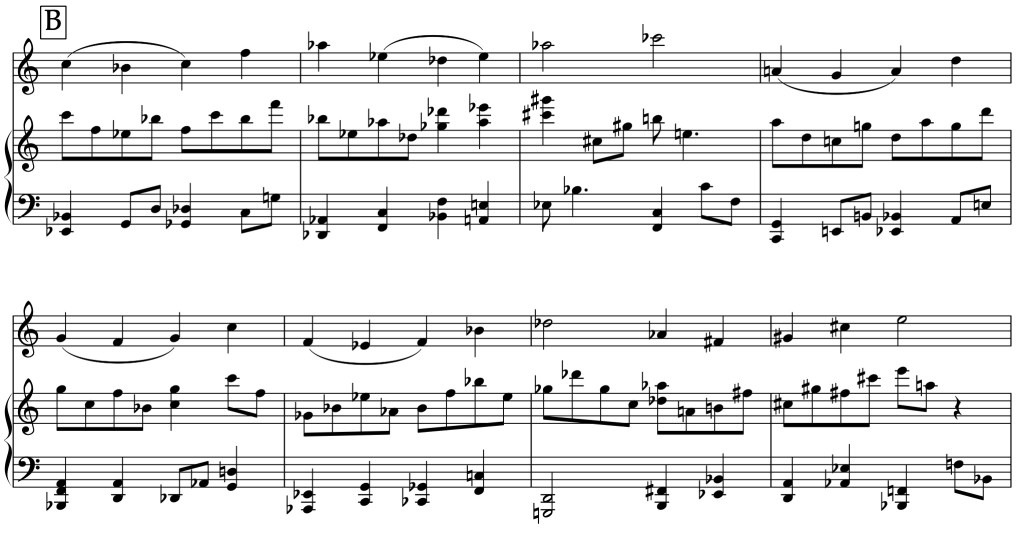
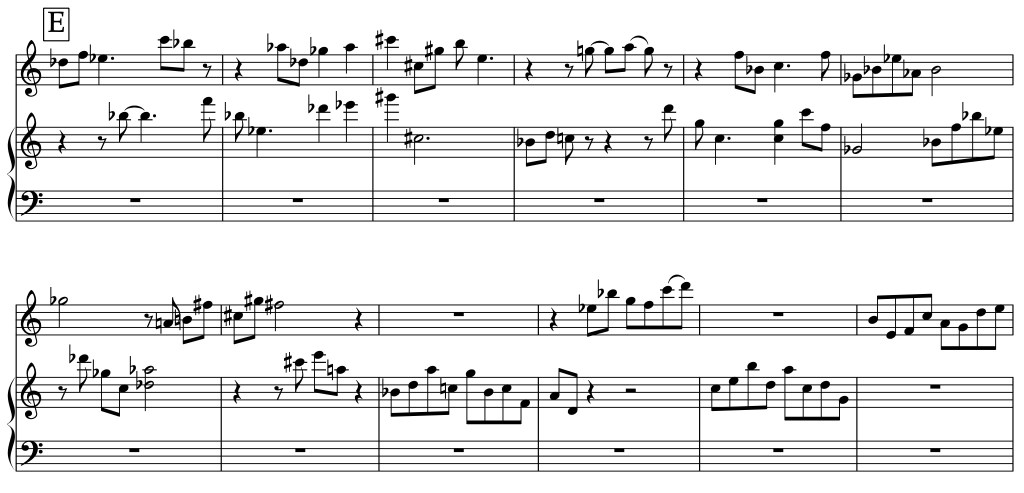
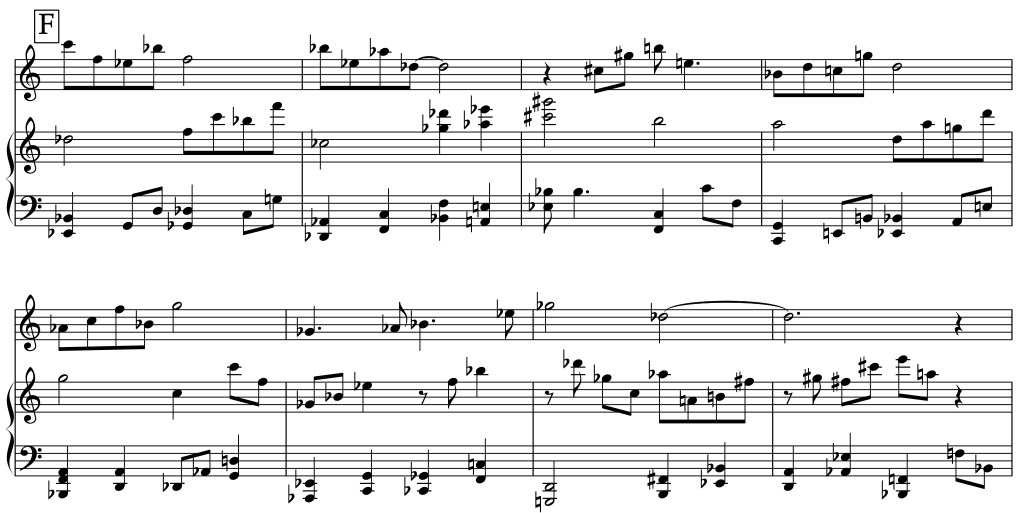
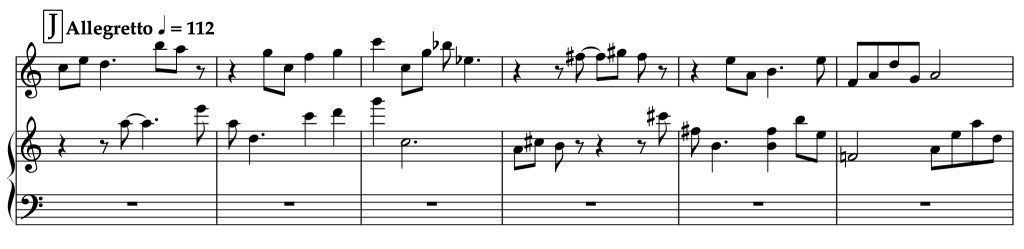
    A more active rhythm for the flute line leaves time gaps that can be filled in by another line. The right hand selects chord tones to make a similarly playful rhythmic line that mostly alternates and sometimes lines up with the flute rhythm.

    The harmonic progression is still there but just hinted at by the chord tones selected for these interacting lines.

    Variation F continues this back-and-forth rhythmic interaction of the flute and piano right hand, now adding back in the left-hand chord-tone pairs with a simple rhythm for a supporting third contrapuntal line.

    Texture

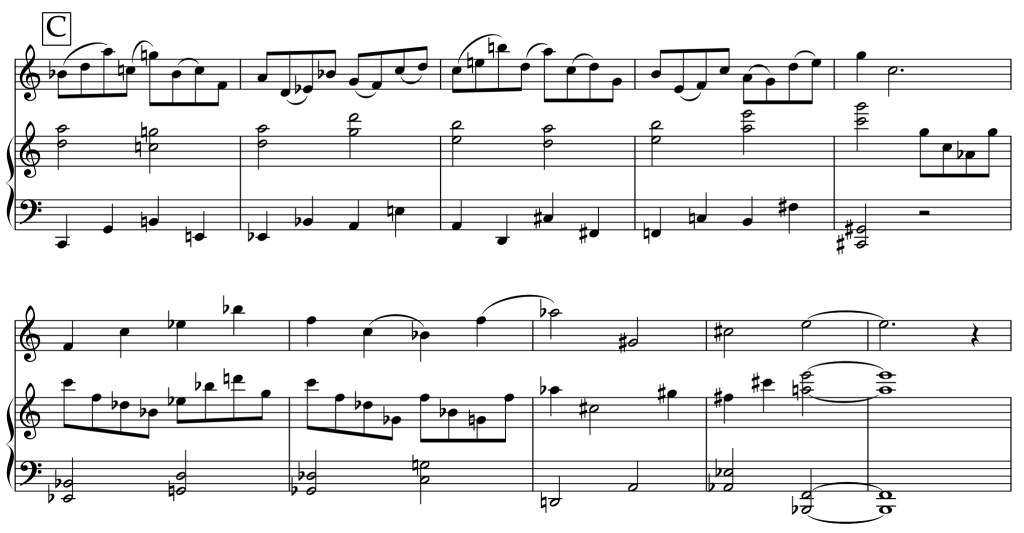
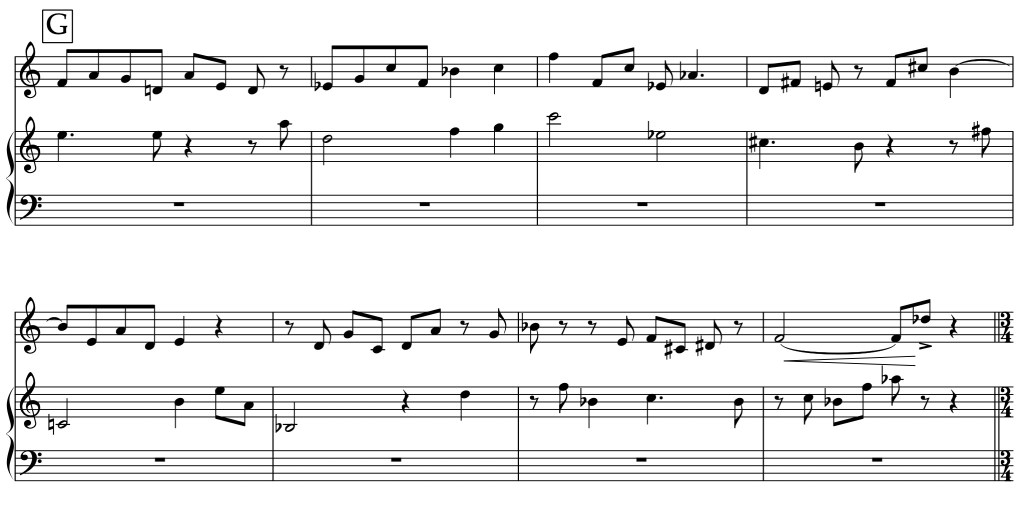
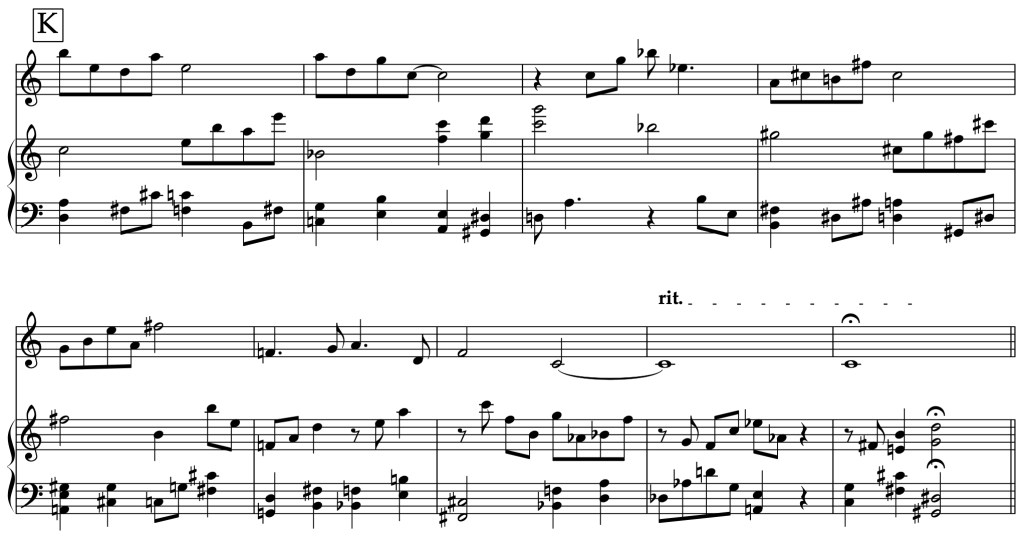
    Having reached a complex level of three rhythmically interacting, independent contrapuntal lines, a nice contrast will be to simplify. Variation G reduces to a lower-register flute line and only a much simplified skeletal supporting line above it in the right hand.

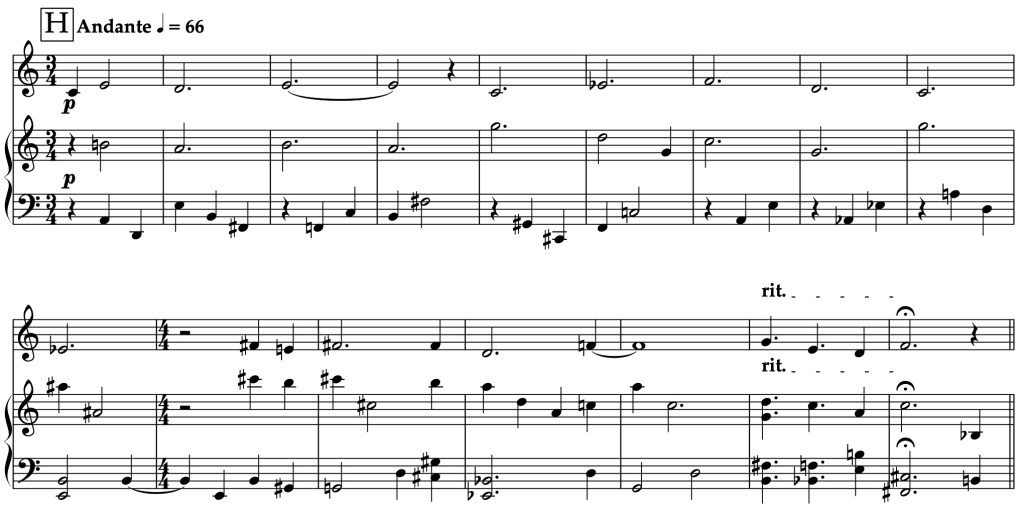
    Then the texture begins to revert rhythmically to a simpler alignment of all chord tones.

    This paves the way back to a simple piano texture revealing the fundamental thematic chord progression.

    Shape a time form

    What is the plan for the whole? How will the various versions of the generating idea unfold in the larger time span of the whole piece?

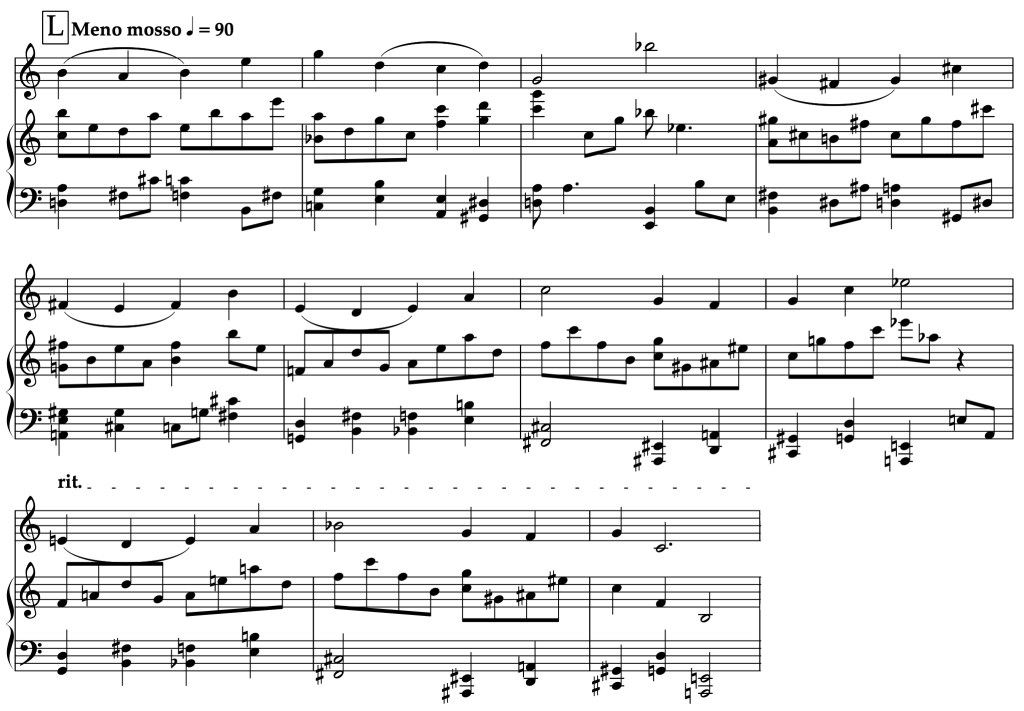
    The quiet letter I variation is the apex of an arch form . . .

    • starting with simple
    • building up more rhythmic and textural complexity
    • reaching a stable plateau
    • subsiding back to what started it all.

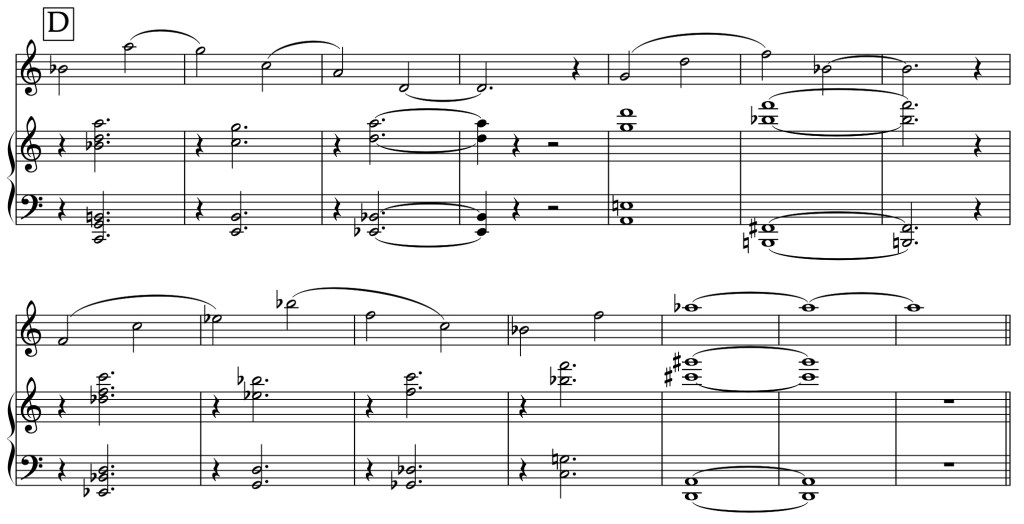
    That sets up a recapitulation of the whole process, building up textural complexity again, first with the high two-part counterpoint:

    Then with three voices:

    Flute line “calming down”:

    Coda

    A good essay ends with a conclusion or a summary restatement of the thesis.

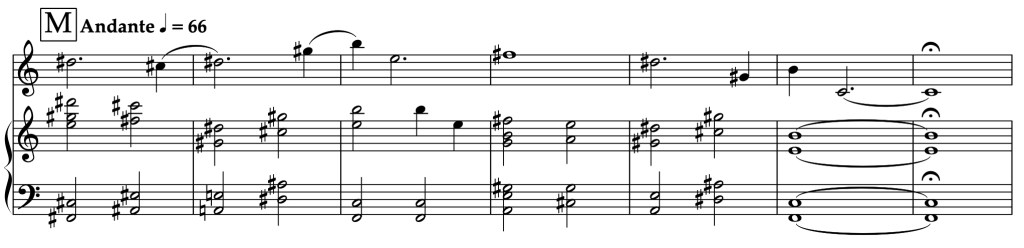
    Our musical coda summarizes with a last return to the beginning. The chords are back to their very low and very high registers. The flute makes a small melodic arch, ascending to the pitch B, then climbing down gently to its lowest possible pitch, C.

    Fine

    A final edit and audit are mandatory. In the case of our example, listening revealed that the beginning needed a piano introduction with some rhythmic vitality. Some sections were also reordered to improve the flow. Thus, the piece will not begin with a plain statement of the progression, and there will be a somewhat different order of other events.

    Now listen to the whole 6-minute parade of variations on a single chord progression.

  • Paths of Light – a composer’s journal
    a composer’s journal –

    retrospectively logging places, events, ideas, and sounds of a life of composing.

    Each chapter remembers a time and place in my career, and explores a particular compositional design approach derived from my study of 20th-century masterworks. Audio clips offer listening to all pieces cited, both the masterworks and my later compositions inspired by them. Take some time to listen as well as read! – TC

    LINK TO CHAPTER

    CONTENTS

    LINK TO CHAPTER

    Read it all:

    a composer’s journal

  • Book of Canons

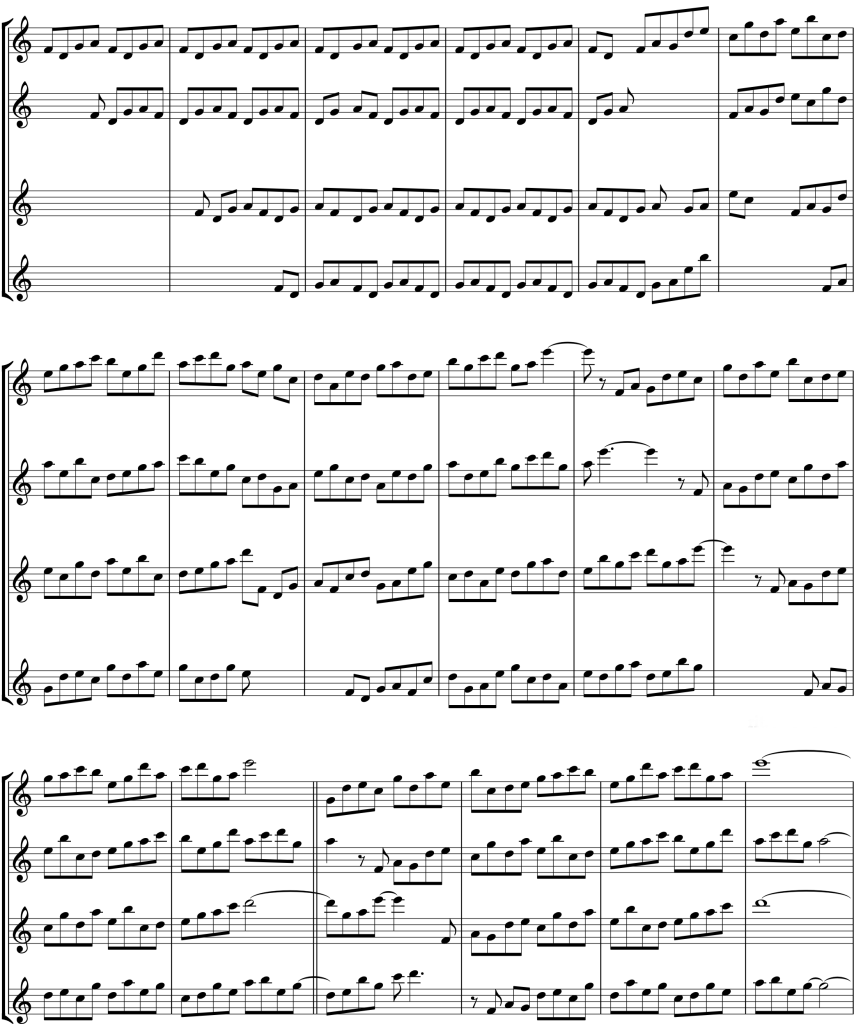
    My compositional fascination with musical canons began in the early 1970s with study (at the University of Michigan) of Ockeghem’s 15th-century polyphony, the 10 canons in Bach’s 18th-century The Musical Offering, and Webern’s 20th-century Symphonie Op.21. As a young professor in the 1980s teaching 16th-century counterpoint at what was then North Texas State University (now UNT), I used canon as a challenging contrapuntal writing assignment. In 1985, a wind ensemble piece, Parallel Horizons (Homage to Schoenberg), was my first formal composition constructed by canon. In Dark Matter, other contrapuntal writing surrounds an extended canon. Now canon pervades much of my 21st-century writing, a challenging yet stimulating and gratifying approach to texture and continuity of material.

    The definition of this ancient form of Rumpelstiltskin magic, spinning complex counterpoint out of a single melodic line:

    CANON
    A leading line is echoed after some delay by one or more answering lines of identical rhythmic values and melodic shape (possibly transposed)

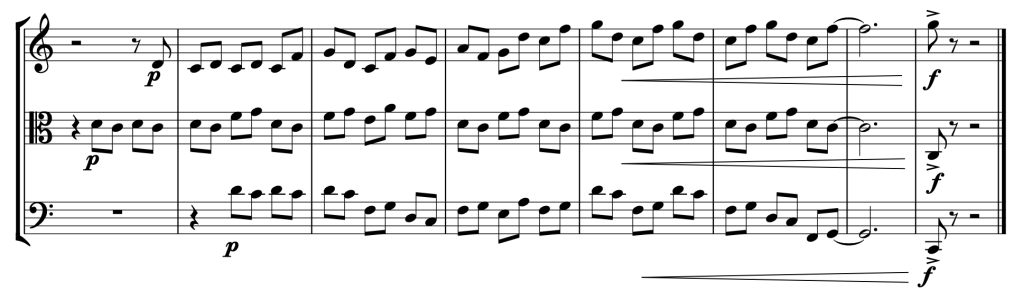
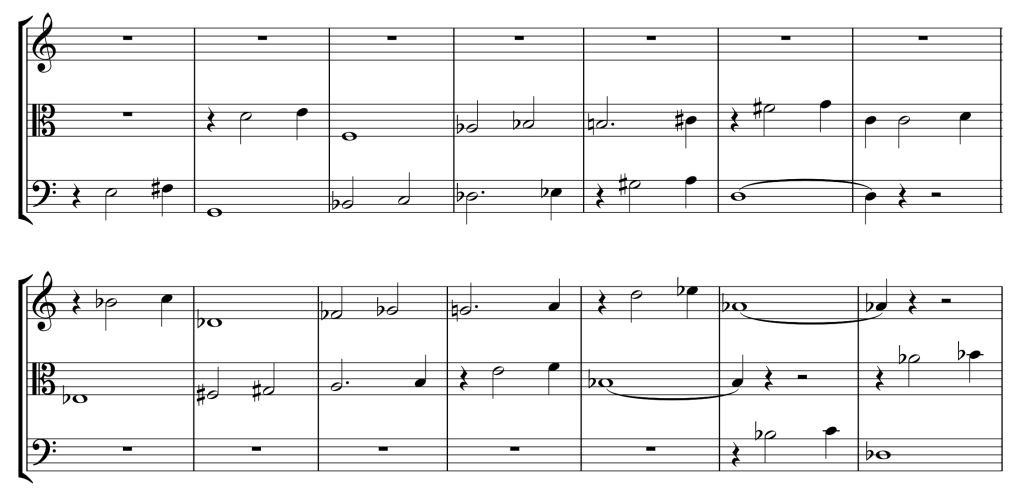
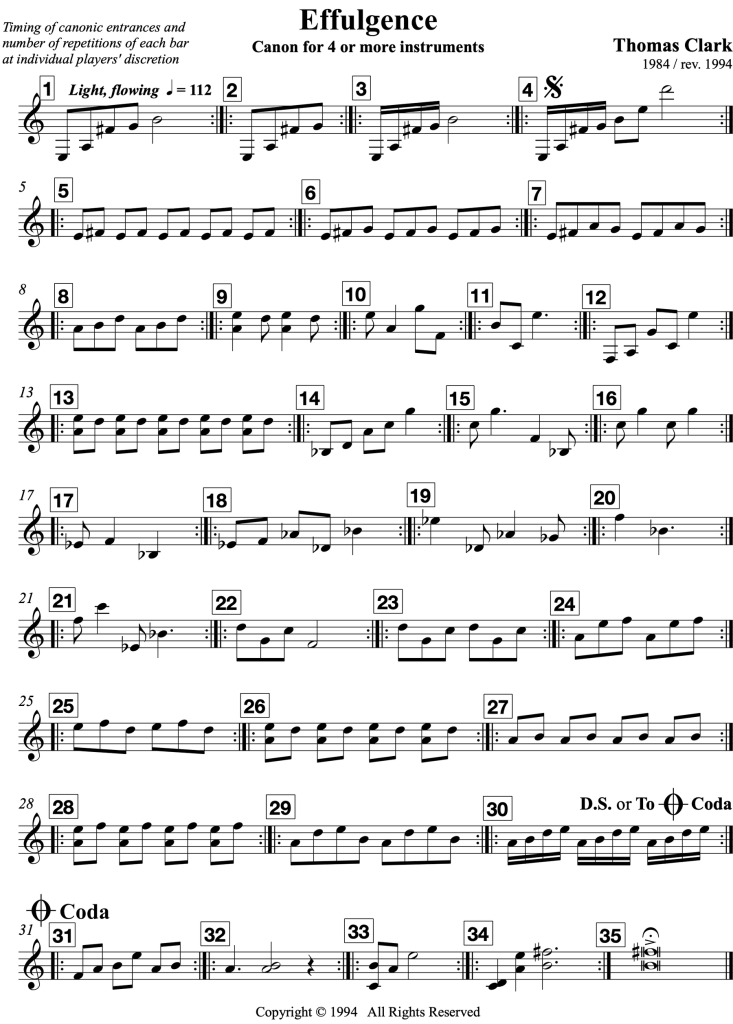
    For a collection of 21st-century examples – 14 studies in 3-voice canon – go to my BOOK OF CANONS in the appendices. For pedagogical demonstration purposes, the subject of each is shown, with indications for when and at what pitch level each answer will occur.

    Read more at Mapping the Music Universe: COUNTERPOINT.

  • GALAXIES: Musical Structure and Relativity

    Pursuing a grand cosmic metaphor, think about the levels of structure scientists study in our physical universe. They have dived deep below the atom’s structure of electrons spinning around a nucleus of protons and electrons to discover subatomic particles like the meson and boson. On the other extreme of scale, they have gathered observations to speculate about the shape of the entire expanding universe. We understand the structure of our planet, of our solar system, and our Milky Way galaxy.

    Texture

    Painting engages techniques to create texture, rising to broad descriptions of style that actually describe structure: impressionism, cubism, pointillism. Musically, macro-structure is thought of as texture and form. Texture has been treated in broad descriptive categories: monody, homophony, polyphony, counterpoint, and more recently, sound mass, each focusing on the number of distinct parts, voices, or layers and how they interrelate. At the risk of invoking too many different metaphors, I like to think of the musical texture as a fabric.

    Other topics

    • Counterpoint
    • Rhythmic alignment
    • Canon
    • Farben
    • Symmetry
    • Pointillism
    • Repetition
    • Multi-phase ostinato
    • Sound mass
    • Hauptstimme
    • Density
    • Relativity

    To read more, request a password from tc24@txstate.edu

    Mapping the Music Universe by Thomas S. Clark . . . CONTENTS