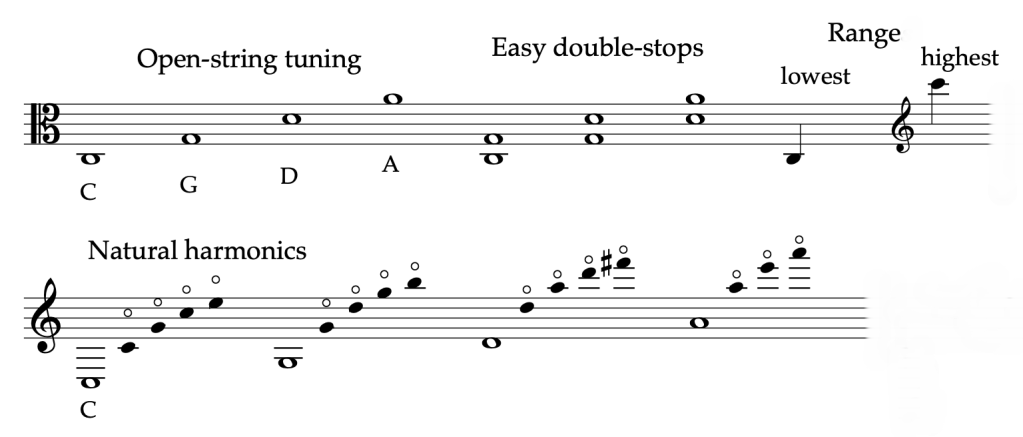
Unaccompanied instrumental solos go back at least to the 18th Century, such as Bach’s violin partitas and cello suites. In the late 19th century, Debussy’s Syrinx for solo flute met the challenge of making a piece with just one wind instrument, not capable of the double-stops that complicate the rich textures of Bach’s string writing.
1. Choose a model
Syrinx launched a whole genre of unaccompanied flute solos, with Density 21.5 (1927) by Edgard Varèse and Sequenza (1958) by Luciano Berio leading the way to experimentation with virtually every wind instrument. My Night Songs (1969) for solo trombone is very much within the tradition of this genre. As a trombonist and undergraduate composition student, I used my intimate knowledge of the instrument to select gestures and techniques to experiment with compositionally.
2. Choose an instrument
I also love the viola, so I readily agreed to write an unaccompanied solo for each member of the Pleasant Street Players, including violist Ames Asbell.
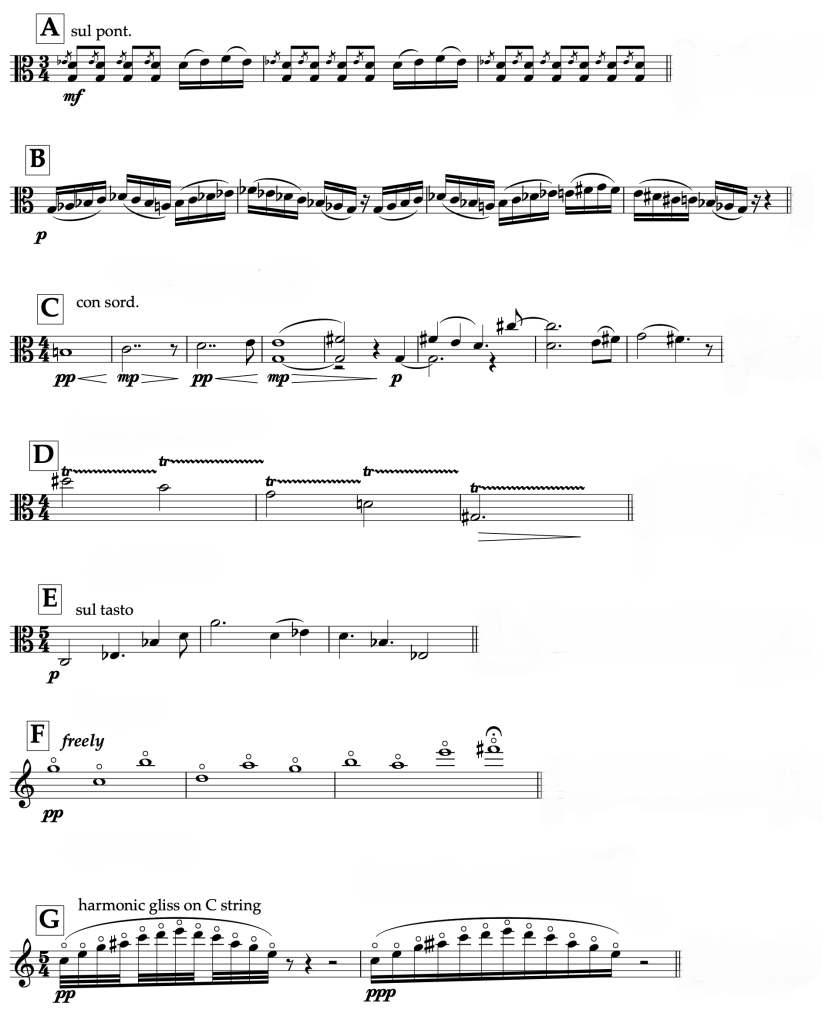
3. Sketch idiomatic gestures
Before I Sleep is inspired by a famous, beautiful Robert Frost poem, “Stopping By Woods.” Its snowy scene tempted me to quote a Mahler’s Symphony No. 4 (1900) that starts with sleigh bells and flutes doing something like the A gesture. (Sul ponticello is a special string technique to brighten tone by moving the bow closer than normal to the bridge.)
B features the quick scale patterns so indigenous to orchestral strings.
C uses a mute, attached to the bridge to subdue the tone. It also uses double-stops, drawing the bow across two adjacent strings together, making two-pitch diads and even two-voice counterpoint. These use an open string and the next string a perfect-fifth higher or fingering a pitch more than a perfect-fifth higher.
D makes bird-like trills.
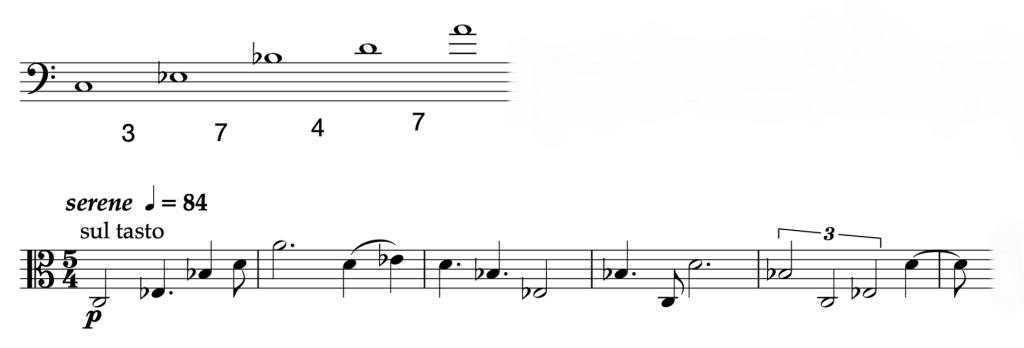
E uses sul tasto, the reverse effect of sul pont, drawing the bow closer to or over the fingerboard for a darker, warmer sound.
F makes the high, glass-like sounds of natural harmonics, produced by touching a string lightly at one of its partial-vibration nodes while drawing the bow on it. (harmonics, like open strings, have no vibrato. Sorry my synthesizer insists on applying vibrato anyway.)
G is a very special effect used by George Crumb in his early chamber music. Sometimes called a seagull effect, it produces a quick arpeggiated succession of natural harmonics by running a finger lightly up and down across the partial-vibration nodes of the string.
The gestures sketched above show a wide variety of pace and rhythmic characters.
4. Interval language
The B idea is scalar, running around through an unusual scale. It is almost an octatonic wholetone-halftone scale, but modified by an Ab, making the lower tetrachord the start of a Phrygian mode scale.
For the rising and falling landscape of melodic lines, choice of pitches and the cumulative constellations they form can be freely crafted the old fashioned way, plunking out pitches on a piano (or on the actual instrument of the piece) in a trial-and-error search for pleasing pitch streams. Identifying one’s favorite intervals can lead to using a more organized cell approach, limiting melodic interval choices to only two or three sizes.
In the TC example, an interesting constellation is established and simply arpeggiated in various shapes.
This produces a single, stable harmonic prolongation, a calming stasis in which the line keeps retracing recently touched pitches.
5. Edit the notation
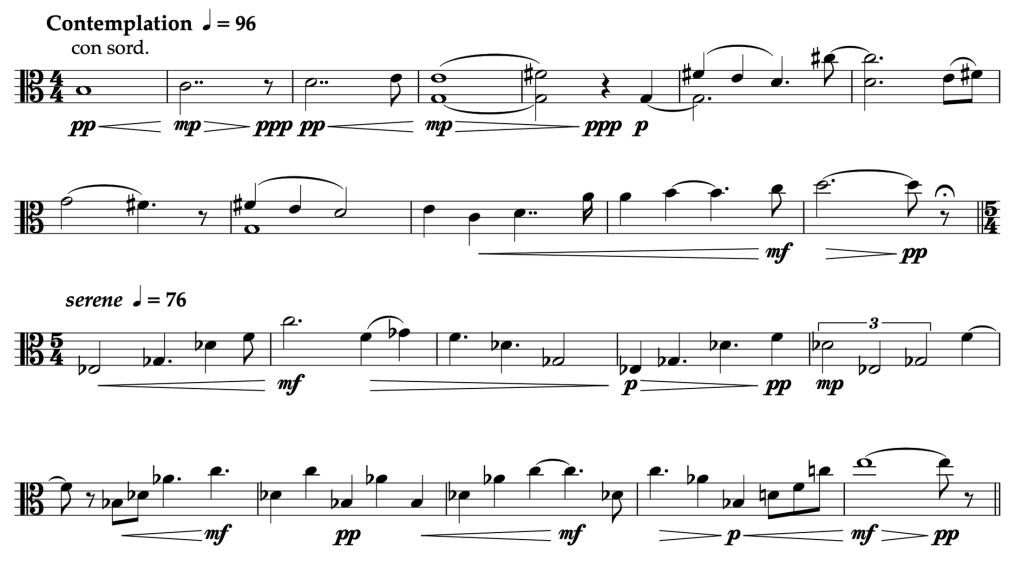
The score is not finished until all details are included, showing clear information and intent. A solo line especially needs strong dynamic shaping to be interesting as a solitary musical voice. The following example from the viola solo notates many of the necessities on this checklist:
timing information, including tempo, rallentando, fermata
expressive indications
dynamics, including ample changes, crescendos, diminuendos
phrasing such as slurs
special techniques such as con sordino, sul pont, sul tasto, harmonics
6. Overall form
An unaccompanied solo is a soliloquy. The dramatic tone can vary: a rage; a contemplation; or a story. The form can be a continuous flow of development of a single, persistent gesture, as in Berio’s Sequenza series. Or it can be sectional, a story told in short chapters, a poem divided into stanzas.
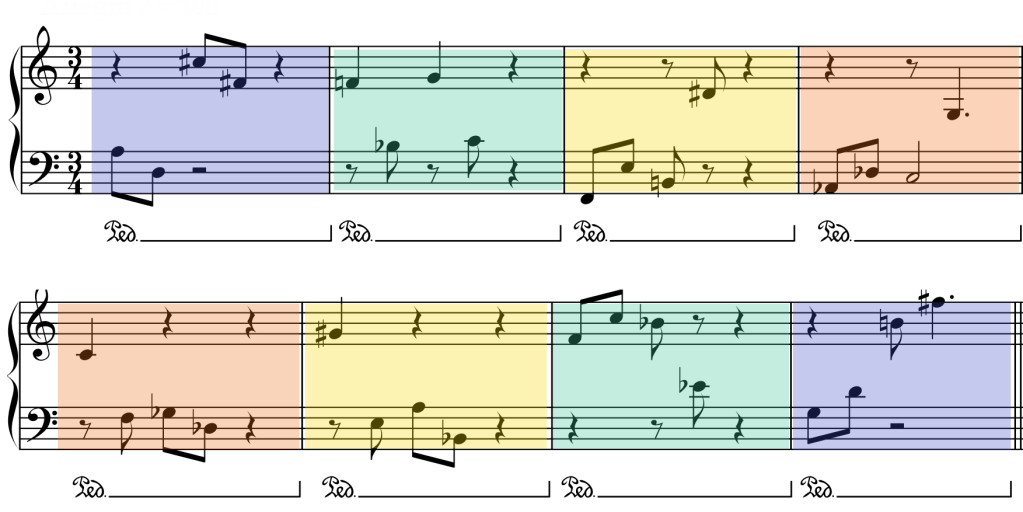
The TC example, actually a previously composed 2018 piece titled Before I Sleep, was written for my colleague Ames Asbell of the Texas State music faculty and Pleasant Street Players, an outstanding artist and player of one of my favorite instruments. The title is a quote from the last lines of Robert Frost’s famous poem “Stopping by Woods,” a contemplation of death on a nocturnal sleigh ride in the snow. The lead motive is a quote from Mahler’s Symphony No. 4, which open with flutes and sleigh bells jingling what is called the “bell theme.” My musical form follows the poem, in three sections:
sleigh bells and a trotting horse (gestures A and B)
snowflakes (a variation of B transitioning into D and F)
contemplation (C and E)
The poem ends famously with a direct repetition of the last line, “and miles to go before I sleep.” That could have been the going-to-sleep hypnotic musical ending as well, but the poet is not ready to die. My musical ending instead is not a coda but a brief tag, gesture G, the horse gently shaking his bells in the glistening moonlight.
Some points of starlight are actually double stars or star clusters, as revealed through a sufficiently powerful telescope. Borrowing that term, one particular type of musical pitch constellation arising in the 20th century involves sounding adjacent scale steps together as a simultaneity.
CLUSTER — a constellation presented harmonically consisting of adjacent scale steps separated by small scalar intervals of one or two semitones.
If the intervals are one-semitone half-steps from the chromatic scale, the resulting harmony is intense, dark, dissonant. If the separating intervals are mostly whole steps, the quality can tend to be like bright glowing light.
It turns out that the diatonic scale is rich with cluster possibilities.
diatonic clusters
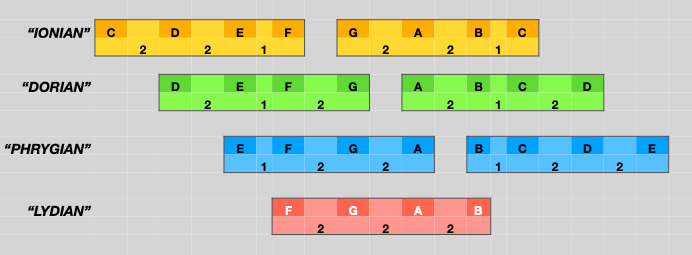
The names are borrowed from the Greek names of modes. One cluster array that can be readily found throughout the octatonic scale but not possible within a diatonic scale is the 1 2 1 array, since the diatonic scale has no one-semitone intervals that close to each other. One other cluster array not found in the diatonic scale is the intense, gritty 1 1 1 chromatic-scale array described above.
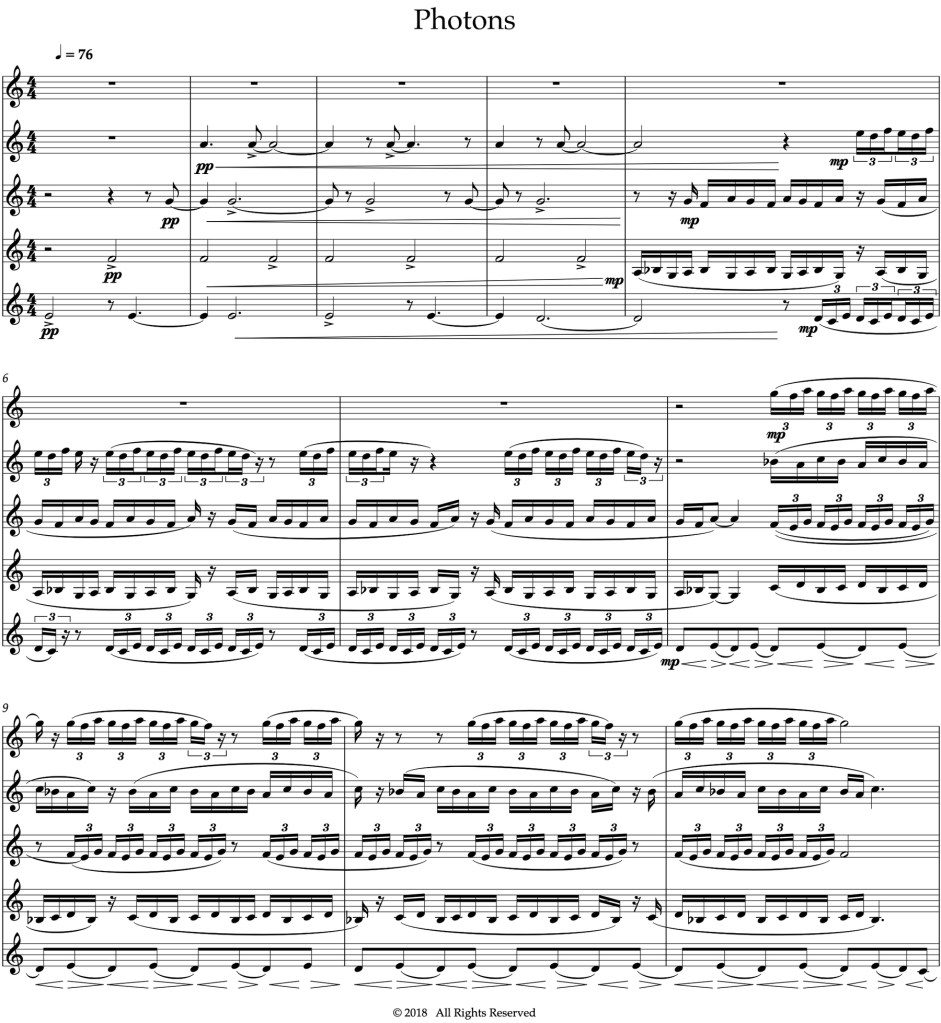
Harmonic constellations built from clusters can be still and radiant or animated by rhythmically active lines close together in pitch space. Here is a composed example that does both.
Photons excerpt
Symmetrical arrays
Dorian and Lydian clusters are symmetrical. Their scale-pattern arrays — 2 1 2 and 2 2 2, respectively — are the same when inverted or reversed. Many other interesting pitch constellations have this property.
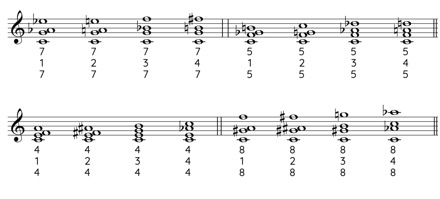
Here is a sampling of other, taller symmetrical constellation arrays, reading the same from top to bottom as bottom to top:
many symmetrical arrays
Note that although each is a 4-pitch constellation, two of them (4 4 4 and 8 4 8) contain an octave and thus only three unique pitch classes.
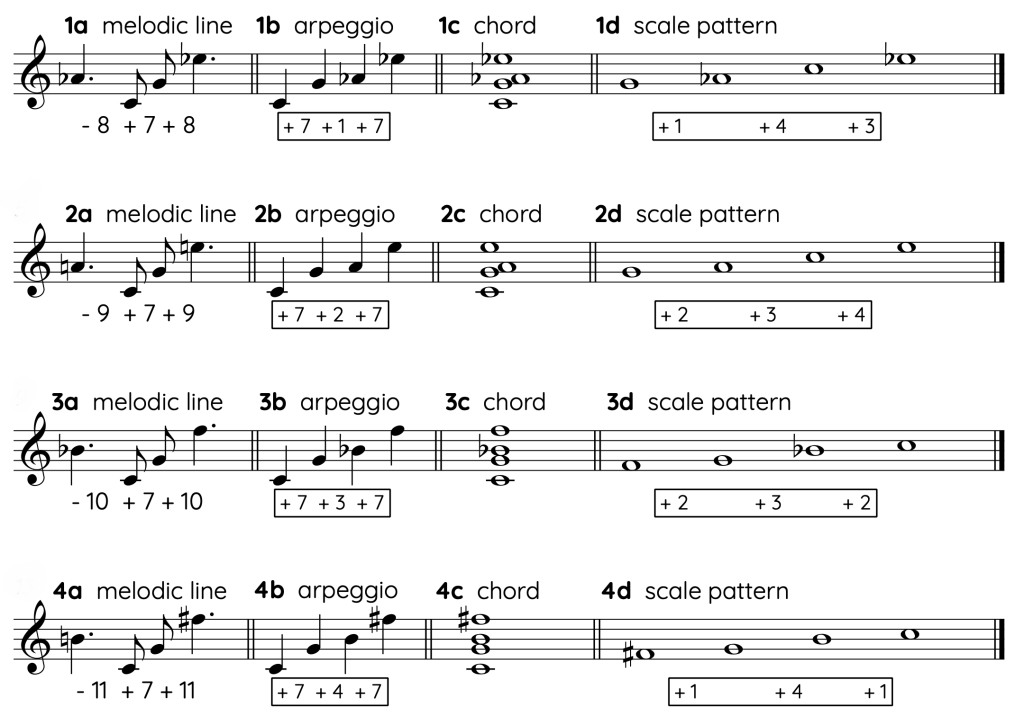
The example below explores the first four arrays listed above. The stacked interval array of 4d is: 7 4 7. Note too that this constellation contains two 11-semitone intervals (+7+4 and +4+7) — in example 4d C up to B and G up to F#; and one very large interval of 18 semitones, C up to F# in the higher octave.
four symmetrical arrays
Three of the four could be analyzed in triadic harmony: 1c as an Ab Major-Major 7th chord in first inversion; 2c as an A minor-minor 7th in first inversion, or a C Major triad with jazz added 6; and 4c as a C Major 11th chord with 3rd and 9th missing! And 3c could be seen as a rearranged voicing of a segment of the “Circle of Fifths”! Obviously, I don’t recommend such contortions of traditional harmonic analysis to explain these beautiful, symmetrical constellations.
Each constellation’s successive-interval array, its stack, is symmetrical under mirror-inversion or palindromic — that is, its interval stack reads the same lowest-to-highest or highest-to-lowest: 7 1 7 and 7 4 7 are two of my favorite constellation stacks.
These interval stacks were chosen here for two of my particular interests. Each features the “Perfect-5th” 7-semitone interval at top or bottom, with a smaller interval in the middle. The Perfect 5th has a stable, rooted quality, but with two “roots” in the harmony, the overall stability of the sonority is compromised — complex yet balanced. It is like a “double star” in astronomy, to further pursue my constellation metaphor.
Acoustic quality
We started with clusters, sonorities that would be traditionally considered highly dissonant. To assess a constellation’s quality or sound character, we will transition from the concept of consonance and dissonance to an assessment of acoustical complexity.
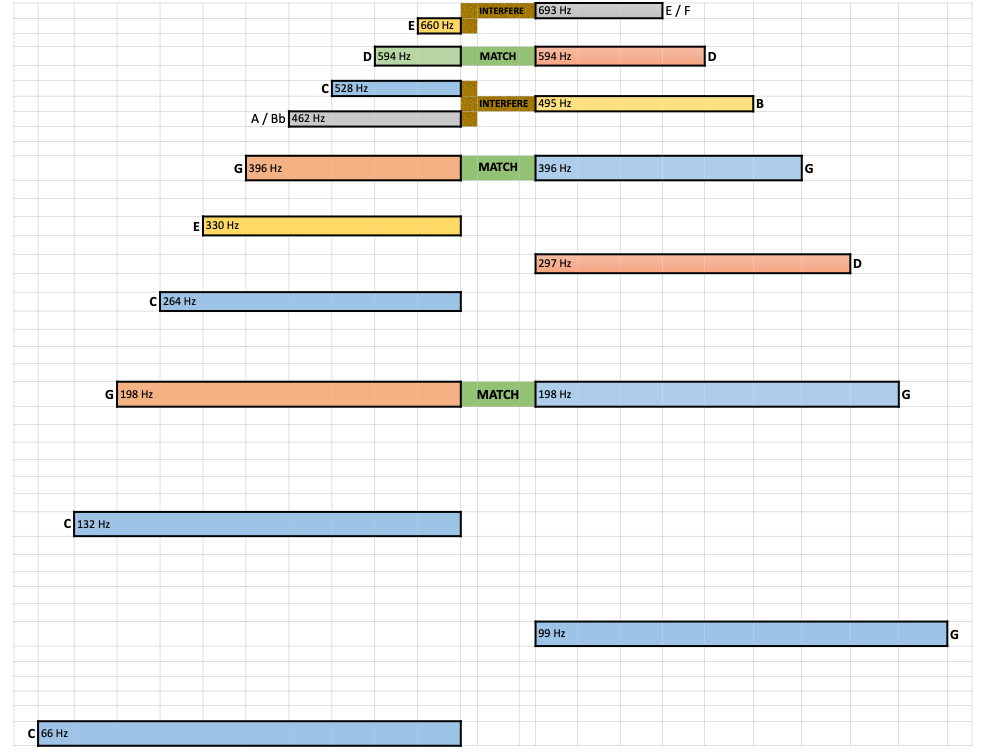
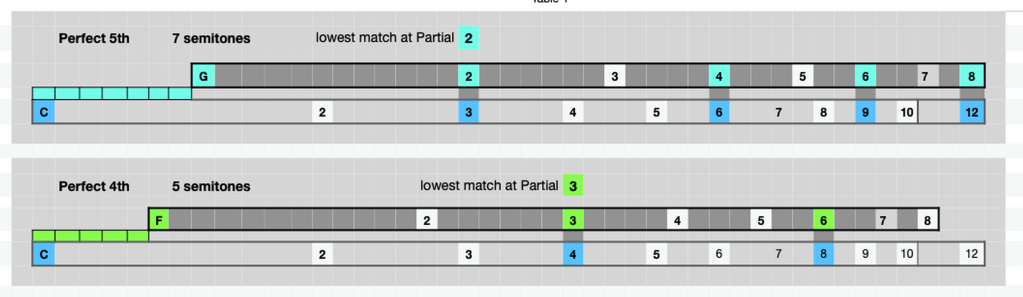
When two pitches sound together, they make a harmonic interval, but also their distinct overtone series are interacting. In the purer sounding intervals, this interaction is mainly a closely compatible one, with some overtones matching. An example, take a Perfect 5th, C up to G. Their overtones are:
overtone match for a Perfect Fifth
The matching or interfering overtones make more of a difference with the lowest partials, as the higher overtones are fainter and fainter higher up in the series. So the c’ 4th partial of C interferes with the 5th partial b’ of the G overtones; but that interference is fainter than the lower g-to-g match. This gets scientifically and mathematically complex to calculate, as we will tackle in a while below.
For now, the ancient classification for counterpoint is accurate enough to adapt: Perfect Consonance, Imperfect Consonance, Dissonance . . . though I will distinguish between mild dissonance and strong dissonance.
PERFECT CONSONANCE — intervals P8, P5 and P4 (12, 7 and 5 semitones) — “pure”
IMPERFECT CONSONANCE — intervals of major and minor 3rds and 6ths (3, 4, 8 or 9 semitones) — “triadic”
MILD DISSONANCE — intervals 2 semitones different in size from a unison, octave, or double octave (2, 10, 14, 22, 26 semitones) and the tritone (6 semitones)
We can use these distinctions to come up with an assessment of the general harmonic complexity of a constellation’s intervals.
PURE — containing no intervals except perfect consonances
SIMPLE — containing no mild or strong dissonances
MODERATE COMPLEXITY — containing at least one mild dissonance but no strong dissonance
STRONGLY COMPLEX — containing at least one strong dissonance
Examples of increasing complexity:
It is important to note that strongly complex does not mean “unpleasantly dissonant.” The Major-Major 7th chord in this category (C E G B) is quite a beautiful harmony. And the last two complex examples, quartal and quintal chords, are the sturdy mainstay of 20th-century American composers such as Copland.
In a recorded excerpt of Tyshawn Sorey’s Pulitzer Prize-winning Adagio (2023) for saxophone and orchestra, beautiful sonorities are quietly complex, tensely dissonant, dark and mysterious in their lyric unfolding. Like dark clouds, some morph to reveal brighter sounds, even simple triads. While there is no sense of any “chord progression,” there is a feeling of impending change in the air.
In notes on a recent composition, Frost Serenade, I described “changing tonal temperature.” Here is a deep dive into what that meant.
The metaphor of tonal color and temperature has to do with what we normally call consonance and dissonance in a chord or other harmonic entity. Centuries-old tradition classified musical pitch-intervals as pure, perfect consonances (“Perfect Fifth” and “Perfect Octave” for example); major or minor (exp. “Major Third” or “minor Sixth”); or problematic (“Augmented Fourth” and “diminished Fifth”). Some major and minor intervals (thirds and sixths) were considered imperfect consonances; the others (seconds and sevenths) were considered dissonant. Every music student learns these categories while studying 16th-century model counterpoint.
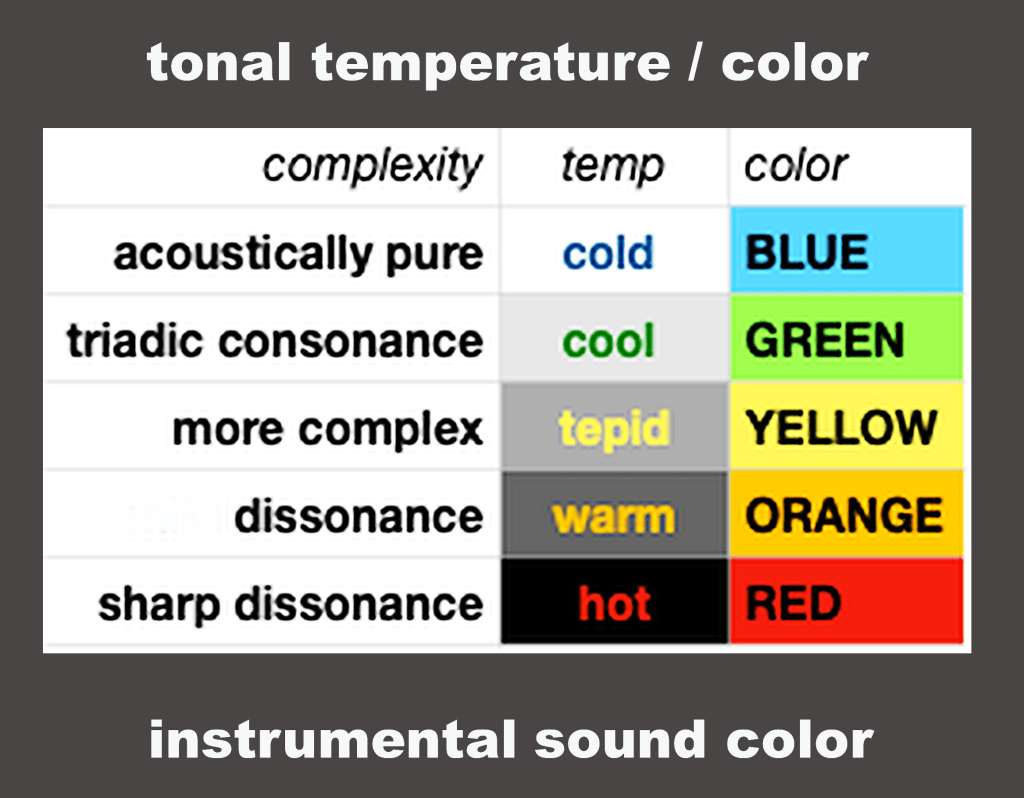
Using the color spectrum in temperature order:
harmonic color spectrum
Let’s convert the consonance/dissonance concept, going back to a pitch-interval’s acoustic complexity. Reviewing what was explained above: every musical tone has a fundamental pitch, plus faint overtones that give the sound its color. They are of fading intensity and felt (as color) more than actually heard as distinct pitches. Discovered by Pythagoras as partial vibrations in whole-number fractions, the overtones are always in a fixed interval ladder, rising from the fundamental: Up an octave, then a Perfect Fifth, then a Perfect Fourth, a Major third, minorthird, then to the eccentric seventh partial, which is out of tune by our scale-trained pitch perception (and shown a pale gray below), and on to the eighth partial, which is three octaves above the fundamental. (An octave is a multiply-by-2 operator, so partials 2, 4, 8, and 16 of the C overtone series are also the pitch-class C. Likewise, partials 3, 6, and 12 are all octave related.)
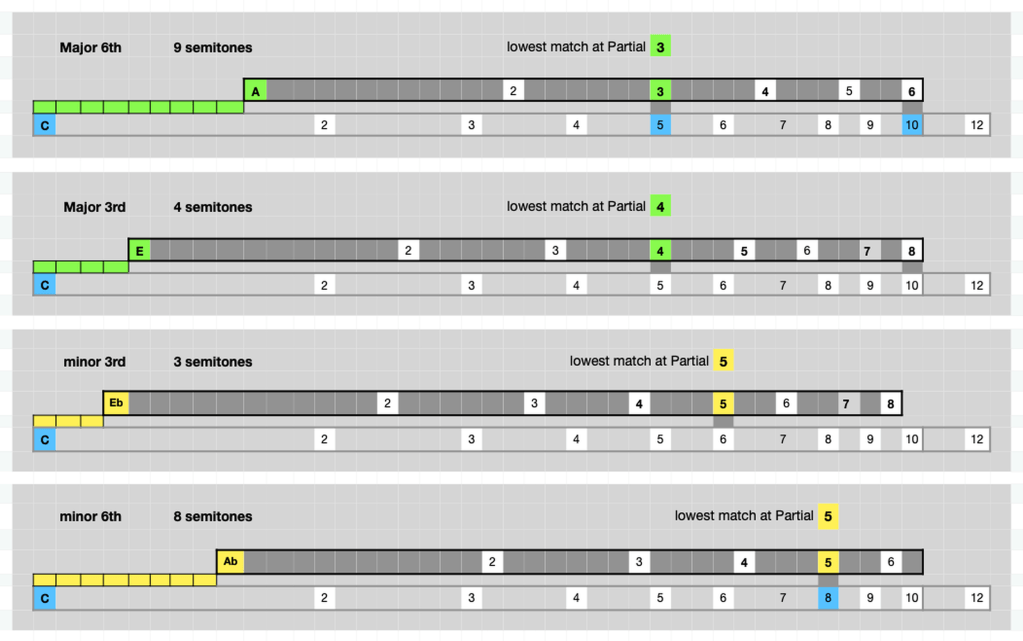
Two different fundamental pitches sounding together each bring into the acoustical mix their distinct overtones. The overtones from one either match (simple) or clash with (complex) overtones of the other. This is what makes the sonic complexity or perceived purity of the interval between two fundamental pitches. Using this relationship, we theorize that the higher we need to go to start finding matching overtones between the two pitches, the more complex is the interval. Following this logic, here is an overtone-match analysis of all harmonic intervals smaller than an octave. (We’ll show these horizontally to fit better what would otherwise be very tall slender graphics!) Each interval is shown from a fundamental pitch C up to a higher pitch.
PERFECT CONSONANCES
overtone match for perfect consonances
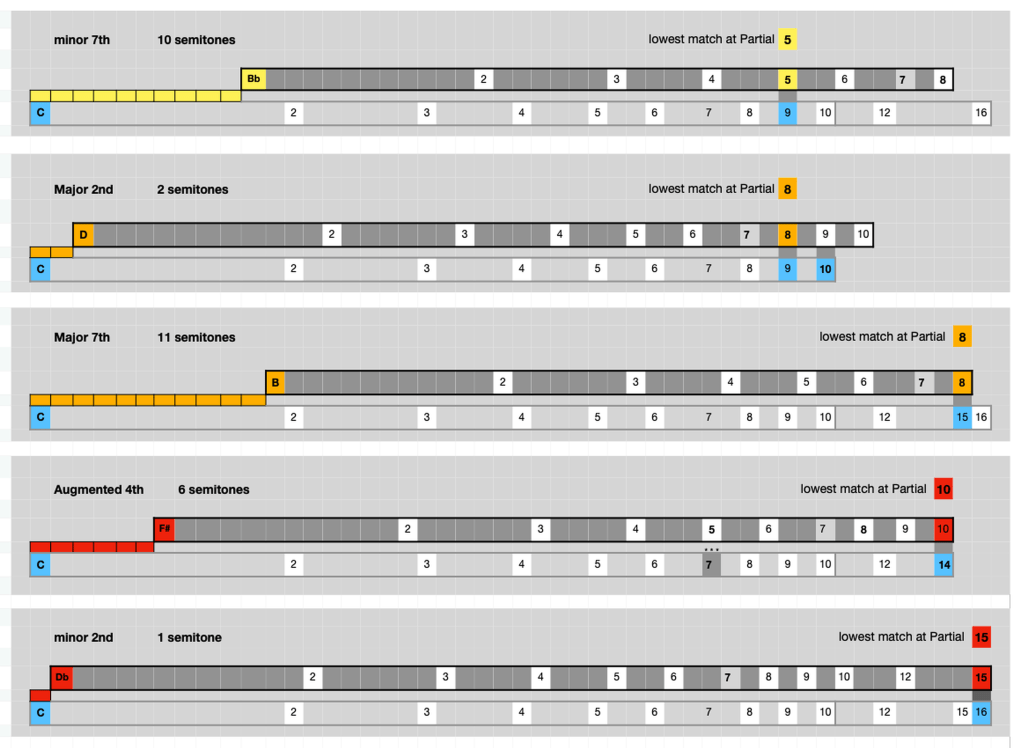
The rather pure Perfect Fifth interval between fundamental pitches, C up to G, matches overtones at G’s partial 2, a low level in the series, matching the C’s partial 3. The interval makes four such matches in this lowest-two-octaves span. The pitch match up of the G’s 2nd partial with the C’s 3rd partial (both are the same pitch, G) will be duplicated in all higher octaves, making this an acoustically simple interval. The two pitches’ overtones mostly match and don’t interfere with each other much.
IMPERFECT CONSONANCES
overtone match for imperfect consonances
The triadic consonant Major 3rd interval between fundamental pitches, C up to E, matches overtones at a somewhat higher level in the series, partial 4, and makes two matches in this lowest-two-octaves comparison.
DISSONANCES
overtone match for dissonances
The dissonant minor 7th interval between fundamental pitches, C up to Bb, matches overtones makes only one match in this lowest-two-octaves comparison, at partial 5. That means its harmonic quality is more complex, with most of the lower overtones interfering, not matching. Not a strong dissonance, but more complex than the others.
By contrast, with the more complex Major Seventh interval (ex. C up to B), you have to go all the way up three octaves to the B’s 8th partial (matching the C’s 15th partial!) to find an overtone that matches and doesn’t conflict/interfere. The Major 7th interval can be considered much more complex at a rating of 8 than a Perfect 5th at rating 2.
The most complex interval analyzed, the minor 2nd, clashes all the way up until the 15th partial.
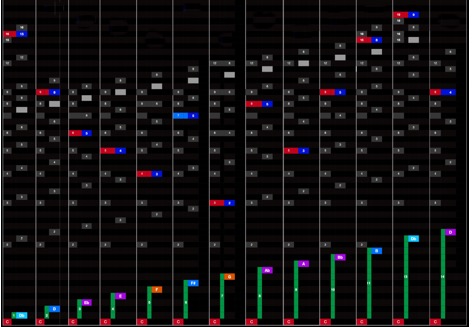
A colorful summary depiction of this Pythagorean analysis of harmonic intervals looks rather like a modern-day sound mixing board.
overtone matching for 13 intervals
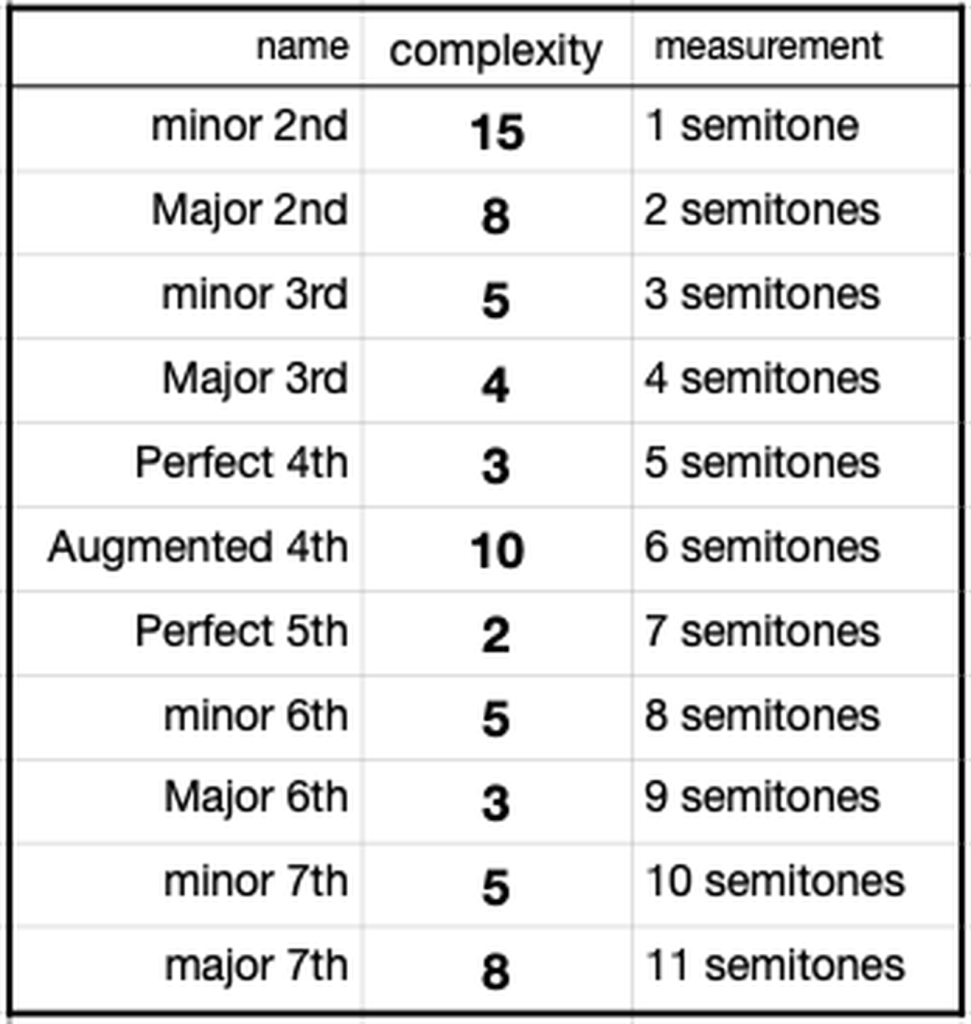
Summarizing the analysis with a complexity rating number for each interval:
interval complexity ratings
Now we can add up the ratings of each interval in a chord and take an average complexity quotient. And we can think of complex as darker than simple, or we can invoke the color spectrum. In digital photo imaging, we use a temperature metaphor, seeing red as warmest (infrared heat) down through orange, yellow, green, down to blue, the coolest. The “hottest,” most complex harmonic interval is the minor 2nd. The “coolest,” purest (other than the octave) is the Perfect 5th.
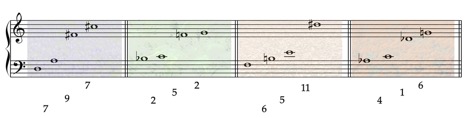
The intervals in the following example are shown in semitones. Each chord has four pitch classes and six intervals between them. The Blue chord has an average complexity rating of 3.8. Green chord is slightly more complex, at 4.3. Yellow, which includes the more complex 11-semitone Major 7ths, rates 5.5. And Orange, with the only minor 2nd 1-semitone hot dissonance, is warmest at 6.2. Try to hear the differences. (No attempt here to demonstrate the red-hot complexity of 10 or higher for a cluster chord!)
examples of four temperatures
The following demonstration phrase uses hose four chord types to build a progression of tonal temperature colors. Again, as you listen, try to feel the temperature warm up then cool back down.
What is a scale? Its essence is an interval pattern, selecting which pitches out of the entire chromatic possibilities become scale steps. Successive interval arrays are a vivid way to describe its pattern:
SCALE PATTERN — periodic interval pattern that cycles through each octave, defining which pitch-classes from the 12 possibilities are degrees of the scale
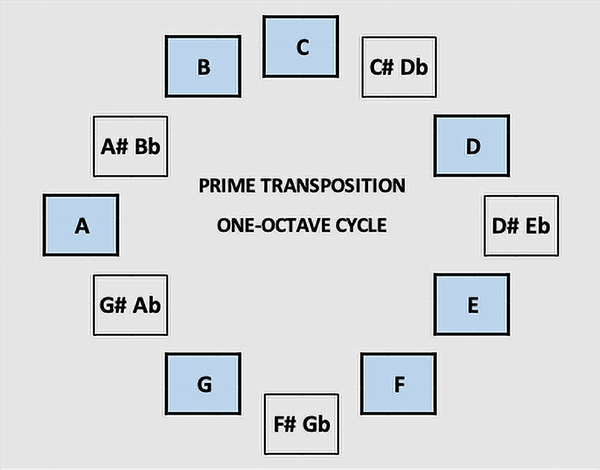
In that sense, it is a theoretical circle, starting over in each octave — or more imaginatively, a spiral. Let’s visualize the natural-note white keys on the keyboard, a prime example of the ubiquitous diatonic scale, as a circle.
diatonic scale circle
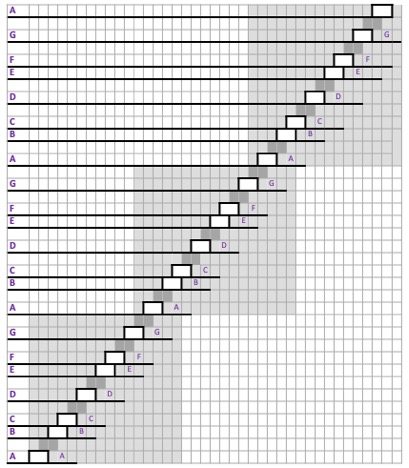
Now an unlooped visualization as stair steps, rungs on a spiral ladder:
diatonic scale cycling through three octaves
Anyone familiar with the white and black keys of a piano will recognize this pattern!
Chroma
Almost all scales in both Western music and other art-music traditions are built on the framework of octave equivalence, the close affinity of two pitches that are one or more octaves apart. We give them the same pitch name – all called “C” or “F#” for example. This makes the circular nature of a scale, that its pitch names and the intervals between them start over at the octave and repeat.
We also have the feature on an equal-tempered piano that one black key produces a pitch with two possible names depending on the scale in which they appear. For example, the D# seventh scale degree in an E Major scale is the same piano key as an Eb, the fourth scale degree in a Bb Major scale. The two pitch names are said to be “enharmonic.”
When a melodic line in an all-white-key C major scale introduces an F# for color or to temporarily alter the interval terrain, we call it a chromatic tone, after the Greek word for color, chroma. Now we have a comprehensive scale of all possible pitches. Going further, theorist Allen Forte defined a way to reduce all the pitches in an entire eight-octave chromatic pitch space into just twelve categories:
PITCH CLASS — a set of all pitches that are octave and/or enharmonically related
He gave them pitch-class numbers 0 through 11.
chromatic scale
In the advent of computer systems to produce, edit, and analyze musical sound, a sound’s identified pitch class is termed its chroma.
Synesthesia – some people, such as the composer Scriabin, actually see a color when they hear a pitch or a tonal key. In his variant of synesthesia, C is red, G is orange, D yellow, and A green. Scriabin’s Promethius: The Poem of Fire (1910) includes a part for “clavier à lumières,” a color organ that emitted light of what he deemed the appropriate color for a pitch instead of sound.
Scale prototypes
When we describe a scale, we name the pitches in order within an octave. Better yet, we name the successive intervals going up within the octave. The classic description of the ubiquitous diatonic scale, in whole-steps or half-steps, in its major mode starting on the tonic pitch, is:
tone / tone / semitone / tone / tone / tone / semitone
In the chromatic 12-tone universe, that scale pattern measuring the intervals in semitone sizes would be:
2 2 1 2 2 2 1
That is what I would call a scale pattern . . . a Successive Upward Interval Sequence in Semitones (SUISS!). But let’s call it a scale pattern array, working exactly like the arrays describing constellations.
Now we can particularize our scale pattern definition to apply to any smaller set of pitch classes, even if they don’t look like a scale:
SCALE ARRAY — successive interval array describing the pitches of a constellation condensed by octave equivalence to their most compact pitch-class-equivalent arrangement within an octave, ordered lowest-to-highest (Forte’s “normal order”)
In this sense, the array of a smaller set or scale fragment is just like a scale pattern.
Successive Interval array is a versatile tool that can apply to any pitch collection, to a linear, scalar pitch pattern as well as to a vertical chord sonority or even an arpeggiated diagonal collection of pitches I call a constellation.
Modes
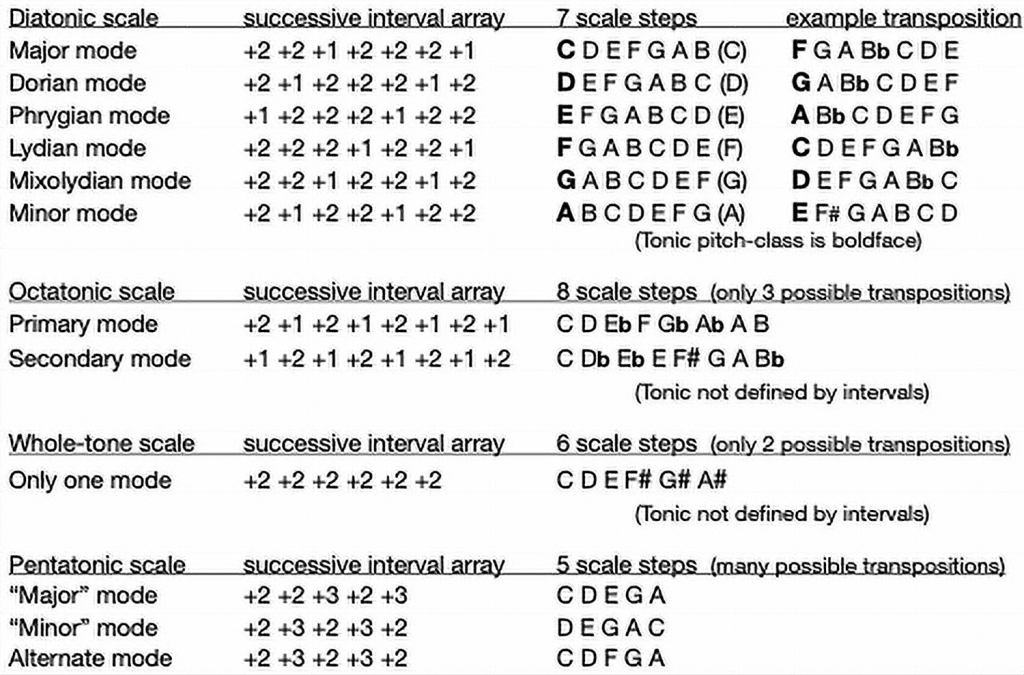
Most of our familiar scales are actually a different mode of the same 7-note diatonic scale, with a different starting and ending point called a tonic establishing the mode.
scale modes
Scale patterns / set classes
We can describe a set of pitches as an octave-compressed abstraction of 3 or 4 pitches as a lowest-to-highest ordering of pitch classes. It doesn’t produce anything like the 7 or so notes per octave we’re used to thinking of as a scale, as those shown above. It is conceptually powerful, nonetheless, to call the successive interval array of this compressed abstraction a scale pattern, even though it’s a scale fragment with no name. Its name can simply be the successive interval array, such as 2 4 2, the array describing a symmetrical pitch-class set called the French Augmented Sixth chord.
[Theoretical aside] In establishing set theory, Forte described these compact arrangements by naming the pitch-classes in order using a mod-12 number system shown above, C=0, C#/Db=1, D=2, etc. He identified twelve 3-note classes, including upside-down inversions reversing the scale pattern, as members of the same class. (Lewin kept these inversions separate, defining instead nineteen 3-note set classes. We’ll use Forte’s; the set classes as generalities are not as crucial to composing as to theoretical analysis.) Forte used cumbersome descriptions employing pitch-class numbers and “normal order.” In the Journal of Music Theory 15 (1971), Richard Chrisman defined and proposed successive interval arrays as a better, more revealing way to characterize the commonality of a family of pitch-class sets that are all related by transposition and/or inversion.
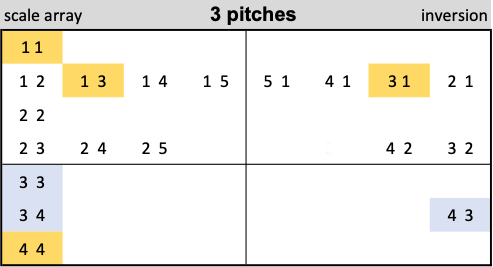
Relating to Forte’s concept of a set class, any set grouping three pitch-classes can be analyzed as an interval array or partial scale pattern.
scale patterns of all 3-pitch-class sets
Sets forming triads (or seventh chords below) are highlighted in BLUE; those that are atonal (cannot be found in a diatonic scale) are highlighted in GOLD.
While the number of possible interval arrays for constellations of four pitches is enormous — even if limited to interval stack sizes less than two octaves, there are more than 12,000 possibilities — we can use this scale-pattern abstraction tool to categorize them into forty-three 4-pitch-class families.
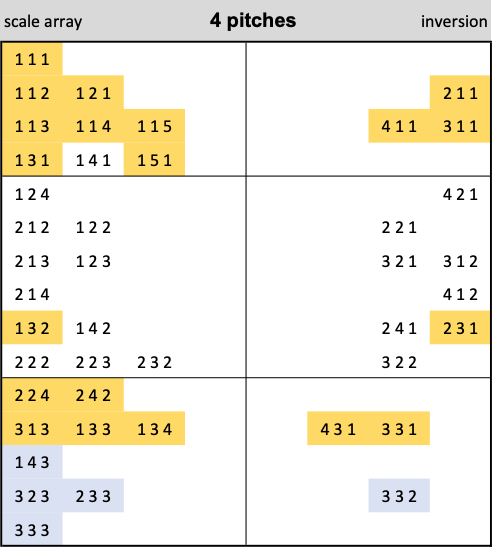
scale patterns of all 4-pitch-class sets
The blue-highlighted scale patterns have common triadic chord names:
1 4 3 = “Major Major 7th chord” (in any chord inversion)
3 2 3 = “minor minor 7th chord” (in any chord inversion)
3 3 2 = “dominant 7th chord” (in any chord inversion)
3 3 3 = “fully diminished 7th chord”
The scale pattern 2 4 2 is an interesting symmetrical, non-diatonic pattern called a “French augmented 6th chord”.
Vocabulary
These maps collecting 62 scale-patterns summarize all possible constellations of 3 or 4 unique pitches, our total harmonic vocabulary in the chromatic universe.