Some points of starlight are actually double stars or star clusters, as revealed through a sufficiently powerful telescope. Borrowing that term, one particular type of musical pitch constellation arising in the 20th century involves sounding adjacent scale steps together as a simultaneity.
CLUSTER — a constellation presented harmonically consisting of adjacent scale steps separated by small scalar intervals of one or two semitones.
If the intervals are one-semitone half-steps from the chromatic scale, the resulting harmony is intense, dark, dissonant. If the separating intervals are mostly whole steps, the quality can tend to be like bright glowing light.
It turns out that the diatonic scale is rich with cluster possibilities.
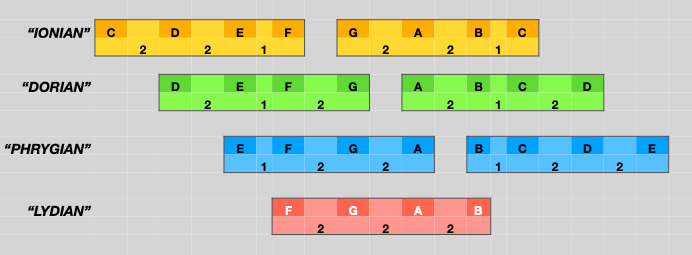
diatonic clusters
The names are borrowed from the Greek names of modes. One cluster array that can be readily found throughout the octatonic scale but not possible within a diatonic scale is the 1 2 1 array, since the diatonic scale has no one-semitone intervals that close to each other. One other cluster array not found in the diatonic scale is the intense, gritty 1 1 1 chromatic-scale array described above.
Harmonic constellations built from clusters can be still and radiant or animated by rhythmically active lines close together in pitch space. Here is a composed example that does both.
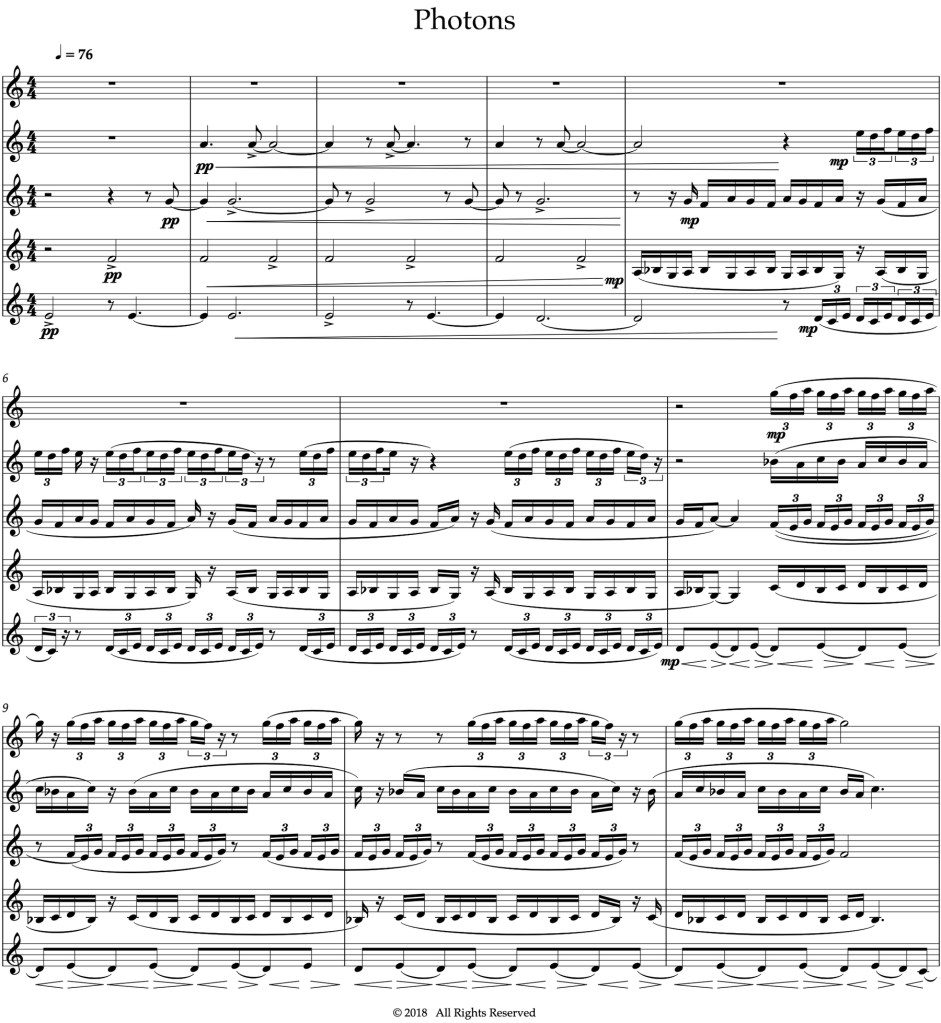
Photons excerpt
Symmetrical arrays
Dorian and Lydian clusters are symmetrical. Their scale-pattern arrays — 2 1 2 and 2 2 2, respectively — are the same when inverted or reversed. Many other interesting pitch constellations have this property.
Here is a sampling of other, taller symmetrical constellation arrays, reading the same from top to bottom as bottom to top:
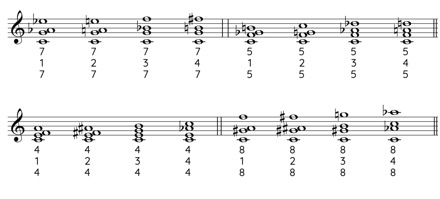
many symmetrical arrays
Note that although each is a 4-pitch constellation, two of them (4 4 4 and 8 4 8) contain an octave and thus only three unique pitch classes.
The example below explores the first four arrays listed above. The stacked interval array of 4d is: 7 4 7. Note too that this constellation contains two 11-semitone intervals (+7+4 and +4+7) — in example 4d C up to B and G up to F#; and one very large interval of 18 semitones, C up to F# in the higher octave.
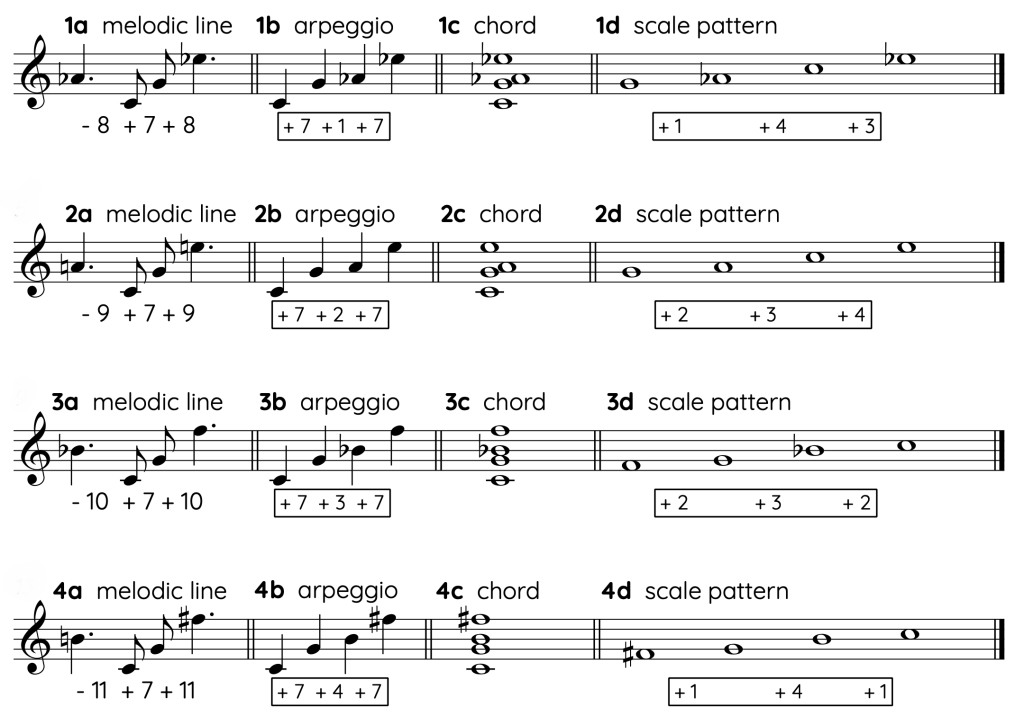
four symmetrical arrays
Three of the four could be analyzed in triadic harmony: 1c as an Ab Major-Major 7th chord in first inversion; 2c as an A minor-minor 7th in first inversion, or a C Major triad with jazz added 6; and 4c as a C Major 11th chord with 3rd and 9th missing! And 3c could be seen as a rearranged voicing of a segment of the “Circle of Fifths”! Obviously, I don’t recommend such contortions of traditional harmonic analysis to explain these beautiful, symmetrical constellations.
Each constellation’s successive-interval array, its stack, is symmetrical under mirror-inversion or palindromic — that is, its interval stack reads the same lowest-to-highest or highest-to-lowest: 7 1 7 and 7 4 7 are two of my favorite constellation stacks.
These interval stacks were chosen here for two of my particular interests. Each features the “Perfect-5th” 7-semitone interval at top or bottom, with a smaller interval in the middle. The Perfect 5th has a stable, rooted quality, but with two “roots” in the harmony, the overall stability of the sonority is compromised — complex yet balanced. It is like a “double star” in astronomy, to further pursue my constellation metaphor.
Acoustic quality
We started with clusters, sonorities that would be traditionally considered highly dissonant. To assess a constellation’s quality or sound character, we will transition from the concept of consonance and dissonance to an assessment of acoustical complexity.
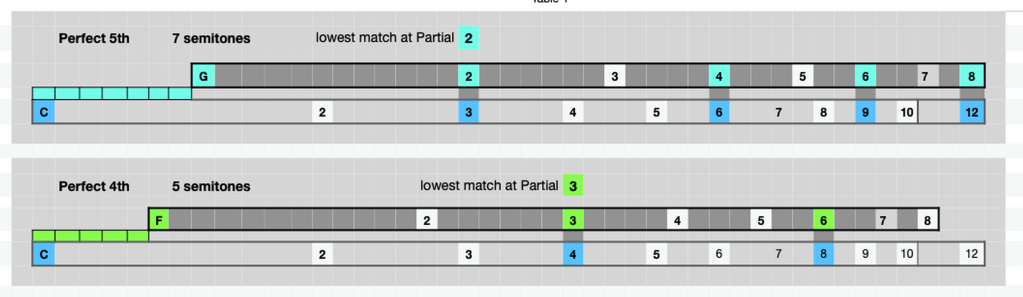
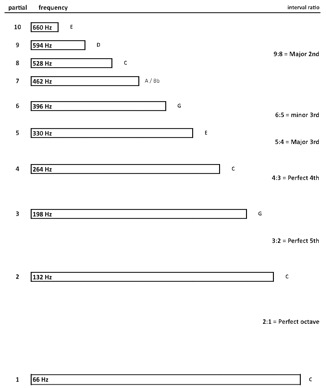
When two pitches sound together, they make a harmonic interval, but also their distinct overtone series are interacting. In the purer sounding intervals, this interaction is mainly a closely compatible one, with some overtones matching. An example, take a Perfect 5th, C up to G. Their overtones are:
overtone match for a Perfect Fifth
The matching or interfering overtones make more of a difference with the lowest partials, as the higher overtones are fainter and fainter higher up in the series. So the c’ 4th partial of C interferes with the 5th partial b’ of the G overtones; but that interference is fainter than the lower g-to-g match. This gets scientifically and mathematically complex to calculate, as we will tackle in a while below.
For now, the ancient classification for counterpoint is accurate enough to adapt: Perfect Consonance, Imperfect Consonance, Dissonance . . . though I will distinguish between mild dissonance and strong dissonance.
PERFECT CONSONANCE — intervals P8, P5 and P4 (12, 7 and 5 semitones) — “pure”
IMPERFECT CONSONANCE — intervals of major and minor 3rds and 6ths (3, 4, 8 or 9 semitones) — “triadic”
MILD DISSONANCE — intervals 2 semitones different in size from a unison, octave, or double octave (2, 10, 14, 22, 26 semitones) and the tritone (6 semitones)
We can use these distinctions to come up with an assessment of the general harmonic complexity of a constellation’s intervals.
PURE — containing no intervals except perfect consonances
SIMPLE — containing no mild or strong dissonances
MODERATE COMPLEXITY — containing at least one mild dissonance but no strong dissonance
STRONGLY COMPLEX — containing at least one strong dissonance
Examples of increasing complexity:

It is important to note that strongly complex does not mean “unpleasantly dissonant.” The Major-Major 7th chord in this category (C E G B) is quite a beautiful harmony. And the last two complex examples, quartal and quintal chords, are the sturdy mainstay of 20th-century American composers such as Copland.
In a recorded excerpt of Tyshawn Sorey’s Pulitzer Prize-winning Adagio (2023) for saxophone and orchestra, beautiful sonorities are quietly complex, tensely dissonant, dark and mysterious in their lyric unfolding. Like dark clouds, some morph to reveal brighter sounds, even simple triads. While there is no sense of any “chord progression,” there is a feeling of impending change in the air.
Tonal color
In notes on a recent composition, Frost Serenade, I described “changing tonal temperature.” Here is a deep dive into what that meant.
The metaphor of tonal color and temperature has to do with what we normally call consonance and dissonance in a chord or other harmonic entity. Centuries-old tradition classified musical pitch-intervals as pure, perfect consonances (“Perfect Fifth” and “Perfect Octave” for example); major or minor (exp. “Major Third” or “minor Sixth”); or problematic (“Augmented Fourth” and “diminished Fifth”). Some major and minor intervals (thirds and sixths) were considered imperfect consonances; the others (seconds and sevenths) were considered dissonant. Every music student learns these categories while studying 16th-century model counterpoint.
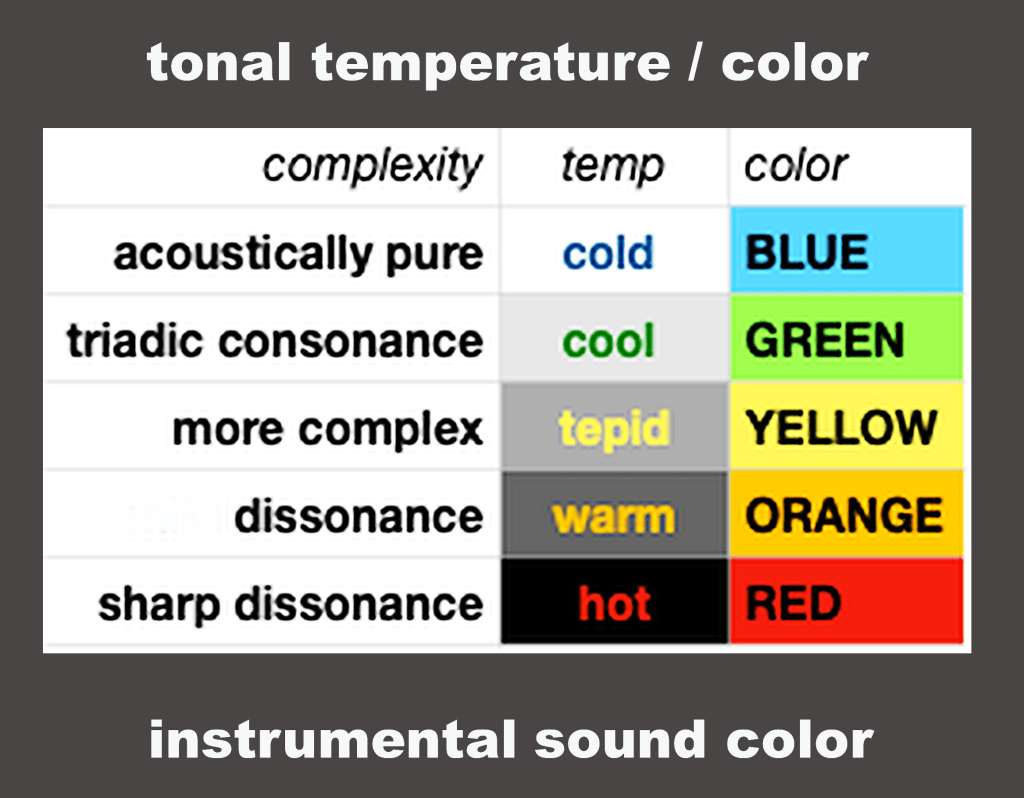
Using the color spectrum in temperature order:
harmonic color spectrum
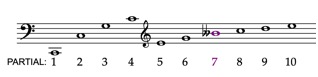
Let’s convert the consonance/dissonance concept, going back to a pitch-interval’s acoustic complexity. Reviewing what was explained above: every musical tone has a fundamental pitch, plus faint overtones that give the sound its color. They are of fading intensity and felt (as color) more than actually heard as distinct pitches. Discovered by Pythagoras as partial vibrations in whole-number fractions, the overtones are always in a fixed interval ladder, rising from the fundamental: Up an octave, then a Perfect Fifth, then a Perfect Fourth, a Major third, minor third, then to the eccentric seventh partial, which is out of tune by our scale-trained pitch perception (and shown a pale gray below), and on to the eighth partial, which is three octaves above the fundamental. (An octave is a multiply-by-2 operator, so partials 2, 4, 8, and 16 of the C overtone series are also the pitch-class C. Likewise, partials 3, 6, and 12 are all octave related.)
Two different fundamental pitches sounding together each bring into the acoustical mix their distinct overtones. The overtones from one either match (simple) or clash with (complex) overtones of the other. This is what makes the sonic complexity or perceived purity of the interval between two fundamental pitches. Using this relationship, we theorize that the higher we need to go to start finding matching overtones between the two pitches, the more complex is the interval. Following this logic, here is an overtone-match analysis of all harmonic intervals smaller than an octave. (We’ll show these horizontally to fit better what would otherwise be very tall slender graphics!) Each interval is shown from a fundamental pitch C up to a higher pitch.
PERFECT CONSONANCES
overtone match for perfect consonances
The rather pure Perfect Fifth interval between fundamental pitches, C up to G, matches overtones at G’s partial 2, a low level in the series, matching the C’s partial 3. The interval makes four such matches in this lowest-two-octaves span. The pitch match up of the G’s 2nd partial with the C’s 3rd partial (both are the same pitch, G) will be duplicated in all higher octaves, making this an acoustically simple interval. The two pitches’ overtones mostly match and don’t interfere with each other much.
IMPERFECT CONSONANCES
overtone match for imperfect consonances
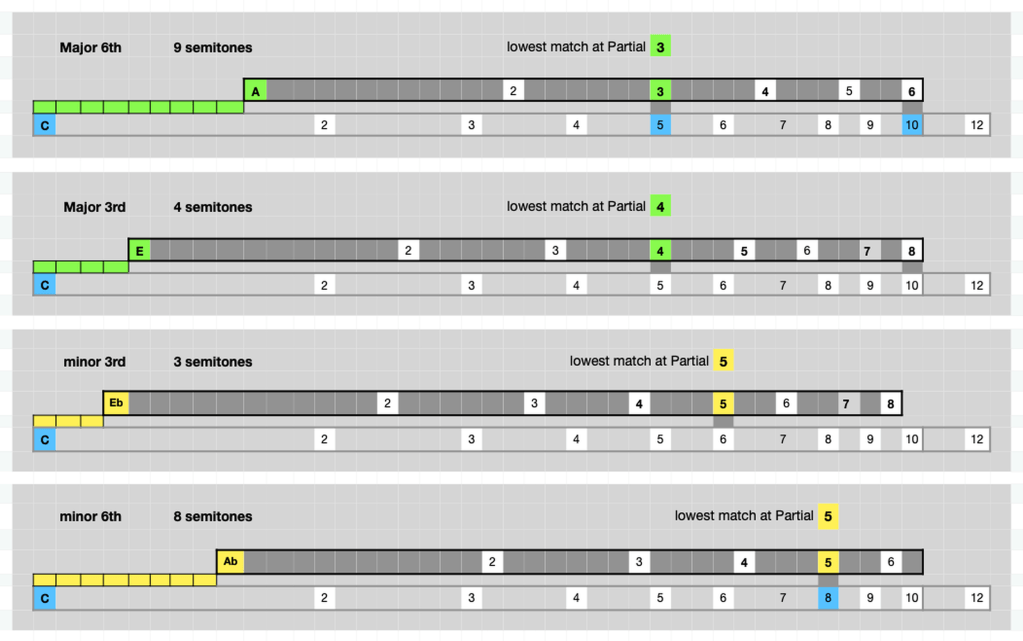
The triadic consonant Major 3rd interval between fundamental pitches, C up to E, matches overtones at a somewhat higher level in the series, partial 4, and makes two matches in this lowest-two-octaves comparison.
DISSONANCES
overtone match for dissonances
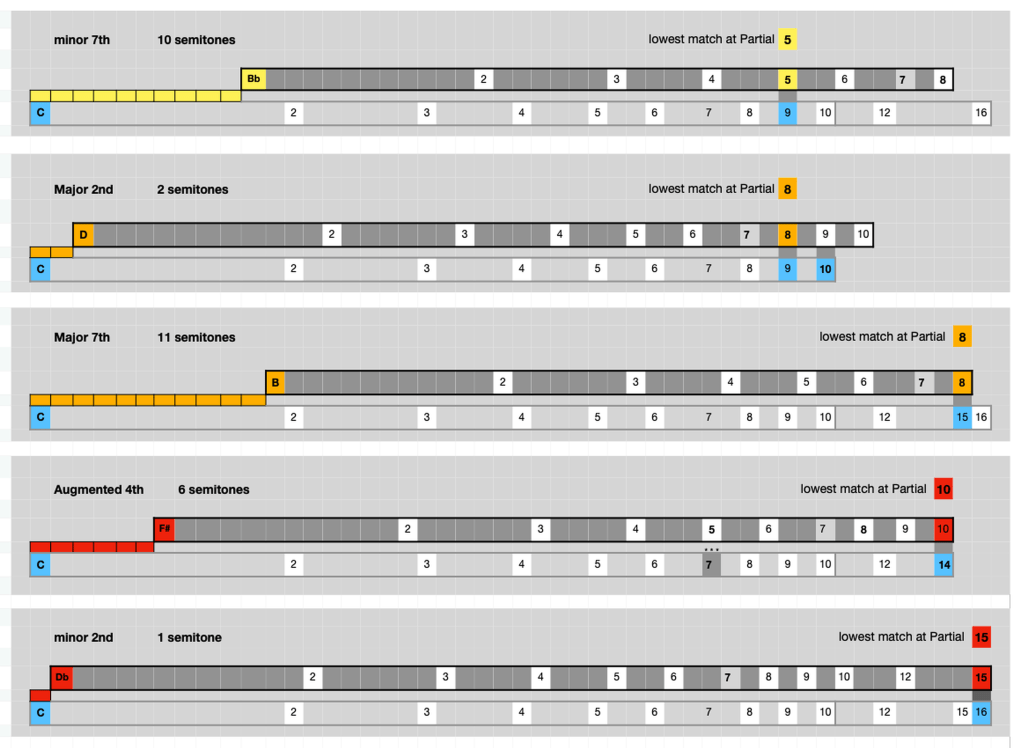
The dissonant minor 7th interval between fundamental pitches, C up to Bb, matches overtones makes only one match in this lowest-two-octaves comparison, at partial 5. That means its harmonic quality is more complex, with most of the lower overtones interfering, not matching. Not a strong dissonance, but more complex than the others.
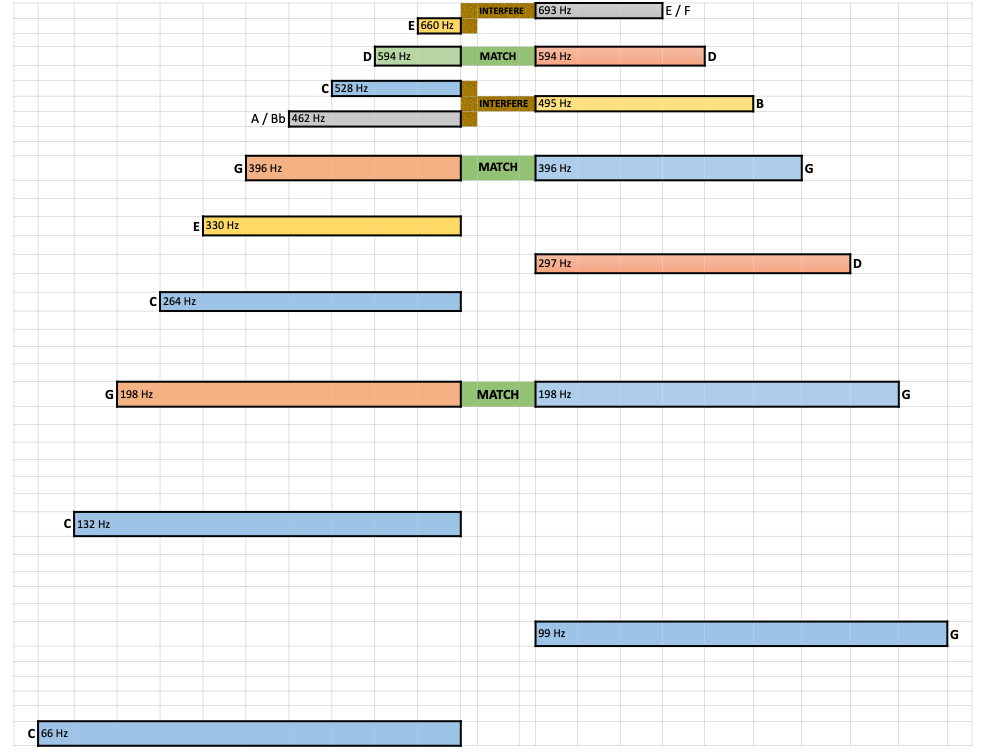
By contrast, with the more complex Major Seventh interval (ex. C up to B), you have to go all the way up three octaves to the B’s 8th partial (matching the C’s 15th partial!) to find an overtone that matches and doesn’t conflict/interfere. The Major 7th interval can be considered much more complex at a rating of 8 than a Perfect 5th at rating 2.
The most complex interval analyzed, the minor 2nd, clashes all the way up until the 15th partial.
A colorful summary depiction of this Pythagorean analysis of harmonic intervals looks rather like a modern-day sound mixing board.
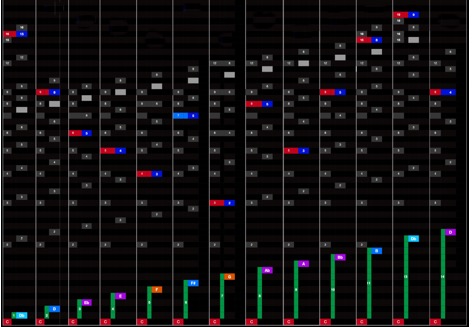
overtone matching for 13 intervals
Summarizing the analysis with a complexity rating number for each interval:
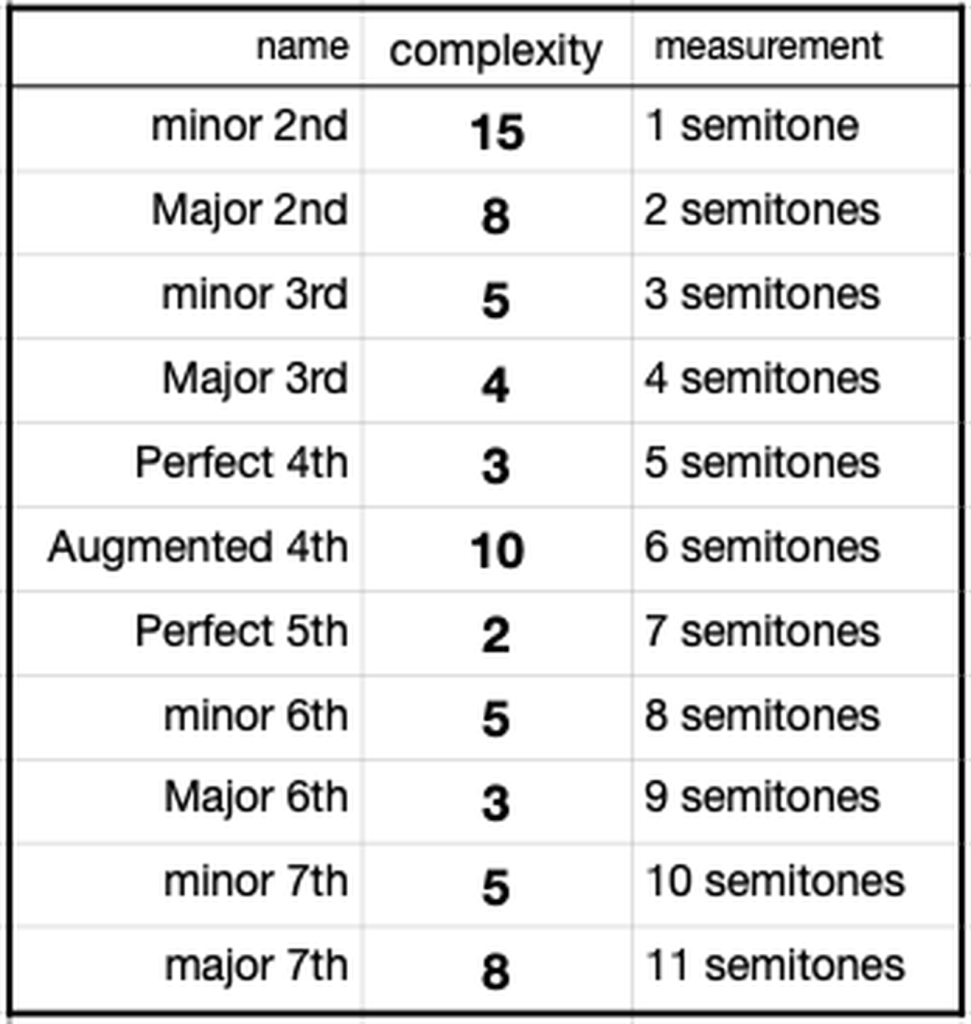
interval complexity ratings
Now we can add up the ratings of each interval in a chord and take an average complexity quotient. And we can think of complex as darker than simple, or we can invoke the color spectrum. In digital photo imaging, we use a temperature metaphor, seeing red as warmest (infrared heat) down through orange, yellow, green, down to blue, the coolest. The “hottest,” most complex harmonic interval is the minor 2nd. The “coolest,” purest (other than the octave) is the Perfect 5th.
The intervals in the following example are shown in semitones. Each chord has four pitch classes and six intervals between them. The Blue chord has an average complexity rating of 3.8. Green chord is slightly more complex, at 4.3. Yellow, which includes the more complex 11-semitone Major 7ths, rates 5.5. And Orange, with the only minor 2nd 1-semitone hot dissonance, is warmest at 6.2. Try to hear the differences. (No attempt here to demonstrate the red-hot complexity of 10 or higher for a cluster chord!)
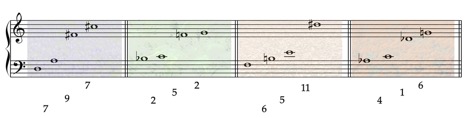
examples of four temperatures
The following demonstration phrase uses hose four chord types to build a progression of tonal temperature colors. Again, as you listen, try to feel the temperature warm up then cool back down.
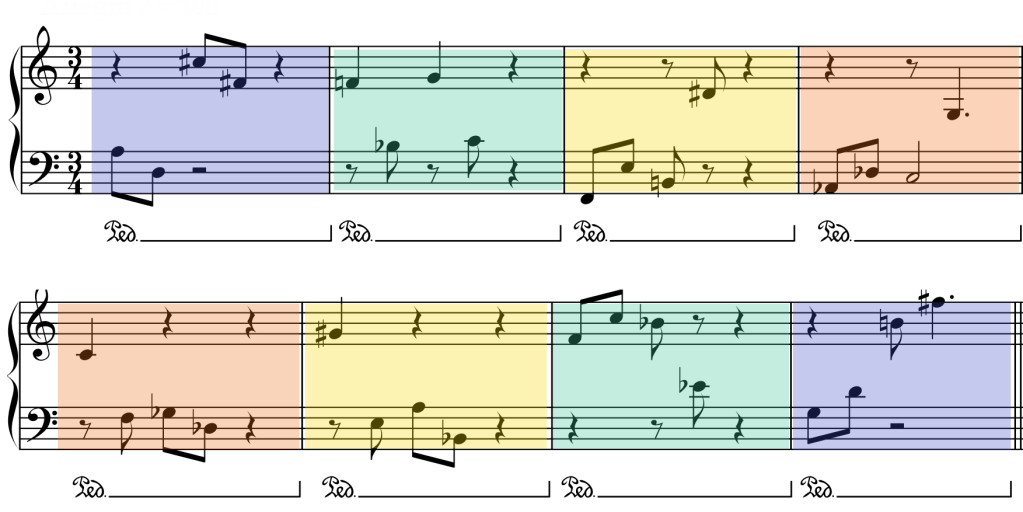
color change demonstration

© 2026 – All Rights Reserved
Thomas S. Clark
–
Continue reading Mapping the Music Universe:
____________
 MAPPING MUSIC