Tag: writing

  • Mapping Music 12. FORM

    Rhythmic intensity is an important factor in shaping musical form. A former research project “Density Functions in the Structure of Modern Music” in the 1970s sought to quantify it along with several other core aspects of structure at play in shaping large-scale form.

    In the TIME chapters, we previously mentioned pace and showed how it can accelerate or decelerate in a line while tempo remains steady. (The Beethoven string quartet example Op. 135 illustrated that.) We have now also defined composite rhythm as an intersecting sum of rhythmic time points of lines, the layers of a textural fabric.

    Density

    In physical terms, density is a ratio comparing the amount of mass to the amount of space it takes up. Measuring time space, tempo (expressed in “M.M.” beats per minute) can convert a count of beats into a time-length in seconds:

    DURATION (in seconds) — multiply BEATS times 60, then divide by TEMPO

    Now we’re ready to measure the pace of a line for a bar or a whole phrase:

    PACE (Notes Per Second) — number of notes divided by the duration of the stream

    And then to quantify for a whole texture of rhythmic activity:

    RHYTHMIC DENSITY (Attack-Points Per Second) — number of note-starting time-points in the composite rhythm of the whole texture divided by the duration of the stream

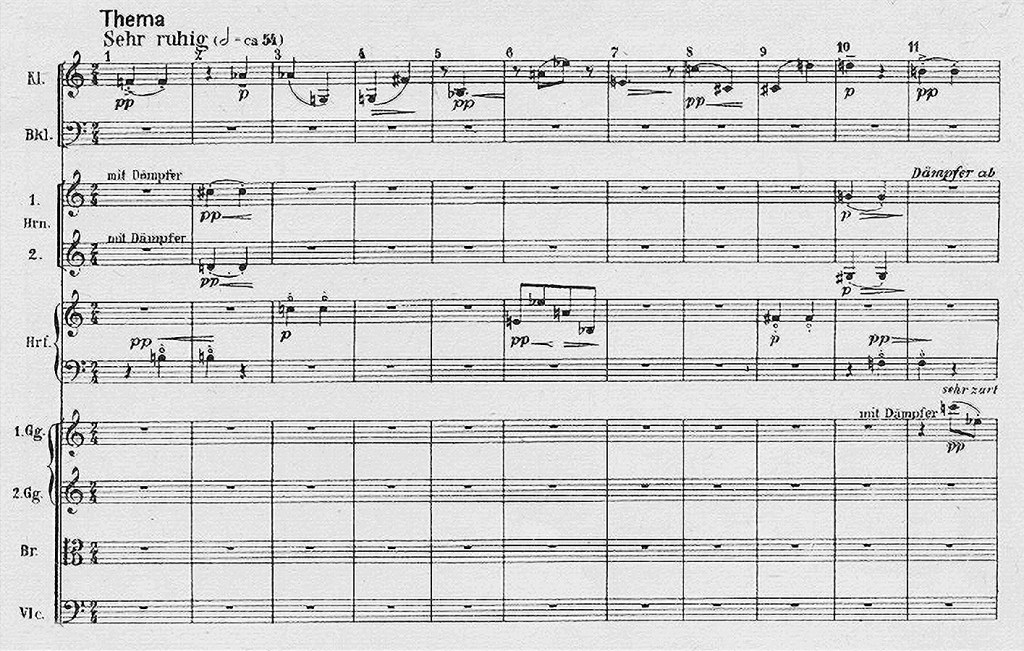
    Let’s go back to the Webern Symphonie Op. 21. Though called a symphony, it has only two movements. The second movement is a theme and variations with coda, each exactly 11 bars long in two-four meter. Here’s the theme:

    Op. 21, II — theme

    Each variation, though 11 bars long like the theme, is in a different marked tempo. Each is distinguished by a contrasting degree of rhythmic density. And though the theme is a sparse (pointillistic) fabric, some variations are contrapuntally thick and intense.

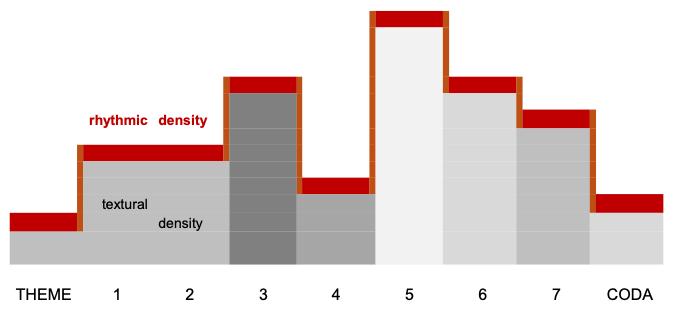
    Rhythmic density and what we might define as textural density (how many lines woven into what octave span) basically trace the same unfolding through the variations. The exception is Variation V. There they diverge, intensely active rhythms but only three textural elements in a diffuse pitch span of almost four octaves.

    A graph of changing rhythmic density values in each variation highlights rhythmic density as the bolder line:

    density graph of Op. 21 II

    About broad form, this reveals that from the beginning, rhythmic density increases to a subordinate peak in Variation III and overall peak in Variation V, then variation by variation steps down to a coda that matches how we started with the sparse theme. In rhythmic density, the whole movement is an arch form, with Variation V the “climax.”

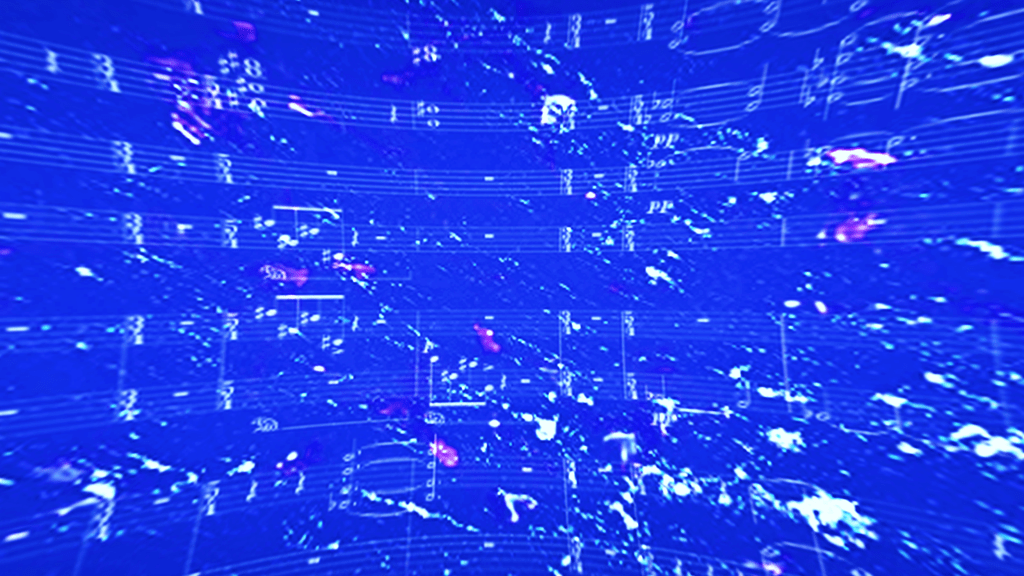
    In the first “abstract sound mobile” of my 2024 work, FOLIO, it is easier to hear changing density as the changing thickness of clouds of sound, swelling and subsiding.

    “Music of the Spheres”

    Relativity

    Modeling, the process of creating an overall design, can mean creating a new model or expanding the possibilities of an existing model. In Learning to Compose we identified and described three basic musical approaches:

    NARRATIVE MODELING — Designing by telling a story, with characters, themes, gestures, suspense. What will happen next?

    SPACIAL MODELING — Designing the size, shape, and texture of blocks or sections of material

    TEMPORAL MODELING — Designing the flow and momentum of events in the passing of perceived time

    Variation and contrast

    Contrast is the essential complement to developmental continuity in musical material, driving musical momentum. Theme and variations form is a straightforward, traditional example of narrative modeling balancing contrast and continuity. Each variation preserves some basic element of structure such as harmonic progression (or in the Webern example, the tone row). Each variation presents a setting of that theme element in distinctly different orchestration, texture, mode, tempo, or rhythmic character.

    The composer determines not just how and when to make a contrast, but how dramatic the contrast will be. Their fluctuations over time are the core of the composer’s instinctive variation skill. This is the impelling force that gives musical form a sense of going somewhere, of leading up to and flowing away from stable plateaus marking the structural pillars of large-scale form.

    FLUCTUATION — Magnitude of contrast from one moment or event to the next

    When analytically quantifying fluctuating data, the time scale of measurement matters. In avant-garde or experimental music, a stream of events may be high-contrast on the moment-to-moment scale but steady-state over broader time spans. Conversely and more traditionally, surface events may be continuous, while the bigger chunks of events, like one variation to the next, may pose more dramatic changes in parameters such as rhythmic density.

    In typical Beethoven or Brahms variations, material within each variation is continuous, not at all fluctuant. The contrast comes altogether in the next variation.

    That consideration plays out differently in Op. 21 II. There is the obvious contrast from one variation to the next; but within each variation, moment-to-moment surface continuity also fluctuates. Surface fluctuation in density factors occurs, especially from one 3-to-4-second “moment” to the next. (We can’t really call them phrases.)

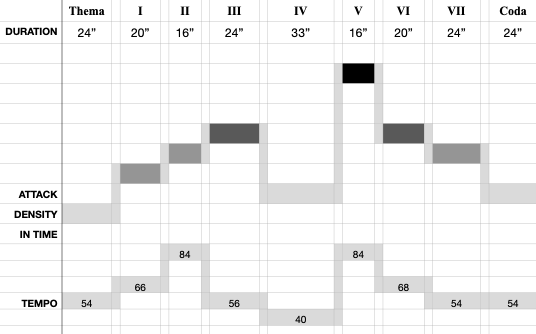
    For the Op. 21 II. Theme and Variations, we can now say something deeper about changing rhythmic density as the variations progress. From the Theme through the first two variations, rhythmic density increases gradually to Variation III. But then the fluctuation of rhythmic density spikes, dropping significantly for Variation IV, then suddenly increasing to its highest level in Variation V.

    large-scale time form

    It is not only Variation V’s greatest rhythmic intensity but also dramatically increased roller-coaster fluctuation, dropping then surging, that makes Variation V the climax of the movement. 

    Macro-structure

    Though Webern may not have thought consciously about Schwankung (fluctuation), this is how composers manipulate momentum to make a climax and shape large-scale form. Likewise, approaching a final ending, not only do fluctuations typically diminish, but also rate of change subsides — the overall change factor levels out to zero. These are examples of temporal modeling.

    The parameters of a musical event are numerous, a multidimensional matrix of at least six distinct, interacting qualities: each sound event’s loudness, resonance, timbre or sound color, duration, pitch (frequency), and time point of initiation. Imagine this as a six-dimensional space. In fact, physicists have imagined the structure of matter as exhibiting many more than six dimensions in string theory, M theory, etc.

    Musical structure establishes the relativity of these parameters, though not exactly the way Einstein explained time, space, gravity, and energy with mathematical precision. Some structures such as the Schoenberg Farben example relate constellation harmony to sound color. Threnody relates rhythmic activity to fabrics of sound in a broad pitch space (spatial modeling). Counterpoint balances rhythmic relationships, metric placement of lines, and synchronicity with their intervallic relationships of consonance and dissonance. Ostinato music manipulates phase relationships.

    And, as observed in Part I, temporal density, the rapidity of fluctuations and larger contrasts in these structures, propels our experience of the whole in time.

    In Thinking in Numbers, Daniel Tammet wrote about a mathematical study of poetry,

    “The best poems . . . combined in equal parts the predictability of meter with the novelty of unusual words. Too much meter made a poem banal; too much freewheeling . . . rendered it hard to follow. The delicate balance of convention and invention gives meaning to what we say.”

    The essence of music’s large-scale temporal form is the relativity of overlapping, fluctuating musical structures in time, repeating, contrasting, interrupting, truncating, expanding, certainly recurring, or simply evolving. Designing a large-scale musical form combines temporal modeling, narrative modeling, and spatial modeling — a pacing plan, a storytelling rhetoric, an architecture of interrelated components. 

    Coda

    sound mass . . . sound color . . . pitch constellations

    ostinato repetition . . . changing density

    evolving form . . . cosmic time

    In Become Ocean (2013), John Luther Adams takes a deep dive into a serene sound sea, incorporating all of the elements and structures we have explored in our mapping journey.

    John Luther Adams – Become Ocean (2013)

    . . . and we have just begun gazing into

    the vast space of color and complexity

    in the Music Universe . . .

    © 2026 – All Rights Reserved

    Thomas S. Clark

    Continue reading Mapping the Music Universe . . .

    MapLab 1. Generate a Gymnopédie

    TClarkArtMusic.com

  • Mapping Music 10. COUNTERPOINT

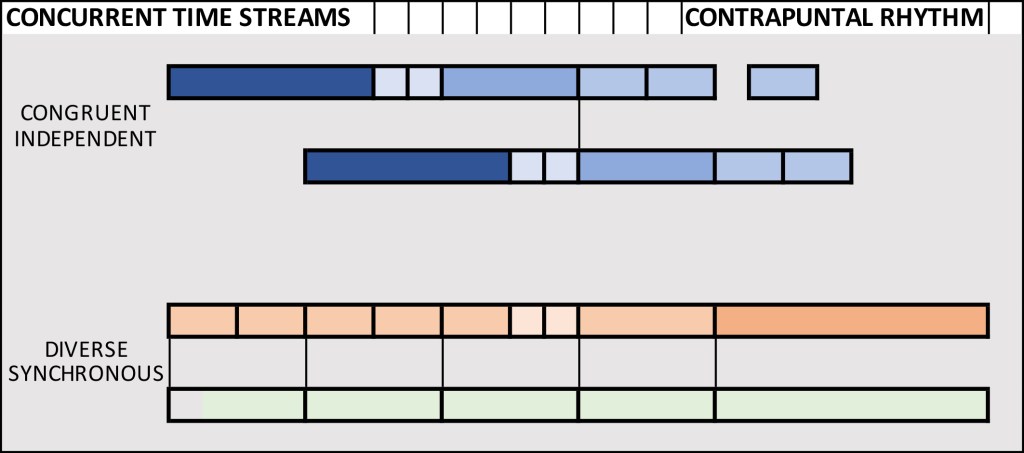
    Two lines woven into a shared time stream — counterpoint — can be relatively more or less independent. How similar or diverse are their rhythmic patterns (congruent or diverse)? How often do their note-initiating time points “line up” (synchronous or independent)?

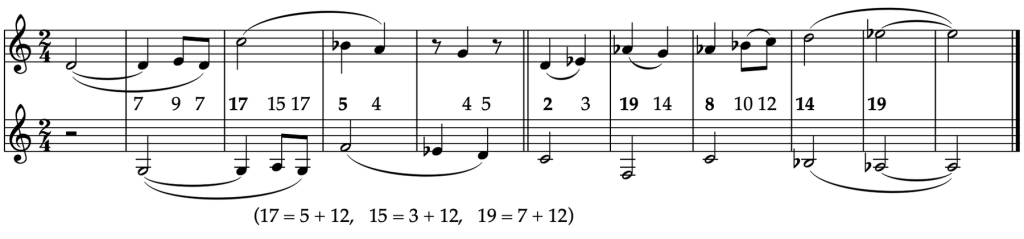
    In an example of congruent, matching rhythmic material, the upper line’s rhythm is echoed in the trailing lower line in the first five bars below. But the lines are rhythmically independent, sharing only one time point, the downbeat of bar 4. This echo process is known as . . .

    CANON — leading line is echoed after some delay by one or more answering lines of identical rhythmic values and melodic shape (possibly transposed)

    For more on canons, go to BOOK OF CANONS, 14 short 3-part canonic studies.

    example of two-voice counterpoint

    Bars 6-11 show diverse rhythms (the upper line in mostly shorter durations than the lower), and not in canon but synchronized at most of their time points.

    Rhythmic alignment

    Johann Joseph Fux established a theoretical construct for pedagogical purposes in which contrapuntal lines in a 16th-century style progressed from congruent, synchronous rhythms (“First Species”) to one line twice the pace of the other (“Second Species”), and so on. Only in Fourth Species was the relationship reversed, back to matching, congruent rhythmic values but in studied alternation avoiding synchrony.

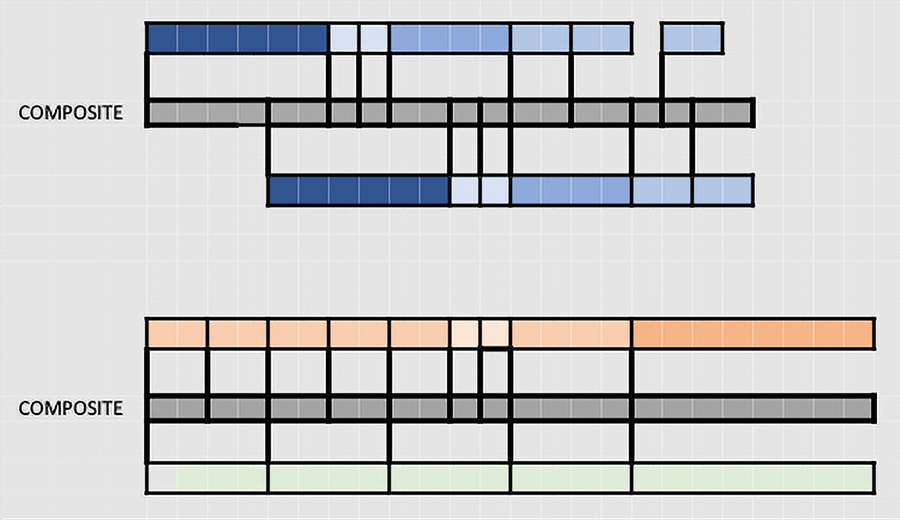
    COMPOSITE RHYTHM — stream of durations between time points marked by an attack of a note in one or more lines of the fabric

    Here is a graphic identification of the composite rhythm of each contrapuntal phrase above.

    composite rhythm

    You can see in the first example that there are 7 notes in the upper line and the same 7 rhythmic values in the lower line. But the composite rhythm shows 12 durational values, due to the non-synchrony of the lines. In the second example, the upper line has 9 notes, but the lower line’s 5 notes all align with them. The “sum” of the two lines is a composite rhythm of only 9 durational values, identical to the upper line.

    Contrapuntal intervals (in number of semitones) are identified between the staves. The time points of the composite rhythm, moments when both lines are starting a note, are contrapuntally accented and emphasize the contrapuntal intervals (boldface) formed at those points. The consistency — in this example the contrapuntally accented intervals of 7, 8, 2 (and 2+octave), and 5 (and 5+octave).


    CONTRAPUNTAL ACCENT — prominence of contrapuntal intervals formed by notes starting together on a time-point

    Refraction

    This term refers to the metaphor of light going through a prism or drop of water, revealing a spectrum of colors. In that sense, a musical refraction might refer to a line presented by instruments of changing sound color. (See Klangfarbenmelodie below.) But let’s apply the refraction concept to pitches in a line of consistent color.

    Refraction can also be a simple way to make two lines out of one, splitting up its notes into two lines shared by alternation or some other less strict pattern. The pitch assigned to one line can be sustained to make a companion pitch to the pitch or pitches that come next in the other line. In this way, the vertical intervals can be strategically controlled to generate a coherent contrapuntal harmonic flow.

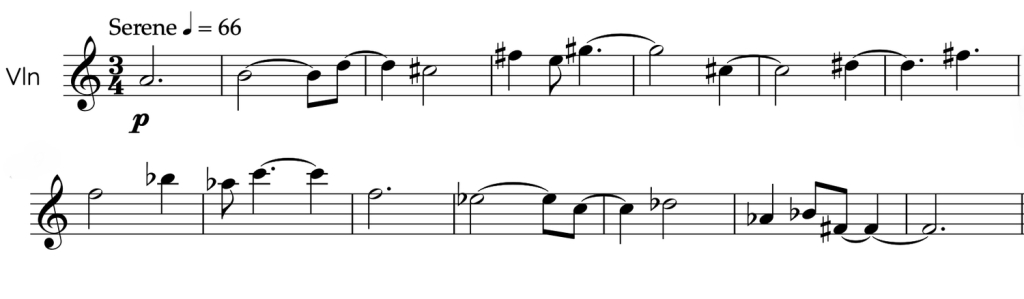
    To demonstrate, here is the opening theme to Jupiter Rising:

    Jupiter Rising theme

    Now splitting this violin line into two violin parts:

    Jupiter theme refracted

    Identifying the contrapuntal intervals (by number of semitones) that are formed reveals a preference for contrapuntal intervals of 2, 4, and 5 semitones.

    Some might say this is not real counterpoint, but the total rhythmic independence of the lines argues for that distinction. Mandelbrot, pioneer of fractal mathematics, described fractional spatial dimensions. Maybe we can call our refraction one-and-a-half voice counterpoint.

    Canon

    Repeating the definition of this ancient form of Rumpelstiltskin magic, spinning complex counterpoint out of a single melodic line:

    CANON — leading line is echoed after some delay by one or more answering lines of identical rhythmic values and melodic shape (possibly transposed)

    For a collection of 21st-century examples, 14 studies in 3-voice canon, go to BOOK OF CANONS.

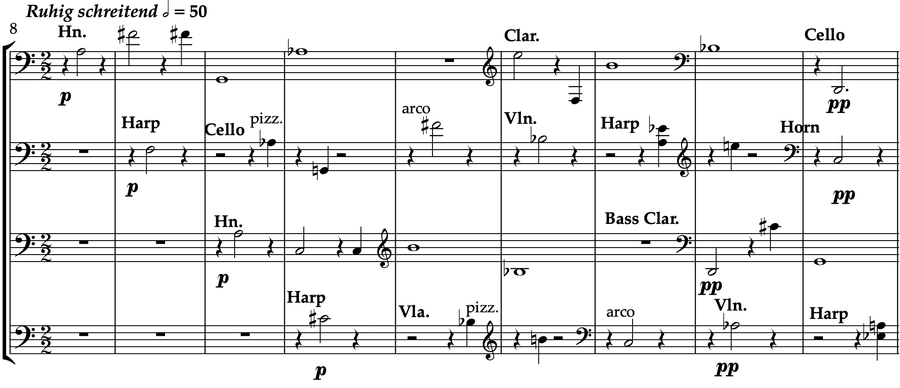
    Now let’s look closely at a more famous canon, in four parts scored for seven different instruments. Here is a contrapuntal example of canonic threads expressed through changing instrumental colors, the opening of the first movement of Webern’s Symphonie Op. 21:

    Webern Symphony opening

    Instead of showing each instrument’s part, I have rearranged the score so that each staff line strings together the successive pitches of a 12-tone row:

    • On the top staff, A F# G Ab played by horn; E F B Bb played by clarinet; then D by cello, continuing past this excerpt to complete the 12-tone row with C# C Eb.
    • The second staff answers in canon one bar later, starting on F plucked by harp and proceeding with a mirror inversion of the lead-line row: F Ab G F# Bb A Eb E C C# D B.
    • The third staff is also an inversion of the row starting on A.
    • The fourth staff, entering last, is a transposition of the original lead-line row starting on C#.

    Repetition

    Any musical element can be repeated — a note, an arpeggio, a measure, a phrase, a whole section of a form, as in the baroque rounded-binary model or the exposition of a classical sonata-allegro form. When a melodic motive or molecule is continuously repeated many times, it is called an ostinato, usually forming a background to some changing line or evolving stream of events. We can analyze two critical factors:

    CYCLE — duration length of a repeating pattern

     PHASE — time point at the start of a cyclic repetition

    Some 20th-century composers, especially Americans, started to bring background patterns or structures into the foreground, as primary objects rather than accompaniments. The incessant repetition of an ostinato, often a chord arpeggio, became the basis for simple structures. With a relentless pulse at its rhythmic core, most ostinato music generates simple highly congruent rhythmic lines in simple or no counterpoint.

    Classic works by composer Philip Glass, such as the ‘70s pieces Music in Twelve Parts, are continual repetition of chord arpeggios, with the chord changing gradually and subtly over many repetitions. This has two effects: making a very slow harmonic change rhythm and time flow under an animated surface; and creating a broad time form that is monolithic and metamorphic, rather than a more traditional multi-section recurrence form.

    John Adams brought this relentlessly repetitive approach to appealing prominence in symphonic music. His Fearful Symmetries (1988) has a pulsing persistence reminiscent of the great Stravinsky ballets, such as Le Sacre du Printemps (1913).

    John Adams – Fearful Symmetries (1988)

    Steve Reich continued this energetic vein of repetitive rhythmic construction into the 21st century with works such as Double Sextet (2008).

    Steve Reich – Double Sextet (2008)

    Despite its sometimes lush fabric of harmony and animated rhythmic activity, persistent-repetition music has unfortunately been labeled “Minimalist,” often having no melody, no sense of harmonic progression or tonal modulation, no themes, no sectional cadences and divisions, and no discernable large-scale recurrence form. (A music more truly described as Minimalist can be found in the more radical works of John Cage, with sparse sounds — or no prescribed sounds at all — in a time-space of mostly “silence.”)

    Phasing

    Back to ostinato — what about more than one ostinato layered into a more complex texture? Even if the ostinato patterns are of the same length, it is possible for their repetitions at different times to not synchronize but overlap. We would say their repetitions are out of phase.

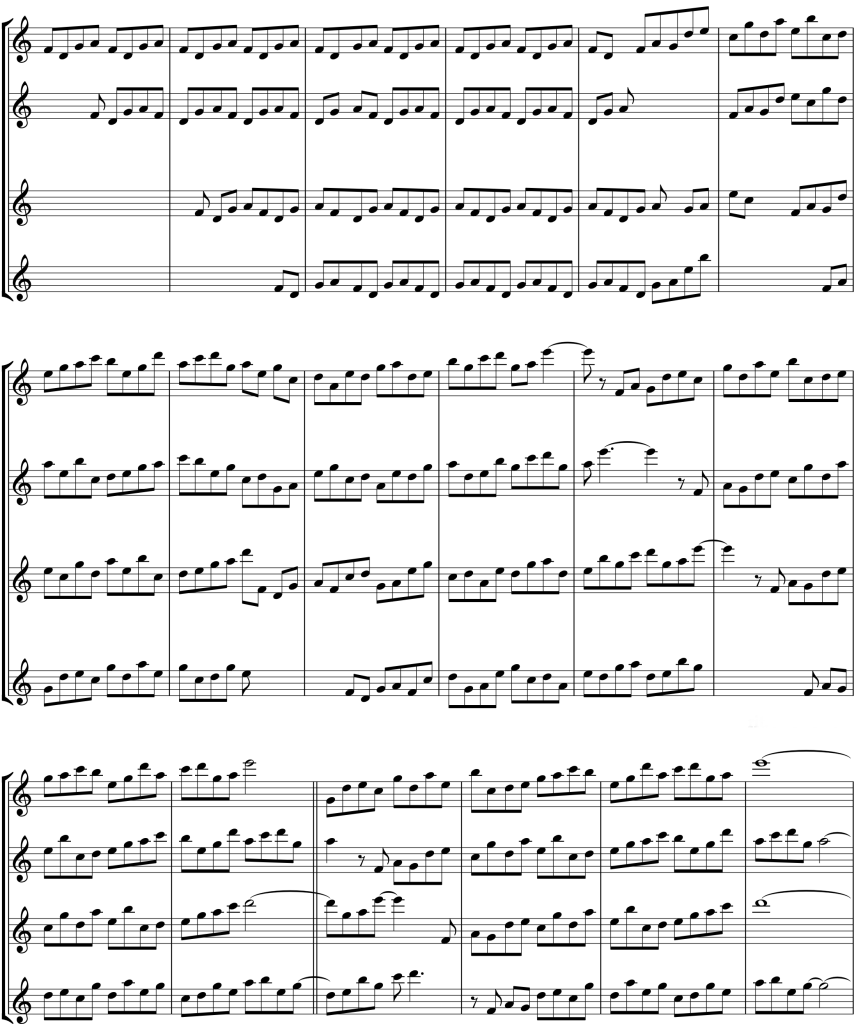
    Using Webern’s canon technique to place identical lines out of phase:

    Milky Way score excerpt

    The Milky Way is our own barred spiral galaxy. The musical fabric is adapted closely from Buckingham Fountain, the third movement of my Chicago Sketches for flute choir.

    There is also the potential for each ostinato pattern to have its own cycle length of repetition. And if the lines repeat different cycle lengths, their phase, the start of another repetition, cannot always align in synchrony. This can be described as multi-cycle/multi-phase ostinato music, pioneered among others by American composer Terry Riley.

    Inspired by tape loops continuously replaying recorded sequences of sounds, in 1968 Riley produced a massive (45- to 90-minute length) multi-phase ostinato work, In C. Becoming iconic, it has been recorded commercially more than 36 times and performed by countless new music ensembles, finding its improvisatory freedom and large flexible instrumentation attractive. (A 2006 performance at the Walt Disney Concert Hall featured 124 musicians.) It consists of 53 ordered patterns of specified, notated rhythm and pitch, to be continually repeated against a steady eight-note pulse. The patterns range in length from only 4 eighth-notes to extended phrases sprawling across a part’s entire manuscript line (without bar lines). Thus the variety of repetition cycle lengths is enormous. And because each musician chooses when to start and how many times to repeat each pattern, multiple phases are also guaranteed.

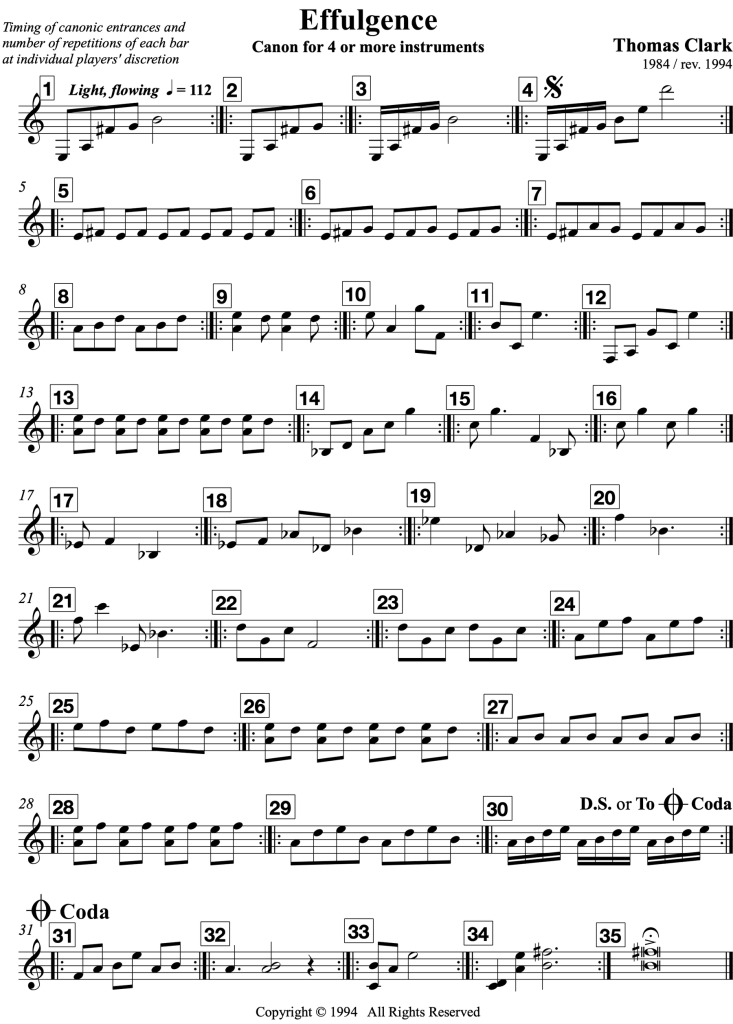
    Rather than analyze this iconic piece, I will show and explore a piece of mine inspired by In C, originally composed in 1984. It employs the canon technique and differing-length patterns to create the constant overlapping of patterns out of phase with other lines, This makes it difficult to express all the patterns in one common meter signature. Riley’s solution, and mine, is to use no meter signature, with all lines (parts) aligning only with a constant eighth-note pulse.

    Effulgence improv score

    Before we dive into its structure, let’s listen to its beginning.

    The surface rhythmic relationship of overlapping patterns is simple, all conforming to a common eighth-note pulse, as in Riley’s In C. The differing bar lengths, however, produce different periodicities, different repetition cycles. Patterns of 2, 4, 6 or 8 eighth-notes relate to each other to establish a common quarter-note based meter, a feel of 2/4, 3/4 or 4/4 meter. But the patterns of a prime number of eighth-notes, 3, 5 or 7, oppose the sense of a quarter-note beat.

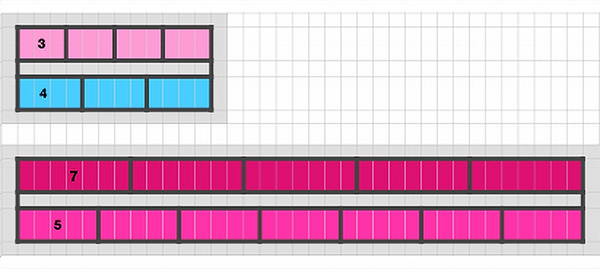
    The prime numbers mean also that the repetition cycles will rarely synchronize, creating a more complex, floating or flying fluidity of motion. Three against four is fairly simple, as with Patterns 6 and 7. Repetition of primes seven against five, as in Patterns 19 and 20, make a much more complex composite, taking some 35 eighth-note pulses to return to a synchronous starting point.

    multi-phase combinations

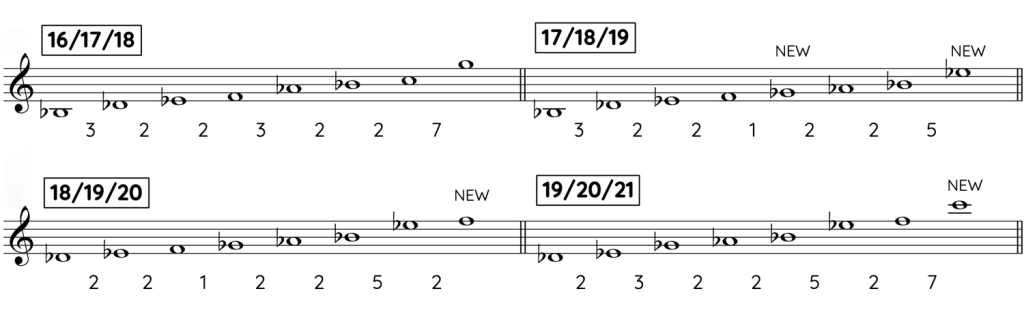
    To control the interaction between successive patterns that will overlap in canonic lines, each pattern’s pitch content must work with the pitches of patterns before and after it. By “work” means that the collective, cumulative constellation should be of an intervallic character, an array, that conforms with the overall harmonic character desired.

     Assuming a performance spread of three patterns, here is a sample analysis of the middle, Patterns 16 through 21, showing the three-pattern collective constellation. Each pattern intersects with common pitches of its neighbor patterns, adding pitches to the sonority that will eventually disappear.

    intersecting pitch collections

    This is the mechanics of a metamorphic harmonic process that gives multi-phase ostinato music its graceful evolving form.

    Now let’s listen to the complete composition from 1984 (revised 1994), one of my personal favorites.

    Effulgence

    © 2026 – All Rights Reserved

    Thomas S. Clark

    Continue reading Mapping the Music Universe:

    TClarkArtMusic.com 

  • Mapping Music 8. TONALITY

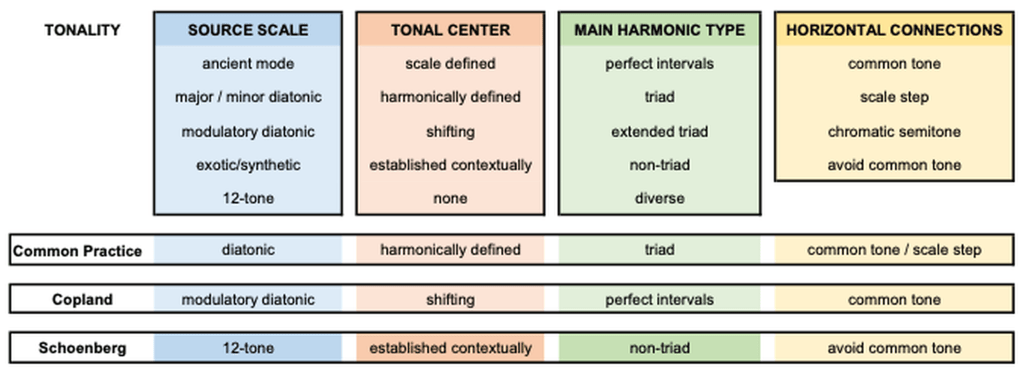
    In traditional tonal music, or for a composer’s personal design, there are four main factors defining a tonal language: source scale (covered in Mapping Music 5); harmonic type; horizontal (voicing) connection; and tonal center, a basic concept for Common-Practice tonal music.

    A diatonic major or minor scale and harmonic structures built from it define a key and “tonic” home-base tonal center. (In the ancient modal music of the monophonic Gregorian chant it was called the “finalis,” as it was the expected final arrival destination of an extended melody.) Triads taken from the scale build a scaffold of harmonies, featuring the dominant chord (scale degrees 5, 7, 2, and sometimes 4) with its scale-degree 7 “leading tone” propelling a progression to resolve back to the tonic chord (scale degrees 1, 3, 5).

    In 20th-century music, some composers (notably Bartók) began to define tonal center contextually rather than by scale-and-key, writing melodic patterns and counterpoint that branched out from and converged back to a core base (but not necessarily bass) pitch. Twelve-tone music, derived from the full chromatic scale, would seem to be avoiding any tonal center, but some composers still built textures whose lines and counterpoint would emphasize one focal pitch-class.

    A matrix of choices

    In forging a tonal language, the composer develops preferences in each of these factors. Choices from each factor column can be mixed in a variety of ways. The composer designs by delving into more specific patterns, especially for the source scale (possibly, say, a six-note pitch-class set) and the harmonic type, establishing a preference for certain harmonic intervals (such as my favoritism for 7-semitone Perfect 5ths and 11-semitone Major 7ths).

    There are, of course, thousands if not millions of possible combinations of all these factors, a universe of tonal possibilities for the individual composer and a particular piece.

    Next, let’s dive more deeply into harmonic types and the factor of horizontal connections between successive harmonies.

    Constellation streams

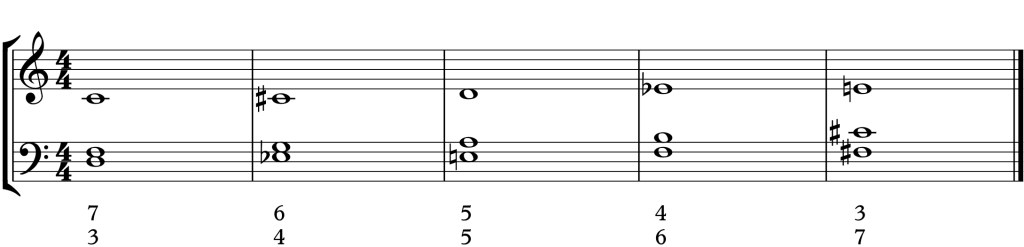
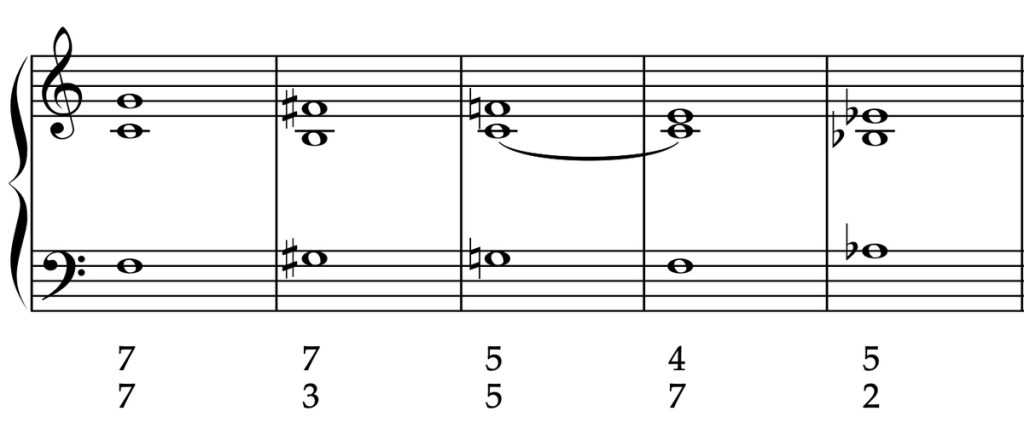
    A stream of successive constellations, which we might nickname a “constream,” would traditionally be called a chord progression. In the following example, all stacks are 10 semitones tall; no common tones in the transposition choices.

    no common-tone connections

    In the next example, stacks of differing heights, with constellations that reduce to three different scale patterns: scale array 5 2, then 2 3, back to 5 2, then 4 1, and finally 2 5, inversion of 5 2.

    common-tone connection

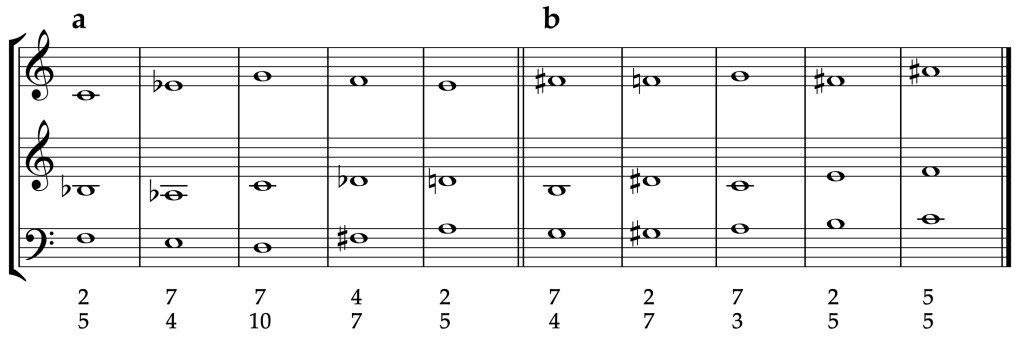
    Now a longer, more mixed succession of interval stacks of constellations belonging to these same three scale patterns (2 5 or 5 2; 1 4 or 4 1; and 2 3).

    extended constreams

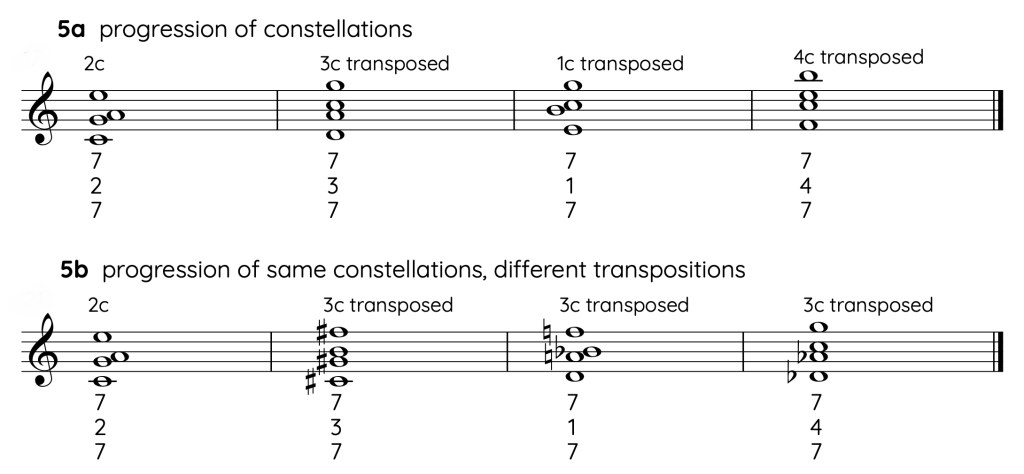
    Back to my constellation friends of Mapping Music 6, we can make some constreams with them.

    diatonic and chromatic successions of symmetrical constellations

    An intriguing example from the literature of great early modern music, an interlude near the beginning of Stravinsky’s L’Histoire du Soldat:

    L’Histoire du Soldat excerpt

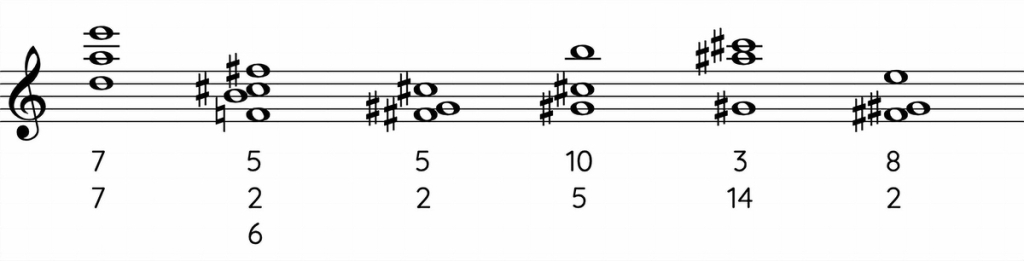
    This passage is intriguing in many ways. It looks like counterpoint between two woodwind instruments in high register. But both lines are quite simple and don’t seem to go anywhere. (In our GALAXIES: Structure chapter, we’ll discuss these questions of texture and counterpoint.) Introducing it here raises the question of harmony, of constellations and their arrays, though the passage doesn’t look at all chordal. Here is an array analysis of the constellations formed in the first through fourth bars then jumping to bar 10 and, finally, bar 14.

    L’Histoire du Soldat constellations

    Now you can see and hear more clearly the role played by array interval of 7 semitones (“Perfect 5th” as in above examples) and also 5, and 2 semitones in the harmonic continuity of the passage. (Also note 7 + 7 = 14; 5 + 2 = 7; 5 +5 = 10; 2 + 12 = 14; etc.)

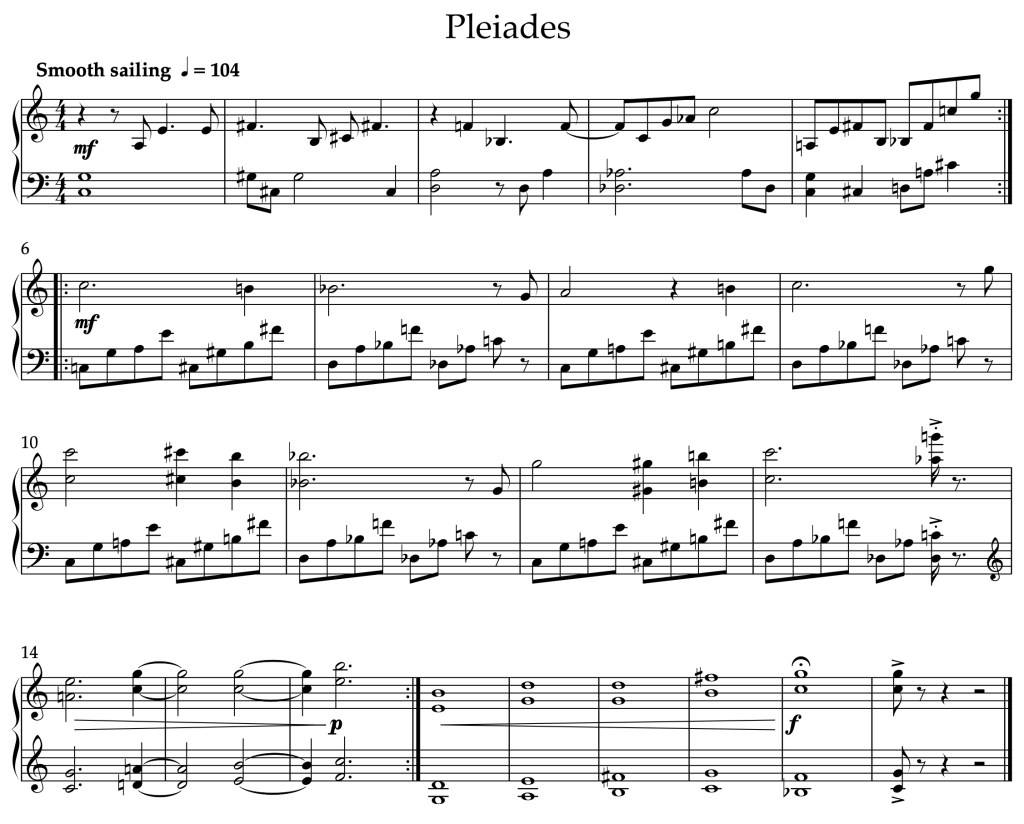
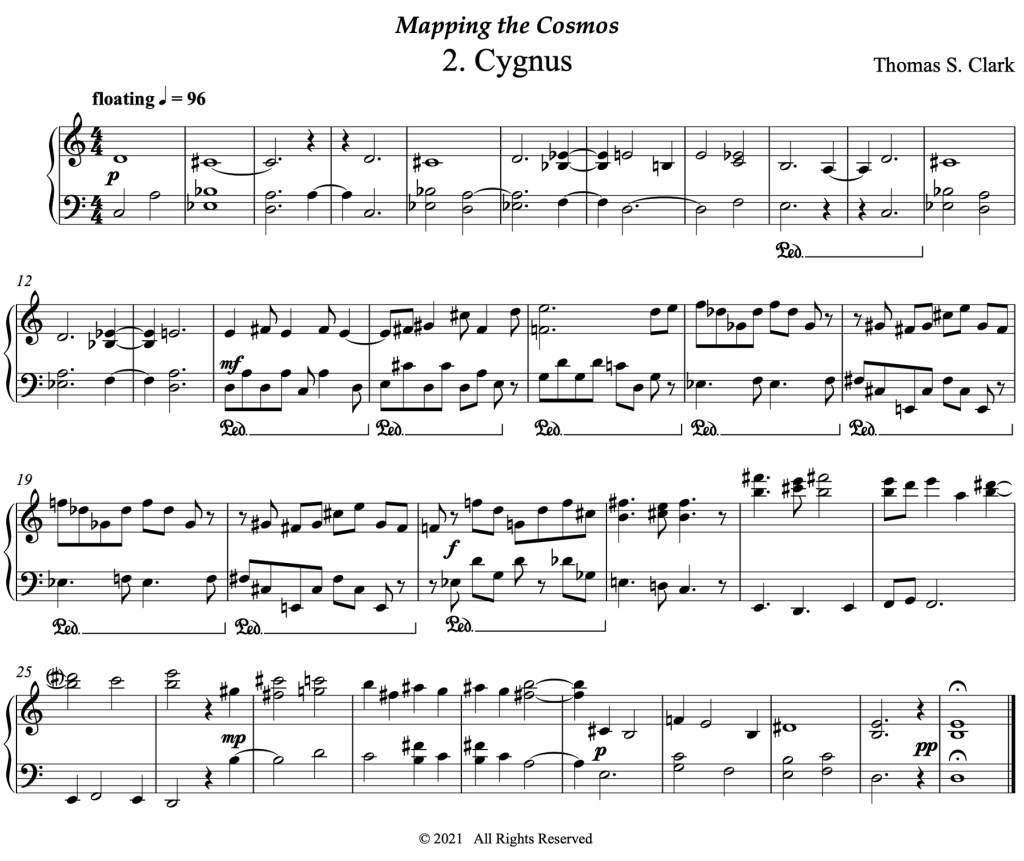
    To illustrate that this is not all just theoretical, here is a simple etude composed using exactly the constellations and successions explored in Examples 12 and 17. It took only about an hour to compose this minute and a half in Sibelius. The title: the constellation Pleiades (“Seven Sisters”) is a tight cluster of 7 stars tagging along in the winter sky with Taurus as the Zodiac sails westward every night.

    12-tone sets

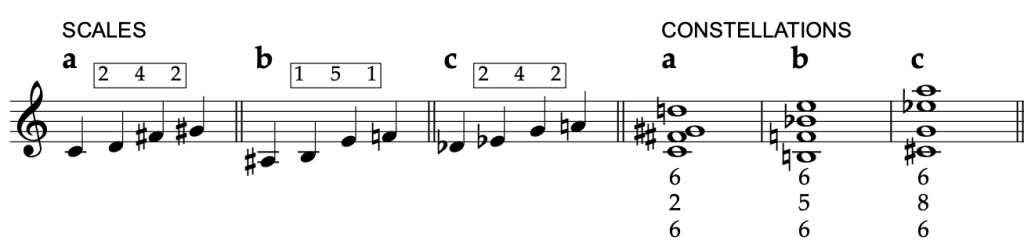
    Let’s keep going. How about designing a succession of three four-pitch constellations, so that all 12 pitch classes of the chromatic scale are included but none repeated? (Traditional terminology calls such a set a 12-tone aggregate.)

    three sets make a row

    Constellations a) and c) are different “chord voicing” of the same scale pattern, 2 4 2 . Both scale patterns and all three interval stacks are symmetrical. And they all contain two 6-semitone “tritones,” giving the whole succession the tritone’s quality of ambiguity and the character of the succession a feeling of mystery.

    Altering arrays

    Similarity of interval patterns can build coherence in a stream of constellations. Beyond functional common-practice harmony, this is a kind of process that composers of the 20th century and today can use to create a “new tonality”.

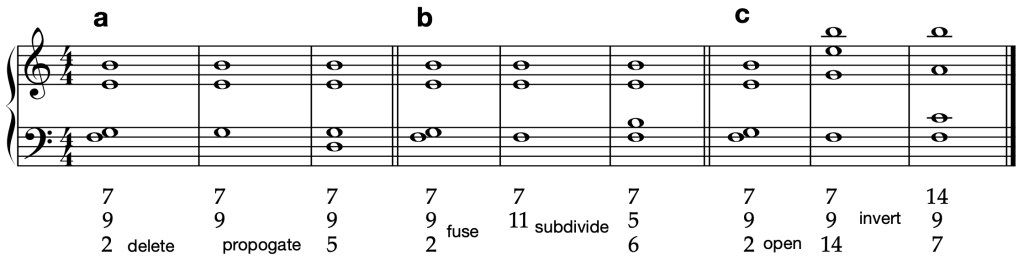
    Possible operations to transform an interval array into a closely related array:

    OPEN — Expand an interval by an octave, adding 12 semitones

    FUSE — Join two adjacent intervals to make a larger interval, the sum of their sizes

    DELETE — Remove an interval, shortening the stack’s height

    SUBDIVIDE — Insert a pitch to divide an interval into two smaller intervals, whose sum equals the original interval

    PROPOGATE — Append or insert an interval of a size already present into the stack

    INVERT — Reverse the registrar order of the stack — turn it upside down

    alteration examples

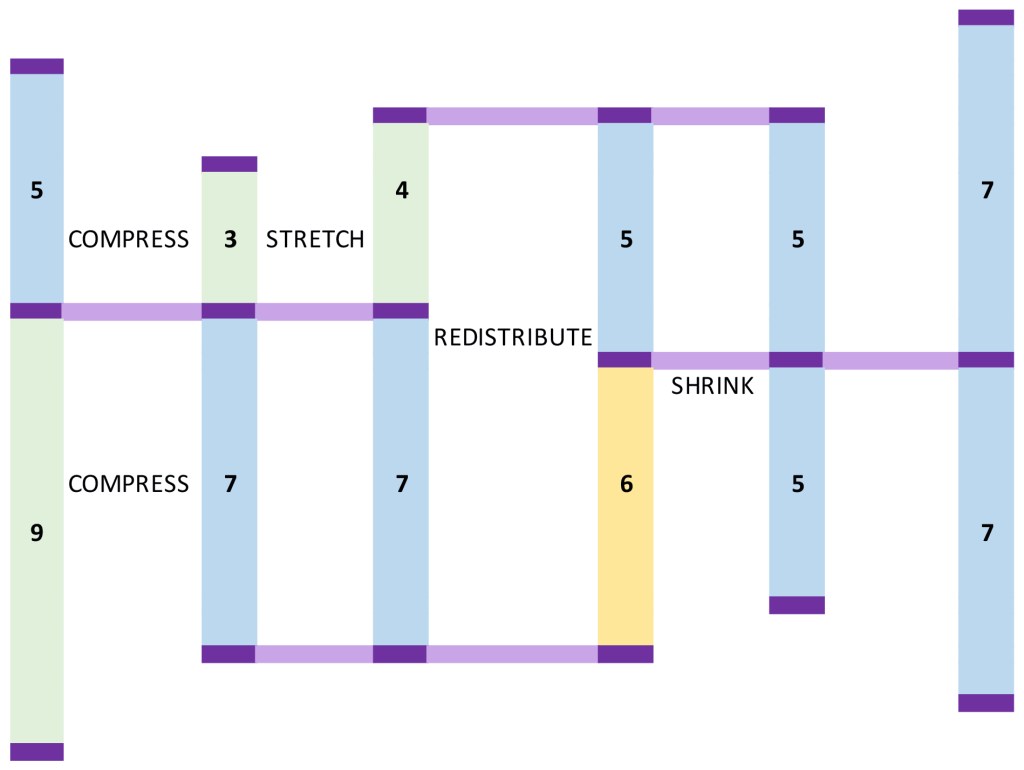
    There are operations that more significantly alter the character of the interval array.

    REDISTRIBUTE — Fuse two adjacent intervals into one larger interval then re-subdivide it into two different smaller intervals

    SHRINK / STRETCH — Alter one interval size by other than an octave, leaving others unchanged

    COMPRESS / EXPAND — Alter all intervals in the stack by adding or subtracting each by the same number of semitones, or multiplying each by a constant

    These alterations are listed in order, from the mildest alteration producing a similar array (redistribution) to the most dramatic producing a substantially different array, compression or expansion of the whole array (preserving little from the original but its symmetry). Here is an example employing these altering transformations.

    more alterations, with common-tone connections

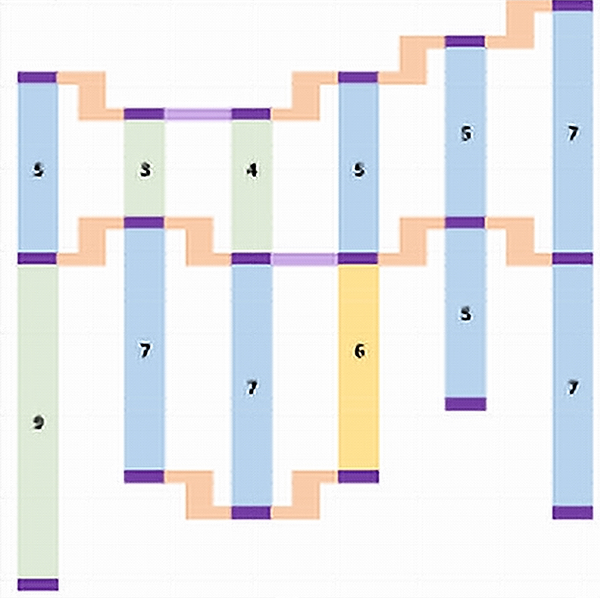
    The other element of coherence in this example is the many common-tone connections between one chord and the next, establishing a slow-moving stability. Another example of the same interval stacks, same succession of alterations, but choosing transpositional level of each constellation to create as many 1-semitone voicing connections as possible (10 such voicing connections in the following example) makes the con stream’s sense of progressive change stronger.

    more alterations, with semitone connections

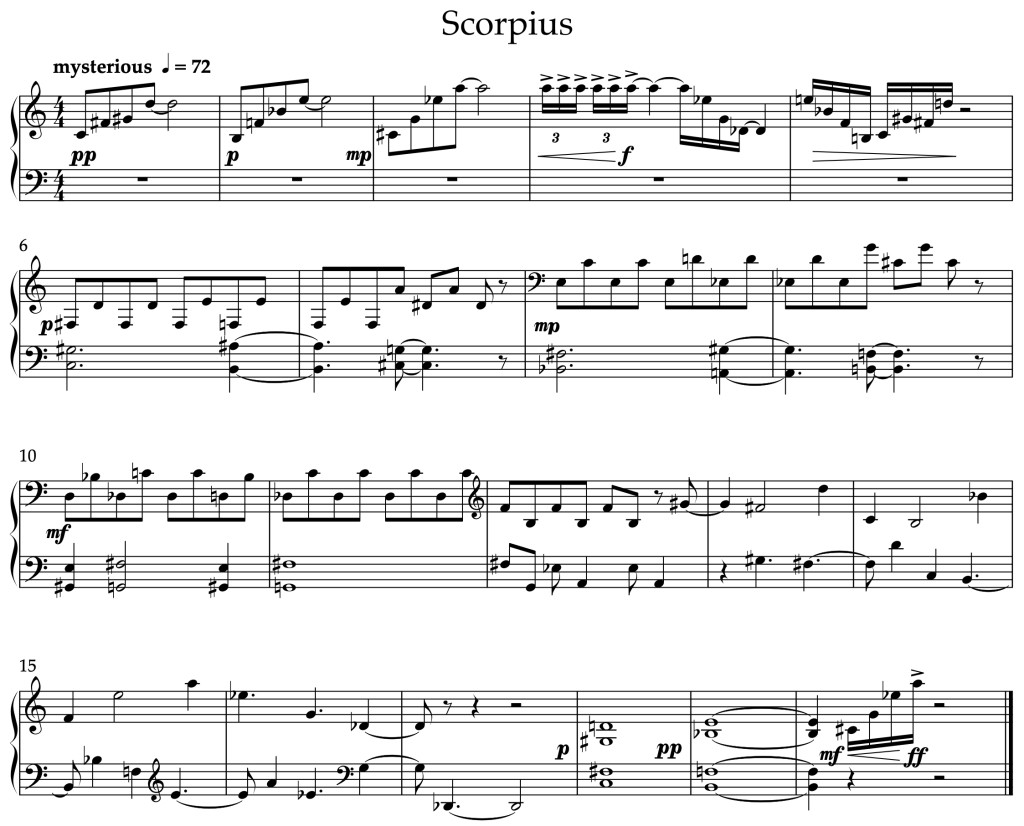
    Finally, another example etude, using this last constream . . .

    © 2026 – All Rights Reserved

    Thomas S. Clark

    Continue reading Mapping the Music Universe:

    TClarkArtMusic.com 

  • Mapping Music 3. CHANGE

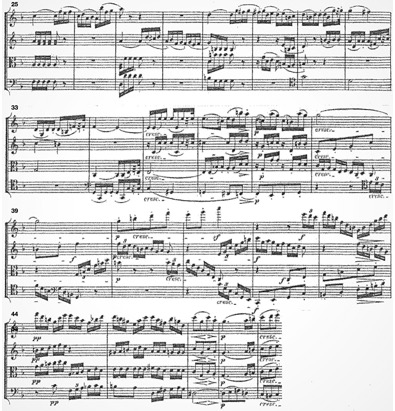
    Harmonic rhythm is the pace at which chords change in common-practice tonal music. Often in songs or simpler instrumental music, the harmony changes periodically, like once every measure or every half-note or every beat. Even when the rate of chord change is this uniform, it often accelerates approaching a cadence at the end of a phrase or other sectional unit. Calculus suggests that there can be a change in the rate of change, a second-order differential. Beethoven offers something like this in his very late work, the String Quartet No. 16 Opus 135. Here is an excerpt from the Allegretto first movement:

    String Quartet Op. 135 Allegretto, mm. 25-48

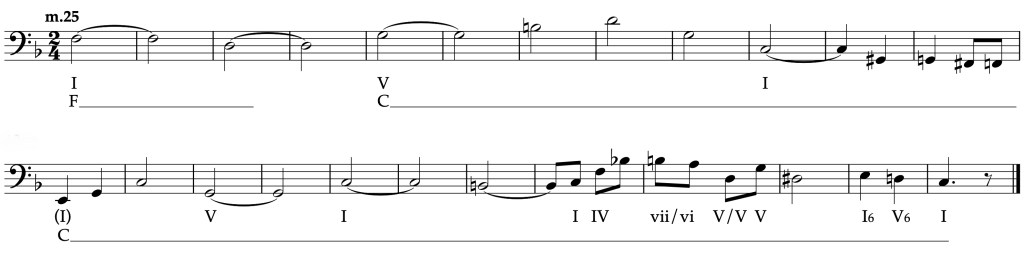
    An analytic sketch of the harmonic-root-foundation bass line reveals that F major gives way in the first four bars to a tonicization of the dominant, C major, starting with its dominant, G major:

    The rate of chord change starts as every 4 beats, eventually quickening toward the end of the excerpt to a different chord every 8th-note — an eight-fold quickening of harmonic pace! As you listen again, notice if you feel this intensifying compression of events.

    Going deeper into the tonal groupings of these harmonies, the starting key of F Major gives way to various tonicizations of G, then C. Here is a reductive sketch showing the durations of these tonicizations.

    Op.135 excerpt harmonic reduction

    Since this section is 24 measures long, it could have been composed as three equal 8-measure periods. Instead, the middle-ground tonal rhythm is surprisingly non-periodic, an irregular durational stream consisting of 8, 10, 10, 4, 7, 1, 1, 5, and 2 quarter-notes.

    Beethoven was beyond eccentric at this late point in his career; Op. 135 was the last work he ever completed. Yet the elasticity of harmonic rhythm found in it is a hallmark of his earlier styles as well.

    Beyond meter

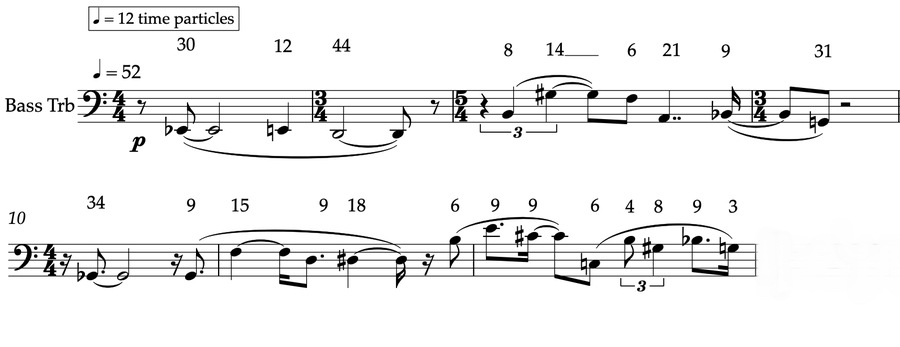
    Arising in the middle of the 20th century, highly complex, elastic rhythms began to be composed, in which every durational value was different and notes or events do not group into periodic measures or phrases. An example composed in 1971 is an elegy that makes a conscious effort to avoid articulating periodic beats or falling into groups of notes of periodic duration.

    Meter signatures are present only for notational purposes and change four times in the passage. Only four of the 22 notes fall “on the beat” and only three of those articulate a downbeat.

    Since the note values are so slightly or drastically different, we can measure each duration from the start of a note to the start of the next note as a multiple of fine “time particles” each one-twelfth of a quarter-note. The durational stream is blatantly non-periodic: 30, 12, 44, 8, 14, 6, 21, 9, 31, etc. The rhythmic range of the first four measures is higher than 7, rhythmic variety at 9. The next three measures have a higher rhythmic range of more than 11 and rhythmic variety of 8 (due to the 9-particle dotted 8th-notes that occur five times).

    Beyond a mathematical comparison, a time graph mapping the durations reveals to the eye no periodicity, no perceived meter or regular conforming rhythmic pattern.

    Elegy rhythm graphed

    The rhythm floats above or beyond meter or pulse in a dreamlike, elastic stream. [From Night Songs (1971)]

    Free time

    Defeating the notated meter in this way, by avoiding beats and periodic, conforming note values, was developed to free a stream of events from periodic pulse, thus freeing the listener’s sense of time flow – free time itself. The logical next step, developed concurrently in mid-20th century, was to remove meter entirely as even a notational necessity. Just like the time graphs we have been using to visualize timing of events, a horizontal, proportional scale (such as one half-inch equals one second of time) enables the horizontal placement and spacing of notes on a staff to suggest visually subtly different durations, both of sustained sounds and the time spacing from one event to another.

    Spatial notation

    Spatial notation — non-metric representation of time by proportional horizontal spacing of notes

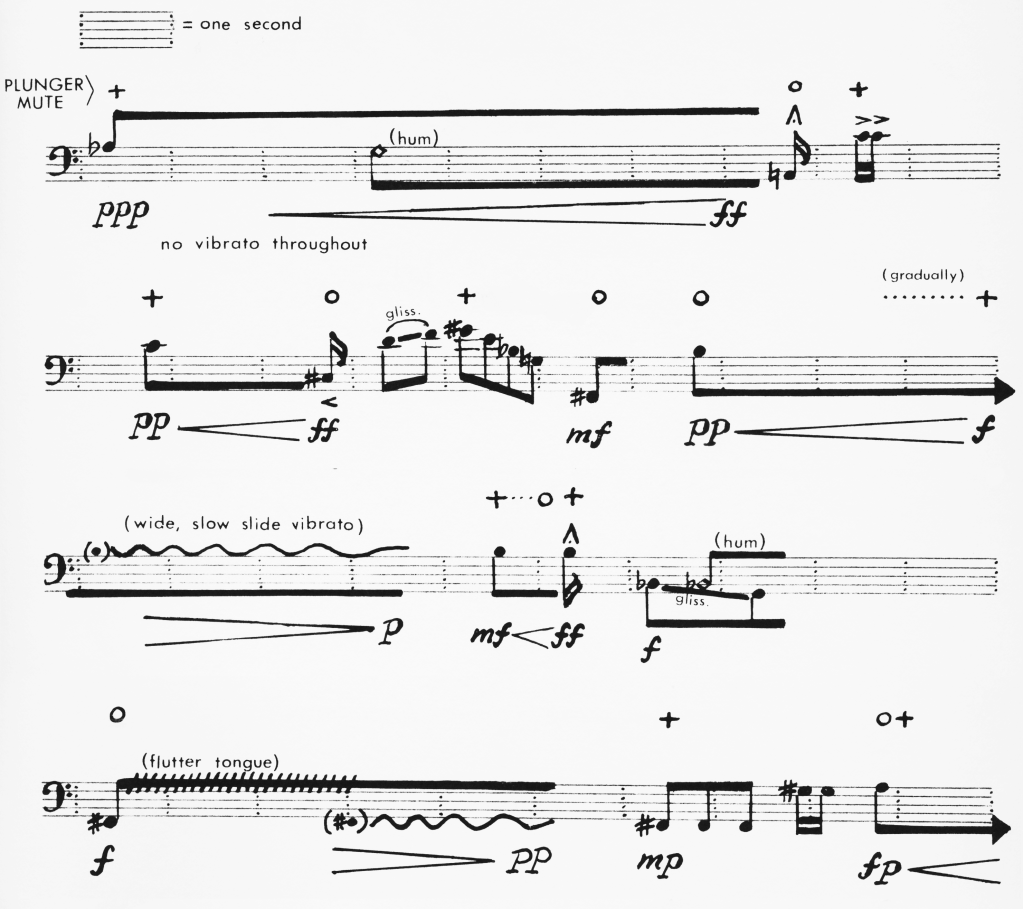
    After “Elegy,” the first movement of the unaccompanied trombone piece Night Songs, the third movement, “Somniloquy,” was originally notated in this manner – what came to be known as “spatial time.”

    Somniloquy notated spatially

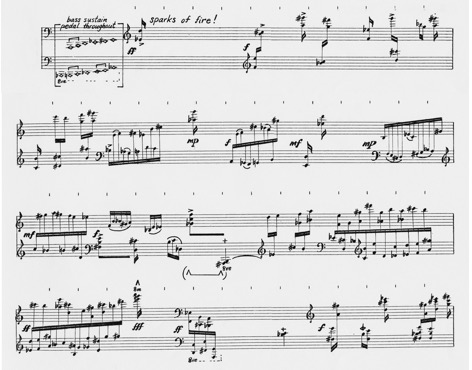
    In his one partially preserved manuscript, On Time, the Greek philosopher Heraclitus wrote about “the unity of opposites” and “flux,” meaning change. “It is not possible to step into the same river twice.” He also imagined that the cosmos is shaped as an enormous vortex of fire.

    That image ignited musical sparks in my imagination for the third movement of my early solo piano work, Geography of the Chronosphere (1975), subtitled “Heraclitean Vortex.”

    The score, in non-metric spatial notation, articulates explosive bursts of notes separated by irregular spans of reverberation.

    Heraclitean Vortex excerpt

    An analytic graph of loudness shows these bursts occurring at unpredictable time intervals, in moments (not so much phrases) of varying length, from 3 to 11 seconds.

    time graph of 11 moments in Heraclitean Vortex excerpt

    Prime time

    Meter, as a periodic grouping of beats, almost always involves groups of two, three, or multiples of these factors. We call them duple meters if the groups are multiples of two, triple meter if multiples of three. Likewise, subdivisions of beats are usually subdivided into twos, threes, or multiples. Sixteenth-notes divide by two to the fourth power.

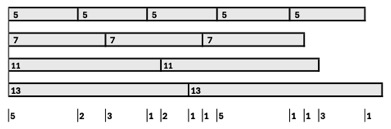
    A prime number is defined as having no integer (whole number) factors other than one and itself. In metric structure, prime numbers, with no sub-grouping factors of two or three, are more complex – 5 8 or 7 4 time for example. A musical stream that avoids metric regularity can be built with the interaction of prime number series. When repeated periodic streams of note values equivalent to 5, 7, 11 or 13 smaller time values (such as eighth-notes or sixteenth-notes) interact in time, layers of rhythm will seldom strike notes together to make a contrapuntal accent that feels like a downbeat.

    Here is a map illustrating this potential for non-metric independence:

    repeating prime numbers interact

    The bottom row of numbers shows rhythmic values of the composite rhythm, time points marked by an attack of a sound in one strand. If the streams start together as shown, they don’t all come together again until after 5,005 time-units. If each time-unit were a sixteenth-note duration, that would be after 312 four-four measures!

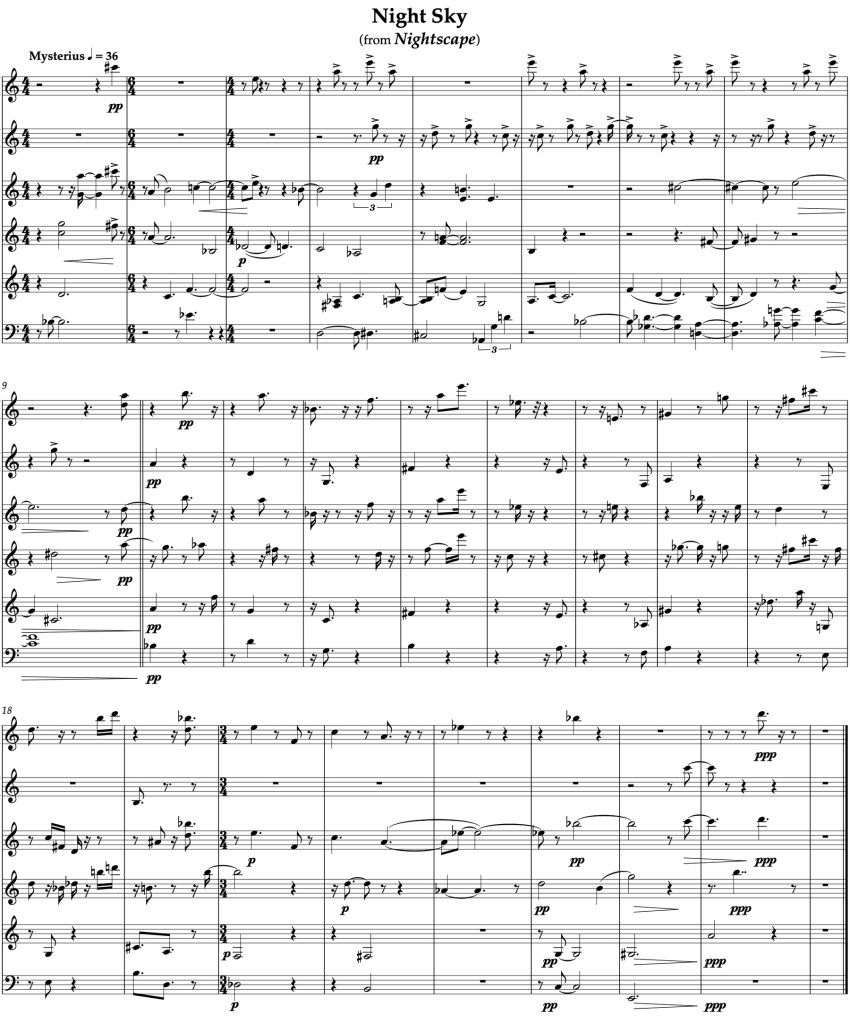
    This is the hidden rhythmic scheme for Night Sky, layers of pitched sounds that don’t synchronize into any meter or composite periodicity. Though not regular and certainly not metric with a pulse, time points are not at all random. Listening to it while not looking at the score’s notational details, pay attention to the way in which the sounds mark points in the flow of time – as stars mark light points in the night sky.

    Night Sky score

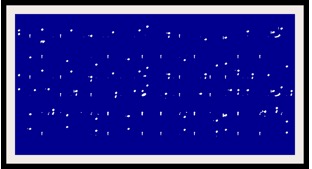
    A direct photographic rendering of the middle system of the score illustrates the non-metric, asynchronous timing of note events in a broad texture of sounds. 

    Night Sky score abstracted

    Do stars make spatial patterns? Of course, that’s what our fanciful constellation names are all about. But are those patterns regular, metric, periodic, symmetrical? No – that is part of their magic, a magic that can be metaphorically translated into floating musical time. 
    Beyond Time

    From the classical tradition of Beethoven’s accelerating harmonic rhythm, we jump finally to the very modern stretching of time itself. Einstein explained gravity as the stretching of “Space/Time.” From composers such as Cage and Feldman in the ‘50s, we experience isolated events, moments of sound separated by extended pause. No pulse drives the clockwork of time; it stretches immeasurably into contemplation. Listen.

    Lei Liang, My Windows (2007)

    © 2026 – All Rights Reserved
    Thomas S. Clark

    Continue reading Mapping the Music Universe:

    TClarkArtMusic.com

  • Mapping Music 2. RHYTHM

    Rhythm is a stream of event durations. Often repetitive but potentially elastic, rhythm can be steady, as a simple march, or volatile, as a melody that hovers, trots, then suddenly starts running.

    Defining some basic terms:

    TIME POINT — a precise moment in time marking the beginning of a span of time extending until a comparable event marks the next time point

     TIME SPAN — the duration of time from one point to the next point marking a comparable event

     STREAM — a series of events formed by the elements of consecutive groups

     PERIODIC — a stream of events whose elements exhibit equivalent time spans

     PULSE — ungrouped periodic time marking in a speed of about 48 to 1,000 per minute (above 1000 per minute becomes pitch)

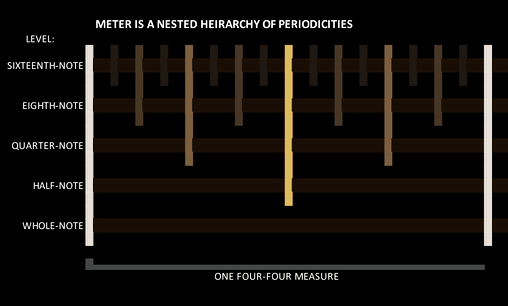
     METER — a nested hierarchy of periodic streams of of time points

    Nested means that two or more time-spans at a quicker level are synchronized with the next longer durational level. Two eighth-notes “fit” within the metric time-span of one quarter-note, for example. Meter creates the perception/expectation of events happening at periodic time points on more than one level of speed/duration.

    BEAT — pulse that constitutes the primary level of a meter’s hierarchy, the connector between both quicker subdivided and slower grouped levels

    PACE — general quickness / slowness of rhythmic activity in a line or whole fabric

    HYPERMEASURE — extension of metric hierarchy grouping measures, typically in two- or three-measure units

    PHRASE — grouping of molecules, shapes, motives, chord changes, etc. in a coherent stream, typically the length of the human breath

     PERIOD — grouping of phrases, typically concluded with a significant harmonic cadence and/or melodic sense of arrival

    Pulse and Beat

    Underneath the sense of a beat, pulse is primordial periodicity – clapping hands, stomping feet, banging rocks, running strides – features we inherit from our primitive musical ancestry and still use to organize our musical actions.

    Susie Ibarra – Sky Islands (2025)

    A rapid pulse can drive music with frenetic motion. Much of jazz relies on this power source. The tension between a fast, steady pulse vs. unpredictable accents (syncopations) and other turbulence generates energy and excitement.

    SYNCOPATION — an accent not synchronized with the beats, or a note length shifted from its regular metric starting point

    Listen to how a relentless, fast pulse drives this music.

    Julia Wolfe – Believing (2012)

    Rhythm makes meter, Meter drives rhythm

    Rhythm first generates meter by marking periodic time points at different levels of speed. The marking is just the moment of initiation of each note but also accents, chord changes, etc. at broader time levels. As a great example, let’s use a famous theme from a piece nicknamed for a planet:

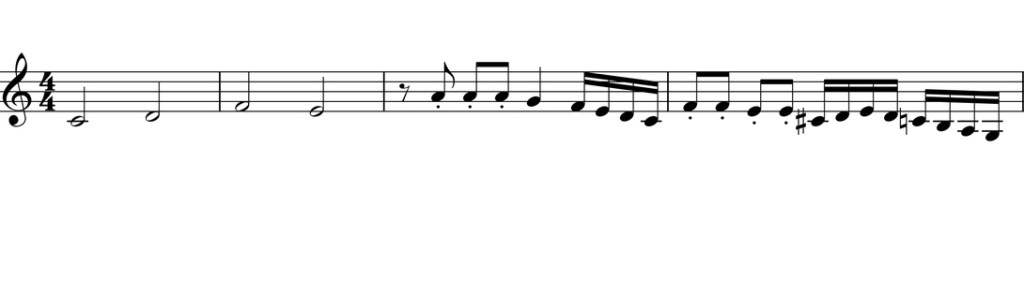
    Jupiter Symphony theme

    This melody first establishes periodicity of half-notes but nothing shorter for a while. This could be any duple meter. Once we hear these first four equal notes, we tend to perceive them as two pairs, establishing the whole-note measure-level meter. We feel the time point that begins the third measure on two levels of periodicity even though no note happens to mark it. In this third measure, eighth-notes then divide those half-note time spans into four parts. In the middle of measure 3, a quarter-note fills in the missing level of meter. Finally, in the last beat of the measure, a burst of sixteenth-notes establishes the fourth, quickest periodicity of the nested hierarchy. This example extends the hierarchy to show 2-bar hypermeasures in a 4-bar phrase.

    Once the tune repeats, our sense of that nested hierarchy of speeds is in full cognitive play. While jumping from metric level to level, half-notes to eighth-notes to quarter-notes then 16th-notes, the melodic rhythm undergoes a compression of pace, moving from longer rhythmic values to quicker and quickest, while the Allegro tempo does not change.

    More definitions


    CYCLE — the duration of equivalent time spans in a periodic stream of events

     ELEMENT — a point and following time span of an event or group of events, relating to other consecutive elements to form a group at a broader (slower) level of time

    COMPRESSION — an element of a group or stream is a shorter span than the previous element

    Example: rhythm changing from half-notes to quarter-notes to eighth-notes, compression of pace.

     EXPANSION — opposite of compression, elements of a group or stream are longer spans than previous elements

     ACCELERATION — consistent successive small compressions of beat or pulse

    PROPORTION — relationship of time spans expressed as a ratio, reduced to smallest-possible integers (whole numbers)

     RHYTHMIC GROUP — consecutive related elements, with a point of initiation and accumulated durational span

     RHYTHMIC RANGE — ratio of longest duration to the shortest

    In the Mozart Jupiter example above, the rhythmic range is 1:1 conformity for the first two bars, then 4:1 with three different note values in the third and fourth bars.)

    RHYTHMIC VARIETY — number of different note values in a stream of notes

    In the Mozart Jupiter example above, the rhythmic variety is 4 (halfs, quarters, eighths, sixteenths).

    Stress and accent

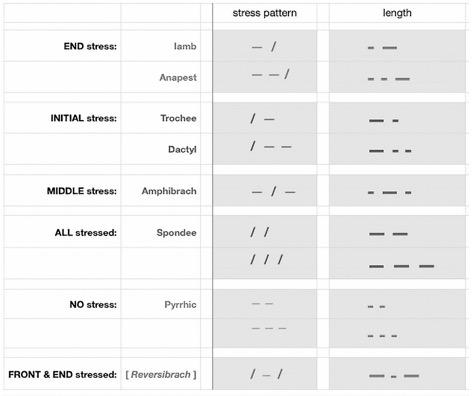
    Classic poetry classifies each syllable grouping (a “foot”) in a line of poetry according to which syllable in the grouping is stressed or longer length (agogic stress). (The last, a “reversibrach,” is my addition to complete the set of possibilities for musical purposes.)

    Metric “feet” in poetry

    Rhythmic molecules, groupings of two or more notes, can be similarly characterized, though with more stress possibilities:

    • Strength (accent) stress
    • Length (agogic) stress
    • Metric stress (strong beat vs. weak beat; on the beat vs. off-beat)

    A molecule can have one stress pattern in accent contradicting a different stress pattern in length or metric placement. Another familiar Mozart example: the opening themes of the first movement of Mozart’s Symphony No. 40 in G Minor. The first theme is fast (allegro) but steady (low elasticity).

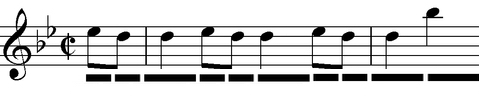
    Symphony No.40 1st theme

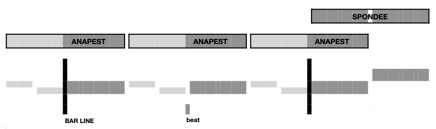
    Analyzed as three rhythmic molecules:

    Three quick, predictable anapests, in which the longer, metrically-accented note is precisely the same length as the pair of shorter notes that lead to it. It also shows a narrow rhythmic range, 2:1, and little rhythmic variety, with only two rhythmic values, the eighth-note and quarter-note.

    Now the contrasting second theme, a soaring oboe line, highly elastic in rhythm.

    Symphony No.40 2nd theme

    This phrase launches with a long trochee, beginning-stressed in both length and metric placement. This rhythm uses four different note values, the longest of which is 12 times the length of the shortest. The first note sounds stretched, like an elastic band that is then released after the third note, unleashing the quick notes that scamper to the last.

    This is just a glimpse on the micro-level of rhythmic contrasts and a temporal elasticity that propels the exciting roller-coaster allegro opening of this great symphony. All our perceptual and gestalt faculties are engaged in a grand game of play with time.

    Molecules

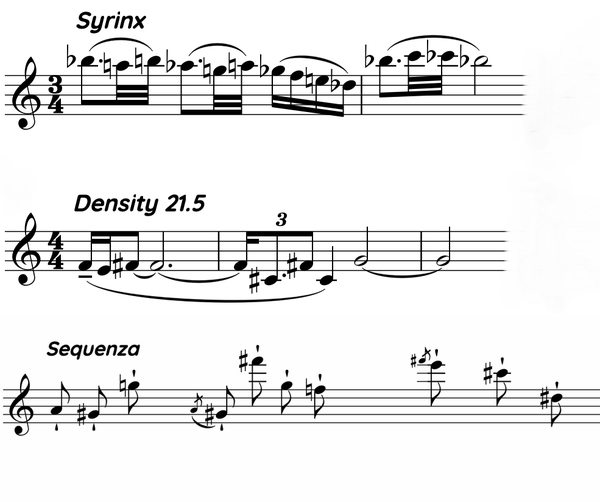
    Here are the opening notes of three famous 20th-century unaccompanied flute pieces, by Debussy, Varese, and Berio, respectively.

    Each uses a three-pitch motive that, when analyzed as a pitch-class set, is a segment of the chromatic scale.

    • Syrinx: A Bb B = +1 +1 semitones chromatic scale pattern
    • Density 21.5: E F F# = +1 +1 semitones, same scale pattern
    • Sequenza: G G# A = same +1 +1 chromatic scale pattern (G displaced by an octave)

    Shown above in their chronological order of writing, it is likely that one influenced the next, and it the next in a chain of evolving variation. While this shared pitch-class-set characteristic is the usual basis for comparison, it is also interesting to compare the rhythmic molecules of their generating motives.

    Syrinx starts with a clear front-stressed dactyl, repeated then echoed in bar 2.

    The Density 21.5 motive is more complicated. Its opening three notes, from a short/long durational standpoint, is an end-stressed anapest. But the first note, though short, has the metric accent, being the only note of the three written on a beat. That first note is also emphasized by the tenuto mark. Those accent factors point toward a front-stressed dactyl like Syrinx. The next three notes starting with the C# are a more ambiguous stress shape.

    The opening three notes of Sequenza have no clear metric or dynamic accent difference; they are all strong. But by duration, the third note is “longer” in effect in the time stream (agogic stress), as the silent time after it, before the next note comes along,is longer. Also the third pitch, G, is much higher, giving it a registral or contour accent. This 3-note molecule is an end-stressed anapest.

    In all three pieces, however, the sense of simple repetition of matching poetic feet is not established or maintained. It is more productive to understand throughout each piece how rhythmic range and variety expand and contract and pace intensifies or subsides.

    © 2026 – All Rights Reserved

    Thomas S. Clark

    Continue reading Mapping the Music Universe:

    TClarkArtMusic.com

  • Mapping Music 1. TIME

    “If you want to find the secrets of the universe,

    think in terms of energy, frequency, and vibration.”

    (Nikola Tesla)

    We start with time. Everything in music involves time, is of time, sound events occurring in our perceived flow of time.

    Sound itself is periodic vibration, a repetition of compression waves of energy in air (or water). Repetition of an event or series of events establishes a frequency of repetition and the period or cycle length, the elapsed time duration from each event’s starting time point (moment) to the starting point (moment) of its repetition.

    We perceive the frequency of air-compression waves as pitch if they are faster than 20 per second and slower than about 4,000. Frequency is typically measured in cycles per second, called Hertz. Non-periodic waves faster than about 20 Hz are perceived as noise. Events or time cycles slower than 20 Hz are perceived as pulses, tempo, rhythm, phrase structure, etc. At these slower sub-sonic event speeds, it is more convenient to identify the duration of the cycle, its period, than the frequency.

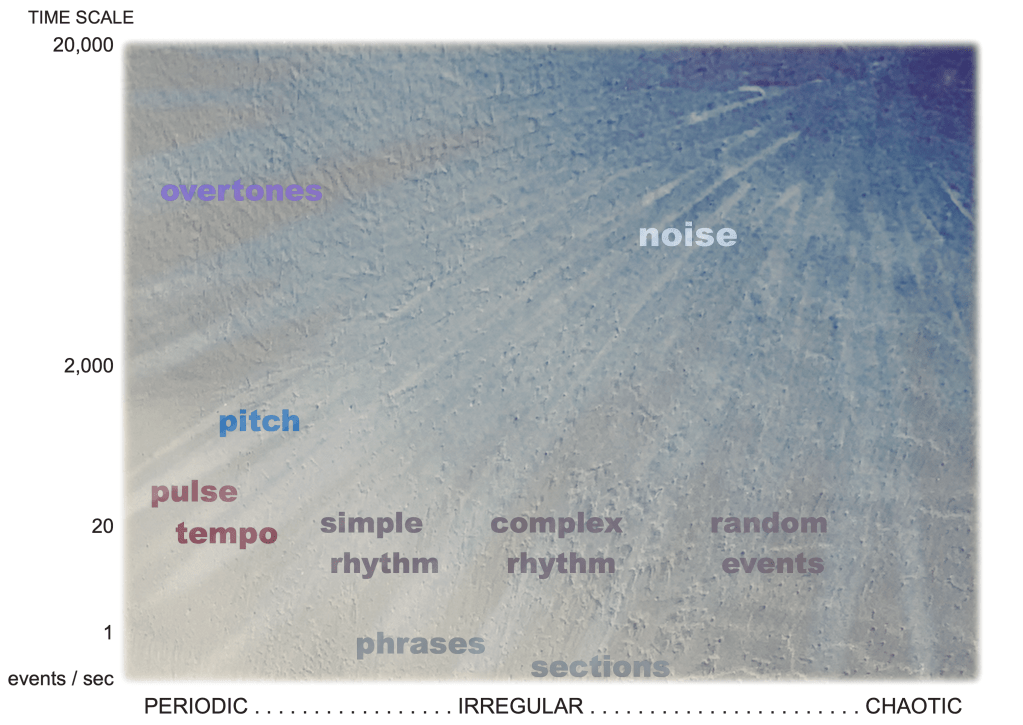
    Periodicity, this repetitive aspect of sound events in time, gives us a dimension to map all the possibilities, from extremely fast to almost frozen slowness, and from simple, highly regular repetitions to a very complex succession of variants.

    the periodic time/sound universe

    In this illustration, the Y-axis is speed/frequency (slowest at bottom, fastest on top), the X-axis is regularity of repetition (perfectly regular at left, randomly sporadic time spans at right). The blocks have sharp rectangular edges; if I were a better artist, the boundaries between descriptive categories would actually be curving and very blurred. Though the graph shows firm straight lines separating pitch and noise, there is actually a fuzzy, curving grayscale continuum from pure, simple pitch through complex, colorful pitched timbres to noise.

    Defining time

    What is time and how does it work in our lives and in the rhythms that are the fundamental “substance” of music? I say substance metaphorically, because time does not exist as any physical matter. It is a perceptual construct, a complex quilt stitched out of human experience.

    Discover magazine ran an article in June of 2007 titled, “Time May Not Exist”.

    “Efforts to understand time below the Planck scale have led to an exceedingly strange juncture in physics. The problem, in brief, is that time may not exist at the most fundamental level of physical reality. If so, then what is time? And why is it so obviously and tyrannically omnipresent in our own experience? ‘The meaning of time has become terribly problematic in contemporary physics,’ says Simon Saunders, a philosopher of physics at the University of Oxford. ‘The situation is so uncomfortable that by far the best thing to do is declare oneself an agnostic.’”

    The mysteries of time were explored as early as sixteen hundred years ago by the great Saint Augustine of Hippo, in Book XI of his deeply philosophical work, Confessions.

    “. . . What is time? Who can give that a brief or easy answer? Who can even form a conception of it to be put in words? Yet what do we mention more often or familiarly in our conversation than time? We must therefore know what we are talking about when we refer to it, or when we hear someone else doing so. But what, exactly, is that? [Book XI, Section 17]

    Nicholas Stratas’ thought-provoking article in the July 2007 issue of Wake County Physician, “Time – Continuous Yet Bidimensional” asserts that most of us have a firm concept of Past, Present, and Future. But defining them is challenging, and sorting out how these constructs interact in our consciousness even more so. Michael Spitzer, in The Musical Human (Bloomsbury Publishing, 2021), wrote:

    “Musical time is a window into time consciousness in general. We listen to music in the moment, sitting in the saddle of an ever-shifting Now, as the past whizzes by to become memory, and the present anticipates what is just around the corner. Music’s present tense is really a bundle of memories and anticipations . . .”

    Many years ago, I first read an article translated from Die Reihe, written by a preeminent avant-garde experimental composer, Karlheinz Stockhausen. “Structure and Experiential Time” described Stockhausen’s view that time does not flow uniformly through the experience of a serious musical composition. It ebbs and surges as the composer shapes not just the tempo but the flow of information in the form of repeated or new musical events, simple or complex musical structures.

    “When we hear a piece of music, processes of alteration follow each other at varying speeds; we have now more time to grasp alterations, now less.”

    Even tempo, a supposedly steady clock in most music, ebbs and flows. Computer music composers in synthesizing musical sounds have found that a mechanistically rigid clock tempo sounds artificial. Human musicians are constantly flexing tempo in subtle ways to convey almost subliminally where the music is “going” (another metaphor, that of travel through space).

    Saint Augustine recognizes the slippery challenge of measuring time:

    “ . . . We observe the different ways times lapse, and compare them, and call some longer and some shorter. . . . It is passing time we measure, as we experience it. . . . Time can only be measured as it passes. Once past, it is no longer there to be measured.” [Book XI, Section 21]

    “We measure time as it passes . . . . But how can we measure the present, when it has no extent of its own? . . . Time must be measured in something with extent . . . But in what extended thing do we measure time as it passes?” [Book XI, Section 27]

    “So time is measured, my mind, in you. Raise no clamor against me—I mean against yourself—out of your jostling reactions. I measure time in you . . . because I measure the reactions that things caused in you by their passage, reactions that remain when the things that occasioned them have passed on. . . . Time has to be these reactions for me to be able to measure it.” [Book XI, Section 36]

    Time perception

    Pulling all this together, I’d like to suggest several things about time in classical music.

    • Time is perceptual.
    • Time is multidimensional.
    • Time is elastic.
    • Time is experienced in complex ways as the fundamental basis of music’s richness.

    In LEARNING TO COMPOSE, co-author Larry Austin and I begin the chapter titled “Time Streams” with a quote from a philosopher, and then express in our own words the fundamental nature of time.

    “ ‘Music makes time audible and its form and continuity sensible.’
    —Suzanne Langer

    Music exists in time. Time exists as we sense it, articulated on many levels by changing and cyclically recurring events.

    As beautiful, colorful and essential as sound is in making music, musical sounds are the means to an end, building blocks for events that primarily mark articulations of time.

    We sometimes like to think of music as having two fundamental dimensions, like a graph. The horizontal dimension is the parameter of time. The vertical dimension is the parameter of pitch. But pitch is actually a temporal phenomenon – the frequency (periodic change over time) of sound waves. How amazing are the human ear and human mind to perceive waves of air coming at us a thousand times a second or much faster and distinguish the small differences that make a pitch “in tune” (or not) and the even subtler differences that identify an oboe instead of a violin producing that pitch. All of this from a perception simply of periodic rates in time!

    Stockhausen pointed out that in mentally processing all of these sonic distinctions, we are forced to pay more attention to changes in their qualities, combinations, and “spacing” in time. These are his “alterations”.

    “The greater the temporal density of unexpected alterations . . . the more time we need to grasp events, and the less time we have for reflection, the quicker time passes; the lower the effective density of alteration (not reduced by recollection or the fact that the alterations coincide with our expectation), the less time the senses need to react, so the greater intervals of experiential time lie between the processes, and the slower time passes.”

    The concepts of expectation and information help make some sense of things. “Information” is perceptual data that is similar to what you just heard or logically confirms what you were expecting next. “Entropy” is the opposite perception – surprise, contrast, noticeable change. In musical listening, though we don’t do so consciously, we are constantly “computing,” assessing, retaining, and predicting.

    Saint Augustine connects Past, Present, and Future with memory, experience, and expectation:

    “What should be clear and obvious by now is that we cannot properly say that the future or the past exist, or that there are three times, past, present, and future. Perhaps we can say that there are three tenses, but that they are the present of the past, the present of the present, and the present of the future. This would correspond, in some sense, with a triad I find in the soul and nowhere else, where the past is present to memory, the present is present to observation, and the future is present to anticipation.” [Confessions, Book XI, Section 26]

    And to make matters more complicated, it is not at all a linear process. Let’s take a metaphor. I can’t resist one that Einstein was very fond of in his thought experiments.

    As listeners, we’d like to imagine ourselves as a train riding on tracks through time, a train that keeps moving forward and doesn’t back up. The clickety-clack of our wheels is a steady tempo measuring time. We only remember back to the tracks the locomotive has passed but still lie under the wheels of our caboose at the end. And we only look ahead a little bit, as the tree-bordered tracks curve, preventing a longer straight view.

    That’s way too simple, a two-dimensional time frame in which we either recall a little of what we just heard or maybe guess a little what might happen next. As Meyers, Stockhausen, Spitzer, and Dr. Stratas all observe, in keen listening to music our minds are filled with memories of not just the previous measure or phrase, but the very beginning of the piece, its theme or launching impetus (Grundgestalt as Schoenberg named it) and, in a more diffuse sense, all that has “happened” up to the present moment. The present moment is not one single phenomenon in time either. Melody, countermelody, bass line, chordal texture, and punctuating sounds are simultaneously tracing distinct paths, each with its own pace through time. At the same time, we are constantly expecting what’s coming, or at least “feeling” where the music might be going. And, as if that weren’t complicated enough, we are busy reevaluating what we just heard in relation to what we had been expecting. Saint Augustine describes it more succinctly:

    “Only in the mind can this [the experience of time] be accomplished, because of three activities there—the acts of anticipating, of observing, and of remembering.” [Book XI, Section 37]

    None of this is conscious, but in describing it in concrete terms, we recognize the dizzying multidimensionality, time arrows pointing in all directions and curling back on themselves. This is what I believe constitutes deep listening, “getting lost in the music”.

    Just one more idea – elasticity. Stockhausen recognizes that in music the sense of time passing changes, stretches or compresses, depending on how much “alteration” is being encountered. This is why music can seem “steady” or “surging ahead” or dissipating and almost “frozen”. It is not at all the tempo that causes this, but rather the rate of change, sharp contrast or subtle evolution, in the harmonies, the melodic character, or the rhythm.

    A rhythmic playfulness in modern music stretches our sense of timing. Tempos change, are interrupted, break down, tumble into avalanches, come to rest. Time itself stretches and becomes the titled thematic element in pieces such as Time Cycles (1960) by Lukas Foss. Here is another example titled about time, written at the starting gun of the new millennium.

    Fred Lerdahl – Time After Time (2000)

    Awe

    In his book When (Riverhead Books, 2018) Daniel H. Pink writes,

    “I used to believe that timing was everything. Now I believe that timing is everything. . . . The experience of awe changes our perception of time. When we experience awe, time slows down. It expands. We feel like we have more of it. And that sensation lifts our well-being.”

    He quotes researchers Rudd, Vohs, and Aaker in Psychological Science 23 No. 10 (2012):

    “Experiences of awe bring people into the present moment, and being in the present moment underlies awe’s capacity to adjust time perception.”

    © 2026 – All Rights Reserved

    Thomas S. Clark

    Continue reading Mapping the Music Universe:

    TClarkArtMusic.com

  • Mapping Music — PRELUDE

    The heavenly motions are nothing

    but a continuous song for several voices,

    perceived not by the ear but by the intellect,

    music that sets landmarks

    in the immeasurable flow of time.”

    Galileo

    When we gaze at stars and planets, they appear as stationary points of light, fixed in place in what seems a random pattern across the entire night sky visible to our hemisphere. Time stands still.

    Throughout human time, humans have imagined that stars make picture patterns we name as constellations: fish, warriors, goddesses, animals. Only the persistent observers, such as astronomers, identify their nightly march across the sky, rising in the east and disappearing below the western horizon.

    Metaphor

    Musical sounds mark points in time, like stars. They form immediately into recognizable patterns we call chords, melodies, rhythms, memorable themes. They convey a sense of motion, time surging forward or slackening in our perception of their well choreographed parade.

    Astronomers observing and mapping (recording) the myriad points discovered that some of the stars are actually whole galaxies, with exotic forms of spirals and clouds. They observed through the color of the light that all these objects are racing away from us and each other in an expanding universe.

    Mapping music means cataloging many possible patterns, distinguishing their contrasts and commonalities. We will explore how to measure and compare the periodic rhythmic streams of musical events and their changing momentum. We will define and employ a simple but powerful math tool for cataloging and then creatively sculpting with all natures of harmony and melodic line in our 88-key chromatic universe. We will explore how master composers weave colorful fabrics and grand structures from skillfully crafted materials.

    Pursuing periodicity

    My music-mapping Periodicity Project began in 2021 as a comprehensive catalog of musical patterns and processes, meant to provide simple tools for understanding the complexities of modern music. It grew into this book, Mapping the Music Universe, written for anyone who is curious about how music works, especially in the 20th-21st-century modern and “post-modern” eras. For me as a composer, it is also an exploration of how some less traveled conceptual paths lead to interesting creative possibilities.

    In 1989 I co-authored a conceptually ground-breaking composition textbook with Larry Austin, Learning to Compose: Modes, Materials, and Models of Musical Invention. My next book, ARRAYS, was an aural skills workbook covering basic modal, tonal, and “post-tonal” music of the Renaissance through the Twentieth Century. Mapping the Music Universe draws in part on the ideas and approaches of both these now out-of-print publications.

    A common assumption within Western culture is that Science is all about observation, measurement, precision, and mathematical rigor . . . and Art is all about the “i” words: imagination, inspiration, intuition, improvisation. Science is Deductive, art is Creative. Our culture has begun to recognize the commonality of all these intellectual strengths, that the best Science can be creatively intuitive and great Art can be rigorous.

    Pioneer map makers

    As an educated musician and professional composer, I also have long been deeply interested in science, especially astronomy. Having read a great deal of general science writing, I am inspired particularly by ground-breaking pioneers who methodically and comprehensively mapped the possibilities of their particular field.

    Johann Joseph Fux — wrote Gradus ad Parnassum in 1725, codifying basic contrapuntal principles of Renaissance music.

    William Smith — a rural surveyor, in 1799 drew a colorful map of the subterranean rock strata of his county in English coal country, launching the modern science of geology.   

    Meriwether Lewis — kept extensive journals of the 1804-1806 Lewis and Clark Expedition, documenting and illustrating the discovered new world of the Northwest.  

    Dmitri Mendeleev — devised a “periodic table of the chemical elements,” published in 1869, providing a solid basis for modern chemistry through its graphic and organizational genius.

    Amédée Mouchez — launched an ambitious international star-mapping project (Carte du Ciel) in 1887 at the Paris Observatory.

    Henrietta Swan Leavitt — worked at the Harvard College Observatory as a “computer,” examining thousands of photographic plates from telescopes to measure and catalog the brightness of stars, identified 1777 variable stars.

    Lawrence Herbert — invented the Pantone system in 1956 to systematize color for printing ink and fabrics.

    Allen Forte — published an article in 1964 that launched musical set theory, defining, classifying and comparing all possible collections of “pitch classes” drawn from the equal-tempered 12-tone chromatic galaxy.

    The work and insights of the two on the list representing rigorous study of music, Fux and Forte, were part of my formal education in music and later an integral part of my teaching of composition and music theory.

    Maps

    Carte du Ciel was an ambitious second phase of an international star-mapping project initiated in 1887 by Paris Observatory director Amédée Mouchez.  A new photographic process revolutionizing the gathering of telescope images inspired the first phase, the Astrographic Catalogue of a dense, whole-sky array of star positions. Carte du Ciel, never completed after 70 years, used the Catalogue as a reference system for a complex survey of the vast field of even fainter images.

    Celebrating the grand metaphor relating astronomy to art music, here is my 8-minute computer-music sound sculpture. In the music, ghostly wisps of sound are punctuated by brighter bursts, clustered in a natural, not-quite randomly dispersed texture.

    _______________

    Looking ahead

    The blog-post chapters of Mapping the Music Universe will proceed in three broad phases, progressing logically from fundamental — time and periodicity — to pitch space, then to larger structures, texture and form. Within each phase, various topics are presented in a progressive order, but jumping in at any point is fine.

    Terms will sometimes be freshly coined. Graphic figures will include notated musical examples, tables, and graphic illustrations of patterns and their relationships. Big Ideas — Periodicity, Complexity, Symmetry, Relativity — will be explored using precise mathematical arrays as well as broad metaphors. Newly composed sample etudes will illustrate aurally.

    Along the way, “Map Labs” will present step-by-step recipes to compose simple pieces based on models of different compositional genres. Each Lab includes an original sample piece following the Map Lab guidelines, illustrating one possible creative outcome.

    Welcome! Join this creative journey of discovery . . .

    a composer’s expedition.

    © 2026 – All Rights Reserved

    Thomas S. Clark

    Continue reading Mapping the Music Universe:

    1. TIME

    TClarkArtMusic.com